Grant, Mira: Newsflesh trilogy

Writing under the pseudonym Mira Grant, Seanan McGuire published the political thriller/zombie trilogy Newsflesh including the books “Feed”, “Deadline” and “Blackout”. I am anything but a zombie fan, but Grant has written a thriller that goes far beyond zombies. We become embroiled in politics and corruption, discussions on freedom of the press and get a look at dysfunctional societies and families. Excellent author that she is, Grant brings her characters alive and gives them depth and color. And the action. My goodness is there ever action in this trilogy. And death. Prepare yourself for a heavy toll on people who made me care about them. Did I say I liked these books??????? Keep on writing under either name and the world will be a better place.

The concept of the Newsflesh trilogy is based on the unforeseen consequences of biological research. By 2014 cancer and the common cold had been defeated. Unfortunately, the side-effect was that when you died you became a zombie and started feeding. Oops. The world was changed forever.  The mainstream media fell, Internet news acquired an undeniable new legitimacy, and the CDC rose to a new level of power.

by dust-bite

FEED (2010)

Set twenty years after the Rising, the Newsflesh trilogy follows a team of bloggers, led by Georgia and Shaun Mason, as they search for the brutal truths behind the infection.  When Senator Peter Ryman of Wisconsin decides to take a team of bloggers along on his run for the White House, Georgia and Shaun Mason are quick to submit their application.  They, along with their friend Georgette “Buffy” M. are selected, and they view this as the chance to launch their careers to a whole new level…that is, if they can survive the campaign trail. Feed follows the Masons and their crew into a world filled with the living dead—and the much more dangerous living.

Shaun Mason by Rowan

DEADLINE (2011)

In Deadline, the members of the After the End Times staff are reeling…none more than Shaun Mason, who can’t figure out what he’s supposed to be doing with his life now that he’s found himself unexpectedly in charge.  The arrival of Dr. Kelly Connolly from the CDC provides a new direction, and a possible new route into the conspiracy that caused so much damage just a year before. However, it turns out that Dr. Connolly’s arrival heralds more death and despair for the crew.

From All Forsaken

BLACKOUT (2012)

The world is getting more and more bizarre by the moment for Shaun and now Georgia. Both of them have had their worlds turned topsy-turvy and struggle to maintain their sanity and belief in humanity. Nothing is as they thought it would be and they are both bruised and battered. But there is hope. Not a great one, but nevertheless. The cost of a free press is clearly portrayed in the courage and sacrifice of the characters of this novel. Sometimes no price is too high to pay to share the truth with the general public.

Benson, Amber: Calliope Reaper-Jones

The series about Calliope Reaper-Jones is urban fantasy. For chick-lit, they’re not half-bad. Calliope is a bit too much of an air-head for my taste, but she has her heart in the right place (at least I hope so). Benson writes well and probably enchants her target group.

The books about Death’s daughter are humorous and lighthearted mysteries with plenty of action and sleuthing.

In Death’s Daughter (2009) we meet a Calliope Reaper-Jones who is trying to suppress the knowledge of her heritage. But when her father is kidnapped, she once again has to return to the family mansion and try to figure out what is going on. To do that, Calliope is going to have to fulfill a quest, one where the competitor is the Devil’s apprentice.

Cat’s Claw (2010) continues where Death’s Daughter left off. She is discovering that trying to keep the family business running is a handful. When she has to pay her debt to Cerberus, Calliope finds herself with her hands full.

Serpent’s Storm (2011) has us back in New York where Calliope is once again trying to fit in with the rest of the world. But it doesn’t matter that Calliope is trying to stay away. Someone still wants to kill her and Calliope is going to have to do her best to stay ahead of the game.

Shearin, Lisa: Raine Benares

The fantasy adventure series about the elven seeker Raine Benares consists of six books. These are:
  • Magic Lost, Trouble Found (2007)
  • Armed & Magical (2008)
  • The Trouble With Demons (2009)
  • Bewitched & Betrayed (2010)
  • Con & Conjure (2011)
  • All Spells Break Loose (2012)

Entertainment and adventure are the main focus of the books. There is action, some romance, more action and humor. Shearin writes well and manages to hold my interest through all six books. “Magic Lost” was a bit rusty, but the books have gotten better and better.

Raine is a fun adventure character. She is a finder of things lost and people missing. But what Raine finds best is trouble. Action and adventure begins right off the bat. Focus is mainly on the adventure and not so much on world building or character building. But as the plot unfolds, so does Raine (and her compatriots).

Her favorite companion in trouble is her cousin, Phelan, and her friend Tam (a goblin mage). As we move further into the series Mychael (Paladin) and Pieras (almost brother) assist more and more in getting Raine out of trouble. For the main part trouble is focused on a pendant called the Saghred (has its own mind). For some reason the Saghred attaches itself to Raine, and as Raine soon discovers the Saghred is not conducive to a peaceful life. From that point on, Raine becomes involved in an international crisis, internal goblin politics, an elven uprising and so on.

Aaron, Rachel: The Spirit War (Eli Monpress) (2012)

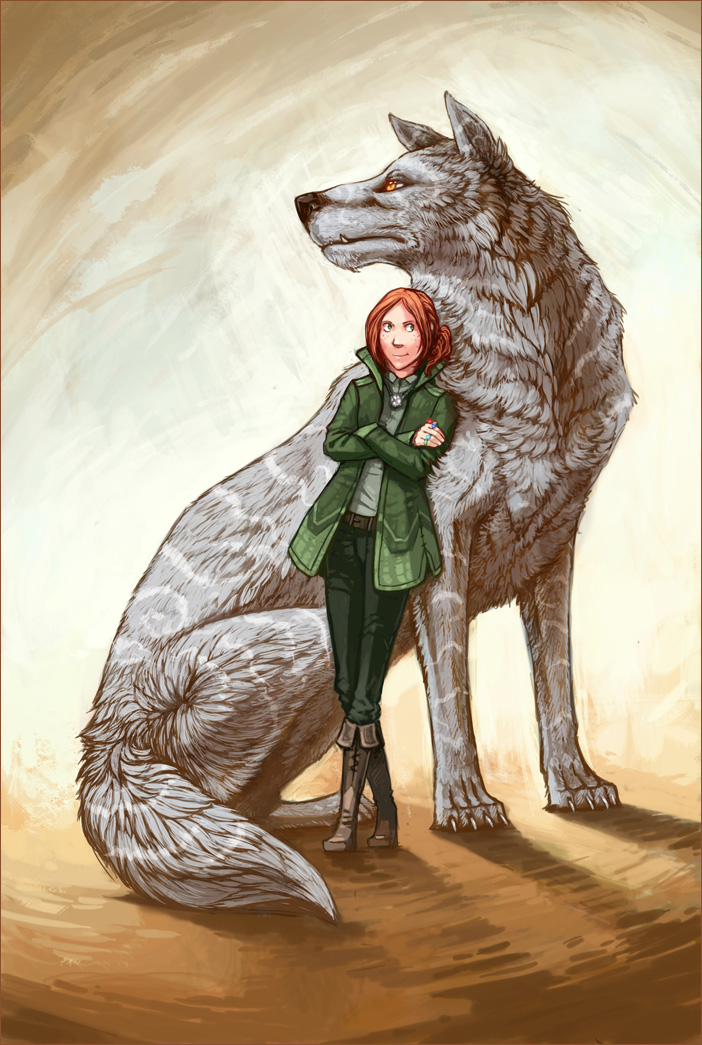
Miranda and Gin by Minna Sundberg

The Spirit War” is book no. 4 in the story about Eli Monpress, the cleverest thief in the world. Eli lives in a world where magic is based upon the cooperation with spirits that live inside all things. Although full of action and deception, all four books are light-hearted. Aaron writes well and brings her characters spirit and verve.

About the book: All Eli Monpress wanted was the biggest bounty in the world. He never meant to have obligations, or friends, but master swordsman Josef Leichten and Nico, the daughter of the dead mountain, have saved Eli’s life too many times to be called anything else. And when a friend upsets your plans and ruins all your hard work, what’s a thief to do?

After years of running from his birthright, Josef is forced to return home and take up his title as prince. War is coming for humans and spirits between the Immortal Empress and the Council of Thrones, and Josef’s little island is right in the middle. But conquest isn’t the Empress’s only goal, she has a personal vendetta against a certain thief.

What started as a simple side trip to help a friend is rapidly turning into the most dangerous job of Eli’s career, but he can’t back out now, not when Josef needs him. But when you’re under attack from all sides, even the world’s greatest thief can find himself cornered, and it’s going to take all the fast talking Eli can muster to survive the next few days.

Harris, Joanne: Coastliners (2003)

Coastliners” is yet another book I’ve read in Norwegian. I prefer reading in English if the author writes in English, but when I receive books as gifts here in Norway, they’re going to be in Norwegian.

“Coastliners” was fun. Harris’ characters are flawed and delightful with all of their imperfections.

On the island of Le Devin, off the British coast, the population is ageing and dwindling. The wealthy live on the la Houssinière side, while the poor live on the les Salants side of the island. As usual, the wealthy hold the power and this has been a source of no little resentment from the poorer population.

Les Salants has a serious problem. Each year the ocean comes closer and closer to the houses that hug the cliffs and dunes. Something must be done to redress the problem, but no one knows quite what to do.

Once Madeleine Prasteu arrives at les Salants, things begin to change. She is trying to recover from the death of her mother and goes back to her childhood vacation spot. After a while Mado becomes involved in the attempt to save les Salants and with the help of mysterious Richard Flynn a secret engineering project is underhand.

Abulhawa, Susan: Mornings in Jenin (2010)

Mornings in Jenin” is a thought-provoking book about the Palestinian side of the Palestine/Israel conflict. It is the author’s debut. I read it in Norwegian, and the Norwegian translation was excellent. It got me thinking about how long conflicts can last, whether there is hope of reconciliation after such a long time and how on earth wounds can possibly heal on either side.

The story begins in the small village of Ein Had in 1941. All is well. The Olive groves have been harvested and the cycle of life continues as always. Seven years later, the Abulheja family are sent to live in a refugee camp in Jenin. Amal, is the main character of the novel. She has a bright and inquisitive mind, always seeking more knowledge. Through her story we discover what happens to her two brothers. Amal’s own journey through life is no less dramatic, taking Amal through childhood, marriage and parenthood.

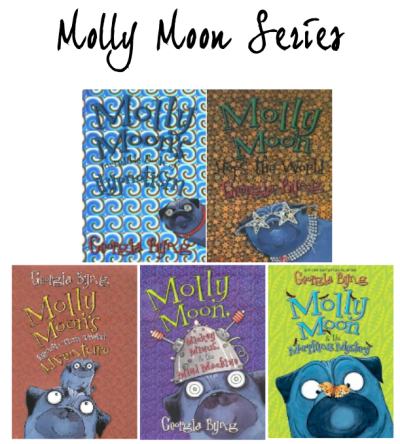
Byng, Georgia: Molly Moon

Molly Moon is a delightful character. I started reading her adventures to my son, and he fell in love with the series. Molly Moon is for children, but as an adult reading to my child I had fun.

We read them in Norwegian, but Byng is an English writing author. Molly Moon is a young orphan who discovers her incredible ability with hypnosis. With this gift, she improves the living conditions at her orphanage, controls her bullies and makes her life a little better. As she moves along in the series, Molly discovers that she has an enemy who is out to best her. She gets to travel in time, both backwards and forwards. During these travels she has the assistance of her two faithful (for the most part) friends: the dog Petula and the boy Rocky.

Our translation was a good one. The various translators have done a good job in making the Molly Moon adventures exiting and funny. We laughed a lot and I was forced to finish the scary parts before I could put the book down. My son did not have to work hard to convince me.

Meaney, John: Context (2007)

Cover art by Jim Burns

Wow. This book is gold. “Context” is book no. 2 of the “Nulapeiron Sequence”. As such it is the continuation of the story about Tom Corcorigan. This story keeps getting better and better. Meaney blends philosophy with action and obsession beautifully. In Context he manages to keep the text flowing in a manner above and beyond most authors. What a gift.

Tom is healed from devastating injury. His security chief, Elva comes along. Unfortunately, she is killed on that trip. This becomes a defining moment for Tom. He realises his love/passion/obsession with Elva. When it turns out that somehow Elva has survived, but that her mind has been transferred to the body of her twin sister. Tom goes off hunting Elva. In the process he becomes one of the most important tools in the fight against the Blight.

Of course, there are many stages of learning for Tom. One does not blithely meet with something as powerful as the Blight. One of the many tools aiding Tom is the mu-space crystal that he got hold off in “Paradox“. From it we learn more about Ro and her role in the whole mystery.

Hard-core science fiction has seldom been more fun. Please, please read this trilogy if you have the chance.

Tolkien, J.R.R.: Letters From Father Christmas (1999)

Letters From Father Christmas is a gem from J.R.R. Tolkien. I have Letters as an audiobook. Derek Jacobi reads Father Christmas’ voice, John Moffatt reads Polar Bear’s voice and Christian Rodska reads Ilbereth’s voice.

“In these letters, Father Christmas kept the Tolkien children updated with stories about the hijinks at the North Pole – the slapsticky North Polar Bear and all the things he broke, firework explosions, the discovery of ancient caves full of old cave drawings, and battles with the goblins. (When Father Christmas couldn’t write, his Elvish secretary filled in).

Tolkien’s old-school style of writing is a bit formal and very correct, but he tosses in comments of exasperation, amusement, and in the last letter, a sort of sad resignation that children will grow up. Maybe it is because they were given to real children, not intended for publication, that the letters are only a little cutesy, and never cloying.”

A delightful read and completely unlike anything else that I have read by Tolkien. His love for his children and grand-children shows throughout the writing.

Hansen, Thore: Skogland (2003)

As far as I can see, Thore Hansen has not been translated, so this review will be Norwegian.

Bildet tatt av Nilenna

<

p>Thore Hansen, ja. Skogland bøkene er noen av de kjæreste jeg har. Stilen hans er var, flytende, engasjerende og spennende. Karakterene hans er søkende og åpne for eventyr. Han beskriver mennesker som drømmer om forandring og en søken etter det forsvunne.

Hjemmeside for Hansen har jeg ikke klart å finne. Wikipedia og SNL er vel det nærmeste jeg har kommet. På Skoleforum kan dere finne en veldig bra analyse av “Gutten i dragereiret” som er den første boka i Skoglandserien. De andre bøkene i serien er: “Reisen til den glemte byen”, “Dragebyen”, “Demonene ved flodens munning”, “Der skogstiene møtes”, “Frost og varme”, “Den vidunderlige leken”, “Alvens lengsel” og “Skogene kommer”.

I bokens etterord forteller Thore at historiene fra Skogland begynte med tegningen vi ser på coveret til samlingsboka (isbn 8205311765). Fortellingene foregår for det meste i de store skogene (et fantasisted der alveverdenen eksisterer). “Skogland … En verden nesten uten begynnelse eller slutt. De gamle kan fortelle at Skogland begynner der havet slutter i syd og strekker seg nordover dit frosten og isen har sin bolig … der vinteren har sin sommerdvale” (s. 8 Skogland). Møtet mellom vår verden og Skogland bringer oss inn i en verden der våre fordommer og holdninger bringes fram i lyset uten at vi føler pekefingeren.

Nexø, Martin Andersen: Pelle, the Conqueror (1906-10)

“Pelle, the Conqueror” begins on the first of May 1877. Lasse Karlsson from Tommelia in Sweden arrives with his son Pelle at Bornholm in Denmark. They are fleeing poverty and starvation and try to find a decent living. Instead they are treated as indentured servants. As Pelle learns Danish, life becomes easier, but he and his father continue to be treated as outsiders. They refuse to give up their dream of a better life in Denmark.
In one sense you could call “Pelle” auto-biographical. Nexø (1869-1954) knew poverty from the inside. When he was 8, his family moved to Bornholm in hopes of having a safer life. Through this inside experience we get to follow Pelle and his father and friends through tragedy, comedy and success. There is an optimism inherent in these four books (mine is an omnibus) that has us identifying with Pelle’s fight to conquer his life.

Nexø writes beautifully. He brings the reader into the text and gives of himself to us. The journey through Pelle’s life is an amazing journey from a life of terrible circumstances into a life of possibilities. With warmth and generosity my heart was warmed by the excellence of Nexø’s text.


Barnes & Nobles seems to have the best price on this omnibus, consisting of 4 books: Boyhood; Apprenticeship; The Great Struggle; Daybreak.

Project Gutenburg offers Pelle the Conqueror.
——————————–
Pelle Erobreren is a Danish/Swedish movie from 1987 based on the book
1988:
  • Palm d’Or at the Cannes Film Festival
  • Golden Globe Award for Best Foreign Language Film
  • Oscar for Best Foreign Language Film

Wells, Jaye: Sabina Kane

Jaye Wells is the author of the Sabina Kane series. Her writing has progressed with each book. In the final installment of the series Well achieves that nirvanic place of writing that I’m certain all authors seek. Her writing flows and she makes me happy to have read her book. The Kane series is entertainment. I’m going out on a limb here, but I believe the books are meant for adults. Some of the content is a bit racy, but the violence avoids goriness. Wells keeps the tension going and the reader hanging on as best they can. This series works is set as an urban fantasy. Most of the books are focused on the characters and not places, so there aren’t a lot of scenic descriptions.

photoSphynx cat – RuthArt

RED-HEADED STEPCHILD (2009)

Sabina Kane is half vampire and half mage – a forbidden product of a forbidden romance. Her grandmother Lavina, is one of the tree leaders of the vampire race. She despises her granddaughter for the impurity that she has brought into the race. Sabina is aware/not-aware of this and does her best to please her grandmother – an impossible task.

Assassin is the only thing that the vampires have deemed Sabina worthy of being, so Sabina makes certain she is the best. When a mischief-demon steps into her living room and stabs her with apple-wood (deadly to vampires), Giguhl comes into Sabina’s life. Slowly, but surely, Sabina’s life changes and magic is introduced – along with the traditional hunky wizard guy who she is bound to fall in love with. One of her magic spells goes haywire and Giguhl gets a form like the above Sphynx cat to use amongst people. You can imagine he was pleased with that.

THE MAGE IN BLACK (2010)

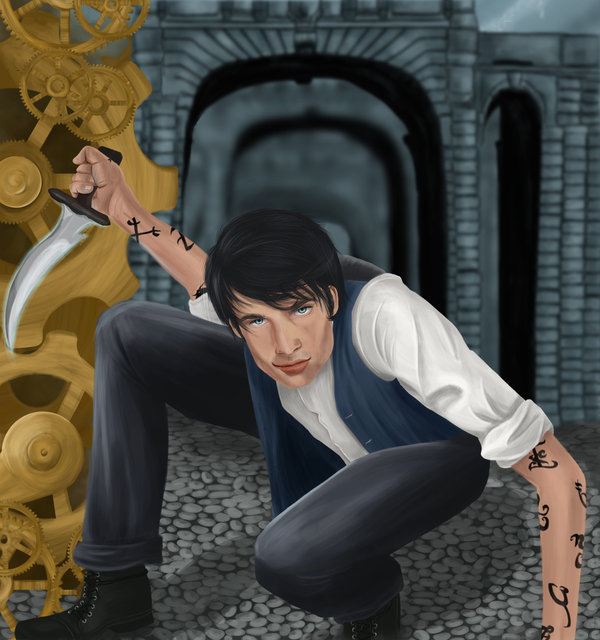
Adam Lazarus by Annie Walls

Learning that she had a twin sister in New York blew Sabina away. She was mostly dreading her meeting with her due to her lack of self-confidence. But Maise accepted her. Now Sabina is in New York and has decided to side with the mages, try to learn magic and work for peace. This enrages her grandmother, who orders her killed. Unfortunately, the process of being accepted by the mages is a difficult one. First she must be cleansed and her abilities decided. In addition Sabina must get used to drinking only processed blood. No more fresh from the vein.

Giguhl and Adam Lazarus continue to be Sabina’s side-kicks – to a varying degree. Giguhl has the humorous part in this play while Adam plays the romantic lead. Sabina struggles with all of the demands placed on her. Whatever a Chosen is, she knows she isn’t it – not matter what the wizards say. Meeting an old flame isn’t doesn’t exactly make life easier on her. But Maise is turning out to be someone Sabina likes and that lightens the burden a little.

GREEN-EYED DEMON (2011)

Maisie has been kidnapped and Sabina sets out to rescue her. First they have to figure out where she is. When all clues lead them to New Orleans, Sabina, Adam and Giguhl travel together to try to find a way to rescue Maisie. As dear grandmother was the one to kidnap Maisie, Sabina worries about the state her sister will be in when they find her.

A local witch and voodoo practitioner and her transgendered assistant find it in their hearts to help in the search. Old acquaintances of Adam end up helping the gang. Will this be enough to do the job?

With Green-Eyed Demon we begin to see the depth of Wells’ writing. She does a good job at portraying her figures. Giguhl is my favorite one. Sabina shows the difficulty of going good when she’s been soooo bad.

SILVER-TONGUED DEVIL (2012)

Cover shoot by Shirley Green

Maisie is back, but she is in trouble. The kidnapping and having to draw blood to survive has taken its toll. Sabina tries to support her, but feels out of her depth. Figuring out who to trust is turning out to be more difficult than she had thought possible, and Sabina is now becoming more and more pessimistic about the possibility of peace between the three races.

Then a string of sadistic murders begin happening, and suspicion falls on Sabina. At the same time her relationship with her lover, sister and demon are getting stronger. Sabina’s investigation into the killings turn up frightening questions and Sabina has to make some difficult choices.

BLUE-BLOODED VAMP (2012)

Now we get to the final book in the series, “Blue-Blooded Vamp”. Sabina is after Cain to revenge the killings of people Sabina has loved. Unfortunately, Cain is hunting Sabina, too.

Abel, the mage who bound Cain is the one who can help Sabina. Sabina sets out for Rome with her friends to find Abel and get some answers. When she gets there, Sabina discovers that the role she and her sister are supposed to play is a game of the gods and she is one of the key pieces.

Good ending. Happily ever after kind of. Wells has given the urban fantasy genre a new and interesting way of portraying the paranormal creatures out there.

My childhood literature

After writing about what got my two sons reading, I started thinking about the books that I read as a child. I have no idea what my parents read to me. But I do remember some of what I read myself. Getting a book for x-mas or b-days was a gift highlight. Usually we got practical gifts, but every once in a while someone found it in their hearts to give a book-hungry child just that. Even way back then I was addicted.

My parents had books from their own childhood that I got to read. These were everything from Jules Verne and Rudyard Kipling to the Bobsey Twins. My heroes were Pippi Langstrømpe (Longstocking) and Nancy Drew. If I wanted to read something comforting and cozy, I would choose animal stories or Norway’s own Anne Cath. Vestly. Her books are wonderful for children, describing life as it is without sugar-coating anything.

If I wanted to be frightened, I would read folk tales. The Brothers Grimm and Hans Christian Andersen were favorites. I would sneak read HCA because my parents had a lovely leather-bound edition of his tales, and we were not allowed to touch it without permission. Folk tales are gory, explicit and seldom “happily ever after”. Horror for children and adults would probably be an appropriate category to place them in.

Sometimes I tried to read the books my parents liked, but they weren’t all that interesting for a child. Madame Bovary and I Saw Him Die just didn’t appeal to me the same way Jungle Boy did.

There were many important lessons reading taught me. One was that it was OK to read a book twice. Nature was fascinating. Reading the end before I had finished the whole book was also just fine (no lightning strikes). If life got to be too much, a book would lighten the load. Subject matter, complexity or level did not matter. Help was to be found for a lonely little girl. No wonder I love books so much.

J.K. Rowling: Harry Potter

While I’m dealing with guilty parties, I might as well tell you about author no. 2 that helped my other son love reading.

Harry Potter by Tsulala

I have to say that I was prejudiced against the Harry Potter books. They were so hyped up, I felt that I would only be disappointed if I read one of them (silly thing these emotions). Then I borrowed “Philosopher’s Stone” from a neighbor. Ha, ha was I ever surprised. I actually liked this little awkward boy trying to fit in and find friends along with mastering his strange ability.

My oldest son has no reading disorder, but by the time he was 10 his teacher was a bit worried. He read poorly, she felt. For some reason I wasn’t worried. I knew what to look for, and he displayed none of the symptoms of dyslexia, so I just figured he was a late reader.

We started reading “Philosopher’s Stone”. He loved it. Then we went on to “Chamber of Secrets” and “Prisoner of Azkaban”. When we got to “Goblet of Fire”, he felt I was too slow and irregular in my reading to him. He picked up the book himself, finished it and the first three in less than three months. After that he devoured books. I have plenty of them and buy and borrow new ones all the time.

All it took was his impatience and an excellent author to open up his reading door. So, thank you to Joanne Rowling as well.

Keene, Carolyn: Nancy Drew

Nancy Drew: Out of This World by sunni-sideup

My son was about 8 when I started reading our old Nancy Drew books to him. Keene’s books were a great help in getting him to a point where he started reading himself. Being dyslexic, this was not an easy point for him to get to.

Our Nancy Drew books were from the 1950’s and on. Part of the appeal laid in the formal language (the way we used to talk here in Norway) and in the fact that a lot of our books had belonged to his grandparents. In addition, the plots are simple and the characters never change. Nancy is always around 16-18, Ned is her boyfriend and George and Bess her best friends. This never-changing world made it easier for him to stay tuned to what was going on.

I think he was about 11/12 when he finished his first Nancy Drew. Since then, he finished all of the ones that we had and went on to other literary adventures.

So, a big THANK YOU to all of the Carolyn Keene authors. You have made a huge contribution in helping a boy with dyslexia learn to love reading.