Vi vet jo alle er lykke er noe man kan regne seg til. Statistikerne prøver jo hele tiden med sine mange undersøkelser. Lett definerbart er det også. For lykke er jo … Der måtte jeg visst gi opp.
Maria Reinertsens Ligningen for Lykke er en ironisk tekst om fenomener fra samfunnsdebatten som vanskelig lar seg regne ut. For hvordan er det nå man har kommet fram til at det er nettopp fire prosent som skal utgjøre handlingsregelen?
Reinertsen harselerer med pengepolitikken, ikke bare Norges, og måten tallene brukes for å få fram et budskap om virkemidler og nødvendige reduksjoner og vekst.
Men Reinertsen er ikke ute etter å gi svar på de problemene hun belyser. Hennes mål er først og fremst å la oss få en titt på samfunnøkonomiske fenomener som de fleste av oss tar for gitt og ikke stiller spørsmål ved. Og dette klarer hun meget godt.
I’m no scientist, but I love science. There’s so much weird stuff in the universe that’s confusing, and confusion is fun. Confusion makes it possible for me to look for answers. Bill Bryson is no scientist either. He’s just a regular person (well kind of) who tries to make the universe comprehensible to a regular person like myself. I guess that’s what has made A Short History of Nearly Everything a popular science book about popular science.
Bill Bryson’s usual job is as an author who writes travel books. I’ve listened to a couple of them and they are presented with talent. He seems to be a curious person who does loads of research in his chosen field.
Usually, when Bill explains why he chose to write his book about nearly everything, his says that he was bored to sleep in his youth by the scientific presentations by teachers and authors. He wanted to see if he could do better.
In A Short History Bill takes us on a journey from the start of the universe up to today, and he questions what tomorrow will be like. On the road we learn bits and pieces about theories and their creators. The bits and pieces we learn about are astronomy, physics, biology, chemistry and paleontology. For the most part Bryson uses words that are accessible. Rather than present the reader with incomprehensible equations, he uses analogies that illustrate the question being asked.
To get to the point where he felt he could write something about the subject, Bill has gone through a large and varied reading list. He has also used a large group of people to help him with his project, experts within the various fields of interest.
I find this kind of “science” interesting, so I guess I’m the target group. For anyone wanting to learn a little about “nearly everything”, this is a book to read. While little kids wouldn’t get much out of it, young adults should be just fine with Bill’s writing.
If you want to learn more about the various fields presented in A Short History, use the bibliography at the end of the book at a guide.
An illustrated edition of the book was released in November 2005. Abridged and unabridged audio versions should also be available.
Aventis Prize for best general science book – 2004
Prejudice and fear seem to be recurring themes in Patricia Brigg’s novels. Raven’s Shadow is no exception. In this instance, the Travellers are the persecuted people. We see instances of this today. In general there seems to be a lack of trust towards people who do not stay in one place and become part of the community. It makes it a whole lot easier to blame them for something, as our links to them won’t be a strong as they would be towards a neighbor. Such is the world of Travellers in Briggs Raven duology.
Tier and Seraph are our two main protagonists in Raven’s Shadow. We meet Tier as he is on his way home from the war. Tier is a rebel. His father was a baker and the expectation was that Tier would take over the craft. But Tier wanted to see the world and did that. Unfortunately, he also ended up disillusioned about the state of the world.
As he enters a village he see a large bon-fire in the town square. A Traveller was burned suspected of using magic. Inside the town’s inn the citizens have joined in drinking to their “brave deed”. Left behind is a young woman. The innkeeper has decided to sell the girl to the highest bidder. Tier ends up buying her, Seraph a Raven traveller who has no reason to trust Tier. This is the beginning of the journey of Seraph and Tier, a journey fraught with danger and betrayal – you know the spiel. I liked both Raven’s Shadow and Raven’s Strike. While not complicated, they are easy to read.
Tier has been rescued and the family is taking it easy on the way home from the Capitol after the run-in with the wizards. Part of the way, they have chosen to travel with Benoin and his tribe. On the way they come to a village where a shadow creature has killed some of the villagers. The creature is taken care of, but the family soon realises that it is just a symptom of what is happening in the land.
At the same time, Tier seems to be having trouble recovering his magic. It seems to be fraying and drawn away from him. Seraph cannot figure out what the problem is, but slowly the family is being led to the ancient city of Collosae – the city where the Travellers came from.
Raven’s Strike gives us more background information on the Travellers and their roots. This background information turns out to be vital to Tier’s ability to solve the puzzle. The romance between Jes and Hennea takes up a bit of space.
Raven’s Strike tied up a few loose ends and was a good follow-up to Raven’s Shadow. They are both typical examples of Brigg’s writing: light, fun and accessible.
We humans are a fearful lot. If anything or anyone differs from the accepted norm, most of us will find some way to avoid that thing or person. Sometimes we’ll use the opportunity to bully and taunt the person exhibiting “strangeness”. The Hob’s Bargain illustrates this ability to pretend that we know how the world should be, even if that means hurting someone we love.
Aren’s (our protagonist) family is not excepted from this. They have an hereditary clairvoyant ability that sometimes expresses itself in a more magical one. That makes them fodder for the blood magicians – who feed on death. Aren’s brother was wanted as a magician by those in power, but he did not want to consequences of such a choice. Rather than have his death be used by the blood magicians, he chose to suicide.
You can imagine this has affected Aren. It seems she is beginning to experience visions, making her worry about her new husband. When the cottage is broken into, she manages to hide in the food cellar, but Aren knows something is terribly wrong.
While hiding in the cellar, Aren suddenly feels a change in the way magic feels. Something has broken, but she has no idea what – being too busy surviving, and all. From that point on Aren’s visions are clearer and the first one concerns the death of her father and husband. Turns out her whole family is gone. Now Aren has to deal with her grief, her out-of-control magic and the changes in the land and her neighbors.
Patricia Briggs books fall into the light-reading fantasy section. Her books are fun and easy to read. In the Alpha and Omega novels we meet werewolves and witches, vampires and fae, all capable of wickedness and heroic deeds. As usual in such tales the characters tend to survive the most amazing things. There is plenty of humor, some romance and lots of action in this series. The Alpha and Omega series has been set in the same world as the Mercy Thompson series.
Bran – the leader of the werewolves (Marrock) in the US lives in the hills of Montana. He has two sons, Samuel and Charles. We’ve met Samuel already in the Mercy Thompson books, although he does make a brief appearance in his function as a doctor. Charles is Bran’s other son. He has been born a werewolf, not something that should be possible. Charles is Bran’s assassin. If a werewolf steps out of order, it is his job to take care of the problem. His ability to remain cool and collected while killing is one of the main reasons for having such a job.
Anna, Charles’ mate (to her surprise), has been living with a pack in Chicago. The other werewolves had been abusing her severely. When that came to the attention of Bran, Charles was sent to take care of the matter. That led to Charles and Anna’s wolves recognizing each other as mates. Anna is brought to Bran’s pack to live with them.
Walter Rice, a Vietnam veteran, lives up in the Cabinet Wilderness in Montana. One day he witnesses the attack on a young man and steps in to protect him. Rice ends up being mauled, but survives. When other mysterious deaths occur in the area a rogue werewolf is suspected and Charles is asked to look into it. He and Anna go.
HUNTING GROUND (2009) – Nominee for the Endeavour Award –for best book by a Pacific Northwest writer 2010
Charles is trying to convince his father to stay away from a convention of werewolves in Seattle. He feels his father will be in unnecessary danger from the European delegation. Charles’ intuition is acting up. Being an Omega, Anna is able to stand up to Bran without his Alpha influence taking over. After she has yelled at Bran, he is able to listen to what the two have to say.
Bran accepts Charles’ feelings and sends Charles and Anna instead as his representatives. Together they are to try to convince the other delegates of the need to go public. The other delegates aren’t exactly thrilled at the idea of going public. Here we see that the timeline is a bit back in time from the Mercy Thompson series. There the decision to go public has already been made and Adam is the werewolves’ outward face.
In Seattle people are being found dead and mauled. When Anna is attacked by vampires using werewolf tricks and magic, Charles has to figure out how to save the situation without getting killed by former lovers and new enemies.
FAIR GAME (2012)
Young Leslie has moved to California with her father. There she ends up in the capable hands of Mrs. Cullinan. When animals and children start disappearing (even Leslie’s new puppy) three people turn up at the neighbors and take her away. The neighbor and the three new people turn out to be fae. When one of them offers Mrs. Cullinan a favor as thanks for her warning, she says no thanks. Instead Leslie ends up being the one owed. But having learned that the fae were powerful and charming and that they ate children and puppies, Leslie was not eager to cash in her favor.
Fair Game is set a while after Hunting Ground but shortly after River Marked. Charles is struggling in his capacity as an assassin and Anna seems the only one capable of seeing it. She keeps on confronting Bran about it, and only Omeganess keeps her from shaking in her shoes. Because of the new rules, Charles no longer feels he is dispensing justice but rather murder and this is causing ghosts to haunt him.
When the FBI call the Marrock for help in solving a spree of murders, Bran chooses to send Charles and Anna to take a look. Anna gets to play good guy and Charles her bodyguard. In Boston Anna meets Leslie and they get to test each other’s intentions.
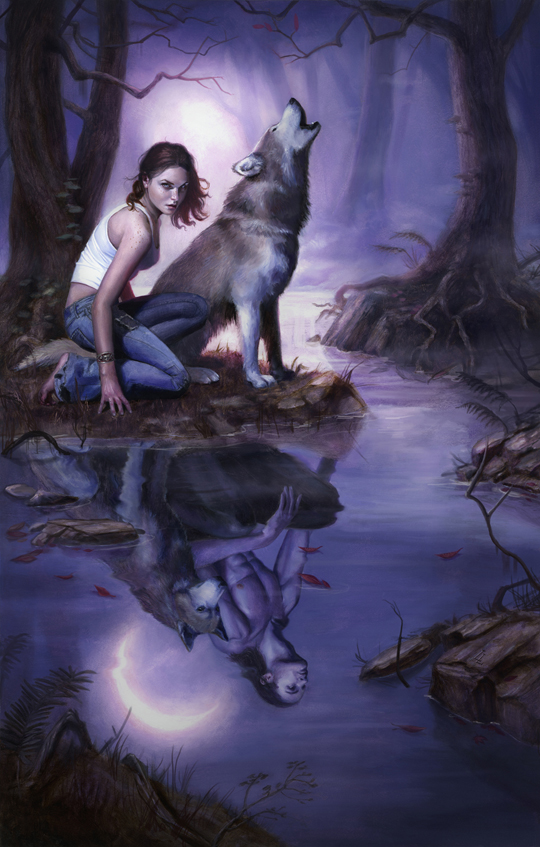
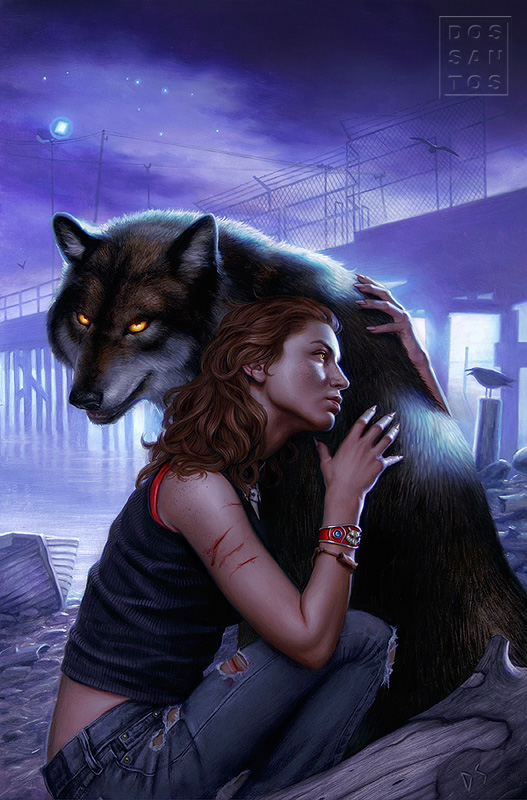
Alpha and Omega: Cry Wolf Graphic Novels published 2012 by Dynamite. Adapted by David Lawrence, illustrated by Todd Herman with additional art by Jenny Frison and a cover by Dan Dos Santos.
I have one complaint about the series – Where is the next book????? My goodness, this series was riveting. Kirstein needs to keep on writing – well, actually, in all selfishness, I need her to keep on writing. I think this was my third read-through and I was still captured by the writing and held prisoner until the end.
THE STEERSWOMAN’S ROAD (2003)
Rosemary KirsteinSteerswoman’Road is an omnibus containing The Steerswoman and The Outskirter’sSecret. In it Kirstein tells the story of the friendship between Rowan, the Steerswoman, and Bel, the Outskirter. Rowan and Bel meet right at the beginning while they are both about their own business. Bel has been travelling with other Outskirters and Rowan has been investigating strange blue jewels that are neither cut nor dug up.
Steerswoman are men and women who travel around the land asking questions and answering them. One must tell the true answer to any question and the Steerswomen must also do so. If one refuses to answer a Steerswoman, they can ban you. That means that no matter what the question you ask is, they will not answer it. Strange rule, but as knowledge is their whole purpose perhaps not.
Rowan’s questions about the jewels seem to have stirred up interest from the wrong parties. Thankfully, she and Bel have decided to travel together for a while because the next day brings an attack. From that point on there is tension, action, betrayal, discovery, friendships and travel. In fact, Rowan’s search for the truth of these blue jewels brings her into the Outskirts.
The Outskirter is about this part of her journey of discovery, and The Outskirter is just as exciting as The Steerswoman. The Outskirters are nomads who live at the border of where people can actually survive. Every day for them is about destroying and seeding the land so humans can live there. Steerswomen are unfamiliar territory to the Outskirters, yet Rowan manages to gain their trust and help them in her own way. The importance of her work becomes clearer and clearer as the role of the wizards in the attacks on Rowan begins to make a strange sort of sense. Rowan is also beginning to realize that perhaps wizards aren’t quite as wizardly as she had thought.
We as readers should have started realizing this long ago. What does not make sense to Rowan and the regular citizens of both the Outskirts and the Inland does to us. This is a science fiction series that to begin with might seem to be a fantasy one. Quite a few science fiction books are like that. The meeting between different sorts of technologic knowledge can, after all, make it seem like magic is afoot. Pressing a button on the wall to make light in the ceiling is pretty magical if you ask me – and I know how it all happens.
Rowan and Bel have parted ways (on friendly terms). Bel is in the Outskirts spreading the bad news, and Rowan has ended up at the Annex in the town of Alameth looking for more information about Slado and the wizards. The Annex is a mess. Mira, the last Steerswoman living there, had not cared one whit about her duties. She was tired of being a Steerswoman and left everything a mess when she died. Now Rowan has to try to find desperately needed information in this chaos. On top of that the townspeople have problems accepting Rowan because she is so different from Mira.
When Rowan meets Janus, a Steersman who resigned the job and was considered lost, she is happy and confused. He was one of her oldest friends and Rowan finds the ban on him difficult in their conversations. After a while, Rowan begins to suspect that things are quite complicated with Janus.
The Lost Steersman is every bit as suspenseful as The Steerswoman’s Road. Kirstein keeps the standard of her writing amazingly high. It goes against the grain, but I think I’m going to put her along with Pratchett. Their styles are completely different. However, they both manage to involve me as a reader in some very serious topics with skills beyond anything I could aspire to.
Rowan and Bel are once again together in their adventures. The Outskirts have been warned and Rowan is finally beginning to get somewhere in her search for the answers to Slade. All roads lead to Rome, it is said. In the Inlands, all roads seem to lead to Donner. To Donner Rowan and Bel go and there they unexpectedly meet Will – our lovable wanna-be apprentice – from the first book.
Will is on the run from Corvus, trying to hide in Donner and looking for revenge on the wizards. Rowan and Bel are overjoyed at meeting their old friend and seek to help him in his quest. But, as would be expected from an adventure novel, things never turn out as one would wish. Will is surprised at Rowan’s grasp of “magic”. Because he knows so much more about science than she, he tends to be a bit overbearing with her. Just because she doesn’t have the background Will has, certainly does not mean that she is without the ability to infer and deduce. After all, her whole life has been about the quest for knowledge – a true addict.
Unfortunately the next book in this series has not come out yet. Aaaargh. Please, Kirstein! We need the next installment! I love the intelligence and wit of Rosemary Kirstein. She actually expects me as a reader to think and doesn’t divert my attention with loads of sex and violence. Sex and violence can be fun, but this is sooooo much more thrilling.
Kin Karad works for the Company. Her job is to oversee the creation of planets. Some of the workers like to play jokes on future inhabitants. The one she has discovered this time is a plesiosaur in the wrong stratum holding a placard reading “End Nuclear Testing Now”. While she is impressed with the inventiveness of the culprit, Kin is getting tired of her life. It has been a long one.
Then she meets a mysterious person who invites her on a journey. Kin Karad decides to go and when she gets to the spaceship she discovers that she is alone, but will be picking up two companions – a kung called Marco Farfarer, and Silver the Shandi. They are told that they will be going to a flat world.
The spaceship takes off and off they go on their adventure.
Strata precedes Pratchett’s Discworld series, but we clearly see how the foundations are laid for the later series. Kin Karad and her fellow explorers are fun characters with clearly defined personalities. Plays on words and concepts are obvious from the first pages. Pratchett was a pretty good author even back in his early days.
This is the story of how one cat changed the life of a man who was a recovering heroin addict living a hand-to-mouth existence to the point where he was able to quit methadone and get his life in order. The responsibility for another life, a life that accepted him for who and what he was made all the difference to James Bowen. From busking, to selling magazines to giving out his own book has been a journey that has been neither easy nor painless.
Plus points to someone who manages to take charge of their own lives to the point where true change occurs. Minus points to co-writer Garry Jenkins and the editor for not helping James streamline the book a little more.
Having said that, a story like this is worth telling. Bob was famous long before the book came out. You’ll find references, pictures and clips in a whole lot of places – the photograph on the left is only one example.
Nominated for a Locus Award for best science fiction novel in 1978
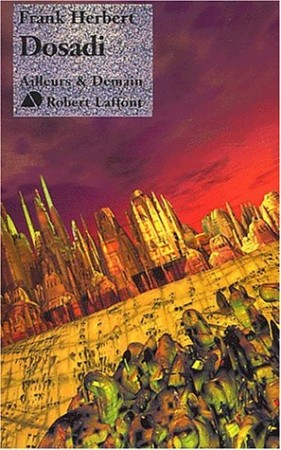
The Dosadi Experiment takes place in the same universe as The Whipping Star, but can be read on its own.
I dipped my toes into the waters of Frank Herbert’s writing with The Dosadi Experiment. It’s been ages and ages, back in the days of the dinosaurs, so I cannot really remember what I thought, but it must have been positive because I kept on exploring Herbert’s world. I reread The Dosadi Experiment from time to time, and each time I discover new bits to love. As I change, so does my understanding of The Dosadi Experiment, and that is a sign of a classic to me.
The ConSentiency is composed of many species who have different abilities. The Taprisiots provide instant mind-to-mind communication between two minds anywhere in the universe. The Caleban provide instantaneous travel between any two points in the universe.
Our extremely intelligent and empathic Saboteur Extraordinary, Jorj X. McKie, gets an assignment that he soon discovers is probably a set-up. He is sent by the agency to Dosadi as their “best”. Compared to those already living on Dosadi, he was like an infant in swaddling clothes.
What he discovers on Dosadi is shocking in its blatant disregard of any and all ConSentiency regulation. Dosadi has been placed behind an impenetrable barrier called “The God Wall”. Humans and Gowachin have been dumped together in numbers that defy description. The planet itself is poisonous except for a narrow valley, containing the city “Chu”, containing nearly 89 million citizens.
Senior Liator Kaila Jedrik starts a war and Jorj becomes a pawn in her hope of saving the population of Dosadi.
Isn’t this cover cool. It pretty much says it all. Frank Herbert had the ability to write scary future scenarios while making them seem completely believable. Maybe someone is actually out there doing something like this at the moment. I wouldn’t put it past someone with a Mengele mindset.
DNA and selective breeding is an interesting topic. How far can you go, and still be human? Is being human as we know them actually desirable?
Hellstrom’s Hive takes us to a US that has become a police state. There really isn’t room for diversity and the government is rather paranoid. Of course, there is an ultra-secretive agency that looks for threats. They intercept schematics for something that looks like a dangerous weapon system. When they begin to suspect insect specialist and film-maker Nils Hellstrom, agents are sent to his remote and secluded farm compound where most of his insect films are being produced.
I’d never thought of selective breeding being used this way. In one sense it makes sense – just look at all of the weird breeds of dog that we have. In another sense, the thought is rather frightening. Frank Herbert has the ability to make me believe the scenarios he presents. What a gift.
This is a collection of short works, written between the 40s and the 70s. As usual in Schmitz’ short story collections a novel has been included. These are all non-Hub, non-Vega, non-Karres stories. Some are even not Science Fiction. Quite a few of them are dark, in the sense that they reveal a lot about the human condition.
TIME AND SPACE
The Big Terrarium (1957): What would you do if you were the one caught in a cage in a zoo? This is the exact situation Fred and Marta Niedheim find themselves in when they, their farm and a tramp called Howard Cooney are transported into an alien zoo. Stuck with them is a friendly alien.
Summer Guests (1959): Mel is starting off his two-week vacation. Upstairs lives Maria the artist. They discover that a storm has brought in two pixie-like creatures in need of aid. Mel tries to help them while not alerting his neighbor, but something seems to get in the way.
Captives of the Thieve-Star (1951): For those of you who are familiar with The Witches of Karres this story shows you transmuted the protagonists into the familiar figures of Captain Pausert and Goth. Chanook, Imperial Secret Service applicant, and his diminutive wife Peer, daughter of the notorious space-rat thief Santis, find themselves in a load of trouble when they discover an abandoned space ship and try to salvage it.
Caretaker (1953): Hulman has been stranded on Cresgyth, protecting the native human population from the encroaching blue worm-like creatures. An exploration ship comes knocking and one of the crewmen, Marsden, is filled with a sense of inexplicable horror when he sees Hulman’s paintings of the human natives.
One Step Ahead (1974): “SKANDER WAR IMMINENT”. The Programmed Corps, the mightiest war-machine ever known, have been designed to fight the alien Skander. When they start leaving the planet of Ridzin, apparently to go to war, questions are asked. The League itself has many internal rivalries, each wanting to hijack the Corps to its own ends. So there is a lot of security protecting the soldiers. But there’s always someone one step ahead.
Left Hand, Right Hand (1962): The Cassa expedition has finally landed on Cassa. Troy Gordon and his fellow humans have been captured by the hostile Hammerheads (Tareegs to themselves), who are preparing to invade Earth. After watching two of the crew tortured to death, Troy’s fellow humans are cooperating with the aliens to save their own lives. Troy is desperate to escape and warn home. But are his fellows as weak and soft as he thinks?
HOMO EXCELSIOR
The Ties of Earth (1955): Alan Commanger discovers he has an unusual ability to win crap games. This comes to the attention of something called the Guides. They ask him to come and talk to them – to discover whether he actually has special powers. It turns out he does. Somehow, he is able to move himself from one place to another. Then he wakes and discovers that he is in a store with a dead body. It seems someone is trying to set him up for murder.
Spacemaster (1965): Haddan and friends tried to escape the City of Liot, ruled by the Spacemasters, and find a planet where they can live free. But they are caught, and Haddan discovers the real reason behind the Spacemasters’ behaviour.
The Altruist (1952): Colonel Magrumssen has long been interested in the Mysterious. When a pair of scissors disappear from his desk and then reappear his interest is woken.
Oneness (1963): Some years ago a bunch of convicts made their escape from Mars in a vessel using a stardrive system that Earth leaders want to get their hands on. One of the rebels turns up on Earth wanting to open negotiations. Earth is under the tyrannical rule of the Directors’ Machine. During the interrogation of Rainbolt it turns out that the escapees have established themselves on other Earth-like planet. Rainbolt has two reasons for coming to Earth: 1 – to gain access to Earth’s vast resources and 2 – to spread their philosophy of Oneness.
DARK VISIONS
We Don’t Want Any Trouble (1953): An apelike alien comes to Earth. The same evening the networks around the world are cleared for broadcast. Humans are deemed as being foolish, limited and incapable of harming the least of them. That means trouble – for humans.
Just Curious (1968): Litton can become any other person for five minutes — which makes him the ultimate spy. But when one of his victims discovers him, he’s forced to become someone he would rather not.
Would You? (1969): Geoffrey comes to visit Markus Menzies at his chalet. While being shown around the chalet, they come to an old chair. The chair promises one chance to change the past. What will Geoffrey do?
These Are the Arts (1962): Hugh Grover learned of the Galcom craze through his friend Andy Britton. Symbols were being used in an advertising craze. The Galactic Community sent The Teachers to adopt Earth into the Community by instructing its inhabitants in a New Method of Thought and Communication. Hugh is highly sceptical and tries to warn the leaders of the Earth, after which he isolates himself until it is past. Then he discovers that his worst fears about its effect are true.
Clean Slate (1964): Hair, one of the original Big Four, but now in disgrace, is put in charge of the ACCED project – an educational system. He is disturbed to find that it is not going well, and is sending children psychotic, but there seems to be no politically expedient way to shut it down. Hair does not give up his fight to get the authorities to listen and shut the project down.
TIME FOR CRIME
Crime Buff (1973): Jeff Clary is a wanted criminal and on the run. He runs into a large estate where he spies a plane. Desperate to get away, he goes into the house in an attempt to find someone who can fly it. He discovers Brooke Cameron and takes her hostage. He’s amazed and confused when she keeps trying to help him.
Ham Sandwich (1963): Dr Ormond runs the Total Insight seminars, getting preferably rich people to donate money in the hope of improving their psychic powers. Two of the students are being advanced to an experimental study. Wallace Cavender signs himself in as a student to find out what is happening at the Institute.
Where the Time Went (1968): The author George Belk is desperately trying to figure out where all the time he thought he spent writing is going. He cannot figure it out. A doctor sends a time-measuring instrument to home.
An Incident on Route 12 (1962): Phil Garfield’s car breaks down on its way to Phil’s escape from the police. He stops a large sedan. When the driver comes out of the car, Phil shoots him. Oh dear, shouldn’t have done that.
Swift Completion (1962): George Redfern has been trying to manipulate his wife into a situation that would leave him a widower. She is not helping things along. Then he discovers that his wife knows that he is trying to kill her. George is not giving up.
Faddist (1966): Herman’s wife Elaine is obsessed with health food. She will not let him eat anything else – ever. When she goes away for a meeting, Herman takes the opportunity to orders in cream cakes. But…;
The Eternal Frontiers (1973) is one of Schmitz’ four novels. Due to separate living conditions mankind has largely divided into to species: Walkers and Swimmers. Crowell was born a swimmer, but has become a Walker by choice. He ends up caught in the middle of an altercation between the two groups. Then he discovers that an alien race is the root cause of the conflict, and he needs to convince both sides of what is going on.
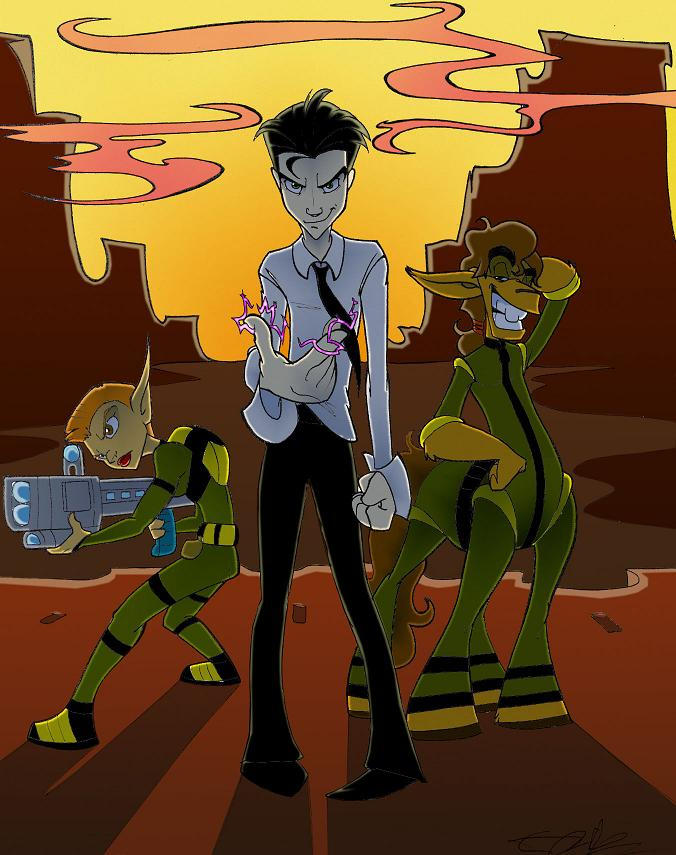
I started reading Artemis Fowl to my oldest son until he got into the whole reading thing himself. Once there, he took over and went through the books below. After I’d thoroughly brainwashed him, I set out to do the same with my youngest – first by reading to him and then through audiobooks. Audiobooks are a miracle for dyslectics. A dyslectic brain is just as brilliant as any other brain, it’s just the whole sorting letters into the right order thing that baffles them. Needless to say, I managed to convert my youngest as well. You’ve probably guessed by now that I’m a fan of Eoin Colfer’s creation of the less than legal character of Artemis.
Artemis Fowl II is the main character of Eoin Colfer’s Artemis Fowl series. Artemis is a teenage criminal mastermind on the lookout for enough gold to restore his family fortune. He considers himself fairly wicked, but as the series progresses we see that there is plenty of good deeds to balance the bad. My kids loved all of the tricks he played on both his friends and enemies. We have not read it yet, but the conclusion to the series was released in July 2012 – The Last Guardian.
Eoin Colfer begins our journey into the world of Artemis Fowl II in the novel Artemis Fowl. Some of the characters we meet will appear in all of the novels while some of them we’ll only see in a few of them. His faithful bodyguard, Butler is one of the characters that will appear again and again.
Artemis is 12 years old. His father is an Irish crime lord, Artemis Fowl, who has disappeared. Through research Artemis thinks he can prove the existence of faeries and when he tracks down The Book of the People he has his proof.
Artemis decodes the book – only natural for someone of his genius – and travels the world looking for locations for a magic-restoring ritual. They discover and capture Captain Holly Short who is out restoring her magic. Holly is then brought to Fowl mansions. The faeries are not pleased with Artemis and sends a crack team (LEP) to recover her.
A graphic novel adaptation was released in 2007. A film adaptation was reported to be in the writing stage in mid-2008, with Jim Sheridan directing.
AWARDS:
W. H. Smith Book Award
British Book Award
Whitbread Book of the Year Award: Shortlist
Lancashire County Library Children’s Book Award: Shortlist
Bisto Book of the Year: Shortlist
New York Times Best-Selling Series
Massachusetts Children’s Book Award Master List (2003)
Bulletin of the Center for Children’s Books Blue Ribbon Award (2001)
In The Arctic Incident, Artemis is a year older (13). We once again meet Butler, Captain Holly Short and Commander Julius Root.
Artemis is set up to take the blame for supplying contraband to goblins. When Artemis and Butler defeat the real baddy, the LEP decides to help Artemis recover his father from the Russian mafia. The rescue group is ambushed by goblins.
It becomes apparent that Opal Koboi of Koboi laboratories is involved somehow, leaving it to Artemis and Holly to figure out how to save the day – both for Artemis’ father and the LEP.
The story in Eternity Code happens shortly after the Arctic Incident. While Artemis has changed somewhat since the first book, he still loves to scheme and steal from the fairies. Artemis has created a supercomputer which he calls the “C-Cube”. It gets stolen and in the process Butler is killed. However, Artemis comes to rescue – along with a bit of fairy magic.
Artemis convinces the fairies to help him recover the Cube and they agree – but with one condition. Artemis is to be left with no memory of the fairy world.
Our lovely Opal Koboi (from The Arctic Incident) has gotten away from the asylum where she was being held by the LEP.
She then sets out to revenge herself on Commander Root, Captain Short, Artemis and Butler.
Holly is desperate for help and turns to Artemis – against the wishes of the LEP. The only problem is that Artemis is left with no memory of the fairy world.
While Artemis likes to think of himself as someone who chooses to do bad, it turns out he is a softy after all. He is still full of trouble and deviousness, but it is difficult to come out of reading the book and not liking Artemis. Mulch provides all the laughs a kid could need.
Artemis and Butler are demonhunting. He is somehow able to predict when a demon materializes. This comes to the attention of our trusted Foaly. This brings Holly and Mulch (who now have their own PI business) into the story.
In the meantime, there is trouble on Hybras (demon island where time is nonexistent). However, it seems that the spell holding Hybras in stasis is fraying and an answer to the problem is needed. Bullying is a favorite pastime, and No1 is one of the victims. He is convinced to come to the human world.
Right now, its glaringly obvious that everyone is going to meet – probably with a huge bang somewhere. The Artemis series does have a habit of loads of action and humor. Thankfully Colfer is keeping up the good work.
When Artemis’ mom contracts a fatal disease, Artemis turns to the fairies for help. Unfortunately the only cure to the disease is through the silky sefaka lemur of Madagascar. It is extinct. The last specimen was killed 8 years ago with the help of Artemis. Talk about the past coming back to haunt you.
Through lies and deception, Artemis gets the fairies to help him time travel. The goal is to save the lemur – hopefully for good. Holly and Artemis go back in time and need to avoid their younger selves.
Everything has a price, so too Artemis’ lies to Holly. Colfer portrays this rather well. He also brings up the issue of the cost of abusing our environment. I find myself wanting to preach here, but The Time Paradox does a much better job of illustrating the issue.
One of the consequences of The Time Paradox is that Artemis is left with a clearer sense of responsibility toward the environment.
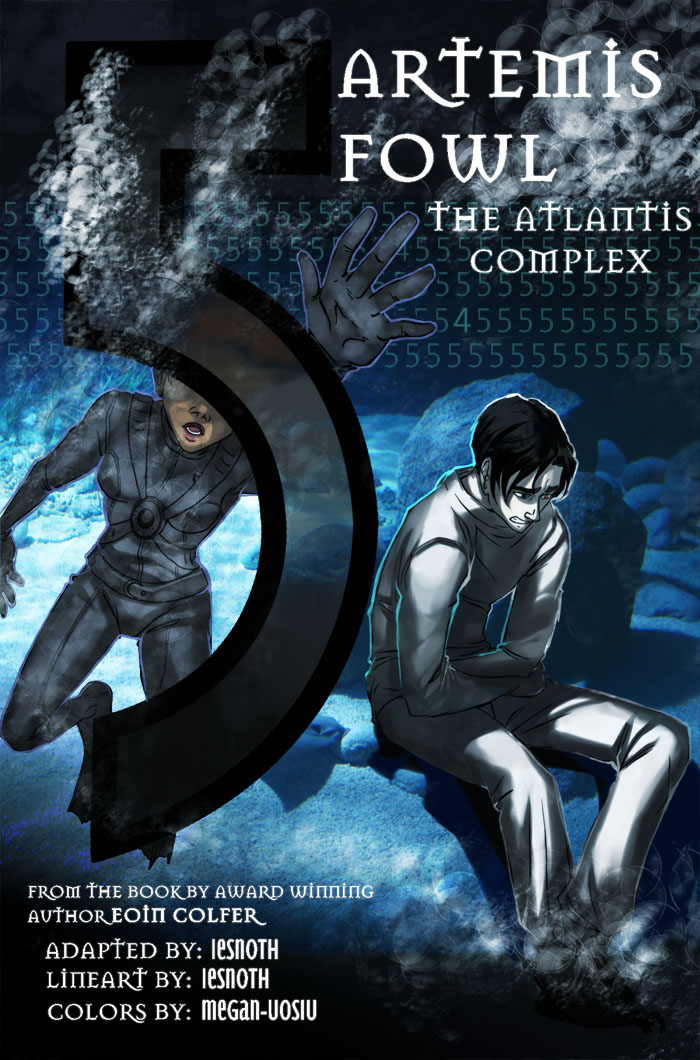
When Artemis unveils the Ice Cube – an invention to stop global warming – the fairies discover that Artemis has developed something called Atlantis Complex (including OCD, paranoia and split personality). Artemis has a break-down during the presentation. Holly and Mulch are left taking care of things, while Artemis is dealing with his episode.
In the meantime, Butler is on an adventure in Mexico. Artemis tricked into travelling to help Butler’s sister. Turns out it was a good thing after all.
Tinker is a romance/adventure book placed in a science fiction setting. While there are elves, they are part of a parallel world that earth got to through technology – sort of side-stepping to another world. Warning on the romance part – it is explicit.
Wen Spencer’s invention of Tinker – our salvage-yard owner protagonist – is the creation of a well-rounded character. All others are rather two-dimensional compared to her, but as she is our scrappy heroine that doesn’t really matter.
Pittsburgh travels between Elfhome and Earth – one month on Elfhome/24 hours on Earth. While on earth the ambient level of magic goes way down. Tinker has found a way to combat that through storage tanks and a magic spell. That turns out to save the life of the Viceroy (Wolf Who Rules), Windwolf. In saving Windwolf’s life Tinker becomes embroiled in the politics of the Elfin court, the NSA and the Elfin Interdimensional Agency. Everyone is out to find her. Thankfully, Tinker has the brains to deal with all of the complications of her life.
I like Tinker. She is smarter than I’ll ever be and a whole lot braver. Her innocence and huge heart are appealing. Wen brings Tinker to life for me and her writing brings music to my soul.
Wolf Who Rules continues right after the end of Tinker. In it we get to know Wolfwind and the elven culture a little better. Tinker is still the main protagonist of the novel.
Tinker is having nightmares. Nightmares that are about things she has no knowledge of. Scary things like the Wizard of Oz. These dreams are draining her but it seems they are important for some reason.
When the royal troops come to Pittsburgh, Tinker needs to figure out how to behave around other domane and royalty. As she is only 18, the elves consider her a baby and therefore of no consequence. Are they in for a surprise!!!! Windwolf is, for the most part, left to deal with the politics of this tense situation.
While Tinker saved Elfhome from the Oni in the previous book, there were side-effects. There is a growing discontinuity in Turtle creek. Add a couple of dragons and the half-oni and the tengu and Tinker and Windwolf have their work cut out for them.
We are still encountering the excellence of Spencer’s writing. Her books are a delight to read. I believe I’ve read them all. This science fiction parallel world of Elfhome is a dangerous place to live and Spencer’s writing makes that quite clear. Warning in this book as well. There is some explicit sex in it.
Elfhome disappointed. I’d gotten used to the excellent writing in Spencer’s two previous book. Elfhome on the other hand was too noisy. There were hiccups in the flow of words and Tinker had all of a sudden become two-dimensional rather than the three-dimensionality she’d had in Tinker and Wolf Who Rules.
The plot itself is actually pretty good. Elven kids come to Pittsburgh to hoping for better lives. They are kidnapped and during the investigation of that kidnapping Oilcan and Tinker discover Skin-Clan interference. It turns out the Skin-Clan might have emigrated to the Oni-world – playing gods with the lives of the population there. When Tommy Chan is added to the mixture the text loses its adhesiveness. Too much is going on in too little text.
I still liked Elfhome. It’s just that I’d gotten used to a different standard of writing from Wen. The whole Elfworld setting is pretty enchanting. A world of powerful magic, beautiful elves, man-eating trees, frost-breathing wargs, and god-like dragons makes for interesting lives for the population.
If there is a book no. 4 in this series, I will buy it. The only problem with Elfhome is Tinker and Wolf Who Rules. Without these two novels, I probably would have had no complaints. That is the problem with excellence I guess.
You know that feeling you get when its been ages since you read a book and then you discover again why you’ve kept it in your library. Julie E. Czerneda has been such a discovery. What a delight. Czerneda has the flowing ability. It’s like listening to good music reading her books.
In a sense the plot is pretty basic. Someone gets screwed and they set out to right the wrong. In Julie’s Trade Pact Cycle books this happens in a universe where the different races of intelligent life have joined in a Trade Pact. There are outsiders. One of these is the Clan – a group of people (look pretty much like humans) who have the ability to travel the M’hir (a place outside of regular space) and telepathic abilities. Some of the members of the Clan are extremely powerful and one of these is Sira – our female protagonist.
The Clan oppose her attraction to Jason Morgan, and Sira herself is afraid of what her power might do to this telepathic human. She is right to fear her own power. When Sira is attacked by the Clan, Sira sends Morgan off to recover what was stolen. Unfortunately a lot of her fury with the Clan is sent along and Morgan is having to fight the urge to express this anger through the book.
As Jason is sent off, Sira transports herself to the only place she feels she will be safe – the Drapsk space ship. She is correct. She is indeed safe on the Drapsk vessel, but that safety also brings a new set of problems Sira’s way. The Drapsk are very good at getting things their own way, and that way includes Sira’s time.
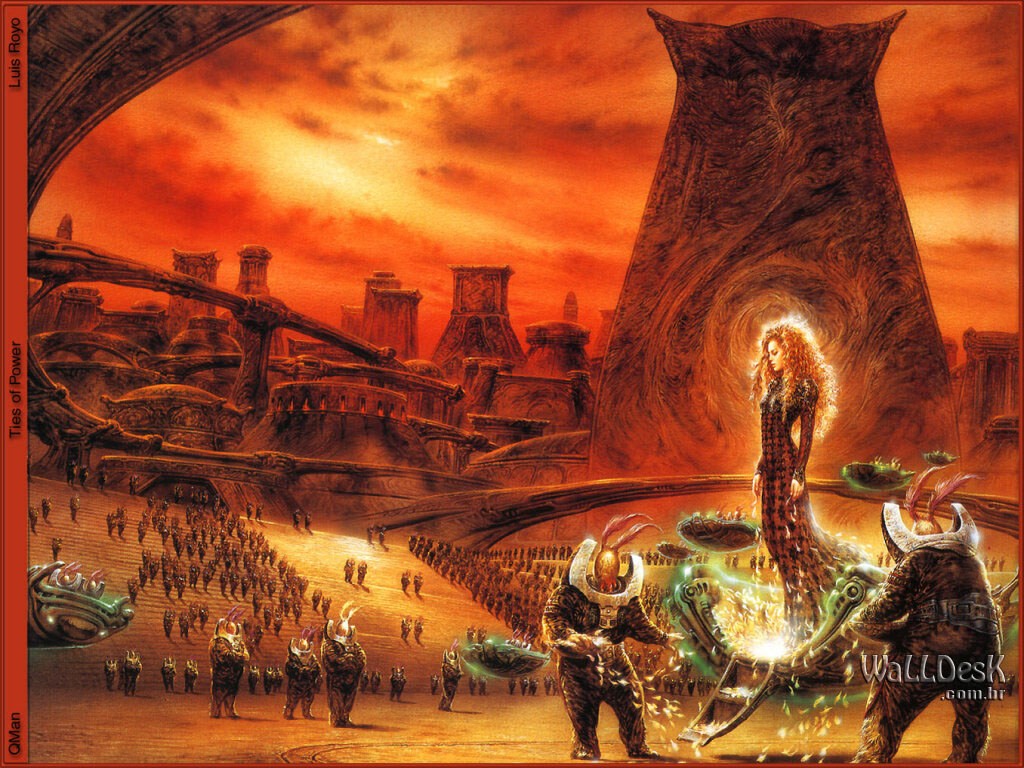
To Trade The Stars continues a few months from where Ties of Power left off. Sira and Jason continue to trade but discover that somehow Jason’s telepathic abilities have become known. This is making it difficult to get good jobs. One does turn up for Morgan at Kimmicle (miner’s world), leaving Sira free to go to Plexis and Huido by M’hir. When she gets there, she ends up being kidnapped. We all know that Jason will turn the universe inside out to find her. He is not going to be alone in this search.
In the meantime Rael and Barac from the previous are stuck on Drapskii continuing what Sira began. They are both understandably frustrated with the Drapsk as the Drapsk are of a different species. When Barac gets a call for help from Huido, he leaps at the chance.
Once again I liked the prose of Julie. She writes seamlessly. Once again, I’ve found an author that has the gift of flow. Her books are just shy of 500 pages and that might hinder some from reading her books. Don’t worry, they are available as audiobooks at audible.com.
Originally, Marion Zimmer Bradley started the Sword and Sorceress series to further strong female protagonists in the sword and sorcery genre. She saw the need to change what she considered an appalling attitude toward women in these works.
Readers flocked to these anthologies and submissions to them increased. By the time of her death, she was on the 18th collection. After her death it was decided to publish three more collections. In the end, a volume 21 with Diana L. Paxson as editor was printed, and the tradition has continued from there on. (Wikipedia)
Dawn and Dusk — Dana Kramer-Rolls – Dagne, with the different colored eyes, grew up ostracised by her father, step-mother and brothers for being a freak. In the end she has to run away to protect herself. We meet her in a cabin in the woods on a cold and bitter night.
Spell of the Sparrow – Jim C. Hines – A family of two ex-thieves and a budding wizard ought to be a dream come true. But parents will be parents everywhere, and our two ex-thieving parents do not approve of Mel’s dabbling in magic. That is all about to change when poor old dad is spelled by a Cloudling.
The Woman’s Place — Susan Urbanek Linville – The continuing welfare of the tribe is of prime importance. When winter threatens to destroy all of the, grand-dame has to make a choice that will mean life or death to them all.
Kin — Naomi Kritzer – Once magic has been properly woken in a person, they become addicted to the feeling. Julia is going to have to make the choice between her magic or the saving of a child.
Child’s Play — Esther M. Friesner – Mira’s father is the richest man for miles, but that does not make a difference to either of them when Mira’s mom dies. When a new woman moves into the house, Mira knows she is in trouble. Thankfully she has her teacher on her side, a teacher willing to go the extra mile to protect this child.
Ursa — Jenn Reese – A child was placed on a mountain side to die. Saving it changes the life of Ursa and the father.
Red Caramae — Kit Wesler – Caramae sneaks into the catacombs of the wizards looking for an object of power. What she finds is more than she has bargained for.
Parri’s Blade — Cynthia McQuillin – When Soela steals away with a blade that was supposed to follow Parri on his pyre, Hamli goes after her to right the wrong. What she discovers is that grief has many ways of expressing itself.
Necessity and the Mother — Lee Martindale – In Hemfrock Donta runs the inn – The Mercenary’s Mother. It has an excellent reputation and is popular with all kinds of customers. When the city council decide that all metal in the city must be confiscated for the sake of magicks, Donta and her crew pack up and go somewhere else. What will the city council do when they discover that perhaps their decision was a bit hasty?
Sun Thief — K. A. Laity – This is a story of the sacrifice rebelling against her fate when she discovers the truth about the alleged god she is being sacrificed to.
Lostland — Rosemary Edghill – Ruana Rulane was a proper hero, the kind with a special sword and a destiny to fulfill. Not everyone wants her to keep her sword or for her to stay true to her destiny. Betrayal sends her to Lostland, from which very few people have returned.
Plowshares — Rebecca Maines – When Elisabeth loses her husband to illness, she decides to go on pilgrimage to the holy cathedral. Her journey will teach her a great deal about herself and the role of women.
Step By Step — Catherine Soto – After betrayal from their uncle, Lin Mei and her brother have taken to the roads as caravan workers. One night they are attacked by robbers.
Favor of the Goddess — Lynn Morgan Rosser – An unknown woman is hiding from the guards. She isn’t sure why she keeps on fighting them and running away, she just knows that she has to. Then the Empress is scheduled to appear on the Holy Moon.
Rose in Winter — Marie M. Loughin – Rosabel has three chances to grab happiness. Some choices are life-defining.
Kazhe’s Blade — Terry McGarry – Kazhe prefers staying drunk to stay the memory of her loss. Then the loss comes to her opening old wounds.
The Skin Trade — Heather Rose Jones – Being a Kaltaoven – skin wearer – is a quality the Marcalt of Wilentelu would like to possess. When two come to town, he uses all of his persuasive powers to give him the gift.
Multiple Choice — Leslie Fish – Magic is exacting business, but is a useful tool in discovering the truth. When the old wizard dies and leaves his cabin for the next one coming, the wizardess discovers that he is haunting it. She calls him forth and asks him a few questions.
Oulu — Aimee Kratts – Hilda Lajatur decides to quit the village she is living in so she can go to warmer areas. But not everyone in the village is happy about her choice and decide to kidnap her.
A Kind of Redemption — John P. Buentello – All I’m going to say about this story is that it is a proper ghost story.
Journey’s End — Dorothy J. Heydt – Looking for answers to her questions to the death of her husband, Cynthia goes into a cavern of the gods.
Love Potion #8½ — Marilyn A. Racette – Sometimes when customers do not wish to pay the full price, one must use imagination to change their minds.
There were three stories that I especially liked: Jim C. Hines – Spell of the Sparrow for the ingenious way mother and daughter solved their problem, Dana Kramer-Rolls – Dawn and Dusk for its retribution, and Marilyn A. Racette – Love Potion #8 1/2 for its wit.
The stories are all good. Some are quite serious: Susan Urbanek Linville – The Woman’s Place and some quite swordy (and humorous): Lee Martindale: Necessity and the Mother.

 Vi vet jo alle er lykke er noe man kan regne seg til. Statistikerne prøver jo hele tiden med sine mange undersøkelser. Lett definerbart er det også. For lykke er jo … Der måtte jeg visst gi opp.
 I’m no scientist, but I love science. There’s so much weird stuff in the universe that’s confusing, and confusion is fun. Confusion makes it possible for me to look for answers. Bill Bryson is no scientist either. He’s just a regular person (well kind of) who tries to make the universe comprehensible to a regular person like myself. I guess that’s what has made
 I have one complaint about the series – Where is the next book????? My goodness, this series was riveting. Kirstein needs to keep on writing – well, actually, in all selfishness, I need her to keep on writing. I think this was my third read-through and I was still captured by the writing and held prisoner until the end.
 THE LOST STEERSMAN (2003) –
  THE LANGUAGE OF POWER (2004) –







 TRADE THE STARS (2002)
 humanitysdarkerside
.JPG)