” You see your kid’s strength and weaknesses, and as long as you’re ignoring the voices of those that will tell you that your kid is a tragedy (such as Autism Speaks or any other number of sources that make us out to be burdens), you’re going to try and meet your kid where they’re at. “
Someone on another website posted the following statement:
if u try to fix & cure autistic ppl as part of being an ally you are not an ally you are the enemy and we will destroy you
I’m not going to argue the semantics of the statement, and I know that statements like this often devolve into accusations about what is meant by the phrase “destroy you”. I tend to take a non-violent approach, and believe that it means “destroy the ideology behind this” rather than actually harming a person.
What I want to talk about today, though, is a response that someone wrote to this meme-like statement and the explanation that Autism isn’t something that needs to be cure.
actually, it does, to a certain degree. autism does not need to be eradicated, but it needs to be “helped” so that people can live a functional, productive life.
The Hobby Lobby decision by the Supreme Court in the USA has the potential of being a decision that will impact not only them but other countries as well. Dylan Greene’s essay on the subject is amazing.
Wellitwon’tbefecking dolphins, that’s for sure. Fishy*feckers. Because:
No opposable thumbs.
No means of creating fire/combustion, whose use for cooking is theorised to be responsible for some of our intelligence [1] and which having is a pre-requisite for escape velocity.**
No means of locomotion on land.
Pseudo-fish scumbags who lie about all day, hitting the pfish chronic [2].
And it won’t be chimpanzees, orang-outans, gorillas, dogs, cats or bats. Sorry crazy cat-people. Why? Because that isn’t how evolution works. Evolution does not have a goal like “become sentient, take over the planet”, evolution is a thing that happens to a population when mutations prove favourable for survival.
Monkeys* do not become intelligent monkeys given enough time: they get – as a species – to continue existing, that’s the ‘prize’.
So it is worth reiterating, absent mankind and given zillions of years of the status quo, we will never see these species take over the world.
My candidate, my boy, for taking over the crown of Top of The World [3] is possibly the most alien order of life mankind has ever encountered….I give you: the octopus!
The octopus! Yesterday! Image: Boing Boing.
Utterly, utterly alien, here are some fun facts about the octopus.
They are highly intelligent and are believed to have individual personalities [4].
They have four pairs of arms and can move on land as well as under water. The dexterity of their arms in combination is easily the equal of opposable thumbs and being able to move on land, they have no hard and fast obstacle to mastering fire.
They have vertebrate-like eyes, evolved independently. Beautiful, pretty, vertebrate eyes…
They are supremely able problem-solvers in terms of interacting with their environment, for example in the pursuit of food but have also been observed to play. They also build houses to protect them from under-sea weather [5].
selection of vertebrate-like neural organization and activity-dependent long-term synaptic plasticity. As octopuses and vertebrates are very remote phylogenetically, this convergence suggests the importance of the shared properties for the mediation of learning and memory. [6].
So, unlike chimps, cats, whatever, octopuses*** are already intelligent, they are just not technologically advanced in terms of manipulating their environment. This doesn’t count against them though in the terms of the question, it just means they haven’t got there yet.
After all, where were we a mere 60,000 years ago? Not launching rockets into space and trying to design interplanetary craft, that’s for sure. We were hiding from Castoroides in caves and the like. So their current status means nothing as regards to the question as written.
In summary therefore, their ascendance is a matter of when, not if.
Contrary to popular belief, most mammals do not menstruate. In fact,it’s a feature exclusive to the higher primates and certain bats*. What’s more, modern women menstruate vastly more than any other animal. And it’s bloody stupid (sorry). A shameful waste of nutrients, disabling, and a dead giveaway to any nearby predators. To understand why we do it, you must first understand that youhave been lied to, throughout your life, about the most intimate relationship you will ever experience: the mother-fetus bond.
Source: Parenting with love
Isn’t pregnancy beautiful? Look at any book about it. There’s the future mother, one hand resting gently on her belly. Her eyes misty with love and wonder. You sense she will do anything to nurture and protect this baby. And when you flip open the book, you read about more about this glorious symbiosis, the absolute altruism of female physiology designing a perfect environment for the growth of her child.If you’ve actually been pregnant, you might know that the real story has some wrinkles. Those moments of sheer unadulterated altruism exist, but they’re interspersed with weeks or months of overwhelming nausea, exhaustion, crippling backache, incontinence, blood pressure issues and anxiety that you’ll be among the 15% of women who experience life-threatening complications.
From the perspective of most mammals, this is just crazy. Most mammals sail through pregnancy quite cheerfully, dodging predators and catching prey, even if they’re delivering litters of 12. So what makes us so special? The answer lies in our bizarre placenta. In most mammals, the placenta, which is part of the fetus, just interfaces with the surface of the mother’s blood vessels, allowing nutrients to cross to the little darling. Marsupials don’t even let their fetuses get to the blood: they merely secrete a sort of milk through the uterine wall. Only a few mammalian groups, including primates and mice, have evolved what is known as a “hemochorial” placenta, and ours is possibly the nastiest of all.
Source: Colorado State University
Inside the uterus we have a thick layer of endometrial tissue, which contains only tiny blood vessels. The endometrium seals off our main blood supply from the newly implanted embryo. The growing placenta literally burrows through this layer, rips into arterial walls and re-wires them to channel blood straight to the hungry embryo. It delves deep into the surrounding tissues, razes them and pumps the arteries full of hormones so they expand into the space created. It paralyzes these arteries so the mother cannot even constrict them.
What this means is that the growing fetus now has direct, unrestricted access to its mother’s blood supply. It can manufacture hormones and use them to manipulate her. It can, for instance, increase her blood sugar, dilate her arteries, and inflate her blood pressure to provide itself with more nutrients. And it does. Some fetal cells find their way through the placenta and into the mother’s bloodstream. They will grow in her blood and organs, and even in her brain, for the rest of her life, making her a genetic chimera**.
Cell free fetal DNA shedding into maternal bloodstream | Source: Wikipedia commons
This might seem rather disrespectful. In fact, it’s sibling rivalry at its evolutionary best. You see, mother and fetus have quite distinct evolutionary interests. The mother ‘wants’ to dedicate approximately equal resources to all her surviving children, including possible future children, and none to those who will die. The fetus ‘wants’ to survive, and take as much as it can get. (The quotes are to indicate that this isn’t about what they consciously want, but about what evolution tends to optimize.)
There’s also a third player here – the father, whose interests align still less with the mother’s because her other offspring may not be his. Through a process called genomic imprinting, certain fetal genes inherited from the father can activate in the placenta. These genes ruthlessly promote the welfare of the offspring at the mother’s expense.
How did we come to acquire this ravenous hemochorial placenta which gives our fetuses and their fathers such unusual power? Whilst we can see some trend toward increasingly invasive placentae within primates, the full answer is lost in the mists of time. Uteri do not fossilize well.
The consequences, however, are clear. Normal mammalian pregnancy is a well-ordered affair because the mother is a despot. Her offspring live or die at her will; she controls their nutrient supply, and she can expel or reabsorb them any time. Human pregnancy, on the other hand, is run by committee – and not just any committee, but one whose members often have very different, competing interests and share only partial information. It’s a tug-of-war that not infrequently deteriorates to a tussle and, occasionally, to outright warfare. Many potentially lethal disorders, such as ectopic pregnancy, gestational diabetes, and pre-eclampsia can be traced to mis-steps in this intimate game.
What does all this have to do with menstruation? We’re getting there.
From a female perspective, pregnancy is always a huge investment. Even more so if her species has a hemochorial placenta. Once that placenta is in place, she not only loses full control of her own hormones, she also risks hemorrhage when it comes out. So it makes sense that females want to screen embryos very, very carefully. Going through pregnancy with a weak, inviable or even sub-par fetus isn’t worth it.
Endometrium | Source: Wikipedia Commons
That’s where the endometrium comes in. You’ve probably read about how the endometrium is this snuggly, welcoming environment just waiting to enfold the delicate young embryo in its nurturing embrace. In fact, it’s quite the reverse. Researchers, bless their curious little hearts, have tried to implant embryos all over the bodies of mice. The single most difficult place for them to grow was – the endometrium.
Far from offering a nurturing embrace, the endometrium is a lethal testing-ground which only the toughest embryos survive. The longer the female can delay that placenta reaching her bloodstream, the longer she has to decide if she wants to dispose of this embryo without significant cost. The embryo, in contrast, wants to implant its placenta as quickly as possible, both to obtain access to its mother’s rich blood, and to increase her stake in its survival. For this reason, the endometrium got thicker and tougher – and the fetal placenta got correspondingly more aggressive.
But this development posed a further problem: what to do when the embryo died or was stuck half-alive in the uterus? The blood supply to the endometrial surface must be restricted, or the embryo would simply attach the placenta there. But restricting the blood supply makes the tissue weakly responsive to hormonal signals from the mother – and potentially more responsive to signals from nearby embryos, who naturally would like to persuade the endometrium to be more friendly. In addition, this makes it vulnerable to infection, especially when it already contains dead and dying tissues.
The solution, for higher primates, was to slough off the whole superficial endometrium – dying embryos and all – after every ovulation that didn’t result in a healthy pregnancy. It’s not exactly brilliant, but it works, and most importantly, it’s easily achieved by making some alterations to a chemical pathway normally used by the fetus during pregnancy. In other words, it’s just the kind of effect natural selection is renowned for: odd, hackish solutions that work to solve proximate problems. It’s not quite as bad as it seems, because in nature, women would experience periods quite rarely – probably no more than a few tens of times in their lives between lactational amenorrhea and pregnancies***.
We don’t really know how our hyper-aggressive placenta is linked to the other traits that combine to make humanity unique. But these traits did emerge together somehow, and that means in some sense the ancients were perhaps right. When we metaphorically ‘ate the fruit of knowledge’ – when we began our journey toward science and technology that would separate us from innocent animals and also lead to our peculiar sense of sexual morality – perhaps that was the same time the unique suffering of menstruation, pregnancy and childbirth was inflicted on women. All thanks to the evolution of the hemochorial placenta.
We can make an estimate from studies of the Hadza of Tanzania, who reach puberty around 18, bear an average of 6.2 children in their lives (plus 2-3 noticeable miscarriages) starting at 19, and go through menopause at about 43 if they survive that long (about 50% don’t). Around 20% of babies die in their first year; the remainder breastfeed for about 4 years. So this is 25 years of reproductive life, of which about 20 are spent lactating, and 4.5 pregnant. That would leave only about 6 periods, but amenorrhoea would cease during the last year of lactation for each child, so this figure is too low. On the other hand, this calculation ignores the ~50% of women who died before menopause, miscarriages, months spent breastfeeding infants who would die, and periods of food scarcity, all of which would further reduce lifetime menstruation. Stats from: www.fas.harvard.edu/%7Ehbe-lab/acrobatfiles/who%20tends%20hadza%20children.pdf
This morning as I was lying on the floor wrestling with my dog for her tennis ball–complete with fake growling on my part and some real growling on her part–I realized how important play is in my life.
Still. At the age of 45.
Since childhood, I’ve enjoyed playing board games and card games, solving puzzles and competing at (some) sports. Basically if there’s a game and I can potentially win at it, or at least enjoy trying, I’m there. But I’m also a huge fan of spontaneous, unstructured, completely pointless play.
Play in its purest form.
Play that arises in the moment and leads to unexpected, unbridled fun.
Which is probably why the assertion that autistic children don’t play “right” is so offensive to me. Why have autism researchers and therapists and clinicians forgotten the meaning of play? Worse, why are autistic kids so often described as not understanding…
Sadly, this story is a common one for both women and men. I wish, I wish, I wish we could all take it to heart and stop our abuse of others however that abuse might express itself.
I have been sexually assaulted three times in my life.
I am sharing my story not because it is fun, but because it is the epitome of common. I hope to help others who have been hurt, and who might be at risk for further harm.
Around age seven, fresh off the tails of my parents’ messy divorce, I became close friends with a neighborhood girl just a few years my senior. I was vulnerable and in need of guidance. Over the next six years I hung on her every word, and believed she wanted the best for me.
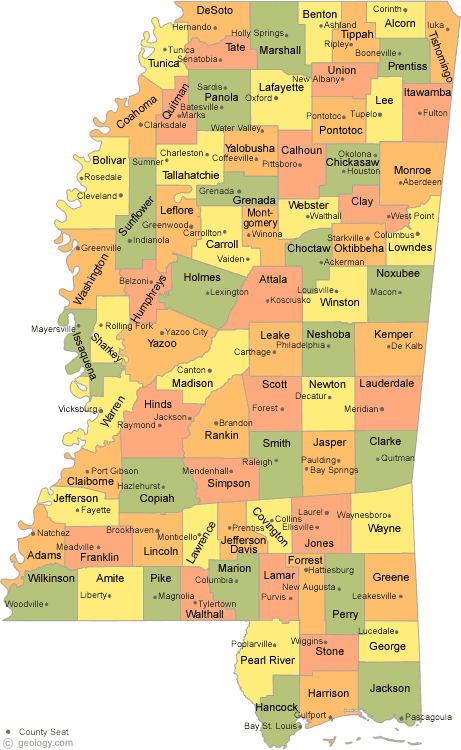
In this post I am going to look at which states struggle the most economically. In addition I will try to include the worst and best schools of that state and finally I’ll see if there are high risk cities/towns/places in the state.
Although things are looking better in the US, they still have a ways to go economically. According to the US Census Bureau their latest numbers show that the ten poorest states are:
Mississippi 22,6 %
New Mexico 21.5 %
Louisiana 20,4 %
Arkansas 19,5 %
Georgia 19,1 %
Kentucky 19,1 %
Alabama 19,0 %
Arizona 19,0 %
South Carolina 18,9 %
District of Columbia 18,7 %
Foreign exchange students are sent to all ten of these states.
My talking and singing to myself works like that. It annoys the hell out of some people and can embarrass my children, but these two stims are a force of nature. My medication lessens my anxiety stims but does nothing at all to my concentration, happy, silly – whatever other non-anxiety moods there are.
This has become a catchphrase in the autism community. And for good reason. It’s certainly true.
A child runs from a store and experts assure the frustrated parent that behavior is communication.
A parent asks for advice about why their recently diagnosed child bursts into tears at bathtime and experienced parents nod in sympathy. “Behavior is communication,” they say.
A child refuses to eat anything but raw carrots and pancakes and the child’s occupational therapist isn’t the least bit surprised. Behavior is communication.
A child flaps at a wind-up toy that’s stopped moving and the experts . . . somberly intone that the child doesn’t know how to communicate . . . that he isn’t aware of the adults around him and is “trapped in his own world”, unable to share his joy with others.
An adult walks away from an autism researcher who is treating him as…
“I am an autistic person, and no, I don’t need that part of me erased. I don’t need a cure, and autism didn’t kidnap the allistic child that I would have been. I didn’t destroy my parents’ marriage. I didn’t ruin my family’s lives.”
Today is World Autism Day. It seems like only yesterday that it was last year’s World Autism Day. And yet, here we are again.
This day is always difficult for me, because while on the one hand, I want to say “yes! Let’s focus on autism and how it affects us!”, I just can’t, because of who is behind this campaign. Autism Speaks is the primary organization behind autism awareness, especially in the United States. I cannot condone their message of fear and dehumanization. I cannot sit back and be passive.
When I see that blue puzzle piece, or one of those Autism Speaks arm bands/bracelets, something within me dies. Something makes me feel ill and shaky, and I wish that I didn’t have such a visceral reaction to a symbol like this. But this is my blog, and I’m an honest person, and yes, Ms. clothing store manager, every…
A few days ago on Emma’s Hope Book Ariane wrote about the realization of how frustrating it must be to communicate something clearly by behaviour and have everyone not realize what it was you wanted.
I thought at the time that the grand frustration of an epic day like picture day for both Emma and her mother on realizing the people at school had not been able to work out what Emma was trying to indicate and had thought her family wouldn’t want a picture was so sadly perfect for every day life as autistic.
The last few years have been horrible on a scale so epic for me that even in a life where little goes right I have started to wonder. At multiple junctures when things could have perhaps made some progress towards decreased stress, some return to functioning levels I had once had one day catastrophically…









 humanitysdarkerside