“Magic Bites” starts off the series about Kate Daniels, yet another urban fantasy series. As an urban fantasy this series is above average. It follows Kate Daniels, a mercenary with interesting and mysterious abilities, who is exposed to the shapeshifting and vampire societies through various mysteries that she and they have to solve.
We get to see how her relationship to the King shape-shifter, Curran, develops. We also get to follow along on her discovery of her magical abilities and get a look-see into her mysterious ancestry.
I guess the series would be comparable to Patricia Briggs: Mercy Thompson, Devon Monk: Allie Beckstrom and Jim Butcher: Dresden Files. These are all good examples of quality writing that does not take itself too seriously. It’s ambition is to entertain, and entertain it does.
This cover by Sharon Tancredi is wonderful. I love the feeling I get while looking at it and the spirit of the main character Jane that she manages to convey in her drawing.
As time has passed and I have written many reviews, I have come to realise that how my head works when approaching a novel has changed. Instead of reading all books as if they needed to be judged by the same ruler, I am now able to divide my thought processes into categories. By doing this it feels as though I am bringing my Aspergers into play instead of trying to bypass it and be “a regular” reader.
Along with several of my early reviews, this one of Tracking the Tempest is an updated one (June 2014 instead of May 2012).
I consider this a true series. Even though I had not read Tempest Rising, I had no problem beginning with number two. Necessary background information was shared without info-dumping and Jane’s relationships with various people were fairly self-explanatory. Tracking the Tempest starts off with Jane working hard to learn how to control her magic and especially how to shield herself.
The light wavered, stilled for a split second, and then winked out of existence. I couldn’t help but close my hand with a little flourish. Now that I couldn’t blow anything up, I was allowed to be pleased with myself. That was the first time I’d managed to create and disperse a mage light start to finish.
“Who’s your daddy?” I demanded rhetorically, doing a little happy dance.
“He died centuries ago; you wouldn’t know him,” Nell replied, coming toward me. “Stop hopping about and shields up.”
One thing I appreciated about Jane is that she is a regular person (despite being a halfling and despite Peeler’s tendency toward hunky men for Jane). I stink at the romantic stuff. Absolutely do not get why romance has to be so mushy (to my husband’s great frustration). Asperger people might be the greatest killers of romantic moments that exist. So not understanding all of Jane’s worries and frustrations about Ruy is just the way things work for me. Let’s just get to the sex is the way I tend to think.
But Peeler makes the romance funny. The way sex and so-called romantic moments tend to be. That I can appreciate and I did. I love it when an author makes sex steamy but also when an author makes sex ridiculous.
One of the comments I read on the novel said something about the Boston Public Parks not being closed at night. I checked that out by googling and that was correct. Living in a stinking rich neighborhood is not a prerequisite for a stinking rich person, so I felt that the same person’s comment about Ruy living in Bay Village didn’t really fit. His personality (what I understand of it) does seem to work with Bay Village.
This is another thing I have learned to do with my reviews. Categories are incredibly difficult for me, so I have to read other people’s reviews so I can place these books in the proper category. Which is why I have ended up adding links to other reviewers at the bottom om my own reviews.
Tracking the Tempest also seems to be about giving in to truth, in Ruy’s case accepting that his wishes for how the faery world operates might not have much to do with reality. Having been in that situation myself, I can sympathise. Once upon a time I was Mormon. Eventually my cognitive dissonance grew out of bounds, I checked out some facts and there flew my beliefs away into the sunset. Ruy seems to be at this same point himself. A point where you realise that your support of something has been abused and you yourself allowed it.
Poor Conleth. Something is mighty strange and wrong about his killings and obsession with Jane. And what a childhood. Hmmm. Perhaps he needs to be pitied more than hated.
Jane discovers that her lack of knowledge about the faery is even greater than she had thought. While she seems to have taken everything in her stride thus far, perhaps a point comes when more knowledge becomes too much knowledge.
The Tomorrow series consists of seven books that should be read in order. The first book of the series is Tomorrow, When the War Began.
In the series we meet a group of young people who have gone camping to celebrate their last summer together. They are:
Ellie Linton: Our narrator. Ellie was born and raised on a cattle and sheep farm not far from the edge of the country town of Wirrawee.
Corrie Mackenzie: Ellie’s best friend.
Homer Yannos: Ellie’s neighbour and close friend.
Fiona Maxwell: Fi is more brains than brawn.
Lee Takkam: Lee is also more brains than brawn.
Robyn Mathers: The pacifist of the group.
Kevin Holmes: Corrie’s boyfriend.
Chris Lang: An introverted, but well liked boy.
All eight of them are regular teenagers getting ready to enter the world of adults. They are all filled with constructive and less constructive qualities and I can see why so many would identify with them. At the beginning of Tomorrow, When the War Began the gang feel so young to an old person like myself, but that does not last. They certainly retain their youthful optimism but gain some of our adult cynicism. I think another thing that might appeal to readers is John Marsden’s willingness to address difficult topics. One of these is death. Unfortunately death is one of the consequences of resistance in war and so it will be for this gang. And, finally, There is plenty of romance and action, both kept well within the young adult literature boundaries. The writing certainly kept me going and Marsden raised some interesting questions along the way.
In Tomorrow, When the War Began a group of friends (in their last year before college) go camping together. They’re all exited and have a wonderful week together. On their way back they find their homes empty of people and their animals suffering from neglect. It turns out all of their families have been collected at the showground by a foreign power trying to take Australia over. The teens have to decide whether to fight or surrender.
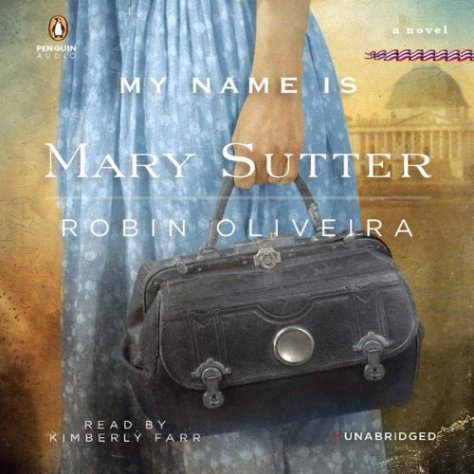
Even though the story is placed at the time of the Civil War in the US, I imagine Robin Oliveira’s own background as a nurse helped in describing some of the work and attitudes we read about in her novel My Name is Mary Sutter. At this time being a physician and a woman was practically unheard of. Physicians were trained through apprenticeships, and for a man to take in a woman as a student would mean overcoming prejudices. Professionally schooled nurses were also a thing unheard of. Apprenticeships were the way to go if a woman wanted to become a mid-wife or assistant to a physician.
All of this haphazard training of either physicians and nurses left both professions with vast differences in the abilities of the people who had finished their training. Some nurses and doctors made matters worse for their patients while others were miraculous healers.
Mary Sutter’s mother was a mid-wife and Mary had gone along with her on her many trips into the child-bearing population. What Mary learned about herself during those trips was that she would love to become a surgeon and thereby save people who otherwise did not get visited by a physician in time. Due to the above apprentice-shipping she was refused this opportunity and also refused admittance into medical school.
Mary Sutter was nothing if not determined in eventually reaching her goal. The US Civil War presented her with one such path. Washington was desperate for help on the battlefield and many women felt called to duty. Mary Sutter happened to be one of them. Her experience seems representative of the others I have read of. As such Sutter’s experience seems to correspond with the experiences my nurse friends tell me of today. Arrogant doctors, incompetent doctors, miracle doctors and patients who span the gamut from assholes to angels. As a someone who has been a patient I have met nurses of all kinds but mainly wonderful ones. Most of my nurse friends feel a “call” to serve and this is their way of serving others. Amazing people!
War is a gory and horrifyingly brutal affair. Not one gram of glory is present anywhere on the battlefield. But what a school for aspiring doctors and nurses. One doctor Mary Sutter had to work with had to care for more than 100 men. She helped with operations and learned how to treat stitch wounds. Eventually she managed to be sent to the front and learned how to amputate and live with the gore of poor medical hygiene.
I liked her character. Mary was a goal-oriented woman who worked extremely hard to achieve her dreams and she was certainly a woman that I could have looked up to. Inserting extraneous yet historical characters did not work well for me. It was Mary I wanted more of. But my wishes are irrelevant to an author’s work and it isn’t even a complaint just an observation.
Warm Bodies is Isaac Marion‘s first novel. He has an interesting take on zombieism. According to the world of Warm Bodies, zombieism is not necessarily a permanent state. Just because something is, doesn’t necessarily mean that it has to remain so. But change will bring resistance from the more conservative (both living and zombies).
The main problem with this novel is that it’s message is too obvious at times – in fact spelled out. I felt as though I was being preached at. This is a first novel, though, and as such – pretty good.
I liked the way “R”‘s, the main protagonist, journey was presented. The road from moan and groan to being able to make himself understood on many levels was interesting. It gets kind of gory at times but probably not more than most teen-literature today.
There’s plenty of humor. I especially appreciated the way the schools for the living and the schools for the dead were.




 humanitysdarkerside