Tag Archives: #SpaceOpera

Viehl, S.L.: Stardoc

StardocBeyond VarallanEnduranceShockballEternity Row
Rebel IcePlague of MemoryOmega GamesCrystal HealerDream Called Time

Sheila Kelly Viehl is from South Florida. She is a USAF-veteran with medical experience from both military and civilian trauma centers.

She writes under several names – SciFi as SL Viehl, Romance as Gena Hale and Jessica Hall, Christian Adult Fiction as Rebecca Kelly and Dark Fantasy, Young Adult and Non-fiction as Lynn Viehl.

SHOCKBALL (2001)

Shockball is book no. 4 in the Stardoc series, but the first one I’ve read. Starting here was no problem. These are all pretty much stand-alone novels that concern the doctor Cherijo Viehl. Warning right away. If you do not like descriptive surgery in your novels, you will have a problem with parts of this novel.

Life has a tendency to surprise us. Sometimes the experience is enjoyable and sometimes, well, not so much. Cherijo Viehl is beginning to get used to the idea. But getting used to having wrenches thrown into what she sees as preferable, can make her angry with herself and her surroundings (most commonly with Duncan Reever).

Cherijo and Duncan are married. As far as I’ve understood, this happened after they became interested in each other when Cherijo was Duncan’s slave (albeit not the most slavish slave around). Now they are trying to adjust to each other’s strong personalities. Tensions are bound to rise. Both are the kind who tries to protect those they love, whether that protection is wanted or not.

Shockball begins with Cherijo and Reever on the Joren starvessel Sunlace. Cherijo is an adopted clanmember, and as such under the protection of her clan. Her clan-brother, Xonea, is the captain of the space-ship. His main concern is to keep Cherijo away from trouble, but finds this intention challenged again and again by Cherijo’s repeated refusal to stay away from danger.

In the previous novel, Cherijo and Reever saved a bunch of non-terran slaves from their masters and are in the process of returning them to their planets of origin. While doing this, they are both worried about the ticking bomb that is dragged along on their journey through the stars. Cherijo’s creator, Joseph Viehl, has gifted her with a spaceship, but Cherijo does not believe for one moment that there is nothing wrong with it. She turns out to be correct.

After having run so long from her creator, Cherijo ends up back with him when Joseph has League soldiers kidnap her and Reever from the Jorens. They are taken back to Earth and Joseph immediately finds joy in telling Cherijo about her future. She is to be his mate, something Cherijo finds repugnant. Reever is held captive as guarantee against her cooperation.

Complications arise when a group of underground Navajoes rescue the couple from the laboratory and take them to their lair. There they meet the Night Horse leader Rico (who seems slightly off). Now it is up to Reever and Cherijo to figure out how to get back to the Jorens without getting killed en route. But before they can leave, they also have to find a way to save the Night Horse from themselves.

Shockball is full of action. We tend to go from one scene to the other, quite often ending up with Cherijo having to use her surgical skills. This is a rip-roaring tale of adventure. There are no attempts at trying to explain how the groups are transported between star systems, nor does Viehl try to make sense of how such completely species are different-planet-races are able to interbreed. Instead this is an action novel placed in space. Viehl writes well and manages to entertain us the whole way.

ETERNITY ROW (2002)

In Eternity Row Reever, Cherijo and Marel finally live together as a family on the star vessel Sunlace. Duncan and Cherijo are trying to figure out how to combine parenthood with their duties, as most parents do. Some children are more precocious than others. Marel is one of them. She has a tendency to appear in the oddest places.

Sunlace is taking Hawk home to the planet of his father. When they get to Taerca, everyone they see seems to be suffering some kind of mysterious disease of both mind and body. Hawk has a difficult time when he meets with his father. Like the rest of the population, his father is fanatically invested in the planet-wide religion.

Later Sunlace goes to Oenrall, Dhreen’s home planet. Cherijo had promised him to go there and see if she could figure out what was causing the population’s sterility. Once they get there Cherijo and the people going with her find that the Oenrallians are manic and addicted to a nerve-desensitizer. But this is by no means the Oenrallians main problem.

Cherijo sees it as her duty to discover the cause of both problems. But the universe is not going along with her plans. Challenges are thrown the way of Cherijo and her loved ones, distracting Cherijo from her work as a doctor and researcher.

As with Shockball, Eternity Row is an action-filled novel whose main goal is to entertain. Viehl does this well. I haven’t read past Eternity Row, but did not find it problematic to end the series here. Being stand-alone novels makes it so much simpler to leave a series, although I have to admit to certain amount of curiosity about the future of the family of Brandon, Cherijo and Marel.
Czerneda, Julie E: The Trade Pact Cycle

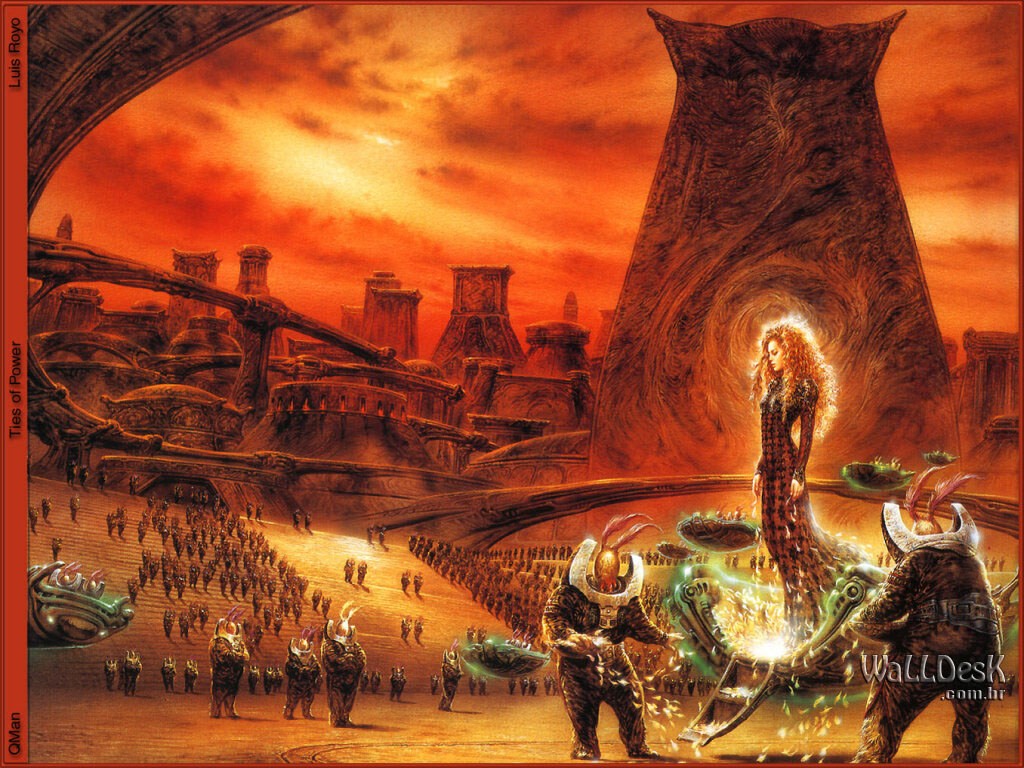
TIES OF POWER (1999)

Cover art by Luis Royo

You know that feeling you get when its been ages since you read a book and then you discover again why you’ve kept it in your library. Julie E. Czerneda has been such a discovery. What a delight. Czerneda has the flowing ability. It’s like listening to good music reading her books.

In a sense the plot is pretty basic. Someone gets screwed and they set out to right the wrong. In Julie’s Trade Pact Cycle books this happens in a universe where the different races of intelligent life have joined in a Trade Pact. There are outsiders. One of these is the Clan – a group of people (look pretty much like humans) who have the ability to travel the M’hir (a place outside of regular space) and telepathic abilities. Some of the members of the Clan are extremely powerful and one of these is Sira – our female protagonist.

The Clan oppose her attraction to Jason Morgan, and Sira herself is afraid of what her power might do to this telepathic human. She is right to fear her own power. When Sira is attacked by the Clan, Sira sends Morgan off to recover what was stolen. Unfortunately a lot of her fury with the Clan is sent along and Morgan is having to fight the urge to express this anger through the book.

As Jason is sent off, Sira transports herself to the only place she feels she will be safe – the Drapsk space ship. She is correct. She is indeed safe on the Drapsk vessel, but that safety also brings a new set of problems Sira’s way. The Drapsk are very good at getting things their own way, and that way includes Sira’s time.

TO Wallpapers 3X Luis Royo 102 To Trade the Stars, papeis desktop image Luis Royo Art and PaintingTRADE THE STARS (2002)

Cover art by Luis Royo

To Trade The Stars continues a few months from where Ties of Power left off. Sira and Jason continue to trade but discover that somehow Jason’s telepathic abilities have become known. This is making it difficult to get good jobs. One does turn up for Morgan at Kimmicle (miner’s world), leaving Sira free to go to Plexis and Huido by M’hir. When she gets there, she ends up being kidnapped. We all know that Jason will turn the universe inside out to find her. He is not going to be alone in this search.

In the meantime Rael and Barac from the previous are stuck on Drapskii continuing what Sira began. They are both understandably frustrated with the Drapsk as the Drapsk are of a different species. When Barac gets a call for help from Huido, he leaps at the chance.

Once again I liked the prose of Julie. She writes seamlessly. Once again, I’ve found an author that has the gift of flow. Her books are just shy of 500 pages and that might hinder some from reading her books. Don’t worry, they are available as audiobooks at audible.com

Asimov, Isaac: Foundation series

The Foundation series continues on from the Elijah Bailey series. The reason I call it a continuation of the series becomes apparent as one reads the books (too much of a spoiler to tell). If you go to Wikipedia, they will tell all. Having said that, their page carries quite an excellent description of the books along with analysis and links. For another in-depth analysis of Asimov’s work go to Wimmer & Wilkins’ blog. Asimov’s home page contains more general information about his life’s work.

Isaac Asimov brought fresh air into science fiction when he arrived on the scene in the 40’s. He wasn’t afraid of taking a hard look at the possible future of mankind based on what he knew of the day’s theories on sociology and psychology. The Foundation series is considered one of the most important contributions to the field of science fiction, a well-deserved opinion.


PRELUDE TO FOUNDATION (1988) AND FORWARD THE FOUNDATION (1993)

SciFi and Fantasy Art PRELUDE TO FOUNDATION by Slawek Wojtowicz
Cover for Polish Prelude to Foundation
by Slawek Wojtowicz

The Foundation series was started in the 1940’s, but for easier reading you should start with Prelude to Foundation and Forward the Foundation. In Prelude we meet Hari Sheldon, the inventor of psychohistory. Hari’s goal was to be able to predict the general future of humanity, and during a conference he presents his fledgling theory to fellow scientists on the planet Trantor. Unfortunately the Empiror finds Hari’s theories a threat and begin to persecute him. This makes it necessary for Hari to flee, and his flight takes him around Trantor. In Forward the story of how Hari develops his theory continues. Sadly for Hari, the people he loves die off (naturally and unnaturally). Hari refuses to give up and finally develops what ends up being called the Seldon Plan, a way to save the future of humankind.


FOUNDATION (1951) / FOUNDATION AND EMPIRE (1952) / AND SECOND FOUNDATION (1953)

Cover for Polish Prelude to Foundation
by Slawek Wojtowicz

After this introduction to the future Galactic Empire, The Foundation Trilogy with the books Foundation, Foundation and Empire and Second Foundation, follow. These are Asimov’s first installments in the Foundation history. When you read these books, please keep in mind that the series was written well before Wikipedia or the internet came into existence. As such, they seem a bit dated. Some of the theory can be tedious, but the adventures and people we meet are quite fun. The titles are a dead give-away, so we know well ahead of time that the Foundation is bound to survive. But we know nothing about the road taken.

In Foundation and Empire the leaders of the Foundation has become corrupt. The internal strife that arises from that makes the organisation susceptible to “The Mule”. The Mule advances, conquering planet after planet, making the Empire deviate from Seldon’s plan. The Foundation does not have it in them to win over the Mule, and desperately some of the members begin seeking a rumoured Second Foundation.

The title Second Foundation kind of gives it away. In this novel we are going to discover the rumoured savior of the Empire while enjoying adventure, science and social interaction. The only way to kill the Mule is by allowing members of the Foundation to find members of the Second Foundation. But this also reveals the fact that there is a Second Foundation and that its nature is somewhat different to the First one’s. Herein lies the conflict.


Foundation’s Edge
by Michael Whelan

FOUNDATION’S EDGE (1982) AND FOUNDATION AND EARTH (1986)

And so we come to the two final books in the Foundation series: Foundation’s Edge and Foundation and Earth. We meet Golan Trevize as main protagonist in both books. He is convinced the Second Foundation has survived the attempt to exterminate its members, and goes looking for them. His search brings him to many planets and finally to the ancient planets (no longer on any star-chart) of Solaria, Aurora and Melpomenia. Each journey brings Trevize closer to a conclusion that may or may not satisfy the reader. I felt ambiguous, and that seems to be the intent of the author.


  • 1966 –  Best All-time Novel Series Hugo Award for the Foundation series
  • 1983 –  Hugo Award for Best Novel for Foundation’s Edge
  • 1983 –  Locus Award for Best Science Fiction Novel for Foundation’s Edge
  • 1996 –  A 1946 Retro-Hugo for Best Novel of 1945 was given at the 1996 WorldCon to “The Mule“, the 7th Foundation story, published in Astounding Science Fiction

Weber, David: Honor Harrington

Field of Dishonor by David Mattingly

The Honor Harrington series by David Weber consists of 12 books:

  • “On Basilisk Station” (1992)
  • “The Honor of the Queen” (1993)
  • “The Short Victorious War” (1994)
  • “Field of Dishonor” (1994)
  • “Flag in Exile” (1995)
  • “Honor Among Enemies” (1996)
  • “In Enemy Hands” (1997)
  • “Echoes of Honor” (1998)
  • “Ashes of Victory” (2000)
  • “War of Honor” (2002)
  • “At All Costs” (2005)
  • “Mission of Honor” (2010)

The Honor series is military science fiction. Technical information is important. The series goes into detail about the various vessels Honor is on. It also explores the relationship between the kingdom of Manticore and the People’s Republic of Haven. Honor is a citizen of the Manticoran kingdom, originally from the planet Sphinx. Along with her is her bonded companion, the tree-cat Nimitz.

Honor and Nimitz end up being in the center of conflicts between the Peeps and the Manties. They survive impossible situations in space and on the ground and Honor really needs her brass ovaries to survive the gruelling conditions she often finds herself in. At the center of each book is the conflict between the Peeps and the Manties. There is always some kind of scheme by the Peeps to get the Manties to reveal their military strength or to get the Manties to join in war. Part of that is due to the instability of the Peep system. Governments come and go and in many ways it reminds me of Russia at the time of the revolution in 1917.

The Manties, on the other hand, have a monarchy with all of its attendant problems. There is a government pretty much like the government of the UK – Overhouse/Underhouse with the peers in the Overhouse and the commoners in the Underhouse. There is plenty of corruption and political scheming. Someone is always seeking more power, quite often at the expense of the Manticoran system.

Wikipedia gives an excellent summary of each book, but be warned of spoilers.

David Weber is a fun writer. There are political discussions, but they are placed in a context that make them interesting not preachy (mucho importante). Adventure, adventure, adventure and then some humor are important ingredients. There is some romance, but thankfully not much. My favorite book in the series is Echoes of Honor. It seemed the most different from the rest, and the action centered around a great deal of people, not just Honor.

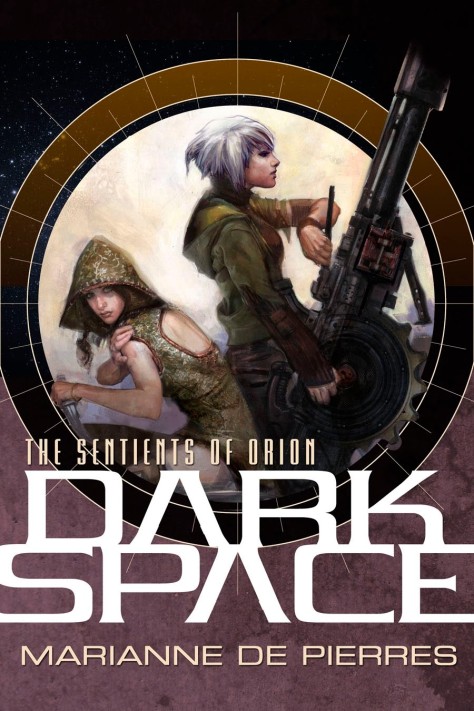
dePierres, Marianne: Dark Space (The Sentients of Orion I) (2007)

Dark Space - Marianne de Pierres

Dark Space is the first novel in the four book serial called Sentients of Orion. Orion refers to the stars and sentients are all intelligent humans and non-humans residing there. Among those non-humans we find dePierres’ favorite little creatures, the tardigrades/water bears (called Sacqr by dePierres). Except dePierres’ Sacqr are a bit overgrown and fond of invading mineral-rich Araldis for food in the form of humanesques. We quickly learn that the Sacqr have been brought to Araldis for nefarious reasons.

Baronessa Mira Fedor is our man character. In Dark Space we follow her from the time she is about to graduate and become Pilot First (intuitive able to bond with the biozoon Insignia). Except Mira learns at her graduation ceremony that her ability is to be removed from her because she happens to be a woman. Women on Araldis are only appreciated for their child-bearing ability. Upper class women are not allowed to learn to defend themselves and are socialised into a sex-slave thought pattern from the time of birth. Mira Fedor is not quite at that point when we first meet her, but she is about to learn some pretty harsh lessons about survival and the dangers of such misogyny.

Don Trin Pelligrini is the spoiled, self-absorbed son of the Principe of Araldis. Trin happens to be the one who was supposed to receive Mira’s innate ability. His life until we meet him has consisted of getting what he wants, when he wants it and at whatever cost it may be to others. He, too, is going to learn quite a bit about his real worth to the world he lives in and possibly about his ability to survive. If survive he does.

Jo-Jo Rasterovich, is the first humanesque to meet the “god” Sole. His meeting has become famous and Jo-Jo has assembled quite a fortune due to it. Except something about that first meeting keeps on nagging at Jo-Jo’s consciousness. Why would this “god” wish to be discovered at the time that it was? What really happened that Jo-Jo seems unable to remember?

Tekton, the God-head, from Lostol gets exactly what he asks for in his meeting with Sole. What I have learned from reading extensively about fictional and real lives is that what we think we wish we had, might not actually be what we really want. Greed, ambition and paranoia guide Tekton’s wish. Let’s face it. Giving in to the three of them all too often brings out the worst in ourselves and often in others as well. No reason why dePierres’ Dark Space should be any different in that respect.

There is one thing I found really strange about dePierres’ creation. Humanesques of various origins are able to interbreed, making for interesting variations. I can see how they would be able to have sex in some cases, but breeding seems a bit far-fetched.

My view of the nature of people is pretty bleak, yet for most people alive life is bleak. If you have a roof over your head, a bed to sleep in, enough food and clothing and semi-safety you are better off than 70% of the world’s population. All of this makes it understandable that some of the choices made by the privileged 30% are considered cruel – not to mention the choices of the top 20 or top five % of the world’s population. Trin and Mira drop abruptly from the life of the privileged 1% of their world and join the rest of the people who fight to stay alive. Dark Space is bleak, filled with action and full of people learning to adapt or die. I liked Dark Space and struggled to put it down.


Reviews:


Dark Space on Amazon US