Tag Archives: #Strangepowers

Gay, Kelly: The Hour of Dust and Ashes (Charlie Madigan) (2011)

Cover art by Christian McGrath

Does Kelly Gay keep up her good work in The Hour of Dust and Ashes? Yes, she most definitely does. She has that rare ability of being able to keep her writing tight, very tight. That and her spelling and grammar helps the reader keep from being distracted. Add to that a pretty good plot, fun characters and talent and you have the flow.

Charlie Madigan is an interesting character. She is a believable woman in a fantastic yet believable world. Yes, this is all science fiction and fantasy, but the plot is about recognisable problems and her characters are flawed and gifted like the rest of us. Fanatics are fanatics and greed is greed.

Charlie suffers from a save-the-world-all-on-her-own syndrome. That makes it easy for her to take the blame for her sister’s ash addiction. It is true that Bryn got addicted to ash while helping Charlie out, but Charlie tends to forget that Bryn has her own will and this is creating trouble between the sisters.

When ash addicts begin taking their own lives, Charlie becomes desperate to make certain Bryn stays alive. Thus far the hunt for a cure has led nowhere. When Charlie goes to the oracle, Allessandra for help, she is told that she will need sylphs. On to Charbydon she must go and Hank and Rex get to go along with her.

Rex (the ex-jinn now revenant), Brimstone (the hellhound) and Hank (the Adonai) make themselves better known to us. We also get to see Charbydon at its best and worst. No wonder the people there think of Earth as a vacation spot.

We get tons of action and some of the fighting is explicit. If you don’t like that, consider yourself warned.

—————————

My reviews on books 1 (The Better Part of Darkness), 2 (The Darkest Edge of Dawn), 3 (The Hour of Dust and Ashes), and 4 (Shadows Before the Sun)

Gay, Kelly: The Darkest Edge of Dawn (Charlie Madigan) (2010)

Cover art by Christian McGrath

Christian McGrath’s portrayal of Charlie Madigan is gritty and strong complementing the writing of Kelly Gay. Gay’s writing continues to engage me as a reader. She maintains the balance between too much and too little keeping her novel tight and well-written.

The Darkest Edge of Dawn begins where The Better Part of Darkness left off. Atlanta became more in tune with the Charbydons living there. Charlie feels responsible for the “accidental darkening” and in a sense that is true. So, being the kind of person she is, Charlie sets a goal of saving Atlanta.

 As we all know, the world is full of nutters. Being from Charbydon or Elysia makes no difference. Crazy people are found among all races. Sadly, some of the crazies go serial. In The Darkest Edge of Dawn Charlie and Hank investigate a warehouse where a dead body was found. Both find the place creepy and for good reason. In this lovely warehouse a pile of dead bodies and a pregnant hellhound is discovered. Something is off about the mound of bodies.

That was the second problem Charlie feels the need to save the world from. On a more personal level, the changes in her DNA are worrisome. What is she turning into and how is she supposed to control the powers she seems to have gained?

Trying to deceive your own daughter works like a charm unless she is psychic. And guess what, Emma is psychic. When Will died and his body was taken over by Rex, Charlie decided that they had to wait until Emma was ready before she could be told. Talk about messed up life. But Charlie also has the pleasure of having a hellhound living at her home, a hellhound that Emma has a mysterious link to.

That’s not all that is going on in Charlie’s life. Her sister Bryn was affected by the drug Ash while trying to help Charlie. Now she has to take regular doses of the drug in order to stay alive.

Charlie’s partner, Hank, still has his voice modifier fused to his neck – joy of joy – hindering his ability to be a proper Elysian.

One of the things Charlie has trouble with is accepting help from others. She is going to need help in The Darkest Edge of Dawn just as she did in The Better Part of Darkness. I get that. Asking for help is difficult even when it is obvious assistance is needed. Just because you are adult age, does not necessarily mean that you are able to act maturely. I guess that is part of the reason why I like Charlie so much. She is vulnerable and strong, prejudiced and willing to look beyond those prejudices.

I think Charlie Madigan could a be a good role model for young women out there.


My reviews on books 1 (The Better Part of Darkness), 2 (The Darkest Edge of Dawn), 3 (The Hour of Dust and Ashes), and 4 (Shadows Before the Sun)

Cheek, Kater: Mean Little Kitty/Waiting Room at the Hero League (2011)

The really great thing about crazy authors is that they are hilarious. I couldn’t help visualising the scene in Mean Little Kitty where the mom in the story looked for her son all over the place and ended up naked on the roof. I’m serious, you just have to read Kater Cheek’s family description.

Waiting Room at the Hero League was the same. Ms. Cheek made the whole thing seem real and brought me into her story. I loved the powers the super-heroes had. That and the ruckus they just happened to cause. Priceless.

Doyle, Kevin: Mourning’s Song (2010)

I have not been able to find any information on Kevin Doyle (except the email address he shares at the beginning of the novel). Too bad, really. The best I can do is link you to Amazon.

Super-heroes. Their aliases are Poison, Winterkill, Eagledawn, Heart, Kalide, Squire, Plaza, Kriegen and Liegelord. These are the ones we are introduced to in Mourning’s Song. These super-heroes are born or created genetically.

While hiking in the mountains two young guys discover an oddity. When they go to find out what it is they get attacked and disappear. This is our first meeting with the Liegelord. Lord of the mountain, insanity and world leaders. We then jump to the city and get to meet two run-aways and five superheroes who try to make the world a better place.

If you are looking for a happy story with a happy ending, you need to go elsewhere. Mourning’s Song is filled with tension, action and death.

So, is it any good? Holy, freaking cow – YES. Mr. Doyle certainly knows how to hold my attention. I recommend Mourning’s Song to any and all interested in mutants, superheroes and fighting/action-scenes. There are no rose-colored glasses to make life beautiful. But in all its harshness Mourning’s Song manages to leave the reader with a tiny ray of hope.

Bryan, J.L.: Jenny Pox (The Paranormals) (2010)

Cover artist Phatpuppy Art

It is difficult enough being a teen-ager as it is. Add in a curse and life gets even rougher. What if that curse happens to be that anything that touches your bare skin or that you touch dies? Well, I would say a person could get mighty depressed.

Children sense when something is different about you. If there is anything to pounce upon, they will. Life is a jungle when you are little. Even if there is nothing strange about you, you will be picked on if the top dog is bored.

Jenny’s difference has made her the favorite kicking ball of her school. “Jenny Pox” has evolved into “Jenny Mittens” (due to the gloves she has to wear). All Jenny wants for herself is to get through her senior year and be finished with her fellow students. But her main bullyer is determined to make Jenny’s last year miserable. Ashley is Miss Popularity at their high school and she HATES Jenny with a passion.

I enjoyed Bryan’s characterisation of Jenny. He caught the desperation brought on by years of bullying. Very good job there. The Paranormals concept was interesting as well. As it would be a spoiler to tell, well, you will just have read Jenny Pox yourself.

Duane, Diane: Stealing the Elf-King’s Roses (2002)

Aaaargh. I’ve had to begin wearing reading glasses. Getting old.

A better cover than the original one.

Diane Duane has been in the writing business for ages. Stealing the Elf-King’s Roses is the only book of hers that I have although I have also read So You Want to be a Wizard“.

Stealing the Elf-King’s Roses was relaunched in new clothes in 2011. Diane had felt the need to fix some issues that she had noticed over the years. My book is the original version.

Who among us is able to state honestly that we have no prejudices? I know I cannot. I try not to let those prejudices interfere with the way I treat people I encounter, but I know that at times I have let my feelings shine through. This is the great thing about fantasy and science fiction. The differences between species become blindingly obvious. In this manner the author has the chance to either preach or teach through their writing. Preaching bores me. I expect to be treated as though I am intelligent enough to catch on to the underlying message without having it spelled out for me.

Diane Duane manages to teach us about prejudice without getting on her high horse or behind a pulpit. This is quite difficult to manage I have noticed in the all-too many books I have read. Authors with this ability really need all the acknowledgement they so richly deserve.

Lee Einfeld and Gelert Reh’Mechren are Lanthomancers at Law in a parallel world where psychic abilities are more common that here. The team seeks out psychospoors at crime scenes. The evidence recorded from that is presented in court and through a sort of ceremony Justice comes into the court-room and the defendant is judged.

An Alfen murder comes their way and that murder brings the Lanthomancer team into inter-universe politics. This is a mystery mixed with techno-jargon mixed with political ploys.

Stealing the Elf-King’s Roses was a fun read. There were some hiccups along the way, but nothing major (might be because I have the older version).

Aaronovitch, Ben: Rivers of London (US: Midnight Riot) (Rivers of London I) (2011)

Midnight-Riot-DUO
Cover artist “Rivers of London”: Stephen Walter
Cover artist “Midnight Riot”:

Before starting on the Peter Grant series – mystery books – Ben Aaronovitch was busy in the writing business. He has been involved in screenwriting, audiodramas, television-series, short stories and spin-off novels. While being mainly an author, Aaronovitch has also had the great pleasure (as so many other writers) of supporting his writing habit with non-writing jobs.

On his blog he states that the Peter Grant series was in part influenced by these sources:

Rivers of London

When Peter Grant gets out of being assigned to the Case Progression Unit by being sent to Chief Inspector Nightingale, he “left in a hurry before he could change his mind, but I want to make it clear that at no point did I break into a skip.” Brits. Gotta love them.

What Peter discovers when he gets to DCI Nightingale is that magic does exist and so does everything else paranormal literature delves into. His and DCI Nightingdale’s job (being the only representatives of that side of life) is to regulate the super-natural community, making sure they uphold the laws.

Rivers of London is at heart a mystery. A serial-killer is on the loose making use of magic in her/his/its killings. It is vital that Nightingdale and the rest of the Met find the serial-killer before more people are found without their faces. Peter has his chance at being a detective at the same time that he has to negotiate peace between the lower and upper sides of the Thames (mother and father Thames). His baptism into the super-natural community is at times frightening for him and delightful for us.

While a mystery with death and mayhem, Rivers of London is a light-hearted novel. There is plenty of humor and an irreverent look at society that I enjoy.

Thus far, Rivers of London is the only book in the series that I have read. I do believe I am going to read the next one as well. Aaronovitch manages to balance humor and action in true British style. I like Peter Grant’s distracted manner, something that gives us insight into his character but also into the city of London.

rivers__of_london_by_deadiscordia-d51xtoa
Fanart by DeaDiscordia
Upper left: Beverley Brook, “daughter” of Mama Thames and goddess of a small river in South London
Bottom left: Police Constable Lesley May
Centre: Police Constable Peter Grant
Upper right: Detective Chief Inspector Thomas Nightingale, head of the Folly and the last officially sanctioned English Wizard.
Bottom right: Molly; The Folly’s domestic helper.

Foster, Alan Dean: Pip and Flinx series

The Pip and Flinx series has spanned 35 years which is quite a long time to follow a series. Alan Dean Foster has written a typically young adult series. They are quite innocent and free of explicit sex and violence. I guess you could say that the Pip and Flinx series is fairly wholesome. Thankfully, Flinx is no angel. He is, however, a good person – for a given definition of good.

The series begins with Flinx as a child on the Planet Moth and ends with Flinx as an adult on the planet Cachalot. He has had many adventures travelling around the galaxy trying to figure out who and what he is. We are in the science fiction world with loads of drama and very little realism. I guess that is part of the charm of the series. Sometimes there is more fantasy in science fiction than there is in fantasy itself. All in all, the Pip and Flinx series has been an enjoyable journey. In spite of the writing being fairly average a lot of the time, I got caught wondering how the whole thing was going to resolve itself.

Flinx (later discovers his name is Philip Lynx) appears for the first time in For Love of Mother Not (1983). For Love of Mother Not was written after the first three books in the series, but for you as a reader it would be a good idea to read For Love of Mother Not first as it explains Flinx’ background.

At the time of For Love of Mother Not, Flinx is not aware of who he is or where he is from. On the planet Moth Mother Mastiff buys Flinx at an auction and raises him as her own. It does not take long for them to discover that there is something unusual about Flinx, and both decide that it is a good idea to keep Flinx’ erratic abilities under wraps.

One night Flinx wakes hearing an emotional distress signal. His empathic abilities are reading loud and clear for once. He goes out into the rain to see who is in trouble and discovers an Alaspin dragon that he names Pip. We never find out how Pip ended up on Moth, nor is it all that important. Pip’s venomous spitting abilities come in handy when the two of them go after Mother Mastiff and her kidnappers.

After having read For Love of Mother Not you go back to the original reading order. Because For Love of Mother Not was written so much later than The Tar-Aim Krang (1972) you will probably notice a couple of discrepancies. You will survive, believe me.

As The Tar-Aim Krang begins Flinx and Pip are still with Mother Mastiff on Moth. They discover a treasure map on a dead man. Flinx meets Bran Tse-Mallory (human) and Truzenzuzex (thranx) for the first time, while acting as their guide. Flinx and Pip end up travelling with the two to the Blight. To get there, they need to go by space-ship. Flinx’ empathic abilities will play an important part in the group’s discoveries.

Foster is not big on explanations of how Flinx and the rest travel from one solar system to another. To him the plot is the important part. Flinx and Pip’s interactions with others and their adventures are what drives this story up, up, up and away.

Flinx is still searching for clues to his ancestry in Orphan Star (1977). During his unwilling stay with the merchant Conda Challis, Conda hinted heavily about Flinx’ parentage. Flinx’ chase brings him into contact with the female Thranx, Sylzenzuzex, who just happens to be the niece of Truzenzuzex. Eventually, the pair of them end up on the edicted planet Ulra-Ujurr, where they meet a highly telepathic race (Ulra-Ujurrians).

Flinx and Pip now have their own space ship – Teacher – making the search for Flinx’s parents a whole lot easier. On their way they acquire a new pet by the name of Abalamahalamatandra (Ab for short). In The End of the Matter (1977) Bran and True turn up out of the blue looking for Ab. What a coincidence. That is the way it is with some authors. The coincidences line up. The human Skua September tells Flinx something of the Meliorare Society and the Qwarm (assassins) are sent after Flinx. Each book takes us a step closer to the end of Flinx’s search.

Love is in the air. Flinx in Flux (1988) shows us a new side of Flinx. I’m hopelessly in love with you, he tells Clarity Held. It cannot be, I’m an experiment. OK. So I exaggerate a bit. But he did tell Clarity Held that due to his experimental state, he felt that the two of them could not be an item. Trouble appears on the horizon in form of Clarity’s boss. He wants what Flinx has, even if he has to kidnap him. But Flinx has these strange abilities, and it might be a bad idea to be mean to him.

By now there are a whole lot of people who want to get to Flinx. There are the authorities who want him for various crimes. The Qwarm want to assassinate him and a few criminal bosses want to use Flinx. As we enter the world of Mid-Flinx (1995) Flinx has become quite a popular person. Maybe the saying “All PR is good PR” isn’t all that correct. To get a break Pip and Flinx go to Midworld. But breaks from trouble only happen to people who are not in adventure novels. On this semi-sentient planet Flinx and Pip learn to respect this dangerous planet, and also find that through this respect they have some protection when the baddies come to get them.

Sliding Scales: A Pip & Flinx Adventure By: Alan Dean Foster

In Reunion (2001) Foster once again throws his heroes Pip and Flinx around the galaxy in search of an answer to Flinx’s heritage. Somehow Flinx thinks that this will make his choice of saviorhood or not easier. Together Pip and Flinx discover more about the Meliorare Society, the eugenicists who experimented with Flinx and other children in their search to create the perfect human.

Due to the information they uncover, Flinx and Pip go to Aan space where the walking lizards live – enemies of both humans and Thranx. Once there, Flinx’s unusual abilities come in handy in uncovering information and keeping himself hidden from the Aan – who would like nothing more than killing a human.

In Flinx’s Folly (2003) Flinx discovers exactly what the Great Emptiness (mysterious force) approaching the Milkyway is. Getting that knowledge almost tore his mind apart, and he would like to avoid repeating the experience. Like all mysterious things, the Great Emptiness has its set of followers. The cult of the Order of Null is set on stopping Flinx permanently. Extinction of life is the goal to have it seems. Fortunately for Flinx, he has loyal friends who want to help him in any way they can. One of these is the love of his life, Clarity Held. I wonder if she really holds clarity.

Flinx is tired of the expectations and just wants to go somewhere peaceful to think. His AI-space-ship Teacher suggests the planet Jast. Jast is where the action in Sliding Scales (2004) takes place. As you’ve probably understood by now, the Pip and Flinx series isn’t so much about Flinx’s search for an identity, nor is it all that much about winning over the Great Emptiness. These books are mainly about the trouble Flinx gets into hopping from place to place.

On Jast three seemingly incompatible races live together in peace. The Vssey, Aan and humans live in apparent harmony though apart. When Flinx upon arrival gets attacked by one of the Aan, he loses his memory and ends up in an Aan artist community. A Vssey rebellion is in the offing, and Flinx and Pip get caught in the middle of it.

trouble-magnet-pip-flinx-adventure-alan-dean-foster-hardcover-cover-art

In his search for a super-weapon that might destroy the darkness, Flinx has problems with his space-vesse,l and the Teacher has to make an emergency landing on an uncharted planet. In Running From the Deity (2005) Flinx experiences for the first time what it is like to live without his headaches and his empathic abilities going haywire.

The prime directive of the Commonwealth is to not interfere with primitive species, especially when using technology. Flinx breaks that rule and ends up being worshipped as a god. These compatible beings aren’t any nicer than any other species, and two opposing sides on the planet both want Flinx for their own. This leaves Flinx running again.

In 1973 Foster wrote Bloodhype. Flinx appears in the latter half of the novel. In a timeline sort of sense this action and humor filled novel should appear after Running From the Deity and before Trouble Magnet.

Bloodhype is a powerful drug that addicts you the first time and kills you if you do not continue with it. A pretty good deal for the producers, I would think. Pip and Flinx end up trying to stop the Bloodhype industry and end up on the planet Repler. We get to meet the Vom and a revived Tar-Aiym Krang in psionic battle, with the Tar-Aiym Krang more or less on the Commonwealth’s side. So, drugwar and psionic battle make for an interesting scifi adventure.

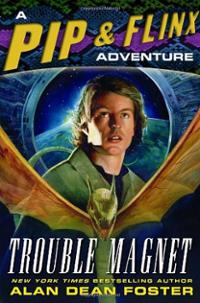
In Trouble Magnet (2006) a group of street-kids need to be rescued several times by Flinx. Once again Flinx has been side-tracked from his mission to find a solution to the problem of the Great Emptiness. As such, Flinx’s visit to Visaria seems part of a tendency to delay the ending of the series. Flinx’s aim seems to be to see if there is still any good out there worth saving, but Foster did not convince me of those intentions. Not one of his better ones.

With Patrimony (2007) Foster is finally back on track, both in terms of the quality of his writing and with the storyline. Oh, well. What would writers do without faithful readers (or suckers as anyone else would call us)? Flinx and Pip go to the planet Gestalt to follow-up on a clue they received in Trouble Magnet.

In showing his face, Flinx has once again come to the attention of the cult of the Order of Null. This time they are not about to fail in destroying him. Flinx is tracked and finally shot down in a river. His native guide is severely wounded but Flinx and Pip are OK. They are discovered and saved by the native Tlel. Together dangers are faced and Flinx discovers what he has wondered about his father.

Flinx Transcendent (2009) is the last story in the adventures of Pip and Flinx, or the last three stories in one novel. The first part of the story sees Pip and Flinx on the Aan home world. Flinx’s interactions with a young Aan are well-paced and well written.

Flinx is once again with the love of his life, Clarity, and his two friends, Bran and True. Once again, the Order or Null are after Flinx, and he will need the help from all of his friends to survive their attention.

And finally, Flinx faces the Great Emptiness that is speeding its way across the universe towards our galaxy. Flinx still does not know how to defeat it, but fear not, a solution will arise.

And so our journey with Pip and Flinx ends, or maybe not. The Commonwealth is a large place, and while Flinx might not again take main stage, he might very well appear in a smaller role – at least according to some of the speculations out there. I for one am finished with the Commonwealth.


ADAPTATIONS

  • Tar Aiym Krang (2M) An experiment with sequencers by Mark Earll Music.
  • Krang (aka Tar-Aiym Krang) music group mentioned by Wikipedia.

Foster, Alan Dean: Journeys of the Catechist

I loved the Journeys of the Catechist. What an excellent trilogy this is. This is Alan Dean Foster at his best. All three novels were of high quality and the characters enjoyable. Fantasy adventure is fun when the author manages to make it work. Our main character Etolje Ehomba takes us through several adventures on his way to fulfill what he sees as his obligation. While there were plenty of adventures and action scenes in the books, for some reason they came across as quiet books to me. Maybe that had to do with all of Etolje’s questions. He does like his questions. Or maybe I like these books because they are different from much of the fantasy and science fiction out there on the market. That probably has to do with the Catechist (teach through questions and answers) part or the story.

CARNIVORES OF LIGHT AND DARKNESS (1998)

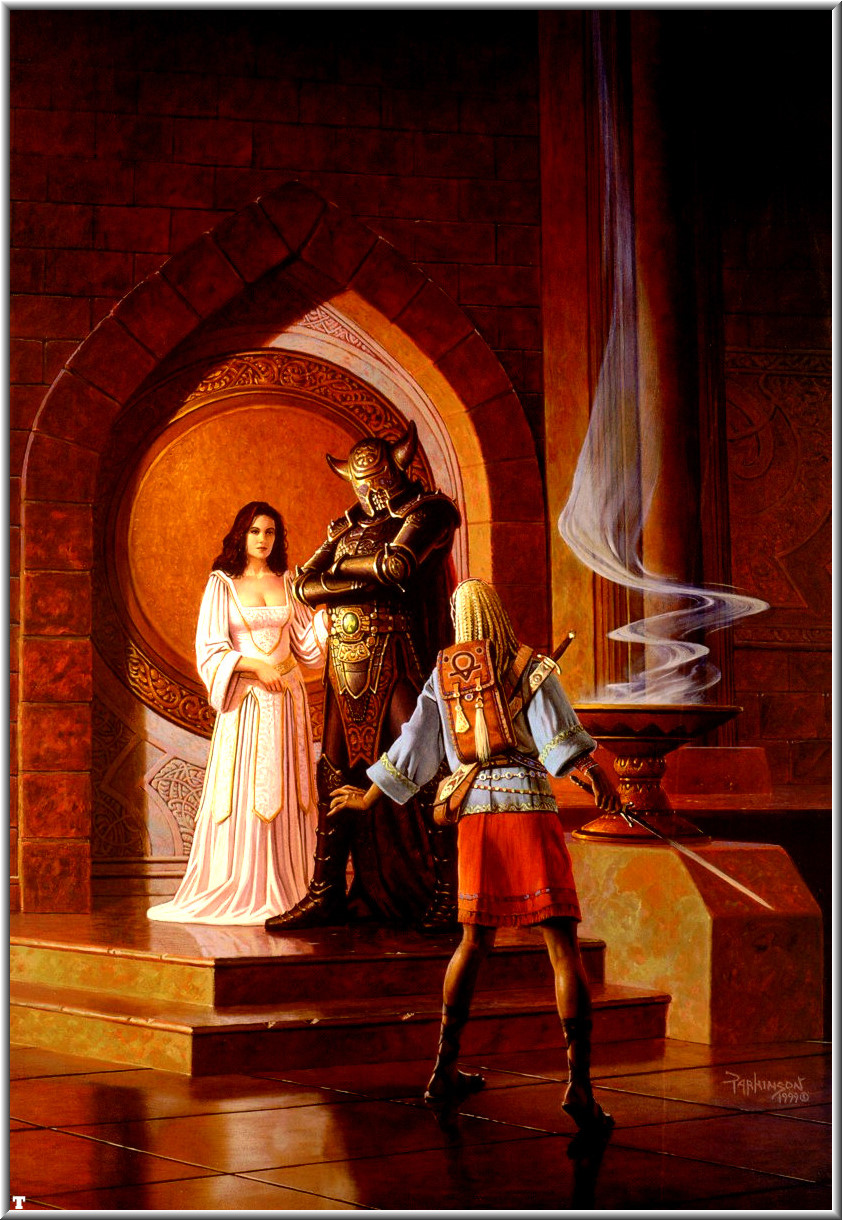
Cover art by Keith Parkinson

When a group of dead men are washed up on the beach near the home of Etolje Ehomba, one of them turns out to be alive but close to death. He charges Etolje to save the Visioness Themary of Laconda who has been abducted by Hymneth the Possessed. Ehomba does as he has been charged despite the protests of his family. Armed with a sword, a spear and a few things that the women of the village have collected for him Ehomba sets off.

Shortly after setting off, Etolje meets up with Simna ibn Sind. Simna ends up following Ehomba on the whole quest. Our suspicions of Etolje’s magical abilities are soon aroused, as he seems able to do miraculous feats. But Etolje never agrees with that description. Instead all credit is given to the collection of things that the women of his village gathered for him.

These two travelling companions’ adventures are like Aesop’s tales. There is a moral behind each encounter. A Catechist is one who teaches by word of mouth. Sometimes Etolje’s tendency to ask questions of everything and everyone, patiently waiting for answers, frustrates Sind. As a reader it gives us insight into the world of Ehomba, and if we are attentive we should certainly begin to see that perhaps Etolje’s village might not be as every other village that he and Simna encounter.

INTO THE THINKING KINGDOMS (1999)

Into the Thinking Kingdoms is book no. 2 in the Journeys of the Catechist trilogy. It begins where Carnivores of Light and Darkness left off. Ehomba is still asking questions and Simna is still complaining about what he sees as a waste of time. Along with them on their journey they have acquired Ahlitah (a feline).
While their environment has changed somewhat, all three still manage to get themselves in and out of trouble. Etolje’s word magic is especially needed when the trio manages to get themselves arrested for thinking and expressing independent thoughts. As in Carnivores of Light and Darkness, each place is left a changed place for having encountered Ehomba, Simna and Ahlitah.

I enjoyed Into The Thinking Kingdoms as much as Carnivores of Light and Darkness. These books show off Foster’s tale-spinning abilities. You need to have read Carnivores of Light and Darkness in order to be able to follow along in the story. Into the Thinking Kingdoms is not a stand-alone book.

A TRIUMPH OF SOULS (2000)

Cover art by Keith Parkinson

A Triumph of Souls is a great conclusion to the Journeys of the Catechist trilogy. The trio, Etolje Ehomba, Simna ibn Sind and Ahlitah, the feline, are still together on their quest to save the Visioness Themaryl from the evil Hymneth the Possessed.

This time they take to the sea to get to their goal. Once again the trio gets themselves in and out of trouble. Some of this trouble is strange indeed. The island with the faceless people is a clear example of Foster’s ability to play with weirdness. Etolje still denies having sorcerous abilities.

When the gang gets to Hymneth the Possessed we meet a person who makes regular fantasy villains look stereotypical. And the ending of the book. What a perfect, yet surprising story this has turned out to be. While there might not have been a great deal of character development on the part of Simna, he feels real. Some pe0ple aren’t really changed by their experiences. Motivations stay the same. Etolje is Etolje. His role seems to be to surprise, and he does that well. As I said earlier, Journeys of the Catechist is an epic fantasy of great quality and it delivers what it promises.

Pratchett, Terry and Gaiman, Neil: Good Omens (1990)

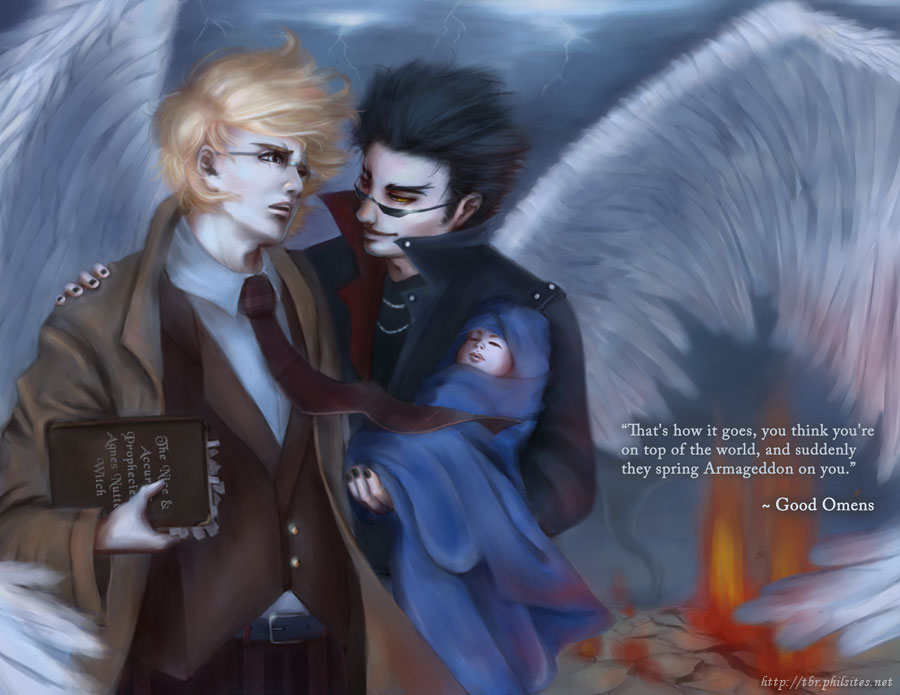
First off, I have to say that there is so much incredible artwork out there dealing with Pratchett and Gaiman. I wish I could include all of it. For most other authors I end up with the cover art, but with these two guys I’m in heaven. I recommend that you google “Good Omens”, go to images and sit back and enjoy yourselves. Below are three examples of what you’ll find.

“Good Omens – Armageddon” by himlayan

Good Omens starts off with a prologue placed in the Garden of Eden. You see, there was this serpent, Crawly, who was sent there to do his best to make trouble. He did. In the meantime the angel with the flaming sword, Aziraphale, gave his sword to the humans as protection because he felt sorry for them.

6000 years later Crowley meets up with fellow demons and gets handed a basket with a baby in it. This is the baby presaging the End Of The World. He is told to deliver it at a certain hospital making certain that it gets exchanged with the chosen baby. Something goes wrong, and the baby ends up with the wrong family – unbeknownst to the minions of Hell.

“Good Omens: Humans” by Julie Dillon

In Lower Tadfield, young Adam and his gang run around being the kind of nuisance only a gang of 11 year olds can manage to be. They are happy in their lack of knowledge about the future and the imminence of the end of the world.

Crowley and Aziraphale discover that something is wrong with the child they thought was the son of the Devil when a promised delivery from Hell does not arrive at its appointed place. Ooops.

good omens riders

“Apocalyptic quartette” by Aviv Or

The four horsemen are gathering to fulfill their destiny, but no one knows quite where to go. Where is the promised son of the Devil?

You just know that when you pick up a book by Terry Pratchett and Neil Gaiman that you are not going to get anything even remotely resembling normality. Good Omens is filled with interesting characters and a strange sense of logic. Whenever I read their books, I get into this weird thought-mode where I go – yeah, that could happen. I did it this time as well. Maybe that’s what I like best about both of them, their ability to fool me into believing them. Kind of cool, that ability.

My favorite characters were Crowley and Aziraphale, both rebels in their own right. After 6000 years neither is wholly good or wholly evil. They are still stuck in the mold they were created for, but little bits of them are able to crack that mold just a little.

———————————-

  • World Fantasy Award nominee for Best Novel, 1991
  • Locus Award for Best Fantasy Novel, 1991

Whates, Ian: City of a Hundred Rows

Although Ian Whates has writing experience, City of a Hundred Rows is his debut into the industry of novels.

CITY OF DREAMS & NIGHTMARE (2010)

Cover art by Greg Bridges (Incredible artwork)

Chance brought me to the city of Thaiburley and the street-nick named Tom. Sometimes chance is a wonderful thing and sometimes it isn’t. In this case I found myself liking the writing of Ian Whates and wanted to read the next book of the trilogy.

Thaiburley is a city built in tiers – one hundred of them. At the bottom we find the City Below (often called City of Nightmare by its denizens) and the poorest of the population. Wealth increases as one ascends, until one hits to the top layer – the Upper Heights. This is where the angel-like demons are supposed to reside.

The first two people we meet in City of Dreams & Nightmare are Tylus, our newly-minted Kite Guard, and Tom, our young street-nick. Tylus is out patrolling for the night, while Tom is climbing the many layers of the city so he can get to the top and steal a demon egg. Both stumble onto the apparent murder of a council-man. Thinking Tom is the culprit, Tylus chases him and sees Tom fall off the side of the building. Action-packed from the very beginning.

The adventure continues through the whole book. Tom is chased by the authorities for his assumed part in the murder of councilman Thomas. While running, Tom meets up with Kat – survivor of the Pits (like Rome’s Colosseum). In spite of her young age, Kat is an incredible fighter. Tom on the other hand is very good at not being seen. Both skills will come in handy during the story, because this novel is for the most part about trying to survive against the odds. The baddy of the story, councilman Magnus, sends off his assassin Dewar to tie off Tom. Dewar is another incredible fighter. He has absolutely no qualms and often likes to play with his victims.

Do I recommend this book. I’ll say definitely. City of Dreams & Nightmare was an easy and fun read. Ian Whates certainly knows his craft, and as a reader I always delight in such authors.

CITY OF HOPE & DESPAIR (2011)

Cover art by Greg Bridges

This second installment in the trilogy City of a Hundred Rows is as fun to read as City of Dreams & Nightmare was. Once again, we get to meet Tom, Kat, Dewar and Tylus, but this time in different combinations.

Thaiburley’s strange power is failing. The Prime Master sends Tom off to discover the source of the great river Thair in hopes that he will find out just what is causing the failure. Ironically, Dewar the assassin is sent along to protect Tom and his companions. There is no way Ian Whates is going to let this journey be a peaceful one, and we are not disappointed. Here too, are plenty of survival struggles.

Kat, in the meantime, remains in the City Below. There The Soul Thief is killing off people with “talent”. In addition to the Soul Thief the gangs of the under-city are changing, both in structure but also in behavior. This change in gang-life makes life more interesting for Kat, her sister and the Tattooed men. Kat is a great character and her adventures in this book are pretty intense.

Tylus, our Kite-Guard, is sent to the under-city to make something of the City Guard there. Automatically, we know that he is going to have his work cut out for him.

City of Hope & Despair is as much fun as City of Dreams & Nightmare. I like the fact that these books are action-filled and lacking in the gooey factor. Both books deliver what they promise – good old-fashioned adventure. Ian Whates is definitely on my author-plus list.

CITY OF LIGHT & SHADOW (2012)

Cover art by Greg Bridges (Breathtaking)

Maybe the bone-flu is not all it seems to be. As City of Light & Shadow begins, we get a glimpse at what might be the reason behind the disease.

Tom has reached his goal and is left trying to assimilate information in amounts he has never had to before. For such a curious soul, this must be a gift – although a double-edged one. Thais is not exactly what he expected in a god, but how are gods supposed to be anyways.

Dewar wakes up, clearer-headed than he has been in a long time. He knows exactly what he wants to do next. It’s time to go home and take care of some unfinished business.

Kat and her Tattooed men have not given up on getting the Soul Thief. With Tylus and some of his men, they set off into the Stain to kill it.

All the stories come together and we see clearly how they all have something to do with Thaiss. Ian Whates tells an action-filled story, one that kept me reading. City of Light & Shadow is a fun and easy read, just like the other two. The ending left me wondering if this was indeed going to remain a trilogy. Hmmm. In a sense there was closure. On the other hand I was left hanging a bit. Hmmm. Oh well, I like it when authors do that to us readers. It’s kind of cruel, but also a lot more fun for me (kind of). I’ve really enjoyed my journey into the City of a Hundred Rows.