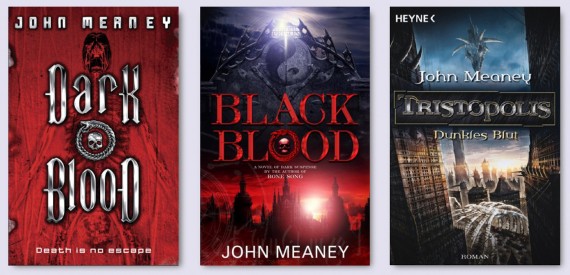
The Tristopolis series about Lieutenant Donal is an incredibly warm and tense mystery. In Bone Song, we see Laura (Donal’s boss and lover) ends up deader and Donal with her heart. “Dark Blood” sets out to discover the whereabouts of the magicians responsible and we follow Donal’s journey towards that end.
We get to see descriptions of loyalty, friendship, love, grief, betrayal and a whole lot of magic throughout the novel. John Meaney is a top-class author who manages to portray a world of complexity and three-dimensionality.
Some of the descriptions inside are quite vivid and that makes me recommend this for teen-aged and upwards. Death-sentences in Tristopolis just aren’t carried out as nicely as the ones on this earth.
I’ve seen several readers on Amazon complaining of McBain‘s treatment of “Alice in Jeopardy”. Just because McBain has strayed from his “Precinct” characterization does not mean that the quality of his writing has diminished. It is as it has always been, good quality mystery prose.
This is a fun mystery. The “bad” guy is a surprise and Alice, our heroine, is fairly three-dimensional. Alice’s two children are kidnapped, and this is the story of getting them back and finding the bad guy.
There is plenty of action and psychology, necessary ingredients in a mystery. McBain was truly one of the better mystery writers out there.
This is the 4th book in the Marla Mason series. I haven’t read the previous installments: “Blood Engines”, “Poison Sleep” and “Dead Reign”, but still felt as though I was able to follow the story-line.
In “Spell Games” Marla’s long-lost brother turns up in her life again. They parted on bad terms and Marla isn’t sure how she feels about seeing him again. But her brother, Jason, is a con-artist and quite a talker and manages to convince Marla to give him a chance. She ends up helping him with a con, and surprisingly has quite a good time – until complications arise.
There are some really strange characters in this novel. One of them is a mushroom-worshipping sorcerer. I guess that’s what I liked about “Spell Games” – its strange twists and turns and dry wit.
As entertainment, this is a pretty good choice of reading.
This cover by Sharon Tancredi is wonderful. I love the feeling I get while looking at it and the spirit of the main character Jane that she manages to convey in her drawing.
As time has passed and I have written many reviews, I have come to realise that how my head works when approaching a novel has changed. Instead of reading all books as if they needed to be judged by the same ruler, I am now able to divide my thought processes into categories. By doing this it feels as though I am bringing my Aspergers into play instead of trying to bypass it and be “a regular” reader.
Along with several of my early reviews, this one of Tracking the Tempest is an updated one (June 2014 instead of May 2012).
I consider this a true series. Even though I had not read Tempest Rising, I had no problem beginning with number two. Necessary background information was shared without info-dumping and Jane’s relationships with various people were fairly self-explanatory. Tracking the Tempest starts off with Jane working hard to learn how to control her magic and especially how to shield herself.
The light wavered, stilled for a split second, and then winked out of existence. I couldn’t help but close my hand with a little flourish. Now that I couldn’t blow anything up, I was allowed to be pleased with myself. That was the first time I’d managed to create and disperse a mage light start to finish.
“Who’s your daddy?” I demanded rhetorically, doing a little happy dance.
“He died centuries ago; you wouldn’t know him,” Nell replied, coming toward me. “Stop hopping about and shields up.”
One thing I appreciated about Jane is that she is a regular person (despite being a halfling and despite Peeler’s tendency toward hunky men for Jane). I stink at the romantic stuff. Absolutely do not get why romance has to be so mushy (to my husband’s great frustration). Asperger people might be the greatest killers of romantic moments that exist. So not understanding all of Jane’s worries and frustrations about Ruy is just the way things work for me. Let’s just get to the sex is the way I tend to think.
But Peeler makes the romance funny. The way sex and so-called romantic moments tend to be. That I can appreciate and I did. I love it when an author makes sex steamy but also when an author makes sex ridiculous.
One of the comments I read on the novel said something about the Boston Public Parks not being closed at night. I checked that out by googling and that was correct. Living in a stinking rich neighborhood is not a prerequisite for a stinking rich person, so I felt that the same person’s comment about Ruy living in Bay Village didn’t really fit. His personality (what I understand of it) does seem to work with Bay Village.
This is another thing I have learned to do with my reviews. Categories are incredibly difficult for me, so I have to read other people’s reviews so I can place these books in the proper category. Which is why I have ended up adding links to other reviewers at the bottom om my own reviews.
Tracking the Tempest also seems to be about giving in to truth, in Ruy’s case accepting that his wishes for how the faery world operates might not have much to do with reality. Having been in that situation myself, I can sympathise. Once upon a time I was Mormon. Eventually my cognitive dissonance grew out of bounds, I checked out some facts and there flew my beliefs away into the sunset. Ruy seems to be at this same point himself. A point where you realise that your support of something has been abused and you yourself allowed it.
Poor Conleth. Something is mighty strange and wrong about his killings and obsession with Jane. And what a childhood. Hmmm. Perhaps he needs to be pitied more than hated.
Jane discovers that her lack of knowledge about the faery is even greater than she had thought. While she seems to have taken everything in her stride thus far, perhaps a point comes when more knowledge becomes too much knowledge.
I have not been able to find an official website or blog for Lucretia (Walsh) Grindle.
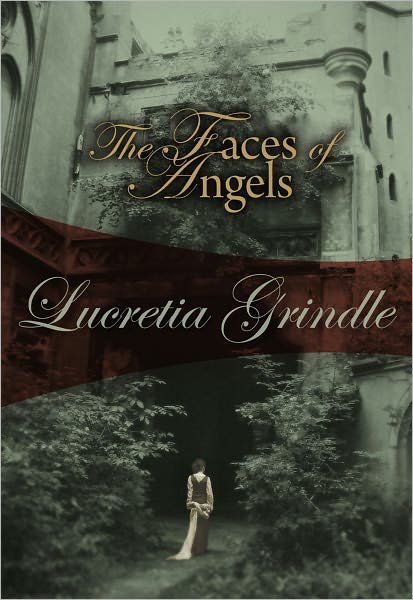
In The Faces of Angels we meet Mary Warren. Mary Warren is a widow who lost her husband while they were on their honey-moon in Firenze. At that time Mary herself was attacked and almost lost her life as well.
The Faces of Angels introduces Inspector Pallioti. In this novel, he is trying to figure out who is killing off people Mary Warren has come into contact with. During a previous visit Mary, herself, was nearly killed. Her husband was murdered. Right after she returns to Florence, the killings begin again. It seems the serial killer has taken an interest in Mary.
Rituals for serial killers seems to be a must. So too with this killer. The murders are brutal and the victims are left with little gifts.
I’m reminded me of most British mysteries, where suspicion is moved from one person to the other (while one person after the other is killed). This novel is above average in its execution. Grindle has managed to keep the atmosphere tense through most of the novel. At times the flow hiccups, but for the most part Grindle manages to draw me from one line to the other.
The other Inspector Anthony Pallioti mystery is The Villa Triste
The Edgar Allan Poe Awards® 2012: Nominee for The Best Paperback Original
I like mysteries. Anything from Agatha Christie to Richard Morgan. They’re all the same, in a sense. Some crime happens and the detective (police or private) comes on the scene and (usually) miraculously solves the crime. The route from A to B varies, but in essence they’re all the same. That’s why they’re so fun.
Add mystery to cyber-punk. Cyber-punk tends to be cynical and dark. Altered Carbon sticks to that kind of tone. Maybe the whole concept of having our personalities stored and ready to be placed into new bodies is a theme that lends itself to exploitation and conflict. Imagine what a person holding immense power, such as the leader of a mega-corporation, could do with access to both bodies and personalities. The lure of power is what keeps the “baddie” of Altered Carbon doing their terrible deeds.
When Takeshi Kovacs, former United Nations Envoy and a native of Harlan’s World, is killed on Harlan’s World (humans now live on various planets in our galaxy) his personality is beamed from Harlan to Old Earth (good old Terra) for a mission where his only choice is do or die (or even do and die).
There he is expected to solve the mystery of what really happened to Laurens Bancroft. Laurens Bancroft is a Meth (Methusalem from the Old Testament). As the name indicates, Mehts live an incredibly long time through resleeving their personality into new bodies. Imagine living like that and the effects time would have upon you. I imagine that in order to choose such a path and to stay on it for centuries you would have to be somewhat of a psychopath. Otherwise you would probably go insane from every one else around you dying. Insane or not Mr. Bancroft’s death has the verdict of suicide. The reason Kovacs has been revived is due to disagreement about the verdict. Here we arrive at the who-dun-it.
Takeshi Kovacs is an enjoyable character. His past haunts him and being in a new body takes some getting used to. There is explicitness in Altered Carbon. I don’t mind that, but then I am 49 years old and not 15.
I like that Mr. Morgan has kept Kovacs alive past Altered Carbon. He is a character well worth knowing – complicated.



 humanitysdarkerside