Tag Archives: #Consequences

Wilson, Catherine M.: The Warrior’s Path (When Women Were Warriors) (2008)

Cover designed by Catherine M. Wilson

When I talk about authors who write musically, Catherine M. Wilson is one of those authors. After reading her The Warrior’s Path right after reading the Frey Saga I found myself understanding a profound musical difference between authors. The Warrior’s Path is written in a minor key (or moll in Norwegian) while the Frey Saga is written in a major key (dur in Norwegian). How cool is that??

Our hero, Tamras, learns a great deal about herself, her prejudices and her talents during The Warrior’s Path. Some of these talents point to a mystical ability that may or may not become more apparent as the trilogy advances. One of her most important lessons is taught by her Warrior, Maara. Maara teaches her that Tamras is not her emotions but that she has the ability to decide how to use them. Tamras learns to deal with disappointment, anger, jealousy and fear.

I often think that we are what we choose. Just think of the many times you might have thought “if only”. Many of my choices have been less than ideal. But choosing to read The Warrior’s Path is a choice that has given me new insight and great pleasure. To think that this is Catherine M. Wilson’s first novel says quite a bit about her talent for the craft and her ability to develop it. I know she doubts she will write any more novels after spending ten years on her trilogy. That would be a pity.

After researching a bit more about the novel on the net I realized it falls within the lesbian/gay category as well as any other. Never entered my mind while reading it. To me it was just fantasy – really good fantasy – with a semi-lesbian twist. Didn’t seem all that important to me. But it is on the must read list of several lesbian/gay sites out there, soooo?


2010 EPIC ebook award in the Mainstream category

Bunn, Christopher: The Wicked Day (The Tormay Trilogy) (2011)

Cover art by Alexey Aparin

The Wicked Day is Christopher Bunn‘s conclusion to The Tormay Trilogy. As this trilogy is a serial it would be wise to read The Hawk and His Boy first, then The Shadow at the Gate and finally The Wicked Day.

There are times when I find myself wholeheartedly able to recommend books for children. There are a couple of criteria I feel they need to fulfill. Violence and love stories have to be within certain parameters. Morals and ethics should be discussed without the discussion being obvious. (I like that in adult novels as well) Preachy authors are a pain. The flow of the written language should be such that I like the feel of reading to a child. I realise not every person in the world understands what I mean by that, but I would assume that a fellow autistically traited person would. It is all about word-texture.

Bunn fulfills all of these criteria in his Tormay Trilogy. The plot itself is pretty basic – light battles darkness/light almost loses/light prevails. I guess when life is boiled down to its most basic ingredients, life for humans is pretty much about the battle between light and darkness. One of the things I liked about this trilogy is Bunn letting us see that a person can contain both light and dark. We are not wholly one or the other.

Bunn’s characters are likeable. The story of Jute and his companions is continued. Not everything that happens in the novel is happy but there is an ending that brings the story to a conclusion. I have enjoyed my experience with the world of Christopher Bunn.

McMillin, Dean C.: Shadewright (Shadewright Cycle) (2012)


shadewright

What an excellent beginning Shadewright is to the Shadewright Cycle. I liked it enough to buy book two of the serial (Shadowslave). Shadewright is also my introduction to the writing of Dean McMillin.

I suspected I was reading steampunk as I got a ways into the novel. Machines that enabled lightning magic turned up. I could be wrong.

I loved McMillin’s writing. It has all the elements I like. Most of all it flows. I love it when that happens. Somehow the author manages to get through to me and we have fun together.

In the world of Phantist there are shadewrights (Phantist is one), arcwrights (Arick is one), flowmen, and bloodwrights.

Shadewrights manipulate shadows. Arcwrights manipulate the electricity in the air. Bloodwrights are flowmen who are able to affect the very nature of living species. Flowmen heal and kill with their power. There are probably other types of Wrights, but these were the only ones that were in Shadewright.

Phantist is a shadewright who is born an orphan. There are plenty of those in the world. He is a greyskin – which means that his skin, hair and eyes are grey. Greyskins are sensitive to light, but have an inborn ability to manipulate shadow (some better than others). Since Phantist is our protaganist, he is bound to end up being good at shadowmastering.

On his journey to fulfill his destiny Phantist is thrown into life-threatening situations. The action is well-written. Dean keeps his writing tight and does not fall for the temptation to embroider into infinity. I imagine he has had to edit quite a bit to get this feeling accross to me.

The people Phantist meets on his journey vary from helpers and goodies to side-kicks and baddies. Most of them are a bit insane but insane in an interesting way. Crazy is good.

I liked the world of the Shadewright. I hope I enjoy Shadowslave as much.


Dean Chalmers: Power of Shadow (Earth, Blood & Shadow I)

Bunn, Christopher: The Shadow at the Gate (The Tormay Trilogy) (2010)

Cover art by Alexey Aparin

Once again Christopher Bunn manages to catch my interest with his characters in The Tormay Trilogy. In The Shadow at the Gate the battle between dark and light continues. As this is a serial, you will have to read The Hawk and His Boy first to make sense of the story. Ronan and Jute had their incident during a break-in in The Hawk and His Boy. Unexpectedly, the robbery goes awry for both Ronan and Jute. The intention behind using Ronan (the Knife) was to prevent Jute from ever talking about the job. But both Ronan and Jute had their lives turned upside-down during that robbery.

In The Shadow at the Gate Ronan is commanded by the Silentman to get Jute back, or else. Ronan goes after Jute. But Jute is not easy to find. He has hidden well realising his precarious position. The kid wants to live, voice in his head notwithstanding.

Levoreth Callas arrives at the castle with her aunt and uncle. She is slowly waking to the necessity of battling the Shadow. But discovering where the Shadow resides, and in whom it is residing, is going to take all she has.

All three characters have allies/helpers that both hinder and aid them in their quests. Dunn keeps a nice pace in his story and manages to make the novel interesting for both young and old. I have forgotten what it is to be ten years old. It would be interesting to hear what a ten-year-old would take from the story of young Jute and the rest of the gang.

Anna, Vivi: Dawning (2011)

Dawning (Nina Decker) Vivi AnnaDawning is my introduction to the Nini Decker universe. My appetite was whet and the novel presented quite a dilemma for the main character Dashrael.

In a blatant show of racism, the chancellor tells Dashrael to kill the spouse of the overseer’s daughter along with their half-breed child.

That is pretty much what this story is about. Dashrael coming face to face with his target and the choices he makes and sadly the consequences his choice has for him personally.

Granted, this is human/elven racism. But, you know, this is reality for quite a few people on this planet. If you dare fall for someone of another color/ethnicity/religion than yourself, lives are at risk. I have to say that it is one of the more confusing aspects of humanity.

A thought-provoking story – and well-written. As my first Vivi Anna experience, I was well-pleased.

Angell, Lorena: A Diamond in my Pocket (The Unaltered I) (2012)

a diamondA Diamond in my Pocket is book one of The Unaltered Series.

What would you do if you one day discovered you had an unexpected ability? Like running fast, really fast. Fast enough to break the world record. It would be a great ability to have if you had to run away from trouble (or maybe to).

Callie Courtnae suddenly discovers this ability and is asked to join a school in Montana that specialises in youth with record-breaking abilities. She goes and discovers that the people at her school are extraordinarily beautiful and a lot quicker than she herself is. Hmmm, I smell a rat.

The premise for A Diamond in my Pocket is pretty good. It is difficult to come up with something new in the world of fantasy. But Angell manages to put a couple of twists in that I don’t think I’ve read before. However, however, however. The characters needed a bit more work and the novel tightening. I wish A Diamond in my Pocket could have fulfilled its potential, because it did have plenty of that.

Bishop, Anne: Ephemera

Musical writers. What a treat they are. Anne Bishop is one such writer, one who knows how to make all of her chords fit together into a song that satisfies the reader. She manages to portray the darkness in people without stepping into the land of horror. I love dark fantasy when it is performed like this.

Like all of Anne Bishop’s stories, Ephemera is character driven. Generally two or three of them are three-dimensional, while the rest end up complementing the main characters. Ephemera comes from an idea of our outer world reflecting our inner one. What if that were literal? Playing with that idea brought about the Ephemera world (Reading Cafe interview). As we discover in reading these books, the world of Ephemera is ephemeral (transitory). One can never know where one ends up, seeing as one’s heart shows the way.

SEBASTIAN (2007)

German cover

“Long ago, in a time that has faded from memory, a mother’s tears forged the bridge that, ever after, connected the power of the living, ever-changing world to the human heart. – Myth”

Sebastian is a love story, but more than that it is a story about the choices we make. Do we dare to follow our dreams, or will we make “safe” choices? In the end it might not really matter, because the choices we make could very well all be the ones we really want.

Sebastian is an incubus, an incubus who has begun longing for something more than the life he is living right now in the Den of Iniquity. The Den of Iniquity is a place of ever-lasting carnival, a place where people come to fulfill those dark desires they have.

You can relax if you are worried that we are being cast into a place where the sex and violence is explicit. While the Den of Iniquity might well be a place where that is the case, Anne Bishop has been kind enough to keep us as readers away from the details.

Anyways, back to Sebastian. The Den of Iniquity has been his home since he was about 15. His past was not a good one with a succubus mother and wizard father. Sebastian’s mother left early on and his father left Sebastian’s care to others, people who were afraid of incubi. But Sebastian has turned out pretty well, thanks to Nadia, Belladonna and Lee (adoptive family). They have shown him that there is sunshine in a person. Now he wants someone to love.

BELLADONNA (2008)

Australian cover

“Heart’s hope lies with Belladonna.”

The Eater of the World is once more loose in Ephemera, free to wreak havoc where it sees fit. Dreams are invaded, monsters set free and lives are becoming darker due to its influence.

The only hope lies with Belladonna. Glorianna Belladonna is of the old blood, the blood of the Guides and Guardians. Her heritage is one of light and darkness. Only through the combination of the two is there a possibility of winning.

Unfortunately, Belladonna and Lee do not have all of the answers to her search for a solution to the Eater. She sends out a Heart’s Wish to Ephemera with the hope that someone will come with what she needs to save Ephemera.

In a sense that says it all. What price are we willing to pay to save the ones we love? I have no idea myself. In the world of fantasy people are willing to go to extremes to save the world and not just those close to themselves. Sometimes the price could end up being horrendous.

BRIDGE OF DREAMS (2012)

Australian cover

Anne Bishop pulls it off again. This time we get to hear more about Lee.

Ever since Glorianna Belladonna became Belladonna in every sense of the word, Lee has been frustrated, hurt and angry. Part of his anger is at Glorianna for placing herself in this position and for not going back to how she was previously. Another part of his anger is toward Michael, the Magician, for giving Belladonna the chance to make her choice, and for stopping him when Lee wanted to jump in and save her. Quite a bit of his hurt is toward the relationship that has developed between Michael, Glorianna and Sebastian. Why was Sebastian the one to call Belladonna back and not Lee? It seems unfair. Lee feels unwanted, and unable to come to terms with the way things have turned out.

When he stumbles upon wizards trying to invade one of Belladonna’s landscapes, Lee uses a one-shot bridge taking the wizards with him. He ends up in a city called Vision having to endure torture and the insidious whispering of the wizards.

Danyal, the Shaman, is sent to Vision to figure out what needs to be done to save the city from those places that no Shaman is able to see any longer. Shamen are like the Landscapers in that they take care of their landscapes. But unlike Landscapers they do not seem to have access to Bridges. Upon meeting up with other ways of doing things, Danyal is about to have his beliefs about the world challenged.

So, what can I say about Bridge of Dreams? I liked it. I like Anne Bishop’s version of the darkness that lives in all of us. Our shadows balance out the light in us. When we accept both sides of ourselves our potential becomes greater. All three books in the Ephemera series (trilogy?) follow the pattern of Anne Bishop’s other novels. I guess most authors have a unique style of writing (much like musicians), and sometimes that style works. In Bishop’s case I find myself embracing and enjoying her characters. Getting people to care about the characters in a novel seems to be what being an author should be about.


SOURCES


TRAILERS

Gay, Kelly: The Better Part of Darkness (Charlie Madigan) (2009)

Cover art by Christian McGrath

There is something about Charlie that I find appealing. Her life is a mess in so many respects, but she, herself, is a really decent person. Kelly’s writing is, of course, alpha and omega in making the series work and helping me like it. I find it amazing that this is actually Gay’s writing debut.

The Charlie Madigan series is an urban fantasy one. They are meant to entertain. There are issues that come up in the books that are important ones, but like most novels out there on the market this is for the general public and not an esoteric philosophical LSD audience (Ok, that might have been a bit mean).

As with a great deal of the other urban fantasies out there the Charlie Madigan has a male/female action team. Since both Hank and Charlie work together, have a bantering tone between them and look quite good – well …

In The Better Part of Darkness we find ourselves in an Atlanta city in a possible future where scientists have discovered two parallel planes of existence. Surprise, surprise, angels and demons do exist although not exactly in the heaven and hell version that we humans are so fond of. We have been visited by them for thousands of years and they have been using us and the earth as a battleground for working out their differences.

Now that humans know about them, we won’t put up with their nonsense any longer and have laid down the law for them. A police-department has been established dealing especially with extraterrestrials. They are called the ITF (Integration Task Force). Charlie Madigan is one of the officers working for the Department and her partner, Hank.

Pretty early on in The Better Part of Darkness, we find out that Charlie had a dead-then-alive experience that seems to be changing her physically.

Charlie’s partner, Hank, is a siren from Elysia. He has the kind of voice that needs to be dampened, otherwise men and women would throw themselves at his feet and do anything he asked of them. This comes in handy in police-work as people really want to tell him the truth.

Her daughter, Emma, is a highly intuitive child, one with a great degree of empathy. She goes to Hope Ridge, a school for rich kids. Charlie can’t afford it on her salary, but her ex-husband, Will, is paying for it.

When Charlie gets called to her daughters’ school (with her partner Hank) she becomes extremely worried. The victim is Emma’s old baby-sitter, Amanda Mott. At first thought dead, it turns out that Amanda is “just” in a coma of some kind. Making the situation a whole lot worse is the fact that there are several others who have been found like Amanda, and they have all died in the end. It seems all of them have been exposed to a new drug called “ash”. It’s extremely addictive and once it leaves a person’s system, they die.

This is the mystery Charlie and Hank are to investigate. As you might imagine unexpected twists and turns do appear. As stated above, Kelly Gay’s writing is of high quality and kept me reading until the end.


Awards/nominations

2009 SIBA Okra Pick
2010 SIBA Long List Book Award Finalist
2010 RITA finalist, Best First Book
2010 RITA finalist, Best Novel w/Romantic Elements


My reviews on books 1 (The Better Part of Darkness), 2 (The Darkest Edge of Dawn), 3 (The Hour of Dust and Ashes), and 4 (Shadows Before the Sun)

Pratchett, Terry: Death

Death as illustrated by Paul Kidby

The Grim Reaper in the form of a skeletal body in a black robe, with a scythe and speaking in CAPITAL LETTERS appears for the first time in The Colour of Magic. His job is to collect human souls. Death is the servant of Azrael, the “Death of Universes”. Opposing him are the Auditors, who want nothing more than the end of all life (it’s soooo messy).

At home Death has a servant, Albert and a daughter, Ysabelle. Kittens and swans are his favorite animals and his horse Binky is with him on each collection.

Because of his fascination with humans, Death sometimes leaves his post to seek understanding. This tends to cause problems because humans don’t like to see what they do not understand and the universe likes the souls of dead people collected. The only ones who can see Death for who he is are witches, wizards, cats and children.

In The Art of Discworld Terry tells us that he has received a number of letters from terminally ill fans in which they hope that Death will resemble the Discworld incarnation (he also says that those particular letters usually cause him to spend some time staring at the wall).

Mort (1987)

“Mort” by Amianna

While Death appears in the previous books, Mort is the first book in which he becomes a main character.

Mort’s family specialized in distilling wine from reannual grapes. (“Reannual are plants that grow backwards in time. You sow the seed this year and they grow last year.”) These growers tended to be big, serious men, much given to introspection and close examination of the calendar. Mort (the youngest son) on the other hand, was tall, red-haired and freckled, with the sort of body that seems to be only marginally under its owner’s control; apparently built out of knees.

Hopeless as he is, Mort’s father decides to take his son to the hiring fair at Sheepridge. At this hiring fair men looking for work would stand in ragged lines in the centre of the square waiting for a tradesman to hire them as apprentices. Noone seems to want Mort, but just before the clock has struck its final strike at midnight, a prospective tradesman enters the square. It is Death and Mort can see him as he really looks. Mort is hired as an apprentice and Death and Mort ride off on Binky.

And so, Mort is off on the adventure of his life learning all sorts of useful things – like how many shades of black there are and how to walk through walls. Obviously death is a theme of all of the books in the Death series. Terry treats this subject with warmth and a light heart. Death comes to us all, after all. Poor old Death is going through a mid-life crisis, and Pratchett’s gentle mocking of the phenomenon is heartwarming.


Adaptions

  • 1994: The graphic novel, Mort: The Big Comic is illustrated by Graham Higgins.
  • 2004: BBC4 broadcast Mort in 4 parts. Adapted for radio by Robin Brooks. It is re-sent regularly.
  • 2007: German musical adaptation of Mort.
  • 2008: English musical adaptation of Mort by Jenifer Toksvig.
  • 2011: English stage adapation of Mort by Stephen Briggs
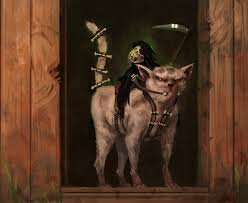
Reaper Man (1991)

“Death of Rats” by Alex Thomas

The terrible Auditors of Reality have been at it again. To them the fact that Death seems to be developing a personality is the sin beyond sins. So, they decide to retire Death and Death is resigned to that decision. What happens when there is no longer a collector of spirits?

Back at the Unseen University Windle Poons – the oldest wizard – is waiting for his collection by Death. He knows to the minute when this is supposed to happen. But does it? Windle Poons certainly dies, but no one shows up for his spirit, so he decides to go back into his body. This tendency seems to be spreading to other people.

Bill Door’s harvesting machine

Now that Death has his own hourglass with sand running down, he has decided to make the most of the life left to him. High up in the Ramtops a figure on a horseback turns up. He knocks at the door of Miss Flitworth asking for help. The stranger goes by name Bill Door. The main qualification needed is the ability to use a scythe, and one might say that Bill is excellent at the job.

Back at Ankh-Morpork Cut-Me-Own-Throat Dibbler has discovered something that he thinks will make his fortune (again). This time he has found some strange globes. When they are shaken a cloud of little white snowflakes swirl up in the liquid inside and settle on a tiny model of a famous Ankh-Morpork landmark.

And finally, magic is behaving strangely at the UU. It seems all of the Life drifting accross the Discworld is acting like water building up behind a dam when the sluice gates are shut. Needing a place to go, it manifests itself in all sorts of phenomena. The wizards decide they have to meddle with all of the strangeness.

Terry addresses fate, life, death, consumerism and relationships in Reaper Man. I’ve seen reviews that praise Reaper Man to the sky and others that despair of Pratchett’s writing this books. For my own part, I rather liked the book. It juggles the serious and the silly quite well in the jump between Flitworth and the wizards.


Adaptations

  • 1996: 8-minute animated television adaptation produced by Cosgrove Hall Animation Studios of Reaper Man.
  • 2012: Australian stage adaptation of Reaper Man by Pamela Munt

Soul Music (1994)

Soul Music moments by Justyna

Mort and Ysabell married and had a baby – a little girl they named Sarah. At age six, Sarah, makes her teachers at Quirm College for Young Ladies extremely nervous. Strangeness tends to happen around the girl and she says the most bizarre things. But Susan didn’t really worry about what other people thought about her. And that continues through the years at school.

Sometimes the gods listen to the words people say. Imp Y Celyn (Buddy) said to his dad: “You don’t know anything! You’re just a stupid old man. But I’m giving my life to music! One day soon everyone will say I was the greatest musician in the world.” In retrospect, perhaps not the wisest words, but they do make for a good story. When he chances upon a pawn shop guitar and becomes possessed by it, rock and roll enters the Discworld. This means some serious hip-rolling and swooning fans. Imp’s band “Music With Rocks In” acquires a manager in Cut-Me-Own-Throat-Dibbler. He tries to do what any good manager would, cash in on the band while keeping them in the dark.

Death has decided to go on another of his walkabouts. Unfortunately, for Susan Sto Helit (Death’s granddaughter) that means leaving boarding school to carry on the family business. Having Death for a grandfather does not make for an easy life and Susan struggles to stay on top of the job. Chaos and mayhem ensue.

Part of the theme of this book is music groups and their managers in all their glory. The generation gap is also something that is experienced at the Unseen University. Ridicully’s thoughts on the younger wizards’ fascination with the new fad is typical. Idealism vs. rationality is a struggle Susan has to face. To let or not to let people die.


Adaptation

1996: An animated mini-series adaptation of Soul Music was produced by Cosgrove Hall Films for Channel 4.

Hogfather (1996)

  • 1997: British Fantasy Award nominee
  • 2007: Winner of BAFTA TV Award for Best Visual Effects and Interactivity
  • 2007: Nominated for BAFTA Tv Award for Best Photography & Lighting
  • 2007: Winner of BPG Multichannel Award
  • 2007: Nominated for RTS Award for Best Drama Serial
  • 2007: Nominated for VES Award

The bad guys by Stato Bizley

“”Something” began when the Guild of Assassins enrolled Mister Teatime, who saw things differently from other people, and one of the ways that he saw things differently from other people was in seeing other people as things (later, Lord Downey of the Guild said, “We took pity on him because he’d lost both parents at an early age. I think that, on reflection, we should have wondered a bit more about that”).”

At the Unseen University the wizards are standing before a nailed shut door, wondering if they should open it – despite the sign that read “Do not, under any circumstances, open this door”. But curiosity is one of the prevailing “talents” of wizards. Ridicully is one of the more curious ones. The door is opened, and what do they find? Bloody Stupid Johnson has been at it again. A wise person would have closed the door again at this moment, but alas. There are not many wise wizards in Ankh-Morpork.

Susan Sto-Helit is enjoying a quit evening at the home she is governessing at. As usual she has put the fear of something into her employer while the children adore her. All of a sudden images formed in her mind. “A red ball … The sharp smell of snow … And then they were gone, and instead there were …

“Teeth?” said Susan, aloud. “Teeth,” again”?”

“Susan and the … Hogfather?” by Rebecca M.

She knows right then that trouble is afoot, and its name is most likely DEATH. As you can see from the picture, DEATH does make a lovely Hogfather – travelling to all the children calling HO, HO, HO in his own unique style.

Absurdity, chaos and laughter are only some words to describe Hogfather. When the assassin Teatime is sent to kill the Hogfather, you just know you have to buckle up for a crazy ride. Christmas and all of its stranger sides (consumerism and altruism) are all examined. This is the ultimate Christmas story, one that might make you want to believe in Santa Claus again.


Adaptation:

2006: Hogfather adapted by Vadim Jean as a two part TV-serial for SKY

French cover by Marc Simonetti

Thief of Time (2001)

Nanny Ogg is called to a birthing – a very unusual one. Some years later Jeremy Clockson was enjoying dismantling and putting a clock back together again. He’d grown up as a child-prodigy at the Guild of Clockmakers since he was a few days old. Then Lady Myria LeJean with her two troll body-guards steps into his shop. Something about her bothers Jeremy. She wants him to build the most accurate clock in the world.

Miss Susan is a very strict and popular teacher with her pupils. Her main concern is to get her pupils to see things for what they are. But her popularity stems mainly for the class-trips she takes her students on – quite unusual ones that should not be possible. Her view on parents was that there ought to be an exam before they were allowed children. When the Death of Rats comes by to tell her that Death needs her help dealing with the Auditors, she sets off to do her duty.

The Order of Wen or the History Monks have a duty to see that tomorrow happens. One of the novices, Ludd, is causing problems. As a baby, he’d been raised by the Guild of Thieves. Then the monk Soto had stumbled upon Ludd and send him to the temple. There all sorts of unusual things happened our young Ludd. To solve the Master of Novices’ problems, Ludd is placed with another troublemaker – the sweeper Lu Tze. Both Ludd and Lu Tze are surprised by the other.

Going along for a ride with Pratchett is bound to be an insane experience and Thief of Time is no exception to the rule. His way of dealing with events of the day – and usually themes that are relevant no matter when or where one lives (like education, family, duty, propaganda, differences and prejudice) is admirable. It’s the warmth in his work that makes Pratchett so worthwhile to me.

For this blog, I’ve used Wikipedia, L-Space, and the above books as my sources.

McGuire, Seanan: October Daye

Seanan McGuire (that has to be an Irish/Scottish name) is the author of the October Daye series. She has a great website with all sorts of fun “facts” about fantastical things.

“Acacia” by Tara O’Shea

October Daye is part fairy part human. It seems the fairies like to mingle with humans, leaving their off-spring to make it in the world as best they can. This series is full of racism and prejudice. The unfortunate halflings need to hide their fairyhood from the humans and are thought of as “less than” by the fairies.

What I like about the October Daye series is that Seanan knows how to write. I’ve already written about her “Newsfeed” books written under the pseudonym of Mira Grant. You’ll find the quality of writing is as good in these books. The Daye books are lighter in spirit. They are about the parallel magic world of the fairy. Humor and action abound and some romance gets slipped into the text as well. San Fransisco is Toby’s base and love.

I like Toby’s character. She’s quite different from a lot of the urban fantasy characters that are out there. Somehow she seems more believable

ROSEMARY AND RUE (2009)

We meet October (Toby) for the first time in  Rosemary and Rue. Living with two cats, Cagney and Lacey, Toby is trying to make it on her own as a changeling in San Francisco.

After getting burned by both sides of her heritage, she’s retreated entirely from the fae community, spending her nights stocking shelves at a San Francisco grocery store and her days asleep in her apartment downtown.

Her days of trying to stay away from the fae community are about to end. When Countess Evening Winterrose phones Toby one evening trying to get help Toby is worried. But Toby wasn’t home when the Countess tried to get hold of her. Next time Toby sees Evening, she is dead. The gaes the Countess placed on Toby makes it inevitable that Toby finds herself yanked back into the world she thought she was leaving behind.

A LOCAL HABITATION (2010)

April by Tara O’Shea

A Local Habitation is the second book in the series about October Daye. It’s important to Toby to maintain contact with her changeling friends. There are all too many of them who find themselves caught between two chairs, unable to fit in anywhere. Fortunately for Toby, she has friends who are part of the pure-blood fae world. One of them is Tybalt, the king of the Cait-Sidhe, and Duke Sylvester Torquill, her liege lord.

Sylvester comes by her apartment seeking Toby’s help. He needs her to go to Fremont, near San Jose. His niece, January, seems to have gone missing, and the Duke wants to know what has happened to her (if anything). January is the Countess of Tamed Lightning, making this something of a diplomatic problem – trying to avoid war with the neighbours. Fortunately, Sylvester does not expect Toby to go alone. Quentin, a teenage Daoine Sidhe, is sent to help Toby if she should need it. Off they go into the land of adventure.

AN ARTIFICIAL NIGHT (2010)

The Blood Road by Tara O’Shea

Everything seems to be going well for Toby. Her PI business is busy, she visits with her friends and gets to sleep days. Then her friend (past lover) calls asking to meet her. When a fetch knocks on her door, Toby knows nothing but trouble is coming her way.

An Artificial Night brings Blind Michael into Toby’s life. The Firstborn son of Oberon and Maeve begins claiming the children of the Mists as his own – something he tends to do at regular intervals. Some of these children belong to friends of Toby and she is taking this quite personally.

Her fetch, May Daye, makes her worry about the success of her challenges. That is because fetches only arrive when you are expected to die, giving you the chance to set your life in order. But that will be difficult when Toby is running to one crisis or the other.

LATE ECLIPSES (2011)

“Lily” by Tara O’Shea

Late Eclipses is the fourth book in the October Daye series. After her challenges in An Artificial Night Toby is trying to live as normal a life as she can. But with her fetch, May, living with her, that isn’t exactly easy. May is pretty much Toby’s opposite – bright and cheerful and fond of healthy living.

Then a messenger from the Queen of Mists arrives. Toby is expected in her presence immediately. Toby brings May and her troll friend Danny along to back her up. Even though the Queen is the reason Toby has ended up with her own knowe, she despises Toby for being a changeling. Warned by Tybalt that the Queen is out to get her, it comes as a surprise when the Queen of Mists actually installs her as Countess Winterrose. But Tybalt warns Toby that she is being set-up for something.

In Late Eclipses we learn more about Toby’s mother. There is also relation stuff between Toby and Tybalt/Connor – you know, the whole who will she choose thing. A close personal friend to Toby dies and that brings more loss into Toby’s life – and responsibility.

ONE SALT SEA (2011)

One Salt Sea by Tara O’Shea

One Salt Sea begins as Toby is getting a grip on the management of her knowe. The Countess of Wintergreen is taking in refugees and letting changelings take an important role in dealing with the management of her knowe.

Then war threatens between the land and the sea. The sons of the Duke and Duchess of Saltmist have been kidnapped and the Luideag calls in her marker and tells Toby that she needs to find the boys before fighting breaks out. The Queen of Mists is suspected of being behind the kidnappings and Toby needs to both prove that this is not the case and to find the boys before their parents lose their patience.

One thing Seanan is good at is to show that not all consequences are fun for her characters. There will be a lot of that in One Salt Sea. I really liked the sadness along with the humor in this book.

ASHES OF HONOR (2012)

Toby is still recovering from the events of One Salt Sea. After having risked her life time and again, she finally realizes that she needs to ask people for help in doing things. And Toby does ask for help.

When Etienne comes asking for help, Toby brings the whole crew in on the job. His daughter has gone missing. The fact that he did not know of her existence is irrelevant to his wanting the girl back. Her name is Chelsea and she is around 15 years old.

The problem with Chelsea is that her fae side is strong. Her teletransporting is off the scale and it seems she has been kidnapped for nefarious reasons. It is up to Toby to solve the mystery and to recover Chelsea (hopefully alive).

Ashes of Honor was an easy read, like all of the October Daye books. Seanan’s writing is seamless, and that translates to flowing reading for me. I’m dragged down this river of words, not wanting to get off the river. Unfortunately, duty does call and sleep is more and more necessary as I age. Bummer.

Meaney, John: Resolution (2008)

Cover art by Jim Burns

While the third and final book in the Nulapeiron Sequence, “Resolution” lacks the brilliance of “Context“, “Resolution” is certainly a well-crafted book. Meaney’s work is moving, engaging and interesting. He manages to braid his thoughts on time and space into the text in a manner that fits in with the rest of the book. This is quite a feat.

Tom Corcorigan leads a complicated life. He’s on top or he’s at the bottom of the social ladder. His life is never the same from moment to moment. Love, friendship and home can change in an instant. I’m glad I’m not he. As in the previous books, we also get a look into the lives of the pilots.

In “Context” the Blight was defeated. But Tom is certain the war has not been won. He is worried that the Anomaly, the mother of the Blights, is on its way to Nulapeiron. There is no-one else that will believe him when he tries to convince them of the seriousness of the situation. Losing his demesne has made life a bit more challenging for him and Elva, but when his friend Corduven dies that all changes. Now they finally have the chance to influence matters. And what do you know, the Anomaly appears. From there on the action is non-stop.

The Nulapeiron is an intense series. The reader is drawn into Meaney’s world and kept there by the force of his words. His science fiction is fun and weird.

Meaney, John: Context (2007)

Cover art by Jim Burns

Wow. This book is gold. “Context” is book no. 2 of the “Nulapeiron Sequence”. As such it is the continuation of the story about Tom Corcorigan. This story keeps getting better and better. Meaney blends philosophy with action and obsession beautifully. In Context he manages to keep the text flowing in a manner above and beyond most authors. What a gift.

Tom is healed from devastating injury. His security chief, Elva comes along. Unfortunately, she is killed on that trip. This becomes a defining moment for Tom. He realises his love/passion/obsession with Elva. When it turns out that somehow Elva has survived, but that her mind has been transferred to the body of her twin sister. Tom goes off hunting Elva. In the process he becomes one of the most important tools in the fight against the Blight.

Of course, there are many stages of learning for Tom. One does not blithely meet with something as powerful as the Blight. One of the many tools aiding Tom is the mu-space crystal that he got hold off in “Paradox“. From it we learn more about Ro and her role in the whole mystery.

Hard-core science fiction has seldom been more fun. Please, please read this trilogy if you have the chance.

Nexø, Martin Andersen: Pelle, the Conqueror (1906-10)

“Pelle, the Conqueror” begins on the first of May 1877. Lasse Karlsson from Tommelia in Sweden arrives with his son Pelle at Bornholm in Denmark. They are fleeing poverty and starvation and try to find a decent living. Instead they are treated as indentured servants. As Pelle learns Danish, life becomes easier, but he and his father continue to be treated as outsiders. They refuse to give up their dream of a better life in Denmark.

In one sense you could call “Pelle” auto-biographical. Nexø (1869-1954) knew poverty from the inside. When he was 8, his family moved to Bornholm in hopes of having a safer life. Through this inside experience we get to follow Pelle and his father and friends through tragedy, comedy and success. There is an optimism inherent in these four books (mine is an omnibus) that has us identifying with Pelle’s fight to conquer his life.

Nexø writes beautifully. He brings the reader into the text and gives of himself to us. The journey through Pelle’s life is an amazing journey from a life of terrible circumstances into a life of possibilities. With warmth and generosity my heart was warmed by the excellence of Nexø’s text.


Barnes & Nobles seems to have the best price on this omnibus, consisting of 4 books: Boyhood; Apprenticeship; The Great Struggle; Daybreak.

Project Gutenburg offers Pelle the Conqueror.
——————————–
Pelle Erobreren is a Danish/Swedish movie from 1987 based on the book
1988:
  • Palm d’Or at the Cannes Film Festival
  • Golden Globe Award for Best Foreign Language Film
  • Oscar for Best Foreign Language Film

Meaney, John: Paradox (2001)

Paradox: Book I of the Nulapeiron Sequence (Bk. 1)

Cover art by Jim Burns

I’ve now read “Paradox” for the third time and am still enjoying it as much as the first. Because I’m a dork, I just realised that there are two more books to this series. Well, well, live and learn.

From the above I’m sure you can tell that I really liked “Paradox“. We get a large dash of philosophy, some biology, sociology, lots of action and a thoroughly likeable protagonist. Tom Corrigan is at the centre of our attention throughout the whole novel. He raises himself through the various layers of society through hard work, luck and other people’s ambition. There is no sugar-coating of our hero. He rises to the greatest heights and falls to the deepest depths of hell. Meaney is a really good writer.

Nulapeiron is a strange world. Semi-alive dwellings and vehicles. Subterranean demesnes layered from the poorest to the richest. At the very top we find the Oracles.

Tom Corrigan is witness to the brutal killing of a woman by the militia. She just happens to the same woman who gave him a small, seemingly insignificant info-crystal. Shocked to his core, Tom realises that she is one of the mythical Pilots.

This info-crystal, along with the Oracle Gerard, are the two things that push Tom onto a path that will take him to his destiny.

Gilbert, Martin: The Boys – Triumph Over Adversity (1996)

ForsideWhen I read “The Boy in the Striped Pyjamas” I was once again reminded of the story of 732 Jewish boys and girls whose story Martin Gilbert tells in his “The Boys: Triumph Over Adversity“. One book is from the viewpoint of someone standing outside the suffering while the other one is about the kids who went through hell. I’m not a believer in the many after-life versions of hell, but I am certainly a believer in the human ability to create hell for their fellow humans. In fact, we’re really creative in the many ways we cause others pain, and that worries me.

The Boys: Triumph Over Adversity tells such a story. This is the story of children who (along with their siblings and parents) were uprooted from their homes and dragged into the horrors of the Holocaust. These children were originally from Poland, Czechoslovakia and Hungary. Their lives were the lives of ordinary children with loving parents. As they just below and above ten years old for the most part, these children had no understanding of all of the abrupt changes in their lives. From living in regular homes, they were stuffed into ghettos and then dragged to even worse circumstances.

And then it all ended. No more parents or siblings, all alone in the world after having endured what only few people in the world have had to endure.

After their liberation from the camps, they had to begin rebuilding their lives in Britain. Despite being physically and emotionally drained by their nightmare past, they drew strength from their group. After leaving their hostels, they remained a close-knit and devoted band of siblings. Their families having been destroyed, they created a family among themselves.

So many people ask themselves how something as terrible as the Holocaust could have happened. I doubt there is any one answer to that question. After all, we let history repeat itself all over the world. What I do believe is that we are all capable of becoming something we had never thought was possible. Ervin Staub in his “Roots of Evil” and Max Weber in his “On Bureaucracy” – Iron Cage both try to look at why people are dehumanized and warn us of the consequences.