Tag Archives: #InEquality

Come Out, Come Out Whoever You Are

Coming out of whatever closet you are in will lessen the anxiety we feel and hasten our ability to accept ourselves for who and what we are according to psychologist Carl Rogers. I believe that people who accept who they are and who others are will be people who are able to feel true happiness in their lives.

BroadBlogs's avatarBroadBlogs

By John DuBois

With apologies to Glinda, I only changed one word to make a point. I’m sure she won’t mind because she’s an ally who supports equality and justice for all, gay, straight, or otherwise.

Whereas Glinda had asked the little Munchkins to come out of hiding, I ask that all future LGBT folk come out, too. Not from hiding in the bushes like the Munchkins were, but hiding from their true selves — or even from themselves.

Today more non-LGBT allies are championing us and lighting the way (thank you Lady Gaga) and we have more opportunity to express ourselves than in other times and places.

Which reminds me, a while back the Iranian President, Mahmoud Ahmadinejad, was asked how gay people in his country were treated. His response? “There are no gay people in Iran.” To which I retorted (yelling at the TV), “Yeah, as soon as…

View original post 332 more words

Briggs, Patricia: Sianim series

Map of Sianim by Michael Enzweiller

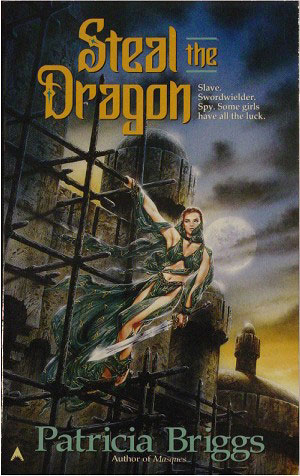
Patricia Briggs was born in 1965. Her joy in storytelling manifested itself early, and scaring her friends (including her husband Mike) was one of her funner hobbies. Patricia kept her story-telling abilities alive through college and her life in Chicago. When she and Mike moved to Montana she got the peace and quiet she needed to finally sit down and write, and she was able to publish Masques in 1993. Then Steal the Dragon followed as her next novel. After that one novel has followed the other. In the Sianim series Wolfsbane was the last one published thus far in 2010.

For best effect, the books should be read in this order: Masques, Wolfsbane, Steal The Dragon, When Demons Walk.

MASQUES (1993)

My version of Masques is the reworked one. Patricia Briggs writes a foreword warning the reader of this. Due to the years that had passed since the first edition of Masques, Briggs and her editor felt it appropriate to remove some of the traces of an author’s first attempt. The book is supposed to be full of clichés, but I’m lucky because I would not recognize a cliché if it bit me on the backside of forever.

Geoffrey ae’Magi is gaining in power and followers. Ren, the spymaster of Sianim sends Aralorn off to see about a death-threat to the magician. At the time, Aralorn felt that switching places with one of the other slaves would be a good idea. With green magic as hers, she is able to change her physical appearance. But while at a party the Archmage is holding for various dignitaries, Aralorn changes her mind. She has been placed in a cage wearing the illusion of a snowfalcon form the ae’Magi has created. But one of the visitors seems to see through the illusion. The King of Reth comes up to Aralorn asking if she is in need of help. She says no.

After the party the Archmage asks Aralorn a few questions. His magic is such that he can do the most horrendous things to people and still have them adore him. Aralorn is not sure how long she will be able to endure her stay with him. When she discovers that his plans for her include her demise, she decides to run.

With her companion Wolf and her war-horse Sheen, Aralorn decides to find a way to fight the great and beloved Archmage’s evil magic.

WOLFSBANE (2010)

Wolfsbane is a tightly-coupled sequel to Masques, and won’t make much sense by itself. Masques had not been a hit and Steal the Dragon hadn’t done all that well either. Briggs wrote Wolfsbane for her own enjoyment and left the book on her shelf. Eventually, she brushed the dust off it, and got it published.

Wolf has been missing for a few weeks and Aralorn has been dreaming dreams of his childhood. Someone seems to be looking for him in them.

Aralorn’s father has died, and Aralorn goes to attend his funeral. She has been gone from Lyon’s keep for ten years and finds it extra difficult that the circumstances are so sad. When she sees her father’s body, Aralorn discovers that Lyon is not quite dead. Instead, some kind of black magic seems to be involved.

STEAL THE DRAGON (1995)

Steal the Dragon is the second book Patricia Briggs wrote. It wasn’t a great hit at the time, but did better than Masques. It has since become more popular.

Steal the Dragon is set a little later than Wolfsbane. Geoffrey ae’Magi is already dead, but not for very long.

In Sianam Ren, the spymaster, decides to send Rialla (former slave from Darran) and Laeth (brother to an important Lord in Darran) to Lord Karsten to try to prevent another murder attempt. Both are highly motivated to do so (Rialla after some convincing) for different reasons.

When they get to Lord Karsten’s keep they play their roles as slave and master. When another attempt at Lord Karsten’s life occurs, they become worried for his safety. Then Rialla’s old master turns up at the keep and the two of them realize that they have probably stepped into a hornet’s nest. It turns out they are correct.

WHEN DEMONS WALK (1998)

When Demons Walk seems to be a while after the previous three installations in the Sianam series. Like the others, When Demons Walk is light and entertaining reading. Patricia Briggs has her own style that is apparent in all of her novels. She is a good author, the quality of her writing is solid and her characters entertaining.

Sham is an orphan from one of the take-overs of the Prophet of Altis. The Cybellians have taken over Southwood, and Sham is left to thieving. Her master (she is a magician/wizard) does not approve, but he does recognize that other venues might be more dangerous.

Sham is surprised when she meets up with the Lord of Southwood – Lord Kerim. He is more likeable than she had thought, but still one of the enemy. But when attempts are made at various people’s lives (which include killing her master and trying to kill Lord Kerim), Sham put enmity aside and gives a helping hand in finding the culprit.

Hmm. All four books in the Sianim series are interesting additions to Briggs’ archive. I liked them. Like I said, Briggs does solid work. Michael Enzweiller’s maps are a great addition to her website.


SOURCES

Harkness, Deborah: A Discovery of Witches (All Souls) (2011)

The Duke Humfrey’s Library in the BodleianWhen you go to Deborah E Harkness’ website, you will find information not only on her All Souls trilogy, but also on Ashmole 782, alchemy and a reading guide. Deborah teaches history of science and medicine specializing in the period from 1400-1700. As such, Deborah is Diana  Bishop – our female protagonist.

Diana is not only in Academia, she is also a witch with a few issues. In fact, she is an anti-magic witch and tries to use her magic as little as possible. After discovering a disturbing volume in the Bodleian library, Ashmole 782, her magic seems to be having a will of its own. Ashmole 782 zapped Diana somehow and she banishes the book back to the stacks.

Other creatures like herself (witches) and vampires and daemons have a difficult time believing that she has gotten rid of the book and a time of stalking and persecution begins.

Like Deborah, Professor Matthew de Claremont (our male protagonist) also has an interest in history. In his case it is the history of genetics (among other things) that he researches. Because of the zap, Matthew takes an interest in Diana. Matthew finds himself drawn to Diana, and she to him.

I really, really like the fact that A Discovery of Witches stays at Oxford and the Bodleian through a major part of the book. It is highly interesting to read about the feeling of reverence that Deborah has for the library and the important role it plays in society. Words are music and the music of A Discovery of Witches is the kind that enters your soul and leaves you replete.

Diana and Matthew are fun and frustrating characters. In many ways A Discovery of Witches follows the pattern that a great many action and romance books do. The main protagonists are on opposite sides to begin with and through hardship they are brought together and become friends/lovers.

I’ve read complaints about all of the things that I liked about the book – lots of data, frustrating characters, library. Kind of funny really, how different our tastes in books are and how we are drawn to such different facets of them. I would say that this is a non-typical yet typical supernatural story about adventure and identity.

Tenn, William: Of Men and Monsters (1968)

Of Men and Monsters

Of Men and Monsters is another novel that belongs in the classic category. It’s not very difficult to see that William Tenn likes to turn things upside down. He is considered one of the foremost satirists of his generation and he is very good at making me think about mankind in a different way. Like all good satires, the ending is bizarre but at the same time believable, given the circumstances described. I’ve seen that others have found the book hilarious, but I can’t say that I did. To me, Of Men and Monsters was more thoughtfully funny.

I couldn’t help thinking of Steinbeck’s Of Mice and Men (one of the most beautifully written books I’ve read) when I read the title. Of Men and Monsters is Tenn’s only full-length novel. I read it one reading, not wanting to put it down. These old-timers were excellent writers.

In Of Men and Monsters the earth has been conquered by gigantic aliens (monsters). Humans have become vermin, living in the walls of the houses of these monsters living like mice, rats and cockroaches off the spoils of the monsters. One of the tribes of men calls itself Mankind. In Mankind lives a boy (soon to be man) called Eric the Only (single child). As part of his initiation as a man, Eric needs to go out into the Monster territory. As his journey progresses he finds betrayal, adventure and love.

People are treated pretty much as we treat our own lab animals. Experiment on them or kill them. Tenn also makes fun of the way people behave when their beliefs self-images are challenged. We pretty much see people behaving as people would, and there really is nothing funnier than that.

Asimov, Isaac: Foundation series

The Foundation series continues on from the Elijah Bailey series. The reason I call it a continuation of the series becomes apparent as one reads the books (too much of a spoiler to tell). If you go to Wikipedia, they will tell all. Having said that, their page carries quite an excellent description of the books along with analysis and links. For another in-depth analysis of Asimov’s work go to Wimmer & Wilkins’ blog. Asimov’s home page contains more general information about his life’s work.

Isaac Asimov brought fresh air into science fiction when he arrived on the scene in the 40’s. He wasn’t afraid of taking a hard look at the possible future of mankind based on what he knew of the day’s theories on sociology and psychology. The Foundation series is considered one of the most important contributions to the field of science fiction, a well-deserved opinion.


PRELUDE TO FOUNDATION (1988) AND FORWARD THE FOUNDATION (1993)

SciFi and Fantasy Art PRELUDE TO FOUNDATION by Slawek Wojtowicz
Cover for Polish Prelude to Foundation
by Slawek Wojtowicz

The Foundation series was started in the 1940’s, but for easier reading you should start with Prelude to Foundation and Forward the Foundation. In Prelude we meet Hari Sheldon, the inventor of psychohistory. Hari’s goal was to be able to predict the general future of humanity, and during a conference he presents his fledgling theory to fellow scientists on the planet Trantor. Unfortunately the Empiror finds Hari’s theories a threat and begin to persecute him. This makes it necessary for Hari to flee, and his flight takes him around Trantor. In Forward the story of how Hari develops his theory continues. Sadly for Hari, the people he loves die off (naturally and unnaturally). Hari refuses to give up and finally develops what ends up being called the Seldon Plan, a way to save the future of humankind.


FOUNDATION (1951) / FOUNDATION AND EMPIRE (1952) / AND SECOND FOUNDATION (1953)

Cover for Polish Prelude to Foundation
by Slawek Wojtowicz

After this introduction to the future Galactic Empire, The Foundation Trilogy with the books Foundation, Foundation and Empire and Second Foundation, follow. These are Asimov’s first installments in the Foundation history. When you read these books, please keep in mind that the series was written well before Wikipedia or the internet came into existence. As such, they seem a bit dated. Some of the theory can be tedious, but the adventures and people we meet are quite fun. The titles are a dead give-away, so we know well ahead of time that the Foundation is bound to survive. But we know nothing about the road taken.

In Foundation and Empire the leaders of the Foundation has become corrupt. The internal strife that arises from that makes the organisation susceptible to “The Mule”. The Mule advances, conquering planet after planet, making the Empire deviate from Seldon’s plan. The Foundation does not have it in them to win over the Mule, and desperately some of the members begin seeking a rumoured Second Foundation.

The title Second Foundation kind of gives it away. In this novel we are going to discover the rumoured savior of the Empire while enjoying adventure, science and social interaction. The only way to kill the Mule is by allowing members of the Foundation to find members of the Second Foundation. But this also reveals the fact that there is a Second Foundation and that its nature is somewhat different to the First one’s. Herein lies the conflict.


Foundation’s Edge
by Michael Whelan

FOUNDATION’S EDGE (1982) AND FOUNDATION AND EARTH (1986)

And so we come to the two final books in the Foundation series: Foundation’s Edge and Foundation and Earth. We meet Golan Trevize as main protagonist in both books. He is convinced the Second Foundation has survived the attempt to exterminate its members, and goes looking for them. His search brings him to many planets and finally to the ancient planets (no longer on any star-chart) of Solaria, Aurora and Melpomenia. Each journey brings Trevize closer to a conclusion that may or may not satisfy the reader. I felt ambiguous, and that seems to be the intent of the author.


  • 1966 –  Best All-time Novel Series Hugo Award for the Foundation series
  • 1983 –  Hugo Award for Best Novel for Foundation’s Edge
  • 1983 –  Locus Award for Best Science Fiction Novel for Foundation’s Edge
  • 1996 –  A 1946 Retro-Hugo for Best Novel of 1945 was given at the 1996 WorldCon to “The Mule“, the 7th Foundation story, published in Astounding Science Fiction

McGuire, Seanan: October Daye

Seanan McGuire (that has to be an Irish/Scottish name) is the author of the October Daye series. She has a great website with all sorts of fun “facts” about fantastical things.

“Acacia” by Tara O’Shea

October Daye is part fairy part human. It seems the fairies like to mingle with humans, leaving their off-spring to make it in the world as best they can. This series is full of racism and prejudice. The unfortunate halflings need to hide their fairyhood from the humans and are thought of as “less than” by the fairies.

What I like about the October Daye series is that Seanan knows how to write. I’ve already written about her “Newsfeed” books written under the pseudonym of Mira Grant. You’ll find the quality of writing is as good in these books. The Daye books are lighter in spirit. They are about the parallel magic world of the fairy. Humor and action abound and some romance gets slipped into the text as well. San Fransisco is Toby’s base and love.

I like Toby’s character. She’s quite different from a lot of the urban fantasy characters that are out there. Somehow she seems more believable

ROSEMARY AND RUE (2009)

We meet October (Toby) for the first time in  Rosemary and Rue. Living with two cats, Cagney and Lacey, Toby is trying to make it on her own as a changeling in San Francisco.

After getting burned by both sides of her heritage, she’s retreated entirely from the fae community, spending her nights stocking shelves at a San Francisco grocery store and her days asleep in her apartment downtown.

Her days of trying to stay away from the fae community are about to end. When Countess Evening Winterrose phones Toby one evening trying to get help Toby is worried. But Toby wasn’t home when the Countess tried to get hold of her. Next time Toby sees Evening, she is dead. The gaes the Countess placed on Toby makes it inevitable that Toby finds herself yanked back into the world she thought she was leaving behind.

A LOCAL HABITATION (2010)

April by Tara O’Shea

A Local Habitation is the second book in the series about October Daye. It’s important to Toby to maintain contact with her changeling friends. There are all too many of them who find themselves caught between two chairs, unable to fit in anywhere. Fortunately for Toby, she has friends who are part of the pure-blood fae world. One of them is Tybalt, the king of the Cait-Sidhe, and Duke Sylvester Torquill, her liege lord.

Sylvester comes by her apartment seeking Toby’s help. He needs her to go to Fremont, near San Jose. His niece, January, seems to have gone missing, and the Duke wants to know what has happened to her (if anything). January is the Countess of Tamed Lightning, making this something of a diplomatic problem – trying to avoid war with the neighbours. Fortunately, Sylvester does not expect Toby to go alone. Quentin, a teenage Daoine Sidhe, is sent to help Toby if she should need it. Off they go into the land of adventure.

AN ARTIFICIAL NIGHT (2010)

The Blood Road by Tara O’Shea

Everything seems to be going well for Toby. Her PI business is busy, she visits with her friends and gets to sleep days. Then her friend (past lover) calls asking to meet her. When a fetch knocks on her door, Toby knows nothing but trouble is coming her way.

An Artificial Night brings Blind Michael into Toby’s life. The Firstborn son of Oberon and Maeve begins claiming the children of the Mists as his own – something he tends to do at regular intervals. Some of these children belong to friends of Toby and she is taking this quite personally.

Her fetch, May Daye, makes her worry about the success of her challenges. That is because fetches only arrive when you are expected to die, giving you the chance to set your life in order. But that will be difficult when Toby is running to one crisis or the other.

LATE ECLIPSES (2011)

“Lily” by Tara O’Shea

Late Eclipses is the fourth book in the October Daye series. After her challenges in An Artificial Night Toby is trying to live as normal a life as she can. But with her fetch, May, living with her, that isn’t exactly easy. May is pretty much Toby’s opposite – bright and cheerful and fond of healthy living.

Then a messenger from the Queen of Mists arrives. Toby is expected in her presence immediately. Toby brings May and her troll friend Danny along to back her up. Even though the Queen is the reason Toby has ended up with her own knowe, she despises Toby for being a changeling. Warned by Tybalt that the Queen is out to get her, it comes as a surprise when the Queen of Mists actually installs her as Countess Winterrose. But Tybalt warns Toby that she is being set-up for something.

In Late Eclipses we learn more about Toby’s mother. There is also relation stuff between Toby and Tybalt/Connor – you know, the whole who will she choose thing. A close personal friend to Toby dies and that brings more loss into Toby’s life – and responsibility.

ONE SALT SEA (2011)

One Salt Sea by Tara O’Shea

One Salt Sea begins as Toby is getting a grip on the management of her knowe. The Countess of Wintergreen is taking in refugees and letting changelings take an important role in dealing with the management of her knowe.

Then war threatens between the land and the sea. The sons of the Duke and Duchess of Saltmist have been kidnapped and the Luideag calls in her marker and tells Toby that she needs to find the boys before fighting breaks out. The Queen of Mists is suspected of being behind the kidnappings and Toby needs to both prove that this is not the case and to find the boys before their parents lose their patience.

One thing Seanan is good at is to show that not all consequences are fun for her characters. There will be a lot of that in One Salt Sea. I really liked the sadness along with the humor in this book.

ASHES OF HONOR (2012)

Toby is still recovering from the events of One Salt Sea. After having risked her life time and again, she finally realizes that she needs to ask people for help in doing things. And Toby does ask for help.

When Etienne comes asking for help, Toby brings the whole crew in on the job. His daughter has gone missing. The fact that he did not know of her existence is irrelevant to his wanting the girl back. Her name is Chelsea and she is around 15 years old.

The problem with Chelsea is that her fae side is strong. Her teletransporting is off the scale and it seems she has been kidnapped for nefarious reasons. It is up to Toby to solve the mystery and to recover Chelsea (hopefully alive).

Ashes of Honor was an easy read, like all of the October Daye books. Seanan’s writing is seamless, and that translates to flowing reading for me. I’m dragged down this river of words, not wanting to get off the river. Unfortunately, duty does call and sleep is more and more necessary as I age. Bummer.

Collier, Paul: The Bottom Billion: Why the Poorest Countries Are Falling and What Can Be Done About It (2008)

The Bottom Billion
The Bottom Billion (Photo credit: Wikipedia)

So, one billion people live in countries that are dirt poor. One billion! 1 000 000 000! The really strange thing is that global poverty is falling, except for in the poorest states (50) where the opposite is the case. Some of these countries, like Malawi, have always been at the bottom but others, like Sierra Leone, have only recently arrived there.

What Paul Collier explores in The Bottom Billion is why there does not seem to be an easily pinpointed answer to the question of why this is the case. Neither is the solution one simple answer. In order to find an answer Collier has had to turn to researching statistical data. Through that data, he tries to answer the following questions:

  • What are the possible causes of some countries staying at the bottom?
  • What, if anything, can be done to change that?

To get to those answers Collier looks at countries plagued by civil war, countries without natural resources, countries that have bad neighbors, poorly governed countries and latecomers to the international market.

This book is well worth reading. It certainly changed my way of thinking of the countries that are stuck in such terrible poverty. All I had to do (extremely difficult for me) is keep in mind that statistics are open to interpretation.