I love the cover by Misa Buckley. She has managed to get that dark, gritty feeling of the short story that Chantal Halpin has created.
Foul is Fair is a 10-page long short story about the witch Sam – not a very powerful witch. Although not powerful magically, Sam does happen to have the strength of “The Terminator”. Sam works for an insurance company that also protects people in the Community (paranormal).
Like in the real world politicians have something to hide. Vampirism might not be the most common thing one tries to hide (that I’ve heard) but you never know. You know there is going to be someone who is threatening to out the politician – just the way of the political world. Sam’s job is to prevent this from happening.
Sam, herself, seems to be hunted by a witch-hunter. Witch-hunters are judge and jury in one. If they suspect you of black magic you are a goner. This is where Chantal Halpin follows the trend in paranormal writing – Sam feels extremely attracted to the witch-hunter. He, of course, is a hottie.
Despite the predictability of the hottie hunter I enjoyed this short story. Halpin’s resolution was fun. Sam’s character is what makes the story. Obviously anything else is difficult as the story is only 10 pages long.
The Diablo Ouija is a Haward Mysteries short story. The Haward Mysteries are about the police officers Remy and Theo Haward at the Sorcerous Crimes Taskforce’s, Murder Squad. With a name like that for a task-force you can probably imagine that their investigations most probably involve something inexplicable. The title of the short story also makes it obvious we are dealing with the super-natural/para-normal.
I’m not saying the twins are insane, but a little unorthodoxy is the least of their qualities. They are on the look-out for an incredibly dangerous magical item: (drumroll) The Diablo Ouija. Three teenagers are already dead and Remy and Theo suspect they have not seen the last victims yet. When they turn to Theo’s old boss, retired DCI Swanson, for information about the old case, they discover something they had not previously known, something that will lead them into dangers untold.
Like most brothers, Theo and Remy are very different. In spite of their differences, they are willing to go to any length to make certain the other brother is safe. The Diablo Ouija tests their loyalty to each other. We get plenty of creep-factor but no tipping over into horror. An enjoyable tale.
Cover artist “Rivers of London”: Stephen Walter Cover artist “Midnight Riot”:
Before starting on the Peter Grant series – mystery books – Ben Aaronovitch was busy in the writing business. He has been involved in screenwriting, audiodramas, television-series, short stories and spin-off novels. While being mainly an author, Aaronovitch has also had the great pleasure (as so many other writers) of supporting his writing habit with non-writing jobs.
On his blog he states that the Peter Grant series was in part influenced by these sources:
When Peter Grant gets out of being assigned to the Case Progression Unit by being sent to Chief Inspector Nightingale, he “left in a hurry before he could change his mind, but I want to make it clear that at no point did I break into a skip.” Brits. Gotta love them.
What Peter discovers when he gets to DCI Nightingale is that magic does exist and so does everything else paranormal literature delves into. His and DCI Nightingdale’s job (being the only representatives of that side of life) is to regulate the super-natural community, making sure they uphold the laws.
Rivers of London is at heart a mystery. A serial-killer is on the loose making use of magic in her/his/its killings. It is vital that Nightingdale and the rest of the Met find the serial-killer before more people are found without their faces. Peter has his chance at being a detective at the same time that he has to negotiate peace between the lower and upper sides of the Thames (mother and father Thames). His baptism into the super-natural community is at times frightening for him and delightful for us.
While a mystery with death and mayhem, Rivers of London is a light-hearted novel. There is plenty of humor and an irreverent look at society that I enjoy.
Thus far, Rivers of London is the only book in the series that I have read. I do believe I am going to read the next one as well. Aaronovitch manages to balance humor and action in true British style. I like Peter Grant’s distracted manner, something that gives us insight into his character but also into the city of London.
Fanart by DeaDiscordia Upper left: Beverley Brook, “daughter” of Mama Thames and goddess of a small river in South London Bottom left: Police Constable Lesley May Centre: Police Constable Peter Grant Upper right: Detective Chief Inspector Thomas Nightingale, head of the Folly and the last officially sanctioned English Wizard. Bottom right: Molly; The Folly’s domestic helper.
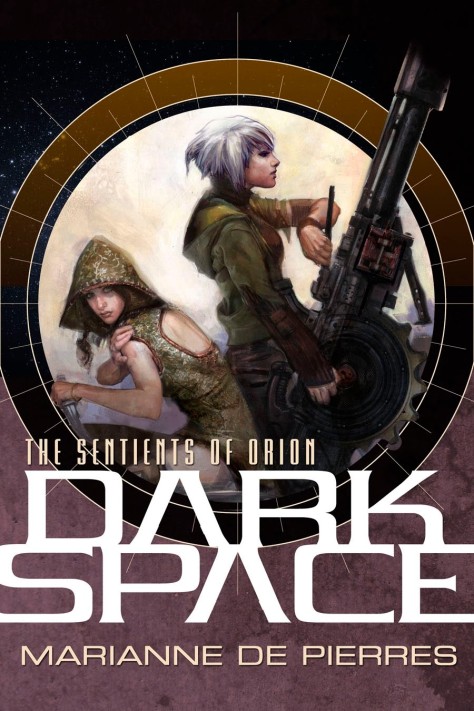
Dark Space is the first novel in the four book serial calledSentients of Orion. Orion refers to the stars and sentients are all intelligent humans and non-humans residing there. Among those non-humans we find dePierres’ favorite little creatures, the tardigrades/water bears (called Sacqr by dePierres). Except dePierres’ Sacqr are a bit overgrown and fond of invading mineral-rich Araldis for food in the form of humanesques. We quickly learn that the Sacqr have been brought to Araldis for nefarious reasons.
Baronessa Mira Fedor is our man character. In Dark Space we follow her from the time she is about to graduate and become Pilot First (intuitive able to bond with the biozoon Insignia). Except Mira learns at her graduation ceremony that her ability is to be removed from her because she happens to be a woman. Women on Araldis are only appreciated for their child-bearing ability. Upper class women are not allowed to learn to defend themselves and are socialised into a sex-slave thought pattern from the time of birth. Mira Fedor is not quite at that point when we first meet her, but she is about to learn some pretty harsh lessons about survival and the dangers of such misogyny.
Don Trin Pelligrini is the spoiled, self-absorbed son of the Principe of Araldis. Trin happens to be the one who was supposed to receive Mira’s innate ability. His life until we meet him has consisted of getting what he wants, when he wants it and at whatever cost it may be to others. He, too, is going to learn quite a bit about his real worth to the world he lives in and possibly about his ability to survive. If survive he does.
Jo-Jo Rasterovich, is the first humanesque to meet the “god” Sole. His meeting has become famous and Jo-Jo has assembled quite a fortune due to it. Except something about that first meeting keeps on nagging at Jo-Jo’s consciousness. Why would this “god” wish to be discovered at the time that it was? What really happened that Jo-Jo seems unable to remember?
Tekton, the God-head, from Lostol gets exactly what he asks for in his meeting with Sole. What I have learned from reading extensively about fictional and real lives is that what we think we wish we had, might not actually be what we really want. Greed, ambition and paranoia guide Tekton’s wish. Let’s face it. Giving in to the three of them all too often brings out the worst in ourselves and often in others as well. No reason why dePierres’ Dark Space should be any different in that respect.
There is one thing I found really strange about dePierres’ creation. Humanesques of various origins are able to interbreed, making for interesting variations. I can see how they would be able to have sex in some cases, but breeding seems a bit far-fetched.
My view of the nature of people is pretty bleak, yet for most people alive life is bleak. If you have a roof over your head, a bed to sleep in, enough food and clothing and semi-safety you are better off than 70% of the world’s population. All of this makes it understandable that some of the choices made by the privileged 30% are considered cruel – not to mention the choices of the top 20 or top five % of the world’s population. Trin and Mira drop abruptly from the life of the privileged 1% of their world and join the rest of the people who fight to stay alive. Dark Space is bleak, filled with action and full of people learning to adapt or die. I liked Dark Space and struggled to put it down.
This cover by Sharon Tancredi is wonderful. I love the feeling I get while looking at it and the spirit of the main character Jane that she manages to convey in her drawing.
As time has passed and I have written many reviews, I have come to realise that how my head works when approaching a novel has changed. Instead of reading all books as if they needed to be judged by the same ruler, I am now able to divide my thought processes into categories. By doing this it feels as though I am bringing my Aspergers into play instead of trying to bypass it and be “a regular” reader.
Along with several of my early reviews, this one of Tracking the Tempest is an updated one (June 2014 instead of May 2012).
I consider this a true series. Even though I had not read Tempest Rising, I had no problem beginning with number two. Necessary background information was shared without info-dumping and Jane’s relationships with various people were fairly self-explanatory. Tracking the Tempest starts off with Jane working hard to learn how to control her magic and especially how to shield herself.
The light wavered, stilled for a split second, and then winked out of existence. I couldn’t help but close my hand with a little flourish. Now that I couldn’t blow anything up, I was allowed to be pleased with myself. That was the first time I’d managed to create and disperse a mage light start to finish.
“Who’s your daddy?” I demanded rhetorically, doing a little happy dance.
“He died centuries ago; you wouldn’t know him,” Nell replied, coming toward me. “Stop hopping about and shields up.”
One thing I appreciated about Jane is that she is a regular person (despite being a halfling and despite Peeler’s tendency toward hunky men for Jane). I stink at the romantic stuff. Absolutely do not get why romance has to be so mushy (to my husband’s great frustration). Asperger people might be the greatest killers of romantic moments that exist. So not understanding all of Jane’s worries and frustrations about Ruy is just the way things work for me. Let’s just get to the sex is the way I tend to think.
But Peeler makes the romance funny. The way sex and so-called romantic moments tend to be. That I can appreciate and I did. I love it when an author makes sex steamy but also when an author makes sex ridiculous.
One of the comments I read on the novel said something about the Boston Public Parks not being closed at night. I checked that out by googling and that was correct. Living in a stinking rich neighborhood is not a prerequisite for a stinking rich person, so I felt that the same person’s comment about Ruy living in Bay Village didn’t really fit. His personality (what I understand of it) does seem to work with Bay Village.
This is another thing I have learned to do with my reviews. Categories are incredibly difficult for me, so I have to read other people’s reviews so I can place these books in the proper category. Which is why I have ended up adding links to other reviewers at the bottom om my own reviews.
Tracking the Tempest also seems to be about giving in to truth, in Ruy’s case accepting that his wishes for how the faery world operates might not have much to do with reality. Having been in that situation myself, I can sympathise. Once upon a time I was Mormon. Eventually my cognitive dissonance grew out of bounds, I checked out some facts and there flew my beliefs away into the sunset. Ruy seems to be at this same point himself. A point where you realise that your support of something has been abused and you yourself allowed it.
Poor Conleth. Something is mighty strange and wrong about his killings and obsession with Jane. And what a childhood. Hmmm. Perhaps he needs to be pitied more than hated.
Jane discovers that her lack of knowledge about the faery is even greater than she had thought. While she seems to have taken everything in her stride thus far, perhaps a point comes when more knowledge becomes too much knowledge.


 at
at  and
and  .
.

 .
.



 humanitysdarkerside