Tag Archives: #Shapeshifters

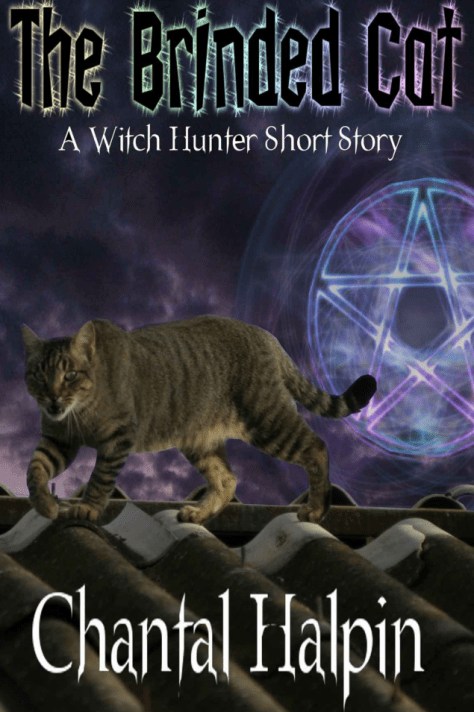
Halpin, Chantal: The Brinded Cat (Witch Hunter) (2013)

Cover art by Chantal Halpin's daughter
Cover art by Chantal Halpin’s daughter

I like Sam’s (Samhain) character. Upon beginning this review I looked for further literature about our magically-challenged witch. There is a novel (Death’s Daughter) in the inning, but I do not know when it is going to be published. The Brinded Cat (striped cat) is even more fun than Foul is Fair.

Witches and their cats! Or maybe it is witches and their familiars. In this case Mrs. McGinty’s cat is caught in a tree and Sam is asked by her boss, Fin, to climb up and rescue it. Fin is involved with Mrs. McGinty and therefore amenable to granting her small favors, but Fin is also afraid of heights. So Sam has to step into the fray and keep Fin in Mrs. McGinty’s favour, and she does. That is after all what good friends do. We support our friends in their affairs of the heart, but only to a certain point.

When Sam meets Mrs. McGinty’s cat, she realises that perhaps the cat needs rescuing but not rescuing from the tree. And off we go.

Sam is adorable. Ms. Halpin has made her strong, vulnerable, insightful, experienced and funny. I think perhaps I like people who protect under-dogs (well, in this case a cat). The vulnerable need protecting and once upon a time Sam herself found such protection when she most needed it.

How old would you have to be to read The Brinded Cat? Well, The Brinded Cat is safe enough for a five-year old to read the story, but I doubt they would get much out of it. There is extremely little violence and no sexual content. Beyond that I haven’t got a clue. There is plenty of action, some fighting, lots of magic, and a look at trust.

—————————–
Review:
—————————–
Words: 10,460
Language: English
ISBN: 9781301757695
—————————–
My review of Foul is Fair
—————————–

Cane, Laken: Blood and Bite (Rune Alexander II) (2013)

Blood and Bite

Blood and Bite was given to me as a reviewer’s copy.

As you all know I loved the first installment of the Rune Alexander series, Shiv Crew. Talk about dark. I am going to state one major complaint about Blood and Bite. It was simply too short. Way too short. I was having this humongously fun time reading it and then it was over. Bummer.

So now you know. I liked Blood Bite. There were still the “baby’s” that I thought were weird. Norwegians just don’t go around throwing endearments at people we like. I kind of wish we did.

Shiv Crew is still adorable. I want to give them all a big hug. You’ve got this gang of huge (except for Rune and Lex) guys running around killing monsters in monstrous ways and I want to give them a group-hug. I must be messed up.

The characters that are the most fun in Blood and Bite are Rune and Ellis. I think that these two characters are the ones that kind of carry the story or maybe the idea of Shiv Crew. Ellis is Shiv Crew’s assistant but also their mascot and heart. At least that is the way Rune feels. Without him she thinks she would fall apart. And Rune might be right about that. For in spite of her stay with the shrinks at the rehab Rune is still messed up, although she is dealing more sensibly with her “monster”. Her mantra has become: “I am my monster, and my monster is me.” Rune’s monster loves fighting. Rune is not averse to it either. If there is one thing she excels at it is fighting. Along with the fighting Rune instills a sense of loyalty in those who work with her (nut-cases excepted).

There are a couple of nut-cases in Blood and Bite. Nicolas Llodra, the vampire master, and Tim Emerson, the Church of Slayers, are the worst ones in Rune’s life at the moment. Nicky has gone bonkers. Insanity seems to be the doom of all vampires. Whether Rune is one is kind of difficult to say. She believes that herself, but we as readers are given hints that there is something else in her blood. Insanity is the one thing that terrifies Rune and killing Nicholas seems a mercy-stroke to her. If only he wasn’t holding something over the heads of Shiv Crew.

Tim Emerson is a nut-case in a human manner. We all know that the worst monsters out there are humans. When we go bad we seem to go all out. Fanaticism just gives us that push to do what we might otherwise hesitate to do. My opinion is that Tim Emerson would have been a cold-blooded monster even without the Church of Slayers. But getting rid of Emerson without proof is difficult.

Raze, our rat-loving, Shiv Crew member is out of jail and Shad returns from Philadelphia with his wife and son. Gunnar the Ghoul is stranger than usual. Ellis is having trouble in his love-life. And – to top it all – Rune’s house is burned down. Hurrah, let’s just give the girl another challenge.

I think there are probably authors out there who love to make the lives of their main protagonists as difficult as possible, and I suspect Laken is such an author. But it makes for a fun time for the reader.

Anyways, have fun. Oh, and there is no sex but some explicit violence.


My review of Shiv Crew

Hoyt, Sarah A.: Draw One in the Dark (Shifter) (2006)

Draw One in the Dark
Cover art by Veronica Casas

Draw One in the Dark made me think about what it must be like to be a foster-kid and a homeless kid in the US. I haven’t been a foster-kid anywhere. Nor have I worked with foster-children and am therefore unqualified to speak about its reality. But I have wondered what it must be like. That and being homeless. I’ve read books and articles about both but that doesn’t show me the way the minds of people who have been in the foster-system and living on the street work. How would this affect a person’s ability to deal with situations? Let’s say you throw in being a shape-shifter on top of that. And on top of that you aren’t really sure if you are a shape-shifter or if you are just having psychotic episodes that leave you covered in blood every once in a while.

This is the point that Kyrie Smith and Tom Ormson are both at when Draw One in the Dark begins. Some months after meeting each other they both receive revelations about their nature and are thrown together into one dangerous situation after the other. This means that life becomes even more chaotic for the two of them but they soldier on as best they can.

That tells me something about resilience. For regular people soldiering on can be difficult enough but for kids with an atypical background soldiering on must be even more of a struggle.

To my way of thinking Draw One in the Dark is partly about resilience and partly about bravery. It is also about messed up people making messed up decisions and living with the consequences of those. Trying to make amends as best we can is one of life’s major lessons. What has been done can never be fixed, but maybe/hopefully some of the pain we inflict can be lessened.

Draw One in the Dark is an easy to read young adult urban fantasy novel that is of pretty average quality. But it spoke to me and helped me clear up a couple of things in my head. Oh, and I really liked the cover art (roar, my name is dragon).


Reviews:


  • Hardcover: 320 pages
  • Publisher: Baen; First Edition edition (November 1, 2006)
  • Language: English
  • ISBN-10: 1416520929
  • ISBN-13: 978-1416520924
  • Shop: Amazon (US)

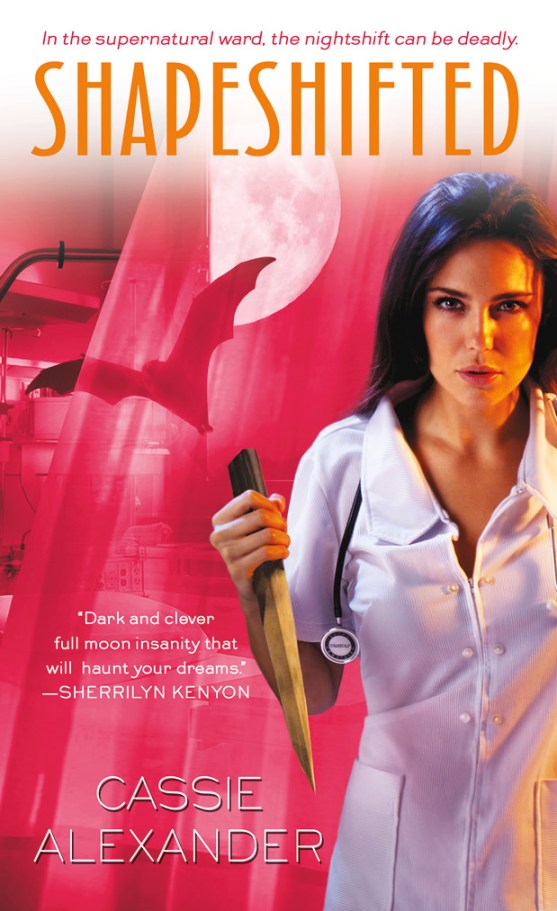
Alexander, Cassie: Shapeshifted (Edie Spence III) (2013)

ShapeshiftedFinal
Cover photo illustration by Aleta Rafton
Cover design by Kerri Resni

The Catholic church is a fascinating church. Within its realm we find people praying to both official and not quite so official saints to get these saints to function as mediators between themselves and God. Santa Muerte (the Skeleton Saint) is one such unofficial saint (a folk saint) – one that people pray to in spite of the priest’s condemnation of her.

For some strange reason the followers of The Godmother are persecuted in both Mexico and parts of the US. Human nature being what it is this has only led to an increase in the Saint Death‘s popularity – in some places eclipsed only by Virgin Mary worshipping. Santa Muerte is The Personification of Death itself and is considered very powerful. People pray to her on issues of health, money, love and so on.

PaleHorse Santa Muerte
Pale Horse Santa Muerte

In Shapeshifted the Lady of the Shadows seems to have disappeared. When Edie seeks help for her mother, the condition for getting help from the Shadows (from the sub-basement of County Hospital) is that she find Santa Muerte for them and inform them of the Skinny Lady‘s location.

Edie has no clue as to who/what the Holy Girl is. So she does what most of us do – goes on the internet. While looking for the Pretty Girl Edie finds a job in a poorer and criminally challenged part of town. The reason she applied for the job is because of a picture on the net of a huge mural of the Black Lady on the wall of the clinic. Unfortunately for Edie her lack of Spanish is a huge minus but due to how she deals with a crisis she gets hired.

Without knowing it, Edie is firmly back in the midst of the supernatural world and is once again going to have to fight for the lives of her friends and herself. Even though Edie felt she was getting a grip on what the supernatural world entailed, she finds her beliefs and values challenged. Not only must she find Santa Muerte, but Edie must also discover how much she believes in freedom of choice.

—————————-

Reviews:


My review of: Nightshifted and Moonshifted

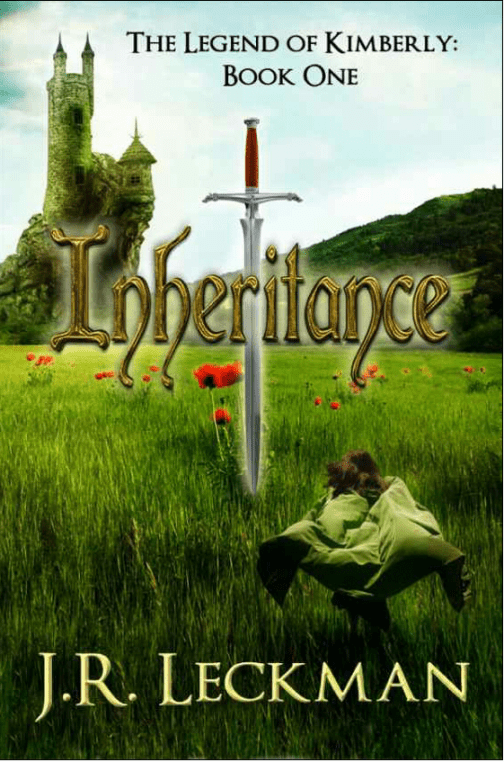
Leckman, J.R.: Inheritance (The Legend of Kimberly) (2011)

Inheritance
Cover art by Isabell Weise

I am really glad I read Inheritance and doubly glad I am not Kimberly. Her father and brothers are crazy violent. Because of the abusive parts of the novel some of the reviewers out there have disagreed about the age-appropriateness of the story. Kimberly is 14 herself, but I think that kids younger than that would be perfectly fine with Inheritance. As usual my advice is that if you are an adult wanting to get this for a child that you read it yourself first (or read it with whomever the intended audience is).

I wonder what it would be like to know that I was going to die at a specific time? Hal Stone does. He tells his “fox” friend Ip that he will die that same evening. Rather than fight it, he makes certain the last of his preparations are finished.

Hal Stone is the author of a YA fantasy series about the land of Auviarra. His success in the book-world is not reflected in his family. His son, Nathan, is utterly and completely mad/insanse/sociopathic … Just add any adjective in this category and you could describe him. Two of Hal’s grandchildren seem to follow in the shadow of their father while the last one seems to be less under his influence and more under the influence of Hal. This, of course, is Kimberly.

Kimberly is a typical child of an abuser. She will do anything to avoid enraging her father all the time knowing that nothing she does stops his rages when he wants to get at her. Novels like Inheritance make me wonder about the future of such children. Even when she gets to Auviarra, and apparently away from her abusive family, Kimberly still cannot get away from their influence.

Ip transfers his loyalty from Hal to Kimberly. Ip is much more than the fox that Kimberly thinks him. He is a creature originally from Auverria and is some sort of shape-shifter. When Kimberly ends up in Auviarra he comes along for the ride.

I try to remember my mentality at 14. How would I have managed to deal with the life Kimberly has been dealt? Hmmmm. Difficult to say – partly because it has been an eternity since I was 14.

I like Kimberly. I also like the troupe she ends up with. They are a combination of different qualities, making their whole so much more than one of them.


Facebook


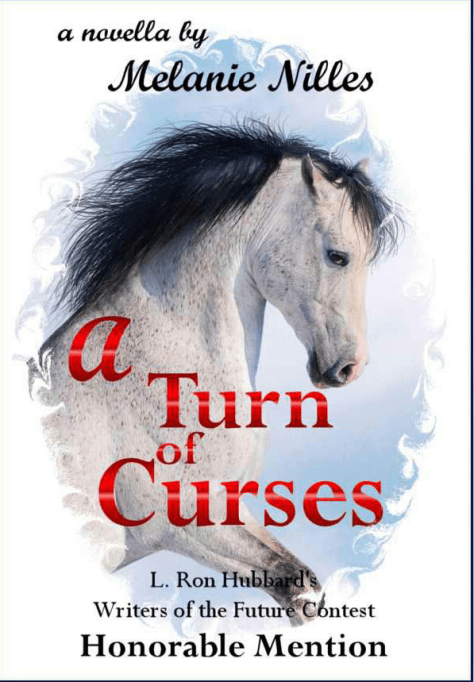
Nilles, Melanie: A Turn of Curses (2008)

A Turn of Curses
Cover art by Melanie Nilles

A Turn of Curses is a novella about 66 pages long. You can get it in a PDF version on the author’s website. With only 66 (or 29 in PDF) pages A Turn of Curses is a short and easy read (unless you are dyslexic).

Selina is an incredibly dedicated healer. In spite of knowing that as soon as one end of her mark touches the other she will die, she keeps on healing all who need it. Would I have this kind of dedication? For the poor she is a gift. A healer willing to heal all regardless of class is unpopular with the priests. As they see it the healing gift should be reserved for the “deserving classes”.

For some reason Faldon, a feyquin (horse shapeshifter) has decided that he needs to stop Selina from reaching her next destination. What we get is a battle of wills.

What did this story give me? Well, as stated above it made me think about how dedicated I would have been myself to helping others? If I knew my life was on the line would I have kept on going? I hope I do not have to find out. Selina’s ability to accept life for what it was impressed me and the ending fit with the story. Sad is just part of life.

—————————

Reviews:


—————————

2008: Honorable mentions in the L. Ron Hubbard Writers of the Future Contest

Green, Amanda S.: Nocturnal Origins (Nocturnal Lives) (2011)

Nocturnal Origins
Cover design by Sarah A. Hoyt
Cover art by Thomaspajot, Ejb1287, Andreas Meyer and Sergey Markov at Dreamstime.com

I love it when an author gives me good details on their covers. A few include this on their copyright page, others on their websites and some again I have to contact. Thus far each author I have contacted has been kind enough to share the details for their cover artists. Yeah! to authors. In Amanda S. Green’s case I was just too blind to see the names on the copyright but she still gave them to me.

Below you will find three reviews for Nocturnal Origins that showed me what the rest of the world (well, three people) thought of this novella. They have a pretty good description of the contents of Nocturnal Origins.

My first impression of Nocturnal Origins was humour. We get it in the 5th paragraph on the first page. Mac describes her “unholy” miracle of coming back to life with these words: “Ask the poor attendant who’d run screaming from that cold, desolate room in the hospital basement, when Mac had suddenly sat up, gasping for breath and still covered with too much blood. He’d been convinced a demon from Hell had risen to come for him.” The visualisation with those words was excellent and hilarious.

Mac’s would-be murderer is insane. Completely and utterly insane. He just has to kill her and damn the consequences. Serial killer is what he is and a gory one at that. I kind of feel sorry for him because he is so lost to his own psychosis.

And then Mac has her whole world view blown apart. I mean shape-shifters and weres. Come one. They don’t exist. Except in Mac’s world they do and drumroll she is one of them.

Nocturnal Origins is meant for a somewhat adult readership. I had fun reading about Mac’s surprises and her reaction to them. Better her than me (or is it “better she than I”).


Amanda S. Green logo


Alexander, Cassie: Moonshifted (Edie Spence) (2012)

Moonshifted is as delightful as Nightshifted. Moonshifted remains as dark and gory as Nightshifted and keeps on being just as fun to read.

Edie’s life has changed after all of the happenings in Nightshifted. Her perspective has widened and her prejudices have been challenged.

Due to an accident Edie witnessed during her lunch-break, she becomes involved in a battle between two were-wolf clans. Little does she know where her instincts will lead her.

Her vampire connections keep on popping up, and not in a pleasant manner. In a sense Edie seems rather self-destructive. However, once we get to know her, we find that it isn’t so. Yes, she is attracted to rather “interesting” men. Yes, she tends to run towards danger. But her motives are anything but self-destructive.

Like I said about Nightshifted: Edie is a wonderful character and someone I would have liked to have met.

Good job Cassie Alexander. You have done it once again!

Cheek, Kater: Mean Little Kitty/Waiting Room at the Hero League (2011)

The really great thing about crazy authors is that they are hilarious. I couldn’t help visualising the scene in Mean Little Kitty where the mom in the story looked for her son all over the place and ended up naked on the roof. I’m serious, you just have to read Kater Cheek’s family description.

Waiting Room at the Hero League was the same. Ms. Cheek made the whole thing seem real and brought me into her story. I loved the powers the super-heroes had. That and the ruckus they just happened to cause. Priceless.

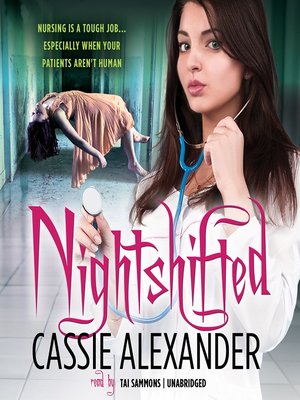
Alexander, Cassie: Nightshifted (Edie Spence) (2012)

Cassie Alexander

Cassie Alexander’s debut into the world of urban fantasy comes in the form of her Edie Spence trilogy. Her real-life job as a registered nurse serves as inspiration for her novels about registered nurse Edie Spence. I am pretty certain these books are targeted at an adult readership

Cover for audiobook

Choosing Edie Spence as her protagonist is probably the best move Ms. Alexander could have done. Edie isn’t afraid of a little/or a lot of blood and gore and finds that her nursing skills come in handy in her new night job.  She had previously worked as a regular nurse working with regular people. To protect her drug-addict brother, Edie made the choice to sign up for hush-hush work at a hush-hush facility at County General. Remember that the next time you go to your own County General. Somewhere below-ground there just might be a secret facility catering to the health needs of the super-natural/para-normal community.

Being on the nursing staff taking care of the rather unusual clientele of zombies, vampires, shape-shifters, weres, etc. can be a bit dangerous to your health. Ms. Spence discovers this when she is present at the death of Mr. November. Because of her nature, Edie ends up looking after a vampire, being chased by a vampire and falling for a zombie. One might just say that her life became a little more challenging after her introduction to the “Other” side of reality.

Nightshifted is a fun and dark novel. Edie is a wonderful character and someone I would have liked to have met. Sometimes authors manage to make their characters seem so real and believable, the way Cassie has managed with Edie. Good job.

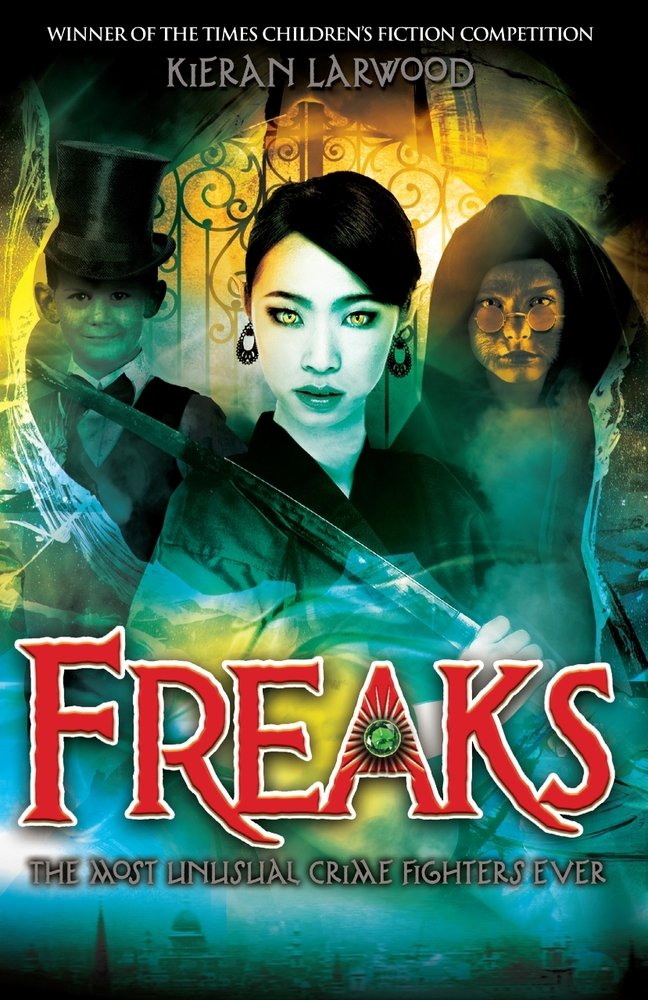
Larwood, Kieran: Freaks (2012)

Freaks cover

Freaks  is a mystery with some very unlikely detectives. Detectives who work in a freak-show are kind of visible wouldn’t you say? It must be difficult to blend in when necessary. But this novel occurs in the chaotic and messy London of the 1800s.

Sheba, the were-something (we don’t know at the beginning of the book exactly what she is) is the main attraction of the Grunchgrindle’s World of Curiosities at the end of Little Pilchton pier. One day a man (Plumpscuttle) buys her and the other attraction (a two-headed sheep) for his own show and takes her to London. There she and the other “freaks” of the show set up for the public every evening.

One evening a mud-lark named Till manages to sneak in and befriend Sheba. When Till goes missing her parents come to the show to ask for help. It turns out Till is not the only one who has disappeared on the mud-flats. Then one day, the gang gets a break in the case.

Freaks is a fun read. It has everything a 10-year old would like. The Monkeyboy likes to throw snot and earwax at the public, a ninja is part of the show and so are rats and a giant. London stinks terribly, there is a monster and the gang gets into strange and dangerous situations. Larwood has written a mystery with plenty of humor and action.

Kieran Larwood‘s daytime job is as a Reception class teacher at a Primary School. After working towards being published for quite a while, Freaks finally won The Times/Chicken House Children’s Fiction Competition 2011 and publication was in the box.

Briggs, Patricia: Sianim series

Map of Sianim by Michael Enzweiller

Patricia Briggs was born in 1965. Her joy in storytelling manifested itself early, and scaring her friends (including her husband Mike) was one of her funner hobbies. Patricia kept her story-telling abilities alive through college and her life in Chicago. When she and Mike moved to Montana she got the peace and quiet she needed to finally sit down and write, and she was able to publish Masques in 1993. Then Steal the Dragon followed as her next novel. After that one novel has followed the other. In the Sianim series Wolfsbane was the last one published thus far in 2010.

For best effect, the books should be read in this order: Masques, Wolfsbane, Steal The Dragon, When Demons Walk.

MASQUES (1993)

My version of Masques is the reworked one. Patricia Briggs writes a foreword warning the reader of this. Due to the years that had passed since the first edition of Masques, Briggs and her editor felt it appropriate to remove some of the traces of an author’s first attempt. The book is supposed to be full of clichés, but I’m lucky because I would not recognize a cliché if it bit me on the backside of forever.

Geoffrey ae’Magi is gaining in power and followers. Ren, the spymaster of Sianim sends Aralorn off to see about a death-threat to the magician. At the time, Aralorn felt that switching places with one of the other slaves would be a good idea. With green magic as hers, she is able to change her physical appearance. But while at a party the Archmage is holding for various dignitaries, Aralorn changes her mind. She has been placed in a cage wearing the illusion of a snowfalcon form the ae’Magi has created. But one of the visitors seems to see through the illusion. The King of Reth comes up to Aralorn asking if she is in need of help. She says no.

After the party the Archmage asks Aralorn a few questions. His magic is such that he can do the most horrendous things to people and still have them adore him. Aralorn is not sure how long she will be able to endure her stay with him. When she discovers that his plans for her include her demise, she decides to run.

With her companion Wolf and her war-horse Sheen, Aralorn decides to find a way to fight the great and beloved Archmage’s evil magic.

WOLFSBANE (2010)

Wolfsbane is a tightly-coupled sequel to Masques, and won’t make much sense by itself. Masques had not been a hit and Steal the Dragon hadn’t done all that well either. Briggs wrote Wolfsbane for her own enjoyment and left the book on her shelf. Eventually, she brushed the dust off it, and got it published.

Wolf has been missing for a few weeks and Aralorn has been dreaming dreams of his childhood. Someone seems to be looking for him in them.

Aralorn’s father has died, and Aralorn goes to attend his funeral. She has been gone from Lyon’s keep for ten years and finds it extra difficult that the circumstances are so sad. When she sees her father’s body, Aralorn discovers that Lyon is not quite dead. Instead, some kind of black magic seems to be involved.

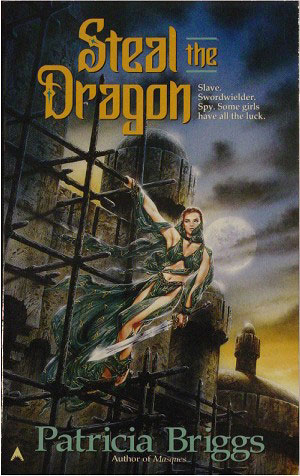
STEAL THE DRAGON (1995)

Steal the Dragon is the second book Patricia Briggs wrote. It wasn’t a great hit at the time, but did better than Masques. It has since become more popular.

Steal the Dragon is set a little later than Wolfsbane. Geoffrey ae’Magi is already dead, but not for very long.

In Sianam Ren, the spymaster, decides to send Rialla (former slave from Darran) and Laeth (brother to an important Lord in Darran) to Lord Karsten to try to prevent another murder attempt. Both are highly motivated to do so (Rialla after some convincing) for different reasons.

When they get to Lord Karsten’s keep they play their roles as slave and master. When another attempt at Lord Karsten’s life occurs, they become worried for his safety. Then Rialla’s old master turns up at the keep and the two of them realize that they have probably stepped into a hornet’s nest. It turns out they are correct.

WHEN DEMONS WALK (1998)

When Demons Walk seems to be a while after the previous three installations in the Sianam series. Like the others, When Demons Walk is light and entertaining reading. Patricia Briggs has her own style that is apparent in all of her novels. She is a good author, the quality of her writing is solid and her characters entertaining.

Sham is an orphan from one of the take-overs of the Prophet of Altis. The Cybellians have taken over Southwood, and Sham is left to thieving. Her master (she is a magician/wizard) does not approve, but he does recognize that other venues might be more dangerous.

Sham is surprised when she meets up with the Lord of Southwood – Lord Kerim. He is more likeable than she had thought, but still one of the enemy. But when attempts are made at various people’s lives (which include killing her master and trying to kill Lord Kerim), Sham put enmity aside and gives a helping hand in finding the culprit.

Hmm. All four books in the Sianim series are interesting additions to Briggs’ archive. I liked them. Like I said, Briggs does solid work. Michael Enzweiller’s maps are a great addition to her website.


SOURCES

Tolkien, J.R.R.: The Hobbit: There and Back Again (1937)

Cover art 1975 ed. by J.R.R. Tolkien

I wonder if I came to The Hobbit the same way everybody else has. First I read The Lord of The Rings. I loved it. Then I discovered that Tolkien had written other books and one of them was The Hobbit. I set out on a quest to go through all of his fantasy work. I should probably read some of Tolkien’s academical work as well, but alas. I have wondered at the sense of writing yet another review on the subject. Then I remember how much I liked The Hobbit and I think that there probably is room for another fan out there amongst the 1s and 0es.

David T. Wentzel 2nd ed. cover

John Ronald Reuel Tolkien was born on January 3, 1892 …. At the age of three his mother brought him and his younger brother, Hilary, back to England. Tolkien’s father died soon afterwards in South Africa …. When he was 12, Tolkien’s mother died, and he and his brother … lived with aunts and in boarding homes …. The young Tolkien … excelled in classical and modern languages … and began to create his own languages….

Tolkien wrote ‘A Middle English Vocabulary’, but it was not published until 1922 …. During this time he began serious work on creating languages that he imagined had been spoken by elves. The languages were based primarily on Finnish and Welsh. He also began his “Lost Tales” a mythic history of men, elves, and other creatures he created to provide context for his “Elvish” languages…

It was also during his years at Oxford that Tolkien would scribble an inexplicable note in a student’s exam book: “In a hole in the ground         there lived a Hobbit.” Curious as to what exactly a “Hobbit” was and why it should live in a hole, he began to build a story about a short creature who inhabited a world called Middle-earth. This grew into a story he told his children, and in 1936 a version of it came to the attention of the publishing firm of George Allen and Unwin.” (Tolkien biography, Tolkien Library)

Note:  On Thror’s map, east is up.

The Shire is an idyllic place to live. Middle-Earth’s rising problems have not yet impacted on the Hobbits living there, and they will not for quite some time. Bilbo Baggins is a seemingly average hobbit. Hobbits are shorter than humans, have furry feet (making foot-wear uncomfortable) and enjoy socializing. Bilbo lives contentedly in his hole in the ground on a hilltop.

Drumroll. Gandalf arrives. Thus far, The Hobbit has been a pleasant children’s tale, not really giving warning of anything nasty about to come. Gandalf is one of the very certain pointers to dangerous things coming one’s way. To begin with Gandalf’s visit is fairly pleasant. But then 13 dwarves appear, for some reason with the belief that Bilbo is supposed to be one of their party searching for the Lonely Mountains and the treasure of the dwarves. After a lot of convincing by Gandalf, both parties decide to give the adventure together a shot.

If you think children should only meet pleasantness, this is probably a good place to end the story. What comes after entails quite a bit of unpleasantness. But the unpleasantness is presented in such a manner that a child would probably want their parent to keep on reading (and you as a parent would want to keep on reading yourself). The Hobbit is certainly not only a children’s tale. It is very much for adults as well. But please do not try to analyze the book. Tolkien himself said that The Hobbit was what it was – no allegories or hidden messages were intended.

Riddles in the Dark by Alan Lee

I’m not really sure how much to reveal. This is a story that is about to be blown open by the movie industry. But until then, it might only be fair to the reader to keep some things under wrap. Tolkien introduces us to the mythology of England through The Hobbit. I’m certain his children loved the way Tolkien made English mythology so accessible for them. Through The Hobbit and The Lord of Rings we as an audience get to know old English beliefs about the world of the fantastic.

On his journey with the dwarves, Bilbo meets trolls. As a Norwegian I am very familiar with the troll myth. Trolls aren’t cute little key-chain trolls that you can get at souvenir stores. They are ugly, large and quite often stupid. Unfortunately for most of the people they meet, trolls are also capable of smelling their victims and finding them wherever they are. But there is one advantage to be had over trolls, and that is sunlight. They turn to stone if even a ray hits them.

Gandalf introduces Bilbo to Beorn by Michael Hague

Shape-shifters, on the other hand, are not a common Norwegian myth. Bilbo gets to meet one of them, in the shape of Beorn. As you might guess from the name, Beorn’s other shape is a bear and he is a fierce fighter. He is wary of strangers, but once he takes to you, he is willing to go to great lengths to help you.

The Arkenstone by Michael Hague

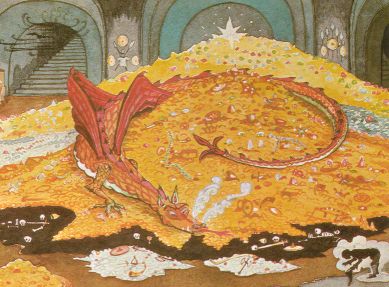
The other non-humans that the gang of 15 meets are elves, who are good for a given definition of good. Some of the baddies are wargs (great big hulking wolves), goblins (tend to want to eat you) and Smaug the dragon. Smaugs lair is where the treasure is (otherwise The Hobbit wouldn’t be as fun). Smaug is who we see on the cover above.

As Gandalf had predicted at the beginning of the book, Bilbo would not remain the same person as he went through his adventures. And this prediction comes true. A very changed hobbit meets us at the end of the book. He has discovered that he is capable of a lot more than he had thought possible. And if we absolutely have to look for a moral to this story, I guess that is as good as any. We are capable of more than we think is possible.

——————————–

AWARDS

1938: New York Herald Tribune Children’s Spring Book Festival Award.


For all of you Hobbit-nutters out there, you can now get the Latin version of the book. See Middle-Earth News for information.


Adaptations

Film

1966: A 12-minute film of cartoon stills by Gene Deitch.

1977: an animated version by Rankin/Bass. Nominated for Hugo Award for Best Dramatic Presentation. I’ve seen this several times on national TV and quite like it.

2012: planned release of film-version of the first installation in a three-part story by Metro-Goldwyn-Mayer and New Line Cinema. The Hobbit: An Unexpected Journey; The Hobbit: The Desolation of Smaug; The Hobbit: There and Back Again.

Awards

1978: Romeo Muller won a Peabody Award for his teleplay for the Rankin/Bass The Hobbit.


Stage

1953: First stage production by St. Margaret’s School, Edinburgh. Several others have followed later.

1986: The Hobbit (A Musical) was produced for the stage by Khandallah Arts Theatre in Wellington, New Zealand.

2001: The Atlantic Theatre Festival in Wolfville, Nova Scotia is presenting a production of The Hobbit.

2012: The Hobbit returns to The Maverick Theater in Fullerton, California.


Radio

1968: Radio-adaptation in eight parts for BBC Radio4 by Michael Kilgarriff. Was released on audio cassette in 1988 and on CD in 1997.


Comics

1989: three-part comic-book adaptation by Chuck Dixon and Sean Deming and illustrated by David Wenzel. Published by Eclipse Comics.


Games

1982The Hobbit, by Beam Software and published by Melbourne House. A copy of the novel was included in each game package.

1999: ME Games Ltd. was offered the licence to run Middle-Earth Play by Mail, an ongoing team-game based on The Hobbit and The Lord of the Rings.

2012: The Hobbit: Boardgame by Fantasy Flight Games.

Awards:

1983: The Hobbit (Beam Software) won the Golden Joystick Award for Strategy Game of the Year in 1983.

1995-1999: Fellows of the Academy of Adventure Gaming Arts and Design awarded the Origin Awards: Best On-going PBM Game: Middle Earth PBM Fourth Age (Game Systems).

1999: ME Games PBM was inducted into the Academy of Adventure Gaming Arts & Design’s Hall of Fame.


SOURCES:

Price, Kalayna: Haven series

First thing to be said about the Haven series is that the books are very easy to read and they do not take long to finish. In this case, easy is meant as a compliment. Both Once Bitten and Twice Dead are addictive. I’ve read them a couple of times and enjoyed them just as much each time. Both are heavy on action and low on romance (although there is plenty of tension between the two main characters). Kalayna Price has done herself proud.

ONCE BITTEN (2008)

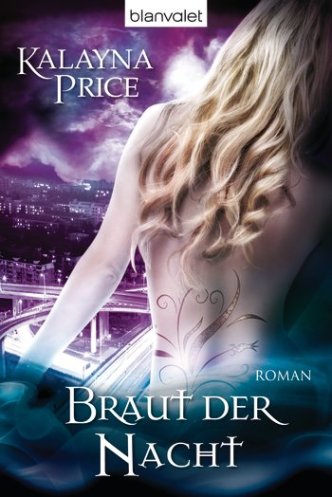
German cover

Young Kita is about to discover what it means to be both shape-shifter and vampire. Or does being a vampire cancel out being a shape-shifter? She is also about to discover what it means to crave blood. Let us just say that the longing makes her nauseous.

Once Bitten is the first novel in the Haven series. Kalayna Price is the author of this series. Her books tend to be in the supernatural/ romance/action categories. So too in Once Bitten.

Kita is on the run from Firth, a parallel world for shape-shifters. Her shape is a cat. In spite of her small size she is Dyre (the one to inherit leadership) and her father Torin. Female shape-shifters are forbidden Earth, which is why there are hunters on her tail. But Kita does not want to go back.

Her running takes her to the city of Haven, and Haven takes her into the world of vampires and scholars (magicians). Once Bitten is pretty much about Kita’s entrance into the world of vampires and the impact the change has upon her and her vampire sire, Nathaniel.

TWICE DEAD (2010)

Both Once Bitten and Twice Dead are urban fantasies set in the city of Haven. I found Twice Dead as good as Once Bitten. They are both light, easy, action-filled and fun to read. Kalayna manages to make her characters pretty three-dimensional (especially our main one – Kita). Focus is not placed on world building but on character building. In a novel of this length I find that wise.

In Twice Dead Nicholas is chastised and punished for not making Kita drink enough human and master blood. She is still a cat at heart and really finds the idea repugnant. Rabbit blood is OK, but human? No way. Therefore, the choice is taken away from her.

When the Collector comes to town wanting to question Kita about the deaths in Once Bitten, other deaths begin happening. Vampires are discovered without their heads attached and Kita is being framed for them.

Twice Dead is pretty much about resolving the mystery surrounding these murders, staying away from the hunters from Firth and trying to keep Kita alive. Enjoy.

THIRD BLOOD (2012) – Not yet published. I just wanted to show the planned new cover. Great, huh?

Briggs, Patricia: The Hurog duology

“The Five Kingdoms” by Michael Enzweiler

Patricia Briggs has written the Hurog duology. As you might have surmised from this blog she is quite a prolific writer. Her books fall into the light entertainment category. The Hurog duology’s version of the Briggsian world-creation is placed in a world reeking of the middle-ages with all of its dragons, shape-changers, magicians and various other people.

I absolutely loved the Danish covers. Wow, what a cool dragon. I don’t think I’ve ever seen an interpretation like that. And it fits with the dragon of the story. This is probably one of the better stories that Briggs has written. Ward is a wonderful character, caught in his own trap, yet never quite giving up hope.

DRAGON BONES (2002)

Danish cover by Bent Holm

Dragon Bones is a stand-alone novel. Its main character is Ward, heir to Hurog. What you need to know about Ward is that his dad was, to put it mildly, a monster. Child-, spouse and animal-abuse were his main hobbies. Until he had managed to damage Ward enough to affect his thinking, he saw Ward as his rival. So when he dies at the beginning of the book, it would be fair to say that Ward did not feel like grieving.

Unfortunately for Ward, the damage done to him had enabled him to pretend to be quite dense. Undoing other people’s perception of himself turns out to be more difficult than Ward would like. Discovering a damsel in distress and the secret of Hurog both play a part in enabling Ward to figure out how to show himself as someone to be trusted. This brings the king’s attention to the Hurog family, driven by his paranoia of the world being against him.

Ward comes across as a believable character. He clearly struggles with the long-term effects of his childhood. But in learning about Hurog’s very secret secret and some truths about the people around him, Ward manages to feel less alone in his struggles. One of the first things Ward must do in getting people to take him seriously is to prove himself a warrior, taking him and a small group accross the kingdom.

The story is told in first-person, through the eyes of Ward. This is part of what makes Ward such a real person, but it also shows us the world around him through his experiences. The people around him are clearly filtered through the life of Ward, making us care more for him and for the people around him. Dragon Bones is quite an enjoyable introduction to the world of Ward of Hurog.

DRAGON BLOOD (2002)

Danish cover by Bent Holm

While Dragon Bones is a stand-alone story,  Dragon Blood depends on the reader having some knowledge of the world. It continues the story of Ward, and in this case Tisala the rebel, and love of Ward. Neither book is a romance, something I quite enjoy. I’m weird like that. For some reason I both dislike romance in books and yet really enjoy it at times. Romance done the Hurog way is great.

The beginning of Dragon Blood is quite brutal. We come upon Tisala while she is being tortured for information about the rebellion that has been realized in the wake of Ward’s exploits in Dragon Bones. She escapes and runs to Hurog. This implicates Ward in the mind of the king and the king demands that Ward be committed for mental illness. All of this comes on top of Ward having to prove himself politically able to his little kingdom. One might say that Ward’s life has a bit more excitement than is good for a person’s health.

Hurog means dragon, and dragons are showing up on the door-steps of the kingdom once more. Dragons have played an important part in the whole kingdom’s past history, not only Hurog’s. Thankfully neither book is very graphic, enabling them to be read by a younger audience (not too young). Neither violence nor romance is explicit. Upon finishing the Hurog duology, I was left with a sense of wanting more.


<

p>Dragon Bones and Dragon Blood are available as audiobook.