Tag Archives: #Stratification

Meaney, John: Paradox (2001)

Paradox: Book I of the Nulapeiron Sequence (Bk. 1)

Cover art by Jim Burns

I’ve now read “Paradox” for the third time and am still enjoying it as much as the first. Because I’m a dork, I just realised that there are two more books to this series. Well, well, live and learn.

From the above I’m sure you can tell that I really liked “Paradox“. We get a large dash of philosophy, some biology, sociology, lots of action and a thoroughly likeable protagonist. Tom Corrigan is at the centre of our attention throughout the whole novel. He raises himself through the various layers of society through hard work, luck and other people’s ambition. There is no sugar-coating of our hero. He rises to the greatest heights and falls to the deepest depths of hell. Meaney is a really good writer.

Nulapeiron is a strange world. Semi-alive dwellings and vehicles. Subterranean demesnes layered from the poorest to the richest. At the very top we find the Oracles.

Tom Corrigan is witness to the brutal killing of a woman by the militia. She just happens to the same woman who gave him a small, seemingly insignificant info-crystal. Shocked to his core, Tom realises that she is one of the mythical Pilots.

This info-crystal, along with the Oracle Gerard, are the two things that push Tom onto a path that will take him to his destiny.

Weber, David: Honor Harrington

Field of Dishonor by David Mattingly

The Honor Harrington series by David Weber consists of 12 books:

  • “On Basilisk Station” (1992)
  • “The Honor of the Queen” (1993)
  • “The Short Victorious War” (1994)
  • “Field of Dishonor” (1994)
  • “Flag in Exile” (1995)
  • “Honor Among Enemies” (1996)
  • “In Enemy Hands” (1997)
  • “Echoes of Honor” (1998)
  • “Ashes of Victory” (2000)
  • “War of Honor” (2002)
  • “At All Costs” (2005)
  • “Mission of Honor” (2010)

The Honor series is military science fiction. Technical information is important. The series goes into detail about the various vessels Honor is on. It also explores the relationship between the kingdom of Manticore and the People’s Republic of Haven. Honor is a citizen of the Manticoran kingdom, originally from the planet Sphinx. Along with her is her bonded companion, the tree-cat Nimitz.

Honor and Nimitz end up being in the center of conflicts between the Peeps and the Manties. They survive impossible situations in space and on the ground and Honor really needs her brass ovaries to survive the gruelling conditions she often finds herself in. At the center of each book is the conflict between the Peeps and the Manties. There is always some kind of scheme by the Peeps to get the Manties to reveal their military strength or to get the Manties to join in war. Part of that is due to the instability of the Peep system. Governments come and go and in many ways it reminds me of Russia at the time of the revolution in 1917.

The Manties, on the other hand, have a monarchy with all of its attendant problems. There is a government pretty much like the government of the UK – Overhouse/Underhouse with the peers in the Overhouse and the commoners in the Underhouse. There is plenty of corruption and political scheming. Someone is always seeking more power, quite often at the expense of the Manticoran system.

Wikipedia gives an excellent summary of each book, but be warned of spoilers.

David Weber is a fun writer. There are political discussions, but they are placed in a context that make them interesting not preachy (mucho importante). Adventure, adventure, adventure and then some humor are important ingredients. There is some romance, but thankfully not much. My favorite book in the series is Echoes of Honor. It seemed the most different from the rest, and the action centered around a great deal of people, not just Honor.

UN: Women A World Report Part II

UN Women logo
UN Women’s logo

Sometimes a gem just drops into your lap. Our library had a book sale and I bought a bag of books for 50NOK. Inside I found this collection of essays from 1986. In connection with the end of UN’s 1975-1985 this status report was created. In it we find women who meet other cultures and report on what they see. This book was sponsored and compiled by New Internationalist, a cooperative specializing in social justice and world development issues. In addition to publishing its own magazine, it collaborates with the UN and other organizations to produce a wide range of press, television, and educational materials.

The essayists are:

Toril Brekke of Norway meets Kenyan women whose husbands have travelled to the cities to find work.

Angela Davis of the US travels to Egypt where virginity is of prime importance.

Anita Desai travels from India to Norway to investigate gender roles.

Buchi Emecheta of Nigeria travels to the United States to investigate the impact of the education boom on sex roles

Marilyn French of the US investigates the difference between middle-class and poor Indian women.

Germaine Greer of Australia meets the women of Cuba, women who are considered both active comrades and sex-objects.

Elena Poniatowska of Mexico investigates the effects of the sexual revolution on the women of Adelaide, Australia.

Nawal El Saadawi of Egypt meets women involved in political activities seeking to change the definition of family and society.

Manny Shirazi of Iran investigates the impact Soviet socialism has had on the female relatives she meets.

Jill Tweedy of England meets the first generation of literate women in Indonesia

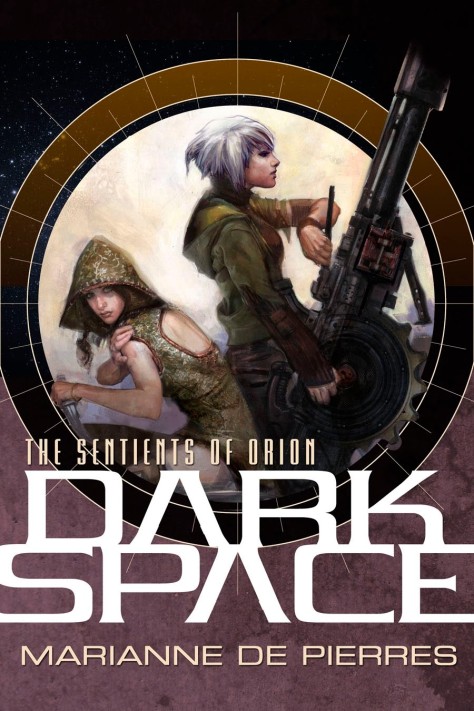
dePierres, Marianne: Dark Space (The Sentients of Orion I) (2007)

Dark Space - Marianne de Pierres

Dark Space is the first novel in the four book serial called Sentients of Orion. Orion refers to the stars and sentients are all intelligent humans and non-humans residing there. Among those non-humans we find dePierres’ favorite little creatures, the tardigrades/water bears (called Sacqr by dePierres). Except dePierres’ Sacqr are a bit overgrown and fond of invading mineral-rich Araldis for food in the form of humanesques. We quickly learn that the Sacqr have been brought to Araldis for nefarious reasons.

Baronessa Mira Fedor is our man character. In Dark Space we follow her from the time she is about to graduate and become Pilot First (intuitive able to bond with the biozoon Insignia). Except Mira learns at her graduation ceremony that her ability is to be removed from her because she happens to be a woman. Women on Araldis are only appreciated for their child-bearing ability. Upper class women are not allowed to learn to defend themselves and are socialised into a sex-slave thought pattern from the time of birth. Mira Fedor is not quite at that point when we first meet her, but she is about to learn some pretty harsh lessons about survival and the dangers of such misogyny.

Don Trin Pelligrini is the spoiled, self-absorbed son of the Principe of Araldis. Trin happens to be the one who was supposed to receive Mira’s innate ability. His life until we meet him has consisted of getting what he wants, when he wants it and at whatever cost it may be to others. He, too, is going to learn quite a bit about his real worth to the world he lives in and possibly about his ability to survive. If survive he does.

Jo-Jo Rasterovich, is the first humanesque to meet the “god” Sole. His meeting has become famous and Jo-Jo has assembled quite a fortune due to it. Except something about that first meeting keeps on nagging at Jo-Jo’s consciousness. Why would this “god” wish to be discovered at the time that it was? What really happened that Jo-Jo seems unable to remember?

Tekton, the God-head, from Lostol gets exactly what he asks for in his meeting with Sole. What I have learned from reading extensively about fictional and real lives is that what we think we wish we had, might not actually be what we really want. Greed, ambition and paranoia guide Tekton’s wish. Let’s face it. Giving in to the three of them all too often brings out the worst in ourselves and often in others as well. No reason why dePierres’ Dark Space should be any different in that respect.

There is one thing I found really strange about dePierres’ creation. Humanesques of various origins are able to interbreed, making for interesting variations. I can see how they would be able to have sex in some cases, but breeding seems a bit far-fetched.

My view of the nature of people is pretty bleak, yet for most people alive life is bleak. If you have a roof over your head, a bed to sleep in, enough food and clothing and semi-safety you are better off than 70% of the world’s population. All of this makes it understandable that some of the choices made by the privileged 30% are considered cruel – not to mention the choices of the top 20 or top five % of the world’s population. Trin and Mira drop abruptly from the life of the privileged 1% of their world and join the rest of the people who fight to stay alive. Dark Space is bleak, filled with action and full of people learning to adapt or die. I liked Dark Space and struggled to put it down.


Reviews:


Dark Space on Amazon US

Morgan, Richard: Altered Carbon (2002)

Altered Carbon to be used

I like mysteries. Anything from Agatha Christie to Richard Morgan. They’re all the same, in a sense. Some crime happens and the detective (police or private) comes on the scene and (usually) miraculously solves the crime. The route from A to B varies, but in essence they’re all the same. That’s why they’re so fun.

Add mystery to cyber-punk. Cyber-punk tends to be cynical and dark. Altered Carbon sticks to that kind of tone. Maybe the whole concept of having our personalities stored and ready to be placed into new bodies is a theme that lends itself to exploitation and conflict. Imagine what a person holding immense power, such as the leader of a mega-corporation, could do with access to both bodies and personalities. The lure of power is what keeps the “baddie” of Altered Carbon doing their terrible deeds.

When Takeshi Kovacs, former United Nations Envoy and a native of Harlan’s World, is killed on Harlan’s World (humans now live on various planets in our galaxy) his personality is beamed from Harlan to Old Earth (good old Terra) for a mission where his only choice is do or die (or even do and die).

There he is expected to solve the mystery of what really happened to Laurens Bancroft. Laurens Bancroft is a Meth (Methusalem from the Old Testament). As the name indicates, Mehts live an incredibly long time through resleeving their personality into new bodies. Imagine living like that and the effects time would have upon you. I imagine that in order to choose such a path and to stay on it for centuries you would have to be somewhat of a psychopath. Otherwise you would probably go insane from every one else around you dying. Insane or not Mr. Bancroft’s death has the verdict of suicide. The reason Kovacs has been revived is due to disagreement about the verdict. Here we arrive at the who-dun-it.

Takeshi Kovacs is an enjoyable character. His past haunts him and being in a new body takes some getting used to. There is explicitness in Altered Carbon. I don’t mind that, but then I am 49 years old and not 15.

I like that Mr. Morgan has kept Kovacs alive past Altered Carbon. He is a character well worth knowing – complicated.


Altered Carbon won the Philip K. Dick Award for best novel in 2003


Movie rights have been bought but the film has not been released yet. Updates on IMDB.