Category Archives: Young Adult

Farrugia, Nathan: The Chimera Vector (The Fifth Column) (2012)

The Chimera Vector
Cover design by Keerati Sarakun and Patrick Naoum
Cover typography by Andrei Stefan-Cosmin
Edited by Nicola O’Shea

The Chimera Vector portrait

The Chimera Vector set me into research mode. I started looking into “chimera vector” and discovered quite a few articles on the research into this type of transportation on the net. I have included four of them below. Chimera: a DNA molecule with sequences derived from two or more different organisms, formed by laboratory manipulation.

According to Psychology Today a psychopath is a person who exhibits a long list of character traits. One needs to show a lack of empathy (cold-heartedness, an inability to feel deeply); show a lack of shame, guilt, fear or embarrassment at ones actions; a tendency to blame others for their own failures, or no shame if confronted; show a strong ability to remain focused on a task; appear charming yet have a tendency toward pathological lying, and they seem comfortable even when found out; incredibly overconfident, as if they cannot fail; impulsive; incredibly selfish and parasitic; lack realistic long-term goals; and finally be prone to violence.

In The Chimera Vector we get to meet several people who fit the bill of a psychopath. The whole concept of psychopathy or sociopathy is extremely fascinating. It is one of those terms that we bandy about as if being a psychopath was a common thing. Looking at the list above, I see many of them that could fit myself and most other people I know. But when I take a closer look at the people I meet, I think I can say that there is probably only one one person that I could definitely call a psychopath. Long-term planning was no problem for him at all and holding power is something he has definitely been concerned with. Power behind the throne, not the apparent one that is more image than real.

Power is what The Chimera Vector is all about. The lengths people are willing to go in their hunger for power. We see people playing power games every day – within families, at work and at play. But seldom do we see power games taken to the extreme that The Chimera Vector shows. But we wouldn’t, would we. That is the whole point of The Fifth Column. People must not see the games the leaders of The Fifth Column play, for their real power lies in their secrecy. To them all the death and mayhem they deal is part of the games.

Programming soldiers like Sofia, Jay and Damien into becoming unquestioning killer robots is fun. Killing innocent people to keep the world going their way is fun. Watching countries erupt into cauldrons of fire is fun. Power is fun. Fun and addictive.

I see all this and I believe it. The Chimera Vector is believable. If some scientist manages to discover how to create weapons like The Fifth Column use, soldiers like this will be developed. Perhaps I have too cynical a view of the world, but this is what I believe. History has shown us time and again that once a power-hungry leader gains control of research and development gruesome consequences evolve. In fact, history has shown us (and shows us) that in their grasp for power the world itself becomes expendable to the power-players.

And yes, I did enjoy The Chimera Factor. A great deal, in fact.

——————————–

Reviews:

——————————–

——————————–


I was given this novel by the author. Whether that affected my review is difficult to say. I’ve tried to be as objective as possible.
Nye, Jody Lynn: A Forthcoming Wizard (Tildi Summerbee II) (2009)

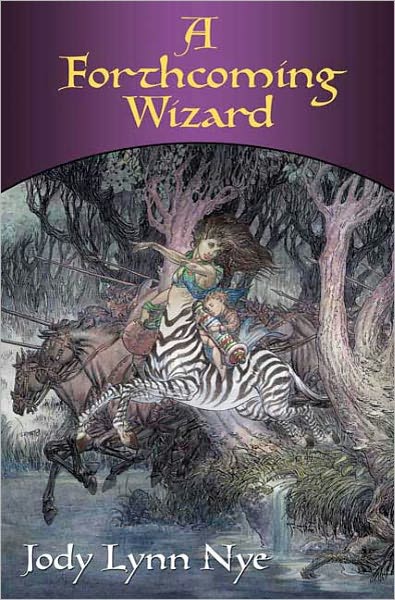
A-Forthcoming-Wizard-150841-d4902f8679c2f83a8362

A lot of the books I read remind me of issues that I regularly think about. A Forthcoming Wizard (and An Unexpected Apprentice) reminded me of the many times I have wondered about the concept of racism and the idea of “perfect/ideal”.

Back in the days the Shining Ones took it upon themselves to experiment with the knowledge they had acquired. Like all good scientist they asked themselves the question “I wonder what would happen if …”. Unlike the really good scientists, the Shining Ones forgot to ask themselves the next important question “If I do this, how will it impact …?”. The Shining Ones just went ahead and did what they wanted in the name of furthering their own knowledge often deceiving themselves as to the level of nobility of their choices. Oh, what tangled webs we weave. At one point some of them looked beyond themselves and saw that perhaps they had gone too far in satisfying their curiosity. All of them except Knemet finally came to see that there comes a point in one’s life when one has to acknowledge the consequences of one’s actions.

Is Knemet evil? Maybe amoral would be a better word for it. He doesn’t do things because they are bad. He just does whatever is needed to expedite his wishes. Knemet just wants the Compendium/the Great Book so he can destroy it, thereby ending what he considers his dreary life. But as we already saw in An Unexpected Apprentice, destroying the Compendium will destroy the world. He could care less, and that is why The Great Book must be kept from him.

In my review of An Unexpected Apprentice I posited the hypothesis that the Scholardom could be considered the “bad guy” of the story of Tildi Summerbee. I believe I retract that hypothesis. They base their actions on a certain set of traditions, values, and knowledge. Some of those actions are definitely in the category “bad” in that the actions are incredibly racist. But most of the Scholardom (at least the ones we meet) are teachable. Once they see that their own theories about purity were wrong/misguided, the Knights of Scholardom are willing to try and change.

Tildi continues with her growing pains. Challenging our own traditions and myths hurts. At least I know it did for me. Tildi managed that awful task of asking herself if what she thought was the “right way” might possibly be wrong or just one of many ways. Doing so changes the way she is perceived by others but more importantly how she perceives herself. Her friends both help and hinder her in this process.

The ending of the Tildi Summerbee saga is predictable and almost Disney-like. I think that will be a comfort for the younger audience.


Reviews:


My review of An Unexpected Apprentice

Angell, Lorena (co-authored by Joshua Angell): The Diamond Bearers’ Destiny (The Unaltered IV)

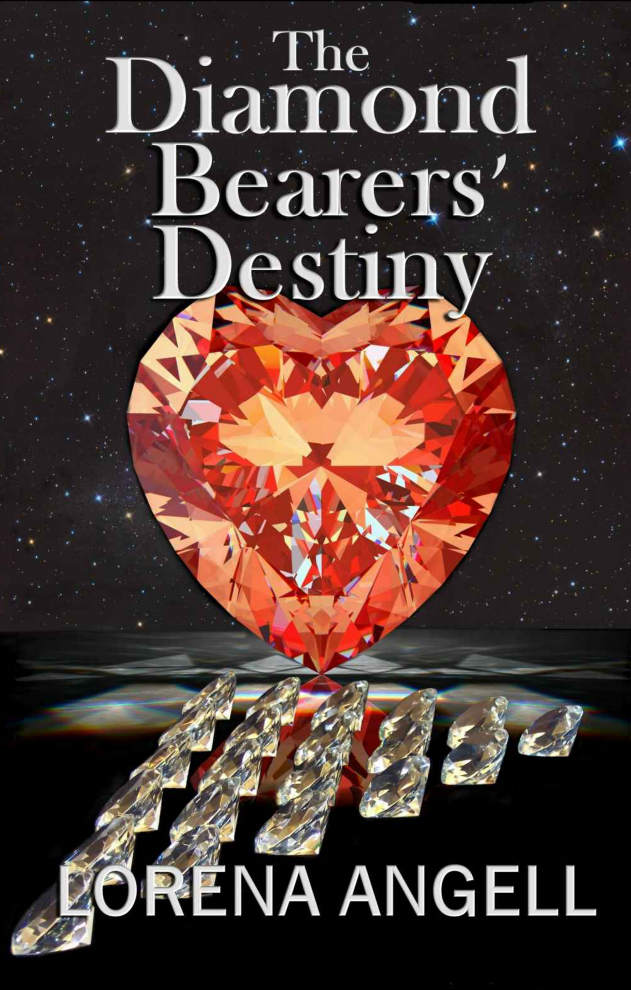
The Diamond Bearer's Destiny

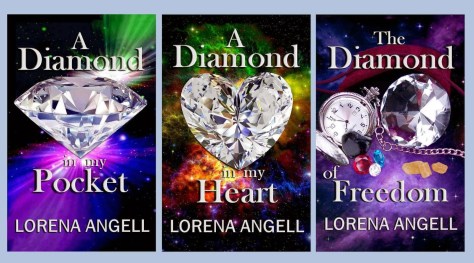
As with the previous covers for The Unaltered serial (need to read them in order) I really like this cover. As the very good thief I am, I stole a compilation of the three others from Angell’s site:

The unaltered series

Once upon a time a human became Crimson. She was the first human with a jewel inserted into her heart. Then came Mathea and later on others. With the abilities brought on by being Diamond Bearers these people were able to help humanity survive and to look for unaltered people. Unaltereds are the only ones who can become a Diamond Bearer and the only way to be an unaltered is to have no special powers at all. In the world of Calli Courtnae, Chris Harding and the rest just about every person has some degree of super-natural ability.

Then along comes Freedom (Henry) and General Harding (Chris’ father). Sometimes the combination of two people can bring about amazing results. In Freedom and General Harding’s case these results were amazingly destructive for people who have more than a smidgen of power. Trouble looms.

The Diamond Bearers’ Destiny starts off with an information dump that lets Calli know why Chris acted as he did in The Diamond of Freedom. For the length of the novel the info-dump is too long. I like the manner in which it was done – by having Calli read Chris’ memories.

Calli meets Crimson for the first time when she meets up with Chris and ends up reading his memories. Crimson tries to make Calli understand just how important she views the freedom to choose. Crimson’s explanation of her world-view is not too long in and of itself. On top of the information dump it is. Once Angell spread the philosophical moments with action we once again started moving into the action/thrillerish nature of the other three Unaltered novels.

The Unaltered serial is definitely for young adults. Both violence and romance is kept extremely innocent. I think even the strictest parents would allow their children to read this kind of content.

Although Brand doesn’t get to be as fun this time around, he does get to show off a bit. For those who are interested in romance, there is even some of that. Chris and Calli are a bit mushy for me, but then they have been all along. Very few romantic descriptions avoid my mushy label.

I found the consequence for Diamond Bearers who tried to go against nature interesting. Whether Calli stuffing the diamond into Jonas’ chest qualifies as one such action is a worry for Crimson (and Calli once she gets to know how serious something like that is).

In The Diamond Bearers’ Destiny Deus Ex and General Harding’s are both obsessed with having their own diamonds. Both are driven by fear of some other person being more powerful than themselves. Aahhh, the ever-present lure of power.

——————————-


My review of:

  1. Diamond in My Pocket
  2. Diamond in My Heart
  3. The Diamond of Freedom

Francis, Diana Pharaoh: Path of Blood (Path of Fate III) (2006)

Path of Blood
Cover art by Alan Pollack
Religion, faith, beliefs seem to control so much of the world’s humans. We allow ourselves to be steered by goddesses and gods who promise all kinds of things in return for our unfailing loyalty. Political systems seem to have the same kind of hold on people. I see how soldiers willingly put their lives on the line in travelling to far-away countries on the say-so of their leaders. In both instances motivations seem to differ from anything from undying loyalty to simple greed (although greed might not be such a simple matter).

Path of Blood takes us into both these worlds. Yohuac and his absolute loyalty to the nahualli’s and the goddesses and gods of Cemanhuatl is disturbing in its completeness. Reisiltark is no different. Like heroes in a great many young adult sagas she will do anything to save her country from destruction. That she happens to be a more or less “good” person is a lucky thing for Kodu Riik. What if she had made the kind of choices that Upsakes had – who also believed that he was doing the Lady’s will.

In spite of seeing what a terrible person Aare is (and it would take a completely blind and deaf person to avoid that) the Lord Marshal of Kodu Riik is going to swear loyalty to the man the moment he takes the Iisand’s throne. To him it is the throne he is swearing himself to and not the man. But life is never like that. It is always the person we end up swearing ourselves to and the values that person emotes. That is if we are looking at tyrannies, monarchies or dictatorships. Whether we choose to follow that person out of our own free will or because we are forced does not really matter in the end. What matters is what price our loyalty ends up having. I doubt I would have the strength to gainsay a person like Aare. His way of ruling is much too brutal and frightening.

Fortunately there are sometimes alternatives. In the case of Path of Blood we have the followers of Reisiltark and the rest of the rebels. These are the ones that managed to escape the steel grip of Aare’s followers. They have set up camp by Mysane Kosk in the hope of helping Reisiltark heal their land. I think I consider people like these rebels brave. They are the ones who have the courage to stand up to a tyrant and have put their lives on the line for their freedom. Sadly that is the consequence of power-hungry people – one sometimes has to take up weapons to stop them maiming the place one lives in and the people one lives with.

I’m not certain how I feel about Reisiltark herself. I don’t know if I really believe in her. Perhaps she is too much the anguished hero. In that sense she and Yohuac are a perfect match. She fills her role as hero perfectly. Heroes are supposed to be larger than life, have amazing values and be able to make difficult decisions on who has to die when trouble arrives. This very good and very bad cast of people is part of what makes a young adult novel. In my head Path of Fate is very much a young adult novel. There is violence, gore and darkness, BUT very little of it is descriptive and the dark is interspersed with light.


Reviews:


<

p>—————————————-

My review of: 

  1. Path of Fate
  2. Path of Honor

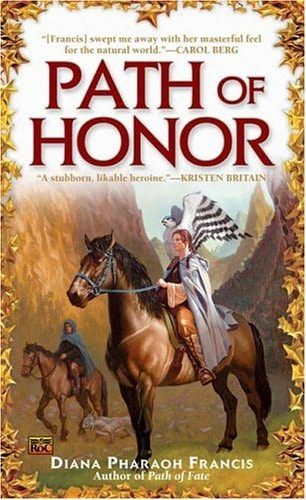
Francis, Diana Pharaoh: Path of Honor (Path of Fate II) (2004)

Path of Honor - Diana Pharaoh Francis
Cover art by Alan Pollack

One of the really interesting people in Path of Honor is Verit Aare. Verit Aare is the heir to the throne and eager to replace his father. As his father has been more or less absent the past six months, Aare’s lust for power is growing. Unfortunately for Koduteel (capital) and all of Kodu Riik Verit Aare is a psychopath/sociopath. While a lot of us have psychopathic traits, very few of us reach Aare’s level of sociopathy. According to Psychology Today one needs to show a lack of empathy (cold-heartedness, an inability to feel deeply); show a lack of shame, guilt, fear or embarrassment at ones actions; a tendency to blame others for their own failures, or no shame if confronted; show a strong ability to remain focused on a task; appear charming yet have a tendency toward pathological lying, and they seem comfortable even when found out; incredibly overconfident, as if they cannot fail; impulsive; incredibly selfish and parasitic; lack realistic long-term goals; and finally be prone to violence.

I feel certain most of you would be worried if a person like this lusted for the leadership of your country. Yet Aare seems to fulfil most of these criteria and for me that is the reason I find him especially fascinating and possibly revolting. Take how he treats his sister, the Vertina Emelovi, and what he does to his father’s hostage, Soka.

When Soka was nine years old his father had broken the terms of the hostage agreement. Something had to be done to avenge the wrong and it was decided that Soka would lose an eye. But the Iisand was not able to attend the removal and sent his son, Verit Aare, instead. Aare made the little boy remain awake during the procedure but had Soka drugged so he would remain docile while it went on. Finally, a map of Soka’s father’s lands was sown into the lid of his eye as a reminder of the deal. It had not been the Iisand’s intention that the procedure would be so cruel for the boy, but Aare liked the feeling it gave him.

Once again, Soka is in his power. Naturally, Soka is scared shitless. What will the Verit do to him this time?

On to Verit Aare’s sister. Poor Emelovi. She has to live with the man on a daily basis and he is not a good brother to have. Her fear of him is intense, yet he has kept his father duped as to the depths of his depravity. Perhaps that is because people tend to see what people want to see. Vertina Emelovi, on the other hand, is quite familiar with her brother’s cruelty. He expects nothing but complete submission. If she does not do what he tells her to, she suffers greatly. The first time she was made aware of that was when he killed her puppy because Emelovi had refused to dance with one of his friends. Since then, well. One does what one has to with such a maniac in the vicinity.

Aare does not like Reisil. He does his best to turn the court against her. Lucky him. Sodur (another ahalad-kaaslane team) has made his job much easier. On his part, Sodur did have the best of intentions. But what do intentions help when consequences are what determines the value of them. Poor Reisil, the consequences for her are stinky. Things are looking up for Aare when it comes to using his charisma and power-hunger against her.

Reisil is not completely alone. Kebonsat has come to court Emelovi on the chance an alliance between Kodu Riik and Patvermese might happen. Hmmm. Despite this task, Kebonsat does not forget his friendship with Reisil. Nor has Juhrnus. Reisil is thankful to have two such loyal friends on her side as it seems the rest of the powers of Kodu Riik have turned against her. But friends do turn up in strange places and sometimes lives change because of decisions one has made. She does have the “common people” on her side. But the common people do not have much power. Not really. Like us, the common people in Kodu Riik trust that the powers that be must be interested in the best of the country. Man, we are suckers, aren’t we.

Then two new powers turn up at court.


Reviews:


My review of Path of Fate

Francis, Diana Pharaoh: Path of Fate I (2003)

Path of Fate - Diana Pharaoh Francis
Cover art by Alan Pollack

Magic. Not all fantasy books include magic, but a lot of them do. Path of Fate is definitely about magic. We have the bond between the ahalad-kaaslane, Reisil-Tark’s evolving power and the power of the Patvermese magicians. All of these types of magic come together and open up a discussion about power, politics, gods and responsibility.

My rhetoric question of the day is: If you have power, do you also have a responsibility for how that power is used? Hell, yes!!! But just because you have a theoretical responsibility does not mean that translates into having to answer for your use/abuse in the real world. We all know that. Even I know that and I am not the best person in the world when it comes to paying attention to what goes on around me.

Reisil-Tark’s greatest role in Path of Fate seems to be to put a light to the abuses of power going on in and around Kallas during the story. We join her as her own sense of responsibility grows and embeds itself firmly into her mind and heart. Watching her come to realise that the people around her are not what she had thought/hoped for is an interesting process. It hurts when people we trust betray that trust. More difficult is seeing how we, ourselves, betray the trust of others. Reisil-Tark has to come to terms with that side of herself as well. My experience is that the reality of myself is the most difficult one of face. Being able to say that I screwed up or need to change a part of myself hurts. The pain is in many ways similar to the pain I have experienced whenever there has been need for surgery. This is the kind of pain I am sensing from Reisil when she has to come to terms with herself.

Path of Fate is Reisil-Tark’s story. She is an enjoyable character who does her best to deal with the life she has been given. Finding her strength in a world where she is pretty much alone is a process and we get to follow her on that journey.


Reviews:


  • Series: Path of Fate (Book 1)
  • Mass Market Paperback: 384 pages
  • Publisher: Roc (November 4, 2003)
  • Language: English
  • ISBN-10: 0451459504
  • ISBN-13: 978-0451459503

Canavan, Trudy: The High Lord (The Black Magician III) (2010)

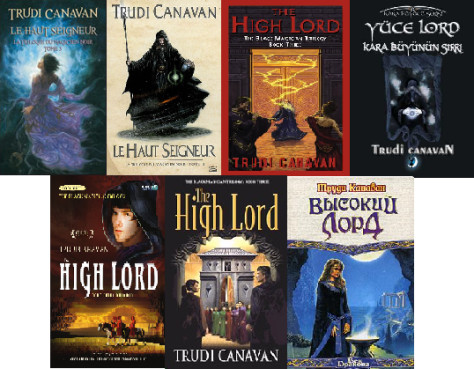
The High Lord - 7 covers
Top left: French cover
Top 2 left: French cover
Top 2 right: Cover art by Matt Stawicki
Top right: Turkish cover
Bottom left: Indonesian cover
Bottom center: Cover art by Les Petersen
Bottom right: Russian cover

My son and I recently finished reading The Black Magician trilogy together. What he discovered is that sometimes favourite characters die. He felt that was kind of cruel of Canavan. It is one thing when the bad guys die, but good guys (especially ones you really like)? Oh, well. It is unlikely this is the last time he experiences this. Despite that, he really enjoyed himself during our adventure. As did I.

The High Lord answers all our questions about why Akkarin uses black magic. It also shows us that the powers that be sometimes make long-term decisions that are seemingly wise at the time but turn out to be bad for future generations. Accidental deaths can cause a lot of trouble down the road.

I’m still impressed with Sonea. I think that growing up rich and powerful blinds you to the reality that most people live under. Peggy McIntosh discusses this phenomenon in her White Privilege: Unpacking the Invisible Backpack. Sonea growing up in the slums has made her aware of the harsher sides of life and made her more open to the possibility that status quo must change. Even Rothen and Dannyl, who are open-minded for wizards, fail to understand exactly how privileged they are.

My dad grew up under extremely difficult conditions. His mom was a paranoid schizophrenic and his dad disappeared after he had enjoyed German hospitality in prison camp. Torture got the better of him and alcohol was used to self-medicate. That left my dad as the responsible person at home from a very young age. His mom did her best, but, you know, being a paranoid schizophrenic without access to medication does not help in creating stability for your children. My mom’s childhood sucked as well. Her dad was an alcoholic and her mom worked her tail off to provide for them. When my mom has told me what it was like to drag a drunk dad up three stairs to get him inside the apartment – after he had pretty much spent his earnings on booze – well, I wonder how she made it????

But that childhood made them into pretty awesome people who have always been concerned with the greater good. They turned what could have made them bitter into something that helps others each and every day (even when they are now ancient =) ). Like Sonea, not all of their decisions have been wise. But like Sonea, what they have done is try to be true to the motto of “not doing unto others what you would not like to have them do unto you”.

Sonea grew up without her parents but was fortunate enough to get to live with her aunt and uncle. This is probably what saved her (and the rest of the city). Her hunger, poverty, the Purge, being bullied by the other novices and being suspected of everything “bad” by the adult wizards did not stop her from being true to her own values. Sonea’s situation is in no way unique in the world (except for the magic that is). Poverty, war, captivity, orphanhood and homelessness are all part of the lives of a huge amount of children and adults. That people are actually able to rise above their experiences and make the world a better place is amazing. Yet people do it all the time – just like my parents have. Which is why I find Sonea utterly believable. Her decisions regarding Akkarin seem inevitable and sensible considering the kind of person she is.

Sonea and The High Lord_by_ceara_finn24-d27a8o2
Picture photoshopped by Lauren Kelly Small

Tayend is my other favorite person of this story. He is our lad from Elyne. While homosexuality was not accepted in Elyne, homosexuals were not persecuted. Unlike Dannyl’s experience in Kyralia. Being a fan of the underdog, I would have thought that Dannyl would be the one to appeal the most to me. But Tayend has an innocence about himself that seems true. When that innocence is challenged, as it is in The Novice, Tayend rises to the occasion. He is loyal to Dannyl, in love with Dannyl and willing to avoid meeting with Dannyl if that is what it takes to protect him from the wrath of the magician’s guild. I wish I could have gotten to know him better.

Cery is back and this time he finds himself with a mysterious customer who seems willing to help him find whatever Sachakans arrive at Imardin. She turns out to be different from what he had originally thought, and that causes friction. But Savara still manages to be of assistance to Cery when he needs her help most. Who to trust or who not to trust when you are a Thief, that is the question.

Reading The Black Magician trilogy with my son was my third time through the series and I still had fun and learned new things about myself and the world.

In The High Lord Trudy Canavan gifted me with really fun words to read. During part of the book she had used the words Sachaka, Akkarin and Takan a lot. My mouth was having so much fun saying those sounds. Sometimes it is really awesome to be an autist (aspergian).


Reviews:


  • Paperback: 656 pages
  • Publisher: Orbit (4 Mar 2010)
  • Language: French
  • ISBN-10: 1841499625
  • ISBN-13: 978-1841499628

My review of:

  1. The Magician’s Guild
  2. The Novice


Jackson, Ros: The Secret Eater (2013)

Ros Jackson
Cover art by Rick Parsons
Editing by Anna Genoese

I was given a reviewer’s copy of The Secret Eater. I promise that I have not included either “bomb-making instructions” or “the directions to” Ros’ house in this review. When contacted by Ros Jackson I went to her website to check out the background info on the novella and was sold when the words “Nigella Express” appeared.  I did the elegant snort laugh that I do sometimes and said I would love to review it.

Kenssie, the demon (of the secret-eating variety), is an insecure girl with a tendency toward denial. She loves what she is in a world of demons, hybrids and humans. As usual, we humans are oblivious to the “others” around us, something that makes us perfect prey. But we aren’t the only prey around it seems. Denial is a wonderful tool of survival in a world where a poor girl wants to believe herself more included than she really is.

The way Ros Jackson has portrayed the demons and hybrids of her world makes them seem a perfect complement to our fears, insecurities, greed and anger. Using humour and satire as a tool to comment on the world is done in the way only Brits are able to.

I liked this first novella of Ros Jackson.


Reviews:


Canavan, Trudi: The Novice (The Black Magician II) (2004)

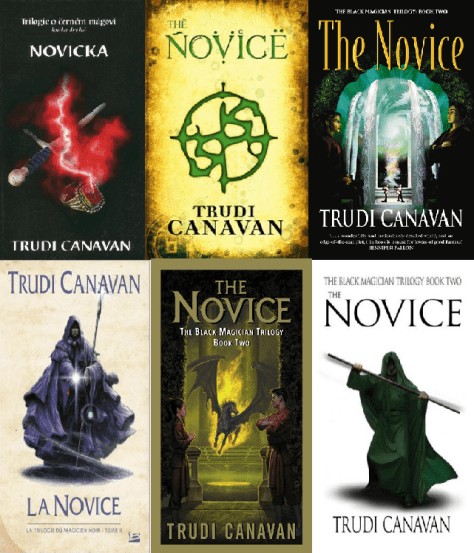
The Novice - 6 different covers
Cover art by:
Top right: Les Petersen
Bottom right: Steve Stone
Bottom centre: Matt Stawicki

Once again Trudi Canavan has shown that she has the ability to reach audiences all over the world. The Novice has been published in three English dialects and 12 other languages. The Black Magician trilogy is a serial. You are going to have to begin with The Magician’s Guild to make sense of The Novice.

As with The Magician’s Guild, I was my son’s audiobook. This time the experience as an out-loud-reader was much smoother. Whereas The Magician’s Guild has awkward phrasing for an out-loud-reader, The Novice flowed as it ought. Being the one who was read to was an enjoyable experience for my son.

Story 1

Breaking out of an abusive relationships is a challenge. In some cases the victim never does while in others some kind of catalyst comes along that makes freedom possible. Before that time, though, pain, confusion, humiliation and helplessness are feelings the victim is dragged through time and again.

Sonea being bullied by Regin and his compatriots (fellow novices) is such an abusive relationship. Regin’s venture into physical and mental violence begins during the first year and follows Sonea into The Novice. One would have thought that Sonea gaining the guardianship of the High Lord would prevent him from being cruel, but no. Regin soon discovers that Sonea is afraid to tell the High Lord what is going on and takes that as encouragement to increase the intensity of his bullying.

Bully lust is a strange thing. I’ve often wondered what makes an abuser tick. Growing up I never understood why the other kids felt it appropriate to tease and harass me. As an adult I think I can see what the attraction is. Power seems to be orgasmic to some people. Being able to get others to go along with what you are doing probably increases that feeling. Regin certainly seems to be getting off on what he is doing to Sonea.

Like a lot of people being abused, Sonea is afraid to tell those in authority about the bullying. She is afraid that matters will get worse. Sonea sees that the episodes that happen in class do not bring about punishment for Regin and I imagine that would make her hesitation even more intense. Class-differences between the victim and the abuser probably made it even more difficult for Sonea to open up about what was going on. After all, what could she – a slum-dweller – hope to achieve with reporting the abuse when the rest of the magically inclined people at the university were of the upper classes.

In- and out-groups. We and them thinking. I think this is one of the most frightening thing I find about humans. When I read some of the comments that are written on some of the sites on the net, I am confused by how others bully writers in the most cruel manner by dehumanising the blog’s author. Regin’s treatment of Sonea is a prime example of how one person makes another person a “them” and thereby setting his behavior at – “not at fault”.

All it takes is one person. One person to make it all bearable. Sometimes one person to help you see the light. One person. You will meet him in The Novice. That one person with the ability to think outside the box. The one who dares think of “them” as human too.

Story 2

Dannyl’s experience with The Thieves has made him prime candidate as Guild Ambassador. I’ll bet he never saw that one coming. Dannyl is one of those people I just could not help but like. His behavior and attitude is clearly colored by the treatment Fergun put him through while they were both novices. Surviving abuse gives us a perspective on life that we would not have otherwise. If circumstances allow, that understanding can be put to good use. Both Dannyl’s behavior and his attitudes have been challenged and continue to be challenged during his adventures in Elyne. His friendship with Tayend shows his strength and the pain of the past he still carries around on his back.

The Novice was fun. Painful at times when old memories were triggered, but fun.


Reviews:


  • Paperback: 592 pages
  • Publisher: Orbit; A fmt edition (1 July 2004)
  • Language: English
  • ISBN-10: 1841493147
  • ISBN-13: 978-1841493145
  • Amazon

My review of The Magician’s Guild

Canavan, Trudi: The Magician’s Guild (Black Magician I) (2001)

Magician's Guild - 6 different covers
Various artists for the 6 different covers:
Les Petersen: bottom centre
Steve Stone: top centre
Matt Stawicki: top right

As far as I can tell, The Magician’s Guild has been published in 3 different English dialects and 15 other languages. That is impressive.

My son and I read the UK version of the The Magician’s Guild. As the reader I worked a bit harder with The Magician’s Guild than I have on my last few audio-jobs for my son. As the readee, my son seemed pleased with my job.

Sonea is somewhere around the age of 17 when we meet her. Her mom is dead and her dad has run off. Thankfully, she had her sister’s mother (Jonea) and Jonea’s husband who stepped in to take care of Sonea. They were part of the dwell society and at the point that Sonea’s mother died they lived in the slums. In the time since they managed to make their way into the Outer Circle of Imardin. There the three lived and worked out of a one room flat. Things were looking up for them. Then life did what life does and hit them in the face.

Before the threesome had moved behind the walls of the Outer City The city of Imardin - Trudi Canavan - Magician's GuildSonea was running with one of the gangs (Harrin’s gang) and had learned to pick pockets and steal. Several of the kids in Harrin’s gang are homeless kids who look upon the gang as their home. One of Sonea’s best friends, Cery, is such a kid. His father was killed by the Thieves for breaking trust with them.

Harrin, Cery and Sonea are one half of the equation of The Magician’s Guild. They bring in people to help them, but in essence the story is about them – and especially about Sonea.

The other half, of course, is about the Magician’s Guild. They have the food, the wealth, the king’s approval and magic. Like most privileged people the magicians are comfortable with status quo and reluctant to share their goods with “less worthy people”.

Compared with the rest of the world I am probably somewhere in the top 20% when it comes to privileges (in spite of being a woman). Being a woman lowers me somewhat but this is what I have going for me: I am of Norse blood living in Norway. I have a college degree and am married to a man who has a university degree. He is well-paid. I am not – due to health issues. We live in a country that assures that all of its citizens have free health-care, free education and are assisted if they should fall on hard times. Our home isn’t stylish or up-to-date but it is largish and warm during the winter. We always have plenty to eat. In other words, we have lucked out in the lottery of life.

What this means for me, is that I have to make some kind of effort to keep the other 80% in mind. Then I have to make even more of an effort to try to be of constructive assistance. It would be much more comfortable to pretend that the other 80% did not exist and that I had no responsiblity for the lives of other people on this planet of ours. But I know life is all about luck, nothing more. So I don’t have a choice.

The Magicians are at the point where they are going to be made aware of the dwells as something more than cockroaches to be stepped on once a  year during the Purge. Sonea is the tool to make it so. Discovering that there is one among the dwells whose powers are so strong that these powers have manifested all by themselves is going to change the opinion of some of the Magicians, frighten others and cement the prejudices of the rest.

Good luck, Sonea! You are going to need both it and loads of hard work to even begin to make an imprint in the sceptical attitudes of most of the magicians of the Guild.


Reviews:


Phantastik Award

Winner: Gilde der schwarzen Magier 1: Die Rebellin
Bester internationaler Roman 2007

Naylor, Joleene & Harvey, Jonathan: 101 Tips for Traveling with a Vampire (Revamped)

101 tips for travelling
Cover design Joleene Naylor
Internal photos/illustrations by Joleene Naylor and Jean Naylor

101 Tips for Traveling with a Vampire is the silliest travel guide you will find. In a humorous manner we are guided by Katelina’s experience in travelling with vampires. The tip repeated most often is to make certain your vampire does not tan (well burn to a crisp).

After a thorough guide on the do’s and do not’s in travelling with a vampire we are then presented with a guide on how to help your vampire remain part of humanity.

It’s all incredibly silly, but it was free on Kindle and good for a couple of smiles. Well worth the minutes it took me to get through it.

———————————-

Tarwater, Tristan J.: Little Girl Lost (Valley of Ten Crescents) (2012)

Little Girl Lost
Book cover design: Christopher Tarwater
Cover artist: Amy Clare Learmonth (she has some incredible illustrations on her site)
Editor: Annetta Ribken

The cover of Little Girl Lost reminds me of the story of The Little Match Girl by HC Andersen (a story that made me bawl when I read it the first time). That look fits the story well as this is a story of orphans and poverty. A very short story. Only 15 pages long.

Tristan J. Tarwater calls Little Girl Lost a prequel to Thieves At Heart. I guess that makes it story no. 0 in the tale of Valley of Ten Crescents.

Tavera is around seven or eight years old when she is sold into service – not for the first time. Such a fate was not unknown (and probably isn’t today) in many parts of the world. Tavera’s previous work had been coal sorting, fruit picking and laundering.

Being an orphan has never been an easy life. Being a “half-breed” (in this case half-elf) seldom helped.

A sense of Hansel and Gretel enters the story when the ancient, hunched over crone, Mrs. Greswin, pokes a finger in Tavera’s ribs and states that she’ll soon have Tavera fattened up. Yikes, what does this sausage maker put into her sausages?

Like all children, at least I was, Tavera is curious and when Mrs. Creswin is drunk enough Tavera explores as much as she can and discovers surprising facts about the old lady, gets into trouble, and sometimes discovers secrets better left alone. As it is a prequel, you all know this story is going to end well for Tavera. Well, kind of.

I enjoyed this little tale that only took a short, short while to read.


Reviews:


Stross, K.M.: The Man in Black – The Woman in White (2013)

The Man in Black-The Woman in White
Cover art by Chris Smith

The Man in Black – The Woman in White shows us what the earth could be like in almost 200 years if we keep on letting it go to pieces and allow money to rule the world.

Stross presents us with a world without hope, a dark story of loss, poverty, inequality and disinformation. The town of Present, Nebraska thinks the world works in one way, and it seems they have been intentionally kept in that belief. Maintaining this status quo is the will of the people who hold power to change the lives of the citizens of Present for the better.

One of the tools the powers that be uses to keep the people of Present in Present is lack of education and information. Another tool seems to be to allow companies to move in and “encourage” farmers to sell their land and water-rights.

Stross encourages me to question my own beliefs of right and wrong. Exactly who is the culprit and why do I consider that person to be a culprit?

Poor young Kyle, living in circumstances that quite a few young people live in today. Desertification, water shortage and hunger are all parts of the lives of young and old in certain places of the world. There, too, tools such as the ones used against Present, Nebraska are utilised. The Man in Black – The Woman in White speaks of a world that already exists for many and will probably exist for many more in the years to come.

Stross doesn’t give us a solution or an answer to the problem. I appreciate that. Having an open ending allows me as a reader to look around and see if an answer exists at all.


Reviews:


I could not find any information at all on K.M. Stross.

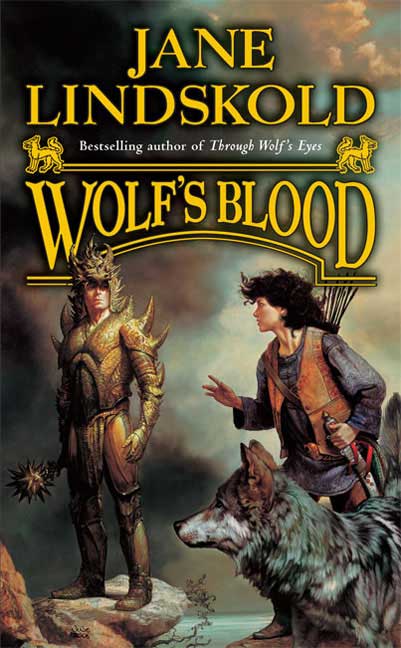
Lindskold, Jane: Wolf’s Blood (Firekeeper Sage VI) (2007)

wolf's blood
Cover art by Julie Bell

I really am an airhead. I managed to press publish before anything had been written. Sorry if that confused you all. Here is the “real” version of my review.

I hadn’t bought this last installment of the Firekeeper Saga until my son asked me to. We had read the previous five novels together and he really wanted to know how it was all going to end. Reading together is an experience more people should be able to enjoy. As I have said before, this is one of the major advantages to having a child with dyslexia.

Jane Lindskold made Wolf’s Blood as much fun to read out loud as she had made the other five. Her language is intelligent and her vocabulary varied. Again I found myself forgetting to follow the plot as I got so caught up in the intense experience of tasting Lindskold’s prose. That didn’t really matter because I had cheated and read through the novel on my own before reading it to my son.

One thing I have wondered is how the Firekeeper Saga can appeal to both an eighteen-year old and a 48-year-old at the same time. What is it about these characters that the two of us find so fascinating?

Firekeeper and Blindseer

Part of it most definitely has to do with Firekeeper and Blind Seer. The whole idea of our wolf-girl trying to find her place in human society and making sense of us all works for us. That Firekeeper often finds herself flummoxed by human society is understandable. All of our various religions and political views are confusing and usually you have to be an insider to understand all of the unwritten codes that rule us. She is an alien and will remain an alien for the rest of her life. But Firekeeper is an alien with a foot in human society and with people who love her and Blind Seer to bits.

I’ve been trying to figure out how Firekeeper was changed by querinalo. In Wolf Hunting we see that something did happen to her. My personal belief is that she became even more firmly a wolf in her heart and head because of her chant during her fever. Blind Seer probably did not change much as he beat the crap out of the source of the illness, but his view of himself changed drastically. Having come from a people who hated magic fiercely would make his adjustment to the “new” him a challenge.

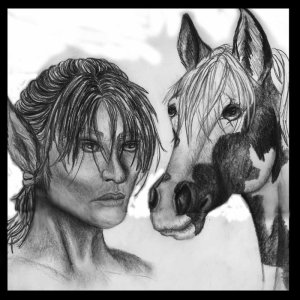
Derian

Derian_and_Eshinarvash_by_Fortunes_Favor (1)
Derian and Eshinarvash by Fortunes Favor

Derian’s change was a bit more visible. This portrait of Derian with Eshinarvash by FortunesFavor shows how he has become a bit more horselike. His ears and forelock are especially telling. Derian struggles terribly to accept his new looks. His greatest fear is how his family will perceive him now that he “looks like a horse”. I would freak out myself if I woke up after an illness and discovered my face and outer extremities had metamorphosed into a blend of human and animal.

Derian also, quite understandably, worries about what women will think of him. Looking past our exteriors seems to be a challenge for a lot of us (myself included). It’s so easy to get hung up in insignificant details all the while forgetting about the significant ones (like personality and temperament). As the saying goes, where there is life there is hope. For Derian this is true (as you will see for yourself when you read Wolf’s Blood).

Perspective

Lindskold presents things from various points of view. Being on the spectrum makes this doubly important to me. I have learned much reading authors like Lindskold. She, too, has been part of a teaching staff who have all helped me understand people.  Perspective changes good guys to bad and vice versa. If there is one thing I have learned in this life of mine, it is that perspective matters.

Enemies

War is a strange thing. King Bryessidan and his compatriots’ desire to take over the gates makes perfect sense. They had convinced themselves that they were being slighted and hindered in their “noble” purpose. Therefore they were justified in planning and executing an attack against the Nexus Islands. Seen from the Nexans’ side that is an erroneous argument, but to the winner goes  the writing of history.

I also found myself understanding Virim. What he did was a terrible thing, but he never intended for querinalo to be so bad. But when it was he took advantage of it and found it difficult to let go of the apparent advantages to its system.

The ending was good. I knew this would be the result, but it needed saying and happening.

Jane Lindskold has been a pleasure to read with my son. The Firekeeper Saga kept him asking for more. Being the fantasy nut that I am, it is a pleasure whenever my sons enjoy the same literature I have enjoyed.


Reviews:


  • Series: Wolf (Book 6)
  • Mass Market Paperback: 736 pages
  • Publisher: Tor Fantasy (January 2, 2008)
  • Language: English
  • ISBN-10: 0765353741
  • ISBN-13: 978-0765353740

My review of:

Bellet, Annie: Avarice (Pyrrh Considerable Crimes Division I) (2012)

avarice with text
Cover art: Nathie
Cover design: Greg Jensen

Avarice: excessive or insatiable desire for wealth or gain (Merriam-Webster)

Avarice was not what I expected. Now that I have read it, I do not know exactly what I did expect. Perhaps something along the more traditional lines of paranormal police procedurals. Avarice is that, but to my relief there were no vampires or werewolves. Sometimes it is nice to read something different.

Avarice had humans interacting with Kirgani (somewhat catlike people) and Anuran (more humanlike in appearance, but with scales and weird eyes). Due to the interaction of these three races we get a sniff of racism. As Avarice is a police procedural we also get a bit of police bias from some of the public – guess which part of the public.

I got a clearer sense of who Cordonate Zhivana Nedrogovna was compared with Cordonate Parshan Koury. Perhaps that had to do with Parshan dealing with his grief and guilt connected with the loss of his previous partner (and lover). The two have one thing in common. Somehow they seem to get more or less unscathed through pretty severe situations. Something is up with that.

The mystery was straight-forward. Some things were clear to the reader early on in the story while others revealed themselves later on. In fact I would say that Avarice is a good old fashioned story of crime and punishment placed in a world of swords, magic and strange creatures.

I’m trying to decide if I deem Avarice a young adult novel. It is dark, but not too dark. There is no sex and the violence is pretty safe. If you can handle Agatha Christie and her likes, you can certainly handle Avarice. I really enjoyed this meeting of minds.


Reviews: