The Bloodhound Files was created by Mr. Barant as a social satire. I had no idea of that when I bought the novel. In fact it was not until creating this review that I discovered that fact. However, the feeling of social criticism was there throughout Dying Bites.
No doubt about it, Dying Bites is an action-filled mystery with a whole lot of dark fantasy/science fiction to it. We are talking about a parallel world with an alternate history and lots of paranormal creatures and magic.
Jace Valchek fits into the gung-ho main protagonist mold without all of the gooey romance that some fantasy/science fiction novels glory in – the kind that I never seem to understand. The closest we get to romance would be a couple of thoughts about Cassius and Dr. Pete and some action with Tanaka.
DD Barant uses vampires, werewolves, golems and humans to create a world where racism is based on races rather than silly things like color. In my head it becomes easier to understand the concept of racism. Several of the scenes where Mr. Barant shows us the less pleasant sides of our world become incredibly clear. Two of those scenes are the post-sex scene with Tanaka and the nazi-camp. I found that dialogue well-done.
Other dialogue that I enjoyed greatly was between Jace and Charlie, her partner, and any conversation including Eisfanger. Eisfanger is a wonderfully nerdy person whose greatest assistant is a rat skull called Wittgenstein. I found myself wanting to sit down with Eisfanger and have a chat. Being a nerd myself along with being married to one and having two sons who are nerds makes me predisposed toward nerdy characters – if they are well-written.
Dying Bites was great entertainment with a serious undertone and lots of humour.
For me Terry Pratchett is the man. Discworld was my first meeting with him. Since then I have gotten to know him better through his cooperative work with other authors. This way he has spread my knowledge of other authors and interest in other types of science fiction and fantasy.
On his website I eventually discovered that Pratchett has developed Alzheimer’s disease. My parents now have friends who have had Alzheimer for quite a while and I have gotten to see some of the effect of that disease. They have also shared with me how these individuals show the symptoms of Alzheimer and how the person they knew disappears slowly but surely.
As late as 2014 May 13 Terry Pratchett writes the article Those of us with dementia need a little help from our friends in The Guardian. He has been able to place a rather famous face in the Alzheimer camp supporting the cause with both words and money for research.
Due to the nature of the disease Terry Pratchett has quite naturally had many thoughts about how it is going to affect him. When will the moment come when his ability to make choices for himself disappear?
BBC’s documentary Choosing to Die with Terry Pratchett is bound to make an impression on the viewer. I was touched by it and remained thoughtful a long time after viewing it.
Alzheimer’s is very definitely not the only disease that has a terrible progression. In Choosing to Die we get to meet two people who are choosing to die before their body gives in on its own to MS and ALS. My own thoughts on the matter are that I would very much like to choose to die rather than have to endure an awful ending.
The film seems to have disappeared from the net.
2011 winner for Best Single Documentary at the British Academy Scottish Awards
2011 winner for Best Single Documentary at the Royal Television Society awards
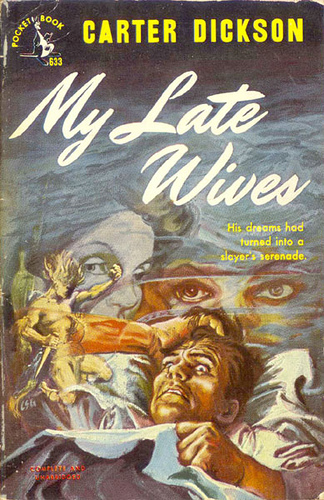
Here in Norway we have this strange tradition of reading mysteries during the Easter holidays. I just finished an oldie by Carter Dickson. My Late Wives is extremely funny in parts, tense in others and keeps me double-guessing myself until the end.
I’m thinking that with the technology available in 1946 Bewlay probably would have gotten away with the murders he did get away with. That is, until he went head-to-head with Merrivale. Today someone might have gotten him filmed somehow.
Sir Henry Merrivale is a delightful character. He is of the old detecting school (Poirot/Marple) but without the apparent self-control of the others. Merrivale is large, loud, active and has a noisy temper. The scene at the game hall at the beginning of the novel is one example of his bluster – and also of Carr’s well-written humor. I laughed at that scene and giggled at some of the comments Sir Henry Merrivale made later on.
We get real tension in My Late Wives. I read this novel a while back and was surprised at how I again became caught up in it. The wonderful thing about it is that time matters not when it comes to humor and tension. I love reading the older language and scenery wrapped neatly up in the spirit of its time.
Back to the tension. There are a couple of things worth mentioning. Bewlay is a great serial murderer to have in a mystery. He is a slightly above average man according to witnesses but impossible to describe. A natural blender or reader of people. His charm brought him women with small inheritances, women who would not be missed. Perfect victims these women who longed for the love of another. In a sense it is really sad to realise that there are plenty of men and women out there who fit this description at this very moment. I find it frightening to realise that there are probably plenty of Bewlay’s of one type or another just waiting to take advantage of such people.
Spooky house – there is definitely a spooky house in My Late Wives. My Late Wives is worth reading just for that scene – that and the above gaming hall. Carter Dickson did an excellent job of getting me at the edge of my seat.
Like many mysteries of its and our age My Late Wives is purely for entertainment. I was entertained.
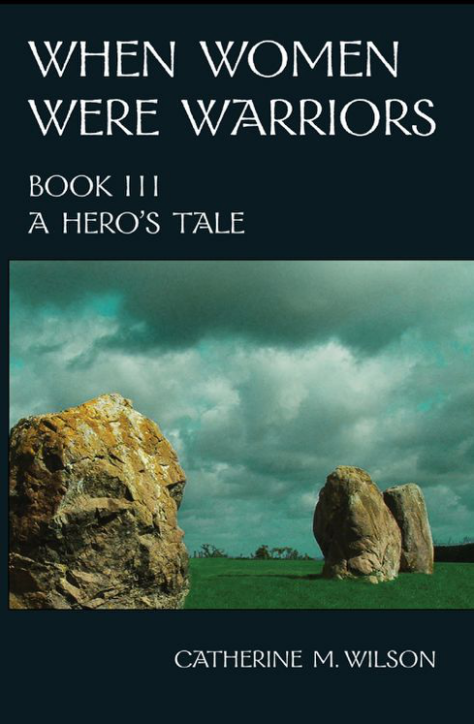
What Catherine M. Wilson describes in When Women Were Warriors is a society that may or may not have existed. A matriarchal society is a society where women rule and inheritance goes through women. A Hero’s Tale is supposed to be set in Great Britain ca. 1000 BCE (late Bronze Age). In fact a bronze knife holds a pivotal role in A Hero’s Tale.
For the average person (as we see with the forest people) tools and weapons would have been largely made of stone/flint (such as arrow heads and spear heads). Warriors would have invested in bronze swords and bronze arrow/spear heads although most would probably not have been as fancy as this sword. More nerdy stuff below.
Ms. Wilson keeps on stringing words together in a manner that creates music in my head.
I have had three teachers in my life that have taught in the manner Maara seems to teach Tamras. Two were in school and one has been in my personal life. The relationship of teacher/student – master/apprentice is a tricky one. An apprentice wants to become as proficient as the master and excellent masters want their students to learn as much as it is possible for the masters to teach. Maara has an ability to impart her knowledge without holding anything back yet pacing her delivery to fit Tamras learning speed. I guess you could say Tamras is the ideal student. She wants to understand and acquire whatever skills Maara sees fit to share. To do that Tamras needs to learn to think for herself. Perhaps that is the most important lesson Maara shares with Tamras.
Tamras’ ability to see past the surface of people and things is not a talent she got from Maara, rather it was one Maara helped Tamras unfold. Seeing beneath the surface of herself was more difficult and at one point in A Hero’s Tale Tamras’ lost herself to appearances. Losing ourselves to the Abyss is a point a great many of us end up at one or more times in our lives. Finding our way out can seem beyond our abilities. Tamras did not even know if she wanted to find her way out. Some people end up letting the Abyss take them. Tamras did not. Her coming back was a choice that was aided by others. Many times in our lives that is the way it is for us. We need others to guide us back from the edge or the canyon and on to safe ground again.
Tamras learns a great deal about Virtel and her past and this opens up for an understanding of Virtel’s actions. The baggage we bring with us from our childhood is incredibly difficult to set down and rearrange. At least it has been for me. All through my life I have had to take that backpack off my back and rearrange its contents to make it more comfortable. I keep on adding to it and removing contents. Virtel has not yet reached that point in her life. Perhaps the meeting between her and Tamras at the pass will turn out to be one of Virtel’s learning moments. I hope so.
Elen’s canyon kingdom reminded me of some of Norway’s inaccessible places. This setting has to be somewhere in Scotland. Not knowing the British Isles all that well, I do not know where you would find such a difficult to access valley. With only a thin footpath from the hills into the valley and a dangerous water-way out it would seem to be a defensible place. If only it had been wide enough to have farms to keep the community alive during a siege things might have turned out differently for Tamras and Maara.
Elen is an interesting character. She seems to be stunningly beautiful. Enough so that men and women are distracted from their own goals. In addition, Elen seems to have some kind of ability to hypnotize or influence people’s thoughts so that her goals become theirs. A trance-like state seems to be what all who oppose her end up in. I imagine that would be a handy tool.
As with Elen’s ability other paranormal/supernatural abilities in people are present in When Women Were Warriors. These talents are for the most part just an increase in various talents that people generally have. Tamras’ ability to understand others seems to be one such boosted talent. She has always had it. During the story Tamras seems to become more aware of having it, but it does not seem as if the talent is anything she has much control over. I cannot tell if Elen’s ability is something Elen controls or if it is just a talent that she uses because it happens to be part of her.
Tamras manner of dealing with Elen is interesting. Alas, I cannot share it here. But it is fascinating to watch all the same.
Ms. Wilson brought her characters and areas alive for me. I do not see strings of words in pictures in my head but as sound. Why that is, I do not know nor do I care. But I care very much about having experienced the music of When Women Were Warriors. The Warrior’s Path is on permanent free offer.
Cover photo by Donna TrifiloSometimes an author strings her words together so beautifully that I want to weep at the music that fills my head. Catherine M. Wilson has managed to keep the moll of The Warrior’s Path so finely tuned throughout A Journey of the Heart that my chest hurt from the notes within. And yet there is nothing new and especially unique in the When Women Were Warriors serial.
One thing is different. In this serial both men and women are warriors and Tamras’ society is matriarchal. In neighboring countries that is not so. Ms. Wilson shows us that a matriarchal society is as full of contradictions as any other society. One of the characters, Virtel – the “baddie”, is aggressive and warlike. In A Journey of the Heart we get the impression that Virtel is ambitious to the extent that she is willing to hurt her leader, Merin. Sparrow, her apprentice, shows us a Virtel who might not be as one-dimensional as Tamras thinks of her. Maybe even life is not as one-dimensional as Tamras would like it to be.
We get to see how sometimes grief/regret has the ability to draw a person closer to death. According to Ms. Wilson her story is set around 1000 BCE. At that time life was precarious and death was no stranger. I imagine the will to live would have been even more essential than it is where I live.
Ms. Wilson shows how having a safe and loved child-hood, such as Tamras has had, gives one insulation in the growing up process. Both Sparrow and Maara show us the faces of what not having that in our lives can be like. However much we might want to deny it, we are probably very much products of the lives we have lived. If we grow up as slaves not owning even ourselves and live in constant fear, well, that produces a person vastly different to one with a childhood where you know you are valuable and loved and where you also have what you need to survive.
In fact. When Women Were Warriors is full of situations that have no simple answers. Maara functions as Tamras’ teacher in both the physical aspects of being a warrior and in understanding the ways of the world. Nothing is easy.
One of the things I really liked about A Journey of the Heart was the way Tamras had to learn how to use a bow and arrow step by step. There was none of this “all of a sudden an expert”. This is what every apprentice has to learn. Easy routes to mastery are non-existent. Me, I want to have mastery right away. I want to understand everything immediately without having to work for it. For some strange reason that never happened. Bummer!
When Women Were Warriors is a serial. You will have to read The Warrior’s Path in order to get anything out of Journey of the Heart. It just so happens that The Warrior’s Path seems to be on a permanent “for free” offer.
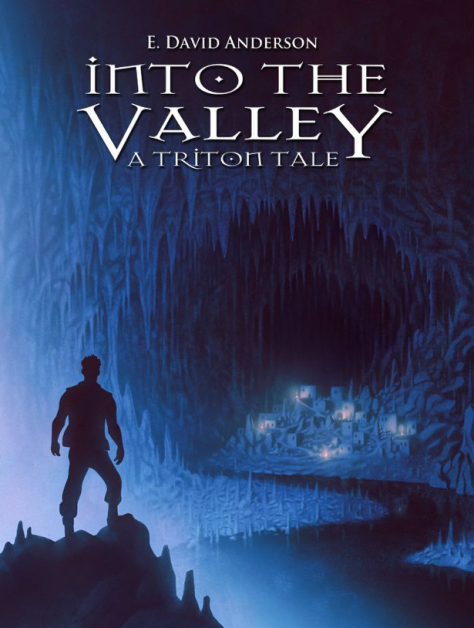
Into the Valley is supposed to be E. David Anderson’s first installation in the Triton series. I believe Into the Valley is Anderson’s first published work. It does not show in its presentation and substance. Into the Valley is an engaging story including elements from Greek mythology and steam-punk (although it might be science fiction instead??).
Every once in a while we make choices that change our whole lives. Lieutenant Aurelian made three of them: Firstly, he escaped his home-island of Akkahellonia. Secondly, Aurelian chose to ignore the advice of the Lighthouse Keeper and his last choice was to dive into the river rather than going across the bridge.
By jumping into the river Aurelian postpones his first meeting with Lord Abraham. Lord Abraham has lovely machines that suck the life out of other people and transfer that life to him instead. Because of his jump into the river Aurelian understands what is going to happen to him before it actually happens.
Aurelian is the kind of young man who believes that one should never give in to whatever life throws at us. Sometimes I am like that myself. At others not at all. How people manage to keep going at all times is beyond me. I know people like Aurelian and I have often wondered how they find the gumption to keep on trying.
“I am an autistic person, and no, I don’t need that part of me erased. I don’t need a cure, and autism didn’t kidnap the allistic child that I would have been. I didn’t destroy my parents’ marriage. I didn’t ruin my family’s lives.”
Today is World Autism Day. It seems like only yesterday that it was last year’s World Autism Day. And yet, here we are again.
This day is always difficult for me, because while on the one hand, I want to say “yes! Let’s focus on autism and how it affects us!”, I just can’t, because of who is behind this campaign. Autism Speaks is the primary organization behind autism awareness, especially in the United States. I cannot condone their message of fear and dehumanization. I cannot sit back and be passive.
When I see that blue puzzle piece, or one of those Autism Speaks arm bands/bracelets, something within me dies. Something makes me feel ill and shaky, and I wish that I didn’t have such a visceral reaction to a symbol like this. But this is my blog, and I’m an honest person, and yes, Ms. clothing store manager, every…
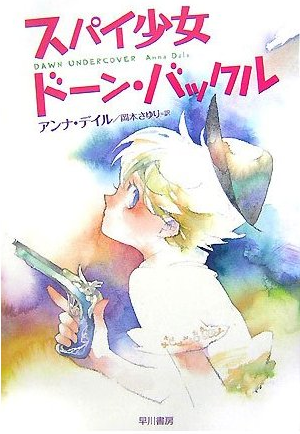
Japanese cover: “The katakana is translated as “supai chiisai onna don bakkaru”, literally “Spy Girl Dawn Buckle”. (Dylan)
Dawn Buckle‘s family is strange. Her father and grand-father could be Aspergers with the keen interest they have in their respective hobbies: wall-clocks and game-shows. Dawn’s mother always has such a lot of work she must do. When the S.H.H. (Strictly Hush-Hush) ask if Dawn can come work for them during the summer, Dawn’s mother says:
“So Dawn would be out from under my feet … I mean she’d be taken care of for the whole of the summer holidays?
And I thought I was bad. I realize there are a great deal of children who live in homes where they are ignored. What a challenge this must be for the child. For Dawn, the appearance of Emma Cambridge is a gift. Finally, a person who actually notices her.
You see, Dawn Buckle is the kind of girl who seems to be invisible. She could be standing next to you and you would not notice her. She is average looking and has nothing that is extraordinary about her. A lot of us fit into that category. In fact this used to be me. I’m of average looks, like comfortable clothes, am observant, have had various types of stuffed animals and like information. My parents though, well they were a bit more present and would never have let me go off on a P.S.S.T. type of stay – that is unless I had recently gotten myself into trouble.
That is the trouble about us quiet ones. We are often underestimated. As Dawn finds out being underestimated is a bonus in the world of espionage. Just because she is seldom noticed does not mean that Dawn is incapable.
Dawn’s first lesson in spying is that things are not always as they seem. As she and Emma arrive at the headquarters of P.S.S.T. (Pursuit of Scheming Spies and Traitors) Dawn is puzzled:
“Emma opened the front gate, knocking the stalk of a magnificent sunflower. Its heavy head swung to one side, revealing a sign behind it that read “Dampside Hotel”.
Dawn is a prime example of not being what she seems. This is a great example to young boys and girls as to how girls really are. Not all girls but a lot.
For some strange reason, the apparently dead Mundo Meek seems to know too much about what is currently going on inside P.S.S.T. But is he really dead? Therein lies the mystery and the suspense.
Delightful names and acronyms are used by Anna Dale. Ms. Dale has managed to create a story that is exciting, funny, interesting and informative all at the same time. Her proposed age group target of 8-12 years seems appropriate.
“Aston is not what your first choice for a hero would be. He doesn’t fit the stereotype of the (as my favorite label from the “Firefly” series indicates) “big d*** hero” like most in the genre do. He’s the everyman who just happens to get into more than his fair share of tricky situations“
In Seekerthis is how Aston describes himself as well. Aston’s way of making money is as a scavenger pirate and cargo transporter. That means that he cleans up after the pirates if he comes across one of their kills. Not an unknown occupation in today’s world either. Although here we probably just call it the way business is done.
Both Aston and the Seeker are prey to a freelance operator who happens to be the system’s law enforcement service provider. Whoop, dee, doo. Naimakeeda (the seeker) is in as much goo as Aston himself. With his arrival she sees the light at the end of the tunnel appear knowing that it is not a train. I guess there must be some advantage to not being able to avoid knowing what is going on inside people’s heads.
Seeker is a space opera with most of its focus on characters. The one bit of tech that we kind of get to know about is “Jeanie”. Other than that the novella is an adventure story for young adults with pirates that you see and pirates that you do not see. The biggest pirate of them all is the man who is supposed to uphold the law. Tsk, tsk, corrupt politicians – whoever heard of such a thing???
This is a light and easily accessible read in the form of a short-story/novella.
Jon Jacks has written his story in first person and it took a couple of pages for me to settle into this uncommon style of writing. Wyrd Girl is written in British English.
Ghosts, ghasts, the nyxt, after-life, the under-world, possessed. Being able to see and communicate with the other-world has never been usual practice in the world. Not even the world of Twice Hadday. Zoofelt, Dunnstedt & Ernst Advertising are the go to people in the area of life/death.
Twice/Tracey/Trace came into contact with ZDEA after she and her boyfriend, Chris, had witnessed the death of one of their couriers. Or was that really how Twice came into contact with them. As the story unfolds we discover that Twice’s world is seldom as clear-cut as we might at first think.
There’s something more powerful, more frightening, than all these things.
Something that could tear every connection apart with an angry squint of an eye.
We only get to know people through Twice’s point of view and are therefore limited in our knowledge by what she focuses on.
Wyrd Girl is clearly meant for young adults (or new adults as Jon Jacks calls them). Mr. Jack’s writing is highly accessible and strange and interesting. I believe I have become a fan.
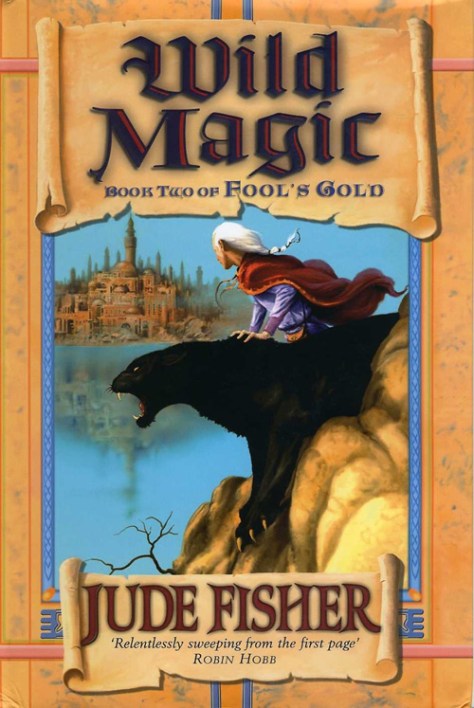
I just finished reading Wild Magic to my son. We are enjoying our last opportunities of reading together before he goes off to uni.
Another favorite word, crepuscular, has been added to my leaking brain.
“Aran Aranson pushed himself slowly to his knees, and stared like a hawk into the crepuscular south.”
Some words grab me, making me theirs. Their sound affects different parts of my head and the joy of reading out loud lies in this effect. Jude Fisher’s writing is of the kind that lends itself to be read out loud.
Katla Aranson is my son’s favorite character out of this bunch. It’s funny but she and he are alike in many ways. Both are oddballs among their peer-groups. Both are impatient. Patience is anything but a virtue to these two. Katla and my son are impulsive. That impulsiveness tends to be of the kind, generous and sometimes not-very-well thought through kind. They are both characters that people love and that people have a difficult time labeling.
Katla is my favorite as well. She is at the beginning of her adult life and is full of the vibrancy and courage that one has at 19. I look back at some of the things I did back then and end up having to admire all that I would put myself through to try to enter the adult world. I like that Katla isn’t interested in following the mores of her society. No marriage and children for her. No thank you! Perhaps she ends up changing her mind, but a lot of things are going to have to fall into place for that to happen. Katla has another quality that I admire. She is able to live in the here and now. If she is in a situation that she cannot change, Katla finds something in the here and now that she can work with. Optimist would a term that could be applied to her.
I feel sorry for Katla’s mom and dad. Bera and Aron are both caught up in the geas that Virelai has created and it is tearing them apart. Aron ends up doing something so stupid that it has a devastating effect on most of his loved ones. All because of a geas that itself has been caught up in the return of magic to the world. It is painful to see how self-destructive obsessions can make us. It’s not that we stop caring about how what we do affects others, rather it is a matter of not being allowed to care because our obsession takes so much room in our bodies. Virelai did a terrible thing in creating his geas, geas that will affect thousands of lives (Virelai’s being one of them).
There are a great many other characters who require their own space in the world of Elda and all of their story-lines are important to the plot. The Rose’s return to memory is definitely one of the important ones. But I am more interested in Saro Vingo. Saro finds himself swamped by the effects of the stone he carries and his amplified gifts. The people around him overwhelm him with their passions and fears. Being able to see a person for who they really are and not for who they present to the world is on the surface a gift. But gift is the last thing Saro’s ability ends up feeling like to him. Never in his wildest imaginations did he imagine people to be as base as he has found them. The feelings and thoughts of animals are easier to deal with.
Saro is the kind of person who happens to be a naturally caring one. His true gift is the desire to make the world a better place and to extend kindness to those he meets – even the people who ruthlessly use him.
Jude Fisher writes a highly entertaining tale about some incredibly insane and real people. If you like Vikings, this is a story for you; and if you like the Osmanians, this is also a story for you.
Seven years old. That is how old poor Paige is when the angels take her from her mother and sister and do medical experiments on her. Seven years old is how old Paige is when Penryn manages to rescue Paige and seven years old is how old Paige is when she sees the rejection of her new self from her sister and others. The only one who accepts Paige as she is happens to be her schizophrenic mother. Seven years old. Seven years old.
Paige’s story is the one that affects me the most in World After. Paige’s story is the one that causes my mind to ponder the concept of rejection and how rejection creates invisible wounds in an already visibly wounded body. And Paige’s story is the one that brings to mind the many people out there who have been changed visibly and invisibly themselves. How do I meet them? Am I one of them? How many wounds can a person bear before they become lost?
Penryn and Paige’s mother is a paranoid schizophrenic. Except in The End of Days serial many of her paranoias are real. Now the monsters are here and doing their best to off humanity. My grandmother was a paranoid schizophrenic. From what my father has told of his childhood Susan Ee‘s description of how a paranoid schizophrenic can appear to others seems right on the dot. The pain of the fear a person carries in such a condition is incomprehensible.
Penryn feels guilty at not being able to accept Paige as she is. I believe that is probably a common feeling when a person comes back changed from an accident or war or disease. After all, the person we loved seems to have disappeared. Perhaps they have. Perhaps we just need to see past the wounds and scars. Penryn is only 17 and 17 is awfully young to have experienced what she has. So Penryn carries wounds of her own, although hers are invisible. Her childhood and the responsibilities she ended up with, the first days after the world ended and having an angel steal her little sister would threaten to destroy a person. In part it does. But not completely. Penryn finds short-term solutions to deal with her inner wounds and a way to hold on to hope.
Penryn And The End of Days serial is a difficult serial to read for an old woman due to Susan Ee’s amazing writing. This is definitely a serial I recommend, painful as it is.
“That’s because pixies think with their hearts,” Quen said, ignoring Trent’s peeved expression. “This decision is already causing problems.”
“Most warriors think with their hearts,” I said, telling the mystics to back off and that I wasn’t angry with anything they could crush or explode. “It’s what keeps them alive through the crap they have to deal with to keep the rest of you safe.”
…
Quen smiled, deep and full. “Rachel,” he amended, then headed into the hall. “Jenks, a word?”
“What the hell is it with you people?” Jenks griped as he followed him out. “Can’t you make a decision without talking to the pixy?”
“Warriors build empires around the kernel of truth that others overlook,” came Quen’s soft voice …
Who are the warriors? Well, in the world of The Undead Pool the warriors are pretty much all of Rachel’s friends. They save the world from the chaos caused by others and sometimes themselves (unintentionally). Some of them crave the adrenalin that comes from the fight while others fight for what they believe even though they are frightened half to bits.
When you take away the trappings of fantasy, you quickly see that Rachel Morgan is like many of us.
She grew up a sickly child. Her father died while she was young and her mother lost it for a while after that. Rachel was an outsider and bullied for being different. As she grew up Rachel learned to keep to herself and was afraid of bonding with others. But her personality was of one that stands up for what she believes in and one that fights for the weak in society. In time the force of her personality drew people to her and because of Rachel’s willingness to sacrifice for others those bonds became strong. Due to her fear of intimate relationships, Rachel had a tendency to choose lovers who spoke to her self-destructive side. But eventually her choices and the choices of others opened her eyes to the fact that it is OK to choose a partner who will be just that – a partner.
What Rachel has learned is that life is about so much more than surviving our pasts. In letting people into her life and taking the chance of being hurt further, Rachel has opened up for possibilities that would not have been there otherwise. In her fight for the protection of the weak, Rachel now has support that enables her to do what has become her “job”. She is still an outsider, but no longer is she alone.
Then we add the trappings of fantasy and we have a rip-roaring yarn told by one of my favorite authors.
The Elementalist is very much an adventure story with earth, wind, fire and water elementals being summoned by trained elementalists. We also have pirates (or privateers as they prefer to be called themselves). I have never really understood the distinction, for what they do tends to be the same. But these pirates are good pirates, at least what we see of them. In addition, we get fighting of the sword and magic kind and a little love and betrayal. All of it is told with a twinkle in the eye and maybe a few winks here and there.
Poor Barin Elicerio! He’s not certain exactly what it is he is supposed to have done, except that he has been accused of consorting with spirits of a malignant nature. Barin is pretty confident he has not done so, but the evidence points straight at him. Barely avoiding the death sentence (who wants to sentence to death the star elementalist), Barin is instead exiled to his birth town forbidden the practice of elementalism. And that is a pretty harsh sentence to serve for a person who practically eats, drinks and breathes elementalism.
Strange things begin happening in Barin’s life. First comes the strangest storm the sea-side village has ever seen.
Barin knew the sea. He had grown up in this village; his father had been a fisherman. He knew about the winds, the tides, and the dangers of the sea. He knew that if the wind blew from the north, as id did now, then the sea in the small protected harbour should be calm…. Far below, powerful white-crested waves tossed the moored boats about like toys….
The wind whipped at them from all directions. The rain and sea spray glowed eerily in the milky light from the small lighthouse. Out of the darkness came snatches of the fearful cries of fishermen, carried on the gusts of wind that threatened to throw everyone into the raging sea.
To the rescue men, to the rescue. Some of the fishermen are saved from the wrath of the waves but not all. What Barin does during the storm changes the attitude of the villagers toward him. Or perhaps their eyes are opened to their own folly. Strangewort, the town Elder, finally accepts Barin, thus opening up the way for the rest of the village to begin treating Barin like something other than a pimple under the skin.
Then another boat fights its way to land having saved several fishermen from certain death. Privateers led by Captain Glib turn Barin’s life up-side-down. All of a sudden Barin finds himself breaking the edict of the Tetras and on the run trying to figure out what on earth is going on.
Courage is a strange thing and we find it at the strangest times and in the oddest places. Barin finds his courage when his journey to figure out why the elemental spirits are behaving the way they do begins. He continues having to drag it out, facing his fears and learnings. Perhaps the most courageous thing any of us does is face ourselves and admit that what we have been taught is only partially true. Barin gets a lot of practice doing that in The Elementalist.
A fun adventure taking us into the land of possibilities. I would say the starting age for The Elementalist would be from 8 to 10 years old.
I admit it. The whole Magnificent Devices serial sent me off on tangents of exploration causing me to spend about as much time exploring as I did reading the novels. I become overwhelmed by curiosity when I sit down to write some reviews and find that I “just have to” see what I can dig up about whatever it is that sets me off. Below are some more links.
Did you know that there was actually a Dunsmuir that was the richest man in Canada at the time Adina Shelley placed the Earl of Dunsmuir there? You didn’t? I’m shocked. Well now you do. That Dunsmuir (James) was machinist, entrepreneur, industrialist, politician, and lieutenant governor. I’m thinking someone must have looked into the area before she wrote her novel. Not mentioning any names or anything.
Not only the US was a place of “Wild West” during the European invasion. People had to be killed and one-sided treaties signed. I am reworking my review on Zane Grey, going into more detail, and man is it ever depressing. Canada’s Wild West mirrors the US Wild-West in many ways. Humans are the same wherever we invade.
In Brilliant Devices Queen Victoria and her spy Isobell Churchill work for the protection of the Equimoux. In our history, Queen Victoria did no such thing. She probably would have put you in Bedlam for even suggesting such a thing. That Davinia and John Dunsmuir are on their side is something Isobell Churchill does not know. I wonder why the Queen did not tell her.
I like the beginning of Brilliant Devices when Lady Claire Trevalyan, Mr. Andrew Malvern, Ms. Alice Chalmers, the Mopsies, Tigg and Jake pull off a miracle using the invention of Andrew, Claire, Tigg and Dr. Craig. It is fun the way Shelley Adina throws in little technical challenges along the way for the gang.
Claire and her little flock are as always ingenious and independent. The Mopsies are as obedient as always, spying for Claire whether she wants them to or not. I wonder at Claire’s reticence, considering how often the Mopsies have come in handy. I guess Claire struggles with her own prejudices and her own fears, constantly forgetting that her charges have been exposed to dangers long before Claire entered their lives. All four charges prove their abilities several times.
Alice Chalmers is another character I like. She turns up in Magnificent Devices saving Claire three times and Andrew once. Alice continues her life-saving in Brilliant Devices. Both the Dunsmuirs and Graf von Zeppelin are impressed by her inventiveness. Her role is not limited to one of invention and rescue but also functions as an addition to the personality of Brilliant Devices.
As with the other three novels in the Magnificent Devices serial Brilliant Devices is a fun and adventurous addition giving me a few hours of fun.








 humanitysdarkerside