My apartment building is testing the alarm system so I’m at the park today, sitting at a picnic table, writing. It’s a beautiful day and the park had been deserted until a few moments ago when a group of kids on a field trip showed up to eat lunch at the picnic tables and play on the nearby playground.
Watching them find seats and settle down to lunch reminds me of how much I dreaded field trips as a kid. The unfamiliarity of the setting. Having to find someone to sit with on the bus. Worrying that I would end up without anyone to hang out with during the inevitable free time we were given as a reward for enduring the educational portion of the outing.
As the kids are finishing up their lunch and breaking into little groups to play football or soccer, I hear a crash. Two boys…
What are my thoughts on reclaiming the word autistic for myself? In many ways autism is a word, but words have power. Perhaps this means that I have to come out of my autism closet and decide how I am going to define autism rather than letting the word define me.
Most adults on the spectrum prefer to be called autistic, rather than a person with autism or a person who has autism. The general consensus is that autism is not a separable entity. To be “with” something or to “have” something implies that we might somehow be able to rid ourselves of that thing and still be the same person, much like someone who has been cured of a physical illness.
I have always been autistic and always will be. If I was not autistic, I would be a completely different person. My autistic neurology affects how I experience the world and how the world experiences me. I am autistic. This feels very simple and logical to me.
It is not, however, always as simple for others. I’ve noticed that a lot of people in the autism community (which is different from the Autistic community) find the use…
Dark Union sure is a fitting title, because the Union of kopis and apsis sure is dark and its motives are suspect. You don’t just round up kopis and apsis and witches by force unless you are a bit iffy. Where do they get their money from? There cannot be all that many Mr. Black type kopis – at least not if they are doing their jobs the way they are supposed to. But messing with friends of Elise might not be the smartest thing these guys have ever done. Especially not an Elise that is bursting with anger from all that happened in Darkest Gate.
Elise and Anthony are angry with each other, angry with the world and angry with the sense of helplessness that they feel. We are like that sometimes. Helplessness, grief and confusion are bummer feelings to have so anger can be a tempting feeling to replace them with. We get a lot of anger in Dark Union. A lot of it.
On top of that Elise has to struggle with this new strange bond that she and James have managed to impose on themselves. They actually know what the other person is feeling and can see what they are doing if they think too much about the other person. No wonder James is in San Fransisco with Stephanie. What an awful thing to experience for humans. Especially for some one as private as Elise is. They are both trying to control the bond, but when her pain is too great it becomes a bit difficult for Elise to control how much she shares.
Anthony is finally beginning to realise that he wants more out of their relationship than Elise is willing and able to give. Another thing to add to the simmering pot of feelings.
I’m trying to figure out if anything happy happens in Dark Union. Let’s see. There is one thing. At one point Elise is challenged about her “greatest kopis” status. That is a fight that is both satisfying and without deadly intent. Getting one over on the Union is also a satisfying (but worrying) episode for Elise. Those Union people – especially the leaders – are great big rear ends (don’t want to offend all the asses out there).
So, if you want cheer, Dark Union is not for you. But if you are like me and enjoy the darker side of humanity, jump right in.
I think my favorite part ofThe Darkest Gate is the way S.M. Reine writes Elise’s pain. Her emotional baggage is at least ten sizes larger than her and the manner she deals with other creatures (human or not) reflects that. Emotional pain eats you up and makes itself so much at home that you forget that it is there. But your interactions will reflect the depth of your pain and the extent to which you work to keep a lid on it. For once the lid comes off, man. Well, it’s an experience.
Elise’s awkwardness is not only due to her emotional pain. As we get snippets of her past we see that the main focus of her parents has been to train her to fight and to repress her feelings. At 14 James found her (see Death’s Hand) and her career as a kopis began. No wonder Elise has no time for the niceties.
Another factor influences Elise’s interactions with others. In 1999 (as you will discover in this novel) Elise went to a gynecologist to figure out what her problem was. Her discovery shocked her and created another wound to place in her casket of pain.
How much influence this next factor has had on Elise’s way of dealing with the world, I do not know, but I imagine quite a deal. The life of kopis and aspis is not an easy one. It requires a great deal of dedication and sacrifice. There is no glory and no wealth in the life of keeping humanity safer from other creatures. At one point James tells us that:
“hope for was dying in the service of mankind. The idea of being able to settle down was equally tempting and disappointing, since he knew it was something he couldn’t have. He couldn’t afford to eat on many days.”
We get several realistic descriptions of their situations. My parents grew up with poverty, my dad with hunger. When they speak of the harsher parts of their childhoods I find myself amazed to see the people they have become and the lives they have been able to provide us. I see some of their pain reflected in the writing of S.M. Reine.
When you are placed in such a position, some of us find ourselves willing to do things we might not otherwise do. Our practical sense of survival takes over. In 1999 Elise, not James, was the practical one of the two and decided she had to do the job Mr. Black offered to pay for. Doing that job and the consequences that derived from it led to the situation the retired kopis and aspis find themselves in when 2009 comes around. One might say that James and Elise’s lovely rear ends are being royally bitten by the past catching up with them.
I think I am going to leave you with that. Well, that and (as you have probably guess) I LOVED The Darkest Gate.
Cover design Joleene Naylor Internal photos/illustrations by Joleene Naylor and Jean Naylor
101 Tips for Traveling with a Vampire is the silliest travel guide you will find. In a humorous manner we are guided by Katelina’s experience in travelling with vampires. The tip repeated most often is to make certain your vampire does not tan (well burn to a crisp).
After a thorough guide on the do’s and do not’s in travelling with a vampire we are then presented with a guide on how to help your vampire remain part of humanity.
It’s all incredibly silly, but it was free on Kindle and good for a couple of smiles. Well worth the minutes it took me to get through it.
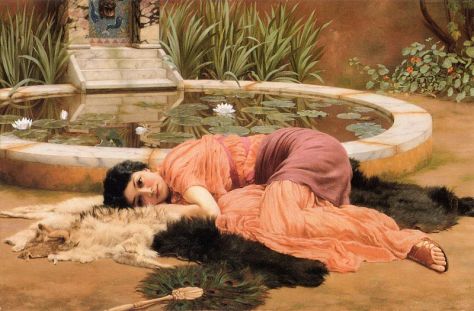
Cover image: “Sweet Nothings”: John William Godward (1861-1922) Cover design by Mira ZaminDolce far Niente (1904) Gorgeous painting
Various versions of the Sleeping Beauty tale have been around since the late 1600’s. The Puppet Queen adds itself to that list and keeps itself somewhat bleak in the tradition of folk-tales.
Twins, fraternal ones, can be as different from each other as any other pair of siblings. Selene and Auralia are like night and day. Auralia is the serene and proper one while Selene is the dark-haired girl in fine, torn tunics, tumbling into trouble any day of the week. Auralia is ready to embrace adulthood while Selene thinks the whole thing sounds like a bore. For a girl growing up in a society such as the one described in The Puppet Queen adulthood could be very constricting, and for a girl like Selene adulthood would probably have been excruciating to adjust to.
Life in the world of folk-tales tends to be fraught with danger. Curses, wickedness, murder, rape, and abuse of various sorts seem to trail through them all. There is always a way out, but that way tends to carry a high price and the “hero” must find it in them to pay it. If not – well …
The curse of Sleeping Beauty and of The Puppet Queen is one of sleep. Sleep for a castle in Sleeping Beauty and sleep for a whole country in The Puppet Queen. The only one to escape the curse in The Puppet Queen is Selene, and Selene it is who must save the day.
I think what I liked most about The Puppet Queen is that it stayed true to the spirit of folk-tales. People in the middle-ages knew how to tell stories. That these stories are used as a base for modern tales only shows the quality of the stories and their value as teaching tools.
I like the way Mira Zamin showed how difficult it was for Selene to withstand Gwydion. Their relationship was clearly an abusive one. But for Selene to break out of that relationship just wasn’t done in the days portrayed in the story. Perhaps she manages to do so and perhaps she doesn’t, but her experiences are the experiences of many women in relationships today. He who was once Prince Charming might well turn into King Terror. I appreciated Princess Selene’s resilience and the way she kept on going no matter what. Her main goal was to break the curse and she would endure what she must to reach her goal.
Book cover design: Christopher Tarwater Cover artist: Amy Clare Learmonth (she has some incredible illustrations on her site) Editor: Annetta Ribken
The cover of Little Girl Lost reminds me of the story of The Little Match Girl by HC Andersen (a story that made me bawl when I read it the first time). That look fits the story well as this is a story of orphans and poverty. A very short story. Only 15 pages long.
Tristan J. Tarwater calls Little GirlLost a prequel to Thieves At Heart. I guess that makes it story no. 0 in the tale of Valley of Ten Crescents.
Tavera is around seven or eight years old when she is sold into service – not for the first time. Such a fate was not unknown (and probably isn’t today) in many parts of the world. Tavera’s previous work had been coal sorting, fruit picking and laundering.
Being an orphan has never been an easy life. Being a “half-breed” (in this case half-elf) seldom helped.
A sense of Hansel and Gretel enters the story when the ancient, hunched over crone, Mrs. Greswin, pokes a finger in Tavera’s ribs and states that she’ll soon have Tavera fattened up. Yikes, what does this sausage maker put into her sausages?
Like all children, at least I was, Tavera is curious and when Mrs. Creswin is drunk enough Tavera explores as much as she can and discovers surprising facts about the old lady, gets into trouble, and sometimes discovers secrets better left alone. As it is a prequel, you all know this story is going to end well for Tavera. Well, kind of.
I enjoyed this little tale that only took a short, short while to read.
The Man in Black – The Woman in White shows us what the earth could be like in almost 200 years if we keep on letting it go to pieces and allow money to rule the world.
Stross presents us with a world without hope, a dark story of loss, poverty, inequality and disinformation. The town of Present, Nebraska thinks the world works in one way, and it seems they have been intentionally kept in that belief. Maintaining this status quo is the will of the people who hold power to change the lives of the citizens of Present for the better.
One of the tools the powers that be uses to keep the people of Present in Present is lack of education and information. Another tool seems to be to allow companies to move in and “encourage” farmers to sell their land and water-rights.
Stross encourages me to question my own beliefs of right and wrong. Exactly who is the culprit and why do I consider that person to be a culprit?
Poor young Kyle, living in circumstances that quite a few young people live in today. Desertification, water shortage and hunger are all parts of the lives of young and old in certain places of the world. There, too, tools such as the ones used against Present, Nebraska are utilised. The Man in Black – The Woman in White speaks of a world that already exists for many and will probably exist for many more in the years to come.
Stross doesn’t give us a solution or an answer to the problem. I appreciate that. Having an open ending allows me as a reader to look around and see if an answer exists at all.
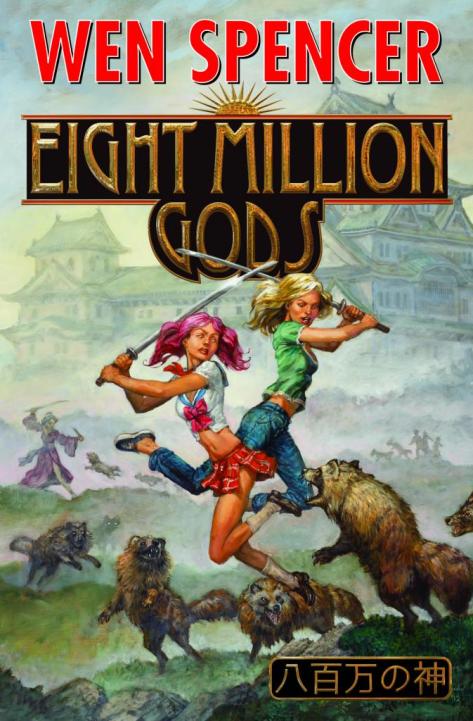
There is a reason I love Wen Spencer’s writing. Her characters are all odd-balls trying to fit in with the rest of the world. Some are more successful than others. Having pretty much grown up in mental institutions ensures that Nikki is going to have a harder time of it than most people. Having an obsessive compulsive disorder called hypergraphia isn’t helping Nikki fit in.
The driving compulsion to write; the overwhelming urge to write. Hypergraphia may compel someone to keep a voluminous journal, to jot off frequent letters to the editor, to write on toilet paper if nothing else is available, and perhaps even to compile a dictionary. Hypergraphia is the opposite of writer’s block.
The way Wen Spencer describes Nikki’s writing compulsion is pretty intense. At one point Nikki tells us that she would even use her own blood to write if the urge became too strong. Wow! That is some disorder to have.
For some weird reason, quoting law to some policemen was like hitting Superman with kryptonite. They just couldn’t cope with material from their home planet. (p. 1)
When Nikki’s mom drags along a police officer to have Nikki interred in a mental institution, quoting law to the police officer is one of the tools Nikki uses to get away. She does get away to Japan on a roller-coaster ride of gods, goddesses, super-natural creatures (like tanuki) and new friends.
But first things have to be resolved with the police officer and Nikki’s mom.
All mom’s are nuts, but some moms are crazier than others. While Nikki certainly has a pronounced form of OCD her obsession is fairly easy to satisfy. All her mom had to do was make certain that Nikki had the writing implements she needed. Being a Senator from a wealthy family (in the US that goes without saying) would also give Nikki’s mom the finances to make certain Nikki could get her education and help her with her obsession at the same time. That means that either Nikki’s mom is insane or maybe there is some other reason for Nikki being placed in a mental institution than the one Nikki thinks is true.
The blurb kind of gives the answer to that. Hah, hah – one of the many reasons I seldom include the blurb in my reviews.
When Nikki discovers that perhaps there is more to her hypergraphia than insanity, she is filled with relief and despair. Her relief is obviously from understanding that she isn’t nuts (well, not only nuts). The despair comes from realising that her horror stories are real, real, real.
What would it be like to realise that the story you had written about a person being killed by a blender was for real? It’s not the most common method of killing a person and to have that person be killed in the exact manner you had written – well that would freak me out. Then imagine finding out that the gods, goddesses and mythical creatures in Japan were real, and wanted something from you. Nikki freaking out is an understandable reaction. She does, but not in a major manner. In fact, her experiences with getting away from her mom’s attempts to get her into mental institutions serve her well in adjusting to her new reality.
“Eight Million Gods” was a fun story. There is an element of romance, but it doesn’t dominate the tale. Instead, we get loads of action, murder and mayhem. In other words, my kind of fantasy story.
I really am an airhead. I managed to press publish before anything had been written. Sorry if that confused you all. Here is the “real” version of my review.
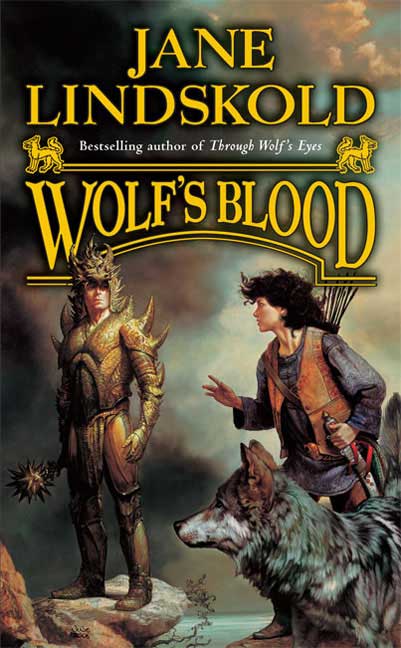
I hadn’t bought this last installment of the Firekeeper Saga until my son asked me to. We had read the previous five novels together and he really wanted to know how it was all going to end. Reading together is an experience more people should be able to enjoy. As I have said before, this is one of the major advantages to having a child with dyslexia.
Jane Lindskold made Wolf’s Blood as much fun to read out loud as she had made the other five. Her language is intelligent and her vocabulary varied. Again I found myself forgetting to follow the plot as I got so caught up in the intense experience of tasting Lindskold’s prose. That didn’t really matter because I had cheated and read through the novel on my own before reading it to my son.
One thing I have wondered is how the Firekeeper Saga can appeal to both an eighteen-year old and a 48-year-old at the same time. What is it about these characters that the two of us find so fascinating?
Firekeeper and Blindseer
Part of it most definitely has to do with Firekeeper and Blind Seer. The whole idea of our wolf-girl trying to find her place in human society and making sense of us all works for us. That Firekeeper often finds herself flummoxed by human society is understandable. All of our various religions and political views are confusing and usually you have to be an insider to understand all of the unwritten codes that rule us. She is an alien and will remain an alien for the rest of her life. But Firekeeper is an alien with a foot in human society and with people who love her and Blind Seer to bits.
I’ve been trying to figure out how Firekeeper was changed by querinalo. In Wolf Hunting we see that something did happen to her. My personal belief is that she became even more firmly a wolf in her heart and head because of her chant during her fever. Blind Seer probably did not change much as he beat the crap out of the source of the illness, but his view of himself changed drastically. Having come from a people who hated magic fiercely would make his adjustment to the “new” him a challenge.
Derian
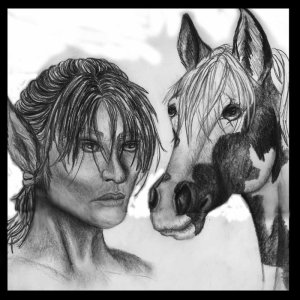
Derian and Eshinarvash by Fortunes Favor
Derian’s change was a bit more visible. This portrait of Derian with Eshinarvash by FortunesFavor shows how he has become a bit more horselike. His ears and forelock are especially telling. Derian struggles terribly to accept his new looks. His greatest fear is how his family will perceive him now that he “looks like a horse”. I would freak out myself if I woke up after an illness and discovered my face and outer extremities had metamorphosed into a blend of human and animal.
Derian also, quite understandably, worries about what women will think of him. Looking past our exteriors seems to be a challenge for a lot of us (myself included). It’s so easy to get hung up in insignificant details all the while forgetting about the significant ones (like personality and temperament). As the saying goes, where there is life there is hope. For Derian this is true (as you will see for yourself when you read Wolf’s Blood).
Perspective
Lindskold presents things from various points of view. Being on the spectrum makes this doubly important to me. I have learned much reading authors like Lindskold. She, too, has been part of a teaching staff who have all helped me understand people. Perspective changes good guys to bad and vice versa. If there is one thing I have learned in this life of mine, it is that perspective matters.
“Enemies”
War is a strange thing. King Bryessidan and his compatriots’ desire to take over the gates makes perfect sense. They had convinced themselves that they were being slighted and hindered in their “noble” purpose. Therefore they were justified in planning and executing an attack against the Nexus Islands. Seen from the Nexans’ side that is an erroneous argument, but to the winner goes the writing of history.
I also found myself understanding Virim. What he did was a terrible thing, but he never intended for querinalo to be so bad. But when it was he took advantage of it and found it difficult to let go of the apparent advantages to its system.
The ending was good. I knew this would be the result, but it needed saying and happening.
Jane Lindskold has been a pleasure to read with my son. The Firekeeper Saga kept him asking for more. Being the fantasy nut that I am, it is a pleasure whenever my sons enjoy the same literature I have enjoyed.
We really do need to do more research when it comes to girls and autism/aspergers. Is the visibility of male Aspergers the reason they are used as a template for what a female Asperger should be?
The overwhelming majority of referrals for a diagnostic assessment for Asperger’s Syndrome are boys. The ratio of males to females is around 10:1, yet the epidemiological research for Autistic Spectrum Disorders suggests that the ratio should be 4:1. Why are girls less likely to be identified as having the characteristics indicative of Asperger’s Syndrome? The following are some tentative suggestions that have yet to be validated by academic research, but they provide some plausible explanations based on preliminary clinical experience.
It appears that many girls with Asperger’s Syndrome have the same profile of abilities as boys but a subtler or less severe expression of the characteristics. Parents may be reluctant to seek a diagnostic assessment if the child appears to be coping reasonably well and clinicians may be hesitant to commit themselves to a diagnosis unless the signs are conspicuously different to the normal range of behaviour and abilities.
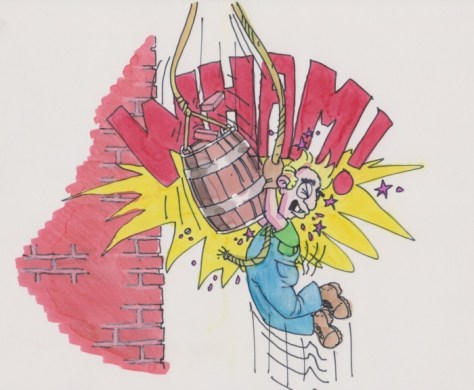
Industrial Safety – Hitting the Bricks by Alonzo Powers (The story as cartoon)
A BRICKLAYER working on a three-story-tall chimney had set up a pulley system so that his helper could raise the bricks up to where he needed them. As he was working, his helper complained about how difficult it would be to get the last of the bricks up to the flat roof of the building. Just then another contractor had some material delivered and it was placed on the roof by a fork lift brought to unload it. The bricklayer asked if the driver would load the rest of the bricks up there as well and the driver agreed. The bricklayer realized that he would not need his helper any more and sent him home.
When the bricklayer completed the chimney he noticed that he had quite a few bricks left over and that the fork lift was no longer at the job site. Now he had to figure out how to get the leftover bricks back down by himself. If he dropped them, they would surely break. So he decided to use the pulley he had set up earlier to lower them down.
First he went down to the ground and raised a large metal bucket up to the roof level using the rope and pulley. Next, he tied the rope off onto a railing and climbed back up to the roof and loaded the bricks into the bucket. Then he went back down to the ground. He knew that the bricks would be heavy, so he wrapped the rope around his hand a couple of times and then untied the end of the rope with his other hand. Well, the bricks were heavier than he imagined and with physics being as it is, he was immediately launched upwards at a high rate of speed.
As he was racing up towards the roof he encountered the bucket full of bricks coming down at an equally fast rate. He collided with the bucket and broke his nose and his shoulder. The bucket passed him by as he sped upwards. He reached the pulley just before the bucket hit the ground and broke a few of his fingers as they were pulled into the pulley. When the bucket hit the ground, its bottom fell out and all of the bricks spilled onto the ground. Now the fun reversed. As the now light bucket sped upwards, the mason took a shot to the groin when one of his legs slipped into the empty bucket.
He then tilted enough to fall out of the bucket and continued with his gravity experiment. Eventually he landed on top of the pile of bricks and broke both feet. He collapsed in pain there on the bricks, but was glad to be alive. He let go off the rope and cried out for help.
It was then that the bucket hit him in the head and fractured his skull.
Cover art by Chris McGrath Cover design by G-Force Design Internal dingbat by Tara O’Shea
I first discovered Seanan McGuire through her pseudonym Mira Grant. I enjoyed her Newsfleshcharacters so much that I wanted to give October (Toby) Daye a chance. Here I am seven novels later still reading about the adventures of changeling / knight / hero / granddaughter of Oberon: Toby Daye.
Why is it I like the October Daye series so much? My main reason has to do with the development of Toby’s character. Growth (whether for light or dark) in a character is what keeps me reading certain authors. If that development stops I move on. Thus far, I have had every reason to remain with October Daye and her faery world.
By now there have been so many losses and changes in Toby’s life that it is a wonder she is still up and about. McGuire has not given Toby the easiest life to live. Simple lives can be fun to read about but in the long run complexity is so much more fun. McGuire doesn’t slow down Toby’s challenges in Chimes at Midnight.
Once again, Toby discovers that just because something is bad for the changelings and for humans does not mean that the pure-bloods care. Some do, but faery who care about the lives of changelings and humans are definitely in the minority. So it has been throughout history. Many are the tales of faery interacting with people with devastating results for the person. Perhaps being immortal has something to do with that. At least that is an excuse we hear in Chimes at Midnight.
There is romance going on between Toby and Tybalt, but romance is not a major part of Chimes at Midnight. Action is. As with the other Daye novels, McGuire keeps her novels free from explicitness.
I liked Chimes at Midnight. When The Winter Long comes out I am going to buy it.








 humanitysdarkerside