It starts off with a barbrawl between the singer Freya (Gothic Warrior) and Lincoln. She wins. That fight gets Lincoln hired as her group’s (Helbound) body-guard.
This is urban fantasy with a demonic twist. Billy Wong manages to fill his 44 pages with plenty of action. I think it would probably be considered a young adult novel.
Kudos to Mr. Young (old link stopped working) for managing to come up with an original idea for a fantasy novel. I cannot remember ever having seen something like Gloomwood described.
Let’s see if I can describe it to you. In Gloomwood the head honcho is The Grim Reaper – yes the skeleton with a scythe. For some reason the Grim Reaper created Gloomwood for dead people (obviously) but also for dead ideas (you will see Father Christmas near to the beginning) and dead dreams. Gods that people have stopped believing in also end up in Gloomwood.
OK. So we have a city for the dead. That is exactly what Gloomwood is – a thriving (maybe not so much) place where the dead (of a certain kind) end up and live their deaths. There is crime, good deeds, bad deeds, bureaucracy, spies.
One of the latest additions to the community is Augustan Blunt. Blunt is his name and blunt is what he is. The leaders of the city decided to expedite his death so he could investigate why/who/how the head of the Grim Reaper was stolen. For that reason they have made him chief investigator. Being an ex-cop and a detective while alive makes him qualified for the job. That and being new and unprejudiced and neutral.
The fun thing about reading Dead Heads is that I read along thinking of the novel as a plain mystery. Then bam, something really weird happens – like decapitations without splatter. I like their library and their “internet”. In fact, I think Ross Young is onto something with real potential here. He writes well and engages me as a reader.
The writing needed a bit of tidying up. Punctuation (periods) were missing and there were odd little paragraph breaks. That was about it I think.
Michael Louis Weinberger’s website on Photium seems to have expired. I guess you might as well use Amazon or one of the other books-sites to find out a tiny bit about him. I did find him on Twitter
Cover art by ???
Blood Harvest sure is a leading title, wouldn’t you agree. The cover no less so. It would have to be about serial killers or vampires. Knowing me – vampires. From the cover you might guess there would be a lot of blood and gore. There is gore, but Blood Harvest is a far cry from gore-celebrating novels. There is about as much blood and gore as you would find in most action novels today.
Blood Harvest was fun. I know, I think that about a lot of novels and authors. But that is the way it is. A lot of books and authors out there are fun.
Tons and tons of action and mystery galore. A real who-dun-it. The answer is revealed to the reader pretty early on in the novel. Once I know I sometimes get annoyed at the characters for not realizing sooner what is going on. That is unfair of me. Yes I realize characters in novels are not really alive – but they are in my head while I am reading a book. Steve and Chris were fun characters. I loved the ending – too funny.
Part of the blurb reads: Respected by his fellow officers and enjoying a special bond with his Captain, whom he considers to be his mentor, Steve feels that he has finally found a place where the world makes sense and he can leave his dark past behind. So when his Captain calls in the middle of the night and instructs him to come to a highly unusual crime scene, Steve does so without question. Arriving on the scene Steve discovers that the entire staff and patronage of nearly one thousand people at a popular and hedonistic Los Angeles nightclub have suddenly and mysteriously collapsed where they stood and appear to be dead. Rumors of a biological or chemical terrorist attack are doubted by the large number of LAPD and emergency personnel on the scene, but there seems to be no other explanation for the unnerving occurrence. Then, before Steve can even fully begin his investigation, the case goes from unusual to absolutely bizarre with the appearance of an exotically beautiful and seductive woman in the company of a large, incredibly powerful white haired man.
Blood Harvest was a great first novel for Mr. Weinberger.
“Blood Harvest: Book 1, The Hidden Amongst Us” recently won a 2012 Next Generation Indie Publishers Award for Regional Fiction
In the same manner Catherine M. Wilson writes in minor key, Melissa Wright writes in major. Initially I read Frey because it was a freebie on Kindle. That is not why I continued reading the rest of the trilogy. Some authors just seem to have fun thinking up their stories and writing about them.
Part of the story was rather obvious, but the rest worked out a whole lot better than expected. I think it was the cover that fooled me. The blurb of Frey reads: “Unaware she’s been bound from using magic, Frey leads a small, miserable life in the village where she’s sent after the death of her mother. But a tiny spark starts a fury of changes and she finds herself running from everything she’s ever known.
Hunted by council for practicing dark magic, she is certain she’s been wrongfully accused. She flees, and is forced to rely on strangers for protection. But the farther she strays from home, the more her magic and forgotten memories return and she begins to suspect all is not as it seems.”
The first sentence kind of sets the tone for the rest of the novel and kind of demonstrates what I mean by writing in major key: “Crap!” I complained as I stubbed my toe on a root, one of the pitfalls of living in a tree. It says quite a bit about an author that begins her story like that.
Frey is an interesting character. As she realizes just how lost she is she also reacts in a manner that I could sympathise with. Frey was a fun read and brought me on to the next two books of the trilogy.
When I talk about authors who write musically, Catherine M. Wilson is one of those authors. After reading her The Warrior’s Path right after reading the Frey Saga I found myself understanding a profound musical difference between authors. The Warrior’s Path is written in a minor key (or moll in Norwegian) while the Frey Saga is written in a major key (dur in Norwegian). How cool is that??
Our hero, Tamras, learns a great deal about herself, her prejudices and her talents during The Warrior’s Path. Some of these talents point to a mystical ability that may or may not become more apparent as the trilogy advances. One of her most important lessons is taught by her Warrior, Maara. Maara teaches her that Tamras is not her emotions but that she has the ability to decide how to use them. Tamras learns to deal with disappointment, anger, jealousy and fear.
I often think that we are what we choose. Just think of the many times you might have thought “if only”. Many of my choices have been less than ideal. But choosing to read The Warrior’s Path is a choice that has given me new insight and great pleasure. To think that this is Catherine M. Wilson’s first novel says quite a bit about her talent for the craft and her ability to develop it. I know she doubts she will write any more novels after spending ten years on her trilogy. That would be a pity.
After researching a bit more about the novel on the net I realized it falls within the lesbian/gay category as well as any other. Never entered my mind while reading it. To me it was just fantasy – really good fantasy – with a semi-lesbian twist. Didn’t seem all that important to me. But it is on the must read list of several lesbian/gay sites out there, soooo?
Reading as much as I do, creates a problem of abundance when it comes to writing a book-blog. Which book am I going to choose to write about. There are sooooo many that I have loved, that I love and that I will probably come to love. Authors and books are my favorite thing on this earth – next to my family and dog (OK and maybe friends). I’ll admit there are quite a few sucky authors, but there is an abundance of fun, excitement and learning out there.
Because I am such an addict I read quite a variety of literature. Scientific articles, jokes, curio and scholarly works. But my favorite is fantasy and science fiction. I have to admit that I consider most of the fiction out there as some kind of science fiction or fantasy as well.
Recently a friend of mine posted a link to an article called We Aren’t the World by Ethan Watters who writes for Pacific Standard. The article We Aren’t the World is about the research performed by the researchers Joe Heinrich, Steven Heine and Ara Norenzayan. They look at some of the assumptions anthropological researchers have made based on research on a selection that might just be a bit biased. I remember asking some of the same questions (to myself) at the time of my own psych classes.
Once I read through the article I thought “Yup, sounds about right” and that was that – until it settled in. Then I got really exited about what this could mean to the world of research and just had to write about the article and the three brilliant researchers on my blog.
Prisoner’s dilemma as presented in various psych texts
Heinrich, Heine And Norenzayan ended up publishing an article called The weirdest people in the world in The Cambridge Journals in 2010. What they claim is that behavior depends on your background. In their case they used a version of the prisoner’s dilemma to see if the West had the answers to how to predict behavior. What they found was that there were grounds to question a theory of genetics determining this type of behavior. It turned out that how people ended up dividing the offered money (which was what was used in the experiment) depended on background (in form of society, religion and class). Sooooooo, in order to predict something about human behavior one would need a wider selection – representation had been too poor thus far.
Science being what it is, theories have to be tested and tested and tested before a degree of certainty can be reached. But, thankfully, the wonderful thing about science is that once some person questions a theory and goes out and finds a different answer, and others find the same different answers scientific knowledge grows and more questions get to be asked. I LOVE science.
There are times when I find myself wholeheartedly able to recommend books for children. There are a couple of criteria I feel they need to fulfill. Violence and love stories have to be within certain parameters. Morals and ethics should be discussed without the discussion being obvious. (I like that in adult novels as well) Preachy authors are a pain. The flow of the written language should be such that I like the feel of reading to a child. I realise not every person in the world understands what I mean by that, but I would assume that a fellow autistically traited person would. It is all about word-texture.
Bunn fulfills all of these criteria in his Tormay Trilogy. The plot itself is pretty basic – light battles darkness/light almost loses/light prevails. I guess when life is boiled down to its most basic ingredients, life for humans is pretty much about the battle between light and darkness. One of the things I liked about this trilogy is Bunn letting us see that a person can contain both light and dark. We are not wholly one or the other.
Bunn’s characters are likeable. The story of Jute and his companions is continued. Not everything that happens in the novel is happy but there is an ending that brings the story to a conclusion. I have enjoyed my experience with the world of Christopher Bunn.
What an excellent beginning Shadewrightis to the Shadewright Cycle. I liked it enough to buy book two of the serial (Shadowslave). Shadewright is also my introduction to the writing of Dean McMillin.
I suspected I was reading steampunk as I got a ways into the novel. Machines that enabled lightning magic turned up. I could be wrong.
I loved McMillin’s writing. It has all the elements I like. Most of all it flows. I love it when that happens. Somehow the author manages to get through to me and we have fun together.
In the world of Phantist there are shadewrights (Phantist is one), arcwrights (Arick is one), flowmen, and bloodwrights.
Shadewrights manipulate shadows. Arcwrights manipulate the electricity in the air. Bloodwrights are flowmen who are able to affect the very nature of living species. Flowmen heal and kill with their power. There are probably other types of Wrights, but these were the only ones that were in Shadewright.
Phantist is a shadewright who is born an orphan. There are plenty of those in the world. He is a greyskin – which means that his skin, hair and eyes are grey. Greyskins are sensitive to light, but have an inborn ability to manipulate shadow (some better than others). Since Phantist is our protaganist, he is bound to end up being good at shadowmastering.
On his journey to fulfill his destiny Phantist is thrown into life-threatening situations. The action is well-written. Dean keeps his writing tight and does not fall for the temptation to embroider into infinity. I imagine he has had to edit quite a bit to get this feeling accross to me.
The people Phantist meets on his journey vary from helpers and goodies to side-kicks and baddies. Most of them are a bit insane but insane in an interesting way. Crazy is good.
I liked the world of the Shadewright. I hope I enjoy Shadowslave as much.
Dean Chalmers: Power of Shadow (Earth, Blood & Shadow I)
Once again Christopher Bunn manages to catch my interest with his characters in The Tormay Trilogy. In The Shadow at the Gate the battle between dark and light continues. As this is a serial, you will have to read The Hawk and His Boy first to make sense of the story. Ronan and Jute had their incident during a break-in in The Hawk and His Boy. Unexpectedly, the robbery goes awry for both Ronan and Jute. The intention behind using Ronan (the Knife) was to prevent Jute from ever talking about the job. But both Ronan and Jute had their lives turned upside-down during that robbery.
In The Shadow at the Gate Ronan is commanded by the Silentman to get Jute back, or else. Ronan goes after Jute. But Jute is not easy to find. He has hidden well realising his precarious position. The kid wants to live, voice in his head notwithstanding.
Levoreth Callas arrives at the castle with her aunt and uncle. She is slowly waking to the necessity of battling the Shadow. But discovering where the Shadow resides, and in whom it is residing, is going to take all she has.
All three characters have allies/helpers that both hinder and aid them in their quests. Dunn keeps a nice pace in his story and manages to make the novel interesting for both young and old. I have forgotten what it is to be ten years old. It would be interesting to hear what a ten-year-old would take from the story of young Jute and the rest of the gang.
Thomas K. Carpenter thinks that augmented reality is part of what our future digital life will be. Augmented reality is an essential part of The Lorieme Job. The Lorieme Job first appeared in the anthology Mirror Shards: Vol. 2. I came into contact with The Lorieme Job through Kindle. It was on offer for nothing and I thought “why not”. This is a choice I am happy I made.
I believe this type of science fiction is called hard science fiction. An essential part of hard science fiction is the believability of the technological future presented. Even though Zel’s world is highly augmented, I have no problem seeing us going in that direction.
Besides the science fiction, The Lorieme Job is a mystery. Zel is trying to find the person in control of “the fountain of youth” and has to do so in a way that will not get her caught. She is probably the ultimate (impossible to catch) hacker of the digital sea. During her hunt, she encounters a few surprises.
I love speculations about the future. Reading The Lorieme Job was a fun few pages. There was plenty of action, plenty of technology and a bit of humor. Zel’s plans for Redman were especially fun. She is my kind of lady.
Freedom of Speech. How far are we willing to go to let our voices be heard? How far are others willing to go to stop our voices from being heard?
Dangerous Voices is a wonderfully terrible short story about the lengths people are willing to go to let their voices be heard and to stop those voices from reaching out. What would my choice have been? Hmmmm.
If it was not for the magic, this could be a story right out of Amnesty International‘s archives.
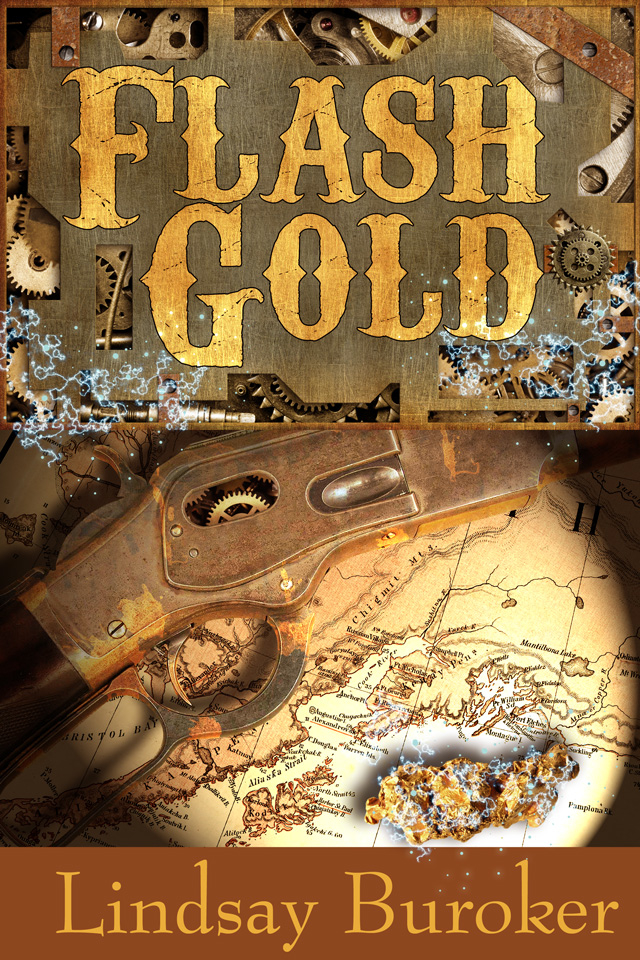
Cover art by Glendon Haddix – a cover I find quite appealing
Flash Gold is a steampunk novella set in the Yukon. As bad as I am at being able to place my litterature in categories, even I am able to discern when something is steampunk. It is the steam that gives it away. Other than that, there seems to be some kind of mystic element involved (supernatural, magic, paranormal and so on).
In Moose Hollow, a small town of Yukon, a young orphan woman named Kali McAlister lives. She has taken over her father’s workshop in an attempt to stay independent. The citizens of Moose Hollow suspect Kali is something more than she seems. Perhaps she is using frowned upon magic??????
A stranger called Cedar drops into her life at the same time as she has entered a contest to win enough money to keep her doing what she loves most – tinker and invent. He applies for an Assistant position as musher for the Barton Race. Kali has no money to pay Cedar with but he is willing to take a cut of the winnings.
What Cedar ends up being is part assistant and part body-guard. It seems there are several parties who are interested in how Kali manages to get her machines to work so well. The two of them end up in a race for their life as much as a race for the money.
Flash Gold is filled with plenty of humor – humor that I actually get – and action. I like action filled books that have a humorous twist. Lindsay Buroker presents her steampunk in a manner that makes me want to read more of her stuff.
Different sites I have been to claim that http://richardleebyers.com/ is Richard Lee Byers’ website. It is NOT. It might have been at one time but now it is a weight and cellulite management site. I think your best bet would be to try his live journal. Hopefully, it is still up and running – it was as of 2013 Mar 04.
In the world of Matt Brown we find superheroes and aliens.
Germantown is attacked by aliens who are looking for a snack. When the superheroes try to defend the population, most of them get killed. Matt Brown then has a life-changing experience. One that enables him to help those around him fight the hungry bugs.
With Suiting Up we see the beginning of a new superhero series, The Impostor. We are looking at a typical superhero style of writing. Those of you out there who are fans of the genre will enjoy Suiting Up.
For some reason I absolutely loved this cover created by ?????
Shatterboyoriginally appeared in Circada in November 2005. It is a short and wonderful science fiction story about loss and letting go. Mr. Carter manages to pack quite a punch into his 8 pages. Such a fragile tale. This is a must-read.
Christopher Bunn begins the Tormay Trilogy with the tale about Jute and his unknown protector. Just who/what this protector is becomes clear in the first chapter of The Hawk and His Boy.
I usually compare myself with the characters of the books that I read. Are we very dissimilar? Is there anything in the story that resonates with me?
Another thing I do is try to figure out how likely the scenario is. Not the whole magic/supernatural thing, but the interaction between various characters. Is there any chance of people acting the way they do in the particular piece of literature I am reading? The answer to those questions determine how I view the author’s passion for her/his work.
Another very important factor for me is words. Are there many mistakes? Do I feel a lot of editing has gone into the novel? Does the author know how to move from word to sentence to paragraph to chapter (or the flow as I call it)?
My mother and father grew up under harsh circumstances. They have both seen how life can force people to commit desperate acts. Jute’s life at the time we meet him is wholly believable. His circumstances have made him a thief and a very good one at that. Unfortunately, being good at something can be dangerous for the expert. Chances are you might be “asked” to do something dangerous.
Jute did that dangerous deed and things went about as one would expect in a fantasy novel – not very well for him. But surprising things can get you out of trouble and into boiling water. That is where Jute ends up – over a very hot fire in a bubbling cauldron.
For Ronan the Knife his job with Jute makes him want to leave his business and change his life around. Is that even possible when your adult life has been spent doing a job that is guaranteed to make you enemies? We shall see.
The third character I want to mention is Levoreth Callas. She is a strange one. As it turns out she is even stranger than one might think.
So. What exactly resonated with me in The Hawk and His Boy? Jute’s character in general. His life is terrible (according to my standards), yet he retains his curiosity and optimism.
In Chapter 6 Bunn writes a scene that could have ended up in overkill, yet he manages the balance needed to keep on writer’s tight edge. Not always an easy thing to achieve.
Christopher’s passion for his work is easy to see in the way he puts his words together so carefully.

 Gothic Warrior and the Dark Man is a 44 page short story.




 humanitysdarkerside