Stealing the Elf-King’s Roses was relaunched in new clothes in 2011. Diane had felt the need to fix some issues that she had noticed over the years. My book is the original version.
Who among us is able to state honestly that we have no prejudices? I know I cannot. I try not to let those prejudices interfere with the way I treat people I encounter, but I know that at times I have let my feelings shine through. This is the great thing about fantasy and science fiction. The differences between species become blindingly obvious. In this manner the author has the chance to either preach or teach through their writing. Preaching bores me. I expect to be treated as though I am intelligent enough to catch on to the underlying message without having it spelled out for me.
Diane Duane manages to teach us about prejudice without getting on her high horse or behind a pulpit. This is quite difficult to manage I have noticed in the all-too many books I have read. Authors with this ability really need all the acknowledgement they so richly deserve.
Lee Einfeld and Gelert Reh’Mechren are Lanthomancers at Law in a parallel world where psychic abilities are more common that here. The team seeks out psychospoors at crime scenes. The evidence recorded from that is presented in court and through a sort of ceremony Justice comes into the court-room and the defendant is judged.
An Alfen murder comes their way and that murder brings the Lanthomancer team into inter-universe politics. This is a mystery mixed with techno-jargon mixed with political ploys.
Stealing the Elf-King’s Roses was a fun read. There were some hiccups along the way, but nothing major (might be because I have the older version).
Michael J. Sullivan has been writing his whole life. Not until he began writing the Rirya Revelations series did he get published. Strange thing that. The Rirya Revelations had been a project that he undertook to please himself and his daughter (who has been part of designing the cartoon on Michael’s website). All six books were finished before the first one was published.
After a while the sales took off and Michael J. Sullivan has become a well-known name in the fantasy world. That recognition is well-deserved. His books are fun to read and they kept me wanting to know how the greater plot is resolved. The characters are fun and varied. It is not immediately clear whether the butler did it or not (I know there isn’t a butler in these books) and that is something that I really like in a writer. We should be kept wondering who the baddest baddie is.
All six books are stand-alone books in the sense that the main problem is resolved. However, there is a greater plot spanning all six books, so it would be a good idea to start at omnibus no. 1 – Theft of Swords. That way you get all of those pesky little threads tied together from the beginning.
Royce Melborne and Hadrian Blackwater are essential characters in all six novels. They are the Rirya – a gang of two. Together they get into and out of all sorts of trouble. These books are good for young adults and upwards. There isn’t too much violence and no sex.
The gods of Elan are: Erebus (Father of the gods), Ferrol (Eldest son, god of elves), Drome (Second son, god of dwarves), Maribor (Third son, god of men), Muriel (Only daughter, goddess of nature) and Uberlin (Son of Muriel and Erebus, god of darkness).
The main political parties to be aware of are:
Imperialists: Those wishing to unite mankind under a single leader who is the direct descendant of the demigod Novron.
Nationalists: Those wishing to be ruled by a leader chosen by the people.
Royalists: Those wishing to continue rule by individual, independent monarchs.
THEFT OF SWORDS (2011): THE CROWN CONSPIRACY AND AVEMPARTHA
Hadrian and Royce are stopped by highway robbers, incredibly incompetent ones according to Hadrian and Royce. When the highway robbers discover that they are dealing with the Rirya, panic settles in. Before they go, Hadrian gives the robbers advice on how to rob people properly.
Hadrian and Royce are on their way to a job. That is what they do. They get paid to rob the wealthy for various reasons. The two of them are quite successful at what they do. But things are bound to go wrong when they are asked to undertake a job that leaves them practically no time plan. A sword is placed in the chapel at the Medford castle, and the boys are to remove it to give Count Pickering trouble in a duel. What Hadrian discovers instead is a dead king and he and Royce are accused of the murder.
AVEMPARTHA
Hadrian and Royce meet up with the guy who asked them to steal the sword, and you can probably imagine that they weren’t best pleased. But for some strange reason the man walked out of that meeting alive. Royce gets to chat with old friends and the two men are told of a young girl looking for them. They must be in a soft frame of mind, for when they meet this young girl, Thrace, they end up going with her to her village. There, mighty adventure awaits. Ok, that was a bit over-kill.
In the meantime, and you just know there has to be a meantime don’t you?, Arista bounces into her brother King Alric’s meeting misunderstanding the meeting’s intent. She thinks he is about to marry her off, while he is in reality planning on sending her as an ambassador to Dunmore. Arista likes the idea of having something to do, especially as it gets her away from all of the rumors of her witchhood. Along with her normal entourage bishop Saldur comes along with the Pickering brothers. Fanin and Mauvin are going to enter into a contest the church of Novron is holding in Ervanon.
RISE OF EMPIRE (2011): NYPHRON RISING AND THE EMERALD STORM
NYPHRON RISING
Young Amilia works as a bullied scullion maid at Aquesta. She is being threatened once again by Edith Mon, the head maid, but saved when two women enter the kitchen. One is clearly some kind of nobility, having both the manners and the clothes for it. The other is an extremely thin and quiet young woman who turns out to be the Empress of Modina. She does not look the part at all.
Through luck Regent Saldur (formerly bishop) appoints Amilia as the Empress’ new secretary. Amilia is terrified as she knows the fate of those who disappoint the regent. But Amilia turns out to have a positive effect on the Empress.
Royce and Hadrian have become royal spies, a job they are really good at. They have found themselves willing to be in the service of the Royal family of Medford, trying to keep the kingdom alive and well in a growing Empire. But keeping Medford on its feet is quite a challenge. Princess Arista has had no luck as an ambassador in finding allies. Every country is too afraid of the new Empire to dare to fight it.
THE EMERALD STORM
Merrick Marius is the world’s best and most cunning assassin. He has been hired to kill someone in Arista’s closest circle. It goes off without a hitch, leaving Arista without an important aid in keeping Ratibor in the hands of the nationalists. But he leaves her with a riddle: “Find the Horn of Gylindora … at Wintertide the Uli Vermar ends … Patriarch … is the same …”. Arista knows the message is extremely important but she hasn’t got a clue how to go about it.
Amilia is still the Empress’ secretary. Modena has been moved to better lodgings, but Amilia still feels as though she is treading water. But fortunately she has acquired her own helper in Nimbus, a landless nobelman. Amilia’s life is on the line every day, as Regent Saldur has made it quite clear what will happen if the Empress embarrasses him in any kind of manner.
Royce and Hadrian go off hunting Merrick. Once Royce and Merrick were good friends, but something happened and Merric now hates Royce. Now he has the chance to play with the Ryria and work against the kingdom of Medford. He tries to lure the two into a trap, quite a cunning one it turns out.
HEIR OF NOVRON (2012): WINTERTIDE AND PERCEPLIQUIS
WINTERTIDE
Stealing is what he has to do to survive. But back luck strikes and he gets yelled at when he gets back to his gang. They decide to try to fleece two newcomers to the city. Royce and Hadrian enter the Imperial Square in a snowstorm. They have come to save Degan Gaunt from execution. The boys discover that the newcomers might be more than they have bargained for, but their meeting actually turns out to be fortuitous for both sides.
Arista is trying to stay sane in her cell. Arista’s attempt to save Degan Gaunt has not been successful. She just knows that she cannot give up trying to escape as the fate of the world rests upon her hands, quite literally.
Amilia is still secretary to the Empress, finding her life full of new experiences. Modena is still quite grief-struck at the challenges that have met her. But something happens to slowly wake her from her dull and grief-struck state. She finds something to live for a meaning to life. Revenge and retribution.
PERCEPLIQUIS
The elves are a hunted people by humans. Persecution is severe by the Church of Nypron. They are thought of as terrible creatures who should be struck down whenever they are seen. Now the elves have come on to human lands once again, striking down humans.
Rather than help the humans in trouble, Guy Luis is chasing a young girl called Mercy. She is the ward of Arcadius and Arcadius is trying to save her. But that job might turn out to be insurmountable.
Refugees are arriving at the Imperial city. All of the North is being overrun and the humans have no idea why. As more and more refugees come into the city Arista decides that the riddle Eshraddon gave her must be solved and as soon as possible. However, she soon discovers, once again, obstacles in her way. Royce and Hadrian end up providing the assistance she needs.
————————–
AWARDS
2010 Iceberg Ink Award Best Read (Avempartha)
2010 Goodreads Choice Award Nominee for Fantasy (The Emerald Storm)
2009 National Indie Book Award Finalist (The Crown Conspiracy)
2008 ReaderViews Annual Literary Award Finalist (The Crown Conspiracy)
Sometimes I wonder if power is THE most basic of our needs. The power to control our own lives, the power to control our environment and the power to control others.
Take the power to control our own lives. Genvieve Taylor never had power over her life. Her creation was a genetic experiment between two incompatible races. Once that succeeded she was promised to someone extremely powerful and extremely deranged. And finally, at the age of 14 she was injected with a poison (V3) that made her vulnerable to vampires.
Our main character never seriously thinks about giving up the fight for the right to decide what to do with herself and her own life. The Sweet Scent of Blood is for the most part about that battle. And battle it is.
At the beginning of The Sweet Scent of Blood Genny imagines she has achieved a modicum of control over her life, in fact about as much power as most of us can expect to have. She has a job, protection against the vampires, a place to live and friends. Yet power over our own lives is often an illusion. Illusions are easily snatched away by someone more powerful or someone willing to engage the help of the powerful.
Being one of the sidhe fae, a bean sidhe, would normally make Genvieve one of the more powerful people of the world of Suzanne McLeod. But her mixed heritage is unhelpful and Genny’s inability to accept who and what she is acts as a barrier in reaching her potential. In McLeod’s London she also happens to be the only sidhe fae. Sadly, this only makes her more attractive to both those who wish to use her and those who wish to destroy her.
In my mind the only person in The Sweet Scent of Blood who is wholly on Genvieve’s side is Hugh Monroe. Hugh has an intense need to protect those who are in need of help. Genny came into his life when she was infected with V3 and has remained there ever since. His protectiveness made it natural for him to wish to enter the police force. He works as a DI at The New Scotland Yard and happens to be one of the straight cops at that facility. We soon discover that not all who work for the police do so for the same need to protect and serve the public.
The Sweet Scent of Blood starts out as a mystery and ends up as a battle amongst the mighty of Genny’s London. Genvieve seeks the answer to who killed Melissa. Was is Roberto, her boyfriend, or was it another character? Through the story we see that sometimes Genny is aided in her search for answers but for the most part barriers are thrown up, one after the other.
In their scrabble to stay on top, the powers that be have decided that the faery are to remain without civil rights. Civil rights is something a great many of us take for granted. I find it comforting to imagine that if something terrible happened to me then I would be safe because Justice would have its day. Sure, it’s just an illusion but one that is legislated for the likes of me. One hundred years ago women did not have the right to vote nor did they have many of the other rights that men did. Disabled could still be sterilized in Norway a long time after that. Many people have sacrificed a great deal to make it possible for me to have the power over my life that I do.
Faery do not. Vampires do, but faery do not. Witches have civil rights, but faery do not. Regular humans have civil rights, but faery do not. Do I have to look far to find people without written legislation to protect them even today? Sadly, no. In The Sweet Scent of Blood the reason for this lack of power lies for the main part in looks. Some of the faery can be frightening looking and some of them are extremely dangerous. Their ethics are unfamiliar to humans. All of these factors have been utilized by the masters of power games in making the faery less powerful.
The Sweet Scent of Blood is one of my re-readables. I know it is supposed to be Suzanne McLeod’s first published novel, but it holds none of the earmarks of a first novel. Indeed she manages to stay on-key throughout the whole story. Definitely recommended.
If there is one thing in this world that has inspired the world of nerddom, it has to be the fantastical writings of J.R.R. Tolkien. While I’m not a Tolkien nerd/geek/fan/cult-member, I understand those who are. I mean, I’m writing a blog mostly about fantasy and science fiction – and I love doing the digging necessary for each article.
Tolkien did not only write “high epic fantasy”. He was first and foremost a Professor of Anglo-Saxon at Oxford. You can see a list of his published material at the Tolkien Library website.
While working as a lexicographer on the New English Dictionary, Tolkien began working on the elven language (primarily based on Finnish and Welsh – go to The Elvish Library to get your Tengwar baptism). At the same time he presented his The Fall of Gandolin. The Fall of Gandolin represents the beginning of what later became The Silmarillion. He ended up at Oxford in 1925, and it was after this that the work on first The Hobbit and then The Lord of The Rings began. (Tolkien Library – biography)
The Hobbit was a hit, making it easier for the publisher to contemplate publishing The Lord of The Rings. But for economic reasons, it was decided that three volumes were necessary. The three volumes were The Fellowship of the Ring, The Two Towers and the Return of the King. My copy is the omnibus containing all three novels and the appendices at the end, appendices that are quite a bit of fun.
Generally, I try to analyze what it is about a book that makes me like it. With The Hobbit it was the adventure of the tale. The Lord of the Rings is rather more difficult to pin down. Part of my liking has to do with the quality of the work. Tolkien nit-picked at details until they fit into his Middle-Earth world. The likeability of all of the characters also plays a great role. Even the “baddies”. The way the story is told, jumping from place to place is frustrating at times but also makes a lot of sense. I absolutely hated it when Tolkien broke from one adventure when things were at their most critical, to visit someone else where he had left them off. But it did keep me reading. I remember the first time I read The Lord of the Rings. I stayed up all night to get through it. Once I get going, The Lord of the Rings is difficult to put down. I have no idea how many times I have read this book, but I have gone through it a few times.
THE FELLOWSHIP OF THE RING
Each book is divided into two parts. The Fellowship of the Ring consists of I: The Ring Sets Out and II: The Ring Goes South.
Bilbo is having his 111th birthday party combining it with Frodo’s 33rd. The whole Shire is looking forward to the celebration as there will be gifts for everyone and enormous amounts of food. As ordered, Gandalf shows up with fireworks for the party.
Bilbo is going to give up the ring, but he is finding it more difficult than he had thought. Somehow, it ends up in his pocket no matter what his intentions are. That is one of the problems with the ring. Once it chooses you as an owner, it will use you up until it feels like letting you go. Now Bilbo has to fight his own desires. In the end he manages to leave the ring with Frodo, his nephew, and Bilbo leaves the Shire with Gandalf.
Originally, the ring had belonged to Sauron. Sauron is a wizard who has gone over to the dark side (like Darth Vader in Star Wars). Now that he has amassed quite a bit of power, he wants his ring back and has sent his minions to search for it. The search has led him to the Shire. Gandalf returns to warn Frodo that he needs to leave the Shire. He does so, and ends up in the company of his friends Sam, Pippin and Merry. They go via the Old Forest to avoid whatever is looking for them.
The Old Forest is ruled by Tom Bombadil. Thankfully, he keeps a close watch over his kingdom and manages to be there for the hobbits when they need him. With his assistance the hobbits are able to get through the Old Forest. Their journey carries them through Barrow-Downs, Bree and Weathertop.
The four hobbits learn quite a bit about themselves, their strengths and weaknesses. Their loyalty to each other increases with their trials. Middle-Earth is not exactly a paradise, free from dangers. Once the Shire is left behind, danger seems to be the word of the day for this little troup. At Bree the hobbits meet up with a ranger called Aragorn. Together, they test the bond between human and hobbits and find out what they all are made of. Eventually, the gang manages to arrive at Rivendell, one of the homes of the elves.
A well-earned rest is taken at Rivendell. Elrond, the elven-leader at Rivendell convenes the Council of Elrond. At the Council, reports are given, and the decision as to what needs to be done next is taken. They decide that the One Ring must be destroyed and once again the hobbits set off. This time there are nine people who set out.
THE TWO TOWERS
As with The Fellowship of the Ring, The Two Towers also consists of two books. Book III is The Treason of Isengard and book IV The Ring Goes East.
This is when Tolkien begins to get seriously annoying. Sadly, he has to because the company has split up and we need to know what happens to each party. Frodo has left the Fellowship and gone down the road he thinks is necessary. Along with him went Sam. For now, we learn very little new about them, but we will later on (of course). This part of the story belongs to Merry and Pippin and the important part they play in furthering the plot.
The group gets split even further. Merry and Pippin are taken by the Uruk-hai. The rest have to make a decision. Try to find Frodo and Sam or follow Merry and Pippin. Merry and Pippin it is. Fortunately for Merry and Pippin, their stay with the Uruk-hai is not an extended one. After their escape they come to Fangorn forest and the Ents. Treebeard’s depiction above is one of the coolest ones I’ve come accross yet. Treebeard is the leader of the Ents, tree-people who have taken a looooong rest (for some of them a permanent one).
Aragorn, Gimli and Legolas come accross tracks that remind them of hobbit feet. They follow them into Fangorn and meet Gandalf again. Meeting him is a shock and a surprise (hah, hah, hah – not telling why). Together they rouse the armies of Rohan and all of them travel on to Helm’s Deep where they are needed.
In the meantime, Frodo and Sam continue on their journey toward Mordor. Who should appear but Gollum. His attraction to the One Ring is strong and he cannot help being pulled towards it. Frodo and Sam get him to promise to guide them to the Black Gate of Mordor.
Once they get to the Black Gate, Gollum finds it easy to convince Frodo and Sam to follow him to a secret entrance into Mordor. By going there, they will avoid guards. As they keep on going, the three-hobbit-group meets up with Faramir and his Rangers. The Rangers help them on their way. Faramir warns Frodo and Sam that Gollum might know more about the secret entrance than he is telling. And he does. Does he ever. But then Gollum is true to the nature that has become his. Possession of the One Ring is all that matters to him. Means justify the end, and what an unpleasant set of means he has awaiting the two hobbits.
THE RETURN OF THE KING
In our last book of The Lord of the Ring trilogy we find the books V: The War of the Ring and VI: The Return of the King.
The Lord of the Rings is not a trilogy for the faint-hearted. From what I’ve heard, that goes for the movies as well (I have not seen them). There is violence, plenty of violence and death. As you have found thus far, people die along the way. How many of these heroes will survive, is not certain at all. But what most of you already know, due to all of the media coverage of the films, is that some of our heroes will make it – all the way to the very end.
But before we get that far, war beckons in another land. A horde of Orcs are attacking Gondor and the people of Gondor are desperate for help. The goal of Gandalf and Aragorn and the rest is to get there in time to make a difference. But when the dreaded Witch King of Angmar arrives on the scene with even more help from Mordor, nothing is certain.
As you will see when you read The Return of the King, plenty has happened to Frodo and Sam. Their journey towards the destruction of the One Ring is proving extremely problematic. Orcs are following their tracks through the desolate landscape of Mordor. Getting from Cirith Ungol to the Crack of Doom is by no means certain. Nothing of value is to be easy for the two friends.
And this is where I leave off. Like I said at the beginning, The Lord of the Rings has been an enjoyable and tense journey, one that I wish everyone could enjoy. I have not seen the films, and I will not do so either. The images evoked by this trilogy through reading, are enough for me. I wish to retain them, not replace them.
For my dyslectic son, the films were the obvious choice and one that he enjoyed. My non-dyslectic son has read the trilogy several times and seen the films and enjoyed all of them. I’m just too old-fashioned, I guess.
1978: Part I of a rotoscoped animation of Lord of the Rings was released by United Artists and directed by Ralph Bakshi. UA considered the film a flop and refused to fund Part II.
1980: Rankin/Bass use the opportunity to give out a televised animation of the Return of the King. It was targeted at a younger audience.
1998: Miramax began a live-action adaptation of The Lord of the Rings, directed by Peter Jackson. New Line Cinema assumed production responsibility and decided that there would be three, not two films. 2001: The Fellowship of the Ring; 2002: The Two Towers; 2003: The Return of the King.
2009: The Hunt for Gollum, a fan film based on elements of the appendices to The Lord of the Rings, was released on the internet in May 2009.
Awards
All three films by Peter Jackson won the Hugo Award for Best (Long-form) Dramatic Presentation in their respective years.
4 Oscars for The Fellowship of the Ring
2 Oscars for The Two Towers
11 Oscars for The Return of the King
Radio
1955: The BBC produced a 13-part-radio adaptation of The Lord of the Rings. It is a very faithful adaptation.
1979: US dramatization subsequently issued on tape and CD.
1981: BBC produced a 26 half-hour-episode adaptation of The Lord of the Rings.
Stage
1990s: Lifeline Theatre in Chicago, Illinois, produced individual plays of each of the three books.
2001-2003: Full-length productions of each of The Fellowship of the Ring (2001), The Two Towers (2002), and The Return of the King (2003) were staged in Cincinnati, Ohio.
2006: Three-hour-stage musical adaptation of The Lord of the Rings by Mirvish Productions opened in Toronto (opened in London 2007).
Music: There are groups playing anything from death-metal to folk music who are fans of Middle-Earth. Some albums are very middle-age while others are far from it.
…Of Forest And Fire…
…Where the Shadows Lie
A Night in Rivendell
All that Glitters
An Evening in Rivendell
At Dawn in Rivendell
Beyond the Western Seas
Complete Songs and Poems
Dol Guldur (album)
Evernight (album)
Firestorm Apocalypse – Tomorrow Shall Know the Blackest Dawn
The First Ring
Forest of Edoras
In Elven Lands
Inspirations of the Middle Earth
Journey of the Dunadan
Landscapes of Middle-earth
Leaving Rivendell
Let Mortal Heroes Sing Your Fame
Lost Tales (album)
Lugburz (album)
Minas Morgul (album)
Mountain Live: The Road Goes Ever On
Music Inspired by Middle Earth
Music of Middle-Earth, Vol. 1: From the Shire to Rivendell
Music of Middle-Earth, Vol. 2: From Khazad-dum to Gondor
Mystic Legends…
Nightfall in Middle-Earth
Nightshade Forests (album)
Oath Bound
Onwards to the Spectral Defile
Sagan om Ringen (album)
Shadow Rising
The Starlit Jewel
Stronghold
Sword’s Song
The Adventures of Tom Bombadil (album)
The Last Alliance (album)
The Lay Of Leithian (album)
The Middle Earth Album
Third Age of the Sun
Unveiling the Essence
Winds of Change
Audio books
1990: Recorded Books published an audio version of The Lord of the Rings, with British actor Rob Inglis.
A soft core porn comedy entitled The Lord of the G-Strings.
The Harvard Lampoon satire Bored of the Rings, and its prequel The Soddit.
A little-known BBC Radio series, Hordes of the Things (1980) attempted to parody heroic fantasy in the style of The Hitchhiker’s Guide to the Galaxy.
A German resynchronization of the Fellowship’s first twenty minutes, called Lord of the Weed – Sinnlos in Mittelerde, portrays the characters as highly drug addicted.
Quickbeam and Bombadil, The Lords of the Rhymes, mix Tolkien’s fantasy world with hip-hop.
Two New York City based authors, Jessica and Chris, parody Tolkien’s work in Once More With Hobbits.
Several former members of Mystery Science Theater 3000 created Edward the Less which parodies the trilogy.
The episode of South Park entitled The Return of the Fellowship of the Ring to the Two Towers spoofs Peter Jackson’s version of the trilogy.
The Lord of The … whatever, a “transcribed electronic text version”, written by the Tolkien fans of the rec.arts.books.tolkien newsgroup as a reply to those who ask where can they download an electronic copy of the book. It has lots of fan in-jokes, like whether Balrogs have wings or not, a long-standing debate in the Tolkien fandom.
Flight of the Conchords claim that their parody Frodo was rejected as a theme song for Peter Jackson’s movies.
The Ring Thing – a Swiss parody of The Lord of the Rings: The Motion Picture Trilogy, however it has received mixed reviews.
MADtv spoofed the series with The Lords of the Bling.
Kingdom O’Magic by Fergus McNeill. He became famous during the eighties for games such as Bored of the Rings (influenced by, but not adapted from, the Harvard Lampoon book) and The Boggit.
Why can’t they just lose the ring in the sink?, humour columnist Dave Barry’s satire.
Dead Ringers, BBC Radio/TV satirical comedy show regularly features Lord of the Rings-themed sketches.
Bobo, a very popular Serbian voice-over video on scene from the first film, which features Boromir and Frodo as gay lovers.
British Comedy duo French & Saunders have also satired and spoofed in detail Peter Jackson’s The Fellowship of the Ring in a BBC 2002 Easter Special entitled The Egg.
A parody entitled teh l0rd of teh Ringz0r has done the rounds of bulletin boards systems.
A Spanish voice-over video of Gollum debating about which is the best football (soccer) video game.
One Man Lord of the Rings A one man show by Charles Ross, reciting and parodying the three films in an hour.
REC Studios’ Fellowship of the Ring A parody starring four people portraying multiple characters each and condensing the first third of the story to under a quarter of an hour.
MTV produced the Lord of the Piercing, a parody about the Council of Elrond, in which Frodo uses the One Ring in a piercing. The 4 minute episode comes as a hidden extra in the first DVD of the 4-disc set of The Fellowship of the Ring.
Fellowship! – A musical parody of The Lord of the Rings
Worth 1,000 – Comical images related to The Lord of the Rings.
50 Reasons Why Lord of the Rings Sucks – Only to be read if no sharp objects are within reach.
Lord of the Rings vs. The Matrix vs. Star Wars – Comical review of the three movies, not to be taken even remotely seriously.
Video games, board games, role playing games, puzzles, card games, a chess set and miniatures games include the themes from Lord of the Rings.
I wonder if I came to The Hobbit the same way everybody else has. First I read The Lord of The Rings. I loved it. Then I discovered that Tolkien had written other books and one of them was The Hobbit. I set out on a quest to go through all of his fantasy work. I should probably read some of Tolkien’s academical work as well, but alas. I have wondered at the sense of writing yet another review on the subject. Then I remember how much I liked The Hobbit and I think that there probably is room for another fan out there amongst the 1s and 0es.
“John Ronald Reuel Tolkien was born on January 3, 1892 …. At the age of three his mother brought him and his younger brother, Hilary, back to England. Tolkien’s father died soon afterwards in South Africa …. When he was 12, Tolkien’s mother died, and he and his brother … lived with aunts and in boarding homes …. The young Tolkien … excelled in classical and modern languages … and began to create his own languages….
Tolkien wrote ‘A Middle English Vocabulary’, but it was not published until 1922 …. During this time he began serious work on creating languages that he imagined had been spoken by elves. The languages were based primarily on Finnish and Welsh. He also began his “Lost Tales” a mythic history of men, elves, and other creatures he created to provide context for his “Elvish” languages…
It was also during his years at Oxford that Tolkien would scribble an inexplicable note in a student’s exam book: “In a hole in the ground there lived a Hobbit.” Curious as to what exactly a “Hobbit” was and why it should live in a hole, he began to build a story about a short creature who inhabited a world called Middle-earth. This grew into a story he told his children, and in 1936 a version of it came to the attention of the publishing firm of George Allen and Unwin.” (Tolkien biography, Tolkien Library)
The Shire is an idyllic place to live. Middle-Earth’s rising problems have not yet impacted on the Hobbits living there, and they will not for quite some time. Bilbo Baggins is a seemingly average hobbit. Hobbits are shorter than humans, have furry feet (making foot-wear uncomfortable) and enjoy socializing. Bilbo lives contentedly in his hole in the ground on a hilltop.
Drumroll. Gandalf arrives. Thus far, The Hobbit has been a pleasant children’s tale, not really giving warning of anything nasty about to come. Gandalf is one of the very certain pointers to dangerous things coming one’s way. To begin with Gandalf’s visit is fairly pleasant. But then 13 dwarves appear, for some reason with the belief that Bilbo is supposed to be one of their party searching for the Lonely Mountains and the treasure of the dwarves. After a lot of convincing by Gandalf, both parties decide to give the adventure together a shot.
If you think children should only meet pleasantness, this is probably a good place to end the story. What comes after entails quite a bit of unpleasantness. But the unpleasantness is presented in such a manner that a child would probably want their parent to keep on reading (and you as a parent would want to keep on reading yourself). The Hobbit is certainly not only a children’s tale. It is very much for adults as well. But please do not try to analyze the book. Tolkien himself said that The Hobbit was what it was – no allegories or hidden messages were intended.
I’m not really sure how much to reveal. This is a story that is about to be blown open by the movie industry. But until then, it might only be fair to the reader to keep some things under wrap. Tolkien introduces us to the mythology of England through The Hobbit. I’m certain his children loved the way Tolkien made English mythology so accessible for them. Through The Hobbit and The Lord of Rings we as an audience get to know old English beliefs about the world of the fantastic.
On his journey with the dwarves, Bilbo meets trolls. As a Norwegian I am very familiar with the troll myth. Trolls aren’t cute little key-chain trolls that you can get at souvenir stores. They are ugly, large and quite often stupid. Unfortunately for most of the people they meet, trolls are also capable of smelling their victims and finding them wherever they are. But there is one advantage to be had over trolls, and that is sunlight. They turn to stone if even a ray hits them.
Shape-shifters, on the other hand, are not a common Norwegian myth. Bilbo gets to meet one of them, in the shape of Beorn. As you might guess from the name, Beorn’s other shape is a bear and he is a fierce fighter. He is wary of strangers, but once he takes to you, he is willing to go to great lengths to help you.
The other non-humans that the gang of 15 meets are elves, who are good for a given definition of good. Some of the baddies are wargs (great big hulking wolves), goblins (tend to want to eat you) and Smaug the dragon. Smaugs lair is where the treasure is (otherwise The Hobbit wouldn’t be as fun). Smaug is who we see on the cover above.
As Gandalf had predicted at the beginning of the book, Bilbo would not remain the same person as he went through his adventures. And this prediction comes true. A very changed hobbit meets us at the end of the book. He has discovered that he is capable of a lot more than he had thought possible. And if we absolutely have to look for a moral to this story, I guess that is as good as any. We are capable of more than we think is possible.
——————————–
AWARDS
1938: New York Herald Tribune Children’s Spring Book Festival Award.
For all of you Hobbit-nutters out there, you can now get the Latin version of the book. See Middle-Earth News for information.
Adaptations
Film
1966: A 12-minute film of cartoon stills by Gene Deitch.
1977: an animated version by Rankin/Bass. Nominated for Hugo Award for Best Dramatic Presentation. I’ve seen this several times on national TV and quite like it.
2012: planned release of film-version of the first installation in a three-part story by Metro-Goldwyn-Mayer and New Line Cinema. The Hobbit: An Unexpected Journey; The Hobbit: The Desolation of Smaug; The Hobbit: There and Back Again.
Awards
1978: Romeo Muller won a Peabody Award for his teleplay for the Rankin/Bass The Hobbit.
Stage
1953: First stage production by St. Margaret’s School, Edinburgh. Several others have followed later.
1986: The Hobbit (A Musical) was produced for the stage by Khandallah Arts Theatre in Wellington, New Zealand.
2001: The Atlantic Theatre Festival in Wolfville, Nova Scotia is presenting a production of The Hobbit.
2012: The Hobbit returns to The Maverick Theater in Fullerton, California.
Radio
1968: Radio-adaptation in eight parts for BBC Radio4 by Michael Kilgarriff. Was released on audio cassette in 1988 and on CD in 1997.
Comics
1989: three-part comic-book adaptation by Chuck Dixon and Sean Deming and illustrated by David Wenzel. Published by Eclipse Comics.
Games
1982: The Hobbit, by Beam Software and published by Melbourne House. A copy of the novel was included in each game package.
1999: ME Games Ltd. was offered the licence to run Middle-Earth Play by Mail, an ongoing team-game based on The Hobbit and The Lord of the Rings.
2012: The Hobbit: Boardgame by Fantasy Flight Games.
Awards:
1983: The Hobbit (Beam Software) won the Golden Joystick Award for Strategy Game of the Year in 1983.
1995-1999: Fellows of the Academy of Adventure Gaming Arts and Design awarded the Origin Awards: Best On-going PBM Game: Middle Earth PBM Fourth Age (Game Systems).
1999: ME Games PBM was inducted into the Academy of Adventure Gaming Arts & Design’s Hall of Fame.
The cannonball bird – a predatory bird that shoots a ball out its mouth killing the victim. I guess it could be a quick death.
With The Long Earth Terry Pratchett and Stephen Baxter have written a tale about mankind’s continued unwise choices given a seemingly unlimited choice in worlds to live on. The funny thing, was that before reading the book I was worried. You all know that Pratchett battles Alzheimer’s and some of the reviews claimed that he had to be well on his way to no more writing. You are sooo wrong.
Pratchett’s insanity is apparent in a great many details of the book. Where Gaiman makes Pratchett’s insanity even more insane, Baxter sort of brought it all down to earth. The lion-tamer did his best to tame the lion. Two science fiction writers need to be a little insane – both apart and together – in their writing. It is part of the charm of the genre. Without the insanity, science fiction would only be fiction, and science fiction is so much more fun.
Off my soap-box and back to The Long Earth. What would happen if humans had millions of earths available to them just a few “steps” away? The Long Earth seems to give a fairly realistic picture of our choices. Because humans are so varied, we would all have different goals. What if some of us weren’t able to “step”, due to some quirk in our brains? This is where it all becomes worrisome. Humans do not handle being left out well. We are silly little buggers.
There are two people we get to know really well, Joshua and Lobsang. Joshua is a natural stepper. Lobsang is an AI supposedly blended with a reincarnated Tibetan mechanic. Together they traverse the millions of earths to find out exactly what it is that is driving trolls and elves from the long earth. Along the way we get a look at various people who have encountered the long earth in its various forms.
Patricia Briggs books fall into the light-reading fantasy section. Her books are fun and easy to read. In the Alpha and Omega novels we meet werewolves and witches, vampires and fae, all capable of wickedness and heroic deeds. As usual in such tales the characters tend to survive the most amazing things. There is plenty of humor, some romance and lots of action in this series. The Alpha and Omega series has been set in the same world as the Mercy Thompson series.
Bran – the leader of the werewolves (Marrock) in the US lives in the hills of Montana. He has two sons, Samuel and Charles. We’ve met Samuel already in the Mercy Thompson books, although he does make a brief appearance in his function as a doctor. Charles is Bran’s other son. He has been born a werewolf, not something that should be possible. Charles is Bran’s assassin. If a werewolf steps out of order, it is his job to take care of the problem. His ability to remain cool and collected while killing is one of the main reasons for having such a job.
Anna, Charles’ mate (to her surprise), has been living with a pack in Chicago. The other werewolves had been abusing her severely. When that came to the attention of Bran, Charles was sent to take care of the matter. That led to Charles and Anna’s wolves recognizing each other as mates. Anna is brought to Bran’s pack to live with them.
Walter Rice, a Vietnam veteran, lives up in the Cabinet Wilderness in Montana. One day he witnesses the attack on a young man and steps in to protect him. Rice ends up being mauled, but survives. When other mysterious deaths occur in the area a rogue werewolf is suspected and Charles is asked to look into it. He and Anna go.
HUNTING GROUND (2009) – Nominee for the Endeavour Award –for best book by a Pacific Northwest writer 2010
Charles is trying to convince his father to stay away from a convention of werewolves in Seattle. He feels his father will be in unnecessary danger from the European delegation. Charles’ intuition is acting up. Being an Omega, Anna is able to stand up to Bran without his Alpha influence taking over. After she has yelled at Bran, he is able to listen to what the two have to say.
Bran accepts Charles’ feelings and sends Charles and Anna instead as his representatives. Together they are to try to convince the other delegates of the need to go public. The other delegates aren’t exactly thrilled at the idea of going public. Here we see that the timeline is a bit back in time from the Mercy Thompson series. There the decision to go public has already been made and Adam is the werewolves’ outward face.
In Seattle people are being found dead and mauled. When Anna is attacked by vampires using werewolf tricks and magic, Charles has to figure out how to save the situation without getting killed by former lovers and new enemies.
FAIR GAME (2012)
Young Leslie has moved to California with her father. There she ends up in the capable hands of Mrs. Cullinan. When animals and children start disappearing (even Leslie’s new puppy) three people turn up at the neighbors and take her away. The neighbor and the three new people turn out to be fae. When one of them offers Mrs. Cullinan a favor as thanks for her warning, she says no thanks. Instead Leslie ends up being the one owed. But having learned that the fae were powerful and charming and that they ate children and puppies, Leslie was not eager to cash in her favor.
Fair Game is set a while after Hunting Ground but shortly after River Marked. Charles is struggling in his capacity as an assassin and Anna seems the only one capable of seeing it. She keeps on confronting Bran about it, and only Omeganess keeps her from shaking in her shoes. Because of the new rules, Charles no longer feels he is dispensing justice but rather murder and this is causing ghosts to haunt him.
When the FBI call the Marrock for help in solving a spree of murders, Bran chooses to send Charles and Anna to take a look. Anna gets to play good guy and Charles her bodyguard. In Boston Anna meets Leslie and they get to test each other’s intentions.
Alpha and Omega: Cry Wolf Graphic Novels published 2012 by Dynamite. Adapted by David Lawrence, illustrated by Todd Herman with additional art by Jenny Frison and a cover by Dan Dos Santos.
I started reading Artemis Fowl to my oldest son until he got into the whole reading thing himself. Once there, he took over and went through the books below. After I’d thoroughly brainwashed him, I set out to do the same with my youngest – first by reading to him and then through audiobooks. Audiobooks are a miracle for dyslectics. A dyslectic brain is just as brilliant as any other brain, it’s just the whole sorting letters into the right order thing that baffles them. Needless to say, I managed to convert my youngest as well. You’ve probably guessed by now that I’m a fan of Eoin Colfer’s creation of the less than legal character of Artemis.
Artemis Fowl II is the main character of Eoin Colfer’s Artemis Fowl series. Artemis is a teenage criminal mastermind on the lookout for enough gold to restore his family fortune. He considers himself fairly wicked, but as the series progresses we see that there is plenty of good deeds to balance the bad. My kids loved all of the tricks he played on both his friends and enemies. We have not read it yet, but the conclusion to the series was released in July 2012 – The Last Guardian.
Eoin Colfer begins our journey into the world of Artemis Fowl II in the novel Artemis Fowl. Some of the characters we meet will appear in all of the novels while some of them we’ll only see in a few of them. His faithful bodyguard, Butler is one of the characters that will appear again and again.
Artemis is 12 years old. His father is an Irish crime lord, Artemis Fowl, who has disappeared. Through research Artemis thinks he can prove the existence of faeries and when he tracks down The Book of the People he has his proof.
Artemis decodes the book – only natural for someone of his genius – and travels the world looking for locations for a magic-restoring ritual. They discover and capture Captain Holly Short who is out restoring her magic. Holly is then brought to Fowl mansions. The faeries are not pleased with Artemis and sends a crack team (LEP) to recover her.
A graphic novel adaptation was released in 2007. A film adaptation was reported to be in the writing stage in mid-2008, with Jim Sheridan directing.
AWARDS:
W. H. Smith Book Award
British Book Award
Whitbread Book of the Year Award: Shortlist
Lancashire County Library Children’s Book Award: Shortlist
Bisto Book of the Year: Shortlist
New York Times Best-Selling Series
Massachusetts Children’s Book Award Master List (2003)
Bulletin of the Center for Children’s Books Blue Ribbon Award (2001)
In The Arctic Incident, Artemis is a year older (13). We once again meet Butler, Captain Holly Short and Commander Julius Root.
Artemis is set up to take the blame for supplying contraband to goblins. When Artemis and Butler defeat the real baddy, the LEP decides to help Artemis recover his father from the Russian mafia. The rescue group is ambushed by goblins.
It becomes apparent that Opal Koboi of Koboi laboratories is involved somehow, leaving it to Artemis and Holly to figure out how to save the day – both for Artemis’ father and the LEP.
The story in Eternity Code happens shortly after the Arctic Incident. While Artemis has changed somewhat since the first book, he still loves to scheme and steal from the fairies. Artemis has created a supercomputer which he calls the “C-Cube”. It gets stolen and in the process Butler is killed. However, Artemis comes to rescue – along with a bit of fairy magic.
Artemis convinces the fairies to help him recover the Cube and they agree – but with one condition. Artemis is to be left with no memory of the fairy world.
Our lovely Opal Koboi (from The Arctic Incident) has gotten away from the asylum where she was being held by the LEP.
She then sets out to revenge herself on Commander Root, Captain Short, Artemis and Butler.
Holly is desperate for help and turns to Artemis – against the wishes of the LEP. The only problem is that Artemis is left with no memory of the fairy world.
While Artemis likes to think of himself as someone who chooses to do bad, it turns out he is a softy after all. He is still full of trouble and deviousness, but it is difficult to come out of reading the book and not liking Artemis. Mulch provides all the laughs a kid could need.
Artemis and Butler are demonhunting. He is somehow able to predict when a demon materializes. This comes to the attention of our trusted Foaly. This brings Holly and Mulch (who now have their own PI business) into the story.
In the meantime, there is trouble on Hybras (demon island where time is nonexistent). However, it seems that the spell holding Hybras in stasis is fraying and an answer to the problem is needed. Bullying is a favorite pastime, and No1 is one of the victims. He is convinced to come to the human world.
Right now, its glaringly obvious that everyone is going to meet – probably with a huge bang somewhere. The Artemis series does have a habit of loads of action and humor. Thankfully Colfer is keeping up the good work.
When Artemis’ mom contracts a fatal disease, Artemis turns to the fairies for help. Unfortunately the only cure to the disease is through the silky sefaka lemur of Madagascar. It is extinct. The last specimen was killed 8 years ago with the help of Artemis. Talk about the past coming back to haunt you.
Through lies and deception, Artemis gets the fairies to help him time travel. The goal is to save the lemur – hopefully for good. Holly and Artemis go back in time and need to avoid their younger selves.
Everything has a price, so too Artemis’ lies to Holly. Colfer portrays this rather well. He also brings up the issue of the cost of abusing our environment. I find myself wanting to preach here, but The Time Paradox does a much better job of illustrating the issue.
One of the consequences of The Time Paradox is that Artemis is left with a clearer sense of responsibility toward the environment.
When Artemis unveils the Ice Cube – an invention to stop global warming – the fairies discover that Artemis has developed something called Atlantis Complex (including OCD, paranoia and split personality). Artemis has a break-down during the presentation. Holly and Mulch are left taking care of things, while Artemis is dealing with his episode.
In the meantime, Butler is on an adventure in Mexico. Artemis tricked into travelling to help Butler’s sister. Turns out it was a good thing after all.
Tinker is a romance/adventure book placed in a science fiction setting. While there are elves, they are part of a parallel world that earth got to through technology – sort of side-stepping to another world. Warning on the romance part – it is explicit.
Wen Spencer’s invention of Tinker – our salvage-yard owner protagonist – is the creation of a well-rounded character. All others are rather two-dimensional compared to her, but as she is our scrappy heroine that doesn’t really matter.
Pittsburgh travels between Elfhome and Earth – one month on Elfhome/24 hours on Earth. While on earth the ambient level of magic goes way down. Tinker has found a way to combat that through storage tanks and a magic spell. That turns out to save the life of the Viceroy (Wolf Who Rules), Windwolf. In saving Windwolf’s life Tinker becomes embroiled in the politics of the Elfin court, the NSA and the Elfin Interdimensional Agency. Everyone is out to find her. Thankfully, Tinker has the brains to deal with all of the complications of her life.
I like Tinker. She is smarter than I’ll ever be and a whole lot braver. Her innocence and huge heart are appealing. Wen brings Tinker to life for me and her writing brings music to my soul.
Wolf Who Rules continues right after the end of Tinker. In it we get to know Wolfwind and the elven culture a little better. Tinker is still the main protagonist of the novel.
Tinker is having nightmares. Nightmares that are about things she has no knowledge of. Scary things like the Wizard of Oz. These dreams are draining her but it seems they are important for some reason.
When the royal troops come to Pittsburgh, Tinker needs to figure out how to behave around other domane and royalty. As she is only 18, the elves consider her a baby and therefore of no consequence. Are they in for a surprise!!!! Windwolf is, for the most part, left to deal with the politics of this tense situation.
While Tinker saved Elfhome from the Oni in the previous book, there were side-effects. There is a growing discontinuity in Turtle creek. Add a couple of dragons and the half-oni and the tengu and Tinker and Windwolf have their work cut out for them.
We are still encountering the excellence of Spencer’s writing. Her books are a delight to read. I believe I’ve read them all. This science fiction parallel world of Elfhome is a dangerous place to live and Spencer’s writing makes that quite clear. Warning in this book as well. There is some explicit sex in it.
Elfhome disappointed. I’d gotten used to the excellent writing in Spencer’s two previous book. Elfhome on the other hand was too noisy. There were hiccups in the flow of words and Tinker had all of a sudden become two-dimensional rather than the three-dimensionality she’d had in Tinker and Wolf Who Rules.
The plot itself is actually pretty good. Elven kids come to Pittsburgh to hoping for better lives. They are kidnapped and during the investigation of that kidnapping Oilcan and Tinker discover Skin-Clan interference. It turns out the Skin-Clan might have emigrated to the Oni-world – playing gods with the lives of the population there. When Tommy Chan is added to the mixture the text loses its adhesiveness. Too much is going on in too little text.
I still liked Elfhome. It’s just that I’d gotten used to a different standard of writing from Wen. The whole Elfworld setting is pretty enchanting. A world of powerful magic, beautiful elves, man-eating trees, frost-breathing wargs, and god-like dragons makes for interesting lives for the population.
If there is a book no. 4 in this series, I will buy it. The only problem with Elfhome is Tinker and Wolf Who Rules. Without these two novels, I probably would have had no complaints. That is the problem with excellence I guess.
The one constant in Alex Craft’s life is Death. Ever since she was 5, she has been able to interact with him. Her mess of a family is another certainty in Alex’ life. Her ability to raise shades and do magic is shameful in a family where the father campaigns against just that.
Thankfully, Alex has more than Death as a friend. She has her dog PC, her landlord Caleb, Holly, Tamara and John, her detective friend. When John asks her to investigate a high stakes murder, Alex finds trouble.
Grave Witch is an old-fashioned mystery with ghosts, fae and magic thrown in. As is so common in a lot of urban fantasy there is romantic tension. In Grave Witch we find that in homicide detective Falin Andrews. For some reason he has decided that Alex is a quack and resents having to work with her.
Having been introduced to two men who are hotties (Death and Falin), we know right away that there is going to be a love triangle. It’s just the way these books go. Once you’ve accepted that, then you’ve got an action-packed, soul-sucking urban fantasy that is a pretty good read.
We continue our journey in the city of Nekros. Alex Craft is still estranged from her family and is first and foremost a grave witch. But her power developed a great deal in the previous book, and she is now discovering more about her fae side.
Because of the fame incurred in Grave Witch, Tongues of the Dead is doing well. This time Alex is called in to investigate the unusual discovery of left feet.
Her investigations make it necessary for Alex to take a trip into the land of faery. She is guided by Falin, but does not know if he can be trusted. As his allegiance has been given to the Winter Queen, it would be a safe bet to assume that she cannot. Death is still a large part of her life. We still have a love-triangle. I find them silly, but it seems they are the THING in these types of urban fantasy novels.
In spite of the love triangle Alex is helped greatly by all of her friends: Death, Falin, Roy, Caleb, Holly, Tamara, and PC. She will need all the help she can get in dealing with the dangers thrown her way.
I liked the development of Alex Craft. She gained more depth and the people around here weren’t quite as two-dimensional. It’s still not quite there, but Kalayna is certainly heading the right way in her Alex Craft series.
Kalayna Price has really nailed the writing in Grave Memory. The previous installments were pretty average, but Grave Memory has taken Price up a notch in my regard. I like that in a writer. It’s not really the story that makes the difference, but rather the way Kalayna ties her words together into beautiful music. Just remember that this is an urban fantasy and is supposed to be a light read.
Falin is still in the clutches of the Winter Queen and that makes him less than reliable. Alex is kind of naive about him in Grave Memory, but then we tend to be like that when we care about a person. She and Death take their relationship to the next level and it seems as if they might possibly become exclusive. But as all good series do, preparation for the next book comes towards the end. Twisty twist, but not wholly unexpected.
This time the pressure is on Alex to choose whether she will be an independent fae or attached to one of the courts. She still knows very little about the fae world, although Rianna and Caleb are trying to educate her. Along with the usual fae pressure, Alex gets into to trouble with the police because she goes on and on about apparent suicides. She will not accept that verdict and begins investigating the whole thing. That lands her into trouble with Death’s colleagues. Some of that trouble is deserved, because Alex messes up on this/these cases.
<
p style=”text-align:left;” align=”center”>I’ll buy the next installment of the Alex Craft series when it comes along. My fascination with the series has grown. I like the world Price has created in Nekros and its fae version. If her writing improves as it has to date, then I’m in for a treat.
Witches (usually women) are a force to be reckoned with on the Discworld. Nowhere near as flashy as the wizards (usually men), these women often rule their villages with an iron fist and a whole lot of headology. Pratchett describes headology as:
a witch’s way of magically setting fire to a log of wood consists of staring at the log until it burns up from pure embarrassment. As a result it is less energy intensive, which means that a witch can do more than a technically equally powerful wizard. (Discworld Wiki)
Now, imagine headology turned on people. That might frighten a few into behaving who might not otherwise behave.
Granny Weatherwax by Paul Kidby
The strongest headologist of the “good” witches is Granny (Esmeralda) Weatherwax. Her sister, Lilith (below), happens to be one of the “bad” ones. In a world supposedly without a hierarchy, Granny is the unspoken ruler of the witches. In the village of Lancre there is absolutely no doubt she is the boss. That is until an attempted rebellion be some wannabe witches (below). Granny is a dream of a witch. In the trio of Lancre her role is the role of the Crone (although noone would actually call her a “Crone” to her face – no one with their senses intact). Granny’s special ability is to see reality clearer than the rest. Pratchett explains that this is a manner of seeing the world that does not lie to itself including an ability to question not only the world but oneself again and again and again. Young Tiffany Aching seems to be following in Granny’s “footsteps” in this regard (below). What one needs to realize about Granny Weatherwax is that she is always there for you when you need her. Her one weak spot is her cat: “gerrofoutofityoubugger!” (generally called “You”). Considering who the owner of “You” is, I find it easy to believe that she is the only creature who has gotten the better of Greebo. While younger and much smaller than Greebo “You” terrifies him – inasmuch as he is able to be terrified of anything/anyone.
Nanny Ogg and Greebo by Visente
Greebo belongs to Nanny Ogg. Nanny is probably the only person alive who thinks of Greebo as a big softy.
To Nanny Ogg he was merely a larger version of the fluffy kitten he had once been. To everyone else he was a scarred ball of inventive malignancy.
Nanny is the Mother of the threesome in Lancre. Now there is a lady I wouldn’t mind meeting. Her sense of humour is broadminded, raunchy and hilarious. At the same time she rules her brood and their spouses with something akin to terror with a dash of love mixed in. They adore her yet fear her – at least her daughters in law. Nanny Ogg saves Granny from herself when that is needed and functions as Granny’s grounding rod. Not only that but Nanny lightens the mood when Granny feels overwhelmed or as if the people around her are too stupid for their own good. While Granny is the one who scares people Nanny is the one who woos them – until it is time to stop wooing. Nanny’s final job in the trio of witches is to prod Magrat in the direction Nanny feels Magrat ought to go without being as truthful about it as Granny tends to be.
Meek, Mild Magrat by MJ Oboe
Magrat Garlick is an interesting character. She happens to be the “Maiden” of the Lancre coven. At first glance Magrat is a young ditz with a heart of gold and a great belief in crystals and folk wisdom.
Witches aren’t like that. We live in harmony with the great cycles of Nature, and do no harm to anyone, and it’s wicked of them to say we don’t. We ought to fill their bones with hot lead.
But as you see, Magrat has another side as well – like we all do. In Lords and Ladies that side shows up in all its glory.
Unlike Granny Weatherwax and Nanny Ogg, Magrat is not very good at headology. Her forte lies in research and development of herbs and cures (and her crystals of course). She struggles with her self-confidence, but Granny and Nanny make up for that by having an abundance of confidence in themselves. It can’t be easy being the youngest witch when the two older ones in your coven have such strong personalities.
Tiffany Aching and the MacNeegles by Alda Rana
Young Tiffany Aching down down on the Chalk (mountain) is a whole different type of character. She has to take over the responsibility for her mountains when her grandmother (the local witch) dies. The only possible candidate is Tiffany Aching. At 9 her ability to ask uncomfortable questions and her quest for knowledge points to her potential as a great witch down the line. But Tiffany isn’t really worried about the whole witch thing nor is she caught up in the need to be one. Instead she happens to have the gift of making cheese. I know, strange gift for a witch one might say. But witches are practical people who prize such abilities over other more wizard-like gifts. In fact, Tiffany excels so much that one of her cheeses has come alive and become and excellent mouser. Its name is Horace. She is friends with the Nac Mac Feegles, a feat not managed by many.
These four witches are my favorite ones. There are many more that make appearances in Pratchett’s Witches’ series, but Granny, Nanny, Magrat and Tiffany get into so many incredibly weird and funny situations that its impossible not to have them as favorites. The Witches’ series consists of Equal Rites, Wyrd Sisters, Witches Abroad, Lords and Ladies, Maskerade, Carpe Jugulum, The Wee Free Men, A Hat Full of Sky, Wintersmith and I Shall Wear Midnight. As usual Wikipedia gives detailed information about these women, Pratchett’s page is a given source and L-Space has fun details.
Eskarina by Hannah Crosby
EQUAL RITES (1987)
As I stated at the beginning of this post most witches are women and most wizards are men. There are exceptions. Some of those exceptions start with mistaken identity.
Up in the Ramtops a wizard comes awalking using his staff as a guide to where he is going. Bad Ass, the village, is his lucky destination. A child is being born, the eight son of an eight son.
Drum Billet, our wizard, knows he is about to die. Wizards and witches get to have that knowledge. He gives his staff to the son of the smith and dies. One problem. The eight son of the eight son just happens to be a girl, Eskarina Smith. A wizard girl. Oops.
Good thing for young Eskarina Smith (Esk to her friends) that Granny Weatherwax was the midwife that saw her into the world. When Eskarina is 7 her mother decides to send her along with her brothers to Granny. Strange things seem to be happening around the girl whenever she is upset.
When they get to Granny’s, Granny Weatherwax is lying on her bed looking quite dead. Being a witch she wasn’t, she was only out borrowing. Eskarina feels Granny’s undeadness and goes downstairs waiting for Granny to return (while her brothers run off terrified). When she hears loud noises upstairs, even she becomes terrified, runs off, falls down and is met by the staff (yes! the staff came to her).
Granny knows something has to be done, and right away. She decides to take her to the wizards school in Ankh-Morpork, the Unseen University, and enroll the young Eskarina. But getting the girl into this all-male school is going to prove more difficult than Granny had thought.
Adaptations
BBC4 dramatisation of Equal Rites as serial on Woman’s Hour
The future king with the witches
WYRD SISTERS (1988)
“The night was as black as the inside of a cat. It was the kind of night, you could believe, on which gods moved men as though they were pawns on the chessboard of fate. In the middle of this elemental storm a fire gleamed among the dripping furze bushes like the madness in a weazel’s eye. It illuminated three hunched figures. As the cauldron bubbled an eldritch voice shrieked: “When shall we three meet again.”
Here we have the Discworld’s version of MacBeth‘s witches. The mother, the crone and the other one. Or as other people know them, Granny Weatherwax, Nanny Ogg and Maigrat.
King Verence of Lancre is making a discovery. He is about to become a ghost, unable to stop the kidnapping of his child. By a freak accident the child ends up in the arms of Granny Weatherwax and she decides to take a hand in playing with the future and sends the baby off with a troupe of actors.
Fifteen years later.
Words have power. In the “good old days” the jester was the only person at a king’s court who could speak his mind without fear of the consequences (supposedly). These days we have the media. But words have power. We might remember an event or something about the people involved, but as the story gets told and re-told our perception of the event changes. Pratchett’s way of pointing a light at our perceptions and prejudices is a wonder.
Adaptations
1997: Wyrd Sisters was produced as a two-part animated television series, produced by Cosgrove Hall.
House of Gogol by Brer Anansi
WITCHES ABROAD (1991)
“This is a story about stories.
Or what it really means to be a fairy godmother.
But it’s also, particularly, about reflections and mirrors.”
On the Ramtops there was only one witch who was not attending the Sabbat. Desiderata Hollow was making her will. Desiderata is a fairy godmother to princess Emberella. The other one was Lilith (who just happens to be Granny’s sister).
In Genua, the magical kingdom, Lady Lilith de Tempscire loved the idea of travelling through mirrors. After speaking to Desiderata she was glad that there would only be her and the voodoo woman left to fight over Emberellas’s future.
At Lancre the fairy godmother wand is delivered into the hands of Magrat. The note from Desiderata reads:
“I niver had time to Trane a replaysment so youll have to Do. You must goe to the City of Genua. I would of done thys myself only cannot by reason of bein dead. Ella Saturday muste NOTTE marry the prins. PS This is important. PSPS The those 2 Olde Biddys they are Notte to come with Youe, they will onlie Ruine everythin. PSPSPS It has tendincy to resett to pumpkins but you wil gett the hange of it in noe time.”
With this bit of headology, Desiderata guarantees that Nanny (with Greebo) and Granny decide to accompany Magrat on her journey to Genua. As the threesome moves through the lands on their way to Genua, they manage to upset quite a few people. In typical tourist style they are loud and obnoxious and wonder why these people cannot speak properly. But there is also magic battle and voodoo fun to be had.
Adaptations
1999: Witches Abroad stage adaptation by Aaron Birkes played at Aberystwyth Arts Centre Theatre
Lords and Ladies by Marc Simonetti
LORDS AND LADIES (1992)
Magrat, Nanny (with Greebo) and Granny are back in Lancre after being absent for eight months. That worried Magrat. Was the kind-of-agreement between her and Verence still up and running.
Upon her return, Magrat was informed by King Verence that they were to be married at midsummer and that all of the arrangements have been made. No proposal, just a statement. He is the King you see, and Magrat a subject.
A stone circle up in the mountains of Lancre keeps the Dancers in. That is if they are not let out. When people forget about the Dancers, it is an easy matter to lure them into the stone circle, leaving them quite dead.
Esme Weatherwax and Nanny Grogg come to the Dancers and discover that someone has been dancing. Diamanda, Perdita and that girl with the red hair decided that they should teach themselves witching in the absence of the older ladies. About six of them have been going up into the mountains every full moon dancing. When Granny goes borrowing she discovers that there is some kind of mind loose in the kingdom – Elf.
Mustrum Ridicully of the Unseen University worrying about baldness and thinking back to the good old days when he went walking with Esme. When he is invited to the wedding of King Verence and Magrat, Ridicully decides it is time to up into the mountains. With him go the Librarian and the Reader in Invisible Writings, Ponder Stibbons.
1995: Lords and Ladies stage adaptation by Irana Brown
2005: Lords and Ladies German feature length fanfilm. I’ve only been able to find the link to the trailer. So if anyone has a link to the full-length movie, please send.
MASKERADE (1995)
In his dedication Pratchett writes:
“My thanks to the people who showed me that opera was stranger than I could imagine.”
What is Pratchett going to make fun of this time you might ask. Well, the answer is The Phantom of the Opera.
Mr. Goatberger, the publisher, has been sent the manuscript to a book. It wasn’t even on proper paper, and he was filled with apprehension. Then he started reading, kept on reading, and called in his assistant, Mr. Cropper. He began dreaming “the dream of all those who publish books, which was to have so much gold in your pockets that you would have to employ two people just to hold your trousers up.”
Agnes Nitt has come to the Opera House to audition for a part. She might not be the greatest looker, but she has a voice to kill for. When the time comes to select the players, Agnes gets stuck singing for the goodlooking Christine.
Gytha Ogg gets a letter addressed to “The Lancre Witch”, bringing Granny’s temper up a bit. Nanny’s book “The Joye of Snacks” has become a hit, and it turns out the publisher has been a bit complacent about paying Nanny her dues. In fact, he owes her about four or five thousand dollars. They decide to take a trip to Ankh-Morpork and stir up the town a little. That, and convince Agnes to come back to Lancre as the maiden witch. They bring Greebo, Nanny’s cat of terror. His part in this story is amazing.
Reading Maskerade with the Phantom of the Opera playing in my head at the same time was great fun. Terry Pratchett has really nailed it this time.
If you want and incredibly detailed and extensive analysis of Maskerade, I recommend Bewitching Writing by Dorte Andersen at Aalborg University. It seems I’m not the only fan of Terry.
1998: Stephen Briggs stage adaptation of Maskerade.
2006: A stage adaptation of Maskerade by Hana Burešová and Štěpán Otčenášek (partly using adaptation by Stephen Briggs) premiered in Divadlo v Dlouhé, Prague. Pratchett attended the closing performance five years later.
The Carpe Jugulum Cast by Vic Hill
CARPE JUGULUM (1998)
Into the country of Lancre comes an army. An army made up of very small blue men, no higher than six inches tall. Little blue men nobody messes with. Men whose favorite pasttime is fighting anything and anyone.
Not too far from Lancre, four vampires come accross an invitation to the name ceremony of the child of Queen Magrat and King Verence. It is a dangerous thing to invite vampires into your home, whether that be house or kingdom. Sort of gives them free rein. Count Magpyr, his wife and their two children enter Lancre with their servant Igor.
Granny Weatherwax gets called away to a birthing that is in trouble. When she gets there, she has to decide who to save, mother or child. Very few people could make such a choice without trying to share the responsibitility with someone. Flying back towards the castle she notices mist is on its way from Uberwald.
The dwarf Casuanunda is having to resort to highway robbery. But robbing that black coach is not very tempting when he sees how another highway robber is treated. Instead he goes on to Lancre where he has a few aquaintances.
In this novel Pratchett plays with the idea of split personality, references vampire movies of the day, pyramid schemes and good and evil through the Phoenix vs. vampire myths. Pratchett managed to give this novel a slightly creepy feel.
THE WEE FREE MEN (2003) (Skrellingene – 2004) – Locus YA winner 2004
We now leave Lancre behind (for the most part) and enter the world of the Chalk and Tiffany Aching. She is nine years old when we meet her for the first time in The Wee Free Men.
My first meeting with Tiffany (or Petronella in Norwegian) was in Norwegian. I thought I would introduce my youngest to Pratchett and this new book on the market seemed like the thing to read. Was it ever.
When we meet her she is lying by the river tickling the trout on their backs. She liked hearing them laugh. With her on this expedition was her brother Wentworth (Steingrim in Norwegian). Like all little kids he was messy and sticky but easy to be around.
I’m sure you remember the little blue men in Carpe Jugulum. Here they come again, trying to fish. For some reason Tiffany was able to see them. Only witches should be able to see the blue terrors.
Grandma Aching has just died and Tiffany thinks that she might have been a witch. The little blue men turn out to be the Nac Mac Feegle. Since Grandma died they are on the lookout for a new “hag”. Since Tiffany sees them and is able to control them (somewhat) the Nac Mac Feegle tell Tiffany that she is their hag.
They need help for their Kelda (mom). She is ill. Tiffany comes with them to their hole in the ground and checks out things for the boys. Sadly, the Kelda is dying (of old age) and Tiffany needs to be there for the boys until a new Kelda can be found.
When Tiffany’s baby brother disappears, she now has allies in her search for him. The search brings Tiffany and the Nac Mac Feegles into a strange world where Tiffany’s hag-hood is proven.
My youngest son laughed his head off and was really spooked at times. An excellent children’s book in my opinion. They won’t get all the references, but who cares, I probably don’t either. What’s really great about the Tiffany Aching series, is that we get a look at Tiffany’s growth from the beginning. Terry has created a wonderful character in our young Tiffany.
There is a possible film adaptation of The Wee Free Men by Rhianna Pratchett (Terry’s daughter) in the inning.
More laughter came for my son in “A Hat Full of Sky“. Those Nac Mac Feegle names are genius. I read them in Norwegian (in one of our dialects of course) and I couldn’t help myself. I giggled along. Pratchett has so many of those giggle moments and then all of a sudden a belly-laugh comes along. All part of his godhood status for me I guess.
Tiffany is now an apprentice to Miss Level. On their way there, Tiffany and Miss Tick are attacked by a hiver (powerful, dangerous creature). At the cottage of Miss Level, Tiffany discovers that Miss Level is in fact two-bodied and that there is a ghost cleaning her house. During her stay Tiffany has to fight the Hiver, but fortunately she does not have to battle alone all of the time. Help is to be found in many places.
We get a great look at the life of an eleven year old torn out of her old life, having to go to boarding school (so to speak). Everything is new. Not everyone is nice. On top of that she has the Nac Mac Feegle and the Hiver. Growing up must come quickly then. Pratchett does an excellent job at looking at the development of Tiffany’s identity. She emerges as someone who has integrity and the willingness to question herself. She’s actually a pretty good role-model for young people.
By now I think we’ve seen that Tiffany is not the kind of girl who is ruffled by just anything. It takes a bit more than normal to get her uncomfortable. Being wooed by the Wintersmith is one of those things. In “Wintersmith” Tiffany does a foolish thing. At the dark morris dance welcoming winter, Tiffany finds herself drawn into the dance. Ooops. Wrong person.
This means the Wintersmith (who brings winter) meets Tiffany rather than the Summer Lady and is enchanted by her. Double oooops.
All of a sudden green stuff sprouts underneath Tiffany’s feet and the Cornucopia appears. Tiffany seems to have taken on at least one of the Summer Lady’s abilities. Her friends Roland, Nac Mac Feegles and Granny Weatherwax have to help Tiffany get out of her new bind.
While her new teacher, miss Treason, is kind of creepy Tiffany manages to learn a lot from her, not least all which color of cheese she does not like.
I’ve seen from commentaries that some people think Wintersmith too childish. Sometimes I wonder if I’m reading the same books as other people or if I’m expecting different things from the books. I find all of the characters delightful, even crazy old Treason. Terry’s writing is up to its usual standard and as a brainwashed cultmember of the Pratchettian cult I’m sold.
OK. Now we come to the last book in the Witches and Tiffany series: I Shall Wear Midnight. For some reason I found it poignant. You know how sometimes you get a feeling of being thankful that you’ve read a book? Well, Midnight and Snuffare both Pratchett books that gave me that quiet feeling. I was moved.
Tiffany is now grown up (15) and is working the Chalk as its only witch in a climate of growing suspicion and hate.
When the Baron of the county dies, she is accused of killing him. Tiffany travels to Ankh-Morpork to inform Roland of his father’s death. As usual the Nac Mac Feegles follow Tiffany into town.
Tiffany’s fight this time is against the Cunning Man. Once again we get a battle between the almost good against the practically evil.
My love for this book could also be due to its darker tone. This darker tone fits the books well.
Seanan McGuire (that has to be an Irish/Scottish name) is the author of the October Daye series. She has a great website with all sorts of fun “facts” about fantastical things.
October Daye is part fairy part human. It seems the fairies like to mingle with humans, leaving their off-spring to make it in the world as best they can. This series is full of racism and prejudice. The unfortunate halflings need to hide their fairyhood from the humans and are thought of as “less than” by the fairies.
What I like about the October Daye series is that Seanan knows how to write. I’ve already written about her “Newsfeed” books written under the pseudonym of Mira Grant. You’ll find the quality of writing is as good in these books. The Daye books are lighter in spirit. They are about the parallel magic world of the fairy. Humor and action abound and some romance gets slipped into the text as well. San Fransisco is Toby’s base and love.
I like Toby’s character. She’s quite different from a lot of the urban fantasy characters that are out there. Somehow she seems more believable
ROSEMARY AND RUE (2009)
We meet October (Toby) for the first time in Rosemary and Rue. Living with two cats, Cagney and Lacey, Toby is trying to make it on her own as a changeling in San Francisco.
After getting burned by both sides of her heritage, she’s retreated entirely from the fae community, spending her nights stocking shelves at a San Francisco grocery store and her days asleep in her apartment downtown.
Her days of trying to stay away from the fae community are about to end. When Countess Evening Winterrose phones Toby one evening trying to get help Toby is worried. But Toby wasn’t home when the Countess tried to get hold of her. Next time Toby sees Evening, she is dead. The gaes the Countess placed on Toby makes it inevitable that Toby finds herself yanked back into the world she thought she was leaving behind.
A Local Habitation is the second book in the series about October Daye. It’s important to Toby to maintain contact with her changeling friends. There are all too many of them who find themselves caught between two chairs, unable to fit in anywhere. Fortunately for Toby, she has friends who are part of the pure-blood fae world. One of them is Tybalt, the king of the Cait-Sidhe, and Duke Sylvester Torquill, her liege lord.
Sylvester comes by her apartment seeking Toby’s help. He needs her to go to Fremont, near San Jose. His niece, January, seems to have gone missing, and the Duke wants to know what has happened to her (if anything). January is the Countess of Tamed Lightning, making this something of a diplomatic problem – trying to avoid war with the neighbours. Fortunately, Sylvester does not expect Toby to go alone. Quentin, a teenage Daoine Sidhe, is sent to help Toby if she should need it. Off they go into the land of adventure.
Everything seems to be going well for Toby. Her PI business is busy, she visits with her friends and gets to sleep days. Then her friend (past lover) calls asking to meet her. When a fetch knocks on her door, Toby knows nothing but trouble is coming her way.
An Artificial Night brings Blind Michael into Toby’s life. The Firstborn son of Oberon and Maeve begins claiming the children of the Mists as his own – something he tends to do at regular intervals. Some of these children belong to friends of Toby and she is taking this quite personally.
Her fetch, May Daye, makes her worry about the success of her challenges. That is because fetches only arrive when you are expected to die, giving you the chance to set your life in order. But that will be difficult when Toby is running to one crisis or the other.
Late Eclipses is the fourth book in the October Daye series. After her challenges in An Artificial Night Toby is trying to live as normal a life as she can. But with her fetch, May, living with her, that isn’t exactly easy. May is pretty much Toby’s opposite – bright and cheerful and fond of healthy living.
Then a messenger from the Queen of Mists arrives. Toby is expected in her presence immediately. Toby brings May and her troll friend Danny along to back her up. Even though the Queen is the reason Toby has ended up with her own knowe, she despises Toby for being a changeling. Warned by Tybalt that the Queen is out to get her, it comes as a surprise when the Queen of Mists actually installs her as Countess Winterrose. But Tybalt warns Toby that she is being set-up for something.
In Late Eclipses we learn more about Toby’s mother. There is also relation stuff between Toby and Tybalt/Connor – you know, the whole who will she choose thing. A close personal friend to Toby dies and that brings more loss into Toby’s life – and responsibility.
One Salt Sea begins as Toby is getting a grip on the management of her knowe. The Countess of Wintergreen is taking in refugees and letting changelings take an important role in dealing with the management of her knowe.
Then war threatens between the land and the sea. The sons of the Duke and Duchess of Saltmist have been kidnapped and the Luideag calls in her marker and tells Toby that she needs to find the boys before fighting breaks out. The Queen of Mists is suspected of being behind the kidnappings and Toby needs to both prove that this is not the case and to find the boys before their parents lose their patience.
One thing Seanan is good at is to show that not all consequences are fun for her characters. There will be a lot of that in One Salt Sea. I really liked the sadness along with the humor in this book.
ASHES OF HONOR (2012)
Toby is still recovering from the events of One Salt Sea. After having risked her life time and again, she finally realizes that she needs to ask people for help in doing things. And Toby does ask for help.
When Etienne comes asking for help, Toby brings the whole crew in on the job. His daughter has gone missing. The fact that he did not know of her existence is irrelevant to his wanting the girl back. Her name is Chelsea and she is around 15 years old.
The problem with Chelsea is that her fae side is strong. Her teletransporting is off the scale and it seems she has been kidnapped for nefarious reasons. It is up to Toby to solve the mystery and to recover Chelsea (hopefully alive).
Ashes of Honor was an easy read, like all of the October Daye books. Seanan’s writing is seamless, and that translates to flowing reading for me. I’m dragged down this river of words, not wanting to get off the river. Unfortunately, duty does call and sleep is more and more necessary as I age. Bummer.
As far as I can see, Thore Hansen has not been translated, so this review will be Norwegian.Bildet tatt av Nilenna
<
p>Thore Hansen, ja. Skogland bøkene er noen av de kjæreste jeg har. Stilen hans er var, flytende, engasjerende og spennende. Karakterene hans er søkende og åpne for eventyr. Han beskriver mennesker som drømmer om forandring og en søken etter det forsvunne.
Hjemmeside for Hansen har jeg ikke klart å finne. Wikipedia og SNL er vel det nærmeste jeg har kommet. På Skoleforum kan dere finne en veldig bra analyse av “Gutten i dragereiret” som er den første boka i Skoglandserien. De andre bøkene i serien er: “Reisen til den glemte byen”, “Dragebyen”, “Demonene ved flodens munning”, “Der skogstiene møtes”, “Frost og varme”, “Den vidunderlige leken”, “Alvens lengsel” og “Skogene kommer”.
I bokens etterord forteller Thore at historiene fra Skogland begynte med tegningen vi ser på coveret til samlingsboka (isbn 8205311765). Fortellingene foregår for det meste i de store skogene (et fantasisted der alveverdenen eksisterer). “Skogland … En verden nesten uten begynnelse eller slutt. De gamle kan fortelle at Skogland begynner der havet slutter i syd og strekker seg nordover dit frosten og isen har sin bolig … der vinteren har sin sommerdvale” (s. 8 Skogland). Møtet mellom vår verden og Skogland bringer oss inn i en verden der våre fordommer og holdninger bringes fram i lyset uten at vi føler pekefingeren.
Jaye Wells is the author of the Sabina Kane series. Her writing has progressed with each book. In the final installment of the series Well achieves that nirvanic place of writing that I’m certain all authors seek. Her writing flows and she makes me happy to have read her book. The Kane series is entertainment. I’m going out on a limb here, but I believe the books are meant for adults. Some of the content is a bit racy, but the violence avoids goriness. Wells keeps the tension going and the reader hanging on as best they can. This series works is set as an urban fantasy. Most of the books are focused on the characters and not places, so there aren’t a lot of scenic descriptions.
Sabina Kane is half vampire and half mage – a forbidden product of a forbidden romance. Her grandmother Lavina, is one of the tree leaders of the vampire race. She despises her granddaughter for the impurity that she has brought into the race. Sabina is aware/not-aware of this and does her best to please her grandmother – an impossible task.
Assassin is the only thing that the vampires have deemed Sabina worthy of being, so Sabina makes certain she is the best. When a mischief-demon steps into her living room and stabs her with apple-wood (deadly to vampires), Giguhl comes into Sabina’s life. Slowly, but surely, Sabina’s life changes and magic is introduced – along with the traditional hunky wizard guy who she is bound to fall in love with. One of her magic spells goes haywire and Giguhl gets a form like the above Sphynx cat to use amongst people. You can imagine he was pleased with that.
Learning that she had a twin sister in New York blew Sabina away. She was mostly dreading her meeting with her due to her lack of self-confidence. But Maise accepted her. Now Sabina is in New York and has decided to side with the mages, try to learn magic and work for peace. This enrages her grandmother, who orders her killed. Unfortunately, the process of being accepted by the mages is a difficult one. First she must be cleansed and her abilities decided. In addition Sabina must get used to drinking only processed blood. No more fresh from the vein.
Giguhl and Adam Lazarus continue to be Sabina’s side-kicks – to a varying degree. Giguhl has the humorous part in this play while Adam plays the romantic lead. Sabina struggles with all of the demands placed on her. Whatever a Chosen is, she knows she isn’t it – not matter what the wizards say. Meeting an old flame isn’t doesn’t exactly make life easier on her. But Maise is turning out to be someone Sabina likes and that lightens the burden a little.
GREEN-EYED DEMON (2011)
Maisie has been kidnapped and Sabina sets out to rescue her. First they have to figure out where she is. When all clues lead them to New Orleans, Sabina, Adam and Giguhl travel together to try to find a way to rescue Maisie. As dear grandmother was the one to kidnap Maisie, Sabina worries about the state her sister will be in when they find her.
A local witch and voodoo practitioner and her transgendered assistant find it in their hearts to help in the search. Old acquaintances of Adam end up helping the gang. Will this be enough to do the job?
With Green-Eyed Demon we begin to see the depth of Wells’ writing. She does a good job at portraying her figures. Giguhl is my favorite one. Sabina shows the difficulty of going good when she’s been soooo bad.
Maisie is back, but she is in trouble. The kidnapping and having to draw blood to survive has taken its toll. Sabina tries to support her, but feels out of her depth. Figuring out who to trust is turning out to be more difficult than she had thought possible, and Sabina is now becoming more and more pessimistic about the possibility of peace between the three races.
Then a string of sadistic murders begin happening, and suspicion falls on Sabina. At the same time her relationship with her lover, sister and demon are getting stronger. Sabina’s investigation into the killings turn up frightening questions and Sabina has to make some difficult choices.
BLUE-BLOODED VAMP (2012)
Now we get to the final book in the series, “Blue-Blooded Vamp”. Sabina is after Cain to revenge the killings of people Sabina has loved. Unfortunately, Cain is hunting Sabina, too.
Abel, the mage who bound Cain is the one who can help Sabina. Sabina sets out for Rome with her friends to find Abel and get some answers. When she gets there, Sabina discovers that the role she and her sister are supposed to play is a game of the gods and she is one of the key pieces.
Good ending. Happily ever after kind of. Wells has given the urban fantasy genre a new and interesting way of portraying the paranormal creatures out there.
This is the image that I feels illustrates Moon Called best and it shows Mercy (Mercedes) as I had imagined her from the words Patricia Briggs has written about her in Moon Called.
I am a fan of Ms. Briggs’ writing. My adventure with her began with the Hurog saga. Then it sort of developed into a full-fledged love affair and here I am writing about yet another series of hers.
Poor little teen-ager Mac/Alan. Little had he thought about the possibility of werewolves being real. Then all of a sudden he was mauled and changed into one by nefarious people. The Marrok (Bran) calls this rape. To make matters worse, Mac was experimented on and kept in a cage. One day he manages to escape and turns up at Mercedes’ garage (auto-shop). She is a softie and takes him under her wings, eventually introducing him to the Alpha of the Tri-Cities area, Adam Hauptman.
Map created by Michael Enzweiler
Adam and Mercy will according to all the foreshadowing become a couple. Mercy and Adam are very alike, yet incredibly different. She is a shape-shifting coyote, he is the alpha werewolf of the Tri-Cities area. If the two of them decide to become mates, his pack will have to accept Mercy as his second. At least one of the members of the pack seems to have done so already, Warren.
Warren is a sweet-heart. He is a gay were-wolf with an open lifestyle. Meeting Mercy changed his life for the better. For once he met another predator who did not care what gender he loved. Then she introduced him to Adam and Adam accepted him as well. That did not mean that the rest of the pack managed to embrace him as one of their own, but that is the way of the world. We all have different prejudices. Some are more vocal and open about them than others. Sadly, getting to love the person you love is not something we all get to experience.
Just now it really struck me. What if I refused to accept a person because of who they loved? How would that change me and the person I met like that? It is a concept I find terribly confusing. It would be like me refusing to accept a person because of the color of their skin or hair or eyes. Being on the receiving end of such prejudice must hurt terribly.
Mercy is the kind of person that opens up her heart to a great variety of people. Vampire, werewolf, fae or human matters not. If the other person seems to be decent, then there is room for them in Mercy’s life. Her attitude does create problems when some of her friends meet others of her friends, but Mercy just expects them to be polite to each other no matter how much they might despise each other (vampires vs. werewolves comes to mind). And people often do what Mercy expects. For reasons they do not always understand themselves, Mercy is definitely a person they want to have in their lives. What a gift, and possibly, what a curse.
Her being a mechanic is a bonus for me. As a kid I wanted to be a lot of things and mechanic was one of them. There is something satisfying about being able to take things apart. Sadly, I stink at putting them back together again. Then there is the goo. Goo is the loveliest thing on earth. Mercy gets to fix cars and is a whole lot better at putting them back together again than I am. My “niece” is a mechanic. Even here in Norway it is still unusual for a girl to choose such a career. I absolutely love that my “niece” chose such a line of work. So the idea of a mechanic that happens to be a woman is an added attraction for me.
Just so you know. One of Patricia Briggs series also begins at the time of Moon Called. When Bran sends Charles off to deal with a problem in Chicago the series Alpha and Omega starts.

 A better cover than the original one.


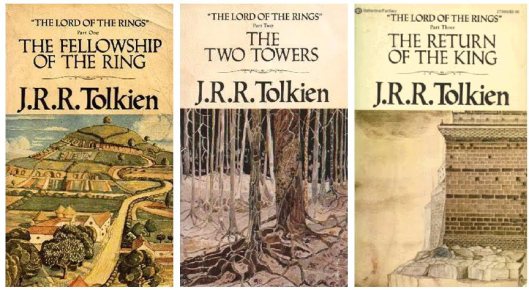


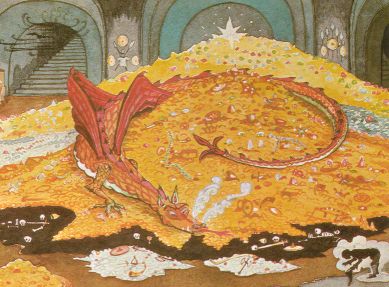


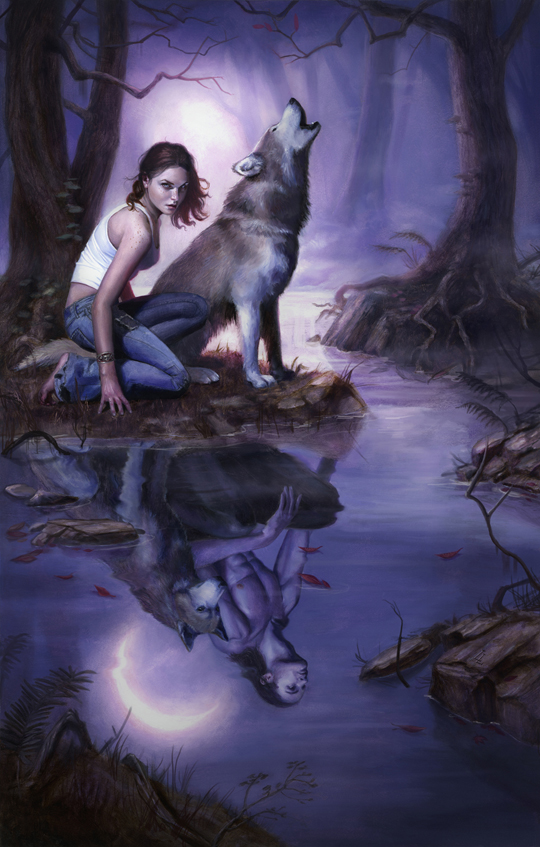
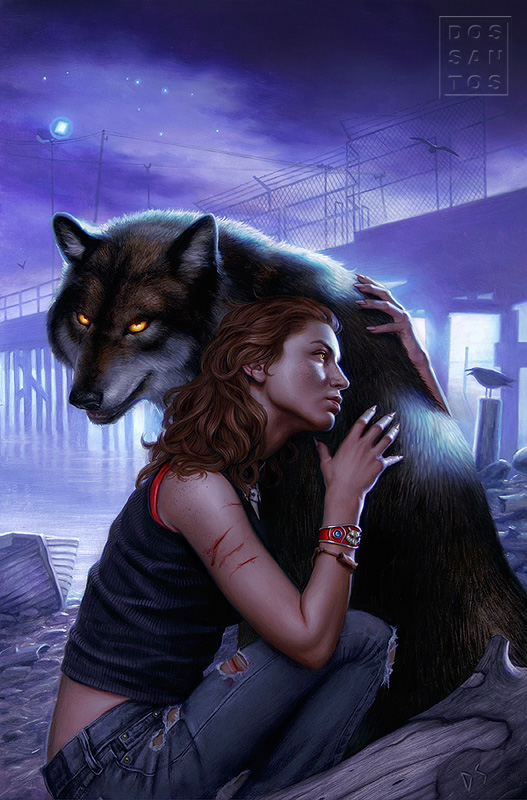


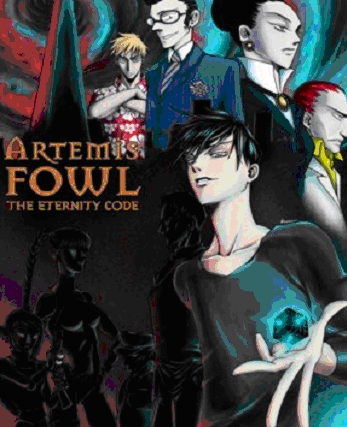


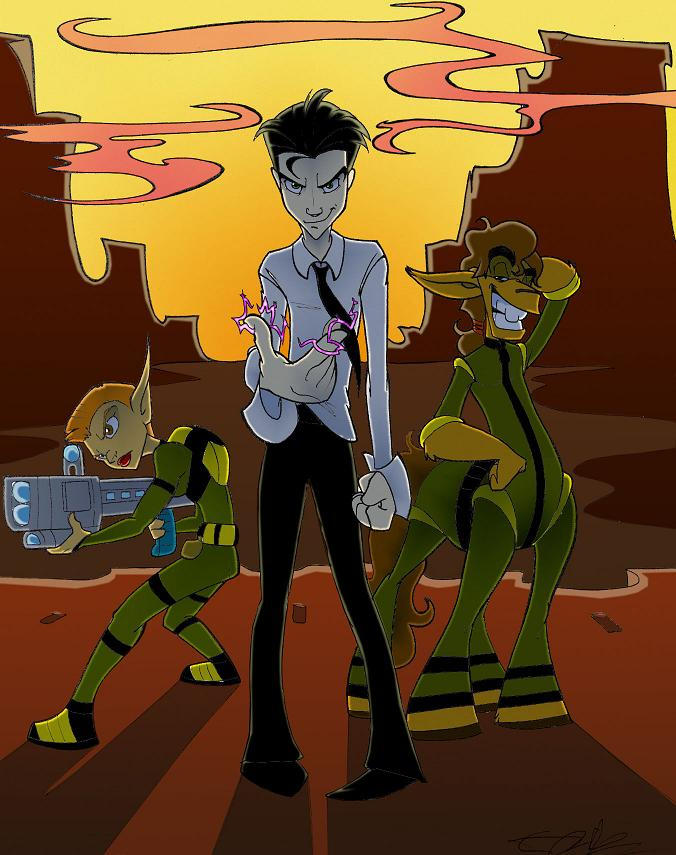

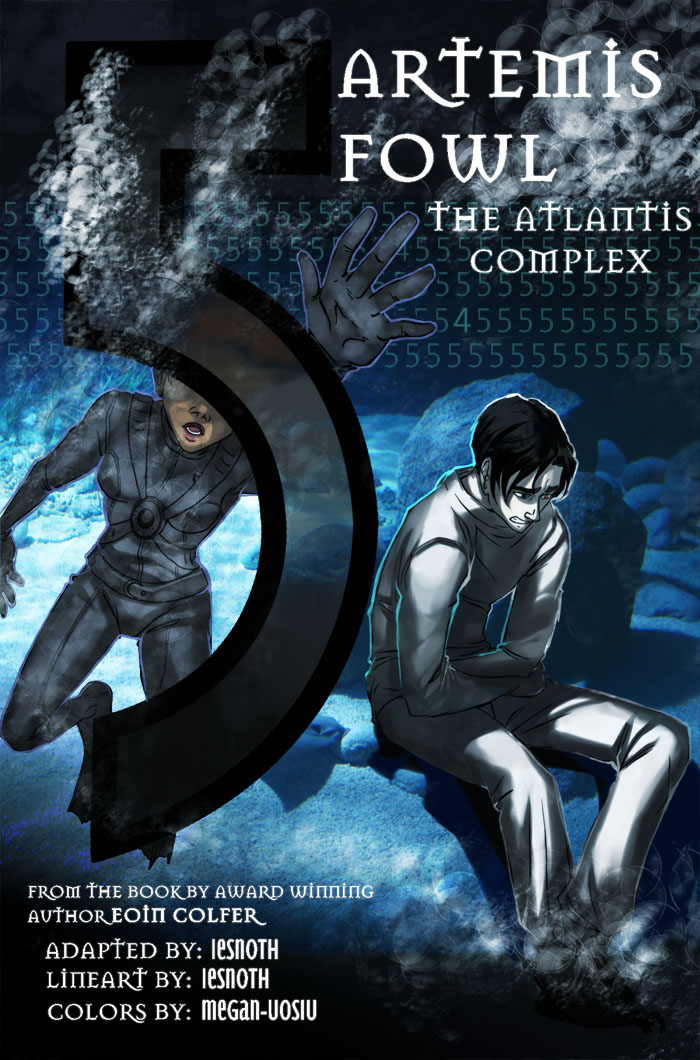


 GRAVE WITCH (2010) –

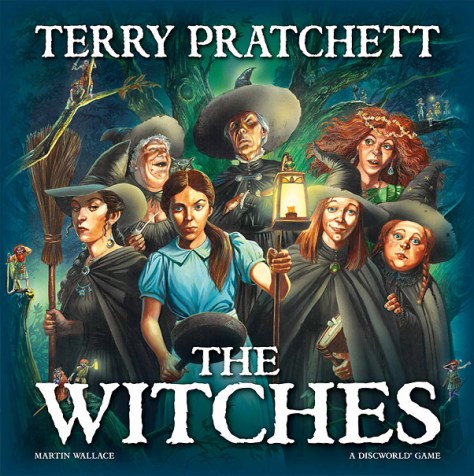

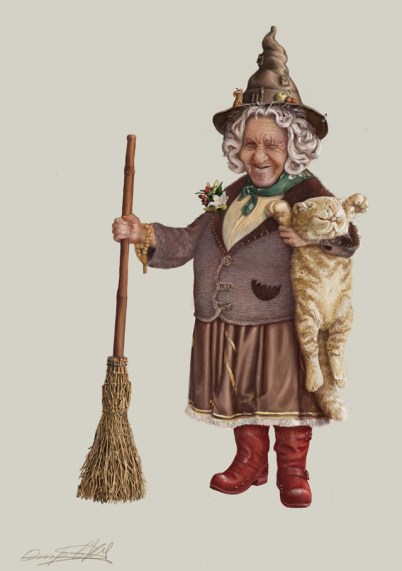


 MASKERADE (1995)


 ROSEMARY AND RUE (2009)
 A LOCAL HABITATION (2010)
 AN ARTIFICIAL NIGHT (2010)
 ONE SALT SEA (2011)


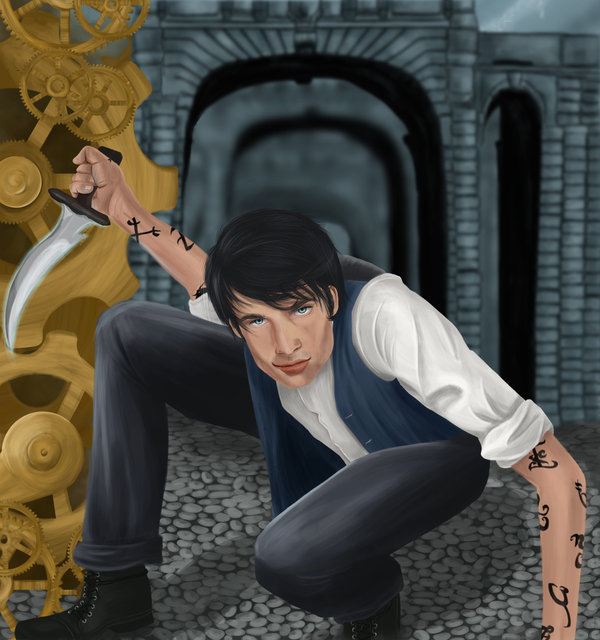

 SILVER-TONGUED DEVIL (2012)
 Now we get to the final book in the series, “Blue-Blooded Vamp”. Sabina is after Cain to revenge the killings of people Sabina has loved. Unfortunately, Cain is hunting Sabina, too.


 humanitysdarkerside


