Cover art by Alan PollackReligion, faith, beliefs seem to control so much of the world’s humans. We allow ourselves to be steered by goddesses and gods who promise all kinds of things in return for our unfailing loyalty. Political systems seem to have the same kind of hold on people. I see how soldiers willingly put their lives on the line in travelling to far-away countries on the say-so of their leaders. In both instances motivations seem to differ from anything from undying loyalty to simple greed (although greed might not be such a simple matter).
Path of Blood takes us into both these worlds. Yohuac and his absolute loyalty to the nahualli’s and the goddesses and gods of Cemanhuatl is disturbing in its completeness. Reisiltark is no different. Like heroes in a great many young adult sagas she will do anything to save her country from destruction. That she happens to be a more or less “good” person is a lucky thing for Kodu Riik. What if she had made the kind of choices that Upsakes had – who also believed that he was doing the Lady’s will.
In spite of seeing what a terrible person Aare is (and it would take a completely blind and deaf person to avoid that) the Lord Marshal of Kodu Riik is going to swear loyalty to the man the moment he takes the Iisand’s throne. To him it is the throne he is swearing himself to and not the man. But life is never like that. It is always the person we end up swearing ourselves to and the values that person emotes. That is if we are looking at tyrannies, monarchies or dictatorships. Whether we choose to follow that person out of our own free will or because we are forced does not really matter in the end. What matters is what price our loyalty ends up having. I doubt I would have the strength to gainsay a person like Aare. His way of ruling is much too brutal and frightening.
Fortunately there are sometimes alternatives. In the case of Path of Blood we have the followers of Reisiltark and the rest of the rebels. These are the ones that managed to escape the steel grip of Aare’s followers. They have set up camp by Mysane Kosk in the hope of helping Reisiltark heal their land. I think I consider people like these rebels brave. They are the ones who have the courage to stand up to a tyrant and have put their lives on the line for their freedom. Sadly that is the consequence of power-hungry people – one sometimes has to take up weapons to stop them maiming the place one lives in and the people one lives with.
I’m not certain how I feel about Reisiltark herself. I don’t know if I really believe in her. Perhaps she is too much the anguished hero. In that sense she and Yohuac are a perfect match. She fills her role as hero perfectly. Heroes are supposed to be larger than life, have amazing values and be able to make difficult decisions on who has to die when trouble arrives. This very good and very bad cast of people is part of what makes a young adult novel. In my head Path of Fate is very much a young adult novel. There is violence, gore and darkness, BUT very little of it is descriptive and the dark is interspersed with light.
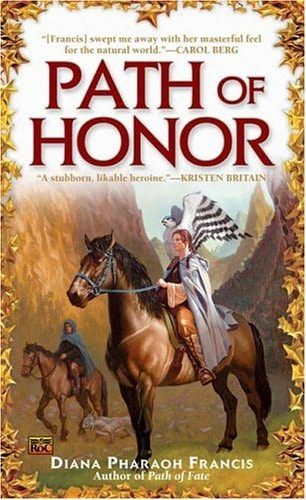
One of the really interesting people in Path of Honor is Verit Aare. Verit Aare is the heir to the throne and eager to replace his father. As his father has been more or less absent the past six months, Aare’s lust for power is growing. Unfortunately for Koduteel (capital) and all of Kodu Riik Verit Aare is a psychopath/sociopath. While a lot of us have psychopathic traits, very few of us reach Aare’s level of sociopathy. According to Psychology Today one needs to show a lack of empathy (cold-heartedness, an inability to feel deeply); show a lack of shame, guilt, fear or embarrassment at ones actions; a tendency to blame others for their own failures, or no shame if confronted; show a strong ability to remain focused on a task; appear charming yet have a tendency toward pathological lying, and they seem comfortable even when found out; incredibly overconfident, as if they cannot fail; impulsive; incredibly selfish and parasitic; lack realistic long-term goals; and finally be prone to violence.
I feel certain most of you would be worried if a person like this lusted for the leadership of your country. Yet Aare seems to fulfil most of these criteria and for me that is the reason I find him especially fascinating and possibly revolting. Take how he treats his sister, the Vertina Emelovi, and what he does to his father’s hostage, Soka.
When Soka was nine years old his father had broken the terms of the hostage agreement. Something had to be done to avenge the wrong and it was decided that Soka would lose an eye. But the Iisand was not able to attend the removal and sent his son, Verit Aare, instead. Aare made the little boy remain awake during the procedure but had Soka drugged so he would remain docile while it went on. Finally, a map of Soka’s father’s lands was sown into the lid of his eye as a reminder of the deal. It had not been the Iisand’s intention that the procedure would be so cruel for the boy, but Aare liked the feeling it gave him.
Once again, Soka is in his power. Naturally, Soka is scared shitless. What will the Verit do to him this time?
On to Verit Aare’s sister. Poor Emelovi. She has to live with the man on a daily basis and he is not a good brother to have. Her fear of him is intense, yet he has kept his father duped as to the depths of his depravity. Perhaps that is because people tend to see what people want to see. Vertina Emelovi, on the other hand, is quite familiar with her brother’s cruelty. He expects nothing but complete submission. If she does not do what he tells her to, she suffers greatly. The first time she was made aware of that was when he killed her puppy because Emelovi had refused to dance with one of his friends. Since then, well. One does what one has to with such a maniac in the vicinity.
Aare does not like Reisil. He does his best to turn the court against her. Lucky him. Sodur (another ahalad-kaaslane team) has made his job much easier. On his part, Sodur did have the best of intentions. But what do intentions help when consequences are what determines the value of them. Poor Reisil, the consequences for her are stinky. Things are looking up for Aare when it comes to using his charisma and power-hunger against her.
Reisil is not completely alone. Kebonsat has come to court Emelovi on the chance an alliance between Kodu Riik and Patvermese might happen. Hmmm. Despite this task, Kebonsat does not forget his friendship with Reisil. Nor has Juhrnus. Reisil is thankful to have two such loyal friends on her side as it seems the rest of the powers of Kodu Riik have turned against her. But friends do turn up in strange places and sometimes lives change because of decisions one has made. She does have the “common people” on her side. But the common people do not have much power. Not really. Like us, the common people in Kodu Riik trust that the powers that be must be interested in the best of the country. Man, we are suckers, aren’t we.
Magic. Not all fantasy books include magic, but a lot of them do. Path of Fate is definitely about magic. We have the bond between the ahalad-kaaslane, Reisil-Tark’s evolving power and the power of the Patvermese magicians. All of these types of magic come together and open up a discussion about power, politics, gods and responsibility.
My rhetoric question of the day is: If you have power, do you also have a responsibility for how that power is used? Hell, yes!!! But just because you have a theoretical responsibility does not mean that translates into having to answer for your use/abuse in the real world. We all know that. Even I know that and I am not the best person in the world when it comes to paying attention to what goes on around me.
Reisil-Tark’s greatest role in Path of Fate seems to be to put a light to the abuses of power going on in and around Kallas during the story. We join her as her own sense of responsibility grows and embeds itself firmly into her mind and heart. Watching her come to realise that the people around her are not what she had thought/hoped for is an interesting process. It hurts when people we trust betray that trust. More difficult is seeing how we, ourselves, betray the trust of others. Reisil-Tark has to come to terms with that side of herself as well. My experience is that the reality of myself is the most difficult one of face. Being able to say that I screwed up or need to change a part of myself hurts. The pain is in many ways similar to the pain I have experienced whenever there has been need for surgery. This is the kind of pain I am sensing from Reisil when she has to come to terms with herself.
Path of Fate is Reisil-Tark’s story. She is an enjoyable character who does her best to deal with the life she has been given. Finding her strength in a world where she is pretty much alone is a process and we get to follow her on that journey.
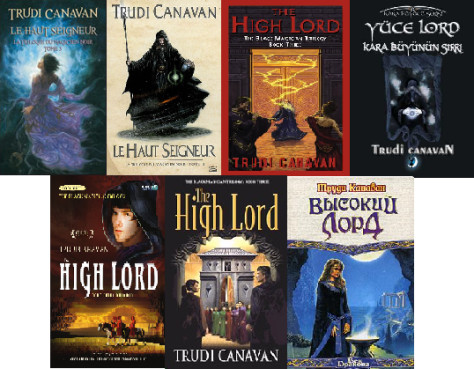
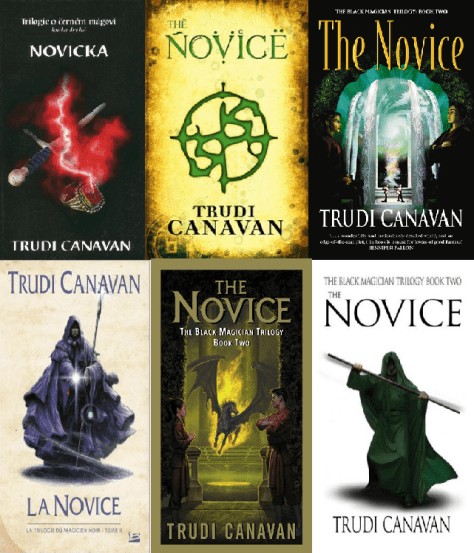
Top left: French cover Top 2 left: French cover Top 2 right: Cover art by Matt Stawicki Top right: Turkish cover Bottom left: Indonesian cover Bottom center: Cover art by Les Petersen Bottom right: Russian cover
My son and I recently finished reading The Black Magician trilogy together. What he discovered is that sometimes favourite characters die. He felt that was kind of cruel of Canavan. It is one thing when the bad guys die, but good guys (especially ones you really like)? Oh, well. It is unlikely this is the last time he experiences this. Despite that, he really enjoyed himself during our adventure. As did I.
The High Lordanswers all our questions about why Akkarin uses black magic. It also shows us that the powers that be sometimes make long-term decisions that are seemingly wise at the time but turn out to be bad for future generations. Accidental deaths can cause a lot of trouble down the road.
I’m still impressed with Sonea. I think that growing up rich and powerful blinds you to the reality that most people live under. Peggy McIntosh discusses this phenomenon in her White Privilege: Unpacking the Invisible Backpack. Sonea growing up in the slums has made her aware of the harsher sides of life and made her more open to the possibility that status quo must change. Even Rothen and Dannyl, who are open-minded for wizards, fail to understand exactly how privileged they are.
My dad grew up under extremely difficult conditions. His mom was a paranoid schizophrenic and his dad disappeared after he had enjoyed German hospitality in prison camp. Torture got the better of him and alcohol was used to self-medicate. That left my dad as the responsible person at home from a very young age. His mom did her best, but, you know, being a paranoid schizophrenic without access to medication does not help in creating stability for your children. My mom’s childhood sucked as well. Her dad was an alcoholic and her mom worked her tail off to provide for them. When my mom has told me what it was like to drag a drunk dad up three stairs to get him inside the apartment – after he had pretty much spent his earnings on booze – well, I wonder how she made it????
But that childhood made them into pretty awesome people who have always been concerned with the greater good. They turned what could have made them bitter into something that helps others each and every day (even when they are now ancient =) ). Like Sonea, not all of their decisions have been wise. But like Sonea, what they have done is try to be true to the motto of “not doing unto others what you would not like to have them do unto you”.
Sonea grew up without her parents but was fortunate enough to get to live with her aunt and uncle. This is probably what saved her (and the rest of the city). Her hunger, poverty, the Purge, being bullied by the other novices and being suspected of everything “bad” by the adult wizards did not stop her from being true to her own values. Sonea’s situation is in no way unique in the world (except for the magic that is). Poverty, war, captivity, orphanhood and homelessness are all part of the lives of a huge amount of children and adults. That people are actually able to rise above their experiences and make the world a better place is amazing. Yet people do it all the time – just like my parents have. Which is why I find Sonea utterly believable. Her decisions regarding Akkarin seem inevitable and sensible considering the kind of person she is.
Picture photoshopped by Lauren Kelly Small
Tayend is my other favorite person of this story. He is our lad from Elyne. While homosexuality was not accepted in Elyne, homosexuals were not persecuted. Unlike Dannyl’s experience in Kyralia. Being a fan of the underdog, I would have thought that Dannyl would be the one to appeal the most to me. But Tayend has an innocence about himself that seems true. When that innocence is challenged, as it is in The Novice, Tayend rises to the occasion. He is loyal to Dannyl, in love with Dannyl and willing to avoid meeting with Dannyl if that is what it takes to protect him from the wrath of the magician’s guild. I wish I could have gotten to know him better.
Cery is back and this time he finds himself with a mysterious customer who seems willing to help him find whatever Sachakans arrive at Imardin. She turns out to be different from what he had originally thought, and that causes friction. But Savara still manages to be of assistance to Cery when he needs her help most. Who to trust or who not to trust when you are a Thief, that is the question.
Reading The Black Magician trilogy with my son was my third time through the series and I still had fun and learned new things about myself and the world.
In The High Lord Trudy Canavan gifted me with really fun words to read. During part of the book she had used the words Sachaka, Akkarin and Takan a lot. My mouth was having so much fun saying those sounds. Sometimes it is really awesome to be an autist (aspergian).
I’ve been wondering for ages what being a soldier for years upon years would do to a person. That is a soldier who is out fighting all the time. It would have to be the close-up kind of soldier who has to make life and death decisions for another person on a regular basis. What would that do to you, and how many of your choices would you find bearing you down?
War is a terrible thing. The Old Warriorhas been trained for a life of killing since childhood by people who treated him roughly. His choices have numbed him to the horrors he is part of. In the end that life is catching up with him, but then …
“The Nightmare” appears in the form of a little girl who has lost her mom and dad and wolf to the killers around her. She stands there in the middle of the noise and gore with an empty look on her face. “The Nightmare”. The one who manages to break through to the old warrior and create a chink in his suit of denial.
The Old Warrior was a sad and action-filled story. It ended differently from how I had expected and that annoyed me. But I also find it refreshing (and annoying – did I mention that) when closure is not reached. But life is like that. We cannot always know how things end.
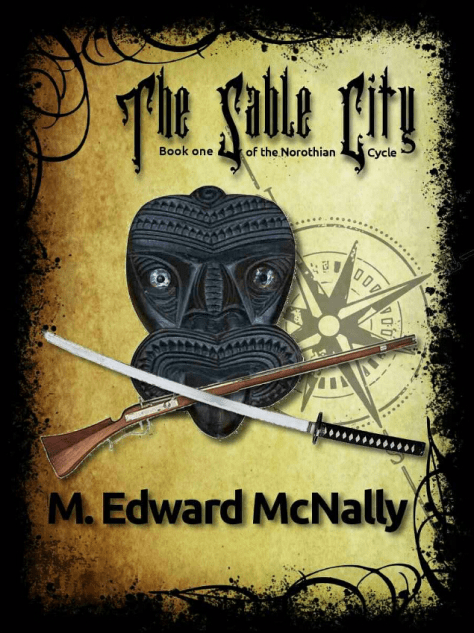
The Sable City is a winner. It is full of humour, tension and action. You know, it is strange how placing a few words on a piece of paper (e-book in this case) can bring such joy to a person like myself.
At the beginning of “The Sable City there was an episode that convinced me that this was a novel for me:
“Matilda Lanai was among them, though at the time Block knew her vaguely by face but not name. Of about typical height for a young Miilarkian woman, she was however paired against a fellow Block recognized and even knew by name as Kauna, a full-blooded Islander with a creamed-coffee complexion and a mass of black hair to his waist. While of only moderate size for a water buffalo, Kauna was an excessively large human. Block had known enough Island men of the type to suspect that later in life the big fellow ran the risk of turning astonishingly fat, but at nineteen years of age he was a chiselled mountain of a man. Stolid in nature, but capable of accidental bursts of breathtaking power.
That hot day last Fourth Month, Matilda Lanai had found herself on the business end of just such a burst.
Block’s attention had been elsewhere, but everyone in the room heard Kauna cry “Tilda!” in sudden alarm. The dwarf turned and saw the big man frozen with one knee on the mat and his arms fully extended, watching wide-eyed as the bare feet of his sparring partner kicked the air. This did nothing to prevent her sailing out head-first through an open cargo door, and dropping out of sight. Four stories up.
Block was on the other side of the room, and well past his sprinting days. As he crossed to the cargo door the dwarf had time to think at least she went out on the water-side, but then he also had time to wonder just how far the timber cart path extended out around that base of the building the hand pier-like over the water. Pretty far, he reckoned.
As everyone converged the one apprentice who had been next to the open doorway gaped, then cheered. She alone had seen Tilda clear the wooden edge of the pier forty feet below by the narrowest of margins. One more inch, as the girl laughingly told the crow later, and Tilda would have lost nose, nipples, and kneecaps.
….
Her classmates cheered, but the young woman with the sodden mop of black hair plastered to her face and shoulders did not look up. Nor did she flop gasping onto her back, as Block expected. Instead, she paused on all fours for only a moment. Then she was up, and running, along the warehouse and around the corner toward the nearest door giving backing inside. She left a trail of wet footprints slapped across the hard wood her nose had missed by a hairsbreadth.
The apprentices blinked after her, then looked around at each other. Their eyes finally settled on Kauna, who had stood up straight but not yet taken a step closer to the doorway out of which he had pitched his classmate.
“She’s all right?” the big Islander finally stammered at everyone, but one man with Varanchian-blond hair answered.
“You are going to find out in about two minutes.”
….
Matilda Lanai was of the mixed-stock know in the Islands as “Ship People.” Lighter in complexion than a Full Blood but with features typical of an Islander, with a rounded chin, broad mouth, and flashing eyes of a brown so deep the occasionally looked black. The looked that way now as she skidded to a halt, swiped her clinging hair out of her face and over her shoulder, and locked her narrowed eyes on Kauna’s wide-open ones. Tilda’s chest heaved and she stood with her feet apart, silent except for her breath and the drops of water pattering the floorboards. She held her hands loose at her sides, arms toned by boundless youth and a hard year of Guild training.
…
Kauna looked at the silt, then back at Tilda, then around at his classmates. They now stood father away from Kauna than was Tilda, for the young Guilders-in-training had been drifting away steadily since she appeared, with nary a squeak from the floor.
The big Islander nodded once, twice, then straightened to his full lofty height. He gave Tilda a short bow. Kauna turned, took two long strides into a dead run, and launched himself out through the open door with a great whoop, arcing majestically out over the pier and falling feet first into the water below.”
And that was how Captain Block found his travelling companion. Captain Block himself is a dwarf of the traditional fantasy type. His loyalty lies with house Deskata, one of the merchant families of Miilark. When the last living leader of the merchant family asks him to bring back their sole blood-line heir (who just happens to have been exiled), he and Tilda go off to the continent to find the proverbial “needle in the haystack” and end up having to follow the mercenary Dugan around to find the lost Islander.
Most of the story is told from Tilda’s point of view and much of it deals with personal and physical journeys. Getting to know Tilda has been fun. She shows us that she is capable of changing her attitudes while holding on to her values. Perhaps being trained as an assassin (among other things) has given her an extra appreciation for the sacredness of life that I know I do not have. Her love for Captain Block shines through. Perhaps he is some kind of father figure to her while away from home. Block also lets his love for Tilda shine through his gruffness. Being centuries old has made it necessary to keep a certain distance to the people he encounters, but Tilda seems to be able to reach through to him and give him back a part of his life that he had not known that he was missing.
I liked Duggan and the lessons he brought into Tilda and Block’s lives. His ability to annoy and charm the two of them is admirable. He might not be the rapscallion he tries to convince them of but there is certainly a ruthlessness there that his mercenary life has left with him.
But The Sable City is not only about the trio. Other people turn up, as is only proper during a quest that ends up in a fabled city supposedly full of treasure.
Axman Zebulon Baj Nif ends up being saved by a Samurai, Uriako Shikashe, and a Far Western healer, Amatesu, from certain death after they had attacked his unit to find him. They bring him with them so he might be a translator for their mistress – Nesha-Tari. This quartet end up adding another member in Phineas of the wizard circle. They are all going to the Sable City along with a couple of other characters who end up being gorgeous Brother Kendall Heggenauer and Father Luis Coralle of the Brothers of Jobe along with the daughter of a duke. Finally, there are dragons, mercenaries and a likeable demon by the name of Lord Dalin.
The Sable City is the kind of fantasy that has its roots back to the days of The Odyssey. As such it is a recipe for writing that has stood the test of time. It is strange that I keep on reading new novels in this genre considering how many of them I have read. But I never seem to tire of them – as long as the author writes well.
Cover art by Joshua Meadows“Iyetrais an episodic series of novellas set in a hybrid sci-fi/fantasy universe.” Each novella can be read as a stand-alone-novella. Sleeping God is the first of the series.
“At the dawn of things, in the eon known as the Whole, Iyetra was a complete, harmonious world and its inhabitants lived with the blessings of the gods, watched over under the authority of the Advent.”
In the usual manner of humans, the Shattering is the effect of our own glorious stupidity. The two opposing factions that led to the Shattering were the Advent that used the gods and magic, and the Imperium that believed in machines and destroying those who could access the powers of the aether. As a result of the fighting between the two opposing factions, the gods chose to shatter Iyetra into pieces. But for some reason they did not want all humans to die out so they made it possible for them to live in the Chaos that came from the shattering. Living on pieces of earth (floaters) the size of cities/countries/continents people go about their lives the way people generally do.
One of these floaters is Koton, the city that ambassador Tela Niala is supposed to negotiate an agreement with. Koton is led by the Magisterium, the “child” of the Imperium. While the Magisterium is not as fanatical as the Imperium, it does have a rather dim view of those who are able to access the aether.
Why Tela’s father would choose his own magically inclined daughter to travel to the male-dominated, magic-hostile floater Koton is a mystery. Perhaps he is willing to sacrifice her in a gambit to increase his own power-base. After all, even people who supposedly have a lot of power, like Tela’s high ranked senator father, can hunger after more. Tela was annoyed enough at her father that she demanded that the usual group of body-guards be left out. He relented. I found that suspicious as well. Tela’s father had to know something about the situation in Koton that we and she did not.
Tela starts off as an insecure graduate from magic school and becomes someone more comfortable with her own gifts/powers. While it might not be appropriate to call Sleeping God a coming of age story it certainly is a coming of self story. Being thrown into the jaws of death could have that effect on some people. Her father might have landed Tela the job as an ambassador, but in the end Tela earns that title through her own actions.
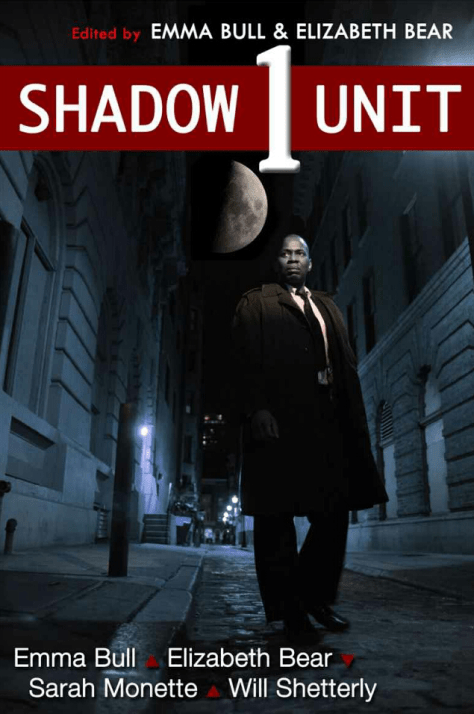
In 2007 Emma Bull and Will Shetterly got together and laid the groundwork for what would become the website Shadow Unit. A series bible was created and authors were contacted, which is how Elizabeth Bear and Sarah Monette got onboard the whole thing. Then they drew in Amanda Downum as art director and Stephen Shipman as technical director. The series bible was amended and improved. Finally Leah Bobet and Holly Black joined the writing team (along with Stephen and Amanda) while Kyle Cassidy had fun with the covers.
Shadow Unit I includes the first four stories from season 1:
The rest of the episodes from season 1, 2, 3 and 4 are available on shadowunit.org. As you will notice the last story available was released December 16, 2012. I recommend that you read the stories in order.
I was introduced to the phenomenon of the Shadow Unit through the above published novel. It is impossible for me to write a review without seeking out more information about the novel. This time I had a plethora of information to choose from, kindly served up by the instigators of the phenomenon. And what a fun phenomenon Shadow Unit is.
The whole group of creators at Shadow Unit are awesome for making such a large body of work available to readers and nutters all over the world for free. They wouldn’t mind donations as it is we, the readers, who are keeping the concept going, and what a fun concept and group of investigators this is.
The Anomalous Crimes Task Force (“Shadow Unit”) consists of: Stephen Reyes (boss), Esther Falkner (vp), Solomon Todd, Nicolette Lau, Daniel Brady, Hafidha Gates, Charles Vilette, Daphne Worth and Madeline Frost. Whenever inexplicable crimes are committed the task force is called upon to help find the criminals.
I recommend you use the website as your starting point and read the stories. They are of the action/thriller/mystery/horrorish kind with strange powers and strange bodies all over the place. The group itself is filled with people of all kinds – anything from the seemingly insecure to the broody ones. If you have read stuff by the above authors before, you know you are probably going to find a venue of enjoyment.
Anna Wolfe is a bleeding good writer. She, once again, engaged me immediately in Ensnared by Magic. Perhaps ensnared would be a better word to use for what she did to me. The title is appropriate in describing the effect an excellent author can have on their readers. Excellent authors certainly ensnare me in what seems to be a magical manner.
At the beginning of the novel Wolfe lets us know that there will be “sexually explicit scenes and adult language that is not appropriate for children.” This is the case. While the sex is explicit it is kind, generous, sad and fun. Anna Wolfe’s excellent writing shows in these parts as well.
Mark Little lets us see a side of himself that had not been apparent in the previous novels. In Ensnared by Magic we get to see Mark’s generous personality and more of his fun-loving side. His demon-bitten side likes to provoke anger and has Mark feeding on pain (his own and others). Thus far, we have gotten to see quite a bit Mark’s demon-bitten side. Now other traits get to come out and play. Too bad the witches have plans for using him in defiance of the Seer. The High Priestess seems to be hungry for what she cannot have – Seer’s power.
Silas is demonborn. That means that he is that product of a demonridden and a witch. “Boss-man” is old and more powerful than the demon-bitten. His strength makes it possible for him to control those demon-bitten who hail to him. Sadly, Silas is the only one left of the demonborn (I think). He is lonely without others of his kind. The Seer seems to have some kind of power over him. Exactly how free he is to live his life is difficult to say at this point. I’m glad I’m not in his position.
Edie, Callie and Hatter are all demon-bitten like Mark is. Callie is a mystery to those around her. Well, maybe not to the Seer. Exactly how strong she is or what her powers will turn out to be is not clear. Her resistance to Silas’ power is stronger than the other demon-bitten he has encountered thus far, and Silas fears that he might have to kill her in the end. Callie would prefer that to causing the kind of damage she is potentially capable of. I’m not sure her ability to resist Silas’ power is solely due to her own powers. Instead I’m kind of wondering if it has something to do with her resilience and another “mysterious” factor. We shall see (I hope).
Why I prefer Silas and Callie to the others is a good question. Perhaps it has to do with the mysteries that surround them. Or it could have something to do with the way they both refuse to let the other have control of them. Both of these factors make them interesting, but there has to be more to it than that. I know that with Callie some of her attraction has to do with all of the questions she raises in my head. People who make me ask questions fascinate me.
I know I like the fact that Wolfe’s writing does not point out an obvious “bad/good person”. Adult literature is supposed to be like that to my thinking. I thoroughly enjoy the obviousness in young adult and children’s literature. There is, however, no getting away from the fact that all the grey zones of adult literature are a lot more fun.
So, perhaps you might have noticed that I enjoyed Wolfe’s writing and recommend it to one and all.
I was given a reviewer’s copy of The Secret Eater. I promise that I have not included either “bomb-making instructions” or “the directions to” Ros’ house in this review. When contacted by Ros Jackson I went to her website to check out the background info on the novella and was sold when the words “Nigella Express” appeared. I did the elegant snort laugh that I do sometimes and said I would love to review it.
Kenssie, the demon (of the secret-eating variety), is an insecure girl with a tendency toward denial. She loves what she is in a world of demons, hybrids and humans. As usual, we humans are oblivious to the “others” around us, something that makes us perfect prey. But we aren’t the only prey around it seems. Denial is a wonderful tool of survival in a world where a poor girl wants to believe herself more included than she really is.
The way Ros Jackson has portrayed the demons and hybrids of her world makes them seem a perfect complement to our fears, insecurities, greed and anger. Using humour and satire as a tool to comment on the world is done in the way only Brits are able to.
Cover art by: Top right: Les Petersen Bottom right: Steve Stone Bottom centre: Matt Stawicki
Once again Trudi Canavan has shown that she has the ability to reach audiences all over the world. The Novice has been published in three English dialects and 12 other languages. The Black Magician trilogy is a serial. You are going to have to begin with The Magician’s Guild to make sense of The Novice.
As with The Magician’s Guild, I was my son’s audiobook. This time the experience as an out-loud-reader was much smoother. Whereas The Magician’s Guild has awkward phrasing for an out-loud-reader, The Novice flowed as it ought. Being the one who was read to was an enjoyable experience for my son.
Story 1
Breaking out of an abusive relationships is a challenge. In some cases the victim never does while in others some kind of catalyst comes along that makes freedom possible. Before that time, though, pain, confusion, humiliation and helplessness are feelings the victim is dragged through time and again.
Sonea being bullied by Regin and his compatriots (fellow novices) is such an abusive relationship. Regin’s venture into physical and mental violence begins during the first year and follows Sonea into The Novice. One would have thought that Sonea gaining the guardianship of the High Lord would prevent him from being cruel, but no. Regin soon discovers that Sonea is afraid to tell the High Lord what is going on and takes that as encouragement to increase the intensity of his bullying.
Bully lust is a strange thing. I’ve often wondered what makes an abuser tick. Growing up I never understood why the other kids felt it appropriate to tease and harass me. As an adult I think I can see what the attraction is. Power seems to be orgasmic to some people. Being able to get others to go along with what you are doing probably increases that feeling. Regin certainly seems to be getting off on what he is doing to Sonea.
Like a lot of people being abused, Sonea is afraid to tell those in authority about the bullying. She is afraid that matters will get worse. Sonea sees that the episodes that happen in class do not bring about punishment for Regin and I imagine that would make her hesitation even more intense. Class-differences between the victim and the abuser probably made it even more difficult for Sonea to open up about what was going on. After all, what could she – a slum-dweller – hope to achieve with reporting the abuse when the rest of the magically inclined people at the university were of the upper classes.
In- and out-groups. We and them thinking. I think this is one of the most frightening thing I find about humans. When I read some of the comments that are written on some of the sites on the net, I am confused by how others bully writers in the most cruel manner by dehumanising the blog’s author. Regin’s treatment of Sonea is a prime example of how one person makes another person a “them” and thereby setting his behavior at – “not at fault”.
All it takes is one person. One person to make it all bearable. Sometimes one person to help you see the light. One person. You will meet him in The Novice. That one person with the ability to think outside the box. The one who dares think of “them” as human too.
Story 2
Dannyl’s experience with The Thieves has made him prime candidate as Guild Ambassador. I’ll bet he never saw that one coming. Dannyl is one of those people I just could not help but like. His behavior and attitude is clearly colored by the treatment Fergun put him through while they were both novices. Surviving abuse gives us a perspective on life that we would not have otherwise. If circumstances allow, that understanding can be put to good use. Both Dannyl’s behavior and his attitudes have been challenged and continue to be challenged during his adventures in Elyne. His friendship with Tayend shows his strength and the pain of the past he still carries around on his back.
The Novice was fun. Painful at times when old memories were triggered, but fun.
Cover art by S.M. Reine Model photo on cover by Marcus J. RanumParadise Damned is the last novel in The Descent serial. Like all the rest, Paradise Damned is dark. We get plenty of violence. Part of that violence involves abuse of Elise in the Garden of Araboth.
“SEPTEMBER 1, 5509 BCE
In the beginning, there was the earth, formless and empty. Darkness hung over the surface of the deep.
And then there was light.
It spilled over the waters, vast and powerful, and its creation severed the unity that had come before. This light was a separate entity from the darkness. Something novel and cruelly different.
The spirits called it “day.” Its opposite was called “night.” Between them was evening and morning – the First Day.
This division marked the end of peace in the universe.
Everything has been pretty much fucked up since then.”
S.M. Reine’s humour seems to fit mine just fine.
Half the fun of writing reviews is the preparatory work I do. This time I felt like checking out the ancient dates in Paradise Damned and ended up with the info at the bottom of this post.
I want to give S.M. Reine a special thanks for coming up with the old women of Oymyakon, Russia. No wonder these ladies are so tough. Oymyakon is so cold that it has the lowest recorded temperature of any permanent village (- 71.2 C). Brrr, not my kind of winter. Here, indeed, “Winter is coming”. Nothing phases these matriarchs. Give them hybrids or Malcolm, and they won’t hesitate to shoot either if they have to.
Paradise Damned is divided into four different stories that tie together. The first is from the good old ancient days, the next is from the good old days, the third is from Limbo with James and the last story occurs in Araboth 2010.
Longevity or immortality is a concept that I have found a lot of people would like to take part in. How would you stay sane? It seems to me that all the people around you would have to be immortal as well. Otherwise, you would have to watch loved ones die over and over all through “eternal life”. I see how people react to such losses already, and have to wonder how you could deal with it on such a time-scale.
Adam seems to stink at it. His one major loss gave him a liking for mayhem. Yatam and Yatai didn’t deal well with it either. In the end they got the release they sought. What about Adam? Will someone relieve him of the burden of life?
Elise is now back to her job of being a false Eve. She isn’t taking to it. Fighting against it brings grooming/training her way in the form of severe mental and physical torture. I wonder if her lifetime of abuse and pain is aiding her or hindering her in keeping hold of who she is?
Sometimes when I read stories about real life people who have gone through stuff like this (not the impossible things but the rest), I wonder how they managed to hold on to themselves through it all. I know it messed up my grandfather who was tortured during WWII. The post traumatic stress was so strong he tried to self-medicate to deal with the mental pain. The face he showed me as a child was that of a gentle and loving man who brought joy to my life. He managed to stay away from alcohol in his meeting with his grand-children.
Granted, Elise is make-believe, but not really. There are people out there who go through grooming/torture in order for another person to achieve some kind of result. Each and every one of these people will end up changed forever. While a lot of them will be able to hold on to themselves, some will not. The question in Paradise Damned is whether Elise manages to stay true to herself and her ideals in spite of what she goes through.
On a lighter tone for me (maybe not for the rest of you), Elise’s arrival at Oymyakon was amazing. I liked what she did and how she did it.
Cover art by S.M. ReineChapter one of Defying Fate reveals exactly who James Faulkner is and has been since 1993. Whereas Elise became a demon, James ended up an angel instead.
There is a need in me to try to understand something about the characters I meet in various fictional and non-fictional works. In Defying Fate it is easy to understand a person like Zane St. Vil. Zane is a kopis with the Union. He is of average intelligence and pleased with the power and firepower the Union brings him. He is a coward at heart and bullyish on the outside. Zane will always do what makes him seem bigger and badder than the rest and if he meets resistance he will use the greatest force possible.
Then we have a person like James. Ultimately, I know that James will do what serves James the best. But what route is he going to take? We are talking about a highly intelligent man with a devious mind and lots of power at hand. He is perfectly willing to harm the people he loves if he thinks it will serve them in the long run, in spite of him never having had the gift of prescience. A person like that is difficult to predict.
I won’t pretend to understand James. His personality has so many twists and turns that I cannot follow along. I imagine part of that personality has come about because he has had to hide his nature from Elise and every other person he has met since his change. Part of it has been with him all along, but as we tend to be the sum of our parts, being an angel would have influence on some of what James does.
Nathaniel is the perfect son for him. This is one powerful kid. James needs a person who exceeds his own abilities so he can stop seeing himself as the epitome of witchcraft. In addition Nathaniel is a 12-year-old in the way that only peeved-off and disappointed 12-year-olds can be. He’d practically worshipped his father ever since he discovered who his father was. Then Nathaniel met the person behind the myths and found that James was not as glorious as he had been made out to be.
Nathaniel is like Elise in many ways. He is fiercely loyal to those he attaches himself to and he will do just about anything for them. In this case that means saving Elise. James says he cannot come along and Nathaniel pretty much says that James has nothing to say in the matter. In the end James brings Nathaniel along because a coming together of choices leaves Hannah dead. Poor Nathaniel.
Gary Zettel is a dedicated and driven leader of the local unit of the Union. He and Allyson are probably the two worst people the Union could have made kopis and apsis. The two of them together are a nuclear bomb waiting to explode. Their potential for destruction is enormous and, like James, they don’t care who gets hurt along the way. Well, James cares, but he still does it. Gary and Allyson on the other hand follow the teaching of “ends justifying the means”. They are also unpredictable.
With a group of people like this Defying Fate can only be one thing – full of thrills. My goodness, Reine writes action well and her descriptions of Malebolge are a delight. Dark, violent and crazy is what Defying Fate is.
Cover art S.M. ReineI’ve had some strange and terrible things happen in my life. Most people have. I grew up in a home with parents who had managed to stray from the original paths their lives might have taken. Instead they changed what they had grown up with into a new type of family life. But the consequences of the lives they had grown up with were there. And let me tell you, their growing up years were extremely difficult. But they changed the script of their lives.
Maybe this is why I prefer Elise over James. Elise continually tries to change what life throws at her into something that will keep the balance between different types of people. James, on the other hand, is driven by his ambition. Both grew up with challenges, although Elise’s seem much more extreme than James’ challenges.
When James was a kid it became apparent that his talent for magic was extreme. At nine years old he taught three girls who were older than he. He thirsted for more knowledge of magic. Conquering magic became his goal in life, no matter what he might end up sacrificing to get there. Sadly, he was good at everything he tried his hand at. I say sadly because in James’ case all of his success turned out to give him a skewed sense of morality (at least it seems that way to me). That affects his relationship with Elise and just about every other person he meets. To him demons are dirty, filthy, evil creatures who deserve only death. Humans are the important breed to him, the ones he needs to protect.
James’ coven has been under the rulership of the angel Metaraon for years and years and years.
Metatron: (Metatetron, Merraton, Metaraon) A great angel honored as the angel of presence, chief of ministering angels, chancellor of heaven, and whom maintained the world.
<
p>The coven has provided Metaraon with girls who are taken to a garden to be with Adam (or Him / God). While James was young Metaraon came to the coven to take away a young girl (Ariane). Metaraon’s ultimate goal was to create “The Godslayer” (yes, you are catching on now, huh? ;= ). Ariane was matched with Isaac Kavenagh in order to create a baby. Ariane became Isaac’s apsis so the two of them would be bound to each other. When Ariane was 16 and Isaac 20 years old Elise was born. And who is Elise supposed to be????
One of Ariane’s co-students was Hannah Pritchard. Hannah later became involved with James and she and James had a son – Nathaniel. If you remember, James found out about Nathaniel in Damnation Marked. James now discovers that Hannah has kept the knowledge of their son from James because of the kind of person James is. That’s got to hurt. James is the god of rationalisation and so manages to keep on finding justification for his actions and ways. Some of the choices he makes bring him and Hannah into great danger. Danger from which Elise is going to have to save them.
As you discovered at the end of Damnation Marked, Elise survived her death. She was changed into a demon of the kind that Yatam and Yatai were. For a kopis that had to suck. All of a sudden she has become what she has fought against her whole life (ever since she was able to hold a falchion). Part of that change has brought confusing urges and a look into other people that she isn’t understanding. So, she is confused, angry and worried.
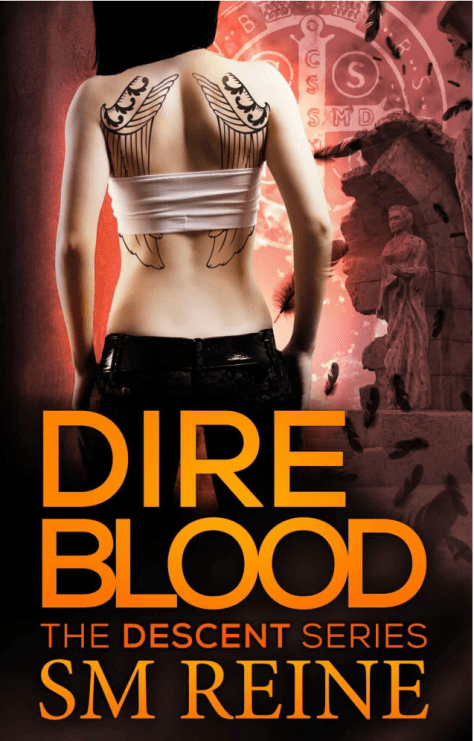
When Nathaniel turns up, what does she do? Well, in true Elise style she drops everything and goes off to help James. Anthony has stuck with her through thick and thin, but this time he says no thanks and leaves Elise and Nathaniel to the job. And what a job this is turning out to be. Throughout Dire Blood I am reminded of why I like Elise so much (and now Nathaniel as well). Sure, she is a mess, her life has turned up-side-down and she has no idea what is happening to her. So what. Life has to go on and a girl’s got to do what a girl’s got to do. If that means saving James with his magically talented son coming along, then that is what she will do.
Action. Is there action in Dire Blood. Oh, yes. Plenty of that. I had fun with both the action and the background information on our main characters. As usual I loved S.M. Reine’s writing. She does an excellent job with this kind of fantasy.
S.M. Reine does not go easy on her characters. Not really on any of them. James is not as present in Damnation Markedas he has been previously. The bond that arose between him and Elise in Dark Union is causing both of them problems, and Elise feels betrayed by the way he has handled the whole Stephanie thing. I understand why Elise would feel attracted to James. As we have seen, James was the first person in Elise’s live that showed her that some adults were worthy of trust. That he later betrays that trust in various ways is another matter altogether. Betty was the person that showed Elise that it was possible to enjoy life. Now that Betty is dead, that part of Elise’s life seems to have died along with her.
With the Night-Hag’s death Reno has been left wide open to attempts from other demons to take over. Anthony seems to have stepped in as Elise’s unofficial apsis without all of the advantages that a real apsis has. Elise seems to feel driven to keep the gate in her hands – and out of the Union’s. At the same time I also get the feeling that she has adopted Reno as HER town and along with that a feeling of responsibility for all that happens to her sphere of it. That pretty much means everything that has to do with keeping balance between demons, angels and humans. When it comes right down to it, being a balance keeper is what being a kopis is all about; and Elise has been trained to be the best kopis ever since she was extremely young.
One of Elise and James’ differences of opinion are about just that. James wants Elise to do kopis things only when he deems it appropriate while Elise realises that it is an all or nothing kind of life. This difference of opinion, one they have had for a while, is one of our first glimpses of the way James justifies his driven and self-absorbed choices.
All three of them are messes, complete messes. Despite her awful childhood and less than ideal career Elise seems to be the most grounded of the three. Perhaps it is because of her childhood that Elise is able to stay true to herself and at the same time be of use to those around her. She is going to need that sense of groundedness in her struggles with the “Shadow” and the Union.
The Union is like a cult. These people are crazy. They are so able to convince themselves that they are right, that anything goes as long as it serves their goals. James and they would be a good fit.
I understand why Anthony is a mess. Who wouldn’t be? This is a fairly regular guy who has had to kill others (granted they are demons) and had his cousin killed while he and she were trying to help a friend. In addition Elise is autistic in the way she handles her relationships. That alone is difficult enough for regular people. Poor kid for being drawn into this mess by his attraction to Elise. Some guys just seem to be ruled by their nether parts (see, trying to keep this g-rated).
I personally think that young adults (not the youngest) will be fine reading The Descent series. You need to be prepared for violence, darkness and really messed up people/creatures.












 humanitysdarkerside