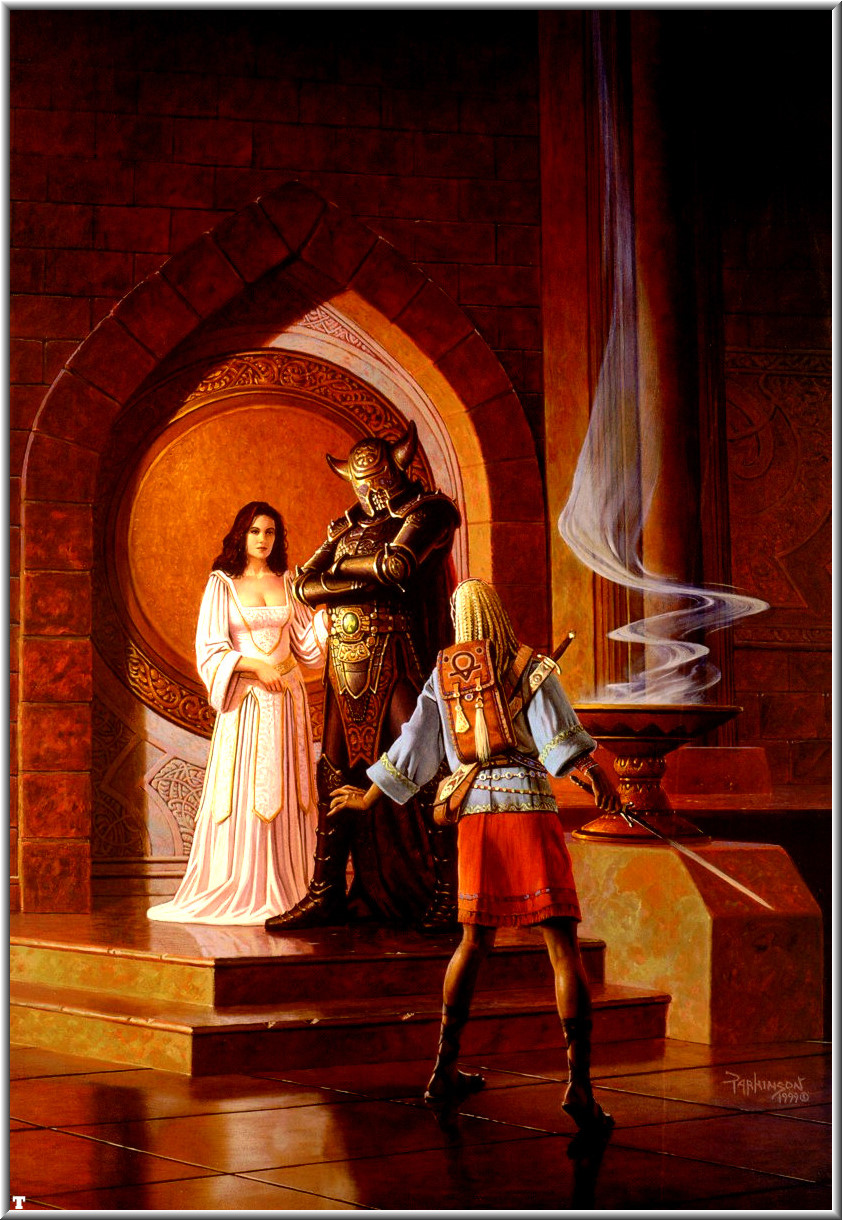
Sometimes I wonder if power is THE most basic of our needs. The power to control our own lives, the power to control our environment and the power to control others.
Take the power to control our own lives. Genvieve Taylor never had power over her life. Her creation was a genetic experiment between two incompatible races. Once that succeeded she was promised to someone extremely powerful and extremely deranged. And finally, at the age of 14 she was injected with a poison (V3) that made her vulnerable to vampires.
Our main character never seriously thinks about giving up the fight for the right to decide what to do with herself and her own life. The Sweet Scent of Blood is for the most part about that battle. And battle it is.
At the beginning of The Sweet Scent of Blood Genny imagines she has achieved a modicum of control over her life, in fact about as much power as most of us can expect to have. She has a job, protection against the vampires, a place to live and friends. Yet power over our own lives is often an illusion. Illusions are easily snatched away by someone more powerful or someone willing to engage the help of the powerful.
Being one of the sidhe fae, a bean sidhe, would normally make Genvieve one of the more powerful people of the world of Suzanne McLeod. But her mixed heritage is unhelpful and Genny’s inability to accept who and what she is acts as a barrier in reaching her potential. In McLeod’s London she also happens to be the only sidhe fae. Sadly, this only makes her more attractive to both those who wish to use her and those who wish to destroy her.
In my mind the only person in The Sweet Scent of Blood who is wholly on Genvieve’s side is Hugh Monroe. Hugh has an intense need to protect those who are in need of help. Genny came into his life when she was infected with V3 and has remained there ever since. His protectiveness made it natural for him to wish to enter the police force. He works as a DI at The New Scotland Yard and happens to be one of the straight cops at that facility. We soon discover that not all who work for the police do so for the same need to protect and serve the public.
The Sweet Scent of Blood starts out as a mystery and ends up as a battle amongst the mighty of Genny’s London. Genvieve seeks the answer to who killed Melissa. Was is Roberto, her boyfriend, or was it another character? Through the story we see that sometimes Genny is aided in her search for answers but for the most part barriers are thrown up, one after the other.
In their scrabble to stay on top, the powers that be have decided that the faery are to remain without civil rights. Civil rights is something a great many of us take for granted. I find it comforting to imagine that if something terrible happened to me then I would be safe because Justice would have its day. Sure, it’s just an illusion but one that is legislated for the likes of me. One hundred years ago women did not have the right to vote nor did they have many of the other rights that men did. Disabled could still be sterilized in Norway a long time after that. Many people have sacrificed a great deal to make it possible for me to have the power over my life that I do.
Faery do not. Vampires do, but faery do not. Witches have civil rights, but faery do not. Regular humans have civil rights, but faery do not. Do I have to look far to find people without written legislation to protect them even today? Sadly, no. In The Sweet Scent of Blood the reason for this lack of power lies for the main part in looks. Some of the faery can be frightening looking and some of them are extremely dangerous. Their ethics are unfamiliar to humans. All of these factors have been utilized by the masters of power games in making the faery less powerful.
The Sweet Scent of Blood is one of my re-readables. I know it is supposed to be Suzanne McLeod’s first published novel, but it holds none of the earmarks of a first novel. Indeed she manages to stay on-key throughout the whole story. Definitely recommended.
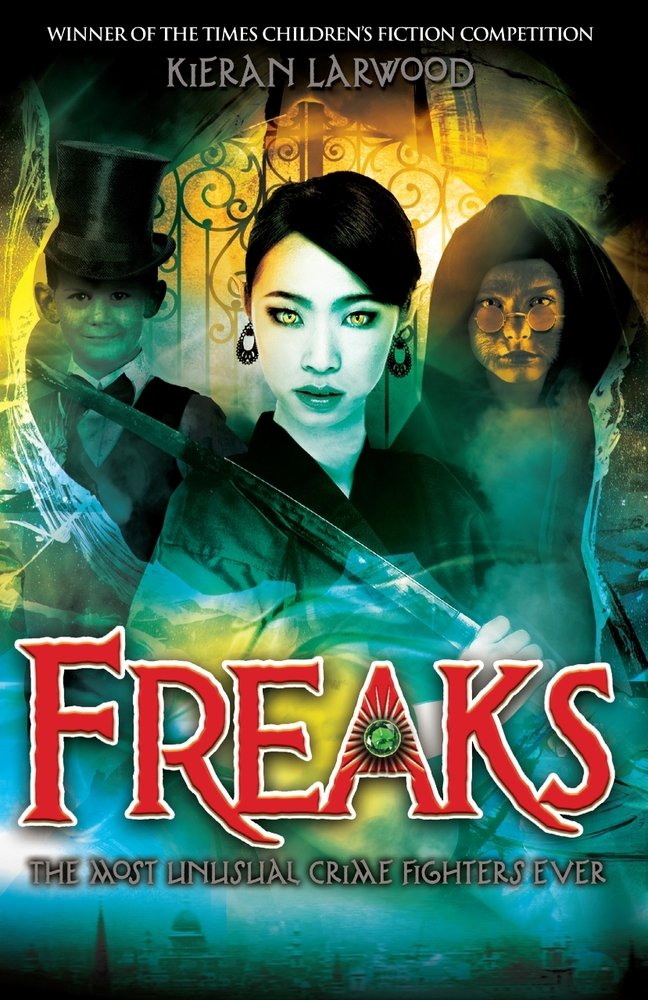
Freaks is a mystery with some very unlikely detectives. Detectives who work in a freak-show are kind of visible wouldn’t you say? It must be difficult to blend in when necessary. But this novel occurs in the chaotic and messy London of the 1800s.
Sheba, the were-something (we don’t know at the beginning of the book exactly what she is) is the main attraction of the Grunchgrindle’s World of Curiosities at the end of Little Pilchton pier. One day a man (Plumpscuttle) buys her and the other attraction (a two-headed sheep) for his own show and takes her to London. There she and the other “freaks” of the show set up for the public every evening.
One evening a mud-lark named Till manages to sneak in and befriend Sheba. When Till goes missing her parents come to the show to ask for help. It turns out Till is not the only one who has disappeared on the mud-flats. Then one day, the gang gets a break in the case.
Freaks is a fun read. It has everything a 10-year old would like. The Monkeyboy likes to throw snot and earwax at the public, a ninja is part of the show and so are rats and a giant. London stinks terribly, there is a monster and the gang gets into strange and dangerous situations. Larwood has written a mystery with plenty of humor and action.
Kieran Larwood‘s daytime job is as a Reception class teacher at a Primary School. After working towards being published for quite a while, Freaks finally won The Times/Chicken House Children’s Fiction Competition 2011 and publication was in the box.
Cover artist “Rivers of London”: Stephen Walter Cover artist “Midnight Riot”:
Before starting on the Peter Grant series – mystery books – Ben Aaronovitch was busy in the writing business. He has been involved in screenwriting, audiodramas, television-series, short stories and spin-off novels. While being mainly an author, Aaronovitch has also had the great pleasure (as so many other writers) of supporting his writing habit with non-writing jobs.
On his blog he states that the Peter Grant series was in part influenced by these sources:
When Peter Grant gets out of being assigned to the Case Progression Unit by being sent to Chief Inspector Nightingale, he “left in a hurry before he could change his mind, but I want to make it clear that at no point did I break into a skip.” Brits. Gotta love them.
What Peter discovers when he gets to DCI Nightingale is that magic does exist and so does everything else paranormal literature delves into. His and DCI Nightingdale’s job (being the only representatives of that side of life) is to regulate the super-natural community, making sure they uphold the laws.
Rivers of London is at heart a mystery. A serial-killer is on the loose making use of magic in her/his/its killings. It is vital that Nightingdale and the rest of the Met find the serial-killer before more people are found without their faces. Peter has his chance at being a detective at the same time that he has to negotiate peace between the lower and upper sides of the Thames (mother and father Thames). His baptism into the super-natural community is at times frightening for him and delightful for us.
While a mystery with death and mayhem, Rivers of London is a light-hearted novel. There is plenty of humor and an irreverent look at society that I enjoy.
Thus far, Rivers of London is the only book in the series that I have read. I do believe I am going to read the next one as well. Aaronovitch manages to balance humor and action in true British style. I like Peter Grant’s distracted manner, something that gives us insight into his character but also into the city of London.
Fanart by DeaDiscordia Upper left: Beverley Brook, “daughter” of Mama Thames and goddess of a small river in South London Bottom left: Police Constable Lesley May Centre: Police Constable Peter Grant Upper right: Detective Chief Inspector Thomas Nightingale, head of the Folly and the last officially sanctioned English Wizard. Bottom right: Molly; The Folly’s domestic helper.
Patricia Briggs was born in 1965. Her joy in storytelling manifested itself early, and scaring her friends (including her husband Mike) was one of her funner hobbies. Patricia kept her story-telling abilities alive through college and her life in Chicago. When she and Mike moved to Montana she got the peace and quiet she needed to finally sit down and write, and she was able to publish Masques in 1993. Then Steal the Dragon followed as her next novel. After that one novel has followed the other. In the Sianim series Wolfsbane was the last one published thus far in 2010.
For best effect, the books should be read in this order: Masques, Wolfsbane, Steal The Dragon, When Demons Walk.
My version of Masques is the reworked one. Patricia Briggs writes a foreword warning the reader of this. Due to the years that had passed since the first edition of Masques, Briggs and her editor felt it appropriate to remove some of the traces of an author’s first attempt. The book is supposed to be full of clichés, but I’m lucky because I would not recognize a cliché if it bit me on the backside of forever.
Geoffrey ae’Magi is gaining in power and followers. Ren, the spymaster of Sianim sends Aralorn off to see about a death-threat to the magician. At the time, Aralorn felt that switching places with one of the other slaves would be a good idea. With green magic as hers, she is able to change her physical appearance. But while at a party the Archmage is holding for various dignitaries, Aralorn changes her mind. She has been placed in a cage wearing the illusion of a snowfalcon form the ae’Magi has created. But one of the visitors seems to see through the illusion. The King of Reth comes up to Aralorn asking if she is in need of help. She says no.
After the party the Archmage asks Aralorn a few questions. His magic is such that he can do the most horrendous things to people and still have them adore him. Aralorn is not sure how long she will be able to endure her stay with him. When she discovers that his plans for her include her demise, she decides to run.
With her companion Wolf and her war-horse Sheen, Aralorn decides to find a way to fight the great and beloved Archmage’s evil magic.
Wolfsbane is a tightly-coupled sequel to Masques, and won’t make much sense by itself. Masques had not been a hit and Steal the Dragon hadn’t done all that well either. Briggs wrote Wolfsbane for her own enjoyment and left the book on her shelf. Eventually, she brushed the dust off it, and got it published.
Wolf has been missing for a few weeks and Aralorn has been dreaming dreams of his childhood. Someone seems to be looking for him in them.
Aralorn’s father has died, and Aralorn goes to attend his funeral. She has been gone from Lyon’s keep for ten years and finds it extra difficult that the circumstances are so sad. When she sees her father’s body, Aralorn discovers that Lyon is not quite dead. Instead, some kind of black magic seems to be involved.
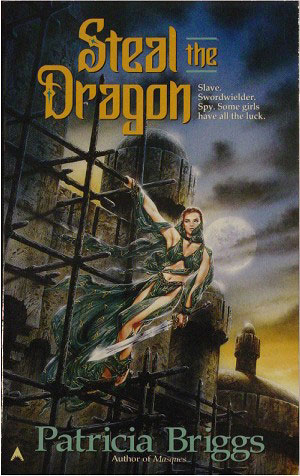
Steal the Dragon is the second book Patricia Briggs wrote. It wasn’t a great hit at the time, but did better than Masques. It has since become more popular.
Steal the Dragon is set a little later than Wolfsbane. Geoffrey ae’Magi is already dead, but not for very long.
In Sianam Ren, the spymaster, decides to send Rialla (former slave from Darran) and Laeth (brother to an important Lord in Darran) to Lord Karsten to try to prevent another murder attempt. Both are highly motivated to do so (Rialla after some convincing) for different reasons.
When they get to Lord Karsten’s keep they play their roles as slave and master. When another attempt at Lord Karsten’s life occurs, they become worried for his safety. Then Rialla’s old master turns up at the keep and the two of them realize that they have probably stepped into a hornet’s nest. It turns out they are correct.
When Demons Walk seems to be a while after the previous three installations in the Sianam series. Like the others, When Demons Walk is light and entertaining reading. Patricia Briggs has her own style that is apparent in all of her novels. She is a good author, the quality of her writing is solid and her characters entertaining.
Sham is an orphan from one of the take-overs of the Prophet of Altis. The Cybellians have taken over Southwood, and Sham is left to thieving. Her master (she is a magician/wizard) does not approve, but he does recognize that other venues might be more dangerous.
Sham is surprised when she meets up with the Lord of Southwood – Lord Kerim. He is more likeable than she had thought, but still one of the enemy. But when attempts are made at various people’s lives (which include killing her master and trying to kill Lord Kerim), Sham put enmity aside and gives a helping hand in finding the culprit.
Hmm. All four books in the Sianim series are interesting additions to Briggs’ archive. I liked them. Like I said, Briggs does solid work. Michael Enzweiller’s maps are a great addition to her website.
Musical writers. What a treat they are. Anne Bishop is one such writer, one who knows how to make all of her chords fit together into a song that satisfies the reader. She manages to portray the darkness in people without stepping into the land of horror. I love dark fantasy when it is performed like this.
Like all of Anne Bishop’s stories, Ephemera is character driven. Generally two or three of them are three-dimensional, while the rest end up complementing the main characters. Ephemera comes from an idea of our outer world reflecting our inner one. What if that were literal? Playing with that idea brought about the Ephemera world (Reading Cafe interview). As we discover in reading these books, the world of Ephemera is ephemeral (transitory). One can never know where one ends up, seeing as one’s heart shows the way.
SEBASTIAN (2007)
German cover
“Long ago, in a time that has faded from memory, a mother’s tears forged the bridge that, ever after, connected the power of the living, ever-changing world to the human heart. – Myth”
Sebastian is a love story, but more than that it is a story about the choices we make. Do we dare to follow our dreams, or will we make “safe” choices? In the end it might not really matter, because the choices we make could very well all be the ones we really want.
Sebastian is an incubus, an incubus who has begun longing for something more than the life he is living right now in the Den of Iniquity. The Den of Iniquity is a place of ever-lasting carnival, a place where people come to fulfill those dark desires they have.
You can relax if you are worried that we are being cast into a place where the sex and violence is explicit. While the Den of Iniquity might well be a place where that is the case, Anne Bishop has been kind enough to keep us as readers away from the details.
Anyways, back to Sebastian. The Den of Iniquity has been his home since he was about 15. His past was not a good one with a succubus mother and wizard father. Sebastian’s mother left early on and his father left Sebastian’s care to others, people who were afraid of incubi. But Sebastian has turned out pretty well, thanks to Nadia, Belladonna and Lee (adoptive family). They have shown him that there is sunshine in a person. Now he wants someone to love.
BELLADONNA (2008)
Australian cover
“Heart’s hope lies with Belladonna.”
The Eater of the World is once more loose in Ephemera, free to wreak havoc where it sees fit. Dreams are invaded, monsters set free and lives are becoming darker due to its influence.
The only hope lies with Belladonna. Glorianna Belladonna is of the old blood, the blood of the Guides and Guardians. Her heritage is one of light and darkness. Only through the combination of the two is there a possibility of winning.
Unfortunately, Belladonna and Lee do not have all of the answers to her search for a solution to the Eater. She sends out a Heart’s Wish to Ephemera with the hope that someone will come with what she needs to save Ephemera.
In a sense that says it all. What price are we willing to pay to save the ones we love? I have no idea myself. In the world of fantasy people are willing to go to extremes to save the world and not just those close to themselves. Sometimes the price could end up being horrendous.
BRIDGE OF DREAMS (2012)
Australian cover
Anne Bishop pulls it off again. This time we get to hear more about Lee.
Ever since Glorianna Belladonna became Belladonna in every sense of the word, Lee has been frustrated, hurt and angry. Part of his anger is at Glorianna for placing herself in this position and for not going back to how she was previously. Another part of his anger is toward Michael, the Magician, for giving Belladonna the chance to make her choice, and for stopping him when Lee wanted to jump in and save her. Quite a bit of his hurt is toward the relationship that has developed between Michael, Glorianna and Sebastian. Why was Sebastian the one to call Belladonna back and not Lee? It seems unfair. Lee feels unwanted, and unable to come to terms with the way things have turned out.
When he stumbles upon wizards trying to invade one of Belladonna’s landscapes, Lee uses a one-shot bridge taking the wizards with him. He ends up in a city called Vision having to endure torture and the insidious whispering of the wizards.
Danyal, the Shaman, is sent to Vision to figure out what needs to be done to save the city from those places that no Shaman is able to see any longer. Shamen are like the Landscapers in that they take care of their landscapes. But unlike Landscapers they do not seem to have access to Bridges. Upon meeting up with other ways of doing things, Danyal is about to have his beliefs about the world challenged.
So, what can I say about Bridge of Dreams? I liked it. I like Anne Bishop’s version of the darkness that lives in all of us. Our shadows balance out the light in us. When we accept both sides of ourselves our potential becomes greater. All three books in the Ephemera series (trilogy?) follow the pattern of Anne Bishop’s other novels. I guess most authors have a unique style of writing (much like musicians), and sometimes that style works. In Bishop’s case I find myself embracing and enjoying her characters. Getting people to care about the characters in a novel seems to be what being an author should be about.
If there is one thing in this world that has inspired the world of nerddom, it has to be the fantastical writings of J.R.R. Tolkien. While I’m not a Tolkien nerd/geek/fan/cult-member, I understand those who are. I mean, I’m writing a blog mostly about fantasy and science fiction – and I love doing the digging necessary for each article.
Tolkien did not only write “high epic fantasy”. He was first and foremost a Professor of Anglo-Saxon at Oxford. You can see a list of his published material at the Tolkien Library website.
While working as a lexicographer on the New English Dictionary, Tolkien began working on the elven language (primarily based on Finnish and Welsh – go to The Elvish Library to get your Tengwar baptism). At the same time he presented his The Fall of Gandolin. The Fall of Gandolin represents the beginning of what later became The Silmarillion. He ended up at Oxford in 1925, and it was after this that the work on first The Hobbit and then The Lord of The Rings began. (Tolkien Library – biography)
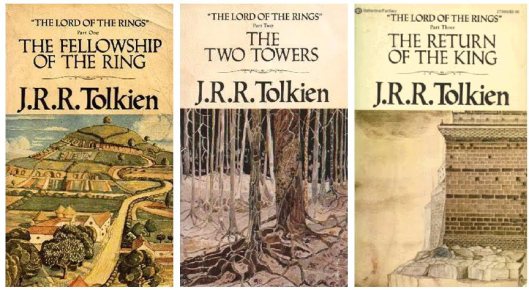
The Hobbit was a hit, making it easier for the publisher to contemplate publishing The Lord of The Rings. But for economic reasons, it was decided that three volumes were necessary. The three volumes were The Fellowship of the Ring, The Two Towers and the Return of the King. My copy is the omnibus containing all three novels and the appendices at the end, appendices that are quite a bit of fun.
Generally, I try to analyze what it is about a book that makes me like it. With The Hobbit it was the adventure of the tale. The Lord of the Rings is rather more difficult to pin down. Part of my liking has to do with the quality of the work. Tolkien nit-picked at details until they fit into his Middle-Earth world. The likeability of all of the characters also plays a great role. Even the “baddies”. The way the story is told, jumping from place to place is frustrating at times but also makes a lot of sense. I absolutely hated it when Tolkien broke from one adventure when things were at their most critical, to visit someone else where he had left them off. But it did keep me reading. I remember the first time I read The Lord of the Rings. I stayed up all night to get through it. Once I get going, The Lord of the Rings is difficult to put down. I have no idea how many times I have read this book, but I have gone through it a few times.
THE FELLOWSHIP OF THE RING
Each book is divided into two parts. The Fellowship of the Ring consists of I: The Ring Sets Out and II: The Ring Goes South.
Bilbo is having his 111th birthday party combining it with Frodo’s 33rd. The whole Shire is looking forward to the celebration as there will be gifts for everyone and enormous amounts of food. As ordered, Gandalf shows up with fireworks for the party.
Bilbo is going to give up the ring, but he is finding it more difficult than he had thought. Somehow, it ends up in his pocket no matter what his intentions are. That is one of the problems with the ring. Once it chooses you as an owner, it will use you up until it feels like letting you go. Now Bilbo has to fight his own desires. In the end he manages to leave the ring with Frodo, his nephew, and Bilbo leaves the Shire with Gandalf.
Originally, the ring had belonged to Sauron. Sauron is a wizard who has gone over to the dark side (like Darth Vader in Star Wars). Now that he has amassed quite a bit of power, he wants his ring back and has sent his minions to search for it. The search has led him to the Shire. Gandalf returns to warn Frodo that he needs to leave the Shire. He does so, and ends up in the company of his friends Sam, Pippin and Merry. They go via the Old Forest to avoid whatever is looking for them.
The Old Forest is ruled by Tom Bombadil. Thankfully, he keeps a close watch over his kingdom and manages to be there for the hobbits when they need him. With his assistance the hobbits are able to get through the Old Forest. Their journey carries them through Barrow-Downs, Bree and Weathertop.
The four hobbits learn quite a bit about themselves, their strengths and weaknesses. Their loyalty to each other increases with their trials. Middle-Earth is not exactly a paradise, free from dangers. Once the Shire is left behind, danger seems to be the word of the day for this little troup. At Bree the hobbits meet up with a ranger called Aragorn. Together, they test the bond between human and hobbits and find out what they all are made of. Eventually, the gang manages to arrive at Rivendell, one of the homes of the elves.
A well-earned rest is taken at Rivendell. Elrond, the elven-leader at Rivendell convenes the Council of Elrond. At the Council, reports are given, and the decision as to what needs to be done next is taken. They decide that the One Ring must be destroyed and once again the hobbits set off. This time there are nine people who set out.
THE TWO TOWERS
As with The Fellowship of the Ring, The Two Towers also consists of two books. Book III is The Treason of Isengard and book IV The Ring Goes East.
This is when Tolkien begins to get seriously annoying. Sadly, he has to because the company has split up and we need to know what happens to each party. Frodo has left the Fellowship and gone down the road he thinks is necessary. Along with him went Sam. For now, we learn very little new about them, but we will later on (of course). This part of the story belongs to Merry and Pippin and the important part they play in furthering the plot.
The group gets split even further. Merry and Pippin are taken by the Uruk-hai. The rest have to make a decision. Try to find Frodo and Sam or follow Merry and Pippin. Merry and Pippin it is. Fortunately for Merry and Pippin, their stay with the Uruk-hai is not an extended one. After their escape they come to Fangorn forest and the Ents. Treebeard’s depiction above is one of the coolest ones I’ve come accross yet. Treebeard is the leader of the Ents, tree-people who have taken a looooong rest (for some of them a permanent one).
Aragorn, Gimli and Legolas come accross tracks that remind them of hobbit feet. They follow them into Fangorn and meet Gandalf again. Meeting him is a shock and a surprise (hah, hah, hah – not telling why). Together they rouse the armies of Rohan and all of them travel on to Helm’s Deep where they are needed.
In the meantime, Frodo and Sam continue on their journey toward Mordor. Who should appear but Gollum. His attraction to the One Ring is strong and he cannot help being pulled towards it. Frodo and Sam get him to promise to guide them to the Black Gate of Mordor.
Once they get to the Black Gate, Gollum finds it easy to convince Frodo and Sam to follow him to a secret entrance into Mordor. By going there, they will avoid guards. As they keep on going, the three-hobbit-group meets up with Faramir and his Rangers. The Rangers help them on their way. Faramir warns Frodo and Sam that Gollum might know more about the secret entrance than he is telling. And he does. Does he ever. But then Gollum is true to the nature that has become his. Possession of the One Ring is all that matters to him. Means justify the end, and what an unpleasant set of means he has awaiting the two hobbits.
THE RETURN OF THE KING
In our last book of The Lord of the Ring trilogy we find the books V: The War of the Ring and VI: The Return of the King.
The Lord of the Rings is not a trilogy for the faint-hearted. From what I’ve heard, that goes for the movies as well (I have not seen them). There is violence, plenty of violence and death. As you have found thus far, people die along the way. How many of these heroes will survive, is not certain at all. But what most of you already know, due to all of the media coverage of the films, is that some of our heroes will make it – all the way to the very end.
But before we get that far, war beckons in another land. A horde of Orcs are attacking Gondor and the people of Gondor are desperate for help. The goal of Gandalf and Aragorn and the rest is to get there in time to make a difference. But when the dreaded Witch King of Angmar arrives on the scene with even more help from Mordor, nothing is certain.
As you will see when you read The Return of the King, plenty has happened to Frodo and Sam. Their journey towards the destruction of the One Ring is proving extremely problematic. Orcs are following their tracks through the desolate landscape of Mordor. Getting from Cirith Ungol to the Crack of Doom is by no means certain. Nothing of value is to be easy for the two friends.
And this is where I leave off. Like I said at the beginning, The Lord of the Rings has been an enjoyable and tense journey, one that I wish everyone could enjoy. I have not seen the films, and I will not do so either. The images evoked by this trilogy through reading, are enough for me. I wish to retain them, not replace them.
For my dyslectic son, the films were the obvious choice and one that he enjoyed. My non-dyslectic son has read the trilogy several times and seen the films and enjoyed all of them. I’m just too old-fashioned, I guess.
1978: Part I of a rotoscoped animation of Lord of the Rings was released by United Artists and directed by Ralph Bakshi. UA considered the film a flop and refused to fund Part II.
1980: Rankin/Bass use the opportunity to give out a televised animation of the Return of the King. It was targeted at a younger audience.
1998: Miramax began a live-action adaptation of The Lord of the Rings, directed by Peter Jackson. New Line Cinema assumed production responsibility and decided that there would be three, not two films. 2001: The Fellowship of the Ring; 2002: The Two Towers; 2003: The Return of the King.
2009: The Hunt for Gollum, a fan film based on elements of the appendices to The Lord of the Rings, was released on the internet in May 2009.
Awards
All three films by Peter Jackson won the Hugo Award for Best (Long-form) Dramatic Presentation in their respective years.
4 Oscars for The Fellowship of the Ring
2 Oscars for The Two Towers
11 Oscars for The Return of the King
Radio
1955: The BBC produced a 13-part-radio adaptation of The Lord of the Rings. It is a very faithful adaptation.
1979: US dramatization subsequently issued on tape and CD.
1981: BBC produced a 26 half-hour-episode adaptation of The Lord of the Rings.
Stage
1990s: Lifeline Theatre in Chicago, Illinois, produced individual plays of each of the three books.
2001-2003: Full-length productions of each of The Fellowship of the Ring (2001), The Two Towers (2002), and The Return of the King (2003) were staged in Cincinnati, Ohio.
2006: Three-hour-stage musical adaptation of The Lord of the Rings by Mirvish Productions opened in Toronto (opened in London 2007).
Music: There are groups playing anything from death-metal to folk music who are fans of Middle-Earth. Some albums are very middle-age while others are far from it.
…Of Forest And Fire…
…Where the Shadows Lie
A Night in Rivendell
All that Glitters
An Evening in Rivendell
At Dawn in Rivendell
Beyond the Western Seas
Complete Songs and Poems
Dol Guldur (album)
Evernight (album)
Firestorm Apocalypse – Tomorrow Shall Know the Blackest Dawn
The First Ring
Forest of Edoras
In Elven Lands
Inspirations of the Middle Earth
Journey of the Dunadan
Landscapes of Middle-earth
Leaving Rivendell
Let Mortal Heroes Sing Your Fame
Lost Tales (album)
Lugburz (album)
Minas Morgul (album)
Mountain Live: The Road Goes Ever On
Music Inspired by Middle Earth
Music of Middle-Earth, Vol. 1: From the Shire to Rivendell
Music of Middle-Earth, Vol. 2: From Khazad-dum to Gondor
Mystic Legends…
Nightfall in Middle-Earth
Nightshade Forests (album)
Oath Bound
Onwards to the Spectral Defile
Sagan om Ringen (album)
Shadow Rising
The Starlit Jewel
Stronghold
Sword’s Song
The Adventures of Tom Bombadil (album)
The Last Alliance (album)
The Lay Of Leithian (album)
The Middle Earth Album
Third Age of the Sun
Unveiling the Essence
Winds of Change
Audio books
1990: Recorded Books published an audio version of The Lord of the Rings, with British actor Rob Inglis.
A soft core porn comedy entitled The Lord of the G-Strings.
The Harvard Lampoon satire Bored of the Rings, and its prequel The Soddit.
A little-known BBC Radio series, Hordes of the Things (1980) attempted to parody heroic fantasy in the style of The Hitchhiker’s Guide to the Galaxy.
A German resynchronization of the Fellowship’s first twenty minutes, called Lord of the Weed – Sinnlos in Mittelerde, portrays the characters as highly drug addicted.
Quickbeam and Bombadil, The Lords of the Rhymes, mix Tolkien’s fantasy world with hip-hop.
Two New York City based authors, Jessica and Chris, parody Tolkien’s work in Once More With Hobbits.
Several former members of Mystery Science Theater 3000 created Edward the Less which parodies the trilogy.
The episode of South Park entitled The Return of the Fellowship of the Ring to the Two Towers spoofs Peter Jackson’s version of the trilogy.
The Lord of The … whatever, a “transcribed electronic text version”, written by the Tolkien fans of the rec.arts.books.tolkien newsgroup as a reply to those who ask where can they download an electronic copy of the book. It has lots of fan in-jokes, like whether Balrogs have wings or not, a long-standing debate in the Tolkien fandom.
Flight of the Conchords claim that their parody Frodo was rejected as a theme song for Peter Jackson’s movies.
The Ring Thing – a Swiss parody of The Lord of the Rings: The Motion Picture Trilogy, however it has received mixed reviews.
MADtv spoofed the series with The Lords of the Bling.
Kingdom O’Magic by Fergus McNeill. He became famous during the eighties for games such as Bored of the Rings (influenced by, but not adapted from, the Harvard Lampoon book) and The Boggit.
Why can’t they just lose the ring in the sink?, humour columnist Dave Barry’s satire.
Dead Ringers, BBC Radio/TV satirical comedy show regularly features Lord of the Rings-themed sketches.
Bobo, a very popular Serbian voice-over video on scene from the first film, which features Boromir and Frodo as gay lovers.
British Comedy duo French & Saunders have also satired and spoofed in detail Peter Jackson’s The Fellowship of the Ring in a BBC 2002 Easter Special entitled The Egg.
A parody entitled teh l0rd of teh Ringz0r has done the rounds of bulletin boards systems.
A Spanish voice-over video of Gollum debating about which is the best football (soccer) video game.
One Man Lord of the Rings A one man show by Charles Ross, reciting and parodying the three films in an hour.
REC Studios’ Fellowship of the Ring A parody starring four people portraying multiple characters each and condensing the first third of the story to under a quarter of an hour.
MTV produced the Lord of the Piercing, a parody about the Council of Elrond, in which Frodo uses the One Ring in a piercing. The 4 minute episode comes as a hidden extra in the first DVD of the 4-disc set of The Fellowship of the Ring.
Fellowship! – A musical parody of The Lord of the Rings
Worth 1,000 – Comical images related to The Lord of the Rings.
50 Reasons Why Lord of the Rings Sucks – Only to be read if no sharp objects are within reach.
Lord of the Rings vs. The Matrix vs. Star Wars – Comical review of the three movies, not to be taken even remotely seriously.
Video games, board games, role playing games, puzzles, card games, a chess set and miniatures games include the themes from Lord of the Rings.
I wonder if I came to The Hobbit the same way everybody else has. First I read The Lord of The Rings. I loved it. Then I discovered that Tolkien had written other books and one of them was The Hobbit. I set out on a quest to go through all of his fantasy work. I should probably read some of Tolkien’s academical work as well, but alas. I have wondered at the sense of writing yet another review on the subject. Then I remember how much I liked The Hobbit and I think that there probably is room for another fan out there amongst the 1s and 0es.
“John Ronald Reuel Tolkien was born on January 3, 1892 …. At the age of three his mother brought him and his younger brother, Hilary, back to England. Tolkien’s father died soon afterwards in South Africa …. When he was 12, Tolkien’s mother died, and he and his brother … lived with aunts and in boarding homes …. The young Tolkien … excelled in classical and modern languages … and began to create his own languages….
Tolkien wrote ‘A Middle English Vocabulary’, but it was not published until 1922 …. During this time he began serious work on creating languages that he imagined had been spoken by elves. The languages were based primarily on Finnish and Welsh. He also began his “Lost Tales” a mythic history of men, elves, and other creatures he created to provide context for his “Elvish” languages…
It was also during his years at Oxford that Tolkien would scribble an inexplicable note in a student’s exam book: “In a hole in the ground there lived a Hobbit.” Curious as to what exactly a “Hobbit” was and why it should live in a hole, he began to build a story about a short creature who inhabited a world called Middle-earth. This grew into a story he told his children, and in 1936 a version of it came to the attention of the publishing firm of George Allen and Unwin.” (Tolkien biography, Tolkien Library)
The Shire is an idyllic place to live. Middle-Earth’s rising problems have not yet impacted on the Hobbits living there, and they will not for quite some time. Bilbo Baggins is a seemingly average hobbit. Hobbits are shorter than humans, have furry feet (making foot-wear uncomfortable) and enjoy socializing. Bilbo lives contentedly in his hole in the ground on a hilltop.
Drumroll. Gandalf arrives. Thus far, The Hobbit has been a pleasant children’s tale, not really giving warning of anything nasty about to come. Gandalf is one of the very certain pointers to dangerous things coming one’s way. To begin with Gandalf’s visit is fairly pleasant. But then 13 dwarves appear, for some reason with the belief that Bilbo is supposed to be one of their party searching for the Lonely Mountains and the treasure of the dwarves. After a lot of convincing by Gandalf, both parties decide to give the adventure together a shot.
If you think children should only meet pleasantness, this is probably a good place to end the story. What comes after entails quite a bit of unpleasantness. But the unpleasantness is presented in such a manner that a child would probably want their parent to keep on reading (and you as a parent would want to keep on reading yourself). The Hobbit is certainly not only a children’s tale. It is very much for adults as well. But please do not try to analyze the book. Tolkien himself said that The Hobbit was what it was – no allegories or hidden messages were intended.
I’m not really sure how much to reveal. This is a story that is about to be blown open by the movie industry. But until then, it might only be fair to the reader to keep some things under wrap. Tolkien introduces us to the mythology of England through The Hobbit. I’m certain his children loved the way Tolkien made English mythology so accessible for them. Through The Hobbit and The Lord of Rings we as an audience get to know old English beliefs about the world of the fantastic.
On his journey with the dwarves, Bilbo meets trolls. As a Norwegian I am very familiar with the troll myth. Trolls aren’t cute little key-chain trolls that you can get at souvenir stores. They are ugly, large and quite often stupid. Unfortunately for most of the people they meet, trolls are also capable of smelling their victims and finding them wherever they are. But there is one advantage to be had over trolls, and that is sunlight. They turn to stone if even a ray hits them.
Shape-shifters, on the other hand, are not a common Norwegian myth. Bilbo gets to meet one of them, in the shape of Beorn. As you might guess from the name, Beorn’s other shape is a bear and he is a fierce fighter. He is wary of strangers, but once he takes to you, he is willing to go to great lengths to help you.
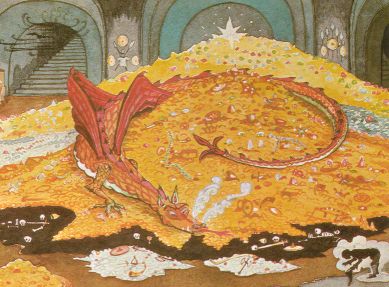
The other non-humans that the gang of 15 meets are elves, who are good for a given definition of good. Some of the baddies are wargs (great big hulking wolves), goblins (tend to want to eat you) and Smaug the dragon. Smaugs lair is where the treasure is (otherwise The Hobbit wouldn’t be as fun). Smaug is who we see on the cover above.
As Gandalf had predicted at the beginning of the book, Bilbo would not remain the same person as he went through his adventures. And this prediction comes true. A very changed hobbit meets us at the end of the book. He has discovered that he is capable of a lot more than he had thought possible. And if we absolutely have to look for a moral to this story, I guess that is as good as any. We are capable of more than we think is possible.
——————————–
AWARDS
1938: New York Herald Tribune Children’s Spring Book Festival Award.
For all of you Hobbit-nutters out there, you can now get the Latin version of the book. See Middle-Earth News for information.
Adaptations
Film
1966: A 12-minute film of cartoon stills by Gene Deitch.
1977: an animated version by Rankin/Bass. Nominated for Hugo Award for Best Dramatic Presentation. I’ve seen this several times on national TV and quite like it.
2012: planned release of film-version of the first installation in a three-part story by Metro-Goldwyn-Mayer and New Line Cinema. The Hobbit: An Unexpected Journey; The Hobbit: The Desolation of Smaug; The Hobbit: There and Back Again.
Awards
1978: Romeo Muller won a Peabody Award for his teleplay for the Rankin/Bass The Hobbit.
Stage
1953: First stage production by St. Margaret’s School, Edinburgh. Several others have followed later.
1986: The Hobbit (A Musical) was produced for the stage by Khandallah Arts Theatre in Wellington, New Zealand.
2001: The Atlantic Theatre Festival in Wolfville, Nova Scotia is presenting a production of The Hobbit.
2012: The Hobbit returns to The Maverick Theater in Fullerton, California.
Radio
1968: Radio-adaptation in eight parts for BBC Radio4 by Michael Kilgarriff. Was released on audio cassette in 1988 and on CD in 1997.
Comics
1989: three-part comic-book adaptation by Chuck Dixon and Sean Deming and illustrated by David Wenzel. Published by Eclipse Comics.
Games
1982: The Hobbit, by Beam Software and published by Melbourne House. A copy of the novel was included in each game package.
1999: ME Games Ltd. was offered the licence to run Middle-Earth Play by Mail, an ongoing team-game based on The Hobbit and The Lord of the Rings.
2012: The Hobbit: Boardgame by Fantasy Flight Games.
Awards:
1983: The Hobbit (Beam Software) won the Golden Joystick Award for Strategy Game of the Year in 1983.
1995-1999: Fellows of the Academy of Adventure Gaming Arts and Design awarded the Origin Awards: Best On-going PBM Game: Middle Earth PBM Fourth Age (Game Systems).
1999: ME Games PBM was inducted into the Academy of Adventure Gaming Arts & Design’s Hall of Fame.
First thing to be said about the Haven series is that the books are very easy to read and they do not take long to finish. In this case, easy is meant as a compliment. Both Once Bitten and Twice Dead are addictive. I’ve read them a couple of times and enjoyed them just as much each time. Both are heavy on action and low on romance (although there is plenty of tension between the two main characters). Kalayna Price has done herself proud.
ONCE BITTEN (2008)
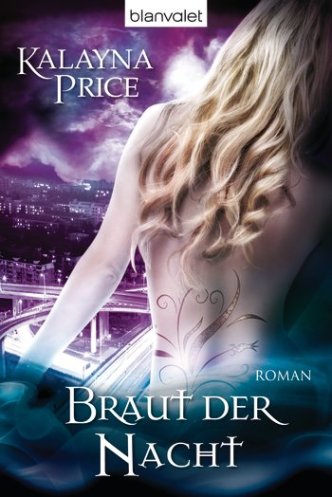
German cover
Young Kita is about to discover what it means to be both shape-shifter and vampire. Or does being a vampire cancel out being a shape-shifter? She is also about to discover what it means to crave blood. Let us just say that the longing makes her nauseous.
Once Bitten is the first novel in the Haven series. Kalayna Price is the author of this series. Her books tend to be in the supernatural/ romance/action categories. So too in Once Bitten.
Kita is on the run from Firth, a parallel world for shape-shifters. Her shape is a cat. In spite of her small size she is Dyre (the one to inherit leadership) and her father Torin. Female shape-shifters are forbidden Earth, which is why there are hunters on her tail. But Kita does not want to go back.
Her running takes her to the city of Haven, and Haven takes her into the world of vampires and scholars (magicians). Once Bitten is pretty much about Kita’s entrance into the world of vampires and the impact the change has upon her and her vampire sire, Nathaniel.
TWICE DEAD (2010)
Both Once Bitten and Twice Dead are urban fantasies set in the city of Haven. I found Twice Dead as good as Once Bitten. They are both light, easy, action-filled and fun to read. Kalayna manages to make her characters pretty three-dimensional (especially our main one – Kita). Focus is not placed on world building but on character building. In a novel of this length I find that wise.
In Twice Dead Nicholas is chastised and punished for not making Kita drink enough human and master blood. She is still a cat at heart and really finds the idea repugnant. Rabbit blood is OK, but human? No way. Therefore, the choice is taken away from her.
When the Collector comes to town wanting to question Kita about the deaths in Once Bitten, other deaths begin happening. Vampires are discovered without their heads attached and Kita is being framed for them.
Twice Dead is pretty much about resolving the mystery surrounding these murders, staying away from the hunters from Firth and trying to keep Kita alive. Enjoy.
THIRD BLOOD (2012) – Not yet published. I just wanted to show the planned new cover. Great, huh?
Patricia Briggs has written the Hurog duology. As you might have surmised from this blog she is quite a prolific writer. Her books fall into the light entertainment category. The Hurog duology’s version of the Briggsian world-creation is placed in a world reeking of the middle-ages with all of its dragons, shape-changers, magicians and various other people.
I absolutely loved the Danish covers. Wow, what a cool dragon. I don’t think I’ve ever seen an interpretation like that. And it fits with the dragon of the story. This is probably one of the better stories that Briggs has written. Ward is a wonderful character, caught in his own trap, yet never quite giving up hope.
Dragon Bones is a stand-alone novel. Its main character is Ward, heir to Hurog. What you need to know about Ward is that his dad was, to put it mildly, a monster. Child-, spouse and animal-abuse were his main hobbies. Until he had managed to damage Ward enough to affect his thinking, he saw Ward as his rival. So when he dies at the beginning of the book, it would be fair to say that Ward did not feel like grieving.
Unfortunately for Ward, the damage done to him had enabled him to pretend to be quite dense. Undoing other people’s perception of himself turns out to be more difficult than Ward would like. Discovering a damsel in distress and the secret of Hurog both play a part in enabling Ward to figure out how to show himself as someone to be trusted. This brings the king’s attention to the Hurog family, driven by his paranoia of the world being against him.
Ward comes across as a believable character. He clearly struggles with the long-term effects of his childhood. But in learning about Hurog’s very secret secret and some truths about the people around him, Ward manages to feel less alone in his struggles. One of the first things Ward must do in getting people to take him seriously is to prove himself a warrior, taking him and a small group accross the kingdom.
The story is told in first-person, through the eyes of Ward. This is part of what makes Ward such a real person, but it also shows us the world around him through his experiences. The people around him are clearly filtered through the life of Ward, making us care more for him and for the people around him. Dragon Bones is quite an enjoyable introduction to the world of Ward of Hurog.
While Dragon Bones is a stand-alone story, Dragon Blood depends on the reader having some knowledge of the world. It continues the story of Ward, and in this case Tisala the rebel, and love of Ward. Neither book is a romance, something I quite enjoy. I’m weird like that. For some reason I both dislike romance in books and yet really enjoy it at times. Romance done the Hurog way is great.
The beginning of Dragon Blood is quite brutal. We come upon Tisala while she is being tortured for information about the rebellion that has been realized in the wake of Ward’s exploits in Dragon Bones. She escapes and runs to Hurog. This implicates Ward in the mind of the king and the king demands that Ward be committed for mental illness. All of this comes on top of Ward having to prove himself politically able to his little kingdom. One might say that Ward’s life has a bit more excitement than is good for a person’s health.
Hurog means dragon, and dragons are showing up on the door-steps of the kingdom once more. Dragons have played an important part in the whole kingdom’s past history, not only Hurog’s. Thankfully neither book is very graphic, enabling them to be read by a younger audience (not too young). Neither violence nor romance is explicit. Upon finishing the Hurog duology, I was left with a sense of wanting more.
<
p>Dragon Bones and Dragon Blood are available as audiobook.
I loved the Journeys of the Catechist. What an excellent trilogy this is. This is Alan Dean Foster at his best. All three novels were of high quality and the characters enjoyable. Fantasy adventure is fun when the author manages to make it work. Our main character Etolje Ehomba takes us through several adventures on his way to fulfill what he sees as his obligation. While there were plenty of adventures and action scenes in the books, for some reason they came across as quiet books to me. Maybe that had to do with all of Etolje’s questions. He does like his questions. Or maybe I like these books because they are different from much of the fantasy and science fiction out there on the market. That probably has to do with the Catechist (teach through questions and answers) part or the story.
When a group of dead men are washed up on the beach near the home of Etolje Ehomba, one of them turns out to be alive but close to death. He charges Etolje to save the Visioness Themary of Laconda who has been abducted by Hymneth the Possessed. Ehomba does as he has been charged despite the protests of his family. Armed with a sword, a spear and a few things that the women of the village have collected for him Ehomba sets off.
Shortly after setting off, Etolje meets up with Simna ibn Sind. Simna ends up following Ehomba on the whole quest. Our suspicions of Etolje’s magical abilities are soon aroused, as he seems able to do miraculous feats. But Etolje never agrees with that description. Instead all credit is given to the collection of things that the women of his village gathered for him.
These two travelling companions’ adventures are like Aesop’s tales. There is a moral behind each encounter. A Catechist is one who teaches by word of mouth. Sometimes Etolje’s tendency to ask questions of everything and everyone, patiently waiting for answers, frustrates Sind. As a reader it gives us insight into the world of Ehomba, and if we are attentive we should certainly begin to see that perhaps Etolje’s village might not be as every other village that he and Simna encounter.
INTO THE THINKING KINGDOMS (1999)
Into the Thinking Kingdoms is book no. 2 in the Journeys of the Catechist trilogy. It begins where Carnivores of Light and Darkness left off. Ehomba is still asking questions and Simna is still complaining about what he sees as a waste of time. Along with them on their journey they have acquired Ahlitah (a feline).
While their environment has changed somewhat, all three still manage to get themselves in and out of trouble. Etolje’s word magic is especially needed when the trio manages to get themselves arrested for thinking and expressing independent thoughts. As in Carnivores of Light and Darkness, each place is left a changed place for having encountered Ehomba, Simna and Ahlitah.
I enjoyed Into The Thinking Kingdoms as much as Carnivores of Light and Darkness. These books show off Foster’s tale-spinning abilities. You need to have read Carnivores of Light and Darkness in order to be able to follow along in the story. Into the Thinking Kingdoms is not a stand-alone book.
A Triumph of Souls is a great conclusion to the Journeys of the Catechist trilogy. The trio, Etolje Ehomba, Simna ibn Sind and Ahlitah, the feline, are still together on their quest to save the Visioness Themaryl from the evil Hymneth the Possessed.
This time they take to the sea to get to their goal. Once again the trio gets themselves in and out of trouble. Some of this trouble is strange indeed. The island with the faceless people is a clear example of Foster’s ability to play with weirdness. Etolje still denies having sorcerous abilities.
When the gang gets to Hymneth the Possessed we meet a person who makes regular fantasy villains look stereotypical. And the ending of the book. What a perfect, yet surprising story this has turned out to be. While there might not have been a great deal of character development on the part of Simna, he feels real. Some pe0ple aren’t really changed by their experiences. Motivations stay the same. Etolje is Etolje. His role seems to be to surprise, and he does that well. As I said earlier, Journeys of the Catechist is an epic fantasy of great quality and it delivers what it promises.
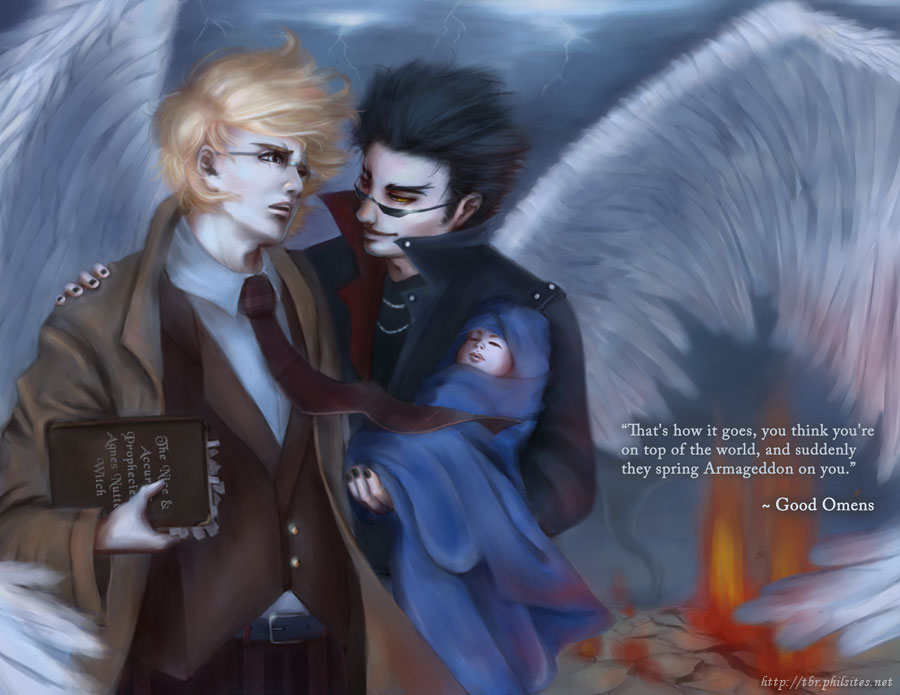
First off, I have to say that there is so much incredible artwork out there dealing with Pratchett and Gaiman. I wish I could include all of it. For most other authors I end up with the cover art, but with these two guys I’m in heaven. I recommend that you google “Good Omens”, go to images and sit back and enjoy yourselves. Below are three examples of what you’ll find.
Good Omens starts off with a prologue placed in the Garden of Eden. You see, there was this serpent, Crawly, who was sent there to do his best to make trouble. He did. In the meantime the angel with the flaming sword, Aziraphale, gave his sword to the humans as protection because he felt sorry for them.
6000 years later Crowley meets up with fellow demons and gets handed a basket with a baby in it. This is the baby presaging the End Of The World. He is told to deliver it at a certain hospital making certain that it gets exchanged with the chosen baby. Something goes wrong, and the baby ends up with the wrong family – unbeknownst to the minions of Hell.
In Lower Tadfield, young Adam and his gang run around being the kind of nuisance only a gang of 11 year olds can manage to be. They are happy in their lack of knowledge about the future and the imminence of the end of the world.
Crowley and Aziraphale discover that something is wrong with the child they thought was the son of the Devil when a promised delivery from Hell does not arrive at its appointed place. Ooops.
The four horsemen are gathering to fulfill their destiny, but no one knows quite where to go. Where is the promised son of the Devil?
You just know that when you pick up a book by Terry Pratchett and Neil Gaiman that you are not going to get anything even remotely resembling normality. Good Omens is filled with interesting characters and a strange sense of logic. Whenever I read their books, I get into this weird thought-mode where I go – yeah, that could happen. I did it this time as well. Maybe that’s what I like best about both of them, their ability to fool me into believing them. Kind of cool, that ability.
My favorite characters were Crowley and Aziraphale, both rebels in their own right. After 6000 years neither is wholly good or wholly evil. They are still stuck in the mold they were created for, but little bits of them are able to crack that mold just a little.
There is something about Charlie that I find appealing. Her life is a mess in so many respects, but she, herself, is a really decent person. Kelly’s writing is, of course, alpha and omega in making the series work and helping me like it. I find it amazing that this is actually Gay’s writing debut.
The Charlie Madigan series is an urban fantasy one. They are meant to entertain. There are issues that come up in the books that are important ones, but like most novels out there on the market this is for the general public and not an esoteric philosophical LSD audience (Ok, that might have been a bit mean).
As with a great deal of the other urban fantasies out there the Charlie Madigan has a male/female action team. Since both Hank and Charlie work together, have a bantering tone between them and look quite good – well …
In The Better Part of Darkness we find ourselves in an Atlanta city in a possible future where scientists have discovered two parallel planes of existence. Surprise, surprise, angels and demons do exist although not exactly in the heaven and hell version that we humans are so fond of. We have been visited by them for thousands of years and they have been using us and the earth as a battleground for working out their differences.
Now that humans know about them, we won’t put up with their nonsense any longer and have laid down the law for them. A police-department has been established dealing especially with extraterrestrials. They are called the ITF (Integration Task Force). Charlie Madigan is one of the officers working for the Department and her partner, Hank.
Pretty early on in The Better Part of Darkness, we find out that Charlie had a dead-then-alive experience that seems to be changing her physically.
Charlie’s partner, Hank, is a siren from Elysia. He has the kind of voice that needs to be dampened, otherwise men and women would throw themselves at his feet and do anything he asked of them. This comes in handy in police-work as people really want to tell him the truth.
Her daughter, Emma, is a highly intuitive child, one with a great degree of empathy. She goes to Hope Ridge, a school for rich kids. Charlie can’t afford it on her salary, but her ex-husband, Will, is paying for it.
When Charlie gets called to her daughters’ school (with her partner Hank) she becomes extremely worried. The victim is Emma’s old baby-sitter, Amanda Mott. At first thought dead, it turns out that Amanda is “just” in a coma of some kind. Making the situation a whole lot worse is the fact that there are several others who have been found like Amanda, and they have all died in the end. It seems all of them have been exposed to a new drug called “ash”. It’s extremely addictive and once it leaves a person’s system, they die.
This is the mystery Charlie and Hank are to investigate. As you might imagine unexpected twists and turns do appear. As stated above, Kelly Gay’s writing is of high quality and kept me reading until the end.
Prejudice and fear seem to be recurring themes in Patricia Brigg’s novels. Raven’s Shadow is no exception. In this instance, the Travellers are the persecuted people. We see instances of this today. In general there seems to be a lack of trust towards people who do not stay in one place and become part of the community. It makes it a whole lot easier to blame them for something, as our links to them won’t be a strong as they would be towards a neighbor. Such is the world of Travellers in Briggs Raven duology.
Tier and Seraph are our two main protagonists in Raven’s Shadow. We meet Tier as he is on his way home from the war. Tier is a rebel. His father was a baker and the expectation was that Tier would take over the craft. But Tier wanted to see the world and did that. Unfortunately, he also ended up disillusioned about the state of the world.
As he enters a village he see a large bon-fire in the town square. A Traveller was burned suspected of using magic. Inside the town’s inn the citizens have joined in drinking to their “brave deed”. Left behind is a young woman. The innkeeper has decided to sell the girl to the highest bidder. Tier ends up buying her, Seraph a Raven traveller who has no reason to trust Tier. This is the beginning of the journey of Seraph and Tier, a journey fraught with danger and betrayal – you know the spiel. I liked both Raven’s Shadow and Raven’s Strike. While not complicated, they are easy to read.
Tier has been rescued and the family is taking it easy on the way home from the Capitol after the run-in with the wizards. Part of the way, they have chosen to travel with Benoin and his tribe. On the way they come to a village where a shadow creature has killed some of the villagers. The creature is taken care of, but the family soon realises that it is just a symptom of what is happening in the land.
At the same time, Tier seems to be having trouble recovering his magic. It seems to be fraying and drawn away from him. Seraph cannot figure out what the problem is, but slowly the family is being led to the ancient city of Collosae – the city where the Travellers came from.
Raven’s Strike gives us more background information on the Travellers and their roots. This background information turns out to be vital to Tier’s ability to solve the puzzle. The romance between Jes and Hennea takes up a bit of space.
Raven’s Strike tied up a few loose ends and was a good follow-up to Raven’s Shadow. They are both typical examples of Brigg’s writing: light, fun and accessible.
We humans are a fearful lot. If anything or anyone differs from the accepted norm, most of us will find some way to avoid that thing or person. Sometimes we’ll use the opportunity to bully and taunt the person exhibiting “strangeness”. The Hob’s Bargain illustrates this ability to pretend that we know how the world should be, even if that means hurting someone we love.
Aren’s (our protagonist) family is not excepted from this. They have an hereditary clairvoyant ability that sometimes expresses itself in a more magical one. That makes them fodder for the blood magicians – who feed on death. Aren’s brother was wanted as a magician by those in power, but he did not want to consequences of such a choice. Rather than have his death be used by the blood magicians, he chose to suicide.
You can imagine this has affected Aren. It seems she is beginning to experience visions, making her worry about her new husband. When the cottage is broken into, she manages to hide in the food cellar, but Aren knows something is terribly wrong.
While hiding in the cellar, Aren suddenly feels a change in the way magic feels. Something has broken, but she has no idea what – being too busy surviving, and all. From that point on Aren’s visions are clearer and the first one concerns the death of her father and husband. Turns out her whole family is gone. Now Aren has to deal with her grief, her out-of-control magic and the changes in the land and her neighbors.
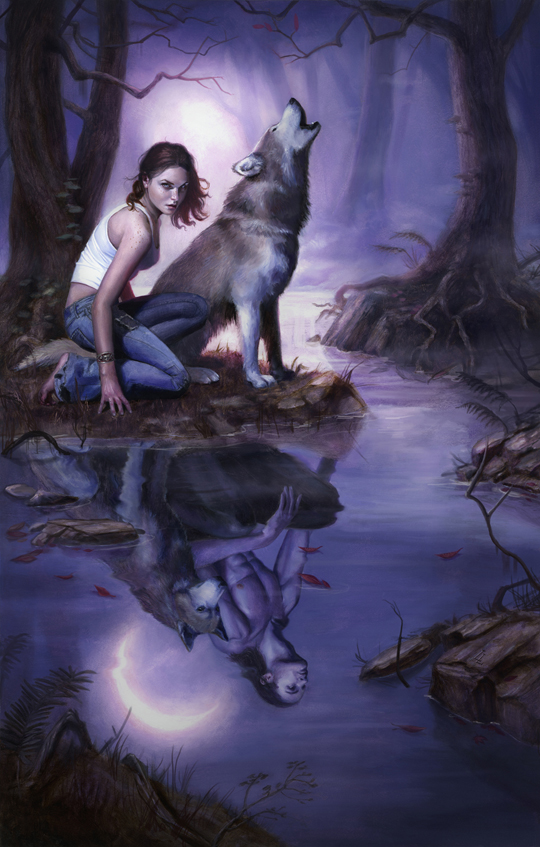
Patricia Briggs books fall into the light-reading fantasy section. Her books are fun and easy to read. In the Alpha and Omega novels we meet werewolves and witches, vampires and fae, all capable of wickedness and heroic deeds. As usual in such tales the characters tend to survive the most amazing things. There is plenty of humor, some romance and lots of action in this series. The Alpha and Omega series has been set in the same world as the Mercy Thompson series.
Bran – the leader of the werewolves (Marrock) in the US lives in the hills of Montana. He has two sons, Samuel and Charles. We’ve met Samuel already in the Mercy Thompson books, although he does make a brief appearance in his function as a doctor. Charles is Bran’s other son. He has been born a werewolf, not something that should be possible. Charles is Bran’s assassin. If a werewolf steps out of order, it is his job to take care of the problem. His ability to remain cool and collected while killing is one of the main reasons for having such a job.
Anna, Charles’ mate (to her surprise), has been living with a pack in Chicago. The other werewolves had been abusing her severely. When that came to the attention of Bran, Charles was sent to take care of the matter. That led to Charles and Anna’s wolves recognizing each other as mates. Anna is brought to Bran’s pack to live with them.
Walter Rice, a Vietnam veteran, lives up in the Cabinet Wilderness in Montana. One day he witnesses the attack on a young man and steps in to protect him. Rice ends up being mauled, but survives. When other mysterious deaths occur in the area a rogue werewolf is suspected and Charles is asked to look into it. He and Anna go.
HUNTING GROUND (2009) – Nominee for the Endeavour Award –for best book by a Pacific Northwest writer 2010
Charles is trying to convince his father to stay away from a convention of werewolves in Seattle. He feels his father will be in unnecessary danger from the European delegation. Charles’ intuition is acting up. Being an Omega, Anna is able to stand up to Bran without his Alpha influence taking over. After she has yelled at Bran, he is able to listen to what the two have to say.
Bran accepts Charles’ feelings and sends Charles and Anna instead as his representatives. Together they are to try to convince the other delegates of the need to go public. The other delegates aren’t exactly thrilled at the idea of going public. Here we see that the timeline is a bit back in time from the Mercy Thompson series. There the decision to go public has already been made and Adam is the werewolves’ outward face.
In Seattle people are being found dead and mauled. When Anna is attacked by vampires using werewolf tricks and magic, Charles has to figure out how to save the situation without getting killed by former lovers and new enemies.
FAIR GAME (2012)
Young Leslie has moved to California with her father. There she ends up in the capable hands of Mrs. Cullinan. When animals and children start disappearing (even Leslie’s new puppy) three people turn up at the neighbors and take her away. The neighbor and the three new people turn out to be fae. When one of them offers Mrs. Cullinan a favor as thanks for her warning, she says no thanks. Instead Leslie ends up being the one owed. But having learned that the fae were powerful and charming and that they ate children and puppies, Leslie was not eager to cash in her favor.
Fair Game is set a while after Hunting Ground but shortly after River Marked. Charles is struggling in his capacity as an assassin and Anna seems the only one capable of seeing it. She keeps on confronting Bran about it, and only Omeganess keeps her from shaking in her shoes. Because of the new rules, Charles no longer feels he is dispensing justice but rather murder and this is causing ghosts to haunt him.
When the FBI call the Marrock for help in solving a spree of murders, Bran chooses to send Charles and Anna to take a look. Anna gets to play good guy and Charles her bodyguard. In Boston Anna meets Leslie and they get to test each other’s intentions.
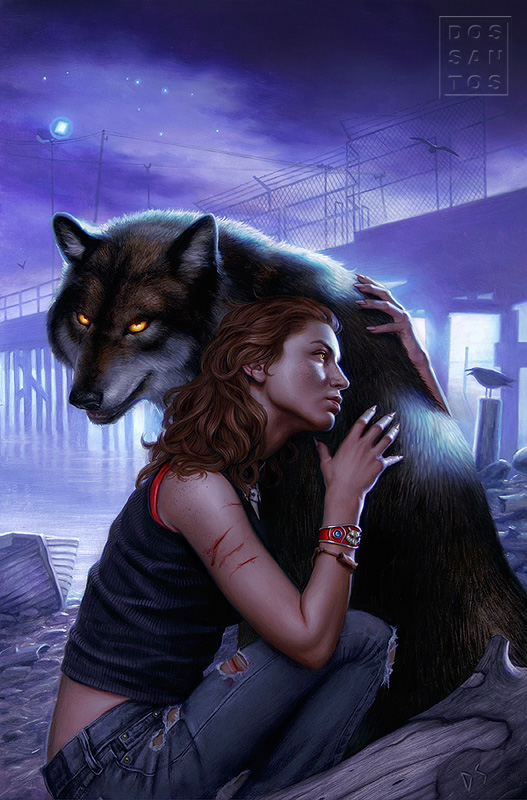
Alpha and Omega: Cry Wolf Graphic Novels published 2012 by Dynamite. Adapted by David Lawrence, illustrated by Todd Herman with additional art by Jenny Frison and a cover by Dan Dos Santos.





 My version of Masques is the reworked one. Patricia Briggs writes a foreword warning the reader of this. Due to the years that had passed since the first edition of Masques, Briggs and her editor felt it appropriate to remove some of the traces of an author’s first attempt. The book is supposed to be full of clichés, but I’m lucky because I would not recognize a cliché if it bit me on the backside of forever.
 When Demons Walk seems to be a while after the previous three installations in the Sianam series. Like the others, When Demons Walk is light and entertaining reading. Patricia Briggs has her own style that is apparent in all of her novels. She is a good author, the quality of her writing is solid and her characters entertaining.
 German cover
 Australian cover




 German cover
 Both Once Bitten and Twice Dead are urban fantasies set in the city of Haven. I found Twice Dead as good as Once Bitten. They are both light, easy, action-filled and fun to read. Kalayna manages to make her characters pretty three-dimensional (especially our main one – Kita). Focus is not placed on world building but on character building. In a novel of this length I find that wise.


 Into the Thinking Kingdoms is book no. 2 in the Journeys of the Catechist trilogy. It begins where Carnivores of Light and Darkness left off. Ehomba is still asking questions and Simna is still complaining about what he sees as a waste of time. Along with them on their journey they have acquired Ahlitah (a feline).


 humanitysdarkerside