I admit it. I am a feminist. As a feminist I find it natural to be a supporter of equal rights to all no matter what age, gender, skin tone, sexuality, class or cultural or religious background. But I am not the bravest person around.
One of the candidates for bravery of the year would have to be Malala Yousafzai. Her willingness to put herself in danger for trying to get an education, is worthy of many a prize. And she is not alone in trying to get what she deserves in a quiet but determined manner. Unfortunately, people like this are never popular. Neither was she, and she was shot.
Thankfully, the world rallied and Malala is seemingly on the mend now. I really hope she pulls through and keeps on being a bright light for the world to see.
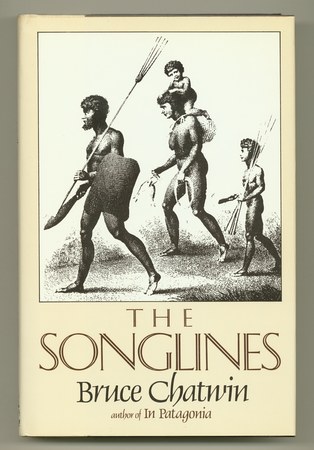
My first comment on this book sounds negative. Maybe I mean it that way. I haven’t made up my mind yet. Bruce Chatwin is another white dude in a long line of white people telling the story of the Aborigines of Australia. It isn’t Bruce’s fault that I bought The Songlines at the library. That is mine and I am glad that I did.
Here in Norway there aren’t many books by indigenous Australians that are sold. But what does the term aboriginal Australian mean. After all, there used to be at least 250 languages spoken among the people. Now, all but 20 are endangered. The Songlines represents one of these groups.
Chatwin grew up with a dream of Australia. As an adult he went there and got to know Arkady, a son of Russian and Ukranian immigrants to Australia. Arkady had fallen for the Aboriginal way of living and he had shown the Indigenous people that he was trustworthy and would respect their traditions. That is why they agreed to show him their Songlines or paths that intersected with the Dreamtime (holy places).
This is why Arkady was the perfect go-to person for Bruce. He had answers to the questions Chatwin wondered about and the means to introduce him to at least some of the decision making elders.
The Aboriginal Land Rights Act of 1976 “defines ‘traditional landowners’ as a group of Aboriginals who have “primary spiritual responsibility” for sacred sites on a piece of land, and who are entitled by Aboriginal tradition to hunt and gather on that land. Traditional landowners are the key decision makers for their land, although Land Councils must also talk to affected communities.”
Arkady Volchok was mapping the sacred sites of the Aboriginals. Part of his mapping was done as a surveyor for an engineer planning on starting the building of the Alice Springs/Darwin railline. But first the engineer had to make certain that the line did not cross the work of a Dreamtime hero.
The Dreamtime has partly to do with the creation of the world and totems. Somehow the world was sung into being from an idea, a singing that is still going on and that the Aboriginal sacred rites help support. Being able to stay off the songline had become important to the railway company – or at least its engineer.
To the Aboriginal people one could even say that all of Australia is a sacred site, one that is extremely important to disturb as little as possible.
I think I like this idea. It makes more sense that the European one and is certainly a whole lot more beautiful and carries a much greater degree of respect toward the preservation of the Earth. Where we Westerners are so caught up in greed and consumption, environmentalism seems to be the way of the Aboriginal people.
I admit it. I got caught up in Chatwin’s writing. I had to go online to research a bit more, trying to figure things out. Great trick that.
Chatwin’s goal with this book is to document the nomads of Australia. Nomad to Chatwin means a person who “moves from pasture to pasture”. He had previously gone into the desert of Sudan with Mahmoud, a nomad. Now he wanted to know what the Australian nomadic trails were like. What he discovers is an incredibly complex world including trade, marriage and survival strategies. I am not even going to try to explain any of this because I do not even begin to understand the songline, anymore than I understand what it means to be a man. Read the book.
I’m no scientist, but I love science. There’s so much weird stuff in the universe that’s confusing, and confusion is fun. Confusion makes it possible for me to look for answers. Bill Bryson is no scientist either. He’s just a regular person (well kind of) who tries to make the universe comprehensible to a regular person like myself. I guess that’s what has made A Short History of Nearly Everything a popular science book about popular science.
Bill Bryson’s usual job is as an author who writes travel books. I’ve listened to a couple of them and they are presented with talent. He seems to be a curious person who does loads of research in his chosen field.
Usually, when Bill explains why he chose to write his book about nearly everything, his says that he was bored to sleep in his youth by the scientific presentations by teachers and authors. He wanted to see if he could do better.
In A Short History Bill takes us on a journey from the start of the universe up to today, and he questions what tomorrow will be like. On the road we learn bits and pieces about theories and their creators. The bits and pieces we learn about are astronomy, physics, biology, chemistry and paleontology. For the most part Bryson uses words that are accessible. Rather than present the reader with incomprehensible equations, he uses analogies that illustrate the question being asked.
To get to the point where he felt he could write something about the subject, Bill has gone through a large and varied reading list. He has also used a large group of people to help him with his project, experts within the various fields of interest.
I find this kind of “science” interesting, so I guess I’m the target group. For anyone wanting to learn a little about “nearly everything”, this is a book to read. While little kids wouldn’t get much out of it, young adults should be just fine with Bill’s writing.
If you want to learn more about the various fields presented in A Short History, use the bibliography at the end of the book at a guide.
An illustrated edition of the book was released in November 2005. Abridged and unabridged audio versions should also be available.
Aventis Prize for best general science book – 2004
When you go to Deborah E Harkness’ website, you will find information not only on her All Souls trilogy, but also on Ashmole 782, alchemy and a reading guide. Deborah teaches history of science and medicine specializing in the period from 1400-1700. As such, Deborah is Diana Bishop – our female protagonist.
Diana is not only in Academia, she is also a witch with a few issues. In fact, she is an anti-magic witch and tries to use her magic as little as possible. After discovering a disturbing volume in the Bodleian library, Ashmole 782, her magic seems to be having a will of its own. Ashmole 782 zapped Diana somehow and she banishes the book back to the stacks.
Other creatures like herself (witches) and vampires and daemons have a difficult time believing that she has gotten rid of the book and a time of stalking and persecution begins.
Like Deborah, Professor Matthew de Claremont (our male protagonist) also has an interest in history. In his case it is the history of genetics (among other things) that he researches. Because of the zap, Matthew takes an interest in Diana. Matthew finds himself drawn to Diana, and she to him.
I really, really like the fact that A Discovery of Witches stays at Oxford and the Bodleian through a major part of the book. It is highly interesting to read about the feeling of reverence that Deborah has for the library and the important role it plays in society. Words are music and the music of A Discovery ofWitches is the kind that enters your soul and leaves you replete.
Diana and Matthew are fun and frustrating characters. In many ways A Discovery of Witches follows the pattern that a great many action and romance books do. The main protagonists are on opposite sides to begin with and through hardship they are brought together and become friends/lovers.
I’ve read complaints about all of the things that I liked about the book – lots of data, frustrating characters, library. Kind of funny really, how different our tastes in books are and how we are drawn to such different facets of them. I would say that this is a non-typical yet typical supernatural story about adventure and identity.
“Mornings in Jenin” is a thought-provoking book about the Palestinian side of the Palestine/Israel conflict. It is the author’s debut. I read it in Norwegian, and the Norwegian translation was excellent. It got me thinking about how long conflicts can last, whether there is hope of reconciliation after such a long time and how on earth wounds can possibly heal on either side.
The story begins in the small village of Ein Had in 1941. All is well. The Olive groves have been harvested and the cycle of life continues as always. Seven years later, the Abulheja family are sent to live in a refugee camp in Jenin. Amal, is the main character of the novel. She has a bright and inquisitive mind, always seeking more knowledge. Through her story we discover what happens to her two brothers. Amal’s own journey through life is no less dramatic, taking Amal through childhood, marriage and parenthood.
Letters From Father Christmas is a gem from J.R.R. Tolkien. I have Letters as an audiobook. Derek Jacobi reads Father Christmas’ voice, John Moffatt reads Polar Bear’s voice and Christian Rodska reads Ilbereth’s voice.
“In these letters, Father Christmas kept the Tolkien children updated with stories about the hijinks at the North Pole – the slapsticky North Polar Bear and all the things he broke, firework explosions, the discovery of ancient caves full of old cave drawings, and battles with the goblins. (When Father Christmas couldn’t write, his Elvish secretary filled in).
Tolkien’s old-school style of writing is a bit formal and very correct, but he tosses in comments of exasperation, amusement, and in the last letter, a sort of sad resignation that children will grow up. Maybe it is because they were given to real children, not intended for publication, that the letters are only a little cutesy, and never cloying.”
A delightful read and completely unlike anything else that I have read by Tolkien. His love for his children and grand-children shows throughout the writing.
When I read “The Boy in the Striped Pyjamas” I was once again reminded of the story of 732 Jewish boys and girls whose story Martin Gilbert tells in his “The Boys: Triumph Over Adversity“. One book is from the viewpoint of someone standing outside the suffering while the other one is about the kids who went through hell. I’m not a believer in the many after-life versions of hell, but I am certainly a believer in the human ability to create hell for their fellow humans. In fact, we’re really creative in the many ways we cause others pain, and that worries me.
The Boys: Triumph Over Adversity tells such a story. This is the story of children who (along with their siblings and parents) were uprooted from their homes and dragged into the horrors of the Holocaust. These children were originally from Poland, Czechoslovakia and Hungary. Their lives were the lives of ordinary children with loving parents. As they just below and above ten years old for the most part, these children had no understanding of all of the abrupt changes in their lives. From living in regular homes, they were stuffed into ghettos and then dragged to even worse circumstances.
And then it all ended. No more parents or siblings, all alone in the world after having endured what only few people in the world have had to endure.
After their liberation from the camps, they had to begin rebuilding their lives in Britain. Despite being physically and emotionally drained by their nightmare past, they drew strength from their group. After leaving their hostels, they remained a close-knit and devoted band of siblings. Their families having been destroyed, they created a family among themselves.
So many people ask themselves how something as terrible as the Holocaust could have happened. I doubt there is any one answer to that question. After all, we let history repeat itself all over the world. What I do believe is that we are all capable of becoming something we had never thought was possible. Ervin Staub in his “Roots of Evil” and Max Weber in his “On Bureaucracy” – Iron Cage both try to look at why people are dehumanized and warn us of the consequences.
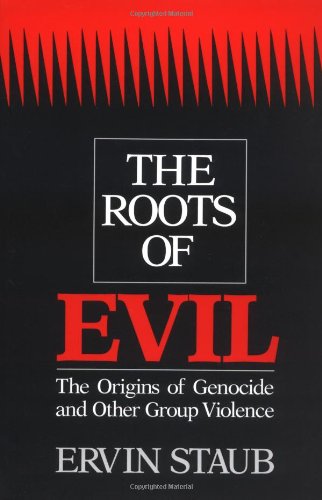
Some books are life-changing. The Roots of Evil by Ervin Staub is one of them in my life. I was at one of those life-choices that we sometimes make. Studying psychology cleared up a lot of questions in my mind. When we got to Staub’s look at the horrible choices some of us make (either as a group or as an individual) I saw how caught I had been in group-thinking that makes “Us” look so much better than “Them”.
Genocide, mass killing, torture and war. Psychology, socialization and culture. How does one go from being a regular, boring person to being a torturer of citizens of ones own country? How did Hitler get an average population of humans to participate in invasion and genocide? Is there such a thing as “EVIL”?
In this clip Stephen Fry discusses the importance of language in the mass-extermination of eight million people during World War II in Europe. (At the bottom of this post see Staub’s lecture in Stockholm.)
My father’s father was a Prisoner of War during the Occupation here in Norway. During his time at Grini (one of the POW camps) he was tortured for information regarding his cell-mates. Not the kind of cell-mates you have in prison, but the kind you have when you participate in resistance against those you consider your oppressors. He was part of the Communist underground.
Torture is one of the many practices of war that Staub discusses in The Roots of Evil. He shows us how the torturer is habituated to the specialized kind of violence that torture is and he shows us that these torturers are simply people. Some of them probably enjoyed their work more than others, but the rest were trained to see the torturee as an object/non-human/sub-human that held needed information.
After the war, the US was incredibly strict about some of the rules for receiving Marshall aid. One of them was a fight against the Evil of Communism. My war-hero grandfather remained an unsung hero due to his political views. He was harassed by employers and spied on by our Norwegian surveillance department. There again propaganda reared its ugly head and lessened his value as a human being.
Roman destruction of Carthage | Source: History Lists
Humanity’s mass exterminations of groups of people follows us through history. The practice of killing all of the men above a certain age while keeping women and younger children alive goes at the very least back to our earliest written records. According to Ben Kiernan, “The First Genocide” happened around 149-146 BC (Jones, 2006). This was the Roman destruction of Carthage. In 2015 the United Nations called the Islamic State out on the IS attempt to wipe out the Yazidi minority in Iraq.
So! Nothing new. According to Staub, we need to learn to interpret early warning signs in order to avoid getting to a point where genocide happens. By that time, it will be too late. According to Staub cultural and social patterns and historical circumstances are vital in understanding whether a country, a people or a belief is in the danger zone. And are there ever plenty of traps that people can fall into (even those who are aware of the dangers):
Cultural stereotyping
Cultural devaluation
Societal self-concept
Moral exclusion
A need for connection
Authority orientation
Personal and group goals
“Better world” ideologies
Justification
Moral equilibrium, and so on.
Within this conceptual framework, Staub then considers the behavior of perpetrators and bystanders in four historical situations:
Holocaust (his primary example)
Genocide of Armenians in Turkey
Genocide in Cambodia
Disappearances in Argentina
Is there hope. Perhaps and it depends. It has taken us thousands of years to not learn a single thing from history. People like Ervin Staub have warned us against a repetition of gruesome actions. Perhaps the secret lies in people like Staub being able to write about terrors and publish his writings. Once people like Staub begin disappearing from the public arena, we must really begin to worry. Until then, we can only hope that by learning some of the warning signs and recognizing that we, ourselves, are also potentially people who do terrible things, will keep us from them.
The Boy in The Striped Pyjamas is a book that all children ought to read, preferably in company with an adult so they can understand the topic better. The Holocaust has been described and fictionalized time and time again. However, there are some topics that can never be delved into enough.
This novel is about 9-year-old Bruno, a German boy who has no idea of the times he is living in. He just realises that times are changing, and not in a manner that he prefers. Then his father, the handsome Commandant, is commanded to go to a dreadful place with his family. Bruno is struggling to understand why Out-With has a fenced-in area where there are many people walking around in striped pyjamas. On his side of the fence people are dressed in uniform or regular clothing.
One day, while exploring along the fence, Bruno meets a friend – Shmuel. He is thinner than Bruno but that is the only difference Bruno can see. Bruno understands enough that he keeps the friendship secret, but has no understanding of what is going on.
The ending was perfect and the last words of the author were: “Of course all this happened a long time ago and nothing like that could ever happen again. Not in this day and age.” Sadly humans have not learned and we and them thinking continues.
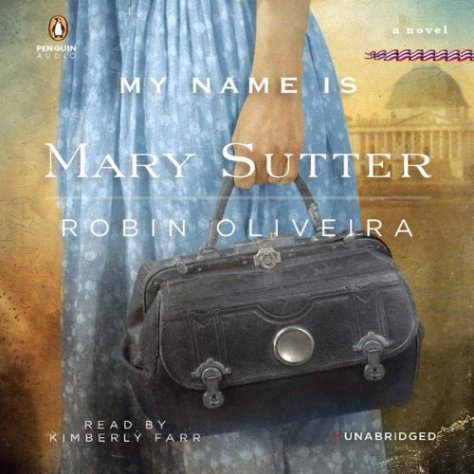
Even though the story is placed at the time of the Civil War in the US, I imagine Robin Oliveira’s own background as a nurse helped in describing some of the work and attitudes we read about in her novel My Name is Mary Sutter. At this time being a physician and a woman was practically unheard of. Physicians were trained through apprenticeships, and for a man to take in a woman as a student would mean overcoming prejudices. Professionally schooled nurses were also a thing unheard of. Apprenticeships were the way to go if a woman wanted to become a mid-wife or assistant to a physician.
All of this haphazard training of either physicians and nurses left both professions with vast differences in the abilities of the people who had finished their training. Some nurses and doctors made matters worse for their patients while others were miraculous healers.
Mary Sutter’s mother was a mid-wife and Mary had gone along with her on her many trips into the child-bearing population. What Mary learned about herself during those trips was that she would love to become a surgeon and thereby save people who otherwise did not get visited by a physician in time. Due to the above apprentice-shipping she was refused this opportunity and also refused admittance into medical school.
Mary Sutter was nothing if not determined in eventually reaching her goal. The US Civil War presented her with one such path. Washington was desperate for help on the battlefield and many women felt called to duty. Mary Sutter happened to be one of them. Her experience seems representative of the others I have read of. As such Sutter’s experience seems to correspond with the experiences my nurse friends tell me of today. Arrogant doctors, incompetent doctors, miracle doctors and patients who span the gamut from assholes to angels. As a someone who has been a patient I have met nurses of all kinds but mainly wonderful ones. Most of my nurse friends feel a “call” to serve and this is their way of serving others. Amazing people!
War is a gory and horrifyingly brutal affair. Not one gram of glory is present anywhere on the battlefield. But what a school for aspiring doctors and nurses. One doctor Mary Sutter had to work with had to care for more than 100 men. She helped with operations and learned how to treat stitch wounds. Eventually she managed to be sent to the front and learned how to amputate and live with the gore of poor medical hygiene.
I liked her character. Mary was a goal-oriented woman who worked extremely hard to achieve her dreams and she was certainly a woman that I could have looked up to. Inserting extraneous yet historical characters did not work well for me. It was Mary I wanted more of. But my wishes are irrelevant to an author’s work and it isn’t even a complaint just an observation.
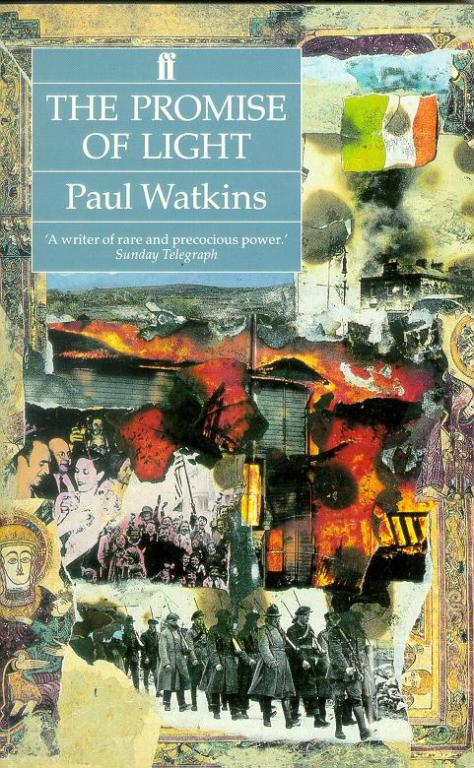
The Irish War of Independence (Irish: Cogadh na Saoirse) or Anglo-Irish War was a guerrilla war fought between the Irish Republican Army (the army of the Irish Republic) and the British Government and its forces in Ireland. (Wikipedia)
The Promise of Light is for the most part about the above war that happened between 1919 and 1921 and Ben Sheridan’s part in it. However, we also get a look at some of the background for the war and the hostilities that had brought Ben Sheridan to Ireland.
When Ben Sheridan discovers that the man he thought was his biological father isn’t, he also discovers that his adopted father’s background was different from the one he had thought. He and other exiles from the Irish conflict had settled on Rhode Island and tried to gain support for the Irish side of the conflict from the US government. They also collected weapons and money and sent these covertly to Ireland.
Ben Sheridan goes with one of these transports on his way to discover who his biological father was.
Without Ben going to Ireland we would not have had this fictional tale of the Black and Tan war / Anglo-Irish war / Irish war for Independence. Just looking at these three different names for the fighting between 1919 and 1921 shows me how incredibly important the combination of our words is. Words have a great deal of power in forming our world views. Some of the links below use this power in their portrayal of the terrible killings of that time.
Inside my head that is what Paul Watkins shows us with The Promise of Light. We get to see the despair of the innocents and the participants who are brutally murdered and tortured by the other part of the conflict. Except for the people who enjoyed killing, raping and maiming what we are dealing with is a bunch of frightened people who are following some kind of leader. These leaders manage to bring others to their side. Sometimes they use words, sometimes money and sometimes brutality in getting people to support them.
I understand the need to be free of the tyranny of rule by people we feel have no right to rule us. After all I am Norwegian and Norway was used as collateral in wars and went between Danish and Swedish rule for centuries. Then the Germans took us over. But I would stink as a patriotic warrior.
However, I do see how Ben got drawn into the conflict. Chance has the potential of bringing about terrible things in our lives. On his way over to Ireland he did not envision killing others, but that is what he ended up doing. Ben was beaten for the cause and he got to watch people he had befriended killed. He also learned even more about grief than he had thought possible.
Paul Watkins portrayal of this period of Irish history drew me in and kept me reading.
Under Heaven affected me profoundly. I believe it was the depth of Shen Tai’s mourning for his father and his offering to his father’s spirit that moved me most. Imagine setting yourself the task of burying all the bones from a battle twenty years past in order that those spirits might find peace. A more appropriate place for restless spirits than a battleground I cannot imagine.
Kay went on to say that he’s interested in how the course of a person’s life can change in a moment, and how “small moments and events can ripple outwards.” Whether it’s an individual or the life of a people, he pointed out, “significant consequences can begin very inconsequentially. That’s one thing that fascinates me. The other thing that fascinates me is how accident can undermine something that’s unfolding, something that might have played out differently otherwise.”
To Kay, “the human condition is redolent with this aspect of randomness, and I try to work that into all of my books.” (CBC Books)
The choices Shen Tai, his older brother and their younger sister, Shen Li-Mei, make end up having both intended and to a great extent unintended consequences. All three discover that assistance and opposition comes in many forms and sometimes from unexpected quarters.
In this story there aren’t any really bad people. There are mainly just people with the regular gamut of human emotions and with varying degrees of ability to do something about their desires. While the Tang Dynasty was a better place for women than the ones before it, women held less room in society than men. As with most places in the world today, women had to be a lot more creative in their maneuvering than men did. Their accepted roles were also very different from the one men were able to hold. To become a warrior like Wei Song, one who even guarded a man, was not something that was open to most women (much like today).
Reading about the role of women was both a painful process but also a delight. Delightful because of the intelligent and brave women I got to meet and painful due to the few changes that have happened in the world when it comes to the roles of women and how true their power is.
Under Heaven is a fairly dark story. Considering the times and the rebellion it portrays that is no wonder. I am trying to decide if I would call it dark fantasy, but I don’t know if that would be appropriate. I love its complexity and many threads that all come together one way or another in the end. What an awful race we humans are. It really is rather sad to see us revealed in all our terrible glory. Under Heaven was an intensely touching book that left me thankful for having found it. According to the author, his goal in writing is to keep the reader turning pages. It worked.
Sarah’s Key was lent to me by my sister. Serendipity. I found it a page-turner. No question about it. The author manages to switch from present to past without effort. Tatiana deRosnay is a truly gifted author.
Sarah’s Key is about poor little Sarah Starzynski. The Germans come to collect her family. To protect her little brother she locks him in a cupboard and tells him that she will be back in a few hours. Alas. The fates want it otherwise.
There are two time-lines to Sarah’s Key. The first one, of course, follows Sarah. The second time-line follows the story of the journalist, Julia Jarmon, who delves into the story behind a hidden skeleton. Along follows the secrecy behind Jews in France during WWII.
Some truths are painful for a nation to acknowledge. Nevertheless, healing comes through shining a light on both what we want visible and what we want hidden.
The story is wholly fictional, but as Leo Bretholz (Holocaust survivor) says: “The perusal of Sarah’s Key evoked memories of my own experiences during the war in the Vichy zone of France.” It tells a terrible story, one that has happened over and over again in history. It reminds us of how easily we turn our heads from what is happening around us.
French film-adaptation (Elle s’appelait Sarah) in 2010 by Stéphane Marsil (won two awards and had three nominations)

 Arkady Volchok was mapping the sacred sites of the Aboriginals. Part of his mapping was done as a surveyor for an engineer planning on starting the building of the Alice Springs/Darwin railline. But first the engineer had to make certain that the line did not cross the work of a Dreamtime hero.
 I’m no scientist, but I love science. There’s so much weird stuff in the universe that’s confusing, and confusion is fun. Confusion makes it possible for me to look for answers. Bill Bryson is no scientist either. He’s just a regular person (well kind of) who tries to make the universe comprehensible to a regular person like myself. I guess that’s what has made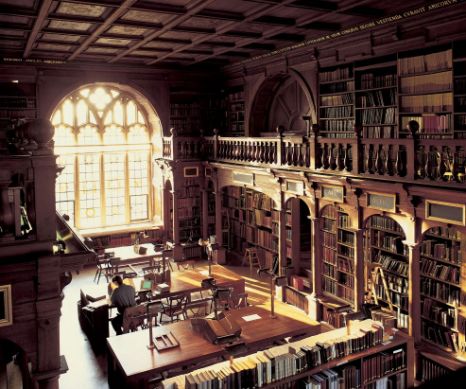






 humanitysdarkerside