Category Archives: Science Fiction

Farrugia, Nathan; Exile (Helix II) (2016)

Helix - Episode 2
Photo by Andrew Maccoll, Cover design by Pat Naoum

Nathan. You cretin.  If telepathic strangling had been possible, I might have given it a try all the way from Norway. Cliff-hangers like this should be forbidden.

History repeats itself over and over and over again. Using The Fifth Column as his title for the Sophia series, and inserting Sixth Column as rebels to the usurper group, shows us how we continue to live in repetition. The tool used by any power, be it national or institutional, to get the public to go along with it is two-fold: propaganda (mild brainwashing) and force. In the Fifth Column trilogy, Denton and McLoughlin used both to get a strong hold on US military, US government and US public. Propaganda uses less blood and is often (usually) difficult to see through.

I am 51 years old and have been through all sorts of propaganda periods. Usually, I like to think of myself as a feminist. In Exile, Nathan showed me how far I have left to go.

Damien, Jay and Nasira have gone to Las Vegas to get hold of Aviary (from The Fifth Column). Since Jay has lost his genetic advantages, and is still healing from the killing shots from Helix I, he is get-away driver. Nasira and Damien want to rescue Aviary and have to get through a group of Marines guarding her room. Nasira begins the fight and Damien joins in.

“That would be my cue, Damien thought.

He launched for the marine behind him, grasped the barrel of her gun and twisted it up, tangling her trigger finger. The scope broke her nose, blood spattering the door of the room.”

I was completely surprised when the marine was a woman. So much for my feminism. But that is the power of propaganda. Farrugia just dump women and men into situations without regard for gender and lets them do their thing. And that is incredibly cool and hopeful.

There are three main groups in Exile. The first is the above. Their self-imposed job is to find Aviary and get her to help them again. The above shows one of the complications that arise.

Our second group is Olesya and Ark(adiy) and their masters. Val was taken by Intron Genetics Incorporated operators towards the end of Helix I. She was the third operative taken that week. They are not the only three who have been kidnapped. The loss of Ark’s sister hit both of them hard, and they desperately want her back. But Illarion does not agree with their assessment of Intron’s involvement. So he sends them to Poland due to an apparent shift of Fifth Column operatives to Eastern Europe and the loss of several hunters in the area. Something major seems to be going down.

The third group is Sophia, Czarina and Ieva. Sophia rescued and deprogrammed both of them. At this point she was teaching them to deprogram others. That is Sophia’s main mission (much as it is Olesya’s), to catch and deprogram Fifth Column operatives. However, catching people who fight for their lives is not a simple matter. At least Sophia has access to the location of every live Fifth Column operative.

Finally, there is the matter of Denton and Loughlin’s goal of making impossible-to-catch operatives. These two are extremely driven people who will do absolutely anything to accomplish their goals and retain their positions. That includes operators like Priya, who Sophia stumbles across on one of her jobs to save people from the clutches of the Fifth Column.

Well written as usual. Fun and believable fighting. Plenty of intrigue. Farrugia does techno-thrillers well. Definitely recommended.


Exile: Helix II is available on Amazon US


My review of Helix: Episode I


An ARC of Exile (Helix II) was given to me by the author


Intron:

Introns are present in the initial RNA transcript, known as pre-mRNA. They need to be removed in order for the mRNA to be able to direct the production of proteins. Pre-mRNA, therefore, undergoes a process, known as splicing, to create mature mRNA. (6, 8)

It is vital for the introns to be removed precisely, as any left-over intron nucleotides, or deletion of exon nucleotides, may result in a faulty protein being produced. This is because the amino acids that make up proteins are joined together based on codons, which consist of three nucleotides. An imprecise intron removal thus may result in a frameshift, which means that the genetic code would be read incorrectly. (3)

This can be explained by using the following phrase as a metaphor for an exon: “BOB THE BIG TAN CAT”. If the intron before this exon was imprecisely removed, so that the “B” was no longer present, then the sequence would become unreadable: “OBT HEB IGT ANC AT…”

Farrugia, Nathan M.: Helix: Episode 1 (2016)

Hi, I’m Nathan and I make up stories. There’s a word for that. Delusional. And sexy.

Helix: Episode 1 is part of the world of The Fifth Column. What I like most, aside from how well the text flows, is its realism. No mental leaps are required of me to believe in the likelihood of the methods used to acquire soldier material, how these people are tested, what training they receive and their use. The military and population application of all of the genetic manipulation described, especially unquestioning loyalty, is frightening.

Some of the brainwashing techniques described in the Sophia serial is brainwashing we all go through. Propaganda is poured at us from every available medium from the time we are born. Our ethics and moral values are all part of this propaganda. Soldiers who are sent to kill, especially the ones who end up in some form of black ops, must endure even more. What military and intelligence leaders want are people who obey and find a way to achieve whatever their leaders command them to do as efficiently as possible. Unlike religious cults, though, the military cannot have unquestioning loyalty in such men and women. At least not in officers.

The Fifth Column is not an officially sanctioned group. They aren’t interested in their doings getting out to the public. So their brainwashing needs to be more thorough.

One of their tools for finding relevant children is the Human Genome Project. Based on certain genetic markers, children from around the world get tested by Project GATE. Olesya, our main character, is one such child. Except she does not seem to have the desired genetic marker. However, she does make it into the program.

“For a while, he was silent. It was the longest she’d seen him not talk. Above the, fireworks crackled, then trickled down the velvet sky. Olesya tried to imagine what this scholarship on the other side of the world would be like without her big brother.

The snow squeaked under Zakhar’s jacket. He rubbed his face with a gloved hand and she realized he’d been crying. The fireworks had faded now, golden glitter in the night.”

Project GATE aims to make the perfect killers. By combining extensive testing, combat and assassin training, brainwashing techniques and an engineered virus, Project GATE gets unquestioning, loyal and adjustable soldiers.

After one of their tests, Olesya, together with other team-members, is broken out of Project GATE by the Sixth Column and de-programmed. The Chimera Vector took us through that process and it was not fun for either the programee or the de-programmer.  Getting de-programmed is only the beginning of Olesya’s life with a mind of her own. Now the Sixth Column wants her to be their soldier. She, and the others from her old team, fight to free other Fifth Column members and to find their own people who seem to be disappearing. Theirs is a race against time and a superior power.

It turns out the Sixth Column is not only fighting against the Fifth Column but also against an organization whose members wear white armbands. All of these conspiracies give us much action, well-written action. With his background, Farrugia has the tools for being able to make the fighting realistic. Realism by itself, would not work well for some of the car-chases, so we get a bit of Bondism as well.  We reacquaint ourselves briefly with Sophia and it is interesting to see what that tells us about the Sixth Column.

Helix was fun, had great flow and interesting people who kept me entertained. Definitely recommended.


Reviews:


My reviews of other Fifth Column stories


Helix, Episode 1 is available at Amazon

Carlon, Lee: A God-Blasted Land (The Bastard Cadre I) (2016)

AGBL_Cover-Low-Res
Cover design by Lee Carlon

The Bastard Cadre, episodes 1-14 is the first book of this ongoing serial written by Lee Carlon. I am not used to continually changing stories, but find the concept fascinating. Carlon describes the way he works:

… one thing to note about this serialization is that unlike traditional serializations where the author is bound to the words that have been committed to the page, publishing online allows me to treat The Bastard Cadre as a continuous work in progress. Each episode is complete at the time of publication, but I do update the text from time to time. (peakcity)

Change can be daunting when you are an aspie. Part of that has to do with the accompanying anxiety. I have to go through mental gymnastics to keep anxiety’s influence on my opinion as limited as possible while reviewing The Bastard Cadre.

Newterra is on a world with two suns. Its geography is loosely based on Australia’s. Some of the inhabitants on Newterra might be descended from Earth humans. Others, not so much. Dragons, dualists, descendants and gods are in the last category, although, I’m arguing with myself about the gods. Newterra’s gods are not very old, they fight each other, hold separate territories and 20 years ago they Cleansed the world with a type of fire. The Cleansing took biological lives but not electrical ones. There are still plenty of AIs around. Vehicles can be picked up in almost any city and cleaning bots are still doing their jobs in the larger cities. We enter the world 20 years after the Cleansing and meet a world that has lost numbers and a great deal of understanding of technology.

Our main characters, Avril Ethanson, Ethan Godkind and Ranora fi’Intar, all seem to be human. Avril and Ranora are both young and have unusual abilities. Avril can affect electrical impulses. Ranora can read people and cards. Ethan is Avril’s foster-father and has held that role since soon after Avril was born. These three characters give us insight into how Newterra works and what its people are like. Clues to their importance and backgrounds are doled out during the telling of this story. This way of learning about places and people in a story is my preferred one.

Avril and Ethan are scavengers who salvage old tech and barter it for essentials. When we meet them, the past is about to catch up with Ethan. Life has a tendency to mess up our plans and put our procrastinations to shame. There was so much Ethan had planned on telling Avril to prepare him for what might happen. When they meet Beads, the finder, it is almost too late and Avril is in for some gigantic surprises that involve his heritage and potential future.

We learn little about Ranora’s background. She is a talented painter who brings the past to life. Bringing the past to life in her art is probably connected to her ability to read people and objects to uncover “secrets”. Ranora seems to be on her own when we meet her. Being alone in Newterra tends to shorten your life-expectancy. When a bounty-hunter gang shows up, Ranora uses her ability to claim a spot in it. We all make choices in our lives. Some mess life up for us while others bring unexpected gifts our way. Joining the gang was a choice that brought both mess and gift to Ranora, such as bringing her into contact with both Ethan and Avril.

The Bastard Cadre’s intended audience is young adult and older. From the get go we get an action-filled story about fate, betrayal, family and different ways of handling the world. The Bastard Cadre was given to me to review. Recommended.


Reviews:

  • Benjamin Spurlock
  • Leachim
  • N.E. White
  • N.N.
  • Rosie Writes

A God-Blasted Land can be found on Amazon

Scott, Alan: The “Y” Front Standoff (The Y-Front Chronicles) (2014)

Artist: Saskia Schnell
Illustrator: Saskia Schnell

Once again Alan Scott serves us a plateful of humour with a dash of serious. OMG, that talk-show. “Women Who Bitch With Other Women” remind me of some very popular talk-shows that definitely do not have ASD’s in mind. “Next season’s must-have fashion accessory!” indeed.

Once again, the idiotic government wants to kill their once-upon-a-time tool. This is one of the worst thing about governments around the world. For heavens sake, let SCoT-1 get his well-deserved revenge instead of wasting unnecessary lives trying to stop an unstoppable person – especially with Terminal Flatulence on his side.

I laughed. Out loud. Definitely recommended.


The “Y” Front Chronicles available at amazon.com


My review of The “Y” Front Chronicles

Green, Dominic: Saucerers and Gondoliers (Ant & Cleo 1) (2008)

Saucerers and Gondoliers cover
Cover by Dominic Green

It was the cover that lured me in. Sometimes I am lucky and the cover actually presages the contents.

Dominic Green‘s Ant & Cleo series is as well-written and ridiculous as only British humor can be. These two young (12 years old) people go through experiences that are disconnected to reality as we prefer to believe it. Unless, of course, Britain, Russia (USSR) and the US have actually managed to get colonies into space. I suppose it is possible?

First, Antony and Cleopatra, the main characters. Their characters have little to do with the portrayal by Shakespeare but more in common with the originals. Ant seems to be bluff, passionate and a little simple-minded (and highly underestimated by Cleo), while Cleo is fairly intelligent and practical.

It all begins with a trip to the woods with Ant’s father. Forests are great places for adventure, though I doubt many people get to go into space with an alien from Lalande 21185. Strangely enough, this alien looks like a human:

“The new man looked tired and thin, and had a haircut that suggested he spent a lot of his time in prison. He was wearing neither a suit nor combat fatigues, but a pair of Levi’s which still had the label dangling from the back of them, and a maroon T shirt. The T shirt had aliens in flying saucers on it, along with the words SPACE RASTA.”

Mr. Green throws Ant & Cleo into situations that keep them wondering about the things they have learned in school. The spaceship they leave Earth in is their first clue to their ignorance. “Made in Britain by Hawker Siddeley Aviation” seems a bit far-fetched to them. But that is what the maker’s plate says.

Then they meet Americans (US) in space. What a parody of every prejudice non-US citizens have had of them. White-supremacy, a confederate flag and deep southern accents along with names like Billy-Bob, Billy-Hank and Wayne-Bob. A whole sleuth of movies go through my memories as I write this. The funniest thing about these stereotypes is that Hollywood is the worst perpetrator of the image (and early James Bond). Their new compatriots join them on that planet. Glenn Bob and Truman make an odd couple. One very curious and the other diligent in carrying out assigned jobs.

After the US, Ant & Cleo get to meet members of the Soviet Union. Yes. In space the USSR still rules and feelings between the US and Russians continue to be very cold (I guess a bit like today).  Here, too, accents and behavior copies movie and television stereotypes. Mr. Green nails these stereotypes.

“Glorious Soviet Yutopia does not kyill wyomen and chyildren”

OMG, non-russians speaking English with Russian accents drive me crazy. Finally, Ant & Cleo get to meet and talk with the British. Their poor kidnapper has been unconscious ever since their spaceship broke Earth’s orbit, so they do not know who he is and where he is from. He is British. Here again, Green nails every stereotype. These are the British who shake their head and carry on with the job even when they are severely wounded, wring sweat out of their long underwear to make water and express strong feelings by saying things like “Golly”, “Gosh” and “Bally good”.

Nothing is realistic. Well, except that quite a lot of it is. Tension between countries, secretive and lying governments and people who try to follow the propaganda they have been brought up are all things Green portrays as is. Propaganda, my goodness, what a great examples of propaganda and the brainwashing citizens are put through and accept.

I enjoyed this book immensely and think it would be appropriate for people from around 10 years old and up. Adults might have to explain some of the references, but with the I-net available to many, they might not.

Definitely recommended.


Reviews:


Reading order:

Brae, Adriaan: The Pitch (2009)

“So, let me get this straight, I pay 10% to you guys until I die, whenever that is, and after I die I’m resurrected in paradise, where I can live forever, free of charge?”

The salesman smiled. “Yes, that about covers it. You can join the program at any one of our weekly guidance meetings.”

Here’s the catch, Steve thought. “Meetings?”

“There’s a meeting you will need to attend every week, for an hour, maybe more some weeks.” Steve had visions of a clinic, some kind of brain scan to save a new backup copy for the promised virtual paradise. “Sounds reasonable.”

Having grown up Mormon, I found The Pitch a delight. The delight part of my reaction might have to do with my distance to my childhood religion. Or perhaps not. I have always enjoyed stories that poke fun at the way I think. Adriaan Brae’s satirical short-story of only 5 pages faces the issue of religious claims in a lighthearted and well-written manner.

Definitely recommended.


The Pitch available at Smashwords

Scott, Alan: The “Y” Front Chronicles (2013)

Cover artist: Saskia Schnell

Alan Scott has written a wonderfully funny and dark story about murder and mayhem.

I suppose it could be read as a warning about the consequences of training our soldiers too well. The thought did not enter my mind until the classroom situation. But, yeah, that could work.

A man with his own brand of conscience and his pet hamster, TF. A killer with a pet hamster. Not much like the hamster I used to own and adore. SCoT-01 is a fun and terrifying person I would hope to always keep on my side. His hamster, too.

Definitely recommended.

Hurley, Kameron: Rapture (The Bel Dame Apocrypha III) (2012)

Throughout Nyx’s exile, she didn’t think much about all the men and women she’d beheaded, or the mullahs she’d pissed off, or the mines she’d planted, or the battles she’d lost. She thought about the ring. A bad left hook. Poor footwork. Blood in her eyes. Hornets on the mat. Because everything that happens after you climb out of a boxing ring, one-half of your face ballooning into a waxy blue-black parody of death while you spit bile and blood and some fleshy bit of somebody’s ear on the mat, slowly losing sight in one leaky eye, dragging your shattered, roach-bitten leg behind you … is easy. Routine. Just another day breathing. (p. 2)

Kameron Hurley

Definitely recommended! Freaking amazing trilogy!


My reviews of:

  1. God’s War
  2. Infidel

Rapture available at scribd.com


Cover art by David Palumbo

Norton, Andre: High Sorcery (1970)

Wizard’s World (1967)

His decision had shaken the “hound”. Craike bared teeth in a death’s-head grin. Now the mob would speed up. But their quarry had already chosen a part of the canyon wall where he might pull his tired and aching body up from one hold to another. He moved deliberately now, knowing that, having lost hope, he could throw aside the need for haste. He would be able to accomplish his purpose before they brought a gas rifle to bear on him.

At last he stood on a ledge, the sand and gravel some fifty feet below. For a long moment he rested, steadying himself with both hands braced on the stone. The weird beauty of the desert country was a pattern of violent color under the afternoon sun. Craike breathed slowly; he had regained a measure of control. There came shouts as they sighted him.

He leaned forward and, as if he were diving into the river which had once run there, he hurled himself outward to the clean death he sought.

Through the Needle’s Eye

“She’s a witch, you know!” She teetered back and forth on the boards of the small front porch. “She makes people disappear; maybe she’ll do that to you if you hang around there.”

“Ruthie!” Cousin Althea, her face flushed from baking, stood behind the patched screen. Her daughter was apprehensively quiet as she came out. But I was more interested in what Ruthie had said than any impending scolding.

“Makes people disappear – how?”

“That’s an untruth, Ruthie,” my cousin said firmly. True to her upbringing, Cousin Althea thought the word “lie” coarse. “Never let me hear you say a thing like that about Miss Ruthevan again. She has had a very sad life -“

By a Hair (1958)

Father Hansel had been one of the three Varoff shot out of hand, and there was no longer an open church in the valley. What went on in the oak glade was another matter. First our women drifted there, half ashamed, half defiant, and later they were followed by their men. I do not think the Countess Ana was their priestess. But she knew and condoned. For she had learned many things.

The wise women began to offer more than just comfort of body. It was a queer wild time when men in their despair turned from old beliefs to older ones, from a god of love and peace, to a god of wrath and vengeance. Old knowledge passed by word of mouth from mother to daughter was recalled by such as Mald, and keenly evaluated by the sharper and better-trained brain of the Countess Ana. I will not say that they called upon Odin and Freya (or those behind those Nordic spirits) or lighted the Beltane Fire. But there was a stirring, as if something long sleeping turned and stretched in its supposed grave.

 Ully the Piper

There was only one among them who was not satisfied with things as they comfortably were, because for him there was no comfort. Ully of the hands was not the smallest, nor the youngest of the lads of Coomb Brackett – he was the different one. Longing to be as the rest filled him sometimes with pain he could hardly bear.

He sat on his small cart and watched the rest off to the feasting on May Day and Harvest home; and he watched them dance Rings Around following the smoking great roast at Yule – his clever hands folded in upon themselves until the nails bit sorely into the flesh of his palms.

Toys of Tamisan (1969)

“If you have any wish, tell it to Porpae.” Kas dropped his hold on her arm and turned to the door. “When Lord Starrex wishes to dream, he will send for you.”

“I am at his command,” she mumbled; it was the proper response.

She watched Kas leave and the looked at Porpae. Tamisan had cause to believe that the android was programmed to record her every move. But would anyone here believe that a dreamer had any desire to be free? A dreamer wished only to dream; it was her life, her entire life. To leave a place which did all to foster such a life – that would be akin to self-killing, something a certified dreamer could not think on.

Goodreads


Translations:

  • Italian: Le terre degli incantesimi (1979)

Miéville, China: Railsea (2012)

“Well, no one knows,” Caldera said, “but they’ve got a sense of the possibilities. What do they say where you come from? Streggeye, you said? What do you think? Were the rails put down by gods?” Her questions came faster. Were they extruded from the ground? Were they writing in heavenly script, that people unknowingly recited as they travelled? Were the rails produced by as-yet-not-understood natural processes? Some radicals said there were no gods at all. Were the rails spit up by the interactions of rock, heat, cold, pressure & dirt? Did humans, big-brained monkeys, think up ways to use them when the rails emerged, to stay safe from the deadly dirt? Was that how trains got thought up? Was the world an infinity of rails down as well as around, seams of them through layers of earth & salvage, down to the core? Down to hell? Sometimes storms gusted off topsoil & uncovered iron below. The most excavation-gung-ho salvors claimed to have found some tracks yards underground. What about Heaven? What was in Heaven? Where was it? (Railsea, p. 181)

Certain subjects will probably interest me until I die. The lengths to which we go to justify our beliefs and avoid being wrong is one of them. We cling so hard to our philosophies that we end up with mechanised arms, like Captain Naphi, or send our navys out to get hold of two children, the way Maniniki did.

Realizing that my childhood faith was not based on facts, had an immense effect on my ability to handle the thought of being wrong. Debating an issue is now merely fun. No longer do I see other people’s beliefs as something to be feared. Some of the lies I told myself are no longer necessary.

Lying to ourselves, even if we are not aware of lying, holds us firmly in our socially accepted places. Sham Yes ap Shoorap is a brave kid. He often needs to be prompted; but by asking himself difficult questions, he manages to defy conventions and seeks answers. Answers are sometimes only found in dangerous waters, and the metaphoric waters of the railsea are indeed dangerous. The Railsea seethes with life wanting to devour anything and anyone in their paths. One has the choice between being eaten by giant burrowing owls, giant moldywarpes, giant earwigs, giant naked mole rats, giant turtles, blood rabbits, tundra worms and so on. Being on the moletrain was one thing. Going from that to his handcart was quite another.

The Railsea‘s culture is post-apocalyptic. A huge war between rail-barons and other big corporations has caused environmental damage that has lasted long enough for cute creatures to mutate into threats for humans. The heavens are only seen as a smog cover containing angels. Yes, angels. And quite scary ones, too. Scientific knowledge has more or less died along with anything resembling healthy ecology for humans. Yet people keep on messing up the ground even more, especially when greed prompts justification. Greed is a fairly common motivator for destroying our habitat in today’s world. I suppose it always has been. I admit that my own attempts at being an environmentally responsible person are inconsistent, yet I keep on trying. George Carlin has a fitting commentary on the effect humans have on the Earth. Railsea seems a fitting vision of it getting revenge.

While Railsea is indeed a young adult story, it is also very much an adult story.

Definitely recommended.


Reviews:


Railsea can be found at Amazon


Translations:

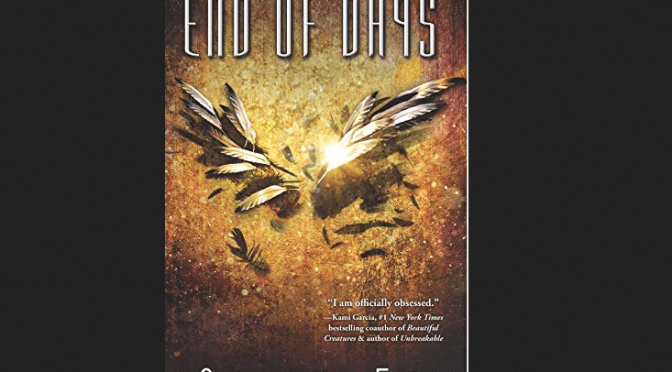
Ee, Susan: End of Days (Penryn and the End of Days III) (2015)

… “Hey, you! Dinnertime! I’m over here, you scabby rats! Come and get me!”

The Hyundai is rocking with hellions as they pile on. I’m about to screech out of the lot – or at least make donuts until all the hellions head my way and leave the rest of the people alone – when I feel a thump. The car drops on one side. Then I see the shredded rubber of a tire being flung over the hood.

That was the front tire.

I stare dumbly at the ripped-up tire as it flops and wobbles to a standstill in the parking lot.

Then so many hellions pile onto my car that I can’t see the tire anymore.

I stroke the fur of my teddy bear. It’s all I can think to do.

Pooky Bear can’t help me in a vehicle. Not a lot of room to slice and dice.

That means I need to exit the car if I want a chance at getting out of this.

I sit in the car.

I wonder how long a person can stay in a vehicle.

But then, of course, the hellions begin pounding on the windshield. (p. 105)

Susan Ee, End of Days

McGuire, Seanan: Midway Relics and Dying Breeds (2014)

“Thing was, the westward portage rope was attached to Billie’s harness, and Billie, for all her advantages as a draft animal, is about as smart as damp moss when it comes to things like “noticing external stimuli.” She’s a genework Indricothere (link by ed) that my Uncle Ren and I bought from a fly-by firm about six years back—a sort of precursor to the rhinoceros, and one of the largest land mammals ever to walk on the planet. When she put down her foot, the ground shook. There were no predators that could take her down and no threats that she recognized as worth giving a damn about, all of which combined to mean that there wasn’t much that could distract her from the essential task of eating her way through the foliage of the world. All nine tons of her continued plodding relentlessly forward, her massive teeth stripping branches as she walked. Her grazing license typed her as a firebreak, preventing fires by clearing out all the dead stuff before it could go up. It was more than halfway true, and it hadn’t caught us any trouble yet.”

Seanan McGuire

Midway Relics and Dying Breeds

Robertson, Edward W.: Outcome (Breakers 0) (2013)

Outcome by Edward W Robertson


Across the table, Ellie Colson’s bosses laughed what might be the last big laugh of their lives. She forgave them. They didn’t know they were joking about the end of the world.

She smiled thinly. Rawlings, her direct superior, chuckled and swabbed his puffy hand across the table, as if he were working at an imaginary water spot. Dr. Armen laughed and clutched his gut, as if he were afraid it might bounce away. Jesper Mason just smiled. Like Ellie, he hadn’t been introduced by rank – Rawlings hadn’t even mentioned which org he belonged to, which meant he was a field hand, and a useful one. She recognized him vaguely. Might have seen him around the stacks once or twice. Mason had told the joke, something about Spanish flu. Ellie hadn’t been listening. She’d been thinking about the transmission rate in Rawlings’ printout.

The laughter stopped. Conversation resumed. The room was bare and windowless but their voices carried no echo, dying in the small space like lost moths. It wasn’t that these men weren’t smart; they had enough degrees between them to paper a den. It wasn’t that they lacked dedication; she would soon prove herself least dedicated of any of them.

It was that they lacked imagination. (page 1)

These are the words that hooked me. Something about Robertson’s writing drew me into his post-apocalyptic chaos until the end, an ending I appreciated.

Why did Ellie risk her life to try to save Chip Billips? Well, as she saw it, she was already dead. In fact, both of them were already dead. Their bodies just hadn’t finished the process yet. The likelihood of escaping this surprising and terrifying new plague seemed highly unlikely. But why Chip? It certainly wasn’t because Chip lived in a convenient place.

New York, a city with a population of about 8.49 million people packed into an area measuring 468.90 sq miles (1,214 km²). Needing to chase down a person in a tight place like that makes for perfect post-apocalysm. Robertson paints both the atmosphere between Ellie and Chip and the atmosphere in the city as bleak, confused and fearful. With his magic, Robertson helped me believe in the plague’s progression and people’s reaction to it.

When authors like Robertson come along, I find it does not matter to me if snags turn up. Yet none did. I loved it.

Definitely recommended.


Reviews:


Outcome available at

Also available on Kobo and Google Play.

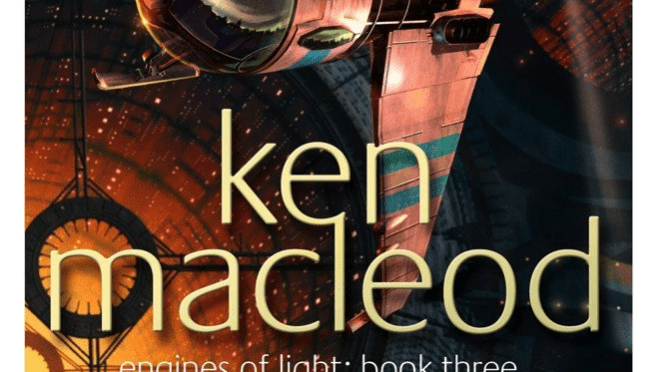
MacLeod, Ken: Engine City (The Engines of Light III) (2003)

Identifying a ruling class and state posed no such problem. The upper and usually senior ranks of the various corporate bodies, patricians and patriarchs or the merchant houses, administrators of cooperatives, guildmasters and latifundists, heads of religious orders and philosophical schools, retired courtesans, professors emeritus, and so on and so forth, formed what was blatantly called the Electorate, who just as blatantly elected the Senate and staffed its administration, and that was that. Volkov had no scruples about elites – having been part of one – and was surprised to find himself shocked by the sheer effrontery of the Republic’s lack of the forms of democracy. All his experience had been with people who insisted on at least the illusion of popular rule, and it was disquieting to encounter a people who seemed satisfied with the substance of self-government in everyday life while letting his politics and statecraft go on over their heads – as it almost always and everywhere did, of course. (Ken MacLeod)

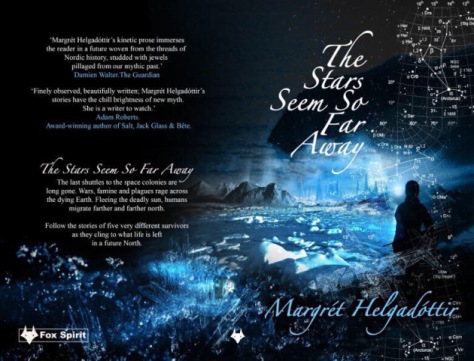
Helgadóttir, Margrét: The Stars Seem So Far Away (2015)

Cover artist: Sarah Ann Langton

I am glad Ms. Helgadóttir asked me to review her book, The Stars Seem So Far Away. Its completion left me feeling weepy and I have been trying to figure out why that is.

How much loss can we endure before we decide that death is for us? I have never truly been alone. Somewhere, within my ability to contact them, have been people I have cared about. I am 50 and both my parents and all of my siblings are still fairly intact. My husband and my children are close, both geographically and emotionally, to me. In each of Ms. Helgadóttir’s stories we meet people who have, or think they have, lost all who they cared about.

When we meet Aida, she is in her early teens and on her way to becoming all alone once again. Her father and mother had died and her brother had disappeared during the plague. Another caretaker turned up, but he is also dying. We meet her grief and her decision to try to survive.

Could I keep from losing a sense of decency in my interactions with other humans in a world where those I encountered were likely to kill me? Nora did and her choice makes all the difference in a world where survival is, at best, a chancy thing. I loved her handling of the piracy situation that arose.

How do you reintroduce yourself to humanity if you have been alone for years? Bjørg has had to manage on her own with her isbos as her only company for some time. Her living conditions have been far superior to those of the other characters. Yet her mission, as set by her father and the Commander, has been traumatizing for her. Somehow she has muddled through it all. Finally, she is unable to do her “duty” yet another time, and that brings the soldiers of Svalbard into her life. Going from a solitary life to one filled with people (even if there are only four others) changes everything for her.

Loss of parents, siblings, children and friends are all losses that our characters experience. Loss of home and safety in a world where the only surviving animal seems to be human is another factor that adds to their burdens. Most plants are gone and the environment makes life difficult, or impossible, in most of today’s temperate zones. Ms. Helgadóttir’s future is entirely believable.

Tying her short stories together in the manner that she has was well done. Her prose is lovely and her portrayal of the Nordic is well done.

Definitely recommended.


Reviews:


The Stars Seem So Far Away available at Amazon here (UK) and here (US)


A copy was given to me by the author


Svalbard Global Seed Vault

2013: Melting Sea Ice Keeps Hungry Polar Bears on Land