Category Archives: Science Fiction

Gimpel, Ann: Earth’s Blood (Earth Reclaimed II) (2014)

Artist: Kelly Shorten Interior book design: Cera Smith Editor: Angela Kelly Line editor: Jenny Rarden
Artist: Kelly Shorten
Interior book design: Cera Smith
Editor: Angela Kelly
Line editor: Jenny Rarden

First of all I am going to talk about going off on tangents. My thing is words – Autism is part of me. That means that sometimes the sound of a word in my head or the way it feels in my mouth sets me off on a chase. One of the words in Earth’s Blood that set me off was Lemurian. The Lemurians are also called the Old Ones and are hated by both the Celtic gods, of which Fionn is one, and Aislinn. But the name Lemurian. It keeps on going round and round in my head. Part of it has to do with lemurs. Lemurs are soooo cute/adorable/sweet (maybe not) and all of those adjectives that we give animals that look like them. The other part was when I started looking for things to do with Lemurian on the net. Wow, there is actually a whole belief system centered around the concept (see links below). People are fascinating.

Sometimes when I read a novel one of the characters begins to annoy me. Once I realise what is happening I stop and ask myself why. This time it was Aislinn’s way of handling her situation that got to me. I was getting more and more frustrated with her until I finally stopped and looked at what it was I was projecting. Surprise, surprise. Thinking is problematic to my imagined self.

One of the things that bothered me was all of the sex between Aislinn and Fionn. This is coming from the woman who claims that she wishes there was as much sex (vanilla kind) in novels as there is action. In Earth’s Blood there is. But it bothered me and here is why: Conditioning. My child-hood religion is very orthodox. Sex is no exception to the rule. That in itself makes the whole concept of reading about it – even when it is as well written as Ms. Gimpel writes it – problematic. Oatmeal has a really great poster on the subject. It is funny and incredibly sad at the same time.

My other problem with descriptive sex was my childhood. I was sexually abused by some of my relatives and that scarred me and made sex less than fun for a long, long time (my poor husband). Once I realised what was going on in my head and emotions I could let go of the pain. Sex is good for me now. I got so turned on by some of the scenes that I dragged my husband upstairs and had some adult playtime.

The other thing that annoyed me was how volatile Aislinn was. Once again I had to stop myself from reacting and instead looked at what on earth was causing such a strong emotion in me. One of the things going on between Aislinn and Fionn was a whole lot of insecurity about their relationship from Aislinn’s side. No wonder, considering how it all came about and all of the challenges thrown their way (an understatement if there ever was one). I looked at my own insecurities when it comes to people and especially my husband. Being an autist is a challenge when it comes to a relationship – both for me and my non-autistic husband. My husband is the kind that shows his love through action and not through words. For me that is incredibly cryptic. My thinking muscles are severely challenged when trying to interpret what is going on in our relationship. We have been together 25 years, so I ought to have caught on by now, but you know – some people are just slow.

The other thing that caught me was what happened when Aislinn discovered she was pregnant and the following abortion. The myth about pregnant women being volatile is no myth. Sometimes our hormones take over completely and there isn’t much we can do about it. Add to that the new relationship between Aislinn and Finn and Aislinn just beginning to open her sealed chest of grief over her many losses in life thus far – and my feelings about Aislinn changed.

Is there action in Earth’s Blood. I realise that the above might have made you think otherwise, but there is plenty of action. Plenty, plenty, plenty. And like the sex it is detailed but not explicit (if that makes sense). The dark gods (another concept that sent me off on a tangent) and the old ones used to fight each other. But in their craving for control over the earth they have pooled their resources for the time being. Power is such a seductive thing and power is what both the Old Ones and the Dark Gods want. Power over the people and power to consume the earth’s resources.

By destroying anything to do with technology they have handicapped humans. And by killing off people without magic they have reduced the population and the potential number of people who could rise up against them. These are the creatures the Celtic gods and Aislinn and their bond animals have to fight. But when one of those Celtic gods is a dragon there is hope. Especially when that dragon does what she does best and goes off on a mission of rescue. I like Dewi. She is a cranky, self-important, stubborn, independent and insecure dragon who is terribly lonely as the only dragon left on earth. I believe she is my favorite character.

Anyways, Earth’s Blood affected me and helped me realise something about myself. That is probably one of the more important things an author can achieve. My imaginary hat off to Ann Gimpel.

I have to add one comment here. If you are one of those who struggles with talking to your teenagers about sexuality, I recommend letting them read this series. There is a lot of action and a whole lot of wholesome and fun sex in it. Sexuality is shown as something fragile in new relationships while also showing how turned on by each other people are at the beginning of a relationship.


I’ve reviewed an ARC copy, so Earth’s Blood is not out on the market yet. For a description:


My review of Earth’s Requiem


Lemuria/Lemurians (not connected to the Lemurians of the novel but I got off on a tangent.):

Farrugia, Nathan: The Chimera Vector (The Fifth Column) (2012)

The Chimera Vector
Cover design by Keerati Sarakun and Patrick Naoum
Cover typography by Andrei Stefan-Cosmin
Edited by Nicola O’Shea

The Chimera Vector portrait

The Chimera Vector set me into research mode. I started looking into “chimera vector” and discovered quite a few articles on the research into this type of transportation on the net. I have included four of them below. Chimera: a DNA molecule with sequences derived from two or more different organisms, formed by laboratory manipulation.

According to Psychology Today a psychopath is a person who exhibits a long list of character traits. One needs to show a lack of empathy (cold-heartedness, an inability to feel deeply); show a lack of shame, guilt, fear or embarrassment at ones actions; a tendency to blame others for their own failures, or no shame if confronted; show a strong ability to remain focused on a task; appear charming yet have a tendency toward pathological lying, and they seem comfortable even when found out; incredibly overconfident, as if they cannot fail; impulsive; incredibly selfish and parasitic; lack realistic long-term goals; and finally be prone to violence.

In The Chimera Vector we get to meet several people who fit the bill of a psychopath. The whole concept of psychopathy or sociopathy is extremely fascinating. It is one of those terms that we bandy about as if being a psychopath was a common thing. Looking at the list above, I see many of them that could fit myself and most other people I know. But when I take a closer look at the people I meet, I think I can say that there is probably only one one person that I could definitely call a psychopath. Long-term planning was no problem for him at all and holding power is something he has definitely been concerned with. Power behind the throne, not the apparent one that is more image than real.

Power is what The Chimera Vector is all about. The lengths people are willing to go in their hunger for power. We see people playing power games every day – within families, at work and at play. But seldom do we see power games taken to the extreme that The Chimera Vector shows. But we wouldn’t, would we. That is the whole point of The Fifth Column. People must not see the games the leaders of The Fifth Column play, for their real power lies in their secrecy. To them all the death and mayhem they deal is part of the games.

Programming soldiers like Sofia, Jay and Damien into becoming unquestioning killer robots is fun. Killing innocent people to keep the world going their way is fun. Watching countries erupt into cauldrons of fire is fun. Power is fun. Fun and addictive.

I see all this and I believe it. The Chimera Vector is believable. If some scientist manages to discover how to create weapons like The Fifth Column use, soldiers like this will be developed. Perhaps I have too cynical a view of the world, but this is what I believe. History has shown us time and again that once a power-hungry leader gains control of research and development gruesome consequences evolve. In fact, history has shown us (and shows us) that in their grasp for power the world itself becomes expendable to the power-players.

And yes, I did enjoy The Chimera Factor. A great deal, in fact.

——————————–

Reviews:

——————————–

——————————–


I was given this novel by the author. Whether that affected my review is difficult to say. I’ve tried to be as objective as possible.

Lockshin, J.L.: Crash Landing (2013)

crash landing cover

Satire at its best. My goodness, all the issues an author can manage to cram into 16 pages.

I guess we cannot call Crash Landing an apocalyptic novel due to its humour. However, it is terribly tempting to place this dark humoured short story into this category due to its military and bureaucratic backdrop.

Bureaucrats were never so bored and generals were never so convinced of their ideas as the Secretary of State and General Wells of Crash Landing. The ending is a gem. All of Crash Landing is a gem. It has brought a smile to my face each time I have thought about it.


Meadows, Joshua: Sleeping God (Iyetra I) (2010)

Iyetra 01
Cover art by Joshua Meadows
Iyetra is an episodic series of novellas set in a hybrid sci-fi/fantasy universe.” Each novella can be read as a stand-alone-novella. Sleeping God is the first of the series.

“At the dawn of things, in the eon known as the Whole, Iyetra was a complete, harmonious world and its inhabitants lived with the blessings of the gods, watched over under the authority of the Advent.”

In the usual manner of humans, the Shattering is the effect of our own glorious stupidity. The two opposing factions that led to the Shattering were the Advent that used the gods and magic, and the Imperium that believed in machines and destroying those who could access the powers of the aether. As a result of the fighting between the two opposing factions, the gods chose to shatter Iyetra into pieces. But for some reason they did not want all humans to die out so they made it possible for them to live in the Chaos that came from the shattering. Living on pieces of earth (floaters) the size of cities/countries/continents people go about their lives the way people generally do. 

One of these floaters is Koton, the city that ambassador Tela Niala is supposed to negotiate an agreement with. Koton is led by the Magisterium, the “child” of the Imperium. While the Magisterium is not as fanatical as the Imperium, it does have a rather dim view of those who are able to access the aether.

Why Tela’s father would choose his own magically inclined daughter to travel to the male-dominated, magic-hostile floater Koton is a mystery. Perhaps he is willing to sacrifice her in a gambit to increase his own power-base. After all, even people who supposedly have a lot of power, like Tela’s high ranked senator father, can hunger after more. Tela was annoyed enough at her father that she demanded that the usual group of body-guards be left out. He relented. I found that suspicious as well. Tela’s father had to know something about the situation in Koton that we and she did not.

Tela starts off as an insecure graduate from magic school and becomes someone more comfortable with her own gifts/powers. While it might not be appropriate to call Sleeping God a coming of age story it certainly is a coming of self story. Being thrown into the jaws of death could have that effect on some people. Her father might have landed Tela the job as an ambassador, but in the end Tela earns that title through her own actions.


Reviews


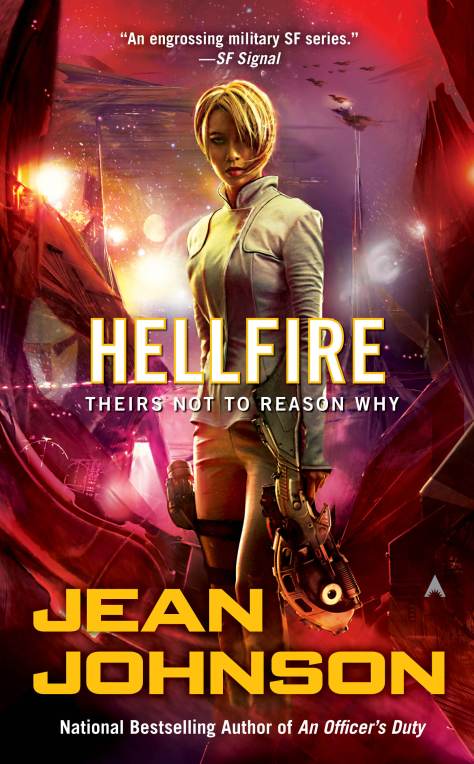
Johnson, Jean: Hellfire (Theirs Not to Reason Why) (2013)

hellfire - larger file
Cover art by Gene Mollica
Cover design by Annette Fiore Defex
Interior text design by Laura K. Corless

I started reading Hellfire and was immediately engrossed in the world of Ia and her Damned. Annoying really when a novel is this good. I believe I actually stayed up until 3 in the morning just because I did not want to go to bed until I knew how Hellfire ended. The ending was a sort of cliff-hanger – in the sense that the story did not end with Hellfire – yet not – in the sense that Hellfire had a conclusion.

…What if you could see the future? What if you foresaw that, three hundred years from your time, your entire galaxy would be destroyed in an overwhelming invasion? What would you do to stop it, when it would all happen long after you were dead and gone? (Jean Johnson)

Me? I don’t know if I would care enough to do anything about it. But what if the experience had been as if I, myself, had experienced the extinction of life? Sad to say, I’m not a particularly noble person. I doubt I could go to the lengths that Ia does in trying to protect the future of her galaxy. I doubt I would stay sane (well, as sane as I will ever be).

Does she see her life as the sacrifice it is? Oh, yes. What she had wanted for herself was to be a singer. Instead she became a soldier on her journey to ready the different breeds of people for the future. A future she would never experience herself. Her motivation? That was what being a pre-cognitive did. Especially being one as strong as she was.

People being the way we are, means we tend to disbelieve anything we have not experienced ourselves. Which is why Ia has let various creatures across the galaxy received snippets of her visions with information on how to avoid the potential future she wishes for them to avoid. This is where Ia’s type of pre-cognition varies from the type of clairvoyance that could be more paradoxical. Ia’s type shows a potential future based on a potential number of choices. By building on her reputation, prophecy by bloody prophecy, Ia has now arrived at Hellfire.

Upon reaching Hellfire Ia has gotten far enough on her journey that she has managed to convince the human authorities of her claims of pre-cognition. All it took was being right a certain number of times and they were more or less on her side. But three hundred years is a long time for most people to keep their minds on. It is the political games here and now that seem to matter, not what some great-, great- … grandchild of ours will be going through. Keeping the military leaders’ minds on what lays ahead is a challenge Ia has to win again and again throughout Hellfire.

With her ship, she and her crew travels around the galaxy recruiting more believers and fighting a whole bunch of battles.

For those of you who like technical details, you will get those. I haven’t a clue as to how likely any of them are, but they are nevertheless interesting.

For those of you who are fans of action and thrills, there are plenty of those as well. The above battles are only part of it. Ia gets herself and her crew out of various tight situations. While we already know that she, herself, has to survive until she has amassed a certain following, we don’t know who else gets to live along with her.

For those of you who like humour, don’t worry. We get plenty of that along with the bleaker moments. Jean Johnson has managed to lighten the story with some witty dialogue.

Finally, for those of you who like romance, there is that as well.

Add to all of this the writing of Jean Johnson and we have a novel that carries its middlehood well. I am certainly looking forward to Damnation.


Review:


  • File Size: 951 KB
  • Print Length: 479 pages
  • Page Numbers Source ISBN: 0425256502
  • Publisher: Ace (July 30, 2013)
  • Sold by: Amazon Digital Services, Inc.
  • Language: English
  • ASIN: B009RYS0PW

My review of:

  1. A Soldier’s Duty
  2. An Officer’s Duty


Stross, K.M.: The Man in Black – The Woman in White (2013)

The Man in Black-The Woman in White
Cover art by Chris Smith

The Man in Black – The Woman in White shows us what the earth could be like in almost 200 years if we keep on letting it go to pieces and allow money to rule the world.

Stross presents us with a world without hope, a dark story of loss, poverty, inequality and disinformation. The town of Present, Nebraska thinks the world works in one way, and it seems they have been intentionally kept in that belief. Maintaining this status quo is the will of the people who hold power to change the lives of the citizens of Present for the better.

One of the tools the powers that be uses to keep the people of Present in Present is lack of education and information. Another tool seems to be to allow companies to move in and “encourage” farmers to sell their land and water-rights.

Stross encourages me to question my own beliefs of right and wrong. Exactly who is the culprit and why do I consider that person to be a culprit?

Poor young Kyle, living in circumstances that quite a few young people live in today. Desertification, water shortage and hunger are all parts of the lives of young and old in certain places of the world. There, too, tools such as the ones used against Present, Nebraska are utilised. The Man in Black – The Woman in White speaks of a world that already exists for many and will probably exist for many more in the years to come.

Stross doesn’t give us a solution or an answer to the problem. I appreciate that. Having an open ending allows me as a reader to look around and see if an answer exists at all.


Reviews:


I could not find any information at all on K.M. Stross.

Sagara, Michelle: Cast in Sorrow (Chronicles of Elantra IX) (2013)

Cast-in-Sorrow
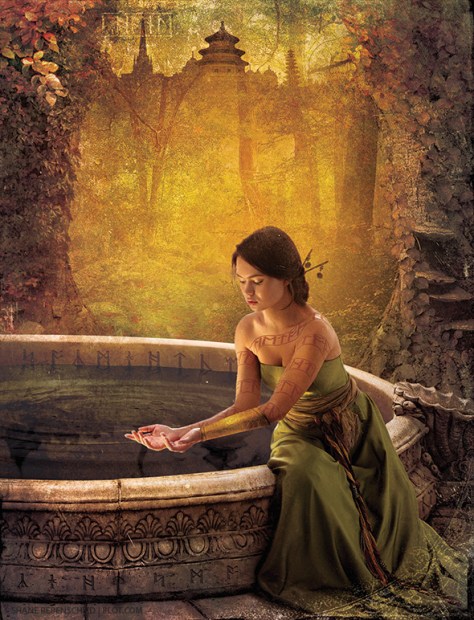
Cover art by Shane Reben­schied
Cast in sorrow without text
Artist: Shane Rebenschied
Nice mood.
From scene late in novel.

Sometimes I fall in love with a character and end up following that character for as long as the author allows me to. Private Kaylin Neya is one such character. Cast in Sorrow is Sagara’s ninth installment in her Chronicles of Elantra series, and I am still enjoying my acquaintance with Kaylin. Part of that has to do with the growth of both the author and our Private. Cast in Shadow was extremely well-written and a fun young adult novel. Cast in Sorrow raises Sagara and Kaylin another level in my opinion.

Part of Sagara’s appeal for me is her prose. Patricia McKillip and Sagara share the same kind of tone to their novels. We are lured in with the beauty of their words and end up being buffeted from side to side by the winds of action.

At the start of the series Kaylin Neya is about 20 years old. She has been with the Hawks for seven years and was around 13 when she escaped the fiefs. Since that time about a year has passed. I’m not really sure about that because one has to allow for time for travel, how long her classes last and regular life between books. But according to other readers, this is about where we are.

In just one year Kaylin goes from a person who hates Severn, to one who feels great guilt about him, to one who accepts the role he has in her life. In that same amount of time Kaylin goes from a person who hates herself to one who more or less accepts that her fate in life is different to that of most humans. In accepting herself and others Kaylin also sees that her lessons have a reason and she slowly implements them.

In Cast in Sorrow Kaylin has come to the point where she is able to help Teela. She now has the tools (her role as harmonista and her latest experiences) and understanding of Barrini nature that are needed for her job.

Each novel has something to do with the runes on her body. In each novel Kaylin ends up as storyteller. Cast in Sorrow is no different from the rest of the novels in that respect. Once again her runes and nature give Kaylin a unique opportunity to heal. For that is pretty much what Kaylin is in each novel – a healer. Whether she brings female dragons back into existence, helps elementals be born, saves strange “aliens” friends, Kaylin’s mission in each novel is to heal something that has been broken. In Cast in Sorrow that is Teela and her friends.

I’ll be buying the next Chronicles of Elantra story as well. This is one person whose life I enjoy following.


Reviews:


Bridger, David: A Flight of Thieves (Sky Ships I) (2013)

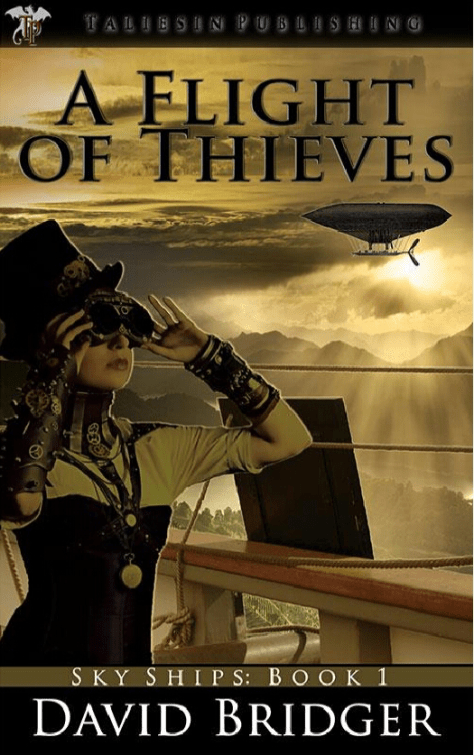
A Flight of Thieves
Cover artist Georgia Woods
Love this cover

A Flight of Thieves was given to me as a reviewer’s copy.

While I do try to say something positive about all novels I review, some novels need less work from my side than others. David Bridger’s new series Sky Ships is such a series. Right off the bat A Flight of Thieves caught my reader and I had to work to put A Flight of Thieves down when real life called.

A Flight of Thieves is very definitely a young adult novel with intelligent language. It has that warm sense of humour that only the British manage to convey. After so many reviews I feel certain some of you have gotten an idea of how much I enjoy writers from all over the United Kingdom. David Bridger just added himself to that list.

We get a combination of political intrigue, action, steam-punk, robot/human interaction and humour blended into 170 pages worth of enjoyment.

King Henry happens to be one of three robot kings who have ruled the Earth after humans managed to ignore the threat of climate warming long enough for it to be too late. We saw that we had been idiots and Henry and his brothers were created to rule us and hopefully keep us from flooding the Earth once again. 1000 years later he has experienced two rebellions and is looking at a third. Only by chance did he and Princess Victoria discover what was going on. The King joined the Princess on a trip to the Lord of Ireland as her footman (travelling incognito as Henry called it) and discovers that all is not well in his kingdom.

Princess Victoria is our main character. It is through her point of view that we learn of this world 1000 years into the future. She is an adventurous sort of person ready to explore her world if only her parents will let her. There is a little rebellion in Victoria and her sister Anne, but these two are pretty good kids who want to do the best for their kingdom. We get to see how Victoria deals with success and failure, love and death – for not all of her allies will make it through the story. That is the way it is when rebellion enters a land. I liked her optimism and willingness to face reality – panic attacks and all.

Definitely had fun with this one.


Gimpel, Ann: Earth’s Requiem (Earth Reclaimed I) (2013)

earth's requiem

Earth’s Requiem is the first installment of the serial Earth Reclaimed. Being a serial, it did what all proper installments of a serial should – ended on a cliff-hanger.

I should probably tell you that there is explicit sex in Earth’s Requiem but no explicit violence. The sex was consensual and safe. Here in Norway teen-agers read this kind of stuff. Other places have other rules.

If you check out Ann Gimpel’s blog, you will see that she has been writing fiction since 2009. She has generally written urban romantic fantasy. Earth’s Requiem is my first meeting with Ann Gimpel and it was sent to me as a reviewer’s copy.

Earth’s Requiem is not urban romantic fantasy. Instead it could be called apocalyptic romantic fantasy. I’m calling it fantasy because we are dealing with the old gods of celt mythology but it might also be deemed science fiction because of the Lemurians who have entered the Earth through gates opened by – you guessed it – humans. We humans are stupid and curious little monkeys. If there is a lever to be pressed, a ritual to be performed or aliens to be contacted we will do our be to do the deed. I’m that dumb myself. When I was a kid I would put a knitting needle into the wall sockets just because my dad had warned me not to. I’ll still do really stupid stuff just because I wonder what would happen if …

Once I started looking for info on the gods in Earth’s Requiem, I became fascinated with Celtic mythology. The celtic gods we get to meet are:

  • Fionn mac Cumhaill: God of wisdom, protection, and divination. A warrior-hunter and god of the wood-lands.
  • Bran the blessed / Benedigeidfran: God of prophecy, the arts, leaders, war, the sun, music, writing.
  • Arawn: God of the underground kingdom of the dead. Revenge, terror and war.
  • Gwydion: Greatest of the enchanters, warrior-magician. Illusion, changes, magics, the sky, healing.
  • Dewi: Dragon goddess

As this is a romance novel all four human-like gods are devastatingly good-looking. Fionn mac Cumhaill is the god we are particularly interested in. He is the paramour of our main protagonist, Aislinn Lenear, whose mother was Tara MacLochlainn. Tara MacLochlainn was thrown into a vortex by one of the new rulers of the Earth when her sanity was insufficient to please the Lemurians. Aislinn’s father had already been killed by one of the Dark gods. The Lemurians and Dark gods fight each other for dominance of the Earth and humans are being used as their tools.

While Aislinn has realised that all she is to the Lemurians is a tool, she has been so wrapped up in her grief that she has been unable to see past that. The compulsion that has been laid upon her and all humans under the thumbs of the Lemurians might have something to do with that inability as well. But after three years, Aislinn meets the above Fionn and he manages to rescue her from that compulsion. Together they spear-head the resistance that includes humans and celtic gods.

It wouldn’t be a romance novel without some pretty complicated inner dialogue about whether or not to love a person, how to love them and all of that other stuff. I always tend to zone out when romance comes along and that is a pity because Ann Gimpel writes well enough to deserve a romance reader that can appreciate romance. I enjoyed the action and the premise of the resistance group and the fascinating stuff this story led me to on the net.

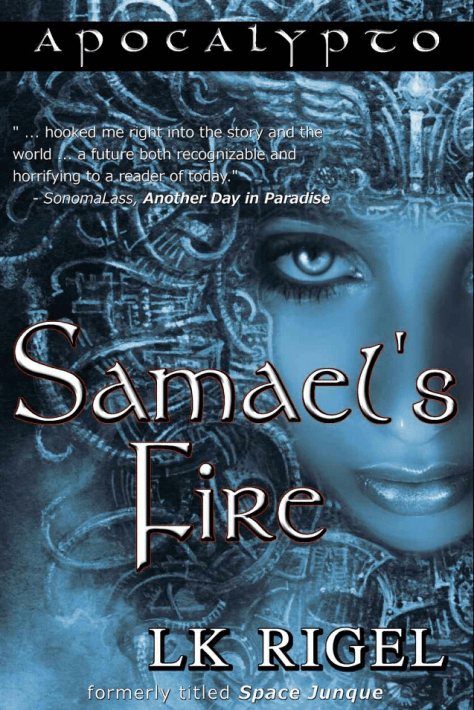
Rigel, L.K.: Space Junque / Hero’s Material / Samael’s Fire (Apocalypto I) (2010)

Apocalypto
Edited by Anne Frasier/Theresa Weir
Cover art by Phatpuppy (link)
Cover design by eyemaidthis

I saw the old cover for Space Junque on Rigel’s site and much preferred this one. This cover is seriously cool. Phatpuppy is on my list of favorite cover artists (she’s got her Halloween theme going right now).

Why change the title so often? Weird. Rigel explains it (I still like the above cover best):

Hero Material is a prequel, the story of how the paranormal world in the Apocalypto series replaces the old unmystical normal world. The series proper is a paranormal fantasy, and all the action is definitely on earth or within the realm of the gods.

In fact, when the paranormal elements of Hero Material nee Space Junque kick in, it’s been a shock to a lot of readers, not expecting such things in science fiction. I blame myself for too-light foreshadowing. But I blame the old cover too.

Now the name has been changed again – to Samael’s Fire.

As you see above Apocalypto is meant to be a paranormal fantasy series. Samael’s Fire is the first step on that road.

Charybdis Meadowlark is living in a post-apocalyptic version of our world where the corporations have been able to play to their heart’s content and the environment has gone down the drain. Environmental terrorists, like the DOGs, aren’t making the Earth any cleaner. When we meet Char, she is fleeing Sacramento. Her friend Mike has warned her that the DOGs are about to bomb Sacramento and that she needs to get off Earth and into space.

From the very beginning many of Char’s experiences are about fleeing one sort of trouble after the other. Trouble seems attracted to her but unlike a great majority of people Char has incredible luck in how it affects her.

Charbydis is very much our main character. The story is told from her point of view and she is the one we get to really know. The only other person we get to know fairly well is Jake. Char meets him as he sells her coffee at the coffee kiosk.

From all of the other reviews I feel certain you’ve realised that Char and Jake become an item. There is instant sexual attraction on both sides, they don’t really like each other and both are beautiful people. Like so many other novels there is a sort of love triangle.

In space there is plenty of action, a lot of explosions, some fighting and meetings with gods/goddesses and shapeshifters. These gods/goddesses are like the older type gods: norse/greek/roman = pretty selfish and fighting each other for their worshippers. It is upon meeting the gods/goddesses that the shift toward fantasy slowly happens.

Samael’s Fire is a safe and fun read both for those who do not like explicit violence and those who do not like explicit sex.


Reviews:


  • File Size: 287 KB
  • Print Length: 188 pages
  • Simultaneous Device Usage: Unlimited
  • Publisher: Beastie Press (September 2, 2010)
  • Sold by: Amazon Digital Services, Inc.
  • Language: English
  • ASIN: B0041T59IY

Murray, R.J.: The Event (Tales of the Triad I) (2011)

The Event

If an author is going to create an Apocalyptic event he might as well do it thoroughly. Killing off seven billion people overnight seems to be pretty thorough to me. Messing with the environment and changing the stars and planets we usually see adds to that thoroughness. R.J. Murray shares such an event with us in The Event. The Event appears to be a science fiction tale that slowly but surely leans toward fantasy. Not fantasy as we know it but rather new technology that has to be developed due to the teeny tiny damages wrought by Earth’s changes. Mutated people that have the qualities we find in traditional fantasy adds to the fantasy feel of the story.

As with other apocalyptic tales, we find that the qualities people already have seem to intensify in times of crisis. This is a normal trait in humans. Any type of traumatic event tends to pare down all of our extras leaving some sort of quality central that we draw upon. This is when we see a person run back into a mall again and again saving people’s lives while others break into buildings raiding them of wares, beat up others and do other heinous deeds. People are people whether our skyline changes or not.

The mutations we see are people whose bodies morph into something other than they were used to being (that is, those who did not turn to dust or remain human). Let’s see what we have:

Wizards are people who find themselves younger/stronger/longer-lived and able to handle the tools left from before the apocalypse. All races have their own wizards.

Elves also seem to be long-lived and changed into a stronger/younger version of themselves. But they seem more attuned to plants and living creatures rather than technology.

Dwarves are like the ones in stories: like to live underground and have an affinity for stone. Dwarves are shorter and more compact than humans. They will probably end up being longer-lived as well.

Humans are more numerous than the others and breed easier. There really isn’t much more to say about them.

Goblins are like the goblins we know from epic fantasy. There are various types, sizes and numbers. Most of them live underground or underwater. They too have wizards.

Thankfully Murray hasn’t fallen for the temptation of making people smarter or dumber than they were just because they happen to be elf, wizard, dwarf or goblin. There are qualities that are intensified but if you were dumb as bread before the apocalypse, well, you are going to remain dumb as bread – and probably dead within a very short time. Some of the people have to learn the hard way and for some that means they end up dead.

That probably tells you that it is not all happy endings. In spite of that I would not say that The Event is particularly dark. It is more like the traditional sword/sorcery stories in tone. I’m guessing this is a young adult story. It’s a pretty straight-forward tale without explicit violence or explicit sex. There is action and plenty of it.

Murray builds his world for us showing us how people become what they are and what happens to the Earth itself. By the end I felt pretty comfortable with the whole thing. I felt there was a proper ending although there was a tiny hill-hanger showing me that a continuation was on its way.

A pretty enjoyable tale that looks as if it has great potential.


Reviews:


  • Print Length: 398 pages
  • Sold by: Amazon Digital Services, Inc.
  • Language: English
  • ASIN: B0083CMJ74

McManamon, Michael: Glory 1 (2013)

Glory

Glory is book one of a five book series. I see that number two is now out on the market.

We enter the world of Glory at the beginning of the Apocalypse. Let me tell you, Jackson was a surprise. He is the first person we meet who seems to be affected by what is striking people.

“Are you all right?” he asked.

By now, the words meant nothing to Jackson. He could only hear sounds coming out of the old man’s mouth. He didn’t know what they meant. The concept of language had left him moments ago.

He didn’t respond.

“Are you all right?” the man asked again. Slower this time.

Jackson continued to look at the old man, but still didn’t say anything.

He looked down at the fingers touching him. He could make out the white hair on the knuckles. Grabbed him. Squeezed him. He didn’t know why this old man was touching him, but he did know that he didn’t like it. He felt anger well up inside of him.

He looked up again at the old man. The old man was smiling his skewed smile, trying to make light of the situation and find out what was wrong. To Jackson, his face caused his anger to turn to rage.

The old man. Smiling. Looking. Staring.

Jackson roared.

Then he took his knife, grasped it tightly and stabbed it into the old man’s throat. The old man’s eyes opened wide with surprise. He tried to grab at the knife as Jackson pulled it away. Blood spurted from the wound and covered the table.

It’s bizarre. People seem to turn in the space of a few minutes. All comprehension of the meaning of words or other people’s actions seems to evaporate. Anger is the prevailing emotion they are left with. Without thought of pain, hunger or consequence they just attack. In that sense they are like zombies. Otherwise they are totally different. Alien infection or some kind of engineered disease were my first thoughts.

The prologue is tense. The whole novel is intense. McMananon writes incredibly well drawing the reader into his world and keeping us there.

What we get after the prologue is easy to imagine. A total collapse of society as we know it occurs. Those who are left “normal” discover they have to stick with each other. But sticking with some of the survivors might not be such a good option. Some of them are almost worse than the diseased in that they have “all of their faculties intact”. Good people remain good and not so good people remain pretty awful.

There is some explicit violence in Glory. Sexual violence is part of that violence. Thankfully, we also encounter samaritans. All of these actions were believable. The shock, anger, helplessness, courage, violence, friendship. All of them were perfectly believable. This is probably what would happen in this world if something like McManamon’s version of Apocalypse happened.

Would I recommend Glory to young adults. NO. Glory is just too dark. On the other hand, kids these days see a lot of violence and sex that I never did back when the dinosaurs lived. Maybe it is good for them to encounter it. I know the feelings portrayed by the sexual abuse victims were pretty much the way real life abuse victims experience them.

We were left with a cliff-hanger or maybe we were already falling off it. Shame on McMananon for sending us to the edge. Glory 1 is an excellent first novel and I very much encourage you to read it.


Lupo, Tarrin P.: The Necessity of Man (2011)

The Necessity of Man
Editor: Adam Lishawa
Cover art: Doc Samson

Gender seems to be the main theme of The Necessity of Man. The Necessity of Man is utterly believable. I cannot count the times men have used women’s nature as a reason for men to rule. Women are supposed to be nurturing and caring by nature. But guys, you could not be more wrong. We are just as self-serving as you are. Lupo shows how things could turn out in a gripping and frightening manner. My goodness, that man is courageous and can he ever write.

The whole idea of how the women at MedTronCorp handle lay-offs and their need for biological products is fascinating. Getting rid of useful men has been a gradual process and does not seem to bother men much. Perhaps that has to do with the spa. There is plenty of sex, zombie games and the availability of everything one might wish. Being offered to stay for an indeterminate length of time in such a pleasant place is a dream come true. But you know, if something seems to be too good to be true it usually is.

I loved The Necessity of Man.

The Necessity of Man has an “anti-copyright” from the author because:

We believe that copying is a form of flattery and do not abide by the copyright laws. Those laws serve to restrict the flow of ideas, which no one can really own. Please share freely and frequently. (Copyright page of The Necessity of Man)


Review:


Hartman, Rachel: Seraphina (2012)

seraphina complete

There are tons of reviews of Seraphina out there. Seriously, tons. Most of them praise Rachel Hartman’s writing to heaven and with good reason. Believe it or not, this is actually Hartman’s first novel. Her grasp of the flow is amazing. This is definitely an author to follow.

What genre is this? Well, that is a toughie. Like The Intergalactic Academy blog points out in their review, there are reasons one might suspect the world of Seraphina lies not only in a fantasy universe but also in a science fiction one. You would be surprised at the number of stories out there that seem to be fantasy (and are) but end up having a basis in humans having come to another world.

One of the traditional conflicts between humans and dragons in Seraphina has to do with humans invading the continent of the dragons. This might be one hint as to the otherworldliness of humans. The other is as TIA points out some of the vocabulary.

How the wars began in the first place is not commonly known, but as Seraphina is lucky enough to have a dragon music teacher (Omra) she learns of these matters. That her father happens to be the local expert on the treaty between humans and dragons has given Seraphina more knowledge than the usual citizen. There is a reason for her father’s expertise. He is the father of a girl who is half-dragon/half-human. Seraphina’s mixed race must be hidden from the knowledge of both dragons and humans as such a relationship is thought of as disgusting. But it is interesting that such a relationship is even possible. Perhaps that means that a dragon’s transformation into human is on a genetic level.

When peace was forged, one of the consequences was that dragons could no longer be among humans in dragon form. Dragons society seems to be ruled by logic rather than emotion. To them becoming human is a shock to the system as they are drenched in feelings they do not understand. Emotions are forbidden and all memories pertaining to such emotions are excised upon returning to dragon form. Such excision could mean that the dragons have some form of advanced technology unless the excision happens through some kind of paranormal ability.

Seraphina’s mother took human form and fell in love with Seraphina’s father. Seraphina was the result of that match. Sadly, Seraphina’s mother died at child-birth. Child-birth is the time her father discovered that Seraphina’s mother was a dragon. This has to do with the color of dragon’s blood. Seraphina herself showed no sign of the match until puberty. At that time she gained scales on parts of her body and a gigantic degree of self-disgust. In fact, her disgust ended up being so strong it led to self-harm. I have absolutely no trouble understanding why the self-harming happened. When one’s difference is so readily identifiable, the temptation to remove it must be staggering.

There are some positive factors in Seraphina’s life. Her music teacher Omra has stuck with her since her dragonhood was revealed. With him she does not have to fear revealing her forbidden race. As I said earlier, Omra is Seraphina’s music teacher. When Seraphina showed the same kind of talent her mother had had, Seraphina was permitted lessons if they were held out of sight of her father. Music has led her to the position she now holds – as the assistant to the court composer.

Seraphina is our protagonist. An excellent protagonist. She has depth and character in a way that only the British can manage to convey. Understatement seems to be something the Brits get through their mother’s milk. Hartman attacks a great deal of society’s crueller sides gently and with enough of a sting that the reader feels it. (I feel it) Such writers are a miracle to me, something I can admire yet never aspire to be.


Reviews:


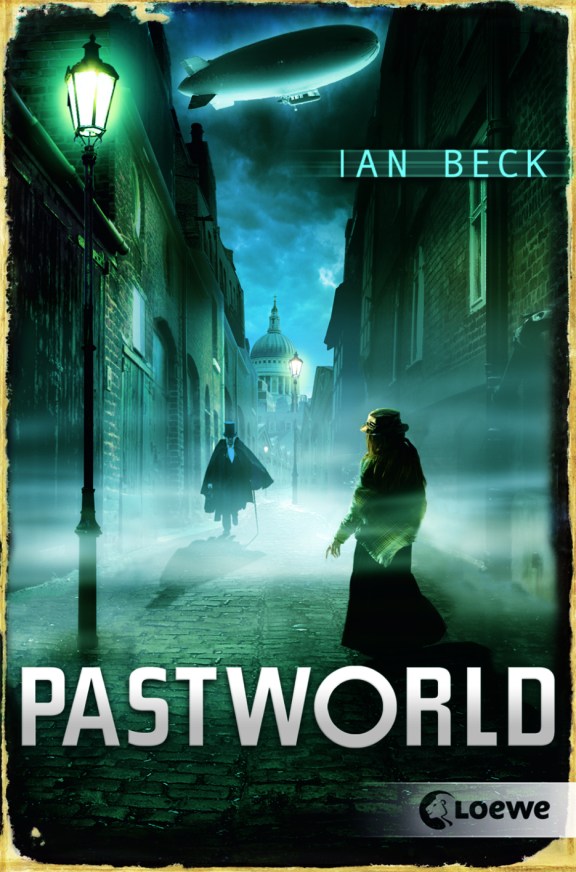
Beck, Ian: Pastworld (2009)

7156_TB_Pastworld.indd
Cover image by David Calub

Pastworld is a Young Adult dystopian, steam-punkish and semi-violent look at what could happen when the future is so bored with itself it seeks relief in pretending to travel to the past. Pastworld is the creation of such a future.

Not all participants know that it is all pretense. Eve is one such character. One of our main mysteries in Pastworld is the reason for Eve’s short memory. Why does she only remember events from the past two years? Why is she being kept hidden in Pastworld? Why does her protector/jailer/friend Jack get killed while keeping her from public attention? These are all questions that are answered.

Eve is 17 years old. I’m trying to remember what it was like to be 17 and decide if Eve is a proper representative of a Victorian 17-year-old young woman with an apparent memory loss. I have a couple of biographies to lean on (not the memory loss part). Girls of a certain class were pretty sheltered back in the day. They were not allowed to go anywhere without a chaperone. Accepted interests beyond home and family were nature. Education was so, so. They were taught how to read, some maths, etiquette, embroidery, housekeeping and painting. I guess with that as a guide, Eve was kind of representative for that group.

When Jack gets more and more eccentric after a mysterious person comes sniffing after Eve, Eve runs for her life. Quite stereotypically she decides that the circus must be the place to go. And she does – Jago’s Acclaimed Pandemonium Show.

In Buckland Corp. Comm. Center Sgt Charles Catchpole becomes aware that something is afoot in Pastworld. A murderer has returned (the Phantom), one who leaves his victims dismembered and sometimes headless. One can certainly see how this would keep his minions in line and whet the appetite of the Scotland Yard.

Much of what we see in Ian Beck’s novel seems probable. 2048 is in 35 years and quite a bit could happen in that time. We already have plenty of theme parks around the world. Making a city into one might not be the stretch I would like to think it is.


Reviews: