Wrede, Patricia C.: Daughter of Witches (Lyra II) (1983)

My copy of Daughter of Witches is the revised version. Daughter of Witches is Patricia C. Wrede’s second story.

Bond servants in Chaldon were servants with only one right: a half-day off every three weeks. Their masters could, in all other respects, treat their bond servants as they would. Ranira, our main character, is one such bond servant. She was bonded for nine years because her parents had been judged and killed for being witches. When we meet her, she has two more years of her bond to serve. She is somewhere in her teens.

When strangers come to Lykken’s inn at Festival time, they ignore the danger they place themselves in. Being foreigners in Drinn at Mid-Winter festival is enough to get you arrested. Hosting foreigners is also enough to get you arrested and sentenced as bond servant. In fact, all of your employees and family are placed in bond service for not having reported your crime. Earlier in the story, Ranira unintentionally offended the priest that is her “arresting officer”. It turns out she offended The High Priest of Chaldon. Her sentence is his way of getting revenge.

“For three days more I will be seated in the place of honor in the Temple, next to the High Priest, while he teaches the people the new rites and leads them in the old ones. Then the High Priest himself will perform the wedding ceremony. And consummate it. Publicly,” she added as an afterthought. She stared resolutely at the door of the cell. She was determined to finish, to make them understand, so that they would leave her to whatever little peace and sanity she could find and cling to. “When he is finished, the god will take me. For two days, Chaldon will walk in my body and speak with my voice, and there will be nothing left of me at all. On the last day of the Festival, when both moons are full and Chaldon has accepted the other sacrifices, the nine High Masters will kill me as well.”

Through history human sacrifice is not uncommon: Aztec, Japan, Serbia, Hawaii, India and Rome are only some places where ritualized human killings were/are practiced. Religion seems to make human sacrifice acceptable to the general populace once propaganda becomes common belief. But I wonder if religion is the only area of sacrifice in human society. What about the squandering of young lives in the fights we have with each other to enforce our own points of view? Or the death penalty?

Anyways. Ranira is not too happy about her future fate. Nor are the strangers once they realize what is going to happen to Ranira. What is about to happen to them as well. Although their fate is probably not the privilege of sacrifice to the god Chaldon, they will likely end up as sacrifices to Drinn’s version of justice. Getting away would seem hopeless yet highly desirable for all of them. Ranira and the strangers now set off on what are narrow escapes, much use of magic and new friendships.

Recommended.


Reviews:


Daughter of Witches at Goodreads

Vincent, Steve P.: Fireplay (Jack Emery 0.5) (2015)

He looked out the front windshield and could see nothing but the desert and the dust kicked up from the Humvee at the head of the column. He shuffled back into the seat and struggled to get comfortable as the music switched to the next track. As a roaring drum solo kicked off the wailing electric guitars, there was a massive explosion and the lead Humvee burst into a fireball.

Steve P. Vincent

Lackey, Mercedes & Edghill, Rosemary: Legacies (Shadow Grail I) (2010)

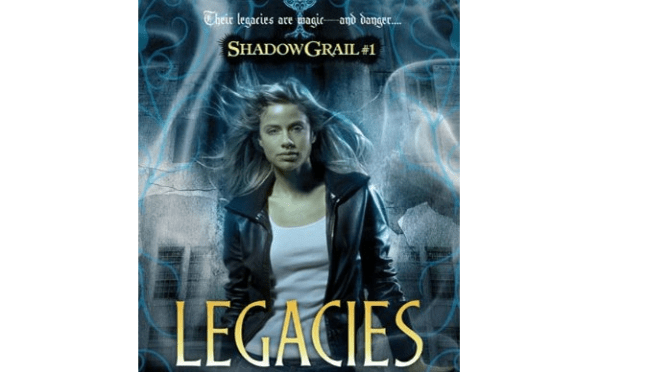
“She’s gone, what’s the harm?” Muirin said. She flipped through the manila folder. “Transcripts, notes from the teachers – huh, she was getting better grades in Art than I am – evaluations from her magic coach – Kissyface Bowman always was too easy on anybody with a flashy Water Gift – Demerits …” She stopped suddenly, as she got to the last page, and stared down at the folder in silence.

“What?” Loch said. Muirin simply held the folder out to him mutely.

He took it, and looked down at the last page. Spirit looked over his shoulder. There was just a single page there at the end, something it would be easy to take out and dispose of if for some reason you were going to hand it over to someone. At the top of the page there were several lines of illegible handwriting. The rest of the page was blank.

Except for a large red stamp that said: “Tithed.”

And the date.

Halloween. (Mercedes Lackey and Rosemary Edghill)

Bunn, Christopher: The Christmas Caper: A story of Merriment, Mayhem and Mafioso (2012)

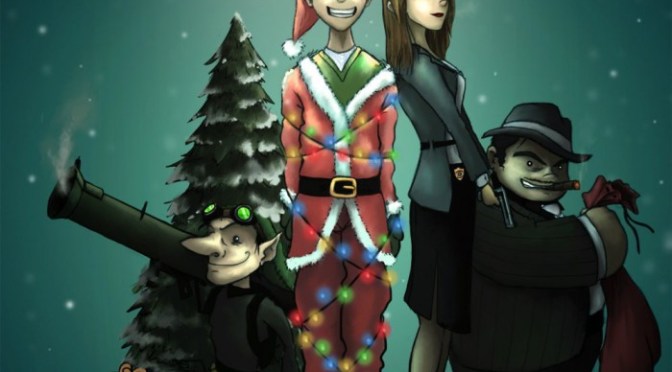
“Hey,” I said. “Don’t I get a backpack?”

“No, boss,” said Snix. “You get something better. You’re the commander of this operation, so you, uh …” He looked around and then picked up something from under the driver’s seat of the Camaro. “You get this special Inter-Modal Communications Module. With it, you can monitor and direct our incursion.”

He handed me what looked like an espresso cup.

“This looks like an espresso cup,” I said.

“It’s designed to look like that,” said Snix. “Camouflage, boss. It’s all about camouflage. Okay, men. Are you ready?” (Christopher Bunn)

Hilarious and irreverent short-story about Santa and the elves.

Robertson, Edward W.: Outcome (Breakers 0) (2013)

Outcome by Edward W Robertson


Across the table, Ellie Colson’s bosses laughed what might be the last big laugh of their lives. She forgave them. They didn’t know they were joking about the end of the world.

She smiled thinly. Rawlings, her direct superior, chuckled and swabbed his puffy hand across the table, as if he were working at an imaginary water spot. Dr. Armen laughed and clutched his gut, as if he were afraid it might bounce away. Jesper Mason just smiled. Like Ellie, he hadn’t been introduced by rank – Rawlings hadn’t even mentioned which org he belonged to, which meant he was a field hand, and a useful one. She recognized him vaguely. Might have seen him around the stacks once or twice. Mason had told the joke, something about Spanish flu. Ellie hadn’t been listening. She’d been thinking about the transmission rate in Rawlings’ printout.

The laughter stopped. Conversation resumed. The room was bare and windowless but their voices carried no echo, dying in the small space like lost moths. It wasn’t that these men weren’t smart; they had enough degrees between them to paper a den. It wasn’t that they lacked dedication; she would soon prove herself least dedicated of any of them.

It was that they lacked imagination. (page 1)

These are the words that hooked me. Something about Robertson’s writing drew me into his post-apocalyptic chaos until the end, an ending I appreciated.

Why did Ellie risk her life to try to save Chip Billips? Well, as she saw it, she was already dead. In fact, both of them were already dead. Their bodies just hadn’t finished the process yet. The likelihood of escaping this surprising and terrifying new plague seemed highly unlikely. But why Chip? It certainly wasn’t because Chip lived in a convenient place.

New York, a city with a population of about 8.49 million people packed into an area measuring 468.90 sq miles (1,214 km²). Needing to chase down a person in a tight place like that makes for perfect post-apocalysm. Robertson paints both the atmosphere between Ellie and Chip and the atmosphere in the city as bleak, confused and fearful. With his magic, Robertson helped me believe in the plague’s progression and people’s reaction to it.

When authors like Robertson come along, I find it does not matter to me if snags turn up. Yet none did. I loved it.

Definitely recommended.


Reviews:


Outcome available at

Also available on Kobo and Google Play.

Gilman, Laura Anne: Hard Magic (Paranormal Scene Investigations I) (2010)

Sharon looked at him as thought he’s just suggested she take up pole dancing. “You think the five of us, here in an unmarked office, with no reason to be here except a mysterious phone message, and a dead body just happens to be in the other office, aren’t going to become the immediate persons of interest to the cops, no matter how he died? You think they’re going to believe how we all ended up here on the basis of some strange phone message from god knows who, for an unspecified interview for an unnamed, unknown company none of us sent a résume to? I don’t know about you, but I don’t need that shit in my life.” (p. 61)

Tolkien, J.R.R. (1968)

If you really come down to any large story that interests people, or holds their attention for a considerable time, the stories are practically always are human stories, and the stories are practically always about one thing aren’t they: Death and the inevitability of death. (J.R.R. Tolkien)

Teasdale, Niall: Thaumatology 101 (2011)

thaumatology-101-Niall Teasdale

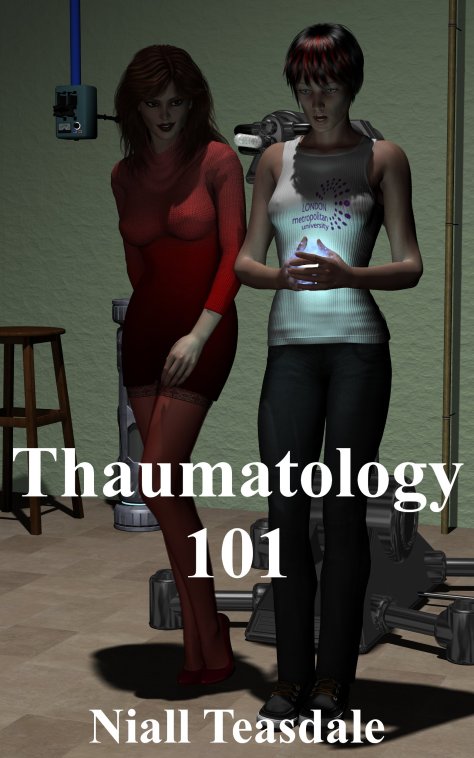
Thaumatology 101 is a mystery. Ceridwyn (Ceri) Brent has been hired as a research assistant to Dr. Tennant at the Metropolitan University in London at the High-energy Thaumatology Building. Thaumatology is the magic of Teasdale’s world. Dr. Tennant has been working for a couple of years on finding a solution for the containment of T-Null. It turns out her other assistant, Shane Walters, has hampered her work. After an accident occurs that almost kills Ceri, Ceri and Lily begin searching for an answer to why Shane is out to stop Ceri.

I like the way Teasdale introduces us to the world (and the house) both Ceri and Lily are part of. Thaumatology 101 is very much about the friendship between Lily and Ceri. Ceri experiences major changes in her life during the story and Lily is there to both support and hamper her. Thaumatology 101 celebrates sexuality without being preachy or crude. I found that refreshing. Not being a romance was also great. Violence in the story was toned down. Because of the toned down violence and joyful sexuality, I would call this an older Young Adult urban fantasy tale.  The story is somewhere between a novella and a novel in length (137 pgs).

Recommended.


Reviews:


Thaumatology 101 available at Smashwords, Amazon.com, Amazon.uk

MacLeod, Ken: Engine City (The Engines of Light III) (2003)

Identifying a ruling class and state posed no such problem. The upper and usually senior ranks of the various corporate bodies, patricians and patriarchs or the merchant houses, administrators of cooperatives, guildmasters and latifundists, heads of religious orders and philosophical schools, retired courtesans, professors emeritus, and so on and so forth, formed what was blatantly called the Electorate, who just as blatantly elected the Senate and staffed its administration, and that was that. Volkov had no scruples about elites – having been part of one – and was surprised to find himself shocked by the sheer effrontery of the Republic’s lack of the forms of democracy. All his experience had been with people who insisted on at least the illusion of popular rule, and it was disquieting to encounter a people who seemed satisfied with the substance of self-government in everyday life while letting his politics and statecraft go on over their heads – as it almost always and everywhere did, of course. (Ken MacLeod)

Gee, Emily: The Sentinel Mage (Cursed Kingdoms I) (2011)

Jáume was in his father’s barn when the curse broke free of its dormancy on the easternmost rim of the Seven Kingdoms.

The story of the Sentinel Mage begins with Jáume, eight years old. Ancient magic turns his father into a monster and the boy has to flee to save his life. Reading up on orphaned children showed me that homeless, orphaned pre-teens looking to survive are more common than I thought. That type of homelessness made Jáume’s tale more believable. Where a lot of children would have died from helplessness, Jáume is crafty and cunning. Sometimes he is not proud of what he has to do to live, but he still does them. Choices we seem to be left with, may not be real choices after all. Do or die?

Magic, like the terrible curse, is the reason witches were hunted until thought extinct on the mainland. But complete extinction of a genetic trait when prophecy is around would never be possible for a fantasy trilogy. In life the complete extinction of a genetic trait seems unlikely. Eventually it might turn up again. In the Sentinel Mage that is even more so the case, as Prince Harkeld is about to discover.

Every prophecy needs its tool and these tools are people who vary from the young and innocent to the old and unwilling. Prince Harkeld starts off with power, wealth and a sense of entitlement. He is 22 years old when he meets the feared witches at his father’s court in Osgaard. King Esgar has called him to meet the diplomatic convoy from Rosny in the Allied Lands. When Prince Harkeld hears what the witches (or “mages” as they prefer) have to say about his destiny and his background he is shocked. It turns out the blood of monsters is in him and he needs to choose between honor and his father’s approval. Fortunately for Prince Harkeld, he choses honor. He is not aware of the personal consequences of doing what his father wishes.

Monsters or not, Harkeld is stuck with the mages (or witches as he curses them). A solution to his distrust is found by the mages. However, this solution requires distraction and a certain amount of naivete on Harkeld’s side. Perhaps the mages figure he is distraught enough that he will not discover the discrepancies that occur when Justen appears.

I understood why Harkeld would act like the distrustful, arrogant and annoying person that he was with the mages. His background, the suddenness of his leaving and the shock of his discovery along with the constant fear of discovery and being on the run would all play a part in leaving him a somewhat unlikable person. I’m not certain I cared much for the mages either. They were dishonest toward Harkeld and very open about the possibility of needing only his hands and blood for the fulfillment of the prophecy. Only as a last resort, of course ….

In leaving the castle behind he also leaves his beloved younger sister and two younger brothers behind. Princess Brigitta wants to come with him but Harkeld feels she will be safer with her father. Hmmmm. Time will show. But Harkeld worries. And with cause. Princess Brigitta and her two helpers, armsman Karel and handmaid Yasma were all that were left to protect her brothers, six-year old Rutgar and four-year old Lukas. But eighteen-year old Brigitta is about to encounter her own set of terrible problems leaving her with little will or ability to look after her brothers. She is also all that stands between Yasma and constant abuse. Being a bondservant in Osgaard equates to slavery and terror. At least with the Princess Yasma had escaped daily rape and beatings.

Gee’s writing is what drove the story on. There were some hiccups but for the main part she kept me caught in her words. Recommended.


Reviews:


The Sentinel Mage is available at Amazon, Amazon UK, IndieBound, Barnes and Noble, Book Depository

MacShane, Gifford: The Hedgerow Schools of Ireland (2015)

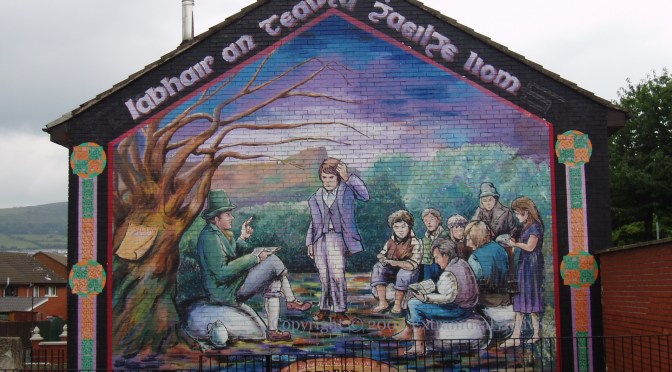
So on a sunny summer afternoon, it was not unusual to see a priest walking up and down on the edge of a field for an hour or so, his hands waving, his mouth working, extolling the tenets of Catholicism to children who were hidden from sight. (Gifford MacShane)

Larke, Glenda: The Aware (The Isles of Glory I) (2003)

Researcher (Special Class) S. iso Fabold, from the National Department of Exploration of the conquering nation Kell, has come to the Isles of Glory. His project is to discover what he can about its history and beliefs. As part of that mission, he interviews Blaze Halfbreed. It is her story we hear in The Aware. Fabold comments on Blaze’s story at regular intervals. I don’t particularly like Fabold. I find him an annoying, misogynistic git.

Blaze takes us back 50 years to a time before the Change, when magic was known. She telles us of her third visit to the Island of Gorthan Spit. Gorthan Spit is the place where those who have no where else to go end up. Blaze calls it a:

middenheap for unwanted human garbage and the dregs of humanity; a cesspit where the Isles of Glory threw their living sewerage: the diseased, the criminals, the mad the halfbreeds, the citizenless. Without people, Gorthan Spit would have been just an inhospitable finger of sand under a harsh southern sun; with them it was a stinking island hell.

Halfbreeds (children of two people from different islands) seldom survive to adulthood. None of the Isles of Glory wish to admit such children exist. Citizenship is only for the purebred. Usually, halfbreeds are abandoned as soon as their mixed background becomes apparent. Blaze, herself grew up

on the streets of the Hub with a group of other outcasts, mainly children of varying ages. Our home was the old graveyard on Duskset hill, where once upon a time the wealthy of the city had buried their dead in tombs above the ground. The place was ancient, the tombs neglected. They made good hiding places, fine home for a pack of feral street kids with no money and no respectability and, in my case, no history or citizenship.

That childhood, her later tutelage by the Menod and her treatment and training by Keepers laid the groundwork for the kind of adult Blaze Halfbreed became. What she learned was that if she wanted to be looked after Blaze was the one who had to do the looking. No one else could be trusted. And she is fine with that. She has no illusions about being some kind of wonderful person who needs to save her world. That she happens to become a pivot is due to Blaze being in the right/wrong place at the right/wrong time.

Sometimes life is like that. Very few people get to become pivots upon which the fate of the world rests. Choices are made at such times that may or may not change the immediate course of history. Long-term very little changes where humans are involved.

I particularly appreciated a few scenes in The Aware. There is an amputation sequence that takes us through the process. Part of that process is letting us know what chance and amputation patient should have had somewhere like Gorthan Spit. There is also an explanation of how a woman like Blaze would be able to handle a two-handed sword for a longer period of time. There is her size, strength, training and practice. In addition the steel of her sword is more refined and therefore a little lighter than the regular ones of that time. Only blood-debts would get you such a sword if you were not from Calmeter. But Blaze needs to take better care of her weapons.

There was plenty of action, an explanation of the magic, a good description of how the Islands worked politically and practically and good character development.

Recommended.


Reviews:


The Aware available at Scribd.com


Translations:

Hyndman, Jennifer Elizabeth: Grinch, Demon Slayer (2013)

Bryce didn’t see the string attached to a fishing hook which Noah had hid, with the direction of Samuel, under his drinking glass. He looked at Brooklyn and said, “You dipped your hair in your gravy again.”

Brooklyn squealed, looking down at her hair and examining it for food. When Bryce had his full attention on Brooke’s hair Noah quickly slipped the fishing hook into the wrist cuff of the head elf’s button up shirt. Bryce didn’t notice nor did anyone else.

“Well it looks like I was wrong.” Noah chuckled at his own genius. Well, technically it was Samuel’s genius. Keeping the string loose, he waited until Bryce was about to lift a spoonful of mashed potatoes to his mouth. That was when he held the string tight so that Bryce had to pull extra hard to lift his hand.

When Bryce pulled harder on his hand, confused at the resistance, the string broke and he quite literally punched himself in the face with a spoon of potatoes. He was not amused. Luckily, Noah was faster than Bryce. …

Gaiman, Neil: The Ocean at the End of the Lane (2013)

Thank you, to my sister-in-law for giving me a copy of The Ocean at the End of the Lane.

In December, right before I turned seven my family moved from Australia to Norway. One of my memories tied to that move is stepping outside the plane into the middle of Norwegian winter. Moving was not something I wanted, and winter did not help.

Soon I was driving slowly, bumpily, down a narrow lane with brambles and briar roses on each side, wherever the edge was not a stand of hazels or a wild hedgerow. It felt like I had driven back in time. That lane was how I remembered it, when nothing else was.

Memory can be triggered by scent, sound and sight. All of a sudden you find yourself re-visiting a time you had forgotten. Neurons spark neurons and whatever filing system you have going for you opens a memory file.

If you’d asked me an hour before, I would have said no, I did not remember the way. I do not even think I would have remembered Lettie Hempstock’s name. But standing in the hallway, it was all coming back to me. Memories were waiting at the edges of things, beckoning to me. Had you told me that I was seven again, I might have half believed you, for a moment.

As others have mentioned, we never discover what the name of the main character is. For the most part he is called “the boy”, and that is how I think of him. Neil Gaiman’s statement that the story is meant for adults fits my feeling while reading the book. There is enough terror (not violent) for a younger audience to enjoy it as well.

At seven years of age, children have little say in their lives. Moving to Norway was not my choice. Nor does the boy have much influence on his own life. There are a few episodes that illustrate this. To me, the episode with the cat stands out the most. Utter disregard of the possibility that the boy might be devastated shocked me. Yet, looking back at my own life, children were presumably fine with whatever the adults chose. In The Ocean at the End of the Lane, adults are judged more believable than the boy. So it is when I look around at the parts of the world I have encountered. My Asperger brain is completely baffled by this phenomenon. When the boy’s enemy states

“And what can you say to her that will make any difference? She backs up your father in everything, doesn’t she.”

I am reminded of many family situations that have crossed my life-path. No matter what one parent does or says, they have the backing of the other. Utterly incomprehensible.

Being without power to decide anything about their lives is something children come to semi-accept. At the same time there is a continuous battle between adults and children to have the ability to decide. We see some of that in The Ocean at the End of the Lane. The boy does not give in to the powers that be, although it might, at first, seem that way to the adults.

The Hempstock women became a safe haven for the boy. For me that is hilarious because some of the most dangerous episodes happen while together with one of them. But they sought to protect him and make his life safer by fighting for him with the means at their disposal. These means aren’t exactly regular ones.

I loved the Hempstock women. I want to be like the Hempstock women.

Definitely recommended.


Reviews:


The Ocean at the End of the Lane can be found at biblio.com


Adaptations:


Trivia:


Translations:

Asperger’s Syndrome – Could the concept of Superpowers be causing more harm than good?

You couldn’t find a super-power in me even if you tried looking for one with a microscope. I am average in most areas, terrible in others and a little above average in a few. Why would people want a super-power anyways? Do we (the asperger/autism community) want to become THEM to such a degree?

seventhvoice's avatarSeventh Voice

316

There’s been a lot of talk about the increasingly popular idea that people with Asperger’s Syndrome possess some kind of superpower.

Indeed, many people seem to genuinely believe it.

Search any website on the topic and you’re sure to find groups of people who freely name their superpower and then describe in minute detail the extraordinary things that whatever their particular superpower of choice may be, enables them to do.

To me, such talk of there being any form of an Asperger type superpower is ultimately harmful as it reflects the misbegotten and much argued against concept that those with Asperger’s Syndrome view themselves as being, in many ways, superior to everyone who does not have Asperger’s.

It wasn’t all that long ago that we were fighting against the claim that all people with Asperger’s Syndrome were arrogant, detached, cold, sub-human, robot type intellectual beings, who were capable of memorizing…

View original post 1,107 more words

Use public libraries