Tag Archives: #Prejudice

Norton, Andre: High Sorcery (1970)

Wizard’s World (1967)

His decision had shaken the “hound”. Craike bared teeth in a death’s-head grin. Now the mob would speed up. But their quarry had already chosen a part of the canyon wall where he might pull his tired and aching body up from one hold to another. He moved deliberately now, knowing that, having lost hope, he could throw aside the need for haste. He would be able to accomplish his purpose before they brought a gas rifle to bear on him.

At last he stood on a ledge, the sand and gravel some fifty feet below. For a long moment he rested, steadying himself with both hands braced on the stone. The weird beauty of the desert country was a pattern of violent color under the afternoon sun. Craike breathed slowly; he had regained a measure of control. There came shouts as they sighted him.

He leaned forward and, as if he were diving into the river which had once run there, he hurled himself outward to the clean death he sought.

Through the Needle’s Eye

“She’s a witch, you know!” She teetered back and forth on the boards of the small front porch. “She makes people disappear; maybe she’ll do that to you if you hang around there.”

“Ruthie!” Cousin Althea, her face flushed from baking, stood behind the patched screen. Her daughter was apprehensively quiet as she came out. But I was more interested in what Ruthie had said than any impending scolding.

“Makes people disappear – how?”

“That’s an untruth, Ruthie,” my cousin said firmly. True to her upbringing, Cousin Althea thought the word “lie” coarse. “Never let me hear you say a thing like that about Miss Ruthevan again. She has had a very sad life -“

By a Hair (1958)

Father Hansel had been one of the three Varoff shot out of hand, and there was no longer an open church in the valley. What went on in the oak glade was another matter. First our women drifted there, half ashamed, half defiant, and later they were followed by their men. I do not think the Countess Ana was their priestess. But she knew and condoned. For she had learned many things.

The wise women began to offer more than just comfort of body. It was a queer wild time when men in their despair turned from old beliefs to older ones, from a god of love and peace, to a god of wrath and vengeance. Old knowledge passed by word of mouth from mother to daughter was recalled by such as Mald, and keenly evaluated by the sharper and better-trained brain of the Countess Ana. I will not say that they called upon Odin and Freya (or those behind those Nordic spirits) or lighted the Beltane Fire. But there was a stirring, as if something long sleeping turned and stretched in its supposed grave.

 Ully the Piper

There was only one among them who was not satisfied with things as they comfortably were, because for him there was no comfort. Ully of the hands was not the smallest, nor the youngest of the lads of Coomb Brackett – he was the different one. Longing to be as the rest filled him sometimes with pain he could hardly bear.

He sat on his small cart and watched the rest off to the feasting on May Day and Harvest home; and he watched them dance Rings Around following the smoking great roast at Yule – his clever hands folded in upon themselves until the nails bit sorely into the flesh of his palms.

Toys of Tamisan (1969)

“If you have any wish, tell it to Porpae.” Kas dropped his hold on her arm and turned to the door. “When Lord Starrex wishes to dream, he will send for you.”

“I am at his command,” she mumbled; it was the proper response.

She watched Kas leave and the looked at Porpae. Tamisan had cause to believe that the android was programmed to record her every move. But would anyone here believe that a dreamer had any desire to be free? A dreamer wished only to dream; it was her life, her entire life. To leave a place which did all to foster such a life – that would be akin to self-killing, something a certified dreamer could not think on.

Goodreads


Translations:

  • Italian: Le terre degli incantesimi (1979)

Gilman, Laura Anne: Hard Magic (Paranormal Scene Investigations I) (2010)

Sharon looked at him as thought he’s just suggested she take up pole dancing. “You think the five of us, here in an unmarked office, with no reason to be here except a mysterious phone message, and a dead body just happens to be in the other office, aren’t going to become the immediate persons of interest to the cops, no matter how he died? You think they’re going to believe how we all ended up here on the basis of some strange phone message from god knows who, for an unspecified interview for an unnamed, unknown company none of us sent a résume to? I don’t know about you, but I don’t need that shit in my life.” (p. 61)

Gee, Emily: The Sentinel Mage (Cursed Kingdoms I) (2011)

Jáume was in his father’s barn when the curse broke free of its dormancy on the easternmost rim of the Seven Kingdoms.

The story of the Sentinel Mage begins with Jáume, eight years old. Ancient magic turns his father into a monster and the boy has to flee to save his life. Reading up on orphaned children showed me that homeless, orphaned pre-teens looking to survive are more common than I thought. That type of homelessness made Jáume’s tale more believable. Where a lot of children would have died from helplessness, Jáume is crafty and cunning. Sometimes he is not proud of what he has to do to live, but he still does them. Choices we seem to be left with, may not be real choices after all. Do or die?

Magic, like the terrible curse, is the reason witches were hunted until thought extinct on the mainland. But complete extinction of a genetic trait when prophecy is around would never be possible for a fantasy trilogy. In life the complete extinction of a genetic trait seems unlikely. Eventually it might turn up again. In the Sentinel Mage that is even more so the case, as Prince Harkeld is about to discover.

Every prophecy needs its tool and these tools are people who vary from the young and innocent to the old and unwilling. Prince Harkeld starts off with power, wealth and a sense of entitlement. He is 22 years old when he meets the feared witches at his father’s court in Osgaard. King Esgar has called him to meet the diplomatic convoy from Rosny in the Allied Lands. When Prince Harkeld hears what the witches (or “mages” as they prefer) have to say about his destiny and his background he is shocked. It turns out the blood of monsters is in him and he needs to choose between honor and his father’s approval. Fortunately for Prince Harkeld, he choses honor. He is not aware of the personal consequences of doing what his father wishes.

Monsters or not, Harkeld is stuck with the mages (or witches as he curses them). A solution to his distrust is found by the mages. However, this solution requires distraction and a certain amount of naivete on Harkeld’s side. Perhaps the mages figure he is distraught enough that he will not discover the discrepancies that occur when Justen appears.

I understood why Harkeld would act like the distrustful, arrogant and annoying person that he was with the mages. His background, the suddenness of his leaving and the shock of his discovery along with the constant fear of discovery and being on the run would all play a part in leaving him a somewhat unlikable person. I’m not certain I cared much for the mages either. They were dishonest toward Harkeld and very open about the possibility of needing only his hands and blood for the fulfillment of the prophecy. Only as a last resort, of course ….

In leaving the castle behind he also leaves his beloved younger sister and two younger brothers behind. Princess Brigitta wants to come with him but Harkeld feels she will be safer with her father. Hmmmm. Time will show. But Harkeld worries. And with cause. Princess Brigitta and her two helpers, armsman Karel and handmaid Yasma were all that were left to protect her brothers, six-year old Rutgar and four-year old Lukas. But eighteen-year old Brigitta is about to encounter her own set of terrible problems leaving her with little will or ability to look after her brothers. She is also all that stands between Yasma and constant abuse. Being a bondservant in Osgaard equates to slavery and terror. At least with the Princess Yasma had escaped daily rape and beatings.

Gee’s writing is what drove the story on. There were some hiccups but for the main part she kept me caught in her words. Recommended.


Reviews:


The Sentinel Mage is available at Amazon, Amazon UK, IndieBound, Barnes and Noble, Book Depository

Decruyenaere, Gilles: I Dreamt of Trees (2015)

I Dreamt of Trees is an amazing first novel. Mr. Decruyenaere has managed that difficult feat of listening to his editors and written tightness and tension into his story. Words flow from one to another drawing me into a dreary and terrible future inhabited by people who are all too believable.

The USS McAdam seems to have been built with every contingency in mind except the humans inhabiting it and the Squelchers. But for the most part it is the humans who are its main problem and also the main theme of the story. We enter the USS McAdam centuries after its launching from a place only guessed at by the general population.

“to think that anyone on the ship actually knew its true origins was just ridiculous; too many centuries had passed since the ship had launched; too many computer malfunctions, human errors, and political shenanigans had transpired for any real proof of Earth to remain.”

The society on the MSS McAdam seems to have been half-way decent during the Prologue. Thirty-five years after the appearance of the Squelchers, life has changed for the entire population of the vessel.

A crisis is a wonderful thing for power-hungry people. What was once unthinkable becomes doable by manipulating a fearful population into wanting to destroy the new “THEM” by any means possible. Even if that entails becoming a strictly stratified and segregated population (“one must make sacrifices”). The “have-nots” are stuck on the Rim-side of a ship-wide sewage moat while the “haves” get to live on the Core-side. Understandably, Core-dwellers will do what is required to remain on their side of the moat.

Core-dwellers are the people the High Command (and true rulers after the revolution) deemed desirable. The High Command tell their puppets, the Council, what attitudes need to be enforced through propaganda and terror. Like many of our own revolutions here on earth, life seldom becomes better for any but the very few. But while life may be terror-laden for Core-dwellers, it is infinitely better than what Rim-dweller endure.

What new regimes need are heroes and “Them”. In this case the major “Them” is obvious. Squelchers are bizarre aliens who zap people into their spaceships when their beams get through the shields of the MSS McAdam. Our new heroes are the Flashers and the Boosterettes.

Flasher Jason Crawford is our main character and seventeen years old. His level of aggression is at a height that is either drug-induced or bred into him. For some reason anger and aggression are seen as a positive qualities for the Flashers (along with youth and short and slender bodies). Everything about Jason screams aggression. His language reveals both his lack of ability to control his temper but also the extremely homophobic and misogynistic nature of his society.

A young girl’s greatest goal is to be able to work in privilege suites as a Boosterette. I strongly doubt dream and reality line up for these young girls. Medical staff are assigned to take care of what is left once the Flashers have “released the pressure”. Thankfully, Mr. Decruyenaere never shows us what goes on in the privilege suites.

Life is going to be full of surprises for young Jason and most of those surprises will shock him. I loved the ending. It was perfect.

Definitely recommended.


I Dreamt of Trees available at:


I was given a copy of this book by the author


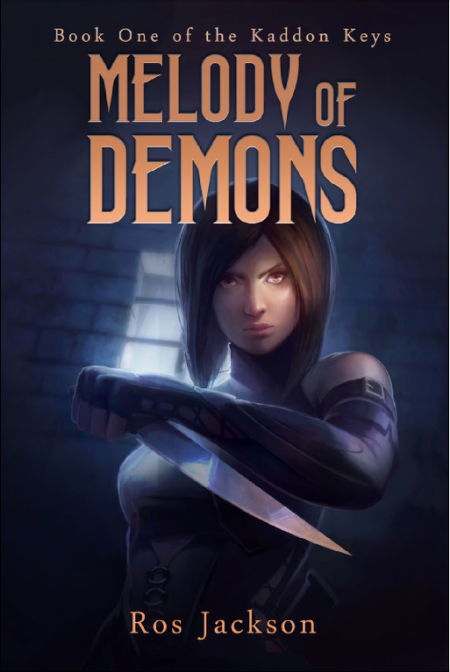
Jackson, Ros: Melody of Demons (Kaddon Keys I) (2015)

Melody of Demons

I had an “aha” experience reading Melody of Demons. Asperger that I am, life apparently affects my ability to read a story. A recent family crisis brought out chaos in my head. To deal with that chaos, I unconsciously shut off certain cognitive processes, one of which was my ability to digest stories. Not until now, have I recognized doing this. What this meant with regards to Melody of Demons was that I had to keep on reading it until I could absorb what I was reading. Annoying as hell, yet an interesting observation for myself and possibly for others out there.

“Well, that was … a sermon. That’s certainly what it was. I think we all learned a valuable, no a lesson. That we already knew. Yes, one thing you can say for my father’s froth-mouthed rants, is they’re definitely spoken with words.”

Statements like this are in part why I enjoy Ms. Jackson’s writing so much. Her sense of humor fits my own. Yet that humor points to serious issues. In this instance, Ms. Jackson showed me how much certain people enjoy going on and on about their prejudices. Poor Aivee had to endure the rantings of a man who had it in for her kind of people, i.e. half krin/half human.

In this medieval world called Tazelinn, magic exists. For some people, only certain types of magic are acceptable. Krin aren’t human-looking at all (except maybe the bi-pedal part), but somehow they have an innate magic that enables them to shift to human and even interbreed. Aivee is the result of this ability. In all ways she seems human. But that shape must be maintained at all times. Her default shape is krin and her greatest fear is that others discover that she is different. I like the way Ms. Jackson shows us what a strain passing is for Aivee.

“She hadn’t noticed before how disconcerting the rhythm was, like the breath of a monstrous beast in her ear. Now everything was more solid, more real. She ran her fingers of the floorboards and felt the grain of them and their unyielding hardness, as though for the first time.”

Aivee’s innate magic appears to be based on sound or music. In Aivee’s case she uses music. As the story unfolds, we see her gain confidence in her abilities while she remains desperate in her need to hide her krinness.

Through misadventure, Aivee comes in contact with the Kaddon Keys. Finding a less qualified vigilante group would take some work. Yet the Kaddon Keys is the only thing The Missing have between themselves and being lost forever. Kaddon’s Guards (police) certainly aren’t looking for them.

Good intentions are a great place to start, but planning would make the difference between being beat almost to death and success. The Kaddon Keys tend to end up with a severe need for healing. Thankfully, they have their own healer. Duando uses crystal magic to help the Keys survive. Three other members are the owner of the Cross Keys, Fendo, and his two children Riko and Lendia. Riko is a prime example of a patriarchal society with his views on women and their abilities.

The only one of the three women in the group who fights to be seen as equal to the men is Niro. Niro’s sister has become one of the many missing in Kaddon. Not knowing where her sister is, drives Niro to demand a place in the group. Soon after she becomes possessed by a voice that fights for control of Niro’s brain. There is one advantage to this possession. Niro gains the ability to fight with and without weapons, but she must allow the voice control of her body while still remaining in charge herself. I do not envy her that challenge. This voice is the reason Aivee became a member of the Kaddon Keys.

Kaddon has its own gangs, and they each have a territory. Like all gangs, the Neffar are extremely territorial and they think the Keys are competitors. Their fearless and feared leader Leussan does her best to make the Keys history. The Neffar aren’t the only ones who end up wanting the Keys gone. They have angered the Guards, the corrupt nobles and whoever is behind the kidnappings as well. How they are going to do the missing any good is a mystery only Ms. Jackson knows how to solve. She will have to guide the Keys to the missing and save them from the above and several others who come their way.

Melody Demon was a fun adventure story to read. It can be read on its own, yet we are left in no doubt that there will be at least one more story. I look forward to it.


Melody Demon was given to me by the author.

Sagara, Michelle: Cast in Secret (Chronicles of Elantra III)

Once again, my son and I have finished reading a book together. He enjoyed the first two books of the Chronicles of Elantra, which is why we just finished the third one, Cast in Secret. My son’s conclusion about Cast in Secret was to get me to begin reading the next in line. He laughed a couple of times, giggled some and seemed touched by certain parts of the story. I had similar feelings in about the same places of the story as he did.

Kaylin’s attention deficit disorder is a good thing for us, the readers. This way Sagara has an excuse to introduce us to concepts Kaylin missed in class. Even though Kaylin knows she needs to learn certain principles about magic and ought to know more about racial relationships in Elantra, she seems to struggle with the same inability to pay attention to subjects she considers irrelevant to her job as I do. In social settings this proves a problem for her, and Lord Sanabalis is clear on her being a long way from ready to meet the Emperor (unless she wishes to be eaten). Some people need to learn from experience rather than theory (well, actually, I think that most of us only get true learning through experience). Kaylin needs this more than most people. This inability to learn any other way tends to get her into trouble.

I like Michelle Sagara writing about a person like this. With one dyslexic son, one autistic son and one autistic mother in this family, we are all stuck in that mode. My reading ability, age and gender have probably all contributed to the theoretical understanding I have of people. Face to face encounters can go really well, but like Kaylin I tend to break social rules. Admittedly, some of that disobedience comes from not seeing the importance of the rules, but there again Kaylin, I and both of my sons find common ground. Other rules are broken because we do not understand them.

Words. Such a powerful tool. And what a difficult tool it is to wield. Sagara does a great job portraying the difficulties that arise from not understanding what is being taught. Kaylin has a theoretical understanding of what the Tha’laani are, but she is petrified of them. Her terror is a common one in humanity – fear of the unknown. In this sense, all humans are autistic. But just because a race is physically able to read your secrets, does not mean that they want to. Unfortunately, we humans seem wired to think that if a person is born a certain way, then that means that they wish to wield that “power” over you. We seldom stop to think that the other person might be just as afraid of us, disgusted with us or simply does not care about who and what we are. I suppose that comes from our ego-centrism.

Thankfully, Kaylin is also the kind of person who tries her hardest to face her fears. Facing our fears is so stinking hard. But sometimes a situation arises that forces us to do so. And what do we usually discover? Well … The answer is given considering the story and the obviousness of the question. In Kaylin’s case, the Tha’laani children helped her face and overcome her fears . Children are great fear-breakers that way – if we let them be.

Definitely recommended.

—————————————————————

Reviews:

—————————————————————

Cast in Secret available at Scribd.com

—————————————————————

My review of:

  1. Cast in Shadow
  2. Cast in Courtlight

—————————————————————

Translations:

Le secret d’Elantra: T1 – Le Cycle d’Elantra

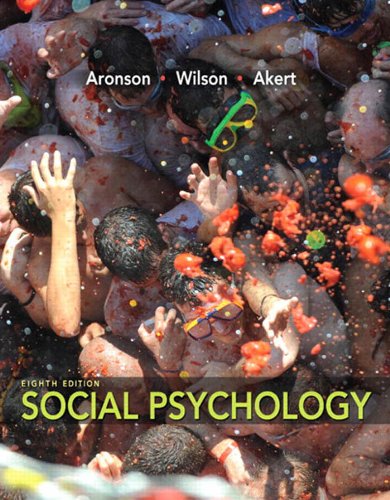
Aaronson, E.; Wilson, T.D. & Akert, RM: Social Psychology

Social Psychology - Aronson Wilson Akert

Social Psychology by Elliot Aronson (University of California, Santa Cruz), Timothy D. Wilson (University of Virginia) and Robin M. Akert (Wellesley College) is one of the books that has made the greatest difference in my life. In fact, I would call it the “great eye-opener” for me, enabling me to acknowledge my own right to truth. An immensely painful journey was what lay ahead of me, one that went against what I had previously thought true. Of course, this did not happen solely due to Social Psychology, but Social Psychology was what enabled me to ask the right questions about the world.

As you might have guessed from the title, Social Psychology is a book about social psychology. It happens to be meant for students taking psychology classes and costs a whole lot. The version I have, is the second edition published in 1997. The current edition is the eight and updated from my older one.

Today I just added a few trailers and films to the left sidebar. From my own observations and the examples in Social Psychology getting ourselves to see another person as “other” allows us to accept and do unto others actions we would not so easily accept being done or doing to our own people. We/them, people/objects, worthy/unworthy or good/evil labels added to other people allows us to rationalize what we do and accept. Some of the experiments that illustrate this gave results that were somewhat surprising at the time. The famous Stanford prison experiment showed how seemingly decent people did terrible things to others given the right circumstances. Stanley Milgram and his team showed how far people were willing to go in hurting others given a uniform was present.

I doubt being autistic/aspergian makes it any easier/worse to discover how convoluted human thinking is. At first I resisted, then I observed and read some more.  Eventually, I had to accept that I was no different than others, and that acceptance has made it slightly easier to recognize what is going when it happens and to adjust my own actions. And when I rationalize, am being a hypocrite or join in group thinking something goes off in my brain and I am able to decide whether I want to continue the behavior.

Perhaps the greatest advantage to being aspergian (at least a highly functioning one) shows itself in what happened once I realized that the authors of Social Psychology might be correct. We go off on tangents in our lives and become extremely interested in something. I need the written word. Television and films often overwhelm me. But books and the computer screen are fine. So I read A LOT. Which is what I did and do regarding social psychology processes.

Now, with 50 being right around the corner, I find it impossible to view others as evil/bad/them once I get time to take a breath and think. Often I disagree with their way of thinking. Sometimes I think that people are incredibly stupid with the tools they use to get their point across. But to them it all makes sense. Some people think of me as bad/less/outsider/evil and that is fine. Sad, but fine. Why should they be exceptions to the social influences we all come under?
Definitely recommended.

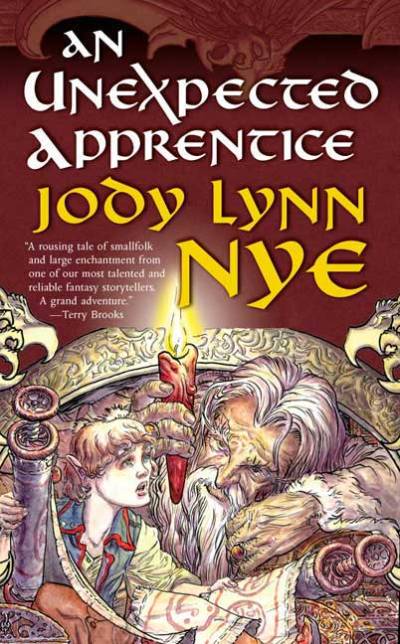
Nye, Jody Lynn: An Unexpected Apprentice (Tildi Summerbee I) (2007)

An Unexpected Apprentice
Cover art by Michael W. Kaluta

“Her friends shot her sympathetic glances, but none of them dared leave their husbands’ or fathers’ sides to be with her.

Smallfolk tradition prevented the girls from going off without permission, even such a small distance. It was only common sense, Tildi had been lectured all the time while growing up. Girls weren’t as strong or as fast as boys. Plenty of dangerous creatures lurked about the Quarters waiting from such a tender young morsel to happen by unprotected – and not all of them were wild animals. That was the rationale her mother had given her for why the custom continued even in cultivated places where there was no reasonable threat. The explanation did not satisfy her, but such matters could only be discussed in private among her companions where the boys couldn’t hear them. Disobedient girls would be made to stand up in meetings with a slate around their necks that read SHAME.”

Even today it can be difficult to find female main characters who stand alone. Or rather female characters who do not need romantic involvement or hero-worship of a male character to keep the story going. Tildi Summerbee in An Unexpected Apprentice manages to be such a character. Perhaps that is not such a surprise considering the society she comes from. In tearing herself loose from the Smallfolk Quarters and setting out on her own, Tildi has to redefine and question the values she has grown up with. Having been orphaned from her entire family is probably a major factor in her seeking her own future independent of the voices of her elders. Sometimes it is when we seemingly have no choices, we find that it is only just now that we have real choices.

I like Tildi. She goes from questioning her right to do anything to being someone who has learned to do without all the things she had previously thought important.

The wizard Nemeth is the reason Tildi and her merry band of 6 set off on their quest to recover “The Book” (really a scroll). My diagnosis is that Nemeth has gone insane from his contact with The Book and from his lust for revenge. I understand his need. Who hasn’t at some point or another wished for the ability to pay back some perceived wrong (whether real or imaginary). Revenge coupled with power over the fabric of the world turns out dire in its effects.

Thankfully Tildi’s merry band is a little more experienced than she. We have the wizards Edynn and her daughter Serafina. Both are accomplished at their craft even though Edynn has centuries more experience than Serafina. The princess Rin is the representative from the centaurs (half horse/half human). She is highly competitive, fun and strong. Tildi ends up having to catch a ride with Rin because of her complete lack of experience in riding any kind of animal. Lakanta is a peddler and a seemingly odd choice for the merry band, but as the story progresses we see that she too represents a group of people that aren’t quite human. Finally we have the Captain Teryn and her soldier Morag. Morag has been magically transformed into a mix of human and something else. For natural reasons he tends to panic when faced with too much magic. The Captain is highly protective of Morag.

There are two more characters that I really enjoyed in An Unexpected Apprentice. One of them is Silvertree. Silvertree is supposed to be the home of the wizard Olen. It is that. But Silvertree is also a person in its own rights. If visitors offend it, Silvertree makes life a whole lot more difficult for them – the way it did with Rin’s brother when he was rude to it. Tildi, on the other, hand gets VIP treatment from Silvertree. I like a tree with a personality.

Magpie is another great character. He lets the world think of him as nothing more than a troubadour with his mind aflutter with silliness. In fact there is a bit more depth to him and he just happens to be the third son of King Solindur of Orontae.

Nemeth isn’t really “the bad guy”. He is just crazy. If I was going to pick a “bad guy”, I would have to choose the Scholardom. Scholardom is such an innocent sounding word. Well-intentioned people can be incredibly dangerous. Getting their hands on The Book is something that must be avoided for these are the people who want to correct all the aberrations of the world. That would mean that any mix of human and other should be changed into human. They find it unfathomable that anyone would actually choose to remain as they are.

I think An Unexpected Apprentice would fit the age range of anyone able to read the Hobbit or Harry Potter. An Unexpected Apprentice is full of humour, of action, warmth, and drama.


Reviews:


Sold at Amazon

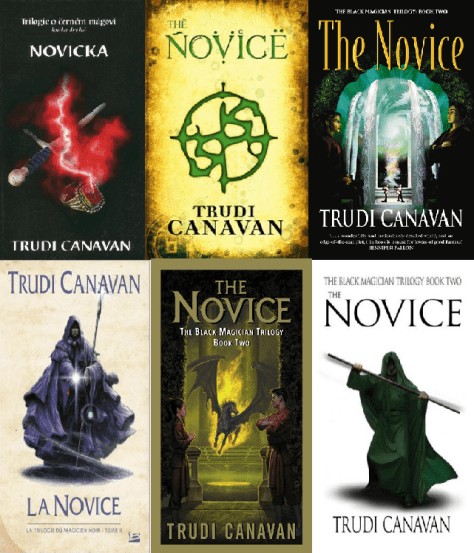
Canavan, Trudi: The Novice (The Black Magician II) (2004)

The Novice - 6 different covers
Cover art by:
Top right: Les Petersen
Bottom right: Steve Stone
Bottom centre: Matt Stawicki

Once again Trudi Canavan has shown that she has the ability to reach audiences all over the world. The Novice has been published in three English dialects and 12 other languages. The Black Magician trilogy is a serial. You are going to have to begin with The Magician’s Guild to make sense of The Novice.

As with The Magician’s Guild, I was my son’s audiobook. This time the experience as an out-loud-reader was much smoother. Whereas The Magician’s Guild has awkward phrasing for an out-loud-reader, The Novice flowed as it ought. Being the one who was read to was an enjoyable experience for my son.

Story 1

Breaking out of an abusive relationships is a challenge. In some cases the victim never does while in others some kind of catalyst comes along that makes freedom possible. Before that time, though, pain, confusion, humiliation and helplessness are feelings the victim is dragged through time and again.

Sonea being bullied by Regin and his compatriots (fellow novices) is such an abusive relationship. Regin’s venture into physical and mental violence begins during the first year and follows Sonea into The Novice. One would have thought that Sonea gaining the guardianship of the High Lord would prevent him from being cruel, but no. Regin soon discovers that Sonea is afraid to tell the High Lord what is going on and takes that as encouragement to increase the intensity of his bullying.

Bully lust is a strange thing. I’ve often wondered what makes an abuser tick. Growing up I never understood why the other kids felt it appropriate to tease and harass me. As an adult I think I can see what the attraction is. Power seems to be orgasmic to some people. Being able to get others to go along with what you are doing probably increases that feeling. Regin certainly seems to be getting off on what he is doing to Sonea.

Like a lot of people being abused, Sonea is afraid to tell those in authority about the bullying. She is afraid that matters will get worse. Sonea sees that the episodes that happen in class do not bring about punishment for Regin and I imagine that would make her hesitation even more intense. Class-differences between the victim and the abuser probably made it even more difficult for Sonea to open up about what was going on. After all, what could she – a slum-dweller – hope to achieve with reporting the abuse when the rest of the magically inclined people at the university were of the upper classes.

In- and out-groups. We and them thinking. I think this is one of the most frightening thing I find about humans. When I read some of the comments that are written on some of the sites on the net, I am confused by how others bully writers in the most cruel manner by dehumanising the blog’s author. Regin’s treatment of Sonea is a prime example of how one person makes another person a “them” and thereby setting his behavior at – “not at fault”.

All it takes is one person. One person to make it all bearable. Sometimes one person to help you see the light. One person. You will meet him in The Novice. That one person with the ability to think outside the box. The one who dares think of “them” as human too.

Story 2

Dannyl’s experience with The Thieves has made him prime candidate as Guild Ambassador. I’ll bet he never saw that one coming. Dannyl is one of those people I just could not help but like. His behavior and attitude is clearly colored by the treatment Fergun put him through while they were both novices. Surviving abuse gives us a perspective on life that we would not have otherwise. If circumstances allow, that understanding can be put to good use. Both Dannyl’s behavior and his attitudes have been challenged and continue to be challenged during his adventures in Elyne. His friendship with Tayend shows his strength and the pain of the past he still carries around on his back.

The Novice was fun. Painful at times when old memories were triggered, but fun.


Reviews:


  • Paperback: 592 pages
  • Publisher: Orbit; A fmt edition (1 July 2004)
  • Language: English
  • ISBN-10: 1841493147
  • ISBN-13: 978-1841493145
  • Amazon

My review of The Magician’s Guild

Soriano, M.F. : Blood Brothers (Bound By Blood) (2013)

Blood Brothers
Cover design by Streetlight Graphics

Blood Brothers is Soriano’s first completed fantasy novel although he has previously published some work under the pseudonym of Don Broma. It is the first one in a series, something that means that we actually get an ending – something I really like. I also really liked the cover designed by Streetlight Graphics. Soriano actually managed to include the name of the cover designer. I wish all authors could do that, even if the designer is themselves.

I have to say that my favorite character was Verlvik. There was absolutely no competition in my mind. He is so completely alien to my way of thinking and yet completely magnetic. This is what I mean by alien:

“The bird let out another chirp, and then broke out in song. High exultant trills that soared up in bright melody, and then dipped into lovely low warbles. Verlvik’s lips split into a wide grin. It delighted him that such a small creature could be so full of life.

For several minutes the bird poured its heart into its wondrous song. And then, as if singing weren’t enough, it started dancing too. It bowed its cherry head low, spread its brilliant wings, and started hopping forward and back.

Verlvik pushed the locks of his hair out of his face, and turned his head slightly to the left, to get a better view of the bird with his good eye. The tiny bird, apparently pleased to found an attentitive audience, abandoned itself to its performance. I began to spin like a little top, its bright wings flashing in the sun.”

Here Soriano has set me up with an image of a perfect moment in life. The vividness and feeling of this picture is so clear. And then he hits me in the head with a hammer:

“One of the bird’s spins brought it within Verlvik’s reach, and quicker than a cat he’d snatched the bird up and popped it into his mouth. Its little skull cracked like a nut between his teeth, splashing his tongue with a burst of rich flavor. Its delicate ribs splintered as he chewed, and pricked the inside of his lips, salting the meal with a hint of his own blood. He closed his eyes and munched away happily.”

Say what? My mouth practically fell open. Then I laughed and was completely in love. A better job at setting me up has seldom been done. The superlatives are lining up. A character like Verlvik has never come my way before.

Grillis is the first one we are introduced to. He is about 18 years old and is now alone in the world. Because of a facial birthmark others tend to avoid him and he has been bullied some. He was raised by his grandmother and well-loved. Because of this love he has learned the ability to trust, something that will come in handy for him but also bring him trouble. Grillis is also the kind of person that just keeps on going. We meet Grillis a lot in fantasy literature and I have to say that putting him first fooled me into thinking that this was a regular hero’s journey novel. Blood Brothers is not quite that but it does have elements of it.

Athemon is a character I understand. He has grown up bullied for who he is, growing up among a people who have been taught that they are less than the others. We get a taste of that bullying in his introduction. I have to say that my heart-strings were playing low notes in reading about the way he was treated by “his betters” and how his father reacted to that treatment. Sad, sad, sad. One day Athemon has had enough and his revenge is sweet.

All three characters are brought together and together they have to fight some really bad guys. If I was going to guess at target group it would be somewhere in the YA range and up. Maybe not too young because of some of the violence.

One of our characters is human, the other is a caprine and the third a pictsee. The story is told from each person’s point of view and that means, of course, that we switch between Grillis, Athemon and Verlvik.

When switching between characters like Soriano has done it can be difficult to keep in the flow. As I am sure you could tell from the quote above, Soriano definitely has a feel for the flow and he stayed in it a lot of the time. When he falls out he manages to find a way in. This is an excellent quality and it is obvious that Soriano has a talent for the craft. Every once in a while I felt preached to. All it takes to get that away is a little more editing and that will probably hurt.


Blood Brothers was given to me as a reviewer’s copy. As usual I have tried not to let this influence my review.

Hicks, Michael R.: Confederation (In Her Name – Redemption) (2008)

Confederation

Cover art by Michael Hicks. Stock images from bought from Dreamstime.com and edited in Photoshop

Has your loss ever been so strong you thought you would die from the pain? I imagine a lot of people of my venerable age of 48 could say yes. How do you deal with something like that? Well, you either learn to live with the pain or you kill yourself I imagine.

Reza Gard has experienced this kind of loss. The kind that rips you apart and leaves you feeling like a raw wound. Life sometimes does that to you.

I think this is part of what makes Michael R. Hicks’ writing flow for me. He leaves me with a sense of someone who understands the feelings he writes about. I highly doubt he has fallen in love with an alien and had to leave her Empire cutting off all contact with the race, but loss is loss.

Just as his disappearance from the Empire was sudden, so too was his appearence in the Confedration. Like an angel from heaven Reza seems to come as the answer to Father Hernandez’ prayers for redemption from the Kreelans. The Marines who are left after meeting the Kreelan warriors are happy about the result of Reza’s return.

For me the Redemption trilogy has partly been about prejudice. What Reza meets upon his return to the Conferation are mixed feelings. Some see him as a threat to humanity while others (those who come to know him) understand that his sense of honor goes beyond what most of us expect. Fraternising with the enemy/the others, becoming like them and then returning to one’s roots is bound to antagonise some people. Being an “Other” myself I have experienced how difficult it is for some to accept my “Otherness” as just as good as their way. Reza’s story has in a very small way been my story.

Confederation shows humanity as it is.


You can meet Michael R Hicks photo at Michael R Hicks Logo, twitter-icon1 and Facebook-Logo.


My review of Empire

Hicks, Michael R.: Empire (In Her Name – Redemption) (2009)

Empire

Cover art by Michael Hicks. Stock images from bought from Dreamstime.com and edited in Photoshop

I saw the old cover on one of the reviews below and prefer this one.

Flow! To me it is all about the flow. It is that magical quality that some authors are born with and some authors can work their way into. Maintaining the flow through a whole text, whether it be fiction or non-fiction, is something most authors struggle with. Some authors never hit it while others fall in and out of it. Then we have the others.

Michael R. Hicks has the ability of remaining in the flow. He did it so well, I had to get the other two novels in the Redemption trilogy and read them right away.

Maybe part of that has to do with the harshness of Empire. Michael did not try to sugar-coat the conditions of the orphanage. I imagine there are people out there who cannot believe that such things exist, but they do. Muldoon is nothing unique in the world of orphanages.

The other thing that really hit me was Reza’s ability to adjust. Some people are like that. They just bend with the blows that life hits them with. Me, I’d break having to live through the death of my parents, abuse at the hands of caretakers and finally having to live with the enemy. Whenever I meet a bender, I am impressed all over again. So, I was impressed with Reza.

As Reza learns so too does Esah-Zhurah. She goes from thinking of him as beneath her to gaining a grudging respect of Reza’s possible value. Inevitable I guess. Tearing down the walls of propaganda takes time – even for superior aliens.


You can meet Michael R Hicks photo at Michael R Hicks Logo, twitter-icon1 and Facebook-Logo.


Empire is available free as an e-book at most online retailers. If you can’t find it free at your favorite e-bookstore, you can always get it free from smashwords-logo in multiple e-book formats.


Ficks, J.L. & Dugue, J.E.: Kingsblood (The Chronicles of Covent) (2012)

Kingsblood cover

On the planet of Covent there once lived a dark elf named Shade. Growing up had brought Shade into the assassin work-force. I’ve often wondered what makes an assassin. In chapter 1 of Kingsblood we get a look at part of what brought Shade into the business.

I like Shade. Yes, he does some pretty gruesome stuff. But, you know, we all do at one time or another. Sometimes we are the victim and sometimes we are the perpetrator.

To Shade being an assassin is a job that he takes pride in. He is the best in his field. There are some people he will not kill – women and children. He also prefers to kill those who he considers black marks on his planet. Shade’s abilities are the best and therefore he wants jobs that challenge him. If you end up being under his protection, you know that you will be protected. On the other hand, if Shade decides the world is better off without you – well …

One person Shade decides to take under his wings is King Magnus. But, you know, one person (albeit the best assassin in the world) against a whole guild of assassins? Maybe Shade has bitten over more than he can chew this time. He is not quite alone. Shade has strange and mysterious people who root for him. Some of them even aid him. Hmmm. Wonder what kind of agenda they have?

There is plenty of action and humour. Our clumsy duo reappears in Kingsblood. You know, I feel sorry for them. Poor guys are out of their league.

Although several of the characters possess magic, there wasn’t really a lot of focus on magic. Instead action scenes were more about the fights themselves and Shade’s ability to be a shadow. King Magnus should be glad Shade is on his side.

I am going to say one extremely positive thing about Fick’s and Dugue’s writing. Even knowing what their agenda is, I struggled to see it in their writing. No soap-boxes, just really good writing.

 ——————————-

You can find the authors at Facebook-Logo and twitter-icon1.

Thom Scott’s website (last updated 2011)


DWED reviews


My review of The Waiting Game

I received a copy of Kingsblood as a reviewer’s copy but have tried to not let that influence my review.

Greenwood, C.: Magic of Thieves (Legends of Dimmingwood) (2012)

Magic of Thieves
Cover art by Michael Gauss

I really like the cover of Magic of Thieves. I don’t know if the gold effect carries over to paper-backs. On the screen a feeling of magic shines through.

Magic of Thieves seems to be a novel meant for a Young Adult audience. Our novel begins with the death of Ilan’s parents. Ilan is a “half-breed” as propaganda calls her. Being half Skeltai/half human is frowned upon. Having a parent who is a magic user is even worse. All of a sudden magic has become evil and the Praetor is on the hunt for all magic users.

While trying to escape the soldiers hunting for her, Ilan’s magic is triggered. The family friend Borlan takes her in but realises that she cannot stay. He gets a peddler to take her to Cros where she ought to be safe as a magic user. But they get waylaid by the thieves of Dimmingwood. This is where Ilan’s life takes a strange turn and she grows up among the thieves with the one called Brig taking a special interest in her raising.

Ilan is a feisty girl having to deal with the loss of her parents and the new father figure in her life. As she grows up her emotions grow up with her. I think Greenwood has made a believably tiresome and brave person who just tries to figure out her place in life. Encountering those who are stronger and weaker than herself is just part of the game.

Terrac was a self-righteous pain in the butt, as I guess he was intended to be. This too seems to be part of the teen-agy hormonal thing that we all have to go through. Some of us even retain that less than stellar quality. But Terrac had guts. He was brave enough to do what had to be done while trying to stick to his convictions.

These are the main two characters of Magic of Thieves. It was interesting to behold the changes they went through as life’s usual surprises hit them.


You can reach Dara England at DaraAndCarol and twitter-icon1.


Other reviews: The Middle Nerd

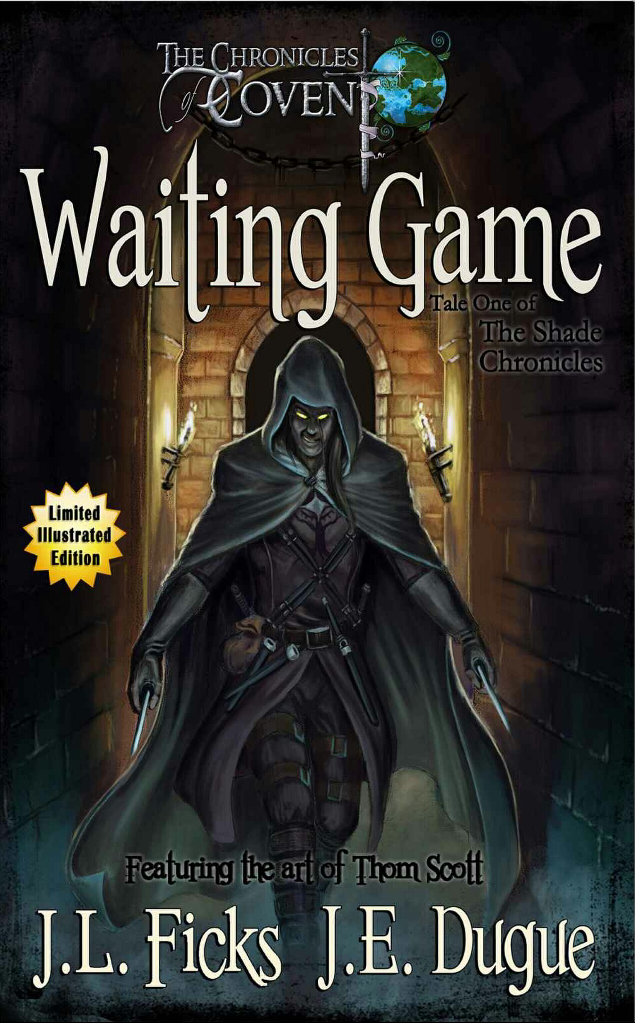
Ficks, J.L. / Dugue, J.E.: Waiting Game (The Shade Chronicles) (2012)

Cover artist Thom Scott
Logo by James Gilks

First things first. You really ought to take a look at the website Chronicles of Covent. It is full of great art and loads of information about characters and storylines. The cover artist, Thom Scott, is responsible for the artwork done on the website. From what I can see on their website Ficks and Dugue aim to create a world that functions as the Forgotten Realm does – with an abundance of authors dealing with the eight continents of Covent.

The Shade Chronicles are about Shade the assassin, probably the best in his field. He is an Unseen (the best of the best) gone rogue and knows to stay away from the forest surrounding his school. Shade is also a dark elf and are exposed to prejudice just like the ones in the Forgotten Realms. 

The Waiting Game is the first book of this series. It has a proper ending and that makes it a series. I prefer stand-alone novels to the serial type. Serials can be annoying.

Shade is bored. He has been trained to utilise his killing abilities to the fullest and is beginning to run out of challenging kills. Anything will do as long as the hit is difficult. He gets what he wants and from there on there is action galore.

There were two scenes that I really liked. One was in the underground while fighting his challenger. The other was in the bar when Lewd’s hench(wo)men kept coming.

It was refreshing meeting someone who wasn’t out to save the world or make it a better place. Instead we find a dark elf who strikes fear into the hearts of all who realise just who they are dealing with. Only idiots mess with Shade but despite the fear he engenders, Shade is not a bully.

Shade was an interesting character, maybe even some one I would like to meet again. What did I think of the writing? Well, Ficks and Dugue kept me reading. They are above average but fall out of the flow at times. That just gives them room for improvement and I expect we shall see that as time passes.