Category Archives: Science Fiction

Farrugia, Nathan M.: The Seraphim Sequence (The Fifth Column II)

The Seraphim Sequence - Nathan M Farrugia

The main question in The Seraphim Sequence seems to be “who is really on Sophia’s side” in her battle against the Fifth Column. She trusts five people. These are Jay, Damian, Nasira and Benito. Her hero is Freeman, the leader of the Akhana. Anyone else is questionable in her mind, although there are a couple who seem to grow on her. Feeling as though you are able to trust as many as five people, considering Sophia’s background, is actually pretty good.

A group of psychopaths deciding the way the world is run doesn’t seem that far-fetched to me. At one point in the story Jay even feels as though he is in a Dan Brown story to which Damien responds “Please don’t make this any worse than it has to be,”. Jay does his best to keep the fighting off them, but a Farrugia novel will not leave its characters in peace. I can only hope that the main characters survive Mr. Farrugia’s clever pen.

Sophia is still dealing with her guilt regarding the 400 million women she inadvertently caused to die horrific deaths. Therein lies the difference between Sophia and the pscyhopaths, like Cecilia and Denton, that have been and are in charge. One has regrets and one does not. On one point, I will give the psychopaths their due. One of them states that being relieved of feelings of guilt would make Sophia more efficient. That is true. Guilt does slow a person down. It makes us rethink our options and try to find less destructive ones – for the people we wish to save. Destruction for the other side should be as complete as possible. Maybe we are all psychopaths to one degree or another.

There is a lot of action and plenty of fun weapons that aren’t too terribly different to what is available today. The weapons that do deviate are within the realm of possibility – at least they are to my non-weapon knowledgeable mind.

Definitely recommended.


Reviews:


The Seraphim Sequence available on Kindle


My review of The Chimera Vector


Can Genes be Turned on and Off in Cells?

DNA building blocks can be made in space, NASA

Human Genome is Part Bonavirus, Tina Hesman Saey

Microwave Mind Control, Tim Rafat

No, diatoms have not been found in a meteorite, Phil Plait

Pseudogenes (from Farrugia’s website)

The Psychology of the Mob Mentality, Nicola Davies

The Roots of Evil by Erwin Staub

Bertauski, Tony: The Legend of Socket Greeny (Socket Greeny III) (2010)

I bawled. Yes, I bawled at the conclusion of the Socket Greeny saga. I even sent the author a text stating that he had made me bawl.

Everything is a lie.

Socket, Chute and Streeter are young for the kind of lives they live. Socket has to take on more responsibilities in being a symbol for the Paladin Nation. But being seen as a super-hero isn’t that big of a deal for a teenager who would rather be with his friends. Unfortunately, being seen as a super-hero is a label Socket isn’t getting away from any time soon.

Socket’s super-hero status came from being able to distinguish reality from lies. Except, what do you do when you discover that the things you thought you knew about yourself are wrong? Everything you have been told is a lie. How do you then keep yourself transcended? With age I have discovered that most things we are told about the world and ourselves are false to one degree or another. For Socket this discovery comes abruptly and at a time when he thought life was finally looking up.

Yet, Socket keeps on going. Then serious trouble comes his way. Where does the line between human and artificial intelligence go? Could an AI become truly human? Bertauski asks this question, and it is one that researchers and laypeople have asked themselves a great many times. I find myself not really caring. Perhaps that is because autists have been and still are considered as less than human. Not that I believe for a second that autists would be more welcoming of AI’s than allistics. Not at all. But I wonder if I might?

Poor Socket Greeny. He is in for “the slings and arrows of outrageous fortune” and the pain that goes with that. Socket is also in for a whole lot of action and difficult choices. Not only the lies told to him by others will have to be faced but also the lies told to him by himself. Personally, I find those the most difficult ones to deal with. Somehow, being honest with myself is much more painful than being honest with others. But that honesty offers growth. Growth that aids Socket Greeny as he fights for survival against the terrifying creatures he encounters.

Definitely recommended. This is a serial, which means you will need to read the previous ones to understand The Legend of Socket Greeny.


Reviews:


The Legend of Socket Greeny available on Amazon US and Audible


My review of:

  1. The Discovery of Socket Greeny
  2. The Training of Socket Greeny

Bertauski, Tony: The Training of Socket Greeny (The Legend of Socket Greeny II) (2010)

To me The Training of Socket Greeny is, like The Discovery of Socket Greeny, about identity. But it is also very much about seeing things as they are. You know, seeing through the bullshit of the propaganda we are fed, and seeing through our expectations into reality. Which is kind of odd to me as much of the book happens in Virtual Reality (no, not for real).

And what a VR it is. Poor Socket draws out new abilities, but the cost of his new abilities is high. His trainer, Pon, puts him through a program that is enough to kill anyone. This is where VR is a good thing. Except some of the damage Socket sustains is real and he has to learn to transcend it. In fact, it seems as if that is what his training is about: transcending himself. Socket doesn’t understand what that entails and I am going to admit that I don’t either. Because how do we let go of our fears. In a sense, they are kind of comforting because we don’t have to think so much about what is going on. But there is a part of me that would love to be able to set them aside.

Socket also has to figure out if transcending himself means that he has to leave his old life and his old friends behind. When do we reach the point of not being able to give any more? Lots and lots of existential questions are being asked throughout the trilogy, questions that we sometimes forget to ask as we grow older. However, these are questions that a lot of youth ask themselves.

It wouldn’t be a Bertauski story if there wasn’t a lot of action thrown in with the deeper story. The action is excellent and probably too violent for some of you. There are also romantic bits.

Definitely recommended.


Reviews:


My review of The Discovery of Socket Greeny


The Training of Socket Greeny available on Audible, Amazon


Bertauski, Tony: The Discovery of Socket Greeny (The Legend of Socket Greeny I) (2010)

Sixteen years old and ripped away from all that was familiar into a new world where his whole identity needs to be re-discovered is pretty much what The Discovery of Socket Greeny was about for me.

My son is doing a paper on tourism, and in it he mentions the possibility of replacing our corporeal experiences with virtual reality ones. In the life of Socket Greeny and his friends technology has gotten to a point where this is possible. Teaching is done this way. Although the students come to a physical school and sit in classrooms with a teacher present, most of the teaching is done in VR rooms. Gaming takes on new meaning when you get to integrate yourself so fully into the experience.

But when Socket Greeny is taken from his friends he discovers that such immersion brings its own hazards, and that he is one of the tools needed to fight the dangers of the virtual world. The world he enters is brutal. His tests are intense. I suppose people who have gone through training as CIA spies would recognize the horrible invasiveness of it all. Yet Socket endures.

Much of that endurance is due to his friend Spindle. Spindle is always there for Socket. His patience and kindness is limitless. One might almost be tempted to think that he was programmed to be that way. And perhaps he was. But then again maybe not.

I am thrilled not to be Socket Greeny, but I am thankful for having met him and his unusual world. Definitely recommended.

—————————————————-

Reviews:


The Discovery of Socket Greeny available on Amazon US

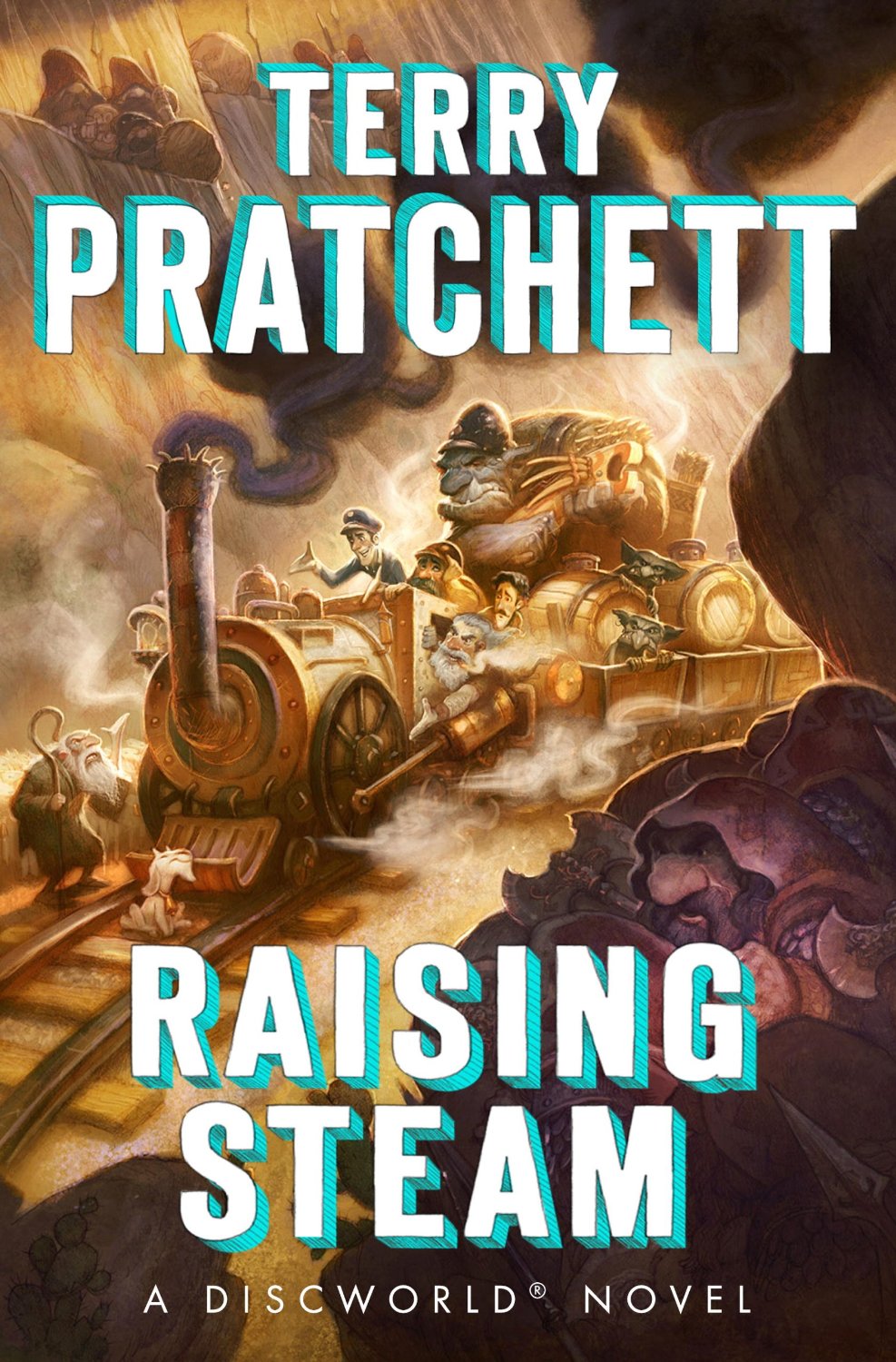
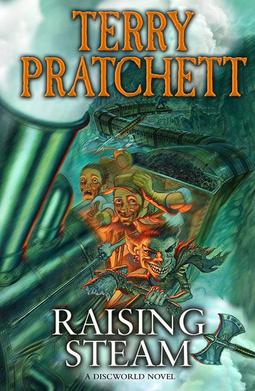
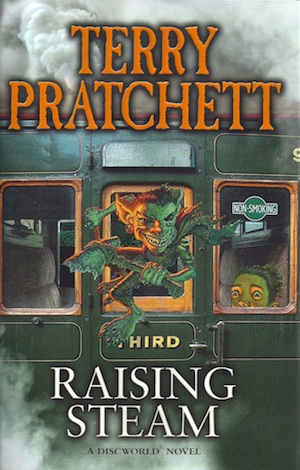
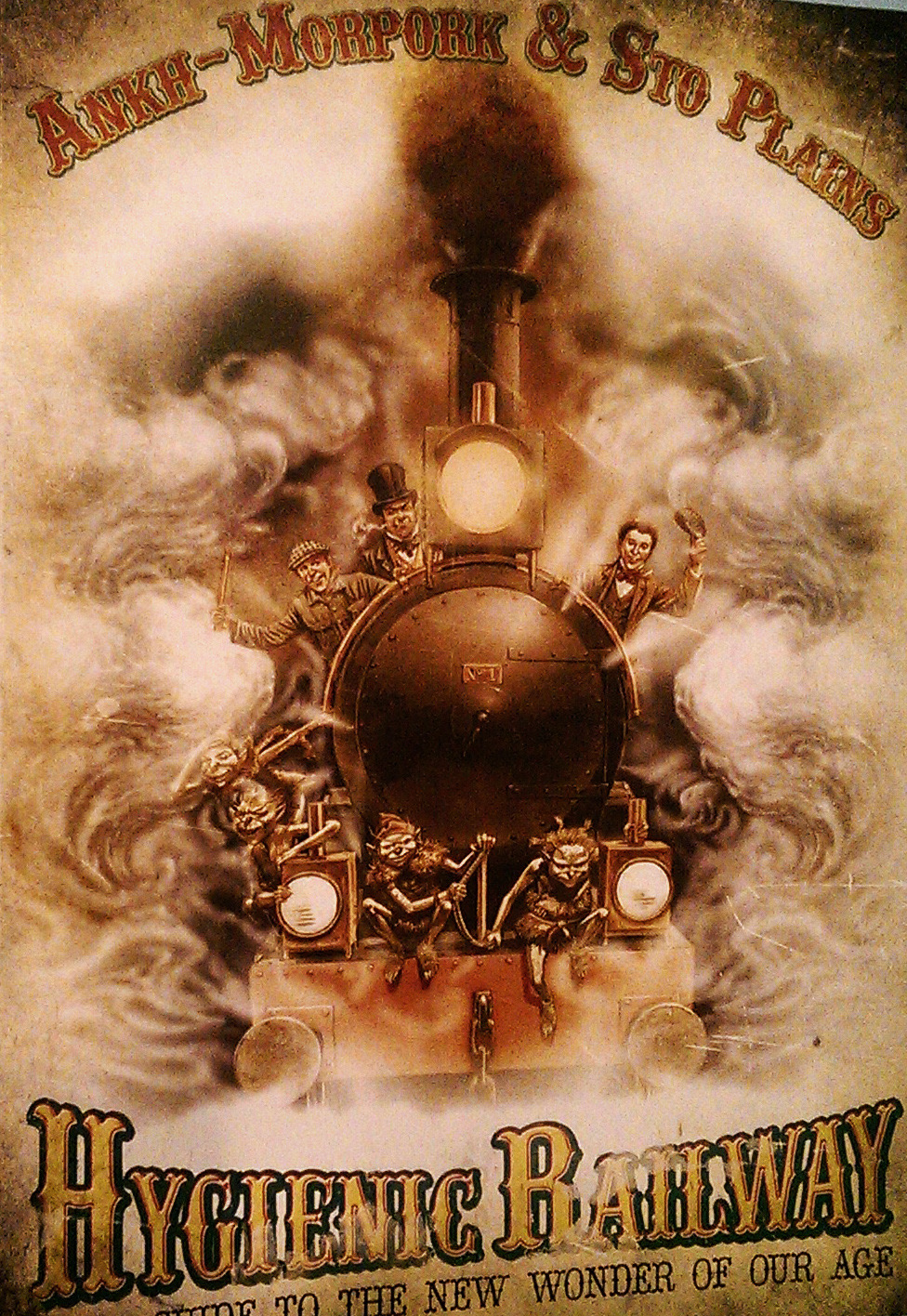
Pratchett, Terry: Raising Steam (Discworld 40) (2013)

Terry Pratchett is God. Or perhaps he is Moist von Lipwig. What a name. Seriously! Pratchett has a way with names that I have never seen outdone.

I loved Raising Steam. Goblins are my new favorite race. These people keep on knocking over the expectations of other races time and again. Their freedom from being eaten, chased, beaten and downtrodden (at least in theory) has led to them outdoing many of their old masters.

Perhaps this is the main reason Pratchett has caught my heart. He isn’t afraid to address problems in society, and he does it in a manner that helps me see them in a new light. Moist von Lipwig is an excellent conduit for that message. He races through the story having to face himself ever so many times. Facing myself is not my favorite pastime but it is one that I try to make time for daily. One of the advantages of limited mobility is that I can no longer run from whatever parts of me I might wish to run from. Moist tries but Mister Of the Twilight the Darkness keeps him on track.

In Raising Steam those tracks are technology and the steam engine. But I guess like so many of Mr. Pratchett stories, Raising Steam is about our fears. Facing our fears. In this case our fears take the shape of racism, fear of technology, fundamentalism and basically fear of any person or thing that is not within our scope of experience.

We are all frightened little shites trying to muddle our way throughout life without realizing that all of the others around us are also frightened little shites. For this reason I truly love Pratchett. He shows us our fears, and our fears are many. What we need is a Vimes who asks us difficult questions and at the same time helps us realize that we are dumber than bread in persisting in our fears.

Like von Lipwig, Pratchett is my enabler. He helps me see what needs to be faced and leaves me feeling graced by his presence. No wonder he is my god.


Wikipedia: Raising Steam


Raising Steam available on Amazon UK paperback, Amazon UK hardcover, Amazon e-book, Audible, iTunes, iTunes AudioRandomhouse, Waterstones paperback, Waterstones audio, Waterstones hardback


Other Moist von Lipwig books

  1. Going Postal
  2. Making Money

Sagara, Michelle: Cast in Courtlight (Chronicles of Elantra II) (2006)

My son and I just finished reading Cast in Courtlight by Michelle Sagara.

Sometimes reading out loud is made difficult by the author. Certain bits  of Cast in Courtlight brought a “crying pain” to my chest and throat. Thankfully, I had reread Cast in Courtlight to myself ahead of getting to that part with my son, so I made it through. He did not.

Growing up hurts. Much of that pain comes from needing to change your point of view. Letting go of what you thought was truth takes courage. Courage to change often takes time and insight. Some of our memories are of the kind we would like to forget. If we were given the choice,  would we actually choose to forget? I used to think I would have dumped some of my memories if asked. Kaylin and Severn are apparently offered that option at one point of the story. What they see, experience and choose there, changes both of them.

Kaylin and Severn are two characters that have snuck into my heart. Their friendship has survived pain of the kind that few friendships can survive. At first it was the pain childhood in the fiefs brings. Later that changed into something darker. At this point of their lives their pain, once again, becomes shared and therefore somehow more bearable.

Living in the High Halls of the Barrani is not something I would like to do. Except in their bath/swim room. I wouldn’t mind living in that. Kaylin seemed to enjoy that part of the Halls as well. Other parts of the High Halls she found rather nerve-wracking. Some of the Barrani also got on her nerves. Lord Evarrim was one of them. She and Evarrim met in Cast in Shadow and their meeting was memorable. Kaylin managed to shock him then and she shocks Lord Evarrim now. Good for Kaylin.

I like Kaylin’s resilience. Severn’s is of a kind that I respect as well. But it is Kaylin’s head we get inside of. Well, actually it is Sagara’s imagination we get inside of, and I am having great fun with that imagination. Being able to share her fantasies with my son is an awesome gift Sagara has given me.


Reviews:


Cast in Courtlight available on Amazon •  ChaptersBorders •  IndieboundBooks A Million •  B & N •  Powell’s • Book Depository • Vroman’s


My reviews of:

Eoin, Colfer: Artemis Fowl and the Atlantis Complex (VII) (2011)

Part of the fun of preparing for a review of one of the Artemis Fowl stories is immersing myself in the fan art. Some of my favorites are in the above collage. The other part is reading other people’s reviews.

“Foaly,” he called after the centaur. “I really think we should search for my secret birthmark. Dragons love that sort of thing.”

Of all the quotes I could have chosen from The Atlantis Complex, this is the one that stuck with me.

Orion is Artemis Fowl’s alter-ego/alter-personality/dissociated identity. I loved him. Granted, Orion was annoying and caught up in some sort of medieval psychosis. Yet he showed us to what degree Artemis confrontations with his own past and dabbling in magic had affected him. Let’s face it. Some of the events Eoin Colfer has put his young charge through have been on the dark side of extreme. In spite of that, Artemis knows that in order for his environmental scheme to go through he has to fight the disorders that are popping up (Atlantis Complex).

My grandmother suffered from schizophrenic paranoia. Eoin Colfer stays true to what that must have been like for her (going by my dad’s descriptions of his childhood). Not trusting the most trusted person in his life is just part of the parcel. When he sent Butler off on what was supposed to be a fake mission, Artemis had no idea that Butler and Juliet (Butler’s much younger sister) would end up having to fight for their lives. And what a fight. The two of them make a great team.

Butler has long suspected that something is off with Artemis. Being sent away in this manner only makes him more determined to be there for Artemis. That is what I like about Butler. I would liken his loyalty to that of a faithful guard dog. What once began as a paid assignment has turned into a strange friendship between two unusual people. Being able to bring Juliet along with him only adds spice to his experience.

Mulch Diggums is Mulch Diggums. He is now on the “right” side of the law if you want to be an upstanding citizen. Mulch isn’t certain he wants that. During The Atlantis Complex that choice will be taken away from him. Poor Mulch. Being friends with Artemis can be quite a challenge.

Turnball Root is the kind of villain I would not like to meet. He has landed on the far side of sanity and psychopathic is a mild term for where he is at. His mission is to get to the “love of his life” and somehow save her.

Like any great author, Eoin Colfer gets me to like all of his characters. I love his humor, his action scenes and the strange people that inhabit the world of Artemis Fowl. Definitely recommended.


Reviews:


The Atlantis Complex available at Amazon US


Williams, Alayna: Rogue Oracle (Delphic Oracle II) (2011)

If humanity was at stake, what price would I be willing to pay? Is the human race worth saving? Is the life of “the many” worth the life of “the one”? What if I could see into the future and had to ask myself these questions? What then?

My personal belief is that politicians are, like the rest of us, inherently selfish. They do what is best for themselves and their tribe (party/family). If they wish for reelection, they pay the necessary price (no matter the cost to others). Lining their pockets as a bonus is part of the political game they play. Disasters, like Chernobyl, and their aftermath become some of the long-term effects of the choices of politicians and the people who wish to avoid their wrath.

Rogue Oracle plays with the idea of what a long-term consequence of the Chernobyl disaster might have been once fantasy/science fiction is applied to the subject. While unlikely to the extreme, this look at a highly unusual form of cannibalism was intensely satisfying to me as a reader. Alayna Williams made me care for the supposed villain of the story. As more and more of his past was revealed, I understood his reasons and found myself sympathizing with his cause and perhaps even his methods.

I like the idea of there being people out there who are nuts enough to sacrifice themselves for a cause. Tara and Harry fit that bill. I’m not sure the world really needs people like that. Perhaps it would even be better off without them. But they do make for fun characters in a story.

Driven by their need to save humanity from itself, both they and the Daughters of Delphi take whatever steps they deem necessary. The really funny part is that Tara is exactly the same kind of person she despises the Pythia for being. The Pythia makes choices on behalf of others without consulting them about it. So did Tara. The Pythia takes whatever actions she deems necessary to get her job done. So did Tara. This is the part of real life that I find hilarious or maybe sad. We so often hate in others parts of ourselves (myself included). Perhaps that is because our potential frightens us. Both our potential for wonderful deeds and our potential for horrifying actions.

The Steves were a great addition.

Rogue Oracle was an action-filled and fun mystery. It was a little gory but mainly gooey in its deadly parts. Definitely recommended.


Reviews:


Rogue Oracle available on Amazon US and Scribd


Adams, Rod (1996), The Accident at Chernobyl: What Caused the Explosion?; Atomic Insights

Chernobyl Children International: Facts and Figures

The Daughters of Delphi

Wikipedia:

Edwards, Nigel: Garrison (2011)

Editing and cover design by Tim C. Taylor Cover images by KireevArt and fotola70
Editing and cover design by Tim C. Taylor
Cover images by KireevArt and fotola70

Garrison is a military fantasy in novella format. It is set in another time and place with pre-industrial technology and strange creatures. Whether these people are human, I do not know. That is just a presumption on my part.

Von was the most interesting person of this story. His exact role within the company wasn’t completely clear to me. While regular soldier seems to have been his official title, his role was more likely as some kind of troubleshooter. New soldiers saw him as a father-figure. Being just another soldier seems to have given him an in that was not open to the officers. The two newbies were highly visible in Garrison, but their role seemed to be as supporting characters to Von.

I liked Von and I enjoyed reading Garrison and Nigel Edwards’ writing.


Reviews:


Garrison on amazon.com | amazon.co.uk | iTunesUS | iTunes UK | Smashwords | Barnes & Noblediesel | Sony | Kobo

Sagara, Michelle: Cast in Shadow (Chronicles of Elantra I) (2005)


My son and I just finished reading Michelle Sagara‘s Cast in Shadow. Reading Michelle Sagara’s writing out loud is a completely different experience to the one we have had reading together lately. She has a lot more dialogue and Cast in Shadow reads more like a play than a novel. Realizing this has made me even more aware of the importance of reading my own posts before I put them on my blog.

… she added softly, remembering. The way they had huddled together in a room that was warm because it was small and it held so many of them. The way Jade had come to her side, had put a skeletal arm around her, …

Poverty stinks. There is the physical stink that comes from not being able to afford all of the things a lot of people (myself included) take for granted. Even stinkier is the unfairness of it all.

When Kaylin at the age of 13 moves out of the fiefs and becomes a hawk, one of the first things she notices is how different the two sides of the river are. Yes, there is poverty. Yes, there is crime (hence the Hawks, Swords and Wolves). Yes, there is inequality. But in the fiefs life was worse to such a degree that we might compare the fiefs with the slums anywhere in the world. The other side of the Ablyn would be more like Norway.

Moving from the fiefs (in her case Nightshade’s) to the Emperor’s side of the Ablyn is no simple matter. In Kaylin’s case she was helped/hindered by the magical marks that appeared on her arms at a younger age. The decision was to either kill her or to let her be under control of the Hawks. The Hawklord felt she deserved a chance to prove herself, now that the danger seemed to be over. Kaylin’s marks represent a danger to both Elantra and the fiefs if the process that was once begun is completed. (Hah, hah not going to tell you more about that).

Because I am practically 50 and perhaps because I happen to be autistical I understand the choice Severn made seven years ago. Kaylin’s rage/sorrow/hatred against him is also something I understand. Now that she is 20 rather than 13 she slowly begins to see Severn’s role in another light.

I also get why Kaylin was so pampered by the Hawks. She was 13 when she was allowed life and given the position of maskot and private. With the immortal Barrani she will always be a child age-wise although her knowledge and understanding has increased. Marcus, the Leontine, loves her dearly because of what she did for one of his wives. The same goes for the Aerians. You see, Kaylin has decided that she needs to use her magic for certain things.

Even though reading out loud was more difficult this time, Kaylin, Severn and Nightshade all captured my heart. My son must have felt the same way for he has stated that he wants to hear book number two of the series: Caught in Courtlight.


Reviews:


Cast in Shadow on Amazon •  ChaptersBorders •  Indiebound
Books A Million •  B & N •  Powell’s • Book Depository • Vroman’s

Ebook on Amazon • B&N  • Kobo • iTunes US/CA/UK / AUSony • OmniLit • GoogleDiesel

Audiobook on Audible US • iTunes US / CA

Simpson, David: Sub-Human (Post-Human 1) (2012)

Because of the way my head works, I think that for me it is best to start the series with Sub-Human. This what I chose to do, so too late now. David Simpson discusses the (dis)advantages of the two ways to read the series.

I see Sub-Human as a story about who has the right to definitions and the lengths to which people will go to enforce their definitions upon others.

What is intelligence?

At what exact point do 1’s and 0’s come to life?

What is a human?

What arguments do we use to justify killing others so we can be “right”?

The Purists are fine with injecting certain soldiers with “nano-infusions”. Yet these infusions change people into super-humans/super-soldiers who can withstand extreme conditions. The Purists are also fine with using dirty bombs to destroy those they consider techno-friendly. Nor are they afraid of killing their own people. In fact, I think it would be safe to say that the Purists represent what I would call an extreme point of view. Yet I sometimes wonder if those kinds of views are becoming increasingly popular because they seem to hold uncomplicated answers.

When the soldiers from the US go on a mission with an AI robot that specializes in heavy trauma suspended animation body bags it makes me wonder exactly who it is that profits from the Purists being in government. Have those who profit been able to use their long-term thinking caps? Hmmm.

Seen from my point of view I found Sub-Human a realistic portrayal of the idiotic decisions we humans make over and over again. A look back into history will show us a frightening tendency toward self-destructive behavior, except now our weapons are a bit more destructive than they used to be. It also clearly shows how hypocritical we are when our own lives are on the line.


Review:


Sub-Human available on Amazon USA

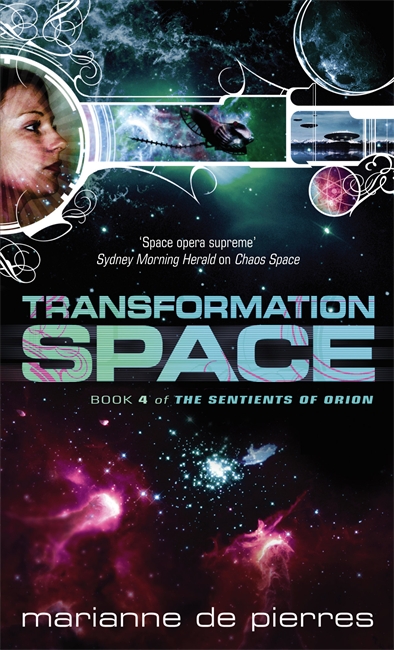
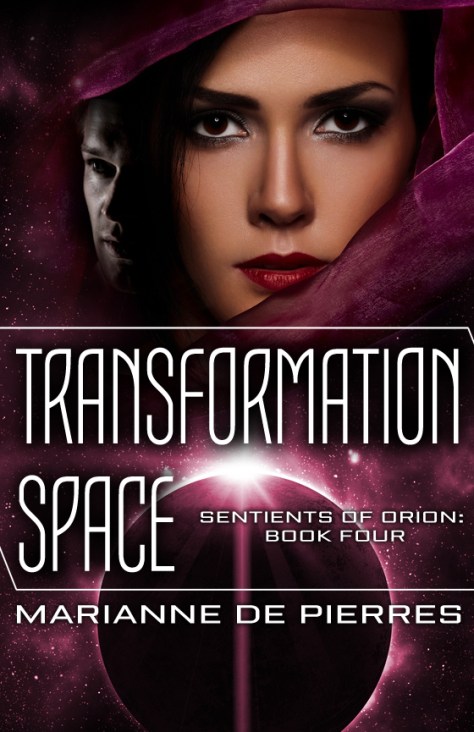
dePierres, Marianne: Transformation Space (Sentients of Orion IV) (2010)

Manta ray: Alexander Safonov;  Space crafts: Dale O'Dell/Alamy;  Cover design: www.blacksheep-uk.com
Manta ray: Alexander Safonov;
Space crafts: Dale O’Dell/Alamy;
Cover design: http://www.blacksheep-uk.com

I haven’t really liked the other covers of the series that are like the one above. Nor have I liked the ones similar to the one below. But in the case of Transformation Space both covers have appealed to me. The bottom one is because of the eyes of the main model. In the above cover I love the details that reveal themselves as I review the picture along with the color combination.

Dum, da, rah, dum! The end is here.

 Like this … Nova projected a grave melancholia, a vast emptiness without end that made Mira want to weep.

<you know this? little one?>

We all know. Do you feel it too?

According to answers.com the definition of melancholia is:

Melancholia brings about a form of pessimism that sees the future as blocked and unchangeable. Such pessimism is accompanied by ideas of guilt and unworthiness, which find expression through self-accusation and can even give rise to delusion. …. Mental suffering engenders a continual desire for death.

How far would we be willing to go to get out of our melancholia? At what point does the melancholia cause us to tip over the boundary of no, nos? There are plenty of stories out there about just what happens to people who end up in this valley of bleakness in their attempts to relieve the pain.

The lovely thing about fiction is that the author gets to explore such subjects. The serial Sentients of Orion has explored the issue of how far one particular non-humanesque is willing to go in order to relieve its melancholia. Because its motivations and background is foreign and more or less unknown to us, we only get to see the effects of trying to relieve its pain.

The Sacqr are one of those effects. You know, the Sacqr are seriously bad-ass. Nothing kills them, except maybe something really big stepping on them. Weapons seem to have no effect and their voraciousness has no limit. Even Rast Randall is scared shit-less by them, and Rast does not frighten easily.  Being kept sensory deprived on the Post-Species vessel almost broke her but she pulled through and used her resilience to help keep the three survivors of that trip alive through Sacqr fun:

Jo-Jo’s muscles twitched with an uncontrollable desire to spring at the creature. Attack it before it could find him, surprise and aggression as his weapon. Not crouch here, shitting his pants, waiting for its maw to open and the bone-piercing stamen to extend down and skewer his skull.

Jo-Jo remembered how it was: ‘esque bodies flung across the floor of the food court on Dowl, Sacqr gorging on their body fluids. The adrenaline that had poured through him then now threatened to overcome his self-control, but Randall kept steady pressure on his head, pressing so hard that the pain across the bridge of his nose began to overshadow his fear.

How much garbage do you have to wade through in your life to be able to keep your cool in such a situation? There are people out there who go through similar experiences every day. Syria, Sudan and Eastern Burma spring to mind. Not much fun living there these days and I imagine what they have experienced is close to what the people of Araldis went through as it was invaded. Rast Randall had fought in plenty of conflicts/wars in her capacity as a mercenary leaving her with the tools to possibly survive what the Sacqr had to dish out.

I found myself admiring the inner strength Thales was able to dig up during Transformation Space. When I first got to know him, Thales seemed afraid of his own shadow. Yet by the end of the tale of the Sentients of Orion Thales emerges as a person who has discovered who and what he is and what price he is willing to pay to remain that person. That journey is one we all need to make. Some of us do. Some of us don’t.

Once again Marianne de Pierres caught me in the trap of her words and would not release me until Transformation Space was a done deal.


2011: Aurealis Award for Best Science Fiction Novel for Transformation Space


Reviews:


Transformation Space on Amazon Canada


My review of:

  1. Dark Space
  2. Chaos Space
  3. Mirror Space

Transformation space 1


dePierres, Marianne: Mirror Space (The Sentients of Orion III) (2009)

mirror space

“Love’s a bitch, ain’t she?”

Not for me, but certainly for Rast Randall and Jo-Jo Rasterovitch who have both fallen for Baronessa Mira Fedor from Araldis. When Mira is captured by the Extropists (nascent humanesques/post-species) Mira shows why Rast and Jo-Jo care so much for her. Resilience is the quality I find most describes the young refugee from Araldis. I’m not certain if resilience is something that most find attractive, but I know that I do. Part of that attraction lies in my own history and perhaps part of it has to do with resilient people radiating some sort of invisible strength. Fighting her fears and going on in spite of the traumas that come her way signifies the kind of courage the young Baronessa has.

Insignia has shown Mira how utterly alien the thought patterns of other creatures can be. Wanton-Poda is about to show her how “evolved” humanesques no longer have much in common with their roots. Indeed, their morals are amoral seen from a Western point of view. Through this, dePierres shows us just how different our own cultures can be in this mix that our global village has become. What one ethnic background considers only proper another might consider sociopathic or paranoid or cruel. Judging others based on our own backgrounds is unwise yet impossible to avoid. Again and again Mira is confronted with the need to reach beyond her own way of thinking. But it ain’t easy!

Tekton is from highly competitive Lostol. Whether the whole population is like him is impossible for me to say, but he and his cousin both seem supremely self-absorbed and willing to do anything to win over the other. Sole (the Entity/God/strange intelligence) knows to use these two qualities against them in its attempt to achieve its own goals. We don’t find out what these goals are until the end of the Sentients of Orion serial (yes, I cheated). As we see in Mirror Space, Tekton learns what being helpless is all about and finds his narcissism challenged. Perhaps there is potential for change in him.

One person who seems to have no hope of changing is Trin Pelligrini. He keeps on insisting that Mira has run off and fights Cass Mulravey for power of the survivors. His ego needs constant stroking, one reason he is so fond of Djeserit. Yet this utter and complete belief in his own superiority might be what the survivors need in order to stay alive.

In fact, characters like Trin Pelligrini, Lancer Farr and Tektor Lostol are fascinating people. I find there is something about deviant fictional characters that makes a story much better. However much I hate it whenever such a person turns up in my own life, they surely make for a deeper understanding of the human psyche. Literature serves this function, along with many others, for me.

One thing that is certain is that Marianne de Pierres has the flow needed to grab hold of me and drag me along in her story. Annoyingly, yet wonderfully, I find myself unable to resist her pull.

Orion star chart
Orion star chart (road map)

Reviews:


Mirror Space on Amazon UK


My review of:

  1. Dark Space
  2. Chaos Space

dePierres, Marianne: Chaos Space (The Sentients of Orion II) (2008)

The Sentients of Orion - Marianne dePierres
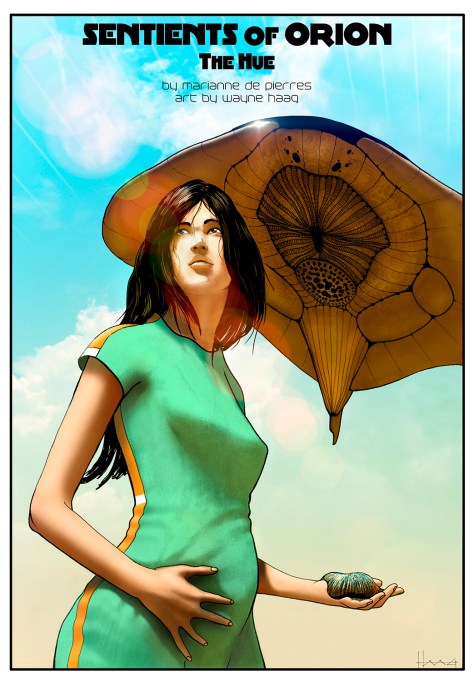
Cover art by Wayne Haag

The end of Dark Space has left Mira pregnant, raped by Trin so he could ensure his progeny with a pure-blood noble from Araldis. Rast states it so well

“Women get raped,” said Rast harshly, her pale skin flushed with emotion. “Sometimes in war, sometimes just for the hell of it. That’s what happens.” She gripped Mira’s wrist and pulled her close. Then she hugged her tightly for a long moment.

“We’ll get your world back for you, Baronessa. But tell me something: are you sure you really want it?”

Not only did Trin rape Mira and send her off-planet to get help. While staying behind he makes certain to besmirch Mira’s reputation by claiming that she has run off. For Trin does not want Mira to become more popular than he. After all, that might endanger his own shot at becoming Principe after the war.

War, ambition, greed, death.

Trin is more concerned with saving his men than with saving the population of Araldis. Cass Mulravey sees that he has no clue that if he wishes to rebuild his world, he will need women to bear children. The two of them are at odds through all of Chaos Space. Only Djeserit’s attempts to broker a peace between them keeps them from open dispute. Until Trin has managed to finagle the loyalty of the women who have followed Cass, he has to at least give the appearance of working for the greater good. Perhaps all of this pretending will turn to true behavior eventually???

We find out who Djeserit’s mother is. Oh, dear! Poor girl. None of us choose our own parents, but some of us are left with worse parents than others. Bethany Farr is no ideal mother. She seems to have repented of sending Djeserit off and now wants to save Djeserit and thereby Aldaris. But will Bethany carry through or perhaps only work towards the redemption of her daughter until her next “love” comes along??

Insignia, the biozoon carrying Mira, turns out to have an agenda of its own. The vessel has repeatedly tried to get Mira to understand that it does not care about humanesques in general, only the ones with which it can communicate. When its contract with the Fedor clan runs out in the middle of an escape, Mira fully comes to understand how true and real that is.

Mira is one severely traumatized person who is thrown from one chaotic episode to the next. Needing to make decisions pronto goes against her socialization, and tearing herself loose from that socialization is incredibly painful for her. In Dark Space Mira learned to handle a gun, something that was forbidden to the upper-class women. In Chaos Space she has to learn to see through the fallacies of her traditions. Having worked my way out of fundamentalism, makes it easy for me to relate to what Mira must have gone through. Being brought up in a society where women are taught from a young age that they are less and also taught how to internalize this tradition and accept it as right and proper makes the reach through the fog of indoctrination severely painful and self-actualizing. Mira is forced to grow once she makes the choice to make her way through her fog and grow she does.

Asking for help is more complicated than Mira had thought. Naively, Mira had expected that explaining her planet’s situation to OLOSS would bring OLOSS to the rescue. But OLOSS is concerned with what is in it for them and want to get hold of Insignia so they can study it. Having read something about the history of our own world this concern with profit in the face of aid is nothing new. In fact, I wonder if the need to profit from another person’s tragedy is embedded in the human psyche?

DePierres’ writing is as riveting in Chaos Space as it was in Dark Space. Again I found myself struggling to stop reading.


Reviews:


Chaos Space on Amazon US


My review of Dark Space

Cornell, Paul: London Falling (James Quill I) (2012)

London Falling

I think the novel actually has a few things in common with Mary’s Glamour books, that, while not realising it at the time, I’d been influenced by her in the writing of it. The force our heroes encounter is ‘the paramilitary wing of feng shui’, something similar to the Psychogeography of the Situationist movement, the power of buildings and landscape (in this case, London) to ‘remember’ beings and events. In other words, it looks and feels like magic, but my inclination (and the police instinct of my leads) is to pick that concept apart, to ask what that means. So, actually, rather as becomes clear of Mary’s series in Glamour in Glass, London Falling is an SF novel wearing another genre’s clothes. It’s actually a ‘clever people solve a problem’ book, in the tradition established by SF editor John W. Campbell. (Paul Cornell)

There is a section in London Falling where Sefton explains the whole concept of “remembering”. You should read it. The concept is rather thought-provoking and essential to the character of Mara Losley and her cat.

Mara Losley is a person whose road was paved with the best of intentions. Then the rule of unintended consequences stepped in, and Mara was drawn onto a much darker path than she had started out on. We meet her at her darkest. As with all good gruesome characters, Mara lets nothing stand in the way of her goals and her beloved team West Ham United F.C.

I feel the need to get this off my chest right away, however small that chest might be. Football fans are insane. Each and every one of them. Completely and utterly bonkers. Seriously. Insane. It doesn’t matter if we are talking US sissy football or European proper football. ALL football fans are deranged. Mara Losley just takes her fandom to another level. She shines in her madness. There is no doubt in her mind that WHUFC is the bestest team in the universe and any player daring enough to challenge that belief is in for a rough time. The player and the sacrifices needed for his punishment.

Paul Cornell has written a wonderfully gruesome antagonist. Mara Losley has spent years upon years honing her creepiness and people’s forgetting and remembering when it comes to who she is. Now all of that work is in danger. And all because of the Smiling Man and his shenanigans.

I loved DS Quill. He heads his team of four and the four of them have to solve the riddle of what happened to Rob Toshack, the crime lord supreme of London. All of a sudden the guy exploded in a shower of blood. Blood everywhere in the interrogation room. On the officers, Mr. Toshack’s brief and the furniture. Four liters can cover a lot of space. Mr. Cornell’s goriness is perfect in its gooey, disgusting and awful description. I’m guessing some of the readers out there will find it too much.

Back to DS Quill. Why him and not one of the others? At the beginning Quill seems like an utter piss-pot. Then Cornell begins opening the cover of Quill’s head. Suddenly I find myself slowly but surely driven to accepting that my suspicions about him are about to come true. Shudder. What a fate! He isn’t the only one to have a terrible shadow hanging over him but he is the one whose remembering/forgetting I understand best. And poor Harry. What a father to have.

Second Sight is something a lot of people think they want to have. As London Falling demonstrates, the reality of Sight is not the blessing some might believe it to be. When the foursome of Quill, Ross, Costain and Sefton receive their curse all at the same time, they will have to dig deep into themselves to manage the trauma that follows. That trauma is intense and it takes a while for each of the four to realize that they are not going mad.

A thanks to Paul Cornell for writing London Falling and another thanks to Suzanne McLeod for recommending this series.


Reviews:


London Falling

  • Language: English
  • ISBN-10: 0230763219
  • ISBN-13: 978-0230763210
  • ASIN: B00AER81ZU