Cover illustration by Don Dimanlig: Loved this cover
I believe the title Assured Destruction could be used to describe several factors in this story about Janus and her current life. One, of course, is the firm Assured Destruction. It seems the employees there are having trouble destroying what ought to be destroyed. It is interesting to see how people trust the honesty of others to such a great extent. I’m guessing the level of reliability in the real world is pretty much as described in Assured Destruction.
Jan’s mother is on the road to assured destruction. We all die and could die at any time. But the path MS takes a person on is one of systematic destruction of one part after the other until the body is completely destroyed. Having to deal with her mother’s illness could take Jan on her own road to assured destruction as her Shadow-Net begins to affect real life people.
Finally, we have the Shadow-Net and its assured destruction. Shadow-Net and the personalities it comprises has made up the people Jan considers her close friends. These imaginary friends have helped her through a terrible phase in her life where more and more responsibility has been dumped on her. Her imaginary friends help Jan interpret the world around her.
Like the rest of us Jan sees the people around her through faulty eyes. Turns out people aren’t what she thinks they are, and as that realization hits her harder and harder, Jan gets the opportunity to change her perspective. And she does. That is the cool thing about Jan. She manages to turn around the way she sees others, to somehow overcome her prejudices and move on to changes in her relationships.
Assured Destruction is a great action/thriller/mystery. I find Stewart’s writing fun and engaging. His characters are loveable. I am going to read the rest of this series. Definitely recommended.
I generally do some research before writing about a book. When the blurb began:
“What if Little Red Riding Hood and the Big Bad Wolf turned out to be the same person?”
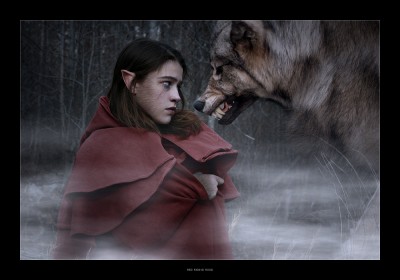
I went off on one of my curiosity sprees. Roald Dahl has a wonderful version of Little Red Riding Hood (below) that resembles the version of Little Red Riding Hood that Jordan Summers writes about.
Red has three Riding Hoods that are eaten by the big bad wolf while their grandmothers are left alone. Our Were-theme is discovered in the first chapter when the murderer describes being wracked with the pain of being ripped apart and put back together again. Then he mauls and eats his murder victim. Summers’ description of the mauling and eating is just as descriptive as her description later on in the novel of sex and its prelude – pretty explicit.
The mystery part of Red is pretty straight-forward. As a reader I know everything long before Red and Morgan do. When Renee Forrester, Lisa Salomon and Moira Collins turn up dead, I draw conclusions faster than the couple-to-be. Embroiled as they are in the action and full of fear of being discovered, fear of the other not liking them, fear of the other person liking them, and being horny to the degree that the two of them are probably slows them down.
Red is full of the non-existent, exterminated Others. These people were supposed to have been wiped out. Instead they are turning up all over the place. Some of them do not even know that they are an Other. Discovering what they are might just mean the difference between life and death for themselves and others.
We are all Others of some sort. It isn’t my Asperger side that defines me as an Other but rather the Beast in me that might rear its head at some point in my life. We sure see a lot of the Beast types in the world without needing to genetically tinker one into us.
As soon as Wolf began to feel
That he would like a decent meal,
He went and knocked on Grandma’s door.
When Grandma opened it, she saw
The sharp white teeth, the horrid grin,
And Wolfie said, “May I come in?”
Poor Grandmamma was terrified,
“He’s going to eat me up!” she cried.
And she was absolutely right.
He ate her up in one big bite.
But Grandmamma was small and tough,
And Wolfie wailed, “That’s not enough!
I haven’t yet begun to feel
That I have had a decent meal!”
He ran around the kitchen yelping,
“I’ve got to have a second helping!”
Then added with a frightful leer,
“I’m therefore going to wait right here
Till Little Miss Red Riding Hood
Comes home from walking in the wood.”
He quickly put on Grandma’s clothes,
(Of course he hadn’t eaten those).
He dressed himself in coat and hat.
He put on shoes, and after that
He even brushed and curled his hair,
Then sat himself in Grandma’s chair.
In came the little girl in red.
She stopped. She stared. And then she said,
“What great big ears you have, Grandma.”
“All the better to hear you with,” the Wolf replied.
“What great big eyes you have, Grandma.”
said Little Red Riding Hood.
“All the better to see you with,” the Wolf replied.
He sat there watching her and smiled.
He thought, I’m going to eat this child.
Compared with her old Grandmamma
She’s going to taste like caviar.
Then Little Red Riding Hood said, “But Grandma,
what a lovely great big furry coat you have on.”
“That’s wrong!” cried Wolf. “Have you forgot
To tell me what BIG TEETH I’ve got?
Ah well, no matter what you say,
I’m going to eat you anyway.”
The small girl smiles. One eyelid flickers.
She wimps a pistol from her knickers.
She aims it at the creature’s head
And bang bang bang, she shoots him dead.
A few weeks later, in the wood,
I came across Miss Riding Hood.
But what a change! No cloak of red,
No silly hood upon her head.
She said, “Hello, and do please note
My lovely furry wolfskin coat.”
I think the novel actually has a few things in common with Mary’s Glamour books, that, while not realising it at the time, I’d been influenced by her in the writing of it. The force our heroes encounter is ‘the paramilitary wing of feng shui’, something similar to the Psychogeography of the Situationist movement, the power of buildings and landscape (in this case, London) to ‘remember’ beings and events. In other words, it looks and feels like magic, but my inclination (and the police instinct of my leads) is to pick that concept apart, to ask what that means. So, actually, rather as becomes clear of Mary’s series in Glamour in Glass, London Falling is an SF novel wearing another genre’s clothes. It’s actually a ‘clever people solve a problem’ book, in the tradition established by SF editor John W. Campbell. (Paul Cornell)
There is a section in London Falling where Sefton explains the whole concept of “remembering”. You should read it. The concept is rather thought-provoking and essential to the character of Mara Losley and her cat.
Mara Losley is a person whose road was paved with the best of intentions. Then the rule of unintended consequences stepped in, and Mara was drawn onto a much darker path than she had started out on. We meet her at her darkest. As with all good gruesome characters, Mara lets nothing stand in the way of her goals and her beloved team West Ham United F.C.
I feel the need to get this off my chest right away, however small that chest might be. Football fans are insane. Each and every one of them. Completely and utterly bonkers. Seriously. Insane. It doesn’t matter if we are talking US sissy football or European proper football. ALL football fans are deranged. Mara Losley just takes her fandom to another level. She shines in her madness. There is no doubt in her mind that WHUFC is the bestest team in the universe and any player daring enough to challenge that belief is in for a rough time. The player and the sacrifices needed for his punishment.
Paul Cornell has written a wonderfully gruesome antagonist. Mara Losley has spent years upon years honing her creepiness and people’s forgetting and remembering when it comes to who she is. Now all of that work is in danger. And all because of the Smiling Man and his shenanigans.
I loved DS Quill. He heads his team of four and the four of them have to solve the riddle of what happened to Rob Toshack, the crime lord supreme of London. All of a sudden the guy exploded in a shower of blood. Blood everywhere in the interrogation room. On the officers, Mr. Toshack’s brief and the furniture. Four liters can cover a lot of space. Mr. Cornell’s goriness is perfect in its gooey, disgusting and awful description. I’m guessing some of the readers out there will find it too much.
Back to DS Quill. Why him and not one of the others? At the beginning Quill seems like an utter piss-pot. Then Cornell begins opening the cover of Quill’s head. Suddenly I find myself slowly but surely driven to accepting that my suspicions about him are about to come true. Shudder. What a fate! He isn’t the only one to have a terrible shadow hanging over him but he is the one whose remembering/forgetting I understand best. And poor Harry. What a father to have.
Second Sight is something a lot of people think they want to have. As London Falling demonstrates, the reality of Sight is not the blessing some might believe it to be. When the foursome of Quill, Ross, Costain and Sefton receive their curse all at the same time, they will have to dig deep into themselves to manage the trauma that follows. That trauma is intense and it takes a while for each of the four to realize that they are not going mad.
A thanks to Paul Cornell for writing London Falling and another thanks to Suzanne McLeod for recommending this series.
The birds annoyed me. Not because they are were-birds/shapeshifters but because Cree carried a person as large as Shad. My asperger soul was triggered to the point of obsession and that set me off in research mode. That is when it became fun. I adore digging into stuff. While increasing my knowledge on the requirements for flight vs. weight vs. mass vs. pain tolerance vs. … I discovered a couple of things (at least that was the way all of this information was put together inside my head). There is a theoretical possibility of humans being able to fly. For flight to happen the human’s form would have to change drastically making us more like the flying creatures we know and less like humans. Were-birds or genetic tinkering are the only alternatives. Whether this would make Cree able to carry Shad is another matter altogether, and not knowing is now something I feel comfortable with.
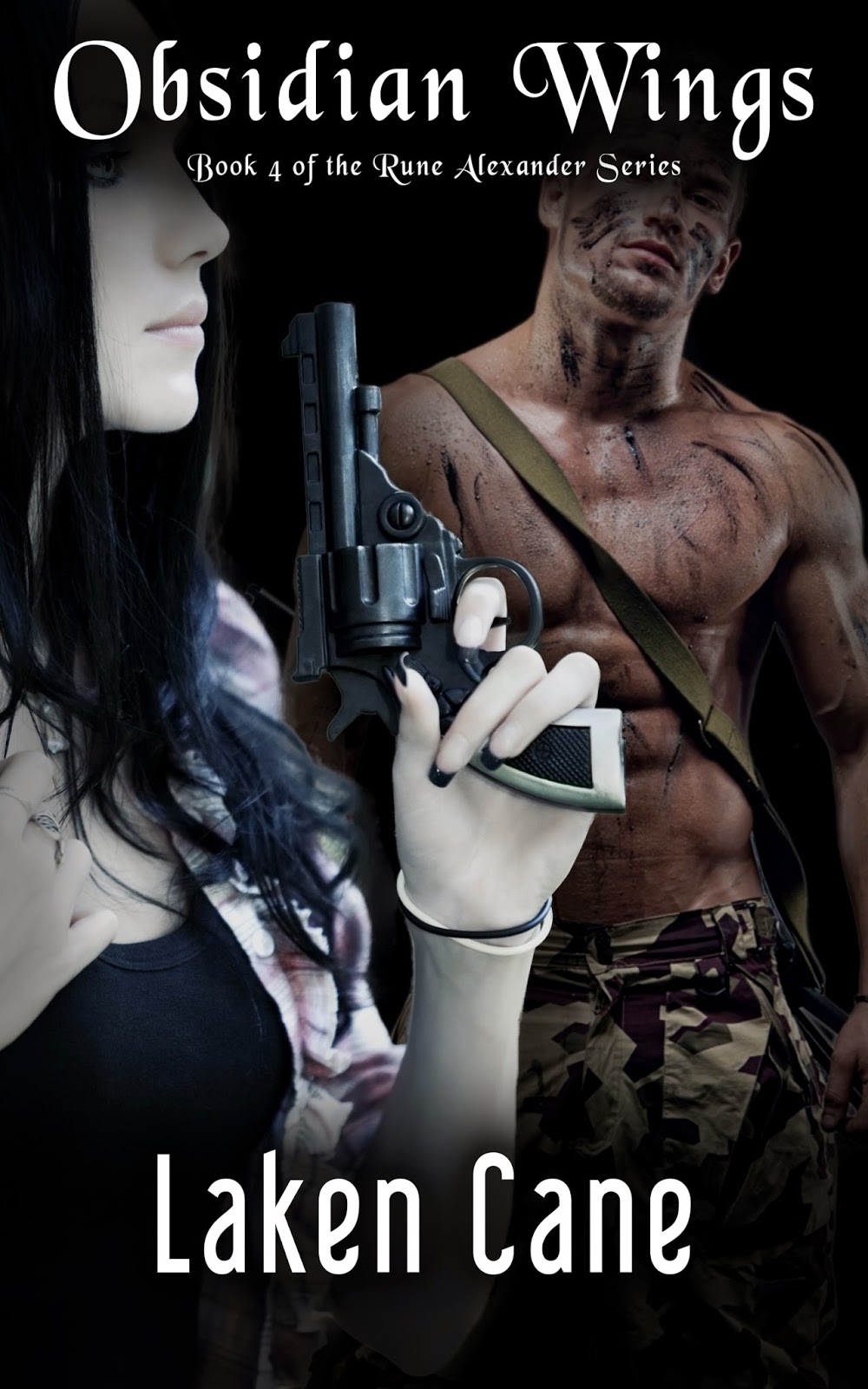
I feel I need to thank Laken Cane for handing me this chance to look at the possibility of humans and flight.
Much later, she lay wrapped in his arms and realized she’d never felt more at peace than when she was with the berserker.
It was not a wholly comforting thought.
Sometimes knowing that another person’s presence brings a sense of completion can frighten us. I happen to be married to a man who brings me that sense. Allowing the peace he brought to set roots in my life was incredibly complicated and perhaps even worrying. What would happen to me if my heart gave up that piece of me? Personally, I do not have words for what his entry into my heart brought.
For a person like Rune, with the frightening and lonely background she has had filled with self-harm, self-disgust and self-fear, letting go of part of herself would be an even greater challenge. Yet a choice needs to made sooner or later. And it will be made eventually and during Obsidian Wings.
In the meantime Shad is driving Rune crazy with his over-protectiveness and willingness to fight Owen for her. I have no idea what Owen’s obsession is with Rune. Nor do I understand why Cruikshanks thinks he is unable to stay away from Rune. Three men driving Rune insane with their need for her while all (hah, hah) she wants is for her world to become whole again, Z to live and the twins to be back in the group, giving Ellis his Levi back and Lex her anchors.
I liked the second demon that turns up on the scene. Well, really it is the first demon but in a way it ends up being the second one for a lot of people. That is about as confusing as I can make this statement in my attempt to avoid giving anything away.
So, yes! Once I had resolved my issues with the birds I was a happy one myself and finished Obsidian Wings in no time.
Blood Tithe is a serial. Too many questions are left unanswered at the end for it to be anything else. Obviously, I recommend that you begin with this novel. I believe Blood Tithe is Soucy’s first novel and it bears signs of just that. But Soucy manages to overcome most of those problems by keeping his characters interesting and active.
“Once someone is altered, they can gather energy from every living thing. If they take that energy and wrap it around their heart, and then give it to another person, it creates a Blood Tithe. From then on, every time the original person collects more energy, the one he made the Blood Tithe automatically gets their fair share.” Glenn J. Soucy
I have been trying to remember what five-year olds are like while reading Blood Tithe. I can see a person his age falling for the temptation of the forbidden. You do not have to be five to fall for the forbidden. But five is how old Jeremy is when he goes against the commands of his parents and finds his life irrevocably changed. The point in his life when the sins of World War II genetic research comes back to haunt a community. I loved the tension Soucy managed to keep going full pace when Jeremy met Howler and his desperation during their subsequent meetings.
If Jeremy had been my son, would I have become afraid of him? Ideally, my answer should be a resounding no. As most of us end up learning, reality and ideals often do not blend. I really do not know which parent I would have become.
When we meet Jeremy at 13/14 life has become dire. He has done something he feels awful yet justified about in an eye for an eye sort of way.
In choosing to jump from Jeremy as little to Jeremy as teen-ager Glenn Soucy has undertaken a task that many authors shy from for good reason. Blending the two without getting details wrong or messing up on details is where we see that a stricter editor would have made Blood Tithe great.
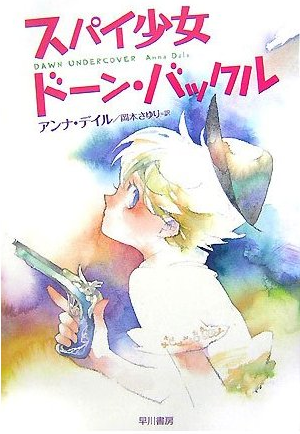
Japanese cover: “The katakana is translated as “supai chiisai onna don bakkaru”, literally “Spy Girl Dawn Buckle”. (Dylan)
Dawn Buckle‘s family is strange. Her father and grand-father could be Aspergers with the keen interest they have in their respective hobbies: wall-clocks and game-shows. Dawn’s mother always has such a lot of work she must do. When the S.H.H. (Strictly Hush-Hush) ask if Dawn can come work for them during the summer, Dawn’s mother says:
“So Dawn would be out from under my feet … I mean she’d be taken care of for the whole of the summer holidays?
And I thought I was bad. I realize there are a great deal of children who live in homes where they are ignored. What a challenge this must be for the child. For Dawn, the appearance of Emma Cambridge is a gift. Finally, a person who actually notices her.
You see, Dawn Buckle is the kind of girl who seems to be invisible. She could be standing next to you and you would not notice her. She is average looking and has nothing that is extraordinary about her. A lot of us fit into that category. In fact this used to be me. I’m of average looks, like comfortable clothes, am observant, have had various types of stuffed animals and like information. My parents though, well they were a bit more present and would never have let me go off on a P.S.S.T. type of stay – that is unless I had recently gotten myself into trouble.
That is the trouble about us quiet ones. We are often underestimated. As Dawn finds out being underestimated is a bonus in the world of espionage. Just because she is seldom noticed does not mean that Dawn is incapable.
Dawn’s first lesson in spying is that things are not always as they seem. As she and Emma arrive at the headquarters of P.S.S.T. (Pursuit of Scheming Spies and Traitors) Dawn is puzzled:
“Emma opened the front gate, knocking the stalk of a magnificent sunflower. Its heavy head swung to one side, revealing a sign behind it that read “Dampside Hotel”.
Dawn is a prime example of not being what she seems. This is a great example to young boys and girls as to how girls really are. Not all girls but a lot.
For some strange reason, the apparently dead Mundo Meek seems to know too much about what is currently going on inside P.S.S.T. But is he really dead? Therein lies the mystery and the suspense.
Delightful names and acronyms are used by Anna Dale. Ms. Dale has managed to create a story that is exciting, funny, interesting and informative all at the same time. Her proposed age group target of 8-12 years seems appropriate.
You could probably start reading The Bastard Cadre series with The Lord of Frake’s Peak. That is because it goes back to the story of the early days of the reign of Lord Obdurin. As long as you don’t mind the spoilers as the beginning of the novel you should be fine. The only problem with doing this is that you would be reading the best first because Lee Carlon‘s writing has gone from one bastion to the next during these four novels.
I am fairly certain the gods aren’t gods. After I finished reading The Lord of Frake’s Peak I knew that the “whatever they are – not gods” had done all they could to keep humans in ignorance. The Cleansing that had occurred three years before the beginning of The Lord of Frake’s Peak seems like something they would do to keep their secret safe because they felt some person had come too close to the truth. I’m still not clear on whether there are any female gods or if there are genders at all. Whatever the case is there, these so-called gods seem to be amoral beings playing the world and humans for what they can. People like that stink. That is my completely unbiased (snort) opinion.
Lord Obdurin is only one of the many chosen running about doing the gods’ deeds. His god is Rhysin. To become a chosen Lord Obdurin had to get the heart of Rhysin from his predecessor, Lord Benshi. Something terrible seems to happen over time to all of the Chosen. Part of the amorality of the gods seems to enter them and they go from being whatever type of person they used to be to taking on part of the nature of the god. If that is the case, Rhysin must be a brute. Lord Benshi became one and his sons paid a terrible price for it.
Vincent d’Rhyne is the only surviving son of Lord Benshi. He wants nothing to do with Rhysin but is not able to tear himself from the place he grew up. Lord Obdurin spared Vincent for some reason only Obdurin knows when Lord Benshi died. Vincent feels only relief at having his father out of his life. Of the two, Vincent feels that Lord Obdurin is the best alternative. Having read all four installments of The Bastard Cadre I find myself unable to give a clear answer as to whether Vincent trusts in vain.
Trust might be the wrong word, but it seems pretty close to how Vincent feels toward Lord Obdurin. It is as if Vincent trusts that Obdurin will keep him from reaching for the gods. But the reach of the gods might be longer than any of the inhabitants of Carlon’s world might know. Perhaps they are all just part of a huge video game.
Life sometimes feels like that. The joke has been on Vincent so many times that it is becoming more and more difficult for him to remember that life is just a big joke. His ability to stay in the present fluctuates. Considering how traumatized Vincent it is a wonder that he manages to stay there at all.
Ever since I read the first novel in this now 11 book long series about Rachel Morgan I have been hooked. How Ms. Harrison manages to keep up the quality of her writing is beyond me.
In Ever After the story is mainly about Rachel, quite a bit about Trent and Jenks with some Quen and Al thrown in. The rest of the players have minor parts this time and some of them are only mentioned in passing.
I have been wondering if I would be able to make decisions based on “the greater good”. Could I harm an individual I knew/liked/loved to save the many? Rachel faces this choice in Ever After. She faces this same choice in just about every single one of Kim Harrison’s stories about her.
Rachel is an interesting person. She is an outsider among outsiders, the peg having to accept that she will never fit into any of the holes. If I was going to choose a main theme for the series it might be how to figure out how to accept your inability to fit in. I felt Rachel managed to do that in The Undead Pool. Like all people who get to that point, the Rachel we now meet is safer in her knowledge that she is who she is. That helps when trouble keeps on following her around.
In many ways Rachel’s life stinks royally. Yes, she is an adrenaline junkie. As with all other addictions, I am assuming that your fixes need to be larger over time. If there is one thing Rachel cannot complain about in Ever After, it is the dose of trouble Ms. Harrison feeds her. Ka-boom, ka-boom, ka-boom. From one fire to the next Rachel tries to keep up dragging along her leaking bucket. Ms. Harrison loves doing that to her Rachel.
Another thing Rachel has discovered she needs in these past few years is friendship. Being friends with Rachel is difficult but rewarding. Once you have her for a friend it takes an awful lot to lose her. All you have to do is ask Nick. He has done his utmost to turn her against him (although he does not see it that way). Nick is one of those persons who is never at fault – never. He and Ku’Sox are alike in that regard and as such make a pretty good team (or maybe not).
What must it be like to think that you are never to blame for anything? I get that most things in life are plain luck of the draw while others are a direct result of what we have done. From what people say to me, the majority seems to find it incredibly easy to see its own flaws. I’m finding myself completely mystified at how a person is able to accept absolutely no blame but be glad to take credit for good things happening. Narcissism is one of the weirder disorders out there and Nick fits the bill in so many ways.
As usual, you get no synopsis from me. There is as always with Rachel Morgan action, character growth, justice, unfairness, tragedy, mystery, love and closure. You can read Ever After without reading the other novels in the series, but why deprive yourself of that much fun?
It was a story as old as time, and Rasha had played the role of disapproving elder with fervor. And even though her intent had been noble – to protect her granddaughter from an untrustworthy man – she paid the price with crushing loneliness so deep that she’d risked death or injury to …
To what lengths will we go to avoid feeling lonely?
The first five novels in the Kara Gillian series shows how far she has been willing to go to avoid that feeling. Now she experiences a sense of belonging she had never thought possible.
Loneliness is a concept I have spent much time contemplating. I’m kind of a misfit with most people. We can talk a bit, but when it comes to wanting to spend more time with me or me wanting to adjust to their expectations of “proper female behavior” – well, it just ain’t happening. In the past I have done stupid things to stop feeling lonely. I genuinely like being in my own company and sometimes find the presence of others intrusive. Even my dog and my husband. But it has been lonely growing up being a person like me. Thankfully, loneliness is no longer a factor in my life.
The other side of the loneliness coin that some people choose is that they would rather be alone than risk facing their own inner demons. Mzatal used to be like that. Then Kara and Idris came along and opened up the cracks of his emotional armor. This I really understand.
Emotions are confusing and illogical. They follow no rhyme or reason and appear when most inconvenient. I used to hide mine in a large chest that only I held the key to. Then patience and acceptance came my way through my husband and tiny emotion-elves started picking that lock.
Sometimes we all have need of a person in our life that sets off our tiny emotion-elves. Kara found several of them in her posse, and Mzatal found his through his protegés. Now both of them just have to figure out how to want to keep those positive influences in their lives.
As a compliment to Ms. Rowland’s writing, I found myself stupidly reading, and reading and reading through the freaking night. Her writing becomes better with each production. I love it when I can follow an author in their progression as a writer.
Bloody hell. Give the poor girl a break. Laken Cane drives her main character, Rune Alexander, hard. And can she write! All of that exquisitely described pain and anguish. Holy horror of a cow! What a life our heroine leads.
Rune Alexander fills me with compassion. I want to crawl into Strange Trouble and somehow comfort her, to let her know that she is OK as she is. My own ghost pain is awakened, and I want to tell her that things will get better. But I would be lying by saying that because Ms. Cane is a cruel mistress for the Shiv Crew.
The Rune Alexander series is a bleak and dark series. There aren’t a great deal of happy moments. Well, there are plenty of happy moments, but that is what they are. Moments. Then Rune and the gang is ripped back into the terror and ache of having to be the “good guys” in spite of all of the persecution and loss. Yet Ms. Cane’s writing makes it all endurable.
The vampires, zombies and werewolves of the Rune Alexander series are not the fluffy ones that we sometimes see in literature today. These are the good, old-fashioned kind. The ones that were told stories about around the fires while night turned into darkest dark and became all the more frightening because we could no see the world.
As usual, I have a couple of favorite moments. Rune’s gift to Ellie – perfect. That put a huge smile on my face. Rune advising Raze about relationships – pot/kettle much? The two episodes with the obsidian sword. Shad and Fie at the hospital – incredibly cute. The monster’s comment: What will you do? … Hurt me? And finally Ms. Cane’s description of Damascus – whew that lady needs to work on her charm.
Laken Cane has kept the promise of Shiv Crew. Her writing has been riveting, tense and tight through all three novels.
Cover design by Keerati Sarakun and Patrick Naoum Cover typography by Andrei Stefan-Cosmin Edited by Nicola O’Shea
The Chimera Vector set me into research mode. I started looking into “chimera vector” and discovered quite a few articles on the research into this type of transportation on the net. I have included four of them below. Chimera: a DNA molecule with sequences derived from two or more different organisms, formed by laboratory manipulation.
According to Psychology Today a psychopath is a person who exhibits a long list of character traits. One needs to show a lack of empathy (cold-heartedness, an inability to feel deeply); show a lack of shame, guilt, fear or embarrassment at ones actions; a tendency to blame others for their own failures, or no shame if confronted; show a strong ability to remain focused on a task; appear charming yet have a tendency toward pathological lying, and they seem comfortable even when found out; incredibly overconfident, as if they cannot fail; impulsive; incredibly selfish and parasitic; lack realistic long-term goals; and finally be prone to violence.
In The Chimera Vector we get to meet several people who fit the bill of a psychopath. The whole concept of psychopathy or sociopathy is extremely fascinating. It is one of those terms that we bandy about as if being a psychopath was a common thing. Looking at the list above, I see many of them that could fit myself and most other people I know. But when I take a closer look at the people I meet, I think I can say that there is probably only one one person that I could definitely call a psychopath. Long-term planning was no problem for him at all and holding power is something he has definitely been concerned with. Power behind the throne, not the apparent one that is more image than real.
Power is what The Chimera Vector is all about. The lengths people are willing to go in their hunger for power. We see people playing power games every day – within families, at work and at play. But seldom do we see power games taken to the extreme that The Chimera Vector shows. But we wouldn’t, would we. That is the whole point of The Fifth Column. People must not see the games the leaders of The Fifth Column play, for their real power lies in their secrecy. To them all the death and mayhem they deal is part of the games.
Programming soldiers like Sofia, Jay and Damien into becoming unquestioning killer robots is fun. Killing innocent people to keep the world going their way is fun. Watching countries erupt into cauldrons of fire is fun. Power is fun. Fun and addictive.
I see all this and I believe it. The Chimera Vector is believable. If some scientist manages to discover how to create weapons like The Fifth Column use, soldiers like this will be developed. Perhaps I have too cynical a view of the world, but this is what I believe. History has shown us time and again that once a power-hungry leader gains control of research and development gruesome consequences evolve. In fact, history has shown us (and shows us) that in their grasp for power the world itself becomes expendable to the power-players.
And yes, I did enjoy The Chimera Factor. A great deal, in fact.
Cover art by Joshua Meadows“Iyetrais an episodic series of novellas set in a hybrid sci-fi/fantasy universe.” Each novella can be read as a stand-alone-novella. Sleeping God is the first of the series.
“At the dawn of things, in the eon known as the Whole, Iyetra was a complete, harmonious world and its inhabitants lived with the blessings of the gods, watched over under the authority of the Advent.”
In the usual manner of humans, the Shattering is the effect of our own glorious stupidity. The two opposing factions that led to the Shattering were the Advent that used the gods and magic, and the Imperium that believed in machines and destroying those who could access the powers of the aether. As a result of the fighting between the two opposing factions, the gods chose to shatter Iyetra into pieces. But for some reason they did not want all humans to die out so they made it possible for them to live in the Chaos that came from the shattering. Living on pieces of earth (floaters) the size of cities/countries/continents people go about their lives the way people generally do.
One of these floaters is Koton, the city that ambassador Tela Niala is supposed to negotiate an agreement with. Koton is led by the Magisterium, the “child” of the Imperium. While the Magisterium is not as fanatical as the Imperium, it does have a rather dim view of those who are able to access the aether.
Why Tela’s father would choose his own magically inclined daughter to travel to the male-dominated, magic-hostile floater Koton is a mystery. Perhaps he is willing to sacrifice her in a gambit to increase his own power-base. After all, even people who supposedly have a lot of power, like Tela’s high ranked senator father, can hunger after more. Tela was annoyed enough at her father that she demanded that the usual group of body-guards be left out. He relented. I found that suspicious as well. Tela’s father had to know something about the situation in Koton that we and she did not.
Tela starts off as an insecure graduate from magic school and becomes someone more comfortable with her own gifts/powers. While it might not be appropriate to call Sleeping God a coming of age story it certainly is a coming of self story. Being thrown into the jaws of death could have that effect on some people. Her father might have landed Tela the job as an ambassador, but in the end Tela earns that title through her own actions.
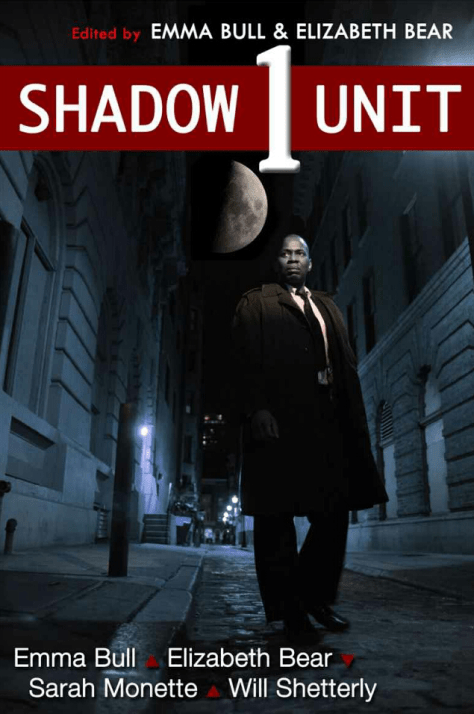
In 2007 Emma Bull and Will Shetterly got together and laid the groundwork for what would become the website Shadow Unit. A series bible was created and authors were contacted, which is how Elizabeth Bear and Sarah Monette got onboard the whole thing. Then they drew in Amanda Downum as art director and Stephen Shipman as technical director. The series bible was amended and improved. Finally Leah Bobet and Holly Black joined the writing team (along with Stephen and Amanda) while Kyle Cassidy had fun with the covers.
Shadow Unit I includes the first four stories from season 1:
The rest of the episodes from season 1, 2, 3 and 4 are available on shadowunit.org. As you will notice the last story available was released December 16, 2012. I recommend that you read the stories in order.
I was introduced to the phenomenon of the Shadow Unit through the above published novel. It is impossible for me to write a review without seeking out more information about the novel. This time I had a plethora of information to choose from, kindly served up by the instigators of the phenomenon. And what a fun phenomenon Shadow Unit is.
The whole group of creators at Shadow Unit are awesome for making such a large body of work available to readers and nutters all over the world for free. They wouldn’t mind donations as it is we, the readers, who are keeping the concept going, and what a fun concept and group of investigators this is.
The Anomalous Crimes Task Force (“Shadow Unit”) consists of: Stephen Reyes (boss), Esther Falkner (vp), Solomon Todd, Nicolette Lau, Daniel Brady, Hafidha Gates, Charles Vilette, Daphne Worth and Madeline Frost. Whenever inexplicable crimes are committed the task force is called upon to help find the criminals.
I recommend you use the website as your starting point and read the stories. They are of the action/thriller/mystery/horrorish kind with strange powers and strange bodies all over the place. The group itself is filled with people of all kinds – anything from the seemingly insecure to the broody ones. If you have read stuff by the above authors before, you know you are probably going to find a venue of enjoyment.
Cover art by Gene Mollica Cover design by Annette Fiore Defex Interior text design by Laura K. Corless
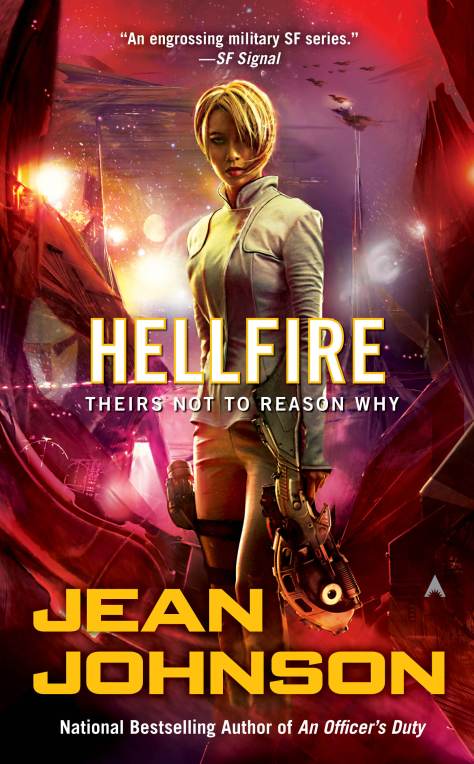
I started reading Hellfireand was immediately engrossed in the world of Ia and her Damned. Annoying really when a novel is this good. I believe I actually stayed up until 3 in the morning just because I did not want to go to bed until I knew how Hellfire ended. The ending was a sort of cliff-hanger – in the sense that the story did not end with Hellfire – yet not – in the sense that Hellfire had a conclusion.
…What if you could see the future? What if you foresaw that, three hundred years from your time, your entire galaxy would be destroyed in an overwhelming invasion? What would you do to stop it, when it would all happen long after you were dead and gone? (Jean Johnson)
Me? I don’t know if I would care enough to do anything about it. But what if the experience had been as if I, myself, had experienced the extinction of life? Sad to say, I’m not a particularly noble person. I doubt I could go to the lengths that Ia does in trying to protect the future of her galaxy. I doubt I would stay sane (well, as sane as I will ever be).
Does she see her life as the sacrifice it is? Oh, yes. What she had wanted for herself was to be a singer. Instead she became a soldier on her journey to ready the different breeds of people for the future. A future she would never experience herself. Her motivation? That was what being a pre-cognitive did. Especially being one as strong as she was.
People being the way we are, means we tend to disbelieve anything we have not experienced ourselves. Which is why Ia has let various creatures across the galaxy received snippets of her visions with information on how to avoid the potential future she wishes for them to avoid. This is where Ia’s type of pre-cognition varies from the type of clairvoyance that could be more paradoxical. Ia’s type shows a potential future based on a potential number of choices. By building on her reputation, prophecy by bloody prophecy, Ia has now arrived at Hellfire.
Upon reaching Hellfire Ia has gotten far enough on her journey that she has managed to convince the human authorities of her claims of pre-cognition. All it took was being right a certain number of times and they were more or less on her side. But three hundred years is a long time for most people to keep their minds on. It is the political games here and now that seem to matter, not what some great-, great- … grandchild of ours will be going through. Keeping the military leaders’ minds on what lays ahead is a challenge Ia has to win again and again throughout Hellfire.
With her ship, she and her crew travels around the galaxy recruiting more believers and fighting a whole bunch of battles.
For those of you who like technical details, you will get those. I haven’t a clue as to how likely any of them are, but they are nevertheless interesting.
For those of you who are fans of action and thrills, there are plenty of those as well. The above battles are only part of it. Ia gets herself and her crew out of various tight situations. While we already know that she, herself, has to survive until she has amassed a certain following, we don’t know who else gets to live along with her.
For those of you who like humour, don’t worry. We get plenty of that along with the bleaker moments. Jean Johnson has managed to lighten the story with some witty dialogue.
Finally, for those of you who like romance, there is that as well.
Add to all of this the writing of Jean Johnson and we have a novel that carries its middlehood well. I am certainly looking forward to Damnation.
Cover art by S.M. Reine Model photo on cover by Marcus J. RanumParadise Damned is the last novel in The Descent serial. Like all the rest, Paradise Damned is dark. We get plenty of violence. Part of that violence involves abuse of Elise in the Garden of Araboth.
“SEPTEMBER 1, 5509 BCE
In the beginning, there was the earth, formless and empty. Darkness hung over the surface of the deep.
And then there was light.
It spilled over the waters, vast and powerful, and its creation severed the unity that had come before. This light was a separate entity from the darkness. Something novel and cruelly different.
The spirits called it “day.” Its opposite was called “night.” Between them was evening and morning – the First Day.
This division marked the end of peace in the universe.
Everything has been pretty much fucked up since then.”
S.M. Reine’s humour seems to fit mine just fine.
Half the fun of writing reviews is the preparatory work I do. This time I felt like checking out the ancient dates in Paradise Damned and ended up with the info at the bottom of this post.
I want to give S.M. Reine a special thanks for coming up with the old women of Oymyakon, Russia. No wonder these ladies are so tough. Oymyakon is so cold that it has the lowest recorded temperature of any permanent village (- 71.2 C). Brrr, not my kind of winter. Here, indeed, “Winter is coming”. Nothing phases these matriarchs. Give them hybrids or Malcolm, and they won’t hesitate to shoot either if they have to.
Paradise Damned is divided into four different stories that tie together. The first is from the good old ancient days, the next is from the good old days, the third is from Limbo with James and the last story occurs in Araboth 2010.
Longevity or immortality is a concept that I have found a lot of people would like to take part in. How would you stay sane? It seems to me that all the people around you would have to be immortal as well. Otherwise, you would have to watch loved ones die over and over all through “eternal life”. I see how people react to such losses already, and have to wonder how you could deal with it on such a time-scale.
Adam seems to stink at it. His one major loss gave him a liking for mayhem. Yatam and Yatai didn’t deal well with it either. In the end they got the release they sought. What about Adam? Will someone relieve him of the burden of life?
Elise is now back to her job of being a false Eve. She isn’t taking to it. Fighting against it brings grooming/training her way in the form of severe mental and physical torture. I wonder if her lifetime of abuse and pain is aiding her or hindering her in keeping hold of who she is?
Sometimes when I read stories about real life people who have gone through stuff like this (not the impossible things but the rest), I wonder how they managed to hold on to themselves through it all. I know it messed up my grandfather who was tortured during WWII. The post traumatic stress was so strong he tried to self-medicate to deal with the mental pain. The face he showed me as a child was that of a gentle and loving man who brought joy to my life. He managed to stay away from alcohol in his meeting with his grand-children.
Granted, Elise is make-believe, but not really. There are people out there who go through grooming/torture in order for another person to achieve some kind of result. Each and every one of these people will end up changed forever. While a lot of them will be able to hold on to themselves, some will not. The question in Paradise Damned is whether Elise manages to stay true to herself and her ideals in spite of what she goes through.
On a lighter tone for me (maybe not for the rest of you), Elise’s arrival at Oymyakon was amazing. I liked what she did and how she did it.









 humanitysdarkerside