Category Archives: Young Adult

Miéville, China: Railsea (2012)

“Well, no one knows,” Caldera said, “but they’ve got a sense of the possibilities. What do they say where you come from? Streggeye, you said? What do you think? Were the rails put down by gods?” Her questions came faster. Were they extruded from the ground? Were they writing in heavenly script, that people unknowingly recited as they travelled? Were the rails produced by as-yet-not-understood natural processes? Some radicals said there were no gods at all. Were the rails spit up by the interactions of rock, heat, cold, pressure & dirt? Did humans, big-brained monkeys, think up ways to use them when the rails emerged, to stay safe from the deadly dirt? Was that how trains got thought up? Was the world an infinity of rails down as well as around, seams of them through layers of earth & salvage, down to the core? Down to hell? Sometimes storms gusted off topsoil & uncovered iron below. The most excavation-gung-ho salvors claimed to have found some tracks yards underground. What about Heaven? What was in Heaven? Where was it? (Railsea, p. 181)

Certain subjects will probably interest me until I die. The lengths to which we go to justify our beliefs and avoid being wrong is one of them. We cling so hard to our philosophies that we end up with mechanised arms, like Captain Naphi, or send our navys out to get hold of two children, the way Maniniki did.

Realizing that my childhood faith was not based on facts, had an immense effect on my ability to handle the thought of being wrong. Debating an issue is now merely fun. No longer do I see other people’s beliefs as something to be feared. Some of the lies I told myself are no longer necessary.

Lying to ourselves, even if we are not aware of lying, holds us firmly in our socially accepted places. Sham Yes ap Shoorap is a brave kid. He often needs to be prompted; but by asking himself difficult questions, he manages to defy conventions and seeks answers. Answers are sometimes only found in dangerous waters, and the metaphoric waters of the railsea are indeed dangerous. The Railsea seethes with life wanting to devour anything and anyone in their paths. One has the choice between being eaten by giant burrowing owls, giant moldywarpes, giant earwigs, giant naked mole rats, giant turtles, blood rabbits, tundra worms and so on. Being on the moletrain was one thing. Going from that to his handcart was quite another.

The Railsea‘s culture is post-apocalyptic. A huge war between rail-barons and other big corporations has caused environmental damage that has lasted long enough for cute creatures to mutate into threats for humans. The heavens are only seen as a smog cover containing angels. Yes, angels. And quite scary ones, too. Scientific knowledge has more or less died along with anything resembling healthy ecology for humans. Yet people keep on messing up the ground even more, especially when greed prompts justification. Greed is a fairly common motivator for destroying our habitat in today’s world. I suppose it always has been. I admit that my own attempts at being an environmentally responsible person are inconsistent, yet I keep on trying. George Carlin has a fitting commentary on the effect humans have on the Earth. Railsea seems a fitting vision of it getting revenge.

While Railsea is indeed a young adult story, it is also very much an adult story.

Definitely recommended.


Reviews:


Railsea can be found at Amazon


Translations:

Abbey, Lynn: Rifkind’s Challenge (2006)

Rifkind's Challenge - Lynn Abbey
Cover art by Julie Bell

Stories about strong female characters have always been important to me. In my younger days these stories were difficult to find. Usually the women depended on a man to be heroic and choices we laud in women were not acceptable in the so-called “weaker sex”. Female authors have been just as guilty as male authors in perpetrating this stereotype. But some authors dared break through unwritten rules and wrote about women who might still struggle to be accepted by readers. Rifkind is one such woman. Her author is Lynn Abbey.

Rifkind’s Challenge is about adventure taking place in a medieval type of society. There are necromancers, possessions, zombies, strange power and sword fighting. Rifkind is tiny and usually underestimated by her much larger opponents. The smart ones quickly learn no to. Other opponents cannot deal with a woman defeating them. Often they end up with their entrails hanging out due to that stupidity.

Rifkind’s Challenge is about difficult choices we make in life. Rifkind leaves the Ashereen because of her dreams. As eldest son to Chief Hamarach, Tyrokon is supposed to take over; but with his handicap, he would just be putting his clan into danger. Chief Hamarach asks Rifkind to go with Tyrokon part of the way. Cho considers himself Tyrokon’s second and goes along. He happens to be Rifkind’s son. Tyrokon ends up being a mediator between Cho and Rifkind. Their family skills are complicated by Rifkind’s fame, youthful appearance and abilities.

“Where does she come off fighting like that? She is a healer … a healer! Isn’t that enough? Does she have to have men’s honors, too? Who does she think she is?”

I have not read the previous two installments in this series, but Rifkind’s Challenge works well as a stand-alone novel and is a great sword and sourcery adventure.

Recommended.


Reviews:


Rifkind’s Challenge available at Scribd.com

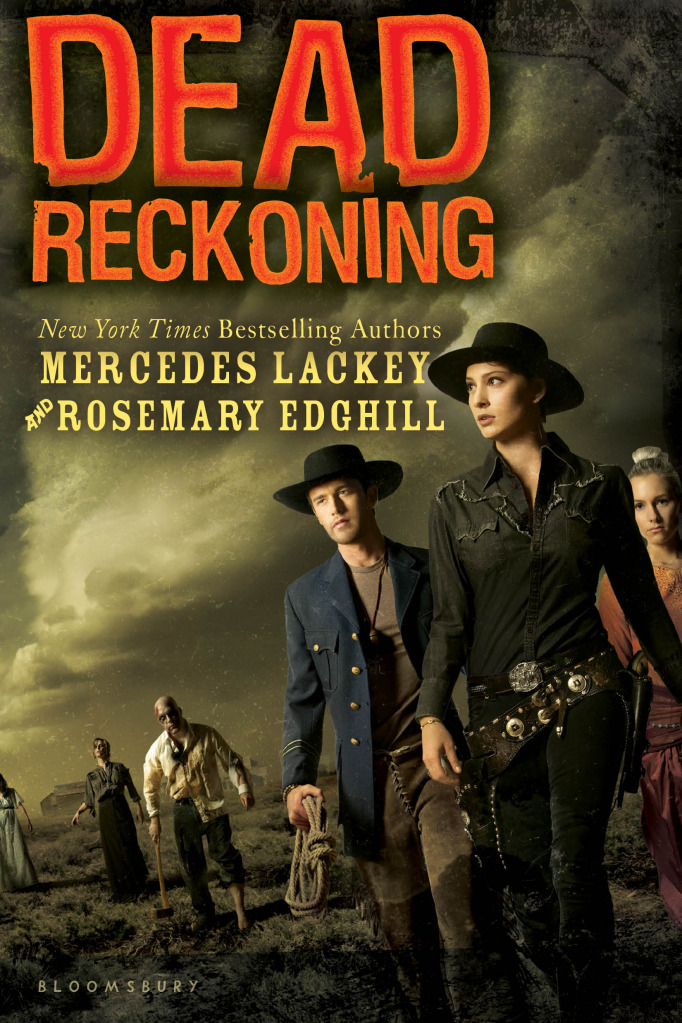
Lackey, Mercedes & Edghill, Rosemary: Dead Reckoning (2012)

Artist: Regina Hoff
Artist: Regina Roff

I have been looking for an updated website for Rosemary Edghill. This link is old (2013). I haven’t found one anywhere else, but she is still alive. She and Mercedes Lackey wrote Dead Reckoning together.

The setting of Dead Reckoning is the Wild West a couple of years after the Civil War. Two of our characters are from either side of the issue while the third is indirectly an American Indian. Jett’s story set me looking for how likely it was that a woman would cross-dress around the time of the Civil War. Well, it happened and not that seldom either. There really wasn’t much choice for any of them. Not for Jett either. If she/he wanted to go off and try to find her brother she would have trouble doing so as a woman. It simply was not accepted. But all of her female habits had to be set aside and Jett had to learn how to walk, talk and adapt the mannerisms of the men of her time to be left alone. She also had to shoot really well, because sometimes seeming like a post-adolescent boy brought many of the same challenges women had. Gunslingers were the shooters who were quick draws and fast shooters.

Honoria had the advantage of an unconventional childhood with an eccentric father. Perhaps eccentric isn’t the correct word. Her father was a genius whose ideas kept interrupting his life and drawing him into new mind-zones. With a daughter just as bright, that may have been a good thing. Honoria was given the freedom to study what she wanted and that enabled her to do what other unusual women of her time also did, invent. I found myself rather liking her insistence upon science over all. Sometimes I wanted to tell her to get over herself, but she was consistent with her character all the way through.

In fact, that can be said of all three characters. Jett remained the male she wanted to be taken for. The last of the three compatriots, White Fox, was consistent with the civilian scout and Algonquin adoptee he was supposed to be. White Fox was on a mission for the 10th Cavalry to find out what had happened to his Captain’s mother at Glory Rest. What he discovered was that the town was completely deserted. There had, in fact, been several incidents of people disappearing or groups of people being slaughtered by unknown parties. The disappearing people fit with the allegations Honoria was investigating.

Their encounters with zombies and cultists are fun and full of action.

Recommended.


Reviews:


Dead Reckoning available at


Ebook available for kindle US, kindle UK & nook


1993: Women in the Civil War
2000: Women Inventors By: Ping Chen W S 301
Way of Life – Algonquian Indians

Meskwaki-Sauk language
Meshkwahkihaki/Sauk history
10th Cavalry Regiment

Ee, Susan: End of Days (Penryn and the End of Days III) (2015)

… “Hey, you! Dinnertime! I’m over here, you scabby rats! Come and get me!”

The Hyundai is rocking with hellions as they pile on. I’m about to screech out of the lot – or at least make donuts until all the hellions head my way and leave the rest of the people alone – when I feel a thump. The car drops on one side. Then I see the shredded rubber of a tire being flung over the hood.

That was the front tire.

I stare dumbly at the ripped-up tire as it flops and wobbles to a standstill in the parking lot.

Then so many hellions pile onto my car that I can’t see the tire anymore.

I stroke the fur of my teddy bear. It’s all I can think to do.

Pooky Bear can’t help me in a vehicle. Not a lot of room to slice and dice.

That means I need to exit the car if I want a chance at getting out of this.

I sit in the car.

I wonder how long a person can stay in a vehicle.

But then, of course, the hellions begin pounding on the windshield. (p. 105)

Susan Ee, End of Days

Wrede, Patricia C.: Daughter of Witches (Lyra II) (1983)

My copy of Daughter of Witches is the revised version. Daughter of Witches is Patricia C. Wrede’s second story.

Bond servants in Chaldon were servants with only one right: a half-day off every three weeks. Their masters could, in all other respects, treat their bond servants as they would. Ranira, our main character, is one such bond servant. She was bonded for nine years because her parents had been judged and killed for being witches. When we meet her, she has two more years of her bond to serve. She is somewhere in her teens.

When strangers come to Lykken’s inn at Festival time, they ignore the danger they place themselves in. Being foreigners in Drinn at Mid-Winter festival is enough to get you arrested. Hosting foreigners is also enough to get you arrested and sentenced as bond servant. In fact, all of your employees and family are placed in bond service for not having reported your crime. Earlier in the story, Ranira unintentionally offended the priest that is her “arresting officer”. It turns out she offended The High Priest of Chaldon. Her sentence is his way of getting revenge.

“For three days more I will be seated in the place of honor in the Temple, next to the High Priest, while he teaches the people the new rites and leads them in the old ones. Then the High Priest himself will perform the wedding ceremony. And consummate it. Publicly,” she added as an afterthought. She stared resolutely at the door of the cell. She was determined to finish, to make them understand, so that they would leave her to whatever little peace and sanity she could find and cling to. “When he is finished, the god will take me. For two days, Chaldon will walk in my body and speak with my voice, and there will be nothing left of me at all. On the last day of the Festival, when both moons are full and Chaldon has accepted the other sacrifices, the nine High Masters will kill me as well.”

Through history human sacrifice is not uncommon: Aztec, Japan, Serbia, Hawaii, India and Rome are only some places where ritualized human killings were/are practiced. Religion seems to make human sacrifice acceptable to the general populace once propaganda becomes common belief. But I wonder if religion is the only area of sacrifice in human society. What about the squandering of young lives in the fights we have with each other to enforce our own points of view? Or the death penalty?

Anyways. Ranira is not too happy about her future fate. Nor are the strangers once they realize what is going to happen to Ranira. What is about to happen to them as well. Although their fate is probably not the privilege of sacrifice to the god Chaldon, they will likely end up as sacrifices to Drinn’s version of justice. Getting away would seem hopeless yet highly desirable for all of them. Ranira and the strangers now set off on what are narrow escapes, much use of magic and new friendships.

Recommended.


Reviews:


Daughter of Witches at Goodreads

Lackey, Mercedes & Edghill, Rosemary: Legacies (Shadow Grail I) (2010)

“She’s gone, what’s the harm?” Muirin said. She flipped through the manila folder. “Transcripts, notes from the teachers – huh, she was getting better grades in Art than I am – evaluations from her magic coach – Kissyface Bowman always was too easy on anybody with a flashy Water Gift – Demerits …” She stopped suddenly, as she got to the last page, and stared down at the folder in silence.

“What?” Loch said. Muirin simply held the folder out to him mutely.

He took it, and looked down at the last page. Spirit looked over his shoulder. There was just a single page there at the end, something it would be easy to take out and dispose of if for some reason you were going to hand it over to someone. At the top of the page there were several lines of illegible handwriting. The rest of the page was blank.

Except for a large red stamp that said: “Tithed.”

And the date.

Halloween. (Mercedes Lackey and Rosemary Edghill)

Gee, Emily: The Sentinel Mage (Cursed Kingdoms I) (2011)

Jáume was in his father’s barn when the curse broke free of its dormancy on the easternmost rim of the Seven Kingdoms.

The story of the Sentinel Mage begins with Jáume, eight years old. Ancient magic turns his father into a monster and the boy has to flee to save his life. Reading up on orphaned children showed me that homeless, orphaned pre-teens looking to survive are more common than I thought. That type of homelessness made Jáume’s tale more believable. Where a lot of children would have died from helplessness, Jáume is crafty and cunning. Sometimes he is not proud of what he has to do to live, but he still does them. Choices we seem to be left with, may not be real choices after all. Do or die?

Magic, like the terrible curse, is the reason witches were hunted until thought extinct on the mainland. But complete extinction of a genetic trait when prophecy is around would never be possible for a fantasy trilogy. In life the complete extinction of a genetic trait seems unlikely. Eventually it might turn up again. In the Sentinel Mage that is even more so the case, as Prince Harkeld is about to discover.

Every prophecy needs its tool and these tools are people who vary from the young and innocent to the old and unwilling. Prince Harkeld starts off with power, wealth and a sense of entitlement. He is 22 years old when he meets the feared witches at his father’s court in Osgaard. King Esgar has called him to meet the diplomatic convoy from Rosny in the Allied Lands. When Prince Harkeld hears what the witches (or “mages” as they prefer) have to say about his destiny and his background he is shocked. It turns out the blood of monsters is in him and he needs to choose between honor and his father’s approval. Fortunately for Prince Harkeld, he choses honor. He is not aware of the personal consequences of doing what his father wishes.

Monsters or not, Harkeld is stuck with the mages (or witches as he curses them). A solution to his distrust is found by the mages. However, this solution requires distraction and a certain amount of naivete on Harkeld’s side. Perhaps the mages figure he is distraught enough that he will not discover the discrepancies that occur when Justen appears.

I understood why Harkeld would act like the distrustful, arrogant and annoying person that he was with the mages. His background, the suddenness of his leaving and the shock of his discovery along with the constant fear of discovery and being on the run would all play a part in leaving him a somewhat unlikable person. I’m not certain I cared much for the mages either. They were dishonest toward Harkeld and very open about the possibility of needing only his hands and blood for the fulfillment of the prophecy. Only as a last resort, of course ….

In leaving the castle behind he also leaves his beloved younger sister and two younger brothers behind. Princess Brigitta wants to come with him but Harkeld feels she will be safer with her father. Hmmmm. Time will show. But Harkeld worries. And with cause. Princess Brigitta and her two helpers, armsman Karel and handmaid Yasma were all that were left to protect her brothers, six-year old Rutgar and four-year old Lukas. But eighteen-year old Brigitta is about to encounter her own set of terrible problems leaving her with little will or ability to look after her brothers. She is also all that stands between Yasma and constant abuse. Being a bondservant in Osgaard equates to slavery and terror. At least with the Princess Yasma had escaped daily rape and beatings.

Gee’s writing is what drove the story on. There were some hiccups but for the main part she kept me caught in her words. Recommended.


Reviews:


The Sentinel Mage is available at Amazon, Amazon UK, IndieBound, Barnes and Noble, Book Depository

Hyndman, Jennifer Elizabeth: Grinch, Demon Slayer (2013)

Bryce didn’t see the string attached to a fishing hook which Noah had hid, with the direction of Samuel, under his drinking glass. He looked at Brooklyn and said, “You dipped your hair in your gravy again.”

Brooklyn squealed, looking down at her hair and examining it for food. When Bryce had his full attention on Brooke’s hair Noah quickly slipped the fishing hook into the wrist cuff of the head elf’s button up shirt. Bryce didn’t notice nor did anyone else.

“Well it looks like I was wrong.” Noah chuckled at his own genius. Well, technically it was Samuel’s genius. Keeping the string loose, he waited until Bryce was about to lift a spoonful of mashed potatoes to his mouth. That was when he held the string tight so that Bryce had to pull extra hard to lift his hand.

When Bryce pulled harder on his hand, confused at the resistance, the string broke and he quite literally punched himself in the face with a spoon of potatoes. He was not amused. Luckily, Noah was faster than Bryce. …

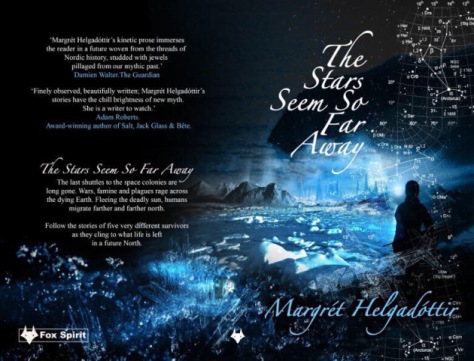
Helgadóttir, Margrét: The Stars Seem So Far Away (2015)

Cover artist: Sarah Ann Langton

I am glad Ms. Helgadóttir asked me to review her book, The Stars Seem So Far Away. Its completion left me feeling weepy and I have been trying to figure out why that is.

How much loss can we endure before we decide that death is for us? I have never truly been alone. Somewhere, within my ability to contact them, have been people I have cared about. I am 50 and both my parents and all of my siblings are still fairly intact. My husband and my children are close, both geographically and emotionally, to me. In each of Ms. Helgadóttir’s stories we meet people who have, or think they have, lost all who they cared about.

When we meet Aida, she is in her early teens and on her way to becoming all alone once again. Her father and mother had died and her brother had disappeared during the plague. Another caretaker turned up, but he is also dying. We meet her grief and her decision to try to survive.

Could I keep from losing a sense of decency in my interactions with other humans in a world where those I encountered were likely to kill me? Nora did and her choice makes all the difference in a world where survival is, at best, a chancy thing. I loved her handling of the piracy situation that arose.

How do you reintroduce yourself to humanity if you have been alone for years? Bjørg has had to manage on her own with her isbos as her only company for some time. Her living conditions have been far superior to those of the other characters. Yet her mission, as set by her father and the Commander, has been traumatizing for her. Somehow she has muddled through it all. Finally, she is unable to do her “duty” yet another time, and that brings the soldiers of Svalbard into her life. Going from a solitary life to one filled with people (even if there are only four others) changes everything for her.

Loss of parents, siblings, children and friends are all losses that our characters experience. Loss of home and safety in a world where the only surviving animal seems to be human is another factor that adds to their burdens. Most plants are gone and the environment makes life difficult, or impossible, in most of today’s temperate zones. Ms. Helgadóttir’s future is entirely believable.

Tying her short stories together in the manner that she has was well done. Her prose is lovely and her portrayal of the Nordic is well done.

Definitely recommended.


Reviews:


The Stars Seem So Far Away available at Amazon here (UK) and here (US)


A copy was given to me by the author


Svalbard Global Seed Vault

2013: Melting Sea Ice Keeps Hungry Polar Bears on Land

Turner, Tej: The Janus Cycle (2015)

The Janus Cycle by Tej Turner
Cover art: Alison Buck

A common theme in all of these short stories seems to be bullying of one sort or another. Needing to dominate others is part of our human history. Countries bully other countries into subservience and oblivion. Two countries are well-known for their tendencies to bully militarily weaker countries while decrying other nations when these do the same. Tej Turner shows us the one-on-one form of bullying and the mob-on-one kind of bullying in his semi-short stories.

All of these short stories are more or less stand alone stories. They are all tied together by Frelia. Frelia has an interesting power that could cause her death if the ones who “rule” it find out about her having that power. But bullies have been part of Frelia’s past and she will not be forced into obedience just because some mysterious stranger tells her she has to. That decision is an essential one to the stories of Pikel, Kev, Tristan, Neal, Namda, Halan, Sam, Pag, Faye and Tilly. Frelia’s intervention changes lives, hopefully for the better.

Mobs with a charismatic leader are a frightening thing. Poor Tilly has the great misfortune of having one of those in her school and she has the kind of aura that many victims end up with. Sadly, this aura attracts predators like Jarvis and his gang.

Bullying (for whatever reason) drags your sense of self-worth down until it seems impossible to gain any of it back. The bullied person becomes so used to people being mean that trust is difficult to come by. At one point things became so desperate for her that Tilly was ready to kill herself. Being treated like a verbal and/or physical punching bag almost every day makes her need to be true to herself something I both admire and understand. Poor little Tilly. Tej Turner made me want to hug her.

“They carried on kicking her. In the face, the head, the stomach. They stamped on her legs, and one of them even spared a moment to spit at her. I desperately tried to intervene, but there were too many and I couldn’t reach them. They were killing her, but they carried on regardless. So long as the rest of them were doing it they seemed to feel it was okay, and none of them wanted to be the first to hesitate.”

In one way or another we all seem to become part of various kinds of mobs.

Definitely recommended.


The story behind the Janus Cycle


Janus Cycle available at Amazon US


I was given an ARC copy by the author

Sagara, Michelle: Cast in Fury (Chronicles of Elantra IV) (2011)

In our case, my reading to my dyslexic child makes the world of words more accessible to her while also giving us the opportunity to cuddle. But needing to be read to is NOT a prerequisite for reading together. Stories like Cast in Fury are wonderful reading out loud stories because there is so much dialogue. That means that I can shout, whisper, and bring humour to my voice. Fortunately, my daughter still enjoys my voice. We had fun and precious together time, something I am not usually very good at.

I adore Merrin. She is what I would have liked to have been. But I would go insane in the chaos of an orphanage. Having two children of my own has been difficult enough. The other thing she does, that I would also like to be able to do, is to accept any person (no matter breed) as long as they are kind to her children.

I fear I am more like Kaylin. My daughter and I laugh at her attention span. Do we ever recognize ourselves in that. Kaylin’s attention span and her bluntness. Autists aren’t famed for being great liars (although some of us are able to lie). Nor is Kaylin. If anything, she if known for the opposite. These traits bring her into trouble with her teachers and friends, but they are also the traits that keep her going as she searches for a truth she can live with. Truth is strange that way. Depending on who I speak with or what I read, ideas of what truth is and must be varies. Kaylin’s greatest truth is that all children have the potential for “good” or “bad” deeds. Only time will prove what they prefer.

Cast in Fury is in part about the child that Kaylin claims as her own. She was there at his birth and licked some of his birthing fluids off his eyelids (not my kind of thing). That makes her part-mother according the laws of the Pridlea, and Kaylin uses any tool at her disposal to save a child she has met. The little dude is one lucky boy to have Kaylin on his side. Without her, he would be a dead little Leontine cub according to Caste laws. That a child might need killing in order to protect a group from something is not a new phenomenon. Nor do I expect it to become an extinct practice. Killing this Leontine baby is the only wise thing to do according to Leontine tradition and lore. Not only Kaylin is in trouble for trying to save the Leontine cub. Her sergeant, Marcus Kassan, is awaiting his trial for murder because of that same cub.

We had fun reading together. Recommended (both reading together and the story).


Reviews:


Cast in Fury available at Scribd

Clement, J.A.: Song of the Ice Lord (On Dark Shores 0) (2014)

Song of the Ice Lord - JA Clement

As usual, I get hung up on the “baddies” in a story. In Song of The Ice Lord, the Ice Lord is our baddie, most likely a spirit/god/demon of destruction and hunger. Not hunger for food, but hunger for everything. The Ice Lord seems to be driven by a desire or need to devour all it touches. Once a place has come into contact with the Ice Lord, it is completely destroyed by it/him/her and its armies. The Ice Lord’s method of gathering armies is through fear, the fear of being devoured. Thinking about the Ice Lord made me think about humanity’s hunger and destructiveness. We are good at that. Sadly, too good. Perhaps we will be lucky and find ourselves a Lodden and Maran to save us from ourselves.

War is one of the many mysteries I struggle to understand. I do realize that humans are incredibly territorial. As a breed, we seem to want to expand our own lands and ideas of right and wrong, even if that means killing other humans. The Skral, Sharan and Gai Ren are no exception to this. What started out as one people developed into competing tribes and nations. At regular intervals they would attack their neighboring countries, city-states or tribal competitors. When the Ice Lord arrives on the scene a few people from each nationality escapes and they are taken to the islands of the Skral. These, usually competing, people band together in an attempt to dethrone the Ice Lord without destroying every last remnant of themselves and their cultures. Changing alliances. What a bizarre phenomenon and terribly confusing to my asperger brain. One of my thoughts on reading this was the same as the thought whenever I hear of this happening in the real world: “How long will it take before they are killing each other again?” Historically speaking, not very long at all.

Song of the Ice Lord is in many ways a terrifying story. Horror it ain’t, not in any kind of manner. But its way of nailing the future of nations (historical and current) makes me want to shout: “can’t we just be friends, please, and stop all of this destruction”. A girl can dream.

The flow of words was very different to the other stories in this series. Most of that probably has to do with the insertion of the three short stories, all three important in the context of the over-all story.

Definitely recommended.


Reviews:


Song of the Ice Lord available at Smashwords


I was given a copy by the author


Sagara, Michelle: Cast in Silence

“It was not a terribly fine door. The frame that contained it was solid and blocky, one piece with the stone of the Tower. There were no letters above it, or, as was often the case in parts of Elantra, adorning the wall to either side. In fact, it looked as if the door had been added as an afterthought. Given that the door seemed flat, rectangular, and plain – the type of door behind which someone like Kaylin or Severn might live – it might have been. It had a doorknob. The hinges were on the inside. It seemed – at this distance – to lack a keyhole.”

Page 252

Rust, Angelika: Once a Rat (Istonnia III) (2014)

once-a-rat - Angelika Rust

Angelika Rust displays one of my favorite traits in an author. She evolves and improves over time. Once a Rat shows just how far Rust has come in her writing. The only thing she continues to do that annoys me is to overuse the word “whom”.

“It’s worse than I thought,” she groaned, rolling onto her back. “It isn’t innocence, it’s honor. You’re the son of a rich bastard of a trader and a madwoman. Whom, for fire’s sake did you inherit your honor from?”

Honor is a strange concept. For one thing, honor varies from person to person. There does seem to be a common denominator across nations, namely that to be considered honorable, one must keep promises/oaths made. Nivvo seems to have honor as an in-born character trait. Such a trait makes Nivvo perfect for some roles but disqualifies him when breaking promises might be needed. There are several high-status professions, in real life and in Istonnia, involving deception and deceit, that Nivvo could not fill.

In Once a Rat Nivvo is sent on a joint mission for the Regent and Underlord of Istonnia in the hopes that Istonnia might be saved from more fighting. Being the kind of story that Once a Rat is, the likelihood of Nivvo surviving that mission is in doubt. But Nivvo accepts that as his duty. Part of that duty has to do with his promises to obey Vicco, but Nivvo also seems to feel that his relationship with the Regent obliges him to serve Istonnia as best he can.

Part of his mission terrifies him. Practical experience of slavery turns out to be completely different from the theoretical understanding of its nature.

“…, he knew they’d come back to haunt him for the rest of his life … a child, little more than a toddler, on his hands and knees, and a soldier stomping on the tiny fingers till they broke with a sickening crunch … a woman his own age, tears streaming from her closed eyes as a slave handler cut her clothes away to reveal her body to a customer … a man hugging the pole he was tied to, screaming relentlessly as a lash opened up gash after gash on his already scarred back …”

Slavery, the objectification of people taken to extremes. The real world still embraces slavery and most of us are quietly complicit in letting it carry on. Nivvo’s mission is to get to the person trying to work against slavery in Baredi and help that person succeed. But the odds are against the abolitionists.

There are some very angry people left in Istonnia. Choosing to smother his loved ones in protectiveness happens to be one of Nivvo’s greatest failings. Even Vilores is kept in the dark. Shame on Nivvo and his father for breaking that law once again.

While Nivvo is gone Cambrosi is having fun trying to stay alive. Fedoro is helping him. Someone in his organization is trying to overthrow the Underlord. If it works, then Istonnia seems doomed to enter what might become a civil war.

Plenty of action, some violence, some sex – neither very explicit.

Definitely recommended.


Once a Rat available at Amazon US

Rust, Angelika: A Rat for a Rat (Istonnia II) (2014)

A Rat for a Rat - Angelika Rust

Everyone self-harms in one way or another. Calling ourselves names or making ourselves less is one way we love to harm our self-confidence. Others self-harm through physical means. In the there and then, self-harming usually relieves some kind of pressure or stress. Long-term, though, we damage ourselves. Taken to extremes we might even lose body parts or become permanently damaged in other ways. Autistic people know about self-harming that may come a part of a stim.

The Baredians see women as doormats. To them, women are to be used without regard for their feelings, growth or well-being. In A Rat for a Rat we meet Miniri, a seriously troubled girl. She is addicted to self-harm, even if that self-harm means putting herself in the way of being trampled on and sexually abused by the Baredi. Imagine what a person like that could get up to in striving to fill the void inside of her.

Healers are revered people in Istonnia. They may go where no other person may and expect no harm to come to them. Like all work groups, some healers are more popular than others. Inna Malduri is definitely lowest on the totem pole and only the worst students get sent to her. Which is why Anniscia is shocked when she is sent to be Malduri’s  apprentice. You see, Anniscia happens to be at the top of her class and feels she is much to good to serve the poorer part of town. She is about to be exposed to a side of life of life she is unused to.

The Regent, being used to living out in the desert with his group of followers, is having trouble adjusting to politics and people who have different goals. He forgets that in politics revealing the identity of people you love is dangerous to yourself and the one you care for, at least if that person is to be a secret. The world is not supposed to know that Nivvo is his son, but the Regent is not able to avoid reaching out to him.

Nivvo tries to protect his father and brother by being absent. He knows the way the city works and what a wonderful weapon Vicco Cambrosi gains in knowing how much the Regent cares about his long-lost son. Both father and son suffer from a need to over-protect, a trait that exasperates the people around them.

Reka is the one who is most annoyed by this father and son interaction. If she could beat some sense into their heads, she would. Instead she treats both like the brats they are. Nivvo is used to her way of showing anger. The Regent, however, is used to getting his own way, and is at a loss about what to do when Reka treats him the way she does.

A Rat for a Rat was an action-filled and fun story that also dealt with consequences that may arise from our actions.

Definitely recommended.


Reviews:


A Rat for a Rat available at Amazon US