15 words you should eliminate from your vocabulary to sound smarter

Guilty as charged. Perhaps you are too?

Censored-paper

Image: Masterfile/Corbis
Newsprint is on life support,emoji are multiplying faster than hungry Gremlins, and 300 million people worldwide strive to make their point in 140 or fewer characters.People don’t have the time or the attention span to read any more words than necessary. You want your readers to hear you out, understand your message, and perhaps be entertained, right? Here’s a list of words toeliminate to help you write more succinctly.

1. That

It’s superfluous most of the time. Open any document you’ve got drafted on your desktop, and find a sentence with “that” in it. Read it out loud. Now read it again without “that.” If the sentence works without it, delete it. Also? Don’t use “that” when you refer to people. “I have several friends that live in the neighborhood.” No. No, you don’t. You have friends who. Not friends that.

2. Went

I went to school. Or the store, or to church, or to a conference, to Vegas, wherever it is you’re inclined to go. Instead of “went,” consider drove, skated, walked, ran, flew. There are any number of ways to move from here to there. Pick one. Don’t be lazy and miss the chance to add to your story.

3. Honestly

People use “honestly” to add emphasis. The problem is, the minute you tell your reader this particular statement is honest, you’ve implied the rest of your words were not. #Awkward

4. Absolutely

Adding this word to most sentences is redundant. Something is either necessary, or it isn’t. Absolutely necessary doesn’t make it more necessary. If you recommend an essential course to your new employees, it’s essential. Coincidentally, the definition of essential is absolutely necessary. Chicken or egg, eh? ………..

The rest of the article can be read at The Muse

Don’t Fart in Bed (2002)

https://i0.wp.com/cdn.shopify.com/s/files/1/0032/7882/products/fart_1024x1024.jpg
“Farting in bed” by Matthew Inman (theoatmeal.com)
This is a story about a couple who had been happily married for years.

The only friction in their marriage was the husband’s habit of farting loudly every morning when he awoke. The noise would wake his wife and the smell would make her eyes water and make her gasp for air. Every morning she would plead with him to stop ripping them off because it was making her sick. He told her he couldn’t stop it and that it was perfectly natural. She told him to see a doctor; she was concerned that one day he would blow his guts out.

The years went by and he continued to rip them out! Then one Thanksgiving morning as she was preparing the turkey for dinner and he was upstairs sound asleep,she looked at the bowl where she had put the turkey innards and neck gizzard, liver and all the spare parts and a malicious thought came to her.

She took the bowl and went upstairs where her husband was sound asleep and, gently pulling back the bed covers, she pulled back the elastic waistband of his underpants and emptied the bowl of turkey guts into his shorts.

Some time later she heard her husband awaken with his usual trumpeting which was followed by a blood curdling scream and the sound of frantic footsteps as he ran into the bathroom. The wife could hardly control herself as she rolled on the floor laughing, tears in her eyes! After years of torture she reckoned she had got him back pretty good.

About twenty minutes later, her husband came downstairs in his bloodstained underpants with a look of horror on his face. She bit her lip as she asked him what the matter was. He said, “Honey, you were right. All these years you have warned me and I didn’t listen to you.”

“What do you mean?” asked his wife. “Well, you always told me that one day I would end up farting my guts out, and today it finally happened. But by the grace of God, some Vaseline, and these two fingers, I think I got most of them back in.”

http://www.greenspun.com/bboard/q-and-a-fetch-msg.tcl?msg_id=009kNX

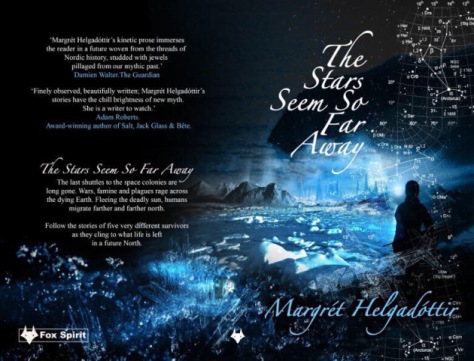
Helgadóttir, Margrét: The Stars Seem So Far Away (2015)

Cover artist: Sarah Ann Langton

I am glad Ms. Helgadóttir asked me to review her book, The Stars Seem So Far Away. Its completion left me feeling weepy and I have been trying to figure out why that is.

How much loss can we endure before we decide that death is for us? I have never truly been alone. Somewhere, within my ability to contact them, have been people I have cared about. I am 50 and both my parents and all of my siblings are still fairly intact. My husband and my children are close, both geographically and emotionally, to me. In each of Ms. Helgadóttir’s stories we meet people who have, or think they have, lost all who they cared about.

When we meet Aida, she is in her early teens and on her way to becoming all alone once again. Her father and mother had died and her brother had disappeared during the plague. Another caretaker turned up, but he is also dying. We meet her grief and her decision to try to survive.

Could I keep from losing a sense of decency in my interactions with other humans in a world where those I encountered were likely to kill me? Nora did and her choice makes all the difference in a world where survival is, at best, a chancy thing. I loved her handling of the piracy situation that arose.

How do you reintroduce yourself to humanity if you have been alone for years? Bjørg has had to manage on her own with her isbos as her only company for some time. Her living conditions have been far superior to those of the other characters. Yet her mission, as set by her father and the Commander, has been traumatizing for her. Somehow she has muddled through it all. Finally, she is unable to do her “duty” yet another time, and that brings the soldiers of Svalbard into her life. Going from a solitary life to one filled with people (even if there are only four others) changes everything for her.

Loss of parents, siblings, children and friends are all losses that our characters experience. Loss of home and safety in a world where the only surviving animal seems to be human is another factor that adds to their burdens. Most plants are gone and the environment makes life difficult, or impossible, in most of today’s temperate zones. Ms. Helgadóttir’s future is entirely believable.

Tying her short stories together in the manner that she has was well done. Her prose is lovely and her portrayal of the Nordic is well done.

Definitely recommended.


Reviews:


The Stars Seem So Far Away available at Amazon here (UK) and here (US)


A copy was given to me by the author


Svalbard Global Seed Vault

2013: Melting Sea Ice Keeps Hungry Polar Bears on Land

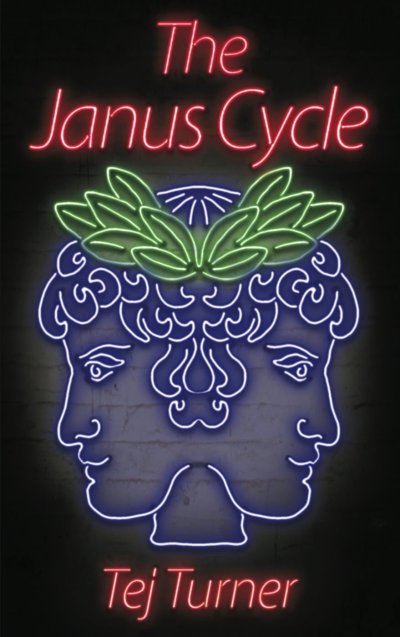
Turner, Tej: The Janus Cycle (2015)

The Janus Cycle by Tej Turner
Cover art: Alison Buck

A common theme in all of these short stories seems to be bullying of one sort or another. Needing to dominate others is part of our human history. Countries bully other countries into subservience and oblivion. Two countries are well-known for their tendencies to bully militarily weaker countries while decrying other nations when these do the same. Tej Turner shows us the one-on-one form of bullying and the mob-on-one kind of bullying in his semi-short stories.

All of these short stories are more or less stand alone stories. They are all tied together by Frelia. Frelia has an interesting power that could cause her death if the ones who “rule” it find out about her having that power. But bullies have been part of Frelia’s past and she will not be forced into obedience just because some mysterious stranger tells her she has to. That decision is an essential one to the stories of Pikel, Kev, Tristan, Neal, Namda, Halan, Sam, Pag, Faye and Tilly. Frelia’s intervention changes lives, hopefully for the better.

Mobs with a charismatic leader are a frightening thing. Poor Tilly has the great misfortune of having one of those in her school and she has the kind of aura that many victims end up with. Sadly, this aura attracts predators like Jarvis and his gang.

Bullying (for whatever reason) drags your sense of self-worth down until it seems impossible to gain any of it back. The bullied person becomes so used to people being mean that trust is difficult to come by. At one point things became so desperate for her that Tilly was ready to kill herself. Being treated like a verbal and/or physical punching bag almost every day makes her need to be true to herself something I both admire and understand. Poor little Tilly. Tej Turner made me want to hug her.

“They carried on kicking her. In the face, the head, the stomach. They stamped on her legs, and one of them even spared a moment to spit at her. I desperately tried to intervene, but there were too many and I couldn’t reach them. They were killing her, but they carried on regardless. So long as the rest of them were doing it they seemed to feel it was okay, and none of them wanted to be the first to hesitate.”

In one way or another we all seem to become part of various kinds of mobs.

Definitely recommended.


The story behind the Janus Cycle


Janus Cycle available at Amazon US


I was given an ARC copy by the author

Baird, Christopher S.: How does water dowsing work? (2015)

  A water witch or dowser, redrawn from a sixteenth-century woodcut. Adapted from   A water witch or dowser, redrawn from a sixteenth-century woodcut. Adapted from Gilluly, Waters, and Woodford (1959)..

A water witch or dowser, redrawn from a sixteenth-century woodcut. Adapted from Gilluly, Waters, and Woodford (1959)..

One of my fascinations has to do with the many paranormal beliefs humans hold as true. I have done so myself at times. At least until science explained what was really going on. Scientific explanations are soooooo very much more fun than the paranormal one. In the case of the myth of water dowsing the scientific explanation could end up saving you a lot of money and perhaps even your life.

wer
When an object, such as a marble on a roof ridge, is in a state of unstable equilibrium, a small movement (such as the breeze nudging the marble to one side) becomes a large movement (such as the marble shooting off one side of the roof). This event could be misinterpreted as a powerful, hidden agent on one side of the house drawing the marble towards it. The belief in water dowsing arises out of this type of misinterpretation. Public Domain Image, source: Christopher S. Baird

.

In the sense that it finds underground water, water dowsing does not work. Water dowsing involves the claim that a person can locate underground sources of water without using any scientific instruments. Typically, the person that is dowsing holds sticks or rods and walks around a property in the hopes that the rods will dip, twitch, or cross when he walks over the underground water. The dowsing rods do indeed move, but not in response to anything underground. They are simply responding to the random movements of the person holding the rods. The rods are typically held in a position of unstable equilibrium, so that a small movement gets amplified into a big movement. The movements of the rods do not seem like they are coming from the small vibrations in the dowser’s arms, since these vibrations are so small and the rod’s movements are so large. From the false assumption that the movements of the rods are not coming from the small random vibrations of the dowser’s arms, people then make the illogical leap that the movements must therefore be caused by something powerful that is out of sight, i.e. underground water. Since successfully locating underground water can save a farmer the trouble of digging several wells that end up dry, and since scientific approaches can be expensive, there is a strong incentive for people to want water dowsing to work.

Unstable equilibrium describes a state where all the forces on an object cancel out but the slightest deviation from the point of equilibrium causes the object to fly off. For instance, if you place a marble on exactly the top edge of a sharply-ridged roof, the marble will sit there motionless since the forces pulling it down either side of the roof cancel out. However, if the slightest breeze blows past the marble, it will give the marble a small bump toward one side of the roof. The forces will no longer cancel and the marble will shoot down one side of the roof. Since the marble was in a state of unstable equilibrium, gravity was able to amplify a small movement invisible to humans (the bump from the gentle breeze) into a large movement (the marble rolling down the side of the roof). To the naked human eye, it looks like a power agent exists only on one side of the house and is drawing the marble towards it. If we didn’t understand the concept of unstable equilibrium, we may be tempted to say that there is underground water only on the one side of the house which pulled the marble down that side. Belief in water dowsing operates on this type of misunderstanding.

The rest of the article can be found on Science Questions With Surprising Answers

Ward, Matthew: Queen of Eventide (Eventide I) (2015)

Queen of Eventide by Matthew Ward

Queen of Eventide kept me up until I had finished it. It was weird, fun and tense (sometimes all at once). Now that playtime is over, it is time for my review.

Maddie twisted around, wiping blood out of her eyes. She saw only mist, glowing and swirling in the moonlight, but this did nothing to stem her rising panic.

Maddie has reason to panic. She is being chased by several parties and does not know who is for her or who is against her. Keeping knowledge from me, the reader, is a great tool for an author. Mr. Ward wields it well although I do catch on to some things before he reveals them to me.

Nottingham supposedly flourishes with ghosts. Certain signs and portents must be present for some of them to show. In Queen of Eventide, some of these ghosts come from a place called Eventide, and they are of a particularly creepy/frightening nature. All of a sudden a person might find themselves being chased by a huntsman and his wolves. Maddie finds herself being chased several times and for reasons she does not understand. Each time William seems to appear to save her. Or is he really there to save her? Allegiances are an iffy matter in Queen of Eventide.

My favorite character was Charles King. Partly, that has to do with the sense of humor he brings to the story. When Maddie first meets him, he introduces himself as a fortune teller. Maddie tells him she thought fortune tellers were old women and Charles answers:

“Ah, there you have me,” Charles replied. “I am not, in fact, and old woman.” Maddie shot him a long-suffering look, and he pressed hurriedly on. “I do, however, possess a knack for peeking into the future.” He leaned forward, conspiratorially. “I inherited it from my grandmother – who was, you’ll be pleased to know, an old woman.”

Hollows are the strangest and possibly most disturbing creatures of the story. They aren’t creepy because of what they do, but due to what they are. We are talking bizarre. And that is all I can say about them without serious spoilers gotting in the way.

As an Asperger, metaphors can be a challenge. Mr. Ward excels in his use of them. Thankfully most of them are familiar ones. Some of them I use myself. The ones who aren’t add to the humor and fantastical aspect of the story.

Queen of Eventide was well worth the read – as my staying up well into the night is evidence of.

Definitely recommended.


Reviews:


Queen of Eventide is available at Smashwords.com


A copy of the story was given to me by the author


Eventide: [Middle English, from Old English ǣfentīd : ǣfen, evening + tīd, time; see dā- in Indo-European roots.] = aftentid/kveldstid in Norwegian

Sagara, Michelle: Cast in Fury (Chronicles of Elantra IV) (2011)

In our case, my reading to my dyslexic child makes the world of words more accessible to her while also giving us the opportunity to cuddle. But needing to be read to is NOT a prerequisite for reading together. Stories like Cast in Fury are wonderful reading out loud stories because there is so much dialogue. That means that I can shout, whisper, and bring humour to my voice. Fortunately, my daughter still enjoys my voice. We had fun and precious together time, something I am not usually very good at.

I adore Merrin. She is what I would have liked to have been. But I would go insane in the chaos of an orphanage. Having two children of my own has been difficult enough. The other thing she does, that I would also like to be able to do, is to accept any person (no matter breed) as long as they are kind to her children.

I fear I am more like Kaylin. My daughter and I laugh at her attention span. Do we ever recognize ourselves in that. Kaylin’s attention span and her bluntness. Autists aren’t famed for being great liars (although some of us are able to lie). Nor is Kaylin. If anything, she if known for the opposite. These traits bring her into trouble with her teachers and friends, but they are also the traits that keep her going as she searches for a truth she can live with. Truth is strange that way. Depending on who I speak with or what I read, ideas of what truth is and must be varies. Kaylin’s greatest truth is that all children have the potential for “good” or “bad” deeds. Only time will prove what they prefer.

Cast in Fury is in part about the child that Kaylin claims as her own. She was there at his birth and licked some of his birthing fluids off his eyelids (not my kind of thing). That makes her part-mother according the laws of the Pridlea, and Kaylin uses any tool at her disposal to save a child she has met. The little dude is one lucky boy to have Kaylin on his side. Without her, he would be a dead little Leontine cub according to Caste laws. That a child might need killing in order to protect a group from something is not a new phenomenon. Nor do I expect it to become an extinct practice. Killing this Leontine baby is the only wise thing to do according to Leontine tradition and lore. Not only Kaylin is in trouble for trying to save the Leontine cub. Her sergeant, Marcus Kassan, is awaiting his trial for murder because of that same cub.

We had fun reading together. Recommended (both reading together and the story).


Reviews:


Cast in Fury available at Scribd

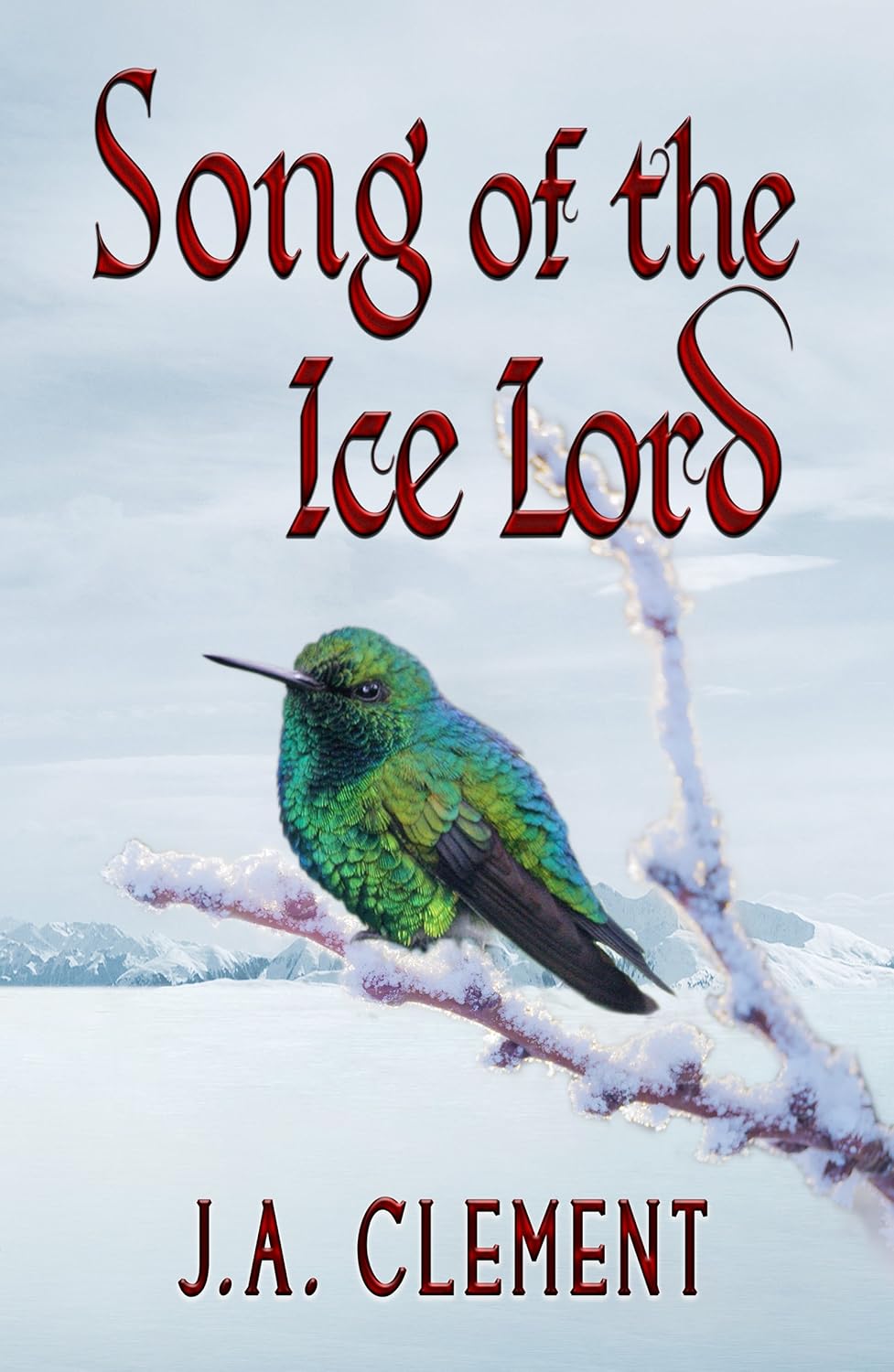
Clement, J.A.: Song of the Ice Lord (On Dark Shores 0) (2014)

Song of the Ice Lord - JA Clement

As usual, I get hung up on the “baddies” in a story. In Song of The Ice Lord, the Ice Lord is our baddie, most likely a spirit/god/demon of destruction and hunger. Not hunger for food, but hunger for everything. The Ice Lord seems to be driven by a desire or need to devour all it touches. Once a place has come into contact with the Ice Lord, it is completely destroyed by it/him/her and its armies. The Ice Lord’s method of gathering armies is through fear, the fear of being devoured. Thinking about the Ice Lord made me think about humanity’s hunger and destructiveness. We are good at that. Sadly, too good. Perhaps we will be lucky and find ourselves a Lodden and Maran to save us from ourselves.

War is one of the many mysteries I struggle to understand. I do realize that humans are incredibly territorial. As a breed, we seem to want to expand our own lands and ideas of right and wrong, even if that means killing other humans. The Skral, Sharan and Gai Ren are no exception to this. What started out as one people developed into competing tribes and nations. At regular intervals they would attack their neighboring countries, city-states or tribal competitors. When the Ice Lord arrives on the scene a few people from each nationality escapes and they are taken to the islands of the Skral. These, usually competing, people band together in an attempt to dethrone the Ice Lord without destroying every last remnant of themselves and their cultures. Changing alliances. What a bizarre phenomenon and terribly confusing to my asperger brain. One of my thoughts on reading this was the same as the thought whenever I hear of this happening in the real world: “How long will it take before they are killing each other again?” Historically speaking, not very long at all.

Song of the Ice Lord is in many ways a terrifying story. Horror it ain’t, not in any kind of manner. But its way of nailing the future of nations (historical and current) makes me want to shout: “can’t we just be friends, please, and stop all of this destruction”. A girl can dream.

The flow of words was very different to the other stories in this series. Most of that probably has to do with the insertion of the three short stories, all three important in the context of the over-all story.

Definitely recommended.


Reviews:


Song of the Ice Lord available at Smashwords


I was given a copy by the author


Decruyenaere, Gilles: I Dreamt of Trees (2015)

I Dreamt of Trees is an amazing first novel. Mr. Decruyenaere has managed that difficult feat of listening to his editors and written tightness and tension into his story. Words flow from one to another drawing me into a dreary and terrible future inhabited by people who are all too believable.

The USS McAdam seems to have been built with every contingency in mind except the humans inhabiting it and the Squelchers. But for the most part it is the humans who are its main problem and also the main theme of the story. We enter the USS McAdam centuries after its launching from a place only guessed at by the general population.

“to think that anyone on the ship actually knew its true origins was just ridiculous; too many centuries had passed since the ship had launched; too many computer malfunctions, human errors, and political shenanigans had transpired for any real proof of Earth to remain.”

The society on the MSS McAdam seems to have been half-way decent during the Prologue. Thirty-five years after the appearance of the Squelchers, life has changed for the entire population of the vessel.

A crisis is a wonderful thing for power-hungry people. What was once unthinkable becomes doable by manipulating a fearful population into wanting to destroy the new “THEM” by any means possible. Even if that entails becoming a strictly stratified and segregated population (“one must make sacrifices”). The “have-nots” are stuck on the Rim-side of a ship-wide sewage moat while the “haves” get to live on the Core-side. Understandably, Core-dwellers will do what is required to remain on their side of the moat.

Core-dwellers are the people the High Command (and true rulers after the revolution) deemed desirable. The High Command tell their puppets, the Council, what attitudes need to be enforced through propaganda and terror. Like many of our own revolutions here on earth, life seldom becomes better for any but the very few. But while life may be terror-laden for Core-dwellers, it is infinitely better than what Rim-dweller endure.

What new regimes need are heroes and “Them”. In this case the major “Them” is obvious. Squelchers are bizarre aliens who zap people into their spaceships when their beams get through the shields of the MSS McAdam. Our new heroes are the Flashers and the Boosterettes.

Flasher Jason Crawford is our main character and seventeen years old. His level of aggression is at a height that is either drug-induced or bred into him. For some reason anger and aggression are seen as a positive qualities for the Flashers (along with youth and short and slender bodies). Everything about Jason screams aggression. His language reveals both his lack of ability to control his temper but also the extremely homophobic and misogynistic nature of his society.

A young girl’s greatest goal is to be able to work in privilege suites as a Boosterette. I strongly doubt dream and reality line up for these young girls. Medical staff are assigned to take care of what is left once the Flashers have “released the pressure”. Thankfully, Mr. Decruyenaere never shows us what goes on in the privilege suites.

Life is going to be full of surprises for young Jason and most of those surprises will shock him. I loved the ending. It was perfect.

Definitely recommended.


I Dreamt of Trees available at:


I was given a copy of this book by the author


hawkgrrrl: My So-Called Post

March 31, 2015

I’m a word nerd, so I always find it interesting when a simple change to grammar alters the meaning of a word or sentence.  Time magazine recently pointed out one grammatical faux pas:  using “actually” can be a red flag. From this article (reprinted from Inc.):

Extra words used in a sales presentation or investor pitch are unnecessary. They subconsciously point listeners to question if there’s more unspoken information. The word “actually” serves as a spoken pause, giving the presenter’s brain time to catch up and decide how to resolve the conflict in their mind between the question asked and reality.

Actually can point to something in contrast to what is expected; for example, (per the article) if you ask someone “Did you get milk at the store?” and they respond, “Actually, I went to the gas station,” they are pointing out that you expected them to get milk at the store, but ha-ha, there is justification to get milk at the gas station, which is what they did, thwarting your heteronormative patriarchal expectations.  Or something like that.

If you ask your son, “Did you finish all your homework?” and he starts with “Actually . . . ” well, as parents, we are immediately suspicious. [1]  He may be deciding how to answer while he’s stringing out the “actually.” ….

The rest of the article can be found at Wheat and Tares

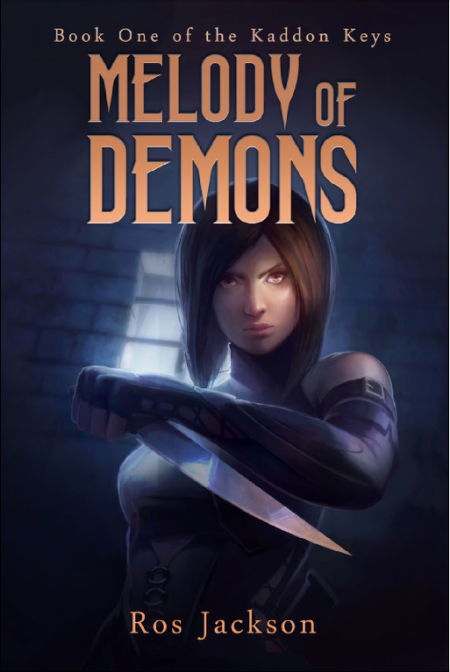
Jackson, Ros: Melody of Demons (Kaddon Keys I) (2015)

Melody of Demons

I had an “aha” experience reading Melody of Demons. Asperger that I am, life apparently affects my ability to read a story. A recent family crisis brought out chaos in my head. To deal with that chaos, I unconsciously shut off certain cognitive processes, one of which was my ability to digest stories. Not until now, have I recognized doing this. What this meant with regards to Melody of Demons was that I had to keep on reading it until I could absorb what I was reading. Annoying as hell, yet an interesting observation for myself and possibly for others out there.

“Well, that was … a sermon. That’s certainly what it was. I think we all learned a valuable, no a lesson. That we already knew. Yes, one thing you can say for my father’s froth-mouthed rants, is they’re definitely spoken with words.”

Statements like this are in part why I enjoy Ms. Jackson’s writing so much. Her sense of humor fits my own. Yet that humor points to serious issues. In this instance, Ms. Jackson showed me how much certain people enjoy going on and on about their prejudices. Poor Aivee had to endure the rantings of a man who had it in for her kind of people, i.e. half krin/half human.

In this medieval world called Tazelinn, magic exists. For some people, only certain types of magic are acceptable. Krin aren’t human-looking at all (except maybe the bi-pedal part), but somehow they have an innate magic that enables them to shift to human and even interbreed. Aivee is the result of this ability. In all ways she seems human. But that shape must be maintained at all times. Her default shape is krin and her greatest fear is that others discover that she is different. I like the way Ms. Jackson shows us what a strain passing is for Aivee.

“She hadn’t noticed before how disconcerting the rhythm was, like the breath of a monstrous beast in her ear. Now everything was more solid, more real. She ran her fingers of the floorboards and felt the grain of them and their unyielding hardness, as though for the first time.”

Aivee’s innate magic appears to be based on sound or music. In Aivee’s case she uses music. As the story unfolds, we see her gain confidence in her abilities while she remains desperate in her need to hide her krinness.

Through misadventure, Aivee comes in contact with the Kaddon Keys. Finding a less qualified vigilante group would take some work. Yet the Kaddon Keys is the only thing The Missing have between themselves and being lost forever. Kaddon’s Guards (police) certainly aren’t looking for them.

Good intentions are a great place to start, but planning would make the difference between being beat almost to death and success. The Kaddon Keys tend to end up with a severe need for healing. Thankfully, they have their own healer. Duando uses crystal magic to help the Keys survive. Three other members are the owner of the Cross Keys, Fendo, and his two children Riko and Lendia. Riko is a prime example of a patriarchal society with his views on women and their abilities.

The only one of the three women in the group who fights to be seen as equal to the men is Niro. Niro’s sister has become one of the many missing in Kaddon. Not knowing where her sister is, drives Niro to demand a place in the group. Soon after she becomes possessed by a voice that fights for control of Niro’s brain. There is one advantage to this possession. Niro gains the ability to fight with and without weapons, but she must allow the voice control of her body while still remaining in charge herself. I do not envy her that challenge. This voice is the reason Aivee became a member of the Kaddon Keys.

Kaddon has its own gangs, and they each have a territory. Like all gangs, the Neffar are extremely territorial and they think the Keys are competitors. Their fearless and feared leader Leussan does her best to make the Keys history. The Neffar aren’t the only ones who end up wanting the Keys gone. They have angered the Guards, the corrupt nobles and whoever is behind the kidnappings as well. How they are going to do the missing any good is a mystery only Ms. Jackson knows how to solve. She will have to guide the Keys to the missing and save them from the above and several others who come their way.

Melody Demon was a fun adventure story to read. It can be read on its own, yet we are left in no doubt that there will be at least one more story. I look forward to it.


Melody Demon was given to me by the author.

Sagara, Michelle: Cast in Silence

“It was not a terribly fine door. The frame that contained it was solid and blocky, one piece with the stone of the Tower. There were no letters above it, or, as was often the case in parts of Elantra, adorning the wall to either side. In fact, it looked as if the door had been added as an afterthought. Given that the door seemed flat, rectangular, and plain – the type of door behind which someone like Kaylin or Severn might live – it might have been. It had a doorknob. The hinges were on the inside. It seemed – at this distance – to lack a keyhole.”

Page 252

Jackson, Ros: Melody of Demons – Quote

“You chose Moreus over me,” she said. “Over all of us. You know what, the more I think about it, the easier it is to understand. That’s not so hard to forgive, after all.”

“It isn’t?” Gauce said, surprised.

“No, it isn’t. I mean, I’d choose Moreus over you any time.”

“You knew my brother?” Gauce asked, his shoulders slumping.

“Oh, no. Never met him.”

Location 6191 of 9046

Mother Teresa – Not such a saint after all

Based on pic from Independent.co.uk

I doubt Mother Theresa did anything a lot of us would not have done ourselves if we were in her place. However, that does not justify continuing glorifying a person who simply was anything but glorious. She does not seem like a very nice person at all, just very pragmatic and eager to play the public for all it was worth. (From one who fell for her sales-jargon herself):

A new exposé of Mother Teresa shows that she—and the Vatican—were even worse than we thought

First Christopher Hitchens took her down, then we learned that her faith wasn’t as strong as we thought, and now a new study from the Université de Montréal is poised to completely destroy what shreds are left of Mother Teresa’s reputation. She was the winner of the 1979 Nobel Peace Prize, was beatified and is well on her way to becoming a saint, and she’s universally admired. As Wikipedia notes:

[She was] named 18 times in the yearly Gallup’s most admired man and woman poll as one of the ten women around the world that Americans admired most. In 1999, a poll of Americans ranked her first in Gallup’s List of Most Widely Admired People of the 20th Century. In that survey, she out-polled all other volunteered answers by a wide margin, and was in first place in all major demographic categories except the very young.

The criticisms of Agnes Gonxha, as she was christened, have been growing for a long time. I wasn’t aware of them until I read Christopher Hitchens’s cleverly titled book, The Missionary Position: Mother Teresa in Theory and Practice, which I found deeply disturbing. The book is polemic at Hitchens’s best, and though the facts were surprising, he was never sued and his accusations were never refuted—nor even rebutted. (You can read excerpts here and here, but I urge you to read the book.) In light of that, I accepted Mother Teresa as a deeply flawed person.

In its “criticism” section of her biography, Wikipedia summarizes the growing opprobrium related to her extreme love of suffering (that is, the suffering of her “patients”), her refusal to provide adequate medical care, her association with (and financial support from) shady characters, and her treatment of her nuns.

Now a paper is about to appear (it’s not online yet) that is apparently peer-reviewed, and that expands the list of Mother Teresa’s malfeasances.  Lest you think this is atheist hype, the summary below is from an official press release by the Université de Montréal.

The myth of altruism and generosity surrounding Mother Teresa is dispelled in a paper by Serge Larivée and Genevieve Chenard of University of Montreal’s Department of Psychoeducation and Carole Sénéchal of the University of Ottawa’s Faculty of Education. The paper will be published in the March issue of the journal Studies in Religion/Sciences religieuses and is an analysis of the published writings about Mother Teresa. Like the journalist and author Christopher Hitchens, who is amply quoted in their analysis, the researchers conclude that her hallowed image—which does not stand up to analysis of the facts—was constructed, and that her beatification was orchestrated by an effective media relations campaign.

“While looking for documentation on the phenomenon of altruism for a seminar on ethics, one of us stumbled upon the life and work of one of Catholic Church’s most celebrated woman and now part of our collective imagination—Mother Teresa—whose real name was Agnes Gonxha,” says Professor Larivée, who led the research. “The description was so ecstatic that it piqued our curiosity and pushed us to research further.”

As a result, the three researchers collected 502 documents on the life and work of Mother Teresa. After eliminating 195 duplicates, they consulted 287 documents to conduct their analysis, representing 96% of the literature on the founder of the Order of the Missionaries of Charity (OMC). Facts debunk the myth of Mother Teresa

In their article, Serge Larivée and his colleagues also cite a number of problems not take into account by the Vatican in Mother Teresa’s beatification process, such as “her rather dubious way of caring for the sick, her questionable political contacts, her suspicious management of the enormous sums of money she received, and her overly dogmatic views regarding, in particular, abortion, contraception, and divorce.”

The release levels three types of accusations against mother Teresa and her supporters (quotes are direct, and I don’t mind extensive excerpting since it’s a press release):

You can read the rest of the article here

Hurley, Kameron: Infidel (Bel Dame Apocrypha II) (2011)

Nyx is a hero I have fallen in love with. As mentioned in my review for God’s War, I am drawn by her passion and love for the people she considers hers. Given the wrong kind of circumstances, my aspergers might have formed me into such a predator. Her emotions are easy to access, and her reasons are simple to understand.

She does her best to protect what is hers. Her ownership of both her people and her country enables Nyx to do what she considers the right thing for her country and her people.

Hurley’s Tirhani is in some ways like my Norway. Norway is a small country known for its apparent peaceful approach to life enabled by the safety of wealth. However, as exporters of arms and ammunition over whose end-location we have no control, we are also guilty of bringing war to other countries. All we have to do is look at the result of the US destruction of both Afghanistan and Iraq. Considering the US is one of our largest customers, this really isn’t something to be proud about. Yet we go about our peaceful lives without giving women and children whose men have been torn out of their lives a single thought. All weapon producing countries whose citizens live fairly peaceful lives share in this destruction.

Rhys and Inaya have settled in peaceful Tirhani hoping that Nyx will never turn up again. Understandable, really, as Nyx represents an excruciating time of both of their lives. But the Beldame rebellion brings them all together effecting a new period of needing to kill or be killed. Who needs enemies when they have a friend like Nyx. Perhaps this is the greatest difference between the three. Rhys and Inaya (and Khos) cling to the idea of not needing to involve themselves in keeping their families safe by keeping the world safe. It is the simplest path to choose in life. I venture in and out of it. Nyx dives head-on into her attempt to keep Umayma as safe as possible.

Once Rhys and Inaya seem to no longer have a choice, they to do their very best to stay alive. Most people seem to wish to live and they will go to great lengths to stay alive. Umayma can be both heaven and hell for its inhabitants. For Nyxnissia, Nasheen and Chenja it seems to be a never-ending hell.


Reviews:

Kameron Hurley on Nyx as a hero


Infidel available at Amazon US


My review of God’s War


Norway Tirhan

Use public libraries