Briggs, Patricia: Moon Called (Mercy Thompson I) (2006)

Moon Called - The last full moon of october

This is the image that I feels illustrates Moon Called best and it shows Mercy (Mercedes) as I had imagined her from the words Patricia Briggs has written about her in Moon Called.

I am a fan of Ms. Briggs’ writing. My adventure with her began with the Hurog saga. Then it sort of developed into a full-fledged love affair and here I am writing about yet another series of hers.

Poor little teen-ager Mac/Alan. Little had he thought about the possibility of werewolves being real. Then all of a sudden he was mauled and changed into one by nefarious people. The Marrok (Bran) calls this rape. To make matters worse, Mac was experimented on and kept in a cage. One day he manages to escape and turns up at Mercedes’ garage (auto-shop). She is a softie and takes him under her wings, eventually introducing him to the Alpha of the Tri-Cities area, Adam Hauptman.

Map created by Michael Enzweiler

Adam and Mercy will according to all the foreshadowing become a couple. Mercy and Adam are very alike, yet incredibly different. She is a shape-shifting coyote, he is the alpha werewolf of the Tri-Cities area. If the two of them decide to become mates, his pack will have to accept Mercy as his second. At least one of the members of the pack seems to have done so already, Warren.

Warren is a sweet-heart. He is a gay were-wolf with an open lifestyle. Meeting Mercy changed his life for the better. For once he met another predator who did not care what gender he loved. Then she introduced him to Adam and Adam accepted him as well. That did not mean that the rest of the pack managed to embrace him as one of their own, but that is the way of the world. We all have different prejudices. Some are more vocal and open about them than others. Sadly, getting to love the person you love is not something we all get to experience.

Just now it really struck me. What if I refused to accept a person because of who they loved? How would that change me and the person I met like that? It is a concept I find terribly confusing.  It would be like me refusing to accept a person because of the color of their skin or hair or eyes. Being on the receiving end of such prejudice must hurt terribly.

Mercy is the kind of person that opens up her heart to a great variety of people. Vampire, werewolf, fae or human matters not. If the other person seems to be decent, then there is room for them in Mercy’s life. Her attitude does create problems when some of her friends meet others of her friends, but Mercy just expects them to be polite to each other no matter how much they might despise each other (vampires vs. werewolves comes to mind). And people often do what Mercy expects. For reasons they do not always understand themselves, Mercy is definitely a person they want to have in their lives. What a gift, and possibly, what a curse.

Her being a mechanic is a bonus for me. As a kid I wanted to be a lot of things and mechanic was one of them. There is something satisfying about being able to take things apart. Sadly, I stink at putting them back together again. Then there is the goo. Goo is the loveliest thing on earth. Mercy gets to fix cars and is a whole lot better at putting them back together again than I am. My “niece” is a mechanic. Even here in Norway it is still unusual for a girl to choose such a career. I absolutely love that my “niece” chose such a line of work. So the idea of a mechanic that happens to be a woman is an added attraction for me.

Just so you know. One of Patricia Briggs series also begins at the time of Moon Called. When Bran sends Charles off to deal with a problem in Chicago the series Alpha and Omega starts.


Amazon Kindle


Reviews:


Moon Called as cartoon:

SKU: C1606902032
Rating: Teen +
Cover: Amelia Woo
Writer: Patricia Briggs, David Lawrence
Penciller/Inker/Colorist: Amelia Woo (digitally painted)
Genre: URBAN FANTASY
Publication Date: March 2011
Format: Comic Book Collection
Page Count: 104+

ISBN-10: 1-60690-203-2
ISBN-13: 978-1-60690-203-5

Just because I like pointing out the obvious. Do the images below remind you of anything? Anything at all??

Layout 1


Meaney, John: Paradox (2001)

Paradox: Book I of the Nulapeiron Sequence (Bk. 1)

Cover art by Jim Burns

I’ve now read “Paradox” for the third time and am still enjoying it as much as the first. Because I’m a dork, I just realised that there are two more books to this series. Well, well, live and learn.

From the above I’m sure you can tell that I really liked “Paradox“. We get a large dash of philosophy, some biology, sociology, lots of action and a thoroughly likeable protagonist. Tom Corrigan is at the centre of our attention throughout the whole novel. He raises himself through the various layers of society through hard work, luck and other people’s ambition. There is no sugar-coating of our hero. He rises to the greatest heights and falls to the deepest depths of hell. Meaney is a really good writer.

Nulapeiron is a strange world. Semi-alive dwellings and vehicles. Subterranean demesnes layered from the poorest to the richest. At the very top we find the Oracles.

Tom Corrigan is witness to the brutal killing of a woman by the militia. She just happens to the same woman who gave him a small, seemingly insignificant info-crystal. Shocked to his core, Tom realises that she is one of the mythical Pilots.

This info-crystal, along with the Oracle Gerard, are the two things that push Tom onto a path that will take him to his destiny.

Weber, David: Honor Harrington

Field of Dishonor by David Mattingly

The Honor Harrington series by David Weber consists of 12 books:

  • “On Basilisk Station” (1992)
  • “The Honor of the Queen” (1993)
  • “The Short Victorious War” (1994)
  • “Field of Dishonor” (1994)
  • “Flag in Exile” (1995)
  • “Honor Among Enemies” (1996)
  • “In Enemy Hands” (1997)
  • “Echoes of Honor” (1998)
  • “Ashes of Victory” (2000)
  • “War of Honor” (2002)
  • “At All Costs” (2005)
  • “Mission of Honor” (2010)

The Honor series is military science fiction. Technical information is important. The series goes into detail about the various vessels Honor is on. It also explores the relationship between the kingdom of Manticore and the People’s Republic of Haven. Honor is a citizen of the Manticoran kingdom, originally from the planet Sphinx. Along with her is her bonded companion, the tree-cat Nimitz.

Honor and Nimitz end up being in the center of conflicts between the Peeps and the Manties. They survive impossible situations in space and on the ground and Honor really needs her brass ovaries to survive the gruelling conditions she often finds herself in. At the center of each book is the conflict between the Peeps and the Manties. There is always some kind of scheme by the Peeps to get the Manties to reveal their military strength or to get the Manties to join in war. Part of that is due to the instability of the Peep system. Governments come and go and in many ways it reminds me of Russia at the time of the revolution in 1917.

The Manties, on the other hand, have a monarchy with all of its attendant problems. There is a government pretty much like the government of the UK – Overhouse/Underhouse with the peers in the Overhouse and the commoners in the Underhouse. There is plenty of corruption and political scheming. Someone is always seeking more power, quite often at the expense of the Manticoran system.

Wikipedia gives an excellent summary of each book, but be warned of spoilers.

David Weber is a fun writer. There are political discussions, but they are placed in a context that make them interesting not preachy (mucho importante). Adventure, adventure, adventure and then some humor are important ingredients. There is some romance, but thankfully not much. My favorite book in the series is Echoes of Honor. It seemed the most different from the rest, and the action centered around a great deal of people, not just Honor.

Collier, Paul: The Bottom Billion: Why the Poorest Countries Are Falling and What Can Be Done About It (2008)

The Bottom Billion
The Bottom Billion (Photo credit: Wikipedia)

So, one billion people live in countries that are dirt poor. One billion! 1 000 000 000! The really strange thing is that global poverty is falling, except for in the poorest states (50) where the opposite is the case. Some of these countries, like Malawi, have always been at the bottom but others, like Sierra Leone, have only recently arrived there.

What Paul Collier explores in The Bottom Billion is why there does not seem to be an easily pinpointed answer to the question of why this is the case. Neither is the solution one simple answer. In order to find an answer Collier has had to turn to researching statistical data. Through that data, he tries to answer the following questions:

  • What are the possible causes of some countries staying at the bottom?
  • What, if anything, can be done to change that?

To get to those answers Collier looks at countries plagued by civil war, countries without natural resources, countries that have bad neighbors, poorly governed countries and latecomers to the international market.

This book is well worth reading. It certainly changed my way of thinking of the countries that are stuck in such terrible poverty. All I had to do (extremely difficult for me) is keep in mind that statistics are open to interpretation.

Benedict, Lyn: Shadows Inquiries series

Lane Robins writing as Lyn Benedict is the author of the Shadows Inquiries series. I think you’ll find that all of these books lean toward the lighter side of fantasy literature. Sylvie Lightner’s character lives in Miami, a slightly different Miami from what most people associate with it. This is a place where the magical and godly take up a lot of space.

Sylvie is the owner of Shadows Inquiries, a P.I. firm that investigates the supernatural. Sylvie Lightner fits the mold that most women in urban fantasy seem to be cast to. The difference in these books is that there seems to be a darker undertone, and Sylvie might be slightly darker than the average. Benedict’s writing is good. The plots are as below, so nothing really complicated.

SINS & SHADOWS (2009)

When one of Sylvie’s employees ends up killed during a case, Sylvie decides she has had enough of investigating the weird and unusual. It is time to close shop.

Then Kevin Dunne turns up looking for his lover, and he just will not take no for an answer. Sometimes you just cannot fight “fate” and Sylvie ends up working for Dunne. Knowing who/what Kevin Dunne is does not make the job pressure any lighter – quite the opposite in fact.

Sylvie’s least favorite part of the whole investigation is that she has to involve friends and her employee Alex. Sometimes the consequences are anything but good and the battle Sylvie has to fight is against herself and the supernatural community.

Sins & Shadows is great entertainment and has no pretensions of grandeur. It delivers what it promises – escape from reality for a while.

GHOSTS & ECHOES (2010)

Once again Benedict writes an entertaining book about the world of Sylvie Lightner. As the title says, ghosts will appear.

During the investigation of what appears to be simple burglaries, Sylvie discovers the involvement hands of glory. On top of looking into the burglaries, Sylvie has to look after her rebellious sister, Zoe. Sylvie feels she has more than enough on her plate.

But the fates would have it otherwise. While investigating the burglaries case, Sylvie is approached by detective Adam Wright who thinks he has picked up the ghost of a dead man. Against her will, Sylvie is drawn into the fate of detective Wright.

Ghosts, black magic and a wayward sister are bound to make for an exciting time for Sylvie. Fortunately for her she has her trusted employee, Alex, helping her out.

GODS & MONSTERS (2011)

The third novel in the Shadows Inquiries series follows in the path of the first two. Once again Sylvie Lightner is confronted with a mystery that only she is able to solve (with the help of a few others).

The legacy of her bloodline – with all of its inherent anger – continues to plague Sylvie. What others might think of as the gift of the century, Sylvie feels is more of a curse. But she will find it invaluable during the process of the novel.

Five women turn up dead in the Everglades. While something feels off about the whole thing, Sylvie decides this is probably a regular murder case. Hah, hah. When the bodies come to life and start killing, Sylvie has to step in and take what help she can in figuring out what dark magic is afoot.

The help of a necromancer is what Sylvie ends up with. Together they end up confronting the world of gods, and once again Sylvie decides that the gods are not all that great.

LIES & OMENS (2012)

The three people Sylvie cares most about are threatened. Zoe, Alex and Demalion are the one thing that can bring Sylvie out of her hiding and into investigating the magical attacks on Internal Surveillance and Investigation government agency.

What Sylvie has discovered throughout the other three books is that she needs help and does not have to do everything alone. That is definitely true in Lies & Omens. Sylvie will need all the help she can get in order to save the mundane world from the magical one.

As a final book in the Shadows Inquiries’ series, Lies & Omens works pretty well. The conclusion tied up loose ends and felt satisfactory.

Cook, Glen: Sweet Silver Blues (1987)

Sweet Silver Blues is the first book in a series about P.I. A. Garrett. It’s a humorous story about a world filled with gnomes, blood-suckers and various other elven creatures. The tone is ironic and the action plenty.

Garrett has to track down the woman his dead pal Denny left a fortune in silver to. On the way he is attacked by various “people” who are after this treasure. Fortunately he has the aid of Morley and his grolls. Otherwise, this would truly be a mission impossible.

Humor is tough. We all laugh at such different things. Some like this type of humor, while I’m more into the dry wit of Terry Pratchett. Without googling him, I would have guessed that Cook is from the US (he is). While the British humor sneaks up on you from behind and taps you on the shoulder, some US humor is more direct.

Which is why commenting on humorous books is practically impossible. Having said ALL that, Silver is well written.

McKinley, Robin: The Blue Sword (1982)

“The Blue Sword” by Emily Doyle

In spite of being written first, The Blue Sword is the second book in the Damarian saga. There are few things in life that I’m truly envious of, but the ability to write in a manner that flows is one. Maybe it has to do with the comfort that I’ve derived from such books. Truly excellent ones distract me from my pain and makes those long boring days when I can’t do much bearable. McKinley has this ability.

While the plot in The Blue Sword is straightforward, the execution is not. What a gift. I guess I’m just in a praise-mood today (maybe).

Harry Crew is a young woman who, after the death of her parents, has to move to Damar and her brother (Victorian standards in her country). There the adventure begins. She falls in love with the desert, gets kidnapped by the Hillfolk and has to fulfill her destiny as Harimad-sol, the hope of the Damarian people.

There is “slightly” more meat to the story =), thankfully. Action galore and some romance. Just the things that make for fun fantasy.


Winner of 1983 Newberry Honor Book

McKinley, Robin: The Hero and the Crown (1984)

The Hero and the Crown (Damar, #2)To me reading is like listening to music or maybe it’s vice versa. Sometimes words flow seamlessly from one sentence to the next, one chapter to the next. Subject matter does not matter. I’ve seen it in academic articles and in this case in a young adult book.The Hero and the Crown flows beautifully. To me that makes McKinley and excellent writer. I’ve only read two of her books, but in both cases I found this indefinable flow. I suspect the ability to make text “flow” is something you have to be born with, like any other talent.

While “Hero” is the first book in the Damarian saga, it was written after The Blue Sword (another Newberry awarded book). Keep that in mind while reading the books.

Aerin is the only child of the Damarian king, born without talent and child of a suspect mother (dead). She refuses to act as a proper “lady” should. Instead she learns to wield the sword, chase dragons and tame horses. Then disaster strikes and Damarian faces war. As the king rides off with his forces, a messenger comes riding in asking for help to kill a dragon. Aerin goes off and …….


Winner of 1985 Newberry Medal Award

Plath, Sylvia: Ariel

There are many advantages to having an autistic mindset. Worry isn’t really much of a problem because my thinking is much to linear. Abstraction is a mystery to me – at least in poetry form. I can get poetry written for children, but when it comes to stuff as abstract as Plath’s is I’m lost. I read the words and think that they’re beautifully written, but interpreting them is out. So, I cheat.

The internet is a wonderful place to analyse collections like Ariel. But it will be a while until I brave poetry again.

Weber, Max: On Bureaucracy (Iron Cage)

It is easy to see the despair of this man sitting in his iron cage. For some reason he’s stuck there and probably will be for quite some time. This despair is part of what Max Weber wishes to illustrate with his description of bureaucracy’s iron cage.

Rules are good. They are part of what makes it possible to have a functioning society. But sometimes (or maybe all the time) power ends up with the few (like Hitler’s Germany). Having just read “The Boy in the Striped Pyjamas” I was reminded of Weber’s work. Along with Ervin Staub I think Weber manages to prompt insight into our own and society’s darker potential. Wikipedia manages to give an easily understood description of Weber’s thoughts on bureaucracy and rationalization.

Through rationalisation and dehumanization through strange bureaucratic rules, a group of people like the Jews experienced the Holocaust. While the Jews were dehumanized, it was also easier for those who sat behind their desks following whatever regulations were sent their way to rationalise away that humanity.

Adolph Eichmann is a classic in that regard. He could/would not see that he had done anything wrong for he had only “followed directives”. In fact his only regret was that they had not done a good enough job. But Eichmann wasn’t anything unusual when you look at the role beureaucracy has had in making lives more difficult or even horrible for others. Sometimes one might even wonder if along the way some bureaucrats lost their own humanity and as such became slaves of a system that they depended upon to give them their wages.

The Boys” by Martin Gilbert is another book that illustrates the effects of such a dehumanization of people. It seems to me that we need to be aware of our darker sides. Only through acknowledging them will we be able to make conscious choices (for good or bad).

In my opinion all of these authors ought to be on everyone’s must-read list.


Norwegian article that illustrates Weber’s theory in practice

Gilbert, Martin: The Boys – Triumph Over Adversity (1996)

ForsideWhen I read “The Boy in the Striped Pyjamas” I was once again reminded of the story of 732 Jewish boys and girls whose story Martin Gilbert tells in his “The Boys: Triumph Over Adversity“. One book is from the viewpoint of someone standing outside the suffering while the other one is about the kids who went through hell. I’m not a believer in the many after-life versions of hell, but I am certainly a believer in the human ability to create hell for their fellow humans. In fact, we’re really creative in the many ways we cause others pain, and that worries me.

The Boys: Triumph Over Adversity tells such a story. This is the story of children who (along with their siblings and parents) were uprooted from their homes and dragged into the horrors of the Holocaust. These children were originally from Poland, Czechoslovakia and Hungary. Their lives were the lives of ordinary children with loving parents. As they just below and above ten years old for the most part, these children had no understanding of all of the abrupt changes in their lives. From living in regular homes, they were stuffed into ghettos and then dragged to even worse circumstances.

And then it all ended. No more parents or siblings, all alone in the world after having endured what only few people in the world have had to endure.

After their liberation from the camps, they had to begin rebuilding their lives in Britain. Despite being physically and emotionally drained by their nightmare past, they drew strength from their group. After leaving their hostels, they remained a close-knit and devoted band of siblings. Their families having been destroyed, they created a family among themselves.

So many people ask themselves how something as terrible as the Holocaust could have happened. I doubt there is any one answer to that question. After all, we let history repeat itself all over the world. What I do believe is that we are all capable of becoming something we had never thought was possible. Ervin Staub in his “Roots of Evil” and Max Weber in his “On Bureaucracy” – Iron Cage both try to look at why people are dehumanized and warn us of the consequences.

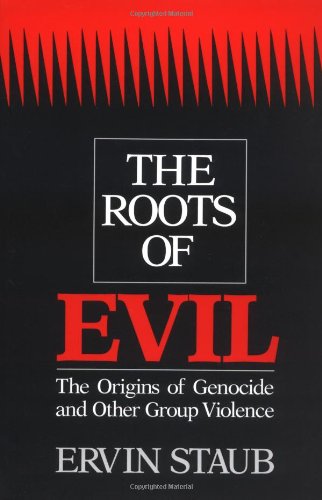
Staub, Ervin: The Roots of Evil – The Origins of Genocide and Other Group Violence (1992)

The Roots of Evil - Ervin Staub

Some books are life-changing. The Roots of Evil by Ervin Staub is one of them in my life. I was at one of those life-choices that we sometimes make. Studying psychology cleared up a lot of questions in my mind. When we got to Staub’s look at the horrible choices some of us make (either as a group or as an individual) I saw how caught I had been in group-thinking that makes “Us” look so much better than “Them”.

Genocide, mass killing, torture and war. Psychology, socialization and culture. How does one go from being a regular, boring person to being a torturer of citizens of ones own country? How did Hitler get an average population of humans to participate in invasion and genocide? Is there such a thing as “EVIL”?

In this clip Stephen Fry discusses the importance of language in the mass-extermination of eight million people during World War II in Europe. (At the bottom of this post see Staub’s lecture in Stockholm.)

My father’s father was a Prisoner of War during the Occupation here in Norway. During his time at Grini (one of the POW camps) he was tortured for information regarding his cell-mates. Not the kind of cell-mates you have in prison, but the kind you have when you participate in resistance against those you consider your oppressors. He was part of the Communist underground.

Torture is one of the many practices of war that Staub discusses in The Roots of Evil. He shows us how the torturer is habituated to the specialized kind of violence that torture is and he shows us that these torturers are simply people. Some of them probably enjoyed their work more than others, but the rest were trained to see the torturee as an object/non-human/sub-human that held needed information.

After the war, the US was incredibly strict about some of the rules for receiving Marshall aid. One of them was a fight against the Evil of Communism. My war-hero grandfather remained an unsung hero due to his political views. He was harassed by employers and spied on by our Norwegian surveillance department. There again propaganda reared its ugly head and lessened his value as a human being.

Source: History Lists
Roman destruction of Carthage | Source: History Lists

Humanity’s mass exterminations of groups of people follows us through history. The practice of killing all of the men above a certain age while keeping women and younger children alive goes at the very least back to our earliest written records. According to Ben Kiernan, “The First Genocide” happened around 149-146 BC (Jones, 2006). This was the Roman destruction of Carthage. In 2015 the United Nations called the Islamic State out on the IS attempt to wipe out the Yazidi minority in Iraq.

So! Nothing new. According to Staub, we need to learn to interpret early warning signs in order to avoid getting to a point where genocide happens. By that time, it will be too late. According to Staub cultural and social patterns and historical circumstances are vital in understanding whether a country, a people or a belief is in the danger zone. And are there ever plenty of traps that people can fall into (even those who are aware of the dangers):

  • Cultural stereotyping
  • Cultural devaluation
  • Societal self-concept
  • Moral exclusion
  • A need for connection
  • Authority orientation
  • Personal and group goals
  • “Better world” ideologies
  • Justification
  • Moral equilibrium, and so on.

Within this conceptual framework, Staub then considers the behavior of perpetrators and bystanders in four historical situations:

  1. Holocaust (his primary example)
  2. Genocide of Armenians in Turkey
  3. Genocide in Cambodia
  4. Disappearances in Argentina

Is there hope. Perhaps and it depends. It has taken us thousands of years to not learn a single thing from history. People like Ervin Staub have warned us against a repetition of gruesome actions. Perhaps the secret lies in people like Staub being able to write about terrors and publish his writings. Once people like Staub begin disappearing from the public arena, we must really begin to worry. Until then, we can only hope that by learning some of the warning signs and recognizing that we, ourselves, are also potentially people who do terrible things, will keep us from them.

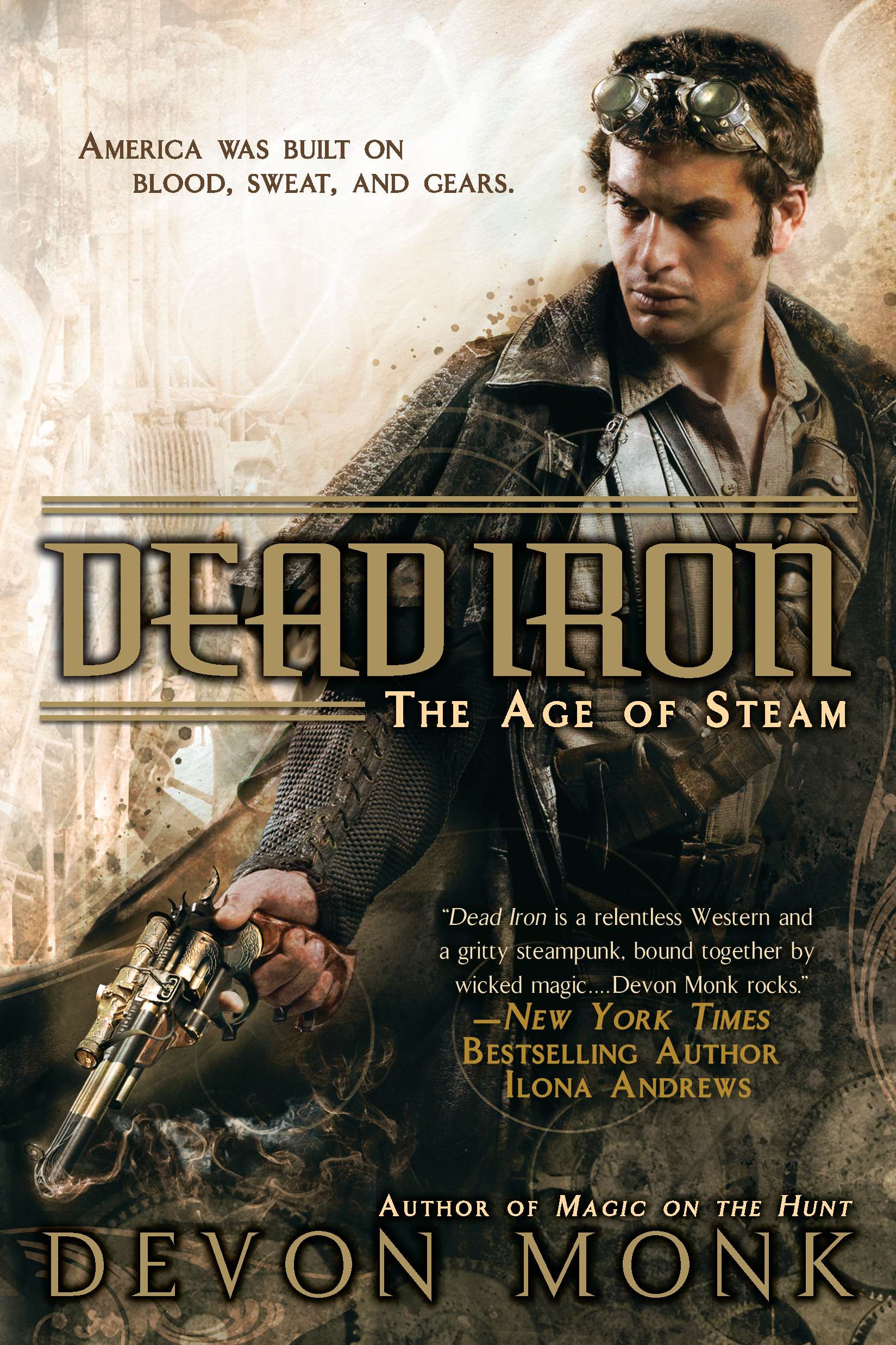
Monk, Devon: Dead Iron (2011)

Dead Iron

The Age of Steam is the new series started by Devon Monk. This time she writes steam-punk (I wonder where they got the word steam-punk?). I don’t really understand why so many fantasy buffs don’t like steam-punk. It’s great fun along with most other fantasy. As Monk is the author, the quality of the book is guaranteed (thankfully). It’s light entertainment (a little heavier than the lightest) and doesn’t strive for moralistic or philosophical preaching. However, Monk does treat her characters as complex beings with dark and light sides. I abhor literature where the goodies are sugar-good and the baddies are black as tar bad. Way to go Monk.

Dead Iron is the first installation in the series about the bounty hunter Cedar Hunt. Cedar has a “slight” health problem that becomes uncontrollable about once a month. To protect others, he lives a bit outside town.

When a small boy goes missing, and the parents go to Cedar for help. After a lot of hesitation he takes on the case. During his search Cedar meets other strange people and a lot of prejudice and fear. In Dead Iron, Monk combines fantasy and technology in a wild-west world where the impact of iron and technology threatens to destroy the presence of magic.

Monk, Devon: Magic to the Bone (Allie Beckstrom) (2008)

Devon Monk has written the Allie Beckstrom series. Allie Beckstrom is one of many strong urban fantasy women. What she has that makes her different from everyone else is Devon Monk. Devon Monk is an excellent urban fantasy author. Her writing is delightful and the entertainment value of the books is high. Humor, action, magic and some romance are all ingredients of this series. I see that the series is recommended for ages 18 and up, but am not really certain why. Maybe I’m too Norwegian???

Allie lives in a Portland where magic has become something anyone can use. But magic extracts a price – memory loss, pain or sickness. If you do not want to pay the price, there are actually people who are willing to do so – for a sum.

Allie’s father is Daniel Beckstrom, the inventor of the rods that attract magic, drawing it away from buildings and into wells beneath the city. He and she do not get along, partly due to her choice of career. You see, Allie is a Hound, someone who hunts magic abusers through smell.

In Magic in the Bone Allie has to hunt for someone who is using blood-magic. All the evidence is pointing right to her father as thee perpetrator. This throws Allie into a world of corporate espionage and black magic.

Devon Monk does an excellent job of introducing the reader to Allie’s universe. This is high quality entertainment.

UN: Women A World Report Part II

UN Women logo
UN Women’s logo

Sometimes a gem just drops into your lap. Our library had a book sale and I bought a bag of books for 50NOK. Inside I found this collection of essays from 1986. In connection with the end of UN’s 1975-1985 this status report was created. In it we find women who meet other cultures and report on what they see. This book was sponsored and compiled by New Internationalist, a cooperative specializing in social justice and world development issues. In addition to publishing its own magazine, it collaborates with the UN and other organizations to produce a wide range of press, television, and educational materials.

The essayists are:

Toril Brekke of Norway meets Kenyan women whose husbands have travelled to the cities to find work.

Angela Davis of the US travels to Egypt where virginity is of prime importance.

Anita Desai travels from India to Norway to investigate gender roles.

Buchi Emecheta of Nigeria travels to the United States to investigate the impact of the education boom on sex roles

Marilyn French of the US investigates the difference between middle-class and poor Indian women.

Germaine Greer of Australia meets the women of Cuba, women who are considered both active comrades and sex-objects.

Elena Poniatowska of Mexico investigates the effects of the sexual revolution on the women of Adelaide, Australia.

Nawal El Saadawi of Egypt meets women involved in political activities seeking to change the definition of family and society.

Manny Shirazi of Iran investigates the impact Soviet socialism has had on the female relatives she meets.

Jill Tweedy of England meets the first generation of literate women in Indonesia

Use public libraries