Boyne, John: The Boy in The Striped Pyjamas (2006)

The Boy in The Striped Pyjamas is a book that all children ought to read, preferably in company with an adult so they can understand the topic better. The Holocaust has been described and fictionalized time and time again. However, there are some topics that can never be delved into enough.

This novel is about 9-year-old Bruno, a German boy who has no idea of the times he is living in. He just realises that times are changing, and not in a manner that he prefers. Then his father, the handsome Commandant, is commanded to go to a dreadful place with his family. Bruno is struggling to understand why Out-With has a fenced-in area where there are many people walking around in striped pyjamas. On his side of the fence people are dressed in uniform or regular clothing.

One day, while exploring along the fence, Bruno meets a friend – Shmuel. He is thinner than Bruno but that is the only difference Bruno can see. Bruno understands enough that he keeps the friendship secret, but has no understanding of what is going on.

The ending was perfect and the last words of the author were: “Of course all this happened a long time ago and nothing like that could ever happen again. Not in this day and age.” Sadly humans have not learned and we and them thinking continues.


Winner of the:

  • Irish Book Award Children’s Book of the Year
  • Irish Book Award People’s Choice Book of the Year
  • Bisto Book of the Year
  • Que Leer Award Best International Novel of the Year (Spain)
  • Orange Prize Readers Group Book of the Year

Nominated for the:

  • British Book Award
  • Border’s New Voices Award
  • Ottaker’s Children’s Book Prize
  • Paolo Ungari Literary Award (Italy)
  • Irish Book Award – Irish Novel of the Year Award
  • Leeds Book Award
  • North-East Book Award
  • Berkshire Book Award
  • Sheffield Book Award
  • Lancashire Book Award
  • Prix Farniente (Belgium)
  • Flemish Young Readers Award
  • Independent Booksellers Book of the Year
  • Deutschen Jugend Literatur Preis (Germany)

2008 filmadaptation by Mark Herman

The movie has won several awards

Goyer, David S. & Cassutt, Michael: Heaven’s Shadow (2011)

Heaven's Shadow (Heaven's Shadow, #1)So! What do you think the various world-leaders would do if a Near Earth Object (NEO) appeared in the sky? Heaven’s Shadow is about that. Not surprisingly, the appearance sparks a contest between the US and the rest of the world to get to the object first. Two space ships are sent to investigate and they discover more than they had bargained for. The NEO turns out to be alien and not necessarily friendly.

Paranoia, curiosity and courage are all displayed along with pretty natural, yet often unwise reactions. Our perspective is from the NASA spaceship’s crews – their actions and reactions.

This novel is a fun read. The way people act in it seems pretty realistic. The whole alien NEO thing not so much. But that’s what SciFi is, likely and unlikely thoughts about the future. What is likely is that at some point in the future an NEO could come close enough for us to visit. That’s what makes it so fun to read. Knowing part of the story could possibly happen given a certain set of circumstances.

Fenn, Jaine: Principles of Angels (2009)

Principles of Angels is Jaine Fenn’s first novel. It’s supposed to be set 7000 years into the future on the uninhabitable world of Vellern. People live either Topside or Undertow, where Topside is the more attractive part of their world. Here the world is ruled by democracy by murder (you get to vote on whether to kill a representative). The assassins are called Angels.

Taro lives with his Angel aunt who is murdered. This throws him even deeper into the Undertow and we get to see his struggles to survive and his search for his aunt’s killer. I think “Principles” could probably be called a mystery. On Taro’s search, Taro is confronted with his own fears and prejudices.

I liked “Principles”. It is a well-written novel with prose that flows from one line to another. It is violent, but I’m guessing people who live in this world’s Undertows would recognise the fears and difficult choices you have to make. If Fenn continues like she has, then her authorship is going to a fun one to follow.

Jacka, Benedict: Fated (2012)

Fated” is the first book in the Alex Versus universe. In many ways it is similar to “The Dresden Files” by Jim Butcher. Harry Dresden is even mentioned by Alex Versus in one of the first chapters. Alex is a pre-cog. In his case, he is able to foresee the future with enough time to possibly do something about it. By seeing various outcomes, he gets to choose action or inaction in order to influence things. This is an ability that many people want to utilise.

As an urban fantasy, “Fated” is pretty average. I consider Butcher the better storyteller, but Jacka managed to hold my attention. Not every author manages to do that. But for me, it was missing that little something that makes entertainment extra entertaining.


Translations:

  • Swedish: Ödesbunden; Transl: Hanna Williamsson; Fenix, 2012

Aaron, Rachel: The Legend of Eli Monpress (2012)

Eli Monpress – bounty, paid dead or alive,
20,000 Council Gold Standard Weights.
Wanted on 157 counts of grand larceny against a noble person,
3 counts of fraud,
1 charge of counterfeiting
and treason against the Rector Spiritualis

“The Legend of Eli Monpress” is an omnibus containing the books “The Spirit Thief“, “The Spirit Rebellion” and “The Spirit Eater“. They are, of course, about Eli Monpress, a charming thief whose only goal is to get his bounty as high as possible. The reason reveals itself. During his adventures he has his mates Nico (a demon carrier) and Joseph Liechten (the greatest swordsman ever).

In order to get his bounty higher and higher Eli steals stuff. Not necessarily things that will bring him a lot of money, but things that are “without price” – like King Heinrich.

Elis main opponent is Miranda, the spiritualist, who ends up helping him in order to serve the greater cause.

The magic used in these books is based on forcing or cooperating spirits (wind, water, earth, trees, etc.).

These are fun novels. Eli is a charming character and well-written. The interplay between and those he meets on his way is described in a manner that draws me as a reader in and makes me want to know more about the characters.


Reviews:

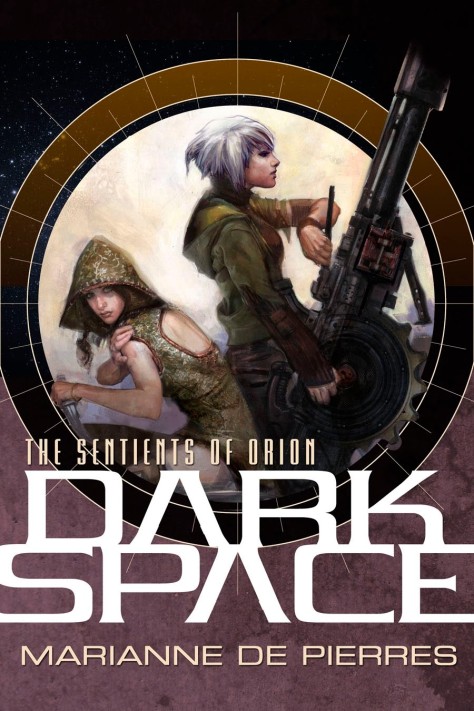
dePierres, Marianne: Dark Space (The Sentients of Orion I) (2007)

Dark Space - Marianne de Pierres

Dark Space is the first novel in the four book serial called Sentients of Orion. Orion refers to the stars and sentients are all intelligent humans and non-humans residing there. Among those non-humans we find dePierres’ favorite little creatures, the tardigrades/water bears (called Sacqr by dePierres). Except dePierres’ Sacqr are a bit overgrown and fond of invading mineral-rich Araldis for food in the form of humanesques. We quickly learn that the Sacqr have been brought to Araldis for nefarious reasons.

Baronessa Mira Fedor is our man character. In Dark Space we follow her from the time she is about to graduate and become Pilot First (intuitive able to bond with the biozoon Insignia). Except Mira learns at her graduation ceremony that her ability is to be removed from her because she happens to be a woman. Women on Araldis are only appreciated for their child-bearing ability. Upper class women are not allowed to learn to defend themselves and are socialised into a sex-slave thought pattern from the time of birth. Mira Fedor is not quite at that point when we first meet her, but she is about to learn some pretty harsh lessons about survival and the dangers of such misogyny.

Don Trin Pelligrini is the spoiled, self-absorbed son of the Principe of Araldis. Trin happens to be the one who was supposed to receive Mira’s innate ability. His life until we meet him has consisted of getting what he wants, when he wants it and at whatever cost it may be to others. He, too, is going to learn quite a bit about his real worth to the world he lives in and possibly about his ability to survive. If survive he does.

Jo-Jo Rasterovich, is the first humanesque to meet the “god” Sole. His meeting has become famous and Jo-Jo has assembled quite a fortune due to it. Except something about that first meeting keeps on nagging at Jo-Jo’s consciousness. Why would this “god” wish to be discovered at the time that it was? What really happened that Jo-Jo seems unable to remember?

Tekton, the God-head, from Lostol gets exactly what he asks for in his meeting with Sole. What I have learned from reading extensively about fictional and real lives is that what we think we wish we had, might not actually be what we really want. Greed, ambition and paranoia guide Tekton’s wish. Let’s face it. Giving in to the three of them all too often brings out the worst in ourselves and often in others as well. No reason why dePierres’ Dark Space should be any different in that respect.

There is one thing I found really strange about dePierres’ creation. Humanesques of various origins are able to interbreed, making for interesting variations. I can see how they would be able to have sex in some cases, but breeding seems a bit far-fetched.

My view of the nature of people is pretty bleak, yet for most people alive life is bleak. If you have a roof over your head, a bed to sleep in, enough food and clothing and semi-safety you are better off than 70% of the world’s population. All of this makes it understandable that some of the choices made by the privileged 30% are considered cruel – not to mention the choices of the top 20 or top five % of the world’s population. Trin and Mira drop abruptly from the life of the privileged 1% of their world and join the rest of the people who fight to stay alive. Dark Space is bleak, filled with action and full of people learning to adapt or die. I liked Dark Space and struggled to put it down.


Reviews:


Dark Space on Amazon US

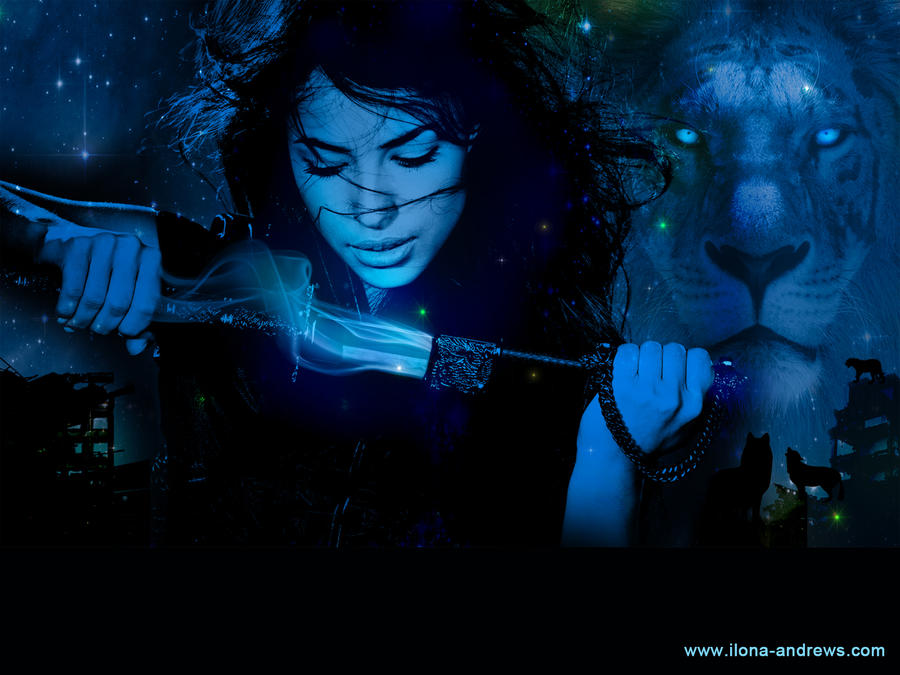
Andrews, Ilona: Kate Daniels

Kate Daniels by Ilona Andrews

“Magic Bites” starts off the series about Kate Daniels, yet another urban fantasy series. As an urban fantasy this series is above average. It follows Kate Daniels, a mercenary with interesting and mysterious abilities, who is exposed to the shapeshifting and vampire societies through various mysteries that she and they have to solve.

We get to see how her relationship to the King shape-shifter, Curran, develops. We also get to follow along on her discovery of her magical abilities and get a look-see into her mysterious ancestry.

Thus far, the books in this series are:

Magic Bites, Magic Burns, Magic Strikes, Magic Bleeds and Magic Slays.

I guess the series would be comparable to Patricia Briggs: Mercy Thompson, Devon Monk: Allie Beckstrom and Jim Butcher: Dresden Files. These are all good examples of quality writing that does not take itself too seriously. It’s ambition is to entertain, and entertain it does.

Leon, Donna: Beastly Things (2012)

Commissario Guido Brunetti is once again out to catch his criminal in “Beastly Things“. The Brunetti series is quite extensive and follows Guido over several years. Leon has managed to maintain a good standard of writing throughout the whole series. “Beastly Things” is a good example of the quality of her work.

Some mystery writers seem to wallow in gore and violence. Leon is NOT one of these. We are made to work for the answers to her riddle. In addition we follow the private life of Brunetti and see his development over quite a few years. The Italian (Venetian) society is revealed in all its glory and corruption.

I like the way Leon has managed to write such an interesting character and maintained my interest over the years.

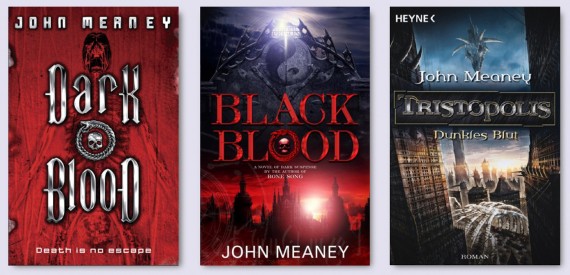
Meaney, John: Dark Blood (2009)

Dark Blood

The Tristopolis series about Lieutenant Donal is an incredibly warm and tense mystery. In Bone Song, we see Laura (Donal’s boss and lover) ends up deader and Donal with her heart. “Dark Blood” sets out to discover the whereabouts of the magicians responsible and we follow Donal’s journey towards that end.

We get to see descriptions of loyalty, friendship, love, grief, betrayal and a whole lot of magic throughout the novel. John Meaney is a top-class author who manages to portray a world of complexity and three-dimensionality.

Some of the descriptions inside are quite vivid and that makes me recommend this for teen-aged and upwards. Death-sentences in Tristopolis just aren’t carried out as nicely as the ones on this earth.

This is definitely a read-again novel.

Lowe, Helen: The Gathering of the Lost (2012)

The Gathering of the Lost” is book no. 2 of “The Wall of Night” series. Helen Lowe has done an excellent job on the follow-up of the first book in the series “The Heir of Night“. She manages to draw the reader in and does not let go until the last page. As teen-lit this is really good. The story is fairly complex and surprising (perhaps) in its twists and turns.

Through various journeys, Lowe leads us to Malian and Kalan. We get to see where they stand in relationship to each other and to the quest they set out on 5 years previously. Saving the Derai (and perhaps the rest of the world) from the fierce Swarm will not be simple. Discovering where the lost clans are takes time, and time is precious.

As in The Heir of Night Malian’s choices will make the difference in the outcome of the coming battle.

Lowe, Helen: The Heir of Night (2010)

“The Heir of Night” is book no. 1 in “The Wall of Night” series. It’s a typical hero’s quest type of story meant for the age group 10 and up set on another world. This is an excellent example of teen-lit. Lowe’s writing is excellent. She grabs hold of the reader and does not let go.

If Night falls, all fall…

Malian is the heir to the clan of Night. The Wall of Night keeps out the Swarm – a traditional enemy. One night the keep is attacked by members of the swarm and they specifically seek to destroy Malian. During this battle Malian discovers that she has powers that will make her an outcast, and she has to decide whether to use them. This choice is the beginning of Malian’s quest.

Malian’s character is the most interesting one. Kalan, the acolyte, is part of a cast of hated power users (the kind of power that Malian has). His and Malian’s friendship is unexpected to them both and vital to the development of the story. As both he and Malian have to deal with the consequences of her choice, the world of humans is on the edge.


The Heir of Night has won the international Gemmell “Morningstar” Award 2012 for Best Fantasy Newcomer

McBain, Ed: Alice in Jeopardy (2005)

I’ve seen several readers on Amazon  complaining of McBain‘s treatment of “Alice in Jeopardy”. Just because McBain has strayed from his “Precinct” characterization does not mean that the quality of his writing has diminished. It is as it has always been, good quality mystery prose.

This is a fun mystery. The “bad” guy is a surprise and Alice, our heroine, is fairly three-dimensional. Alice’s two children are kidnapped, and this is the story of getting them back and finding the bad guy.

There is plenty of action and psychology, necessary ingredients in a mystery. McBain was truly one of the better mystery writers out there.

Freeman, Lorna: Shadow’s Past (Borderlands III) (2010)

How is it that some authors write a series and as they go along their books maintain high quality and re-readability while others end up with muck in the end. Lorna Freeman’s books are in the first category. Her books continue to be fun to read, leaving me happy at the end of them – glad to have read them.

Shadows Past continues shortly after The King’s Own. Rabbit keeps on being flung into unexpected situations (trouble-magnet that he is), challenging his loyalties and his ability to trust others. He is still delightfully naive yet wise. Everyone has their own plans on how to use Rabbit, but he keeps on being true to himself. When an offer of marriage turns up, King Jussom takes Rabbit to check out the offer.

The Borderlands series has no pretensions of immortality. But this is a series I keep on reading, gaining nuggets of wisdom and good old entertainment.

Freeman, Lorna: The King’s Own (Borderlands II) (2006)

Lorna Freeman is still going strong in “The King’s Own”, the second book of the “Borderlands” series.

The King’s Own continues shortly after Covenants ended. Rabbit’s journey into the mastery of magic continues. Towards the end of Covenants we see that Rabbit’s abilities as a magician make him one of the stronger magicians in the Borderlands. Along with his lack of control, Rabbit discovers that people are suspicious and fearful of his new-found abilities. The discovery of death magic in the same city as Rabbit and the king heightens the suspicion of him. Once again, Rabbit has to prove himself.

Rabbit’s character is fun. He is true to himself, confused, naive, foolish and wise – I guess just like most people are. Perhaps that is what attracts me about his character. Rabbit is someone I wouldn’t have minded being in my early 20’s. That aside, Freeman is simply a great writer. She has the gift, no doubt about it.

Freeman, Lorna: Covenants (Borderlands I) (2004)

I love Lorna Freeman’s writing. I’ve read the whole Borderlands series several times.

I’ve tried several times to figure out what there is about this series that I like so much. The first thing that comes to mind is the quality of Freeman’s writing. It draws me in and refuses to let me go. In the ocean of average authors, Freeman is a lighthouse. Her books are clean. This is a rare quality today. Explicitness is seemingly sought after by the masses, at least when I consider the many authors out there. No sex and nothing gory. How amazing is that? Along with the naive worldliness of Rabbit, his tricky mentor – Faena Laurel, the respected captain Suiden and his nemesis Slevoic – we get served a story full of action, humor, wisdom and fun. I’m left a happier person each time I read her books.

“Covenants” is book no. 1 in the series about Rabbit. This is the story of how he comes into his magic, his discovery of familial relationships and his willingness to be true to himself.

Use public libraries