Tag Archives: #Family

Monk, Devon: Magic to the Bone (Allie Beckstrom) (2008)

Devon Monk has written the Allie Beckstrom series. Allie Beckstrom is one of many strong urban fantasy women. What she has that makes her different from everyone else is Devon Monk. Devon Monk is an excellent urban fantasy author. Her writing is delightful and the entertainment value of the books is high. Humor, action, magic and some romance are all ingredients of this series. I see that the series is recommended for ages 18 and up, but am not really certain why. Maybe I’m too Norwegian???

Allie lives in a Portland where magic has become something anyone can use. But magic extracts a price – memory loss, pain or sickness. If you do not want to pay the price, there are actually people who are willing to do so – for a sum.

Allie’s father is Daniel Beckstrom, the inventor of the rods that attract magic, drawing it away from buildings and into wells beneath the city. He and she do not get along, partly due to her choice of career. You see, Allie is a Hound, someone who hunts magic abusers through smell.

In Magic in the Bone Allie has to hunt for someone who is using blood-magic. All the evidence is pointing right to her father as thee perpetrator. This throws Allie into a world of corporate espionage and black magic.

Devon Monk does an excellent job of introducing the reader to Allie’s universe. This is high quality entertainment.

Boyne, John: The Boy in The Striped Pyjamas (2006)

The Boy in The Striped Pyjamas is a book that all children ought to read, preferably in company with an adult so they can understand the topic better. The Holocaust has been described and fictionalized time and time again. However, there are some topics that can never be delved into enough.

This novel is about 9-year-old Bruno, a German boy who has no idea of the times he is living in. He just realises that times are changing, and not in a manner that he prefers. Then his father, the handsome Commandant, is commanded to go to a dreadful place with his family. Bruno is struggling to understand why Out-With has a fenced-in area where there are many people walking around in striped pyjamas. On his side of the fence people are dressed in uniform or regular clothing.

One day, while exploring along the fence, Bruno meets a friend – Shmuel. He is thinner than Bruno but that is the only difference Bruno can see. Bruno understands enough that he keeps the friendship secret, but has no understanding of what is going on.

The ending was perfect and the last words of the author were: “Of course all this happened a long time ago and nothing like that could ever happen again. Not in this day and age.” Sadly humans have not learned and we and them thinking continues.


Winner of the:

  • Irish Book Award Children’s Book of the Year
  • Irish Book Award People’s Choice Book of the Year
  • Bisto Book of the Year
  • Que Leer Award Best International Novel of the Year (Spain)
  • Orange Prize Readers Group Book of the Year

Nominated for the:

  • British Book Award
  • Border’s New Voices Award
  • Ottaker’s Children’s Book Prize
  • Paolo Ungari Literary Award (Italy)
  • Irish Book Award – Irish Novel of the Year Award
  • Leeds Book Award
  • North-East Book Award
  • Berkshire Book Award
  • Sheffield Book Award
  • Lancashire Book Award
  • Prix Farniente (Belgium)
  • Flemish Young Readers Award
  • Independent Booksellers Book of the Year
  • Deutschen Jugend Literatur Preis (Germany)

2008 filmadaptation by Mark Herman

The movie has won several awards

Goyer, David S. & Cassutt, Michael: Heaven’s Shadow (2011)

Heaven's Shadow (Heaven's Shadow, #1)So! What do you think the various world-leaders would do if a Near Earth Object (NEO) appeared in the sky? Heaven’s Shadow is about that. Not surprisingly, the appearance sparks a contest between the US and the rest of the world to get to the object first. Two space ships are sent to investigate and they discover more than they had bargained for. The NEO turns out to be alien and not necessarily friendly.
Paranoia, curiosity and courage are all displayed along with pretty natural, yet often unwise reactions. Our perspective is from the NASA spaceship’s crews – their actions and reactions.

This novel is a fun read. The way people act in it seems pretty realistic. The whole alien NEO thing not so much. But that’s what SciFi is, likely and unlikely thoughts about the future. What is likely is that at some point in the future an NEO could come close enough for us to visit. That’s what makes it so fun to read. Knowing part of the story could possibly happen given a certain set of circumstances.

Fenn, Jaine: Principles of Angels (2009)

Principles of Angels is Jaine Fenn’s first novel. It’s supposed to be set 7000 years into the future on the uninhabitable world of Vellern. People live either Topside or Undertow, where Topside is the more attractive part of their world. Here the world is ruled by democracy by murder (you get to vote on whether to kill a representative). The assassins are called Angels.

Taro lives with his Angel aunt who is murdered. This throws him even deeper into the Undertow and we get to see his struggles to survive and his search for his aunt’s killer. I think “Principles” could probably be called a mystery. On Taro’s search, Taro is confronted with his own fears and prejudices.

I liked “Principles”. It is a well-written novel with prose that flows from one line to another. It is violent, but I’m guessing people who live in this world’s Undertows would recognise the fears and difficult choices you have to make. If Fenn continues like she has, then her authorship is going to a fun one to follow.

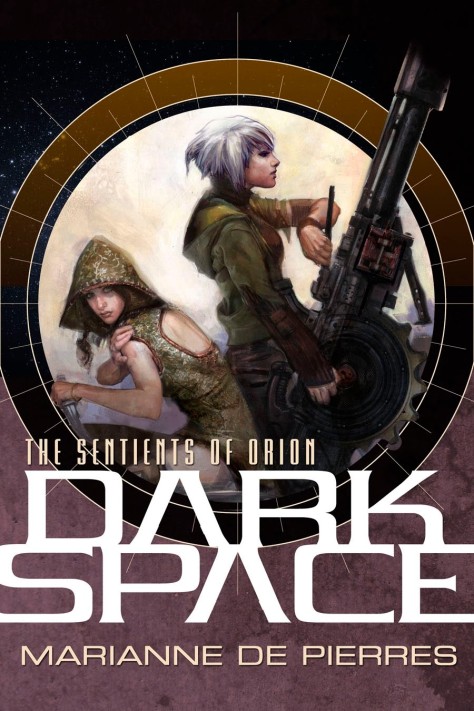
dePierres, Marianne: Dark Space (The Sentients of Orion I) (2007)

Dark Space - Marianne de Pierres

Dark Space is the first novel in the four book serial called Sentients of Orion. Orion refers to the stars and sentients are all intelligent humans and non-humans residing there. Among those non-humans we find dePierres’ favorite little creatures, the tardigrades/water bears (called Sacqr by dePierres). Except dePierres’ Sacqr are a bit overgrown and fond of invading mineral-rich Araldis for food in the form of humanesques. We quickly learn that the Sacqr have been brought to Araldis for nefarious reasons.

Baronessa Mira Fedor is our man character. In Dark Space we follow her from the time she is about to graduate and become Pilot First (intuitive able to bond with the biozoon Insignia). Except Mira learns at her graduation ceremony that her ability is to be removed from her because she happens to be a woman. Women on Araldis are only appreciated for their child-bearing ability. Upper class women are not allowed to learn to defend themselves and are socialised into a sex-slave thought pattern from the time of birth. Mira Fedor is not quite at that point when we first meet her, but she is about to learn some pretty harsh lessons about survival and the dangers of such misogyny.

Don Trin Pelligrini is the spoiled, self-absorbed son of the Principe of Araldis. Trin happens to be the one who was supposed to receive Mira’s innate ability. His life until we meet him has consisted of getting what he wants, when he wants it and at whatever cost it may be to others. He, too, is going to learn quite a bit about his real worth to the world he lives in and possibly about his ability to survive. If survive he does.

Jo-Jo Rasterovich, is the first humanesque to meet the “god” Sole. His meeting has become famous and Jo-Jo has assembled quite a fortune due to it. Except something about that first meeting keeps on nagging at Jo-Jo’s consciousness. Why would this “god” wish to be discovered at the time that it was? What really happened that Jo-Jo seems unable to remember?

Tekton, the God-head, from Lostol gets exactly what he asks for in his meeting with Sole. What I have learned from reading extensively about fictional and real lives is that what we think we wish we had, might not actually be what we really want. Greed, ambition and paranoia guide Tekton’s wish. Let’s face it. Giving in to the three of them all too often brings out the worst in ourselves and often in others as well. No reason why dePierres’ Dark Space should be any different in that respect.

There is one thing I found really strange about dePierres’ creation. Humanesques of various origins are able to interbreed, making for interesting variations. I can see how they would be able to have sex in some cases, but breeding seems a bit far-fetched.

My view of the nature of people is pretty bleak, yet for most people alive life is bleak. If you have a roof over your head, a bed to sleep in, enough food and clothing and semi-safety you are better off than 70% of the world’s population. All of this makes it understandable that some of the choices made by the privileged 30% are considered cruel – not to mention the choices of the top 20 or top five % of the world’s population. Trin and Mira drop abruptly from the life of the privileged 1% of their world and join the rest of the people who fight to stay alive. Dark Space is bleak, filled with action and full of people learning to adapt or die. I liked Dark Space and struggled to put it down.


Reviews:


Dark Space on Amazon US

McBain, Ed: Alice in Jeopardy (2005)

I’ve seen several readers on Amazon  complaining of McBain‘s treatment of “Alice in Jeopardy”. Just because McBain has strayed from his “Precinct” characterization does not mean that the quality of his writing has diminished. It is as it has always been, good quality mystery prose.

This is a fun mystery. The “bad” guy is a surprise and Alice, our heroine, is fairly three-dimensional. Alice’s two children are kidnapped, and this is the story of getting them back and finding the bad guy.

There is plenty of action and psychology, necessary ingredients in a mystery. McBain was truly one of the better mystery writers out there.

Freeman, Lorna: Shadow’s Past (Borderlands III) (2010)

How is it that some authors write a series and as they go along their books maintain high quality and re-readability while others end up with muck in the end. Lorna Freeman’s books are in the first category. Her books continue to be fun to read, leaving me happy at the end of them – glad to have read them.

Shadows Past continues shortly after The King’s Own. Rabbit keeps on being flung into unexpected situations (trouble-magnet that he is), challenging his loyalties and his ability to trust others. He is still delightfully naive yet wise. Everyone has their own plans on how to use Rabbit, but he keeps on being true to himself. When an offer of marriage turns up, King Jussom takes Rabbit to check out the offer.

The Borderlands series has no pretensions of immortality. But this is a series I keep on reading, gaining nuggets of wisdom and good old entertainment.

Freeman, Lorna: Covenants (Borderlands I) (2004)

I love Lorna Freeman’s writing. I’ve read the whole Borderlands series several times.

I’ve tried several times to figure out what there is about this series that I like so much. The first thing that comes to mind is the quality of Freeman’s writing. It draws me in and refuses to let me go. In the ocean of average authors, Freeman is a lighthouse. Her books are clean. This is a rare quality today. Explicitness is seemingly sought after by the masses, at least when I consider the many authors out there. No sex and nothing gory. How amazing is that? Along with the naive worldliness of Rabbit, his tricky mentor – Faena Laurel, the respected captain Suiden and his nemesis Slevoic – we get served a story full of action, humor, wisdom and fun. I’m left a happier person each time I read her books.

“Covenants” is book no. 1 in the series about Rabbit. This is the story of how he comes into his magic, his discovery of familial relationships and his willingness to be true to himself.

Barraclough, Lindsey: Long Lankin (2011)

Long Lankin - Lindsey Barraclough

Lamkin, Bold Lamkin, Bold Lantern, Bolakin, False Linfinn and Long Lankin are some of the titles belonging to the story of the mason who builds a castle, is cheated of his fee and who then exacts a bloody revenge (A.L. Lloyd). I have included below what is thought to be the original ballad along with one of the musical interpretations of the story.

Long Lankin is Lindsey Barraclough’s first novel. Whatever hiccups it might suffer from are compensated by Barraclough’s excellent prose. For a new author her flow was a delight.

Horror stories are not my forte simply because I am too easily frightened by authors stringing words together in that manner, but Long Lankin is within my endurance limit. Barraclough’s ability to convey the creepiness and uneasiness of the horror story did affect me in the manner the author probably intended.

During their stay at great-auntie Ida’s, Cora and Mimi encounter a mystery of terrible dimensions. As all children ought, Cora and Mimi venture into places they should not. Auntie Ida has not explained why they need to stay away from certain places, thinking to spare them from a terrible truth. Even though I promised myself that I would never do such a thing to my own children, I too have been guilty of doing underestimating them. Auntie Ida is going to discover what I did. Telling the truth is generally the wisest.

With their new friends, Peter and Roger, the four children set out to explore the church and the graveyard, and our horror story begins. Cora is the hero of this story. She is the one who is responsible for looking after her little sister. This is the age-old duty of older siblings. But keeping Mimi safe becomes increasingly difficult.

Cora and Mimi become embroiled in the history of the village, the history of the church and the history of their Auntie’s old house Guerdon Hall. Some places are the perfect settings for a horror tale. Old manors struggling to keep themselves together would qualify in my mind. Another such location can be old churches and graveyards, perhaps even forests and marshes. Long Lankin has three of these: Guerdon Hall, of course. The church close to the house and the nearby marsh.

Choices may have far-reaching consequences, sometimes centuries into the future. Everything has a cost. Payment must be made one way or another. Friendship, family, loss, grief can be some of the price extracted. Cora and Mimi coming to stay with Auntie Ida happens to be one of these long-term costs. I love the way Barraclough brings the old ballad into her story in tiny drips along the way. The Lay of Lambert Lanikin is frightening enough on its own. Add the terror of the future that Barraclough shares, and we can all huddle under our covers waiting for the wolf under our bed to jump onto it.

What a creepy good time I had!

Exactly what age group this falls into is difficult to say. According to the author, she did not have a particular age group in mind when she wrote Long Lankin.


Reviews:


Long Lamkin, 2008; By Wong Mei Sheong;
Long Lamkin, 2008;
By Wong Mei Sheong;
Thought to be the original version
Belinkin was as gude a mason
As e’er pickt a stane;
He built up Prime Castle,
But payment gat nane.
The lord said to his lady,
5 When he was going abroad,
“O beware of Belinkin,
For he lyes in the wood.”
The gates they were bolted,
Baith outside and in;
10 At the sma’ peep of a window
Belinkin crap in.
“Gude morrow, gude morrow,”
Said Lambert Linkin.
“Gude morrow to yoursell, sir,”
15 Said the fause nurse to him.
“O whare is your gude lord?”
Said Lambert Linkin.
“He’s awa to New England,
To meet with his king.”
20 “O where is his auld son?
Said Lambert Linkin.
“He’s awa to buy pearlings,
Gin our lady ly in.”
“Then she’ll never wear them,”
25 Said Lambert Linkin.
“And that is nae pity,”
Said the fause nurse to him.
“O where is your lady?”
Said Lambert Linkin.
30 “She’s in her bouir sleepin’,”
Said the fause nurse to him.
“How can we get at her?”
Said Lambert Linkin.
“Stab the babe to the heart
35 Wi’ a silver bo’kin.”
“That wud be a pity,”
Said Lambert Linkin.
“Nae pity, nae pity,”
Said the fause nurse to him.
40 Belinkin he rocked,
And the fause nurse she sang,
Till a’ the tores o’ the cradle
Wi’ the red blude down ran.
“O still my babe, nurice,
45 O still him wi’ the knife.”
“He’ll no be still, lady,
Tho’ I lay down my life.”
“O still my babe, nurice,
O still him wi’ the kame.”
50 “He’ll no be still, lady,
Till his daddy come hame.”
“O still my babe, nurice,
O still him wi’ the bell.”
“He’ll no be still, lady,
55 Till ye come down yoursell.”
“It’s how can I come doun,
This cauld frosty nicht,
Without e’er a coal
Or a clear candle licht?”
60 “There’s twa smocks in your coffer,
As white as a swan;
Put ane o’ them about you,
It will shew you licht doun.”
She took ane o’ them about her,
65 And came tripping doun;
But as soon as she viewed,
Belinkin was in.
“Gude morrow, gude morrow,”
Said Lambert Linkin.
70 “Gude morrow to yoursell, sir,”
Said the lady to him.
“O save my life, Belinkin,
Till my husband come back,
And I’ll gie ye as much red gold
75 As ye’ll haud in your hat.”
“I’ll not save your life, lady,
Till your husband come back,
Tho’ you wud gie me as much red gold
As I could haud in a sack.
80 “Will I kill her?” quo’ Belinkin,
“Will I kill her, or let her be?”
“You may kill her,” said the fause nurse,
“She was ne’er gude to me;
And ye’ll be laird o’ the Castle,
85 And I’ll be ladye.”
Then he cut aff her head
Fra her lily breast bane,
And he hung ‘t up in the kitchen,
It made a’ the ha’ shine.
90 The lord sat in England A-drinking the wine:
“I wish a’ may be weel
Wi’ my lady at hame;
For the rings o’ my fingers
95 They’re now burst in twain!”
He saddled his horse,
And he came riding doun;
But as soon as he viewed,
Belinkin was in.
100 He hadna weel stepped
Twa steps up the stair,
Till he saw his pretty young son
Lying dead on the floor.
He hadna weel stepped
105 Other twa up the stair,
Till he saw his pretty lady
Lying dead in despair.
He hanged Belinkin
Out over the gate;
110 And he burnt the fause nurice,
Being under the grate.

Tores. The projections or knobs at the corners of old-fashioned cradles, and the ornamented balls commonly found surmounting the backs of old chairs. Motherwell.


 Sites of interest:


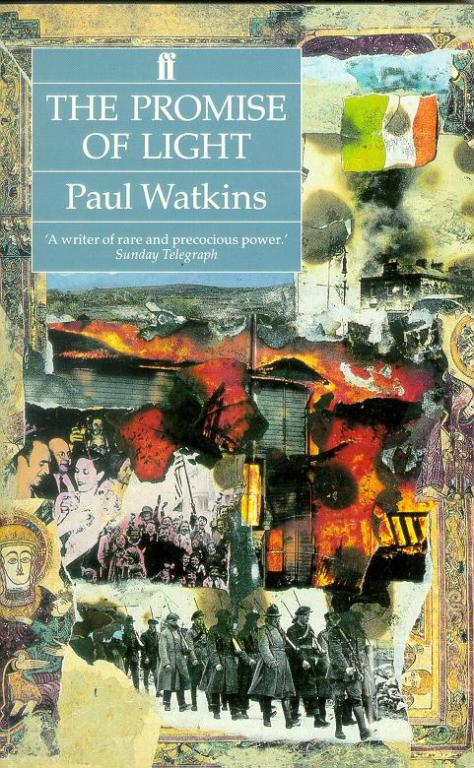
Watkins, Paul: The Promise of Light (1992)

The Promise of Light - Paul Watkins

The Irish War of Independence (Irish: Cogadh na Saoirse) or Anglo-Irish War was a guerrilla war fought between the Irish Republican Army (the army of the Irish Republic) and the British Government and its forces in Ireland. (Wikipedia)

The Promise of Light is for the most part about the above war that happened between 1919 and 1921 and Ben Sheridan’s part in it. However, we also get a look at some of the background for the war and the hostilities that had brought Ben Sheridan to Ireland.

When Ben Sheridan discovers that the man he thought was his biological father isn’t, he also discovers that his adopted father’s background was different from the one he had thought. He and other exiles from the Irish conflict had settled on Rhode Island and tried to gain support for the Irish side of the conflict from the US government. They also collected weapons and money and sent these covertly to Ireland.

Ben Sheridan goes with one of these transports on his way to discover who his biological father was.

Without Ben going to Ireland we would not have had this fictional tale of the Black and Tan war / Anglo-Irish war / Irish war for Independence. Just looking at these three different names for the fighting between 1919 and 1921 shows me how incredibly important the combination of our words is. Words have a great deal of power in forming our world views. Some of the links below use this power in their portrayal of the terrible killings of that time.

Inside my head that is what Paul Watkins shows us with The Promise of Light. We get to see the despair of the innocents and the participants who are brutally murdered and tortured by the other part of the conflict. Except for the people who enjoyed killing, raping and maiming what we are dealing with is a bunch of frightened people who are following some kind of leader. These leaders manage to bring others to their side. Sometimes they use words, sometimes money and sometimes brutality in getting people to support them.

I understand the need to be free of the tyranny of rule by people we feel have no right to rule us. After all I am Norwegian and Norway was used as collateral in wars and went between Danish and Swedish rule for centuries. Then the Germans took us over. But I would stink as a patriotic warrior.

However, I do see how Ben got drawn into the conflict. Chance has the potential of bringing about terrible things in our lives. On his way over to Ireland he did not envision killing others, but that is what he ended up doing. Ben was beaten for the cause and he got to watch people he had befriended killed. He also learned even more about grief than he had thought possible.

Paul Watkins portrayal of this period of Irish history drew me in and kept me reading.


Reviews:


Amazon UK


The Anglo-Irish War (BBC History)

The Black and Tans – who were they? by Tom Toomey

The Irish War of Independence by Noreen Higgins

Timeline of the Irish War of Independence Wikipedia

Marion, Isaac: Warm Bodies (2011)

Warm Bodies

Warm Bodies is Isaac Marion‘s first novel. He has an interesting take on zombieism. According to the world of Warm Bodies, zombieism is not necessarily a permanent state. Just because something is, doesn’t necessarily mean that it has to remain so. But change will bring resistance from the more conservative (both living and zombies).

The main problem with this novel is that it’s message is too obvious at times – in fact spelled out. I felt as though I was being preached at. This is a first novel, though, and as such – pretty good.

I liked the way “R”‘s, the main protagonist, journey was presented. The road from moan and groan to being able to make himself understood on many levels was interesting. It gets kind of gory at times but probably not more than most teen-literature today.

There’s plenty of humor. I especially appreciated the way the schools for the living and the schools for the dead were.


Reviews:


Film-adaptation acquired 2010 by Summit Entertainment to be released 2013