Tag Archives: #Leadership

Butcher, Jim: Academ’s Fury (The Codex Alera II) (2006)

Academ's Fury 1

Academ’s Fury follows Calderon’s Fury as book number two in the Codex Alera by Jim Butcher. You know the saying, “you should be careful what you wish for”. Well, Tavi has gotten his wish, and it is proving a bit more of a handful than he would have liked. For one thing, going to an Academy where he is the only one without a fury among obnoxious kids is less than fun. But the upside is that Tavi does meet kids his own age that he likes and he also learns quite a bit.

In addition to his studies, Tavi is also the First Lord’s page and is studying to be a cursor spy. Both are taxing his strength but he is growing in knowledge and hopefully wisdom.

Kitai and her father discover the disappearance of the Vord from the Wax Forest. Dorago looks for the long-time enemies of the Marat and he is worried what their disappearance means. While he is looking he sends Kitai to “watch” (all is revealed in the book). The Vord will include Bernhard, Amare and Isana in our tale.

And then we have the Canim. There is an ambassadorial retinue living at the First Lord’s palace. The ambassador’s name is Varg. Jim likes to make the story lines of the Codex Alera pretty complex. Part of that is probably to keep the reader on their toes, but it is difficult to tell his story without bringing in the various people involved. So too, the Canim.

The ambassador seeks the First Lord’s help, but due to circumstances around the First Lord that is going to prove extremely difficult. In fact, getting help from the First Lord for anyone at all is going to be a challenge in Academ’s Fury. But fear not, Tavi is here. OK! It might not be quite that simple, but Tavi is, after all, the hero of this series and that means that he has to do impossibly heroic deeds.

The problem with so much art on the net is that it is difficult finding just who to credit with it. If you press on the picture above it will take you to one site, and I hope that is the correct one. If not, someone will have to tell me.

While reading these books, I have been trying to place their age group. Sex wise they are pretty safe. I would probably give the books a PG rating for that (only because of how strict the US public is). When it comes to violence I’m having a bit more trouble. How graphic is graphic and where do I draw the line? Well, I don’t really know. There is violence and it is descriptive, but it isn’t what carries the story (at least not in Academ’s Fury). I guess I would say that the reader should not be too young, but it is OK for a teen-ager. But I am ancient, so what do I know?

Anyways, after that struggle, I want to say that Academ’s Fury is fun and fast to read (for a given definition of fast). The book is around 600 pages long and you don’t read that in one go. Butcher’s language flows along its river of words without drowning me in anything unwanted.


My reviews of books  1 (Furies of Calderoon), 3 (Cursor’s Fury), 4 (Captain’s Fury), 5 (Princep’s Fury) and 6 (First Lord’s Fury)

Wooley, Emma M.: What it’s Like Being a Teen Girl (October 22, 2012)

Emma M. Wooley shares an incredibly important message about what it means to be a teen-girl on her blog. Folks, this is what it is like for most girls out there. Girls are treated as objects, and continue to be after their teen-years. It’s just the way things are right now.

But they do not have to be. Each of us has the responsibility to teach pre-teens and teenagers (boys and girls) that some things are off-limits. Talk about sex, boundaries and being wanted with your kids.

If you are a teen-age girl:

YOUR BODY = YOU DECIDE!

Lee, Patrick: The Breach (2010)

David Demaret (French cover)

The Breach is the first book in the trilogy about Travis Chase and Tangent.

Travis Chase is an ex-cop just out of prison. He is trying to decide whether to live close to or far from his brother. In trying to make up his mind, Travis takes a trip to the wilderness of Alaska where he feels that he will have the peace to think.

Ok, Ok! We all know that peace is not what will happen to Travis. We just know it. And of course we are correct. Travis wakes one morning and discovers a crashed airplane. When he gets down to the plane, Travis encounters dead people – all of them shot.

When he sees who the the last person he gets to is, Travis worries. This is the President of the USA’s wife, and she has been shot. On her he finds the message:

“I hope that someone from Tangent finds this. If you are anyone else, do not contact local authorities. Go to a phone as quickly as you can, dial …. Hostiles are torturing our two people for info within close range of this crash, they will not leave the area until they have broken them. (Not a guess, there is a reason they can’t leave before then.) …”

This is only part of the message, but you can probably see where the story is going. Travis is going to try to do what the note says and plenty of action will ensue. There is action galore in The Breach. Time/space questions arise and our ability to change our future will be explored in the plot of The Breach and the other two books of this trilogy.

I liked The Breach. It will never be one of my favorites, but it has appeal and I would recommend it. It has all of the ingredients a thriller needs and Lee keeps up the tempo throughout the book.

Sullivan, Michael J.: The Riyria Revelations

Michael J. Sullivan

Michael J. Sullivan has been writing his whole life. Not until he began writing the Rirya Revelations series did he get published. Strange thing that. The Rirya Revelations had been a project that he undertook to please himself and his daughter (who has been part of designing the cartoon on Michael’s website). All six books were finished before the first one was published.

After a while the sales took off and Michael J. Sullivan has become a well-known name in the fantasy world. That recognition is well-deserved. His books are fun to read and they kept me wanting to know how the greater plot is resolved. The characters are fun and varied. It is not immediately clear whether the butler did it or not (I know there isn’t a butler in these books) and that is something that I really like in a writer. We should be kept wondering who the baddest baddie is.

All six books are stand-alone books in the sense that the main problem is resolved. However, there is a greater plot spanning all six books, so it would be a good idea to start at omnibus no. 1 – Theft of Swords. That way you get all of those pesky little threads tied together from the beginning.

Royce Melborne and Hadrian Blackwater are essential characters in all six novels. They are the Rirya – a gang of two. Together they get into and out of all sorts of trouble. These books are good for young adults and upwards. There isn’t too much violence and no sex.

The gods of Elan are: Erebus (Father of the gods), Ferrol (Eldest son, god of elves), Drome (Second son, god of dwarves), Maribor (Third son, god of men), Muriel (Only daughter, goddess of nature) and Uberlin (Son of Muriel and Erebus, god of darkness).

The main political parties to be aware of are:

  • Imperialists: Those wishing to unite mankind under a single leader who is the direct descendant of the demigod Novron.
  • Nationalists: Those wishing to be ruled by a leader chosen by the people.
  • Royalists: Those wishing to continue rule by individual, independent monarchs.

THEFT OF SWORDS (2011): THE CROWN CONSPIRACY AND AVEMPARTHA

French covers by March Simonetti

THE CROWN CONSPIRACY

Hadrian and Royce are stopped by highway robbers, incredibly incompetent ones according to Hadrian and Royce. When the highway robbers discover that they are dealing with the Rirya, panic settles in. Before they go, Hadrian gives the robbers advice on how to rob people properly.

Hadrian and Royce are on their way to a job. That is what they do. They get paid to rob the wealthy for various reasons. The two of them are quite successful at what they do. But things are bound to go wrong when they are asked to undertake a job that leaves them practically no time plan. A sword is placed in the chapel at the Medford castle, and the boys are to remove it to give Count Pickering trouble in a duel. What Hadrian discovers instead is a dead king and he and Royce are accused of the murder.

AVEMPARTHA

Hadrian and Royce meet up with the guy who asked them to steal the sword, and you can probably imagine that they weren’t best pleased. But for some strange reason the man walked out of that meeting alive. Royce gets to chat with old friends and the two men are told of a young girl looking for them. They must be in a soft frame of mind, for when they meet this young girl, Thrace, they end up going with her to her village. There, mighty adventure awaits. Ok, that was a bit over-kill.

In the meantime, and you just know there has to be a meantime don’t you?, Arista bounces into her brother King Alric’s meeting misunderstanding the meeting’s intent. She thinks he is about to marry her off, while he is in reality planning on sending her as an ambassador to Dunmore. Arista likes the idea of having something to do, especially as it gets her away from all of the rumors of her witchhood. Along with her normal entourage bishop Saldur comes along with the Pickering brothers. Fanin and Mauvin are going to enter into a contest the church of Novron is holding in Ervanon.

RISE OF EMPIRE (2011): NYPHRON RISING AND THE EMERALD STORM

NYPHRON RISING

Young Amilia works as a bullied scullion maid at Aquesta. She is being threatened once again by Edith Mon, the head maid, but saved when two women enter the kitchen. One is clearly some kind of nobility, having both the manners and the clothes for it. The other is an extremely thin and quiet young woman who turns out to be the Empress of Modina. She does not look the part at all.

Through luck Regent Saldur (formerly bishop) appoints Amilia as the Empress’ new secretary. Amilia is terrified as she knows the fate of those who disappoint the regent. But Amilia turns out to have a positive effect on the Empress.

Royce and Hadrian have become royal spies, a job they are really good at. They have found themselves willing to be in the service of the Royal family of Medford, trying to keep the kingdom alive and well in a growing Empire. But keeping Medford on its feet is quite a challenge. Princess Arista has had no luck as an ambassador in finding allies. Every country is too afraid of the new Empire to dare to fight it.

THE EMERALD STORM

Merrick Marius is the world’s best and most cunning assassin. He has been hired to kill someone in Arista’s closest circle. It goes off without a hitch, leaving Arista without an important aid in keeping Ratibor in the hands of the nationalists. But he leaves her with a riddle: “Find the Horn of Gylindora … at Wintertide the Uli Vermar ends … Patriarch … is the same …”. Arista knows the message is extremely important but she hasn’t got a clue how to go about it.

Amilia is still the Empress’ secretary. Modena has been moved to better lodgings, but Amilia still feels as though she is treading water. But fortunately she has acquired her own helper in Nimbus, a landless nobelman. Amilia’s life is on the line every day, as Regent Saldur has made it quite clear what will happen if the Empress embarrasses him in any kind of manner.

Royce and Hadrian go off hunting Merrick. Once Royce and Merrick were good friends, but something happened and Merric now hates Royce. Now he has the chance to play with the Ryria and work against the kingdom of Medford. He tries to lure the two into a trap, quite a cunning one it turns out.

 HEIR OF NOVRON (2012): WINTERTIDE AND PERCEPLIQUIS

WINTERTIDE

Stealing is what he has to do to survive. But back luck strikes and he gets yelled at when he gets back to his gang. They decide to try to fleece two newcomers to the city. Royce and Hadrian enter the Imperial Square in a snowstorm. They have come to save Degan Gaunt from execution. The boys discover that the newcomers might be more than they have bargained for, but their meeting actually turns out to be fortuitous for both sides.

Arista is trying to stay sane in her cell. Arista’s attempt to save Degan Gaunt has not been successful. She just knows that she cannot give up trying to escape as the fate of the world rests upon her hands, quite literally.

Amilia is still secretary to the Empress, finding her life full of new experiences. Modena is still quite grief-struck at the challenges that have met her. But something happens to slowly wake her from her dull and grief-struck state. She finds something to live for a meaning to life. Revenge and retribution.

PERCEPLIQUIS

The elves are a hunted people by humans. Persecution is severe by the Church of Nypron. They are thought of as terrible creatures who should be struck down whenever they are seen. Now the elves have come on to human lands once again, striking down humans.

Rather than help the humans in trouble, Guy Luis is chasing a young girl called Mercy. She is the ward of Arcadius and Arcadius is trying to save her. But that job might turn out to be insurmountable.

Refugees are arriving at the Imperial city. All of the North is being overrun and the humans have no idea why. As more and more refugees come into the city Arista decides that the riddle Eshraddon gave her must be solved and as soon as possible. However, she soon discovers, once again, obstacles in her way. Royce and Hadrian end up providing the assistance she needs.

————————–

AWARDS

  • 2010 Iceberg Ink Award Best Read (Avempartha)
  • 2010 Goodreads Choice Award Nominee for Fantasy (The Emerald Storm)
  • 2009 National Indie Book Award Finalist (The Crown Conspiracy)
  • 2008 ReaderViews Annual Literary Award Finalist (The Crown Conspiracy)

Viehl, S.L.: Stardoc

StardocBeyond VarallanEnduranceShockballEternity Row
Rebel IcePlague of MemoryOmega GamesCrystal HealerDream Called Time

Sheila Kelly Viehl is from South Florida. She is a USAF-veteran with medical experience from both military and civilian trauma centers.

She writes under several names – SciFi as SL Viehl, Romance as Gena Hale and Jessica Hall, Christian Adult Fiction as Rebecca Kelly and Dark Fantasy, Young Adult and Non-fiction as Lynn Viehl.

SHOCKBALL (2001)

Shockball is book no. 4 in the Stardoc series, but the first one I’ve read. Starting here was no problem. These are all pretty much stand-alone novels that concern the doctor Cherijo Viehl. Warning right away. If you do not like descriptive surgery in your novels, you will have a problem with parts of this novel.

Life has a tendency to surprise us. Sometimes the experience is enjoyable and sometimes, well, not so much. Cherijo Viehl is beginning to get used to the idea. But getting used to having wrenches thrown into what she sees as preferable, can make her angry with herself and her surroundings (most commonly with Duncan Reever).

Cherijo and Duncan are married. As far as I’ve understood, this happened after they became interested in each other when Cherijo was Duncan’s slave (albeit not the most slavish slave around). Now they are trying to adjust to each other’s strong personalities. Tensions are bound to rise. Both are the kind who tries to protect those they love, whether that protection is wanted or not.

Shockball begins with Cherijo and Reever on the Joren starvessel Sunlace. Cherijo is an adopted clanmember, and as such under the protection of her clan. Her clan-brother, Xonea, is the captain of the space-ship. His main concern is to keep Cherijo away from trouble, but finds this intention challenged again and again by Cherijo’s repeated refusal to stay away from danger.

In the previous novel, Cherijo and Reever saved a bunch of non-terran slaves from their masters and are in the process of returning them to their planets of origin. While doing this, they are both worried about the ticking bomb that is dragged along on their journey through the stars. Cherijo’s creator, Joseph Viehl, has gifted her with a spaceship, but Cherijo does not believe for one moment that there is nothing wrong with it. She turns out to be correct.

After having run so long from her creator, Cherijo ends up back with him when Joseph has League soldiers kidnap her and Reever from the Jorens. They are taken back to Earth and Joseph immediately finds joy in telling Cherijo about her future. She is to be his mate, something Cherijo finds repugnant. Reever is held captive as guarantee against her cooperation.

Complications arise when a group of underground Navajoes rescue the couple from the laboratory and take them to their lair. There they meet the Night Horse leader Rico (who seems slightly off). Now it is up to Reever and Cherijo to figure out how to get back to the Jorens without getting killed en route. But before they can leave, they also have to find a way to save the Night Horse from themselves.

Shockball is full of action. We tend to go from one scene to the other, quite often ending up with Cherijo having to use her surgical skills. This is a rip-roaring tale of adventure. There are no attempts at trying to explain how the groups are transported between star systems, nor does Viehl try to make sense of how such completely species are different-planet-races are able to interbreed. Instead this is an action novel placed in space. Viehl writes well and manages to entertain us the whole way.

ETERNITY ROW (2002)

In Eternity Row Reever, Cherijo and Marel finally live together as a family on the star vessel Sunlace. Duncan and Cherijo are trying to figure out how to combine parenthood with their duties, as most parents do. Some children are more precocious than others. Marel is one of them. She has a tendency to appear in the oddest places.

Sunlace is taking Hawk home to the planet of his father. When they get to Taerca, everyone they see seems to be suffering some kind of mysterious disease of both mind and body. Hawk has a difficult time when he meets with his father. Like the rest of the population, his father is fanatically invested in the planet-wide religion.

Later Sunlace goes to Oenrall, Dhreen’s home planet. Cherijo had promised him to go there and see if she could figure out what was causing the population’s sterility. Once they get there Cherijo and the people going with her find that the Oenrallians are manic and addicted to a nerve-desensitizer. But this is by no means the Oenrallians main problem.

Cherijo sees it as her duty to discover the cause of both problems. But the universe is not going along with her plans. Challenges are thrown the way of Cherijo and her loved ones, distracting Cherijo from her work as a doctor and researcher.

As with Shockball, Eternity Row is an action-filled novel whose main goal is to entertain. Viehl does this well. I haven’t read past Eternity Row, but did not find it problematic to end the series here. Being stand-alone novels makes it so much simpler to leave a series, although I have to admit to certain amount of curiosity about the future of the family of Brandon, Cherijo and Marel.

Briggs, Patricia: The Hurog duology

“The Five Kingdoms” by Michael Enzweiler

Patricia Briggs has written the Hurog duology. As you might have surmised from this blog she is quite a prolific writer. Her books fall into the light entertainment category. The Hurog duology’s version of the Briggsian world-creation is placed in a world reeking of the middle-ages with all of its dragons, shape-changers, magicians and various other people.

I absolutely loved the Danish covers. Wow, what a cool dragon. I don’t think I’ve ever seen an interpretation like that. And it fits with the dragon of the story. This is probably one of the better stories that Briggs has written. Ward is a wonderful character, caught in his own trap, yet never quite giving up hope.

DRAGON BONES (2002)

Danish cover by Bent Holm

Dragon Bones is a stand-alone novel. Its main character is Ward, heir to Hurog. What you need to know about Ward is that his dad was, to put it mildly, a monster. Child-, spouse and animal-abuse were his main hobbies. Until he had managed to damage Ward enough to affect his thinking, he saw Ward as his rival. So when he dies at the beginning of the book, it would be fair to say that Ward did not feel like grieving.

Unfortunately for Ward, the damage done to him had enabled him to pretend to be quite dense. Undoing other people’s perception of himself turns out to be more difficult than Ward would like. Discovering a damsel in distress and the secret of Hurog both play a part in enabling Ward to figure out how to show himself as someone to be trusted. This brings the king’s attention to the Hurog family, driven by his paranoia of the world being against him.

Ward comes across as a believable character. He clearly struggles with the long-term effects of his childhood. But in learning about Hurog’s very secret secret and some truths about the people around him, Ward manages to feel less alone in his struggles. One of the first things Ward must do in getting people to take him seriously is to prove himself a warrior, taking him and a small group accross the kingdom.

The story is told in first-person, through the eyes of Ward. This is part of what makes Ward such a real person, but it also shows us the world around him through his experiences. The people around him are clearly filtered through the life of Ward, making us care more for him and for the people around him. Dragon Bones is quite an enjoyable introduction to the world of Ward of Hurog.

DRAGON BLOOD (2002)

Danish cover by Bent Holm

While Dragon Bones is a stand-alone story,  Dragon Blood depends on the reader having some knowledge of the world. It continues the story of Ward, and in this case Tisala the rebel, and love of Ward. Neither book is a romance, something I quite enjoy. I’m weird like that. For some reason I both dislike romance in books and yet really enjoy it at times. Romance done the Hurog way is great.

The beginning of Dragon Blood is quite brutal. We come upon Tisala while she is being tortured for information about the rebellion that has been realized in the wake of Ward’s exploits in Dragon Bones. She escapes and runs to Hurog. This implicates Ward in the mind of the king and the king demands that Ward be committed for mental illness. All of this comes on top of Ward having to prove himself politically able to his little kingdom. One might say that Ward’s life has a bit more excitement than is good for a person’s health.

Hurog means dragon, and dragons are showing up on the door-steps of the kingdom once more. Dragons have played an important part in the whole kingdom’s past history, not only Hurog’s. Thankfully neither book is very graphic, enabling them to be read by a younger audience (not too young). Neither violence nor romance is explicit. Upon finishing the Hurog duology, I was left with a sense of wanting more.


<

p>Dragon Bones and Dragon Blood are available as audiobook.

Kirstein, Rosemary: Steerswoman

The Steerswoman's roadI have one complaint about the series – Where is the next book????? My goodness, this series was riveting. Kirstein needs to keep on writing – well, actually, in all selfishness, I need her to keep on writing. I think this was my third read-through and I was still captured by the writing and held prisoner until the end.

THE STEERSWOMAN’S ROAD (2003)

Rosemary Kirstein Steerswoman’Road is an omnibus containing The Steerswoman and The Outskirter’s Secret. In it Kirstein tells the story of the friendship between Rowan, the Steerswoman, and Bel, the Outskirter. Rowan and Bel meet right at the beginning while they are both about their own business. Bel has been travelling with other Outskirters and Rowan has been investigating strange blue jewels that are neither cut nor dug up.

Steerswoman are men and women who travel around the land asking questions and answering them. One must tell the true answer to any question and the Steerswomen must also do so. If one refuses to answer a Steerswoman, they can ban you. That means that no matter what the question you ask is, they will not answer it. Strange rule, but as knowledge is their whole purpose perhaps not.

Rowan’s questions about the jewels seem to have stirred up interest from the wrong parties. Thankfully, she and Bel have decided to travel together for a while because the next day brings an attack. From that point on there is tension, action, betrayal, discovery, friendships and travel. In fact, Rowan’s search for the truth of these blue jewels brings her into the Outskirts.

The Outskirter is about this part of her journey of discovery, and The Outskirter is just as exciting as The Steerswoman. The Outskirters are nomads who live at the border of where people can actually survive. Every day for them is about destroying and seeding the land so humans can live there. Steerswomen are unfamiliar territory to the Outskirters, yet Rowan manages to gain their trust and help them in her own way. The importance of her work becomes clearer and clearer as the role of the wizards in the attacks on Rowan begins to make a strange sort of sense. Rowan is also beginning to realize that perhaps wizards aren’t quite as wizardly as she had thought.

We as readers should have started realizing this long ago. What does not make sense to Rowan and the regular citizens of both the Outskirts and the Inland does to us. This is a science fiction series that to begin with might seem to be a fantasy one. Quite a few science fiction books are like that. The meeting between different sorts of technologic knowledge can, after all, make it seem like magic is afoot. Pressing a button on the wall to make light in the ceiling is pretty magical if you ask me – and I know how it all happens.

The Lost SteersmanTHE LOST STEERSMAN (2003) – 2004 Locus Science Fiction Award Nominee

Rowan and Bel have parted ways (on friendly terms). Bel is in the Outskirts spreading the bad news, and Rowan has ended up at the Annex in the town of Alameth looking for more information about Slado and the wizards. The Annex is a mess. Mira, the last Steerswoman living there, had not cared one whit about her duties. She was tired of being a Steerswoman and left everything a mess when she died. Now Rowan has to try to find desperately needed information in this chaos. On top of that the townspeople have problems accepting Rowan because she is so different from Mira.

When Rowan meets Janus, a Steersman who resigned the job and was considered lost, she is happy and confused. He was one of her oldest friends and Rowan finds the ban on him difficult in their conversations. After a while, Rowan begins to suspect that things are quite complicated with Janus.

The Lost Steersman is every bit as suspenseful as The Steerswoman’s Road. Kirstein keeps the standard of her writing amazingly high. It goes against the grain, but I think I’m going to put her along with Pratchett. Their styles are completely different. However, they both manage to involve me as a reader in some very serious topics with skills beyond anything I could aspire to.

The Language of Power THE LANGUAGE OF POWER (2004) – 2005 Locus Science Fiction Award Nominee

Rowan and Bel are once again together in their adventures. The Outskirts have been warned and Rowan is finally beginning to get somewhere in her search for the answers to Slade. All roads lead to Rome, it is said. In the Inlands, all roads seem to lead to Donner. To Donner Rowan and Bel go and there they unexpectedly meet Will – our lovable wanna-be apprentice – from the first book.

Will is on the run from Corvus, trying to hide in Donner and looking for revenge on the wizards. Rowan and Bel are overjoyed at meeting their old friend and seek to help him in his quest. But, as would be expected from an adventure novel, things never turn out as one would wish. Will is surprised at Rowan’s grasp of “magic”. Because he knows so much more about science than she, he tends to be a bit overbearing with her. Just because she doesn’t have the background Will has, certainly does not mean that she is without the ability to infer and deduce. After all, her whole life has been about the quest for knowledge – a true addict.

Unfortunately the next book in this series has not come out yet. Aaaargh. Please, Kirstein! We need the next installment! I love the intelligence and wit of Rosemary Kirstein. She actually expects me as a reader to think and doesn’t divert my attention with loads of sex and violence. Sex and violence can be fun, but this is sooooo much more thrilling.

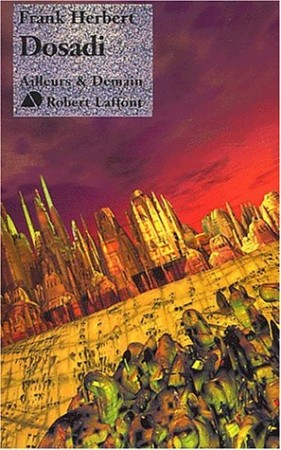
Herbert, Frank: The Dosadi Experiment (1977)

“The Dosadi Experiment” by Robert Laftont

Nominated for a Locus Award for best science fiction novel in 1978

The Dosadi Experiment takes place in the same universe as The Whipping Star, but can be read on its own.

I dipped my toes into the waters of Frank Herbert’s writing with The Dosadi Experiment. It’s been ages and ages, back in the days of the dinosaurs, so I cannot really remember what I thought, but it must have been positive because I kept on exploring Herbert’s world. I reread The Dosadi Experiment from time to time, and each time I discover new bits to love. As I change, so does my understanding of The Dosadi Experiment, and that is a sign of a classic to me.

The ConSentiency is composed of many species who have different abilities. The Taprisiots provide instant mind-to-mind communication between two minds anywhere in the universe. The Caleban provide instantaneous travel between any two points in the universe.

Our extremely intelligent and empathic Saboteur Extraordinary, Jorj X. McKie, gets an assignment that he soon discovers is probably a set-up. He is sent by the agency to Dosadi as their “best”. Compared to those already living on Dosadi, he was like an infant in swaddling clothes.

What he discovers on Dosadi is shocking in its blatant disregard of any and all ConSentiency regulation. Dosadi has been placed behind an impenetrable barrier called “The God Wall”. Humans and Gowachin have been dumped together in numbers that defy description. The planet itself is poisonous except for a narrow valley, containing the city “Chu”, containing nearly 89 million citizens.

Senior Liator Kaila Jedrik starts a war and Jorj becomes a pawn in her hope of saving the population of Dosadi.

Czerneda, Julie E: The Trade Pact Cycle

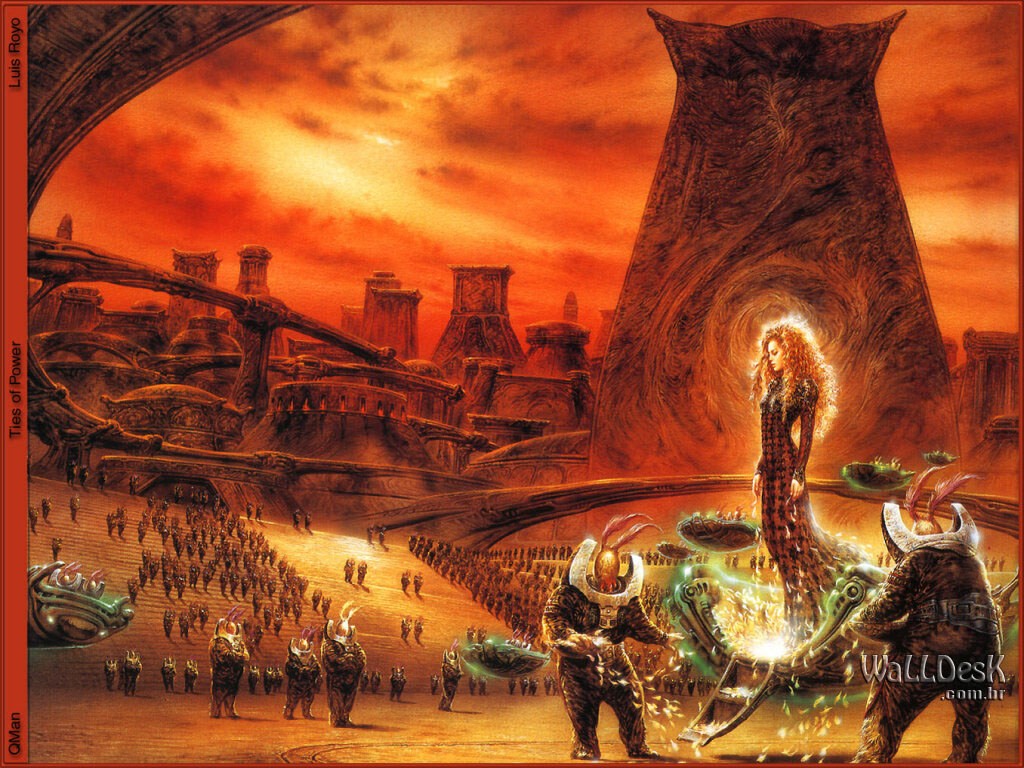
TIES OF POWER (1999)

Cover art by Luis Royo

You know that feeling you get when its been ages since you read a book and then you discover again why you’ve kept it in your library. Julie E. Czerneda has been such a discovery. What a delight. Czerneda has the flowing ability. It’s like listening to good music reading her books.

In a sense the plot is pretty basic. Someone gets screwed and they set out to right the wrong. In Julie’s Trade Pact Cycle books this happens in a universe where the different races of intelligent life have joined in a Trade Pact. There are outsiders. One of these is the Clan – a group of people (look pretty much like humans) who have the ability to travel the M’hir (a place outside of regular space) and telepathic abilities. Some of the members of the Clan are extremely powerful and one of these is Sira – our female protagonist.

The Clan oppose her attraction to Jason Morgan, and Sira herself is afraid of what her power might do to this telepathic human. She is right to fear her own power. When Sira is attacked by the Clan, Sira sends Morgan off to recover what was stolen. Unfortunately a lot of her fury with the Clan is sent along and Morgan is having to fight the urge to express this anger through the book.

As Jason is sent off, Sira transports herself to the only place she feels she will be safe – the Drapsk space ship. She is correct. She is indeed safe on the Drapsk vessel, but that safety also brings a new set of problems Sira’s way. The Drapsk are very good at getting things their own way, and that way includes Sira’s time.

TO Wallpapers 3X Luis Royo 102 To Trade the Stars, papeis desktop image Luis Royo Art and PaintingTRADE THE STARS (2002)

Cover art by Luis Royo

To Trade The Stars continues a few months from where Ties of Power left off. Sira and Jason continue to trade but discover that somehow Jason’s telepathic abilities have become known. This is making it difficult to get good jobs. One does turn up for Morgan at Kimmicle (miner’s world), leaving Sira free to go to Plexis and Huido by M’hir. When she gets there, she ends up being kidnapped. We all know that Jason will turn the universe inside out to find her. He is not going to be alone in this search.

In the meantime Rael and Barac from the previous are stuck on Drapskii continuing what Sira began. They are both understandably frustrated with the Drapsk as the Drapsk are of a different species. When Barac gets a call for help from Huido, he leaps at the chance.

Once again I liked the prose of Julie. She writes seamlessly. Once again, I’ve found an author that has the gift of flow. Her books are just shy of 500 pages and that might hinder some from reading her books. Don’t worry, they are available as audiobooks at audible.com

Pratchett, Terry: The Watch/Vimes

Streets of Ankh-Morpork (wow)

Samuel Vimes is a beautiful character. He grew up in Cockbill Street, the poorest area of Ankh-Morpork. They were so poor that while they had practically nothing to eat, at least their floors were clean enough to eat off. Getting into the Night Watch was quite a change for Sam. Now he had money for food. Being a guard runs in Vimes’ family. In fact one of his ancestors, old Stoneface, beheaded the last king of the city. Vimes’ worldview is that everyone is guilty of some kind of crime.

Guards! Guards! (1989)

[nightwatch.jpg]Nobby, Colon, Carrot, Vimes and the Librarian by William Bradford

Our first proper meeting with Captain Samuel Vimes occurs with him falling over drunk into one of Ankh-Morpork’s streets. It had been a hard day for the Watch. Poor old Herbert Gaskin had broken one of the fundamental rules of being a guard. He forgot to run away from trouble. Now the most despised group of men in the entire city consisted of only three men: himself, Sergeant Colon and Nobby.

In the meantime a young man is heading for the city with “all the openness, sincerity and innocence of purpose of an iceberg drifting into a major shipping lane.” Carrot is the name of this young man, due to the color of his hair but also due to the shape of his body. One day at sixteen his dad sat him down and told him he was not the six-foot dwarf he had always thought he was. Human was his race. His dwarven parents had in fact found him in the woods next to a burned out carriage. Now it is time for him to depart and seek his fortune as a watch-man in Ankh-Morpork. With him his father sends a sword, a dwarven woolen shirt, a golden cod-piece and The Laws And Ordinances of The Cities of Ankh and Morpork.

The Unique and Supreme Lodge of the Elucidated Brethren of the Ebon Night have a plan to overthrow the Patrician. They are going to summon a dragon. Against all odds they actually succeed in calling one forth. It turns out that this is a double-edged sword. Now that they have called the dragon forth, the dragon figures out a way to get back on its own.

One of the themes that we will encounter again and again in the Watch series is the power play between Vimes and Vetinari (patrician). Vetinari plays Vimes like the strings on a guitar. Carrot is the person who manages quite well to live between a rock and a hard place. His literal interpretation of the laws of Ankh-Morpork and his ability to own any situation makes it possible for him to soften Vimes’ explosiveness after meetings with Vetinari.


Adaptations

  • 1992: BBC4 produced a 6-episode serial dramatisation by Michael Butt of Guards! Guards!
  • 1997: Stage play scripted by Stephen Briggs,
  • 1997: Geoffrey Cush’s stage-adaptation,
  • 2000: Comic adaptation of Guards! Guards! Graham Higgins
  • 2011: Board Game by Backspindle Games in conjunction with Z-Man Games

Men at Arms (1993)

Scenes from Men at Arms by Justyna

Edward d’Eath’s father has just died, leaving him the thirty-seventh Lord d’Eath and an assassin to boot. Unfortunately his father had not left Edward any money. Quite a single-minded person whose belief in a King as ruler of Ankh-Morpork was quite fervent. Coincidentally, he stumbles upon Corporal Carrot, who just happens to look like one of the old Kings. Edward sets about trying to get Carrot and kinghood into fashion.

Captain Vimes is retiring from the police to marry Sybil Ramkin, Countess and the richest woman in Akh-Morpork. He is about to become one of the posh, a gentleman of leisure. But Vimes is finding it difficult to let go of policing.

Thankfully, an important artifact disappears from the Assassin’s Guild. The mystery must be solved. But the Assassin’s Guild aren’t interested in help from the Watch. Vimes loves the chase and the opportunity to get out onto the streets again. The chase after the weapon/artifact turns out to be both challenging and bloody.

Gaspode the wonder dog makes his appearance in Men-at-Arms. Gaspode the talking dog (too much time at the UU can change someone). He is rather keen on Angua (the werewolf).

In Men-at-Arms Pratchett plays with our biases. Here we get to see racism in all its “glory”. Even though the cops in the Watch are only supposed to be cops, they still have to overcome biases towards each other. Like so many others of the Discworld books, Men-at-Arms looks at the power of belief. We get a look at what that belief makes it possible for people to do.


2000: Stage adaptation of Men At Arms by Stephen Briggs

Feet of Clay (1996)

  • 1996: Winner of SFX award for best SF/Fantasy Original Novel
  • 1997: Nominated for 1997 Locus Awards – best Fantasy novel

Warhammer’s miniature grouping

Commander Sir Samuel Vimes is shaving, thinking on the horrors he has to face as a gentleman. People doing things for him, formal dinners and not being able to sit with the servants any longer playing cards and drinking beer. And then: “There was a flicker in the glass. He moved sideways and ducked. The mirror smashed. There was the sound of feet somewhere beyond the broken window, and then a crash and a scream.” The Assassin’s Guild are at it again. Some of the other gentle-people of the city do not want Vimes alive, and the Assassin’s Guild keeps on trying to do their job.

Captain Carrot has made it through his first two years in Ankh-Morpork. The love of his life is Corporal Angua, a werewolf, whose bad-hair days he takes in his stride. She is quite handy to have around when people want scaring. So when some incredibly thick thieves rob Ironcrust’s Dwarf Bakery she does just that – earning the “respect of the community.”

The body of Father Tubelcek is discovered. The watch have just hired their new alchemist, a dwarf by the name of Cheery Littlebottom. She is sent along to investigate the clues she discovers, of which one of them is a strange light in the dead eyes of Father Tubelcek.

Weirdly enough, it turns out Nobby is posh. He has his own coat of arms and has now become a peer. Poor guy, how is he going to deal with this? With increasing desperation it seems.


Adaptation

2007: Stage adapatation of Feet of Clay by Stephen Briggs.

jingo

Jingo by Marc Simonetti

Jingo (1997)

An Ankh-Morporkian and a Klatchian fisher are both at the scene when a strange island rises above the sea. Both immediately lay claim to the island and this leads to a dispute between Ankh-Morpork and Klatch. The Klatchian crown prince is sent to Ankh-Morpork and diplomacy ensues (kind of). One of the funniest scenes Terry has ever written comes when Vimes has to lead a parade. The whole thing came alive in my head and I almost fell over laughing.

An assassination attempt is made on the prince and the Klatchian embassy declare war against Ankh-Morpork. Vetinari resigns and Lord Rust takes over. He is slightly eager for war and his decision leads to Vimes and the gang ending up in the Klatchian desert.

At the same time Vetinari, Colon, Nobby and Leonard of Quirm take a u-boat ride to the island and then to Klatch. Nobby ends up having the time of his life with “nubile” women. This is also an extremely funny scene. Poor Nobby. But while there is plenty of humor in the foursome’s trip, there is also a serious reason for their trip (obviously since Vetinari is involved).


2005: Jingo stage adaptation by Stephen Briggs

French cover by Marc Simonetti – Simonetti has become my favorite Pratchett artist

The Fifth Elephant (1999)

Uberwald – the land of vampires, werewolves, trolls and dwarves, is becoming restless. Something very important is happening in a few weeks time. A new Low King is being crowned, and that is causing fighting in Ankh-Morpork. With 50000 dwarves living in the city, people are bound to notice that something is going on.

The old grievances between trolls and dwarves have not yet been resolved and large areas are controlled as fiefdoms by vampire or werewolf clans. Into this “suet pudding” Vetinari plans to send an ambassador for Ankh-Morpork, and he wants to send the Duke of Ankh. Cunning man that he is, Vetinari had already spoken to Lady Sybil about it. Vimes knew when he was beaten.

The replica of the Scone (dwarf throne) is stolen from The Dwarf Bread Museum. Vimes finds an aboundance of clues, to many in his opinion. To him it is a stupid crime that does not feel stupid.

Vimes goes off to Uberwald, leaving Carrot in charge of the city. Thankfully, Sybil is along. She will take care of the negotiations, while Vimes will represent Ankh-Morpork in his unique style.

Angua discovers that her xenophobic brother Wolfgang has decided to take over Uberwald. She leaves Ankh-Morpork and Carrot to stop Wolfgang. Carrot makes a difficult choice. He chooses love over duty and goes after Angua. This time Colon is left in charge of the Watch – a recipe for disaster.

The Fifth Elephant follows these three journeys – Vimes and Sybil/Carrot and Angua/Colon as head of Watch.

In a sense, The Fifth Elephant is a love story. Sometimes the choice is between the people we love, duty and tradition. Can we have it all?


2002: Stage adaptation of The Fifth Elephant by Stephen Briggs

Ankh-Morpork found at The Same Old Song (I need help finding the name of the artist – Kidby, Kirby ???)

The Night Watch (2002)

The Night Watch for the most part happens in the past. Through a freak accident, Vimes is thrown back to the time when he was a younger man and new to the Watch. Along for the ride is Carcer, a cold-blooded murderer. Carcer’s goal in the past is to kill Sybil, thereby wounding Sam beyond repair. Sam’s goal on the other hand is to make the city safer from people like Carcer. To do that he has to establish a new identity as his old self cannot know who he is. Luckily/unluckily Vimes assumes the identity of John Keel, his old sergeant. John Keel has been killed by Carcer. Vimes knows that changing the past will also affect his future. There might not be a wife and child-to-be when he gets home to modern Ankh-Morpork. But Vimes is who he is and cannot leave the Watch or his old self in their old shape.

Unfortunately, Carcer joins the Unmentionables. They are the secret police, carrying out the whims of Lord Winder (patrician of the time). This often includes people going missing, torture and terror. Vimes sets out to make life difficult for both Carcer and the Unmentionables.

Would we try to change the past if we could? Many of us probably would. In trying to influence his younger self to be a better copper, Vimes changed himself. But the big lines of the city. Hmmm – read and see. Corruption and incompetence are dangerous qualities in rulers, but also in the ones set to carrying out the rules. So, what happens when Vimes sets out to change his old world, trying to make it a better place?

———————————-

2008: BBC Radio 4 2008 radio adaptation dramatised by Robin Brooks

2004: Night Watch stage adaptation by Stephen Briggs

Thud (2005) 2006 Locus F Nominated 

Dribble the dragon, Samuel Vimes, Sam Jr. by Kiriban

Vimes really, really does not like Vampires. Until now he has refused to have any of them on the Watch. That choice is taken away from him by his “beloved” Vetinari. Sally is employed to assist in the investigation around the death of the dwarven demagogue, Grag Hamcrusher. Apparently a troll is the culprit. Sergeant Angua and Captain Carrot are the other Watch member assigned to the case.

Corporal Nobbs and Sergeant Colon get the job of investigating the disappearance of a 50-foot painting titled The Battle of Koom Valley. The discovery of the disappearance leads to several things happening. Trolls vs. dwarves, assassination attempts, a Kube and the Summoning Dark all lead to Vimes, Sybil, Young Sam, Wilikins, and several members of the Watch going to the Koom Valley where Vimes discovers the secret of the valley.

Young Sam has become the mainstay of Vimes’ life. This will prove essential in keeping Vimes alive and sane. Family is all to him. Vimes’ dedication to peace is strong throughout the book, as can be seen clearly in his fight with the Summoning Dark. Racism is prevalent in the book through the animosity between dwarves and trolls. Once again we are confronted by our own biases. One might even replace racism with religious conflict: Protestant/Catholic (Ireland) or political conflict: Palestine/Israel.

Snuff (2011)

Samuel Vimes and one of his weapons (dragon) by Jan Pospisil(Perfect)

Snuff’s focus is for the main part on Vimes and his family. Lady Sybil makes him take a family vacation to her mansion Crundells. Of course Wilikins comes along. Here all is peaceful and Sam is enjoying being able to concentrate on being with his wife and son. But that is not the way things stay. The house-staff seems to hate Sam and Vimes nose is itching with the smell of wrong-doings.

Samuel discovers a grotto of goblins living nearby. For some inexplicable reason the local gentry seems to hate/despise/revile the goblins and treat them as disposables. When the murder of a local blacksmith occurs, all of a sudden the whole country side is involved. On his side, Vimes has Sybil, Wilikins, a young police officer called Upshot and the goblins. Against him are Lord Rust (who has interests in the area) and most of the local gentry and quite a few of the peasants.

It’s time to call in the cavalry. While he has no jurisdiction at Crundell, Vimes is able to ask his people to investigate certain aspects of his discoveries. The Watch does not play a large part in Snuff, but they are present.

I was touched by Snuff. In a sense I felt as though I was saying goodbye to Samuel Vimes, Duke of Ankh-Morpork and Commander of the Watch. Pratchett writing has gotten darker as the years have passed for the Discworld. The topics are no longer solely focused on making fun (in his gentle way) of current sci-fi and fantasy fashions, but very much on personal development and the conflicts people meet in life. The slavery of the goblins in Snuff very much reminded me of the slavery that has gone on and is going on in the world. Somehow people find it in themselves to treat others as nothing. Rising up to fight this slavery, both on a large and a small-scale is incredibly difficult. Thankfully Pratchett always leaves us with a sense of hope that things might get better.


SOURCES:

Tenn, William: Of Men and Monsters (1968)

Of Men and Monsters

Of Men and Monsters is another novel that belongs in the classic category. It’s not very difficult to see that William Tenn likes to turn things upside down. He is considered one of the foremost satirists of his generation and he is very good at making me think about mankind in a different way. Like all good satires, the ending is bizarre but at the same time believable, given the circumstances described. I’ve seen that others have found the book hilarious, but I can’t say that I did. To me, Of Men and Monsters was more thoughtfully funny.

I couldn’t help thinking of Steinbeck’s Of Mice and Men (one of the most beautifully written books I’ve read) when I read the title. Of Men and Monsters is Tenn’s only full-length novel. I read it one reading, not wanting to put it down. These old-timers were excellent writers.

In Of Men and Monsters the earth has been conquered by gigantic aliens (monsters). Humans have become vermin, living in the walls of the houses of these monsters living like mice, rats and cockroaches off the spoils of the monsters. One of the tribes of men calls itself Mankind. In Mankind lives a boy (soon to be man) called Eric the Only (single child). As part of his initiation as a man, Eric needs to go out into the Monster territory. As his journey progresses he finds betrayal, adventure and love.

People are treated pretty much as we treat our own lab animals. Experiment on them or kill them. Tenn also makes fun of the way people behave when their beliefs self-images are challenged. We pretty much see people behaving as people would, and there really is nothing funnier than that.

Asimov, Isaac: Foundation series

The Foundation series continues on from the Elijah Bailey series. The reason I call it a continuation of the series becomes apparent as one reads the books (too much of a spoiler to tell). If you go to Wikipedia, they will tell all. Having said that, their page carries quite an excellent description of the books along with analysis and links. For another in-depth analysis of Asimov’s work go to Wimmer & Wilkins’ blog. Asimov’s home page contains more general information about his life’s work.

Isaac Asimov brought fresh air into science fiction when he arrived on the scene in the 40’s. He wasn’t afraid of taking a hard look at the possible future of mankind based on what he knew of the day’s theories on sociology and psychology. The Foundation series is considered one of the most important contributions to the field of science fiction, a well-deserved opinion.


PRELUDE TO FOUNDATION (1988) AND FORWARD THE FOUNDATION (1993)

SciFi and Fantasy Art PRELUDE TO FOUNDATION by Slawek Wojtowicz
Cover for Polish Prelude to Foundation
by Slawek Wojtowicz

The Foundation series was started in the 1940’s, but for easier reading you should start with Prelude to Foundation and Forward the Foundation. In Prelude we meet Hari Sheldon, the inventor of psychohistory. Hari’s goal was to be able to predict the general future of humanity, and during a conference he presents his fledgling theory to fellow scientists on the planet Trantor. Unfortunately the Empiror finds Hari’s theories a threat and begin to persecute him. This makes it necessary for Hari to flee, and his flight takes him around Trantor. In Forward the story of how Hari develops his theory continues. Sadly for Hari, the people he loves die off (naturally and unnaturally). Hari refuses to give up and finally develops what ends up being called the Seldon Plan, a way to save the future of humankind.


FOUNDATION (1951) / FOUNDATION AND EMPIRE (1952) / AND SECOND FOUNDATION (1953)

Cover for Polish Prelude to Foundation
by Slawek Wojtowicz

After this introduction to the future Galactic Empire, The Foundation Trilogy with the books Foundation, Foundation and Empire and Second Foundation, follow. These are Asimov’s first installments in the Foundation history. When you read these books, please keep in mind that the series was written well before Wikipedia or the internet came into existence. As such, they seem a bit dated. Some of the theory can be tedious, but the adventures and people we meet are quite fun. The titles are a dead give-away, so we know well ahead of time that the Foundation is bound to survive. But we know nothing about the road taken.

In Foundation and Empire the leaders of the Foundation has become corrupt. The internal strife that arises from that makes the organisation susceptible to “The Mule”. The Mule advances, conquering planet after planet, making the Empire deviate from Seldon’s plan. The Foundation does not have it in them to win over the Mule, and desperately some of the members begin seeking a rumoured Second Foundation.

The title Second Foundation kind of gives it away. In this novel we are going to discover the rumoured savior of the Empire while enjoying adventure, science and social interaction. The only way to kill the Mule is by allowing members of the Foundation to find members of the Second Foundation. But this also reveals the fact that there is a Second Foundation and that its nature is somewhat different to the First one’s. Herein lies the conflict.


Foundation’s Edge
by Michael Whelan

FOUNDATION’S EDGE (1982) AND FOUNDATION AND EARTH (1986)

And so we come to the two final books in the Foundation series: Foundation’s Edge and Foundation and Earth. We meet Golan Trevize as main protagonist in both books. He is convinced the Second Foundation has survived the attempt to exterminate its members, and goes looking for them. His search brings him to many planets and finally to the ancient planets (no longer on any star-chart) of Solaria, Aurora and Melpomenia. Each journey brings Trevize closer to a conclusion that may or may not satisfy the reader. I felt ambiguous, and that seems to be the intent of the author.


  • 1966 –  Best All-time Novel Series Hugo Award for the Foundation series
  • 1983 –  Hugo Award for Best Novel for Foundation’s Edge
  • 1983 –  Locus Award for Best Science Fiction Novel for Foundation’s Edge
  • 1996 –  A 1946 Retro-Hugo for Best Novel of 1945 was given at the 1996 WorldCon to “The Mule“, the 7th Foundation story, published in Astounding Science Fiction

Asimov, Isaac: Elijah Bailey/Robot series

Isaac Asimov was my introduction to science fiction. I imagine he has been for a lot of people. The libraries here in Norway didn’t have a lot of fantasy/science fiction material in my youth. But there were a few robot anthologies with Isaac. I fell in love.

It’s incredible to me that Asimov began the Foundation series in 1942. I would begin my reading with the Robot series (Elijah Bailey series). These four books give the reader an excellent starting point for understanding Foundation: The Caves of SteelThe Naked Sun, The Robots of Dawn, and Robots and Empire (these are links to Wikipedia so spoiler warning is necessary).

michael whelan_isaac asimov_the caves of steel.jpg

Michael Whelan – Caves of Steel

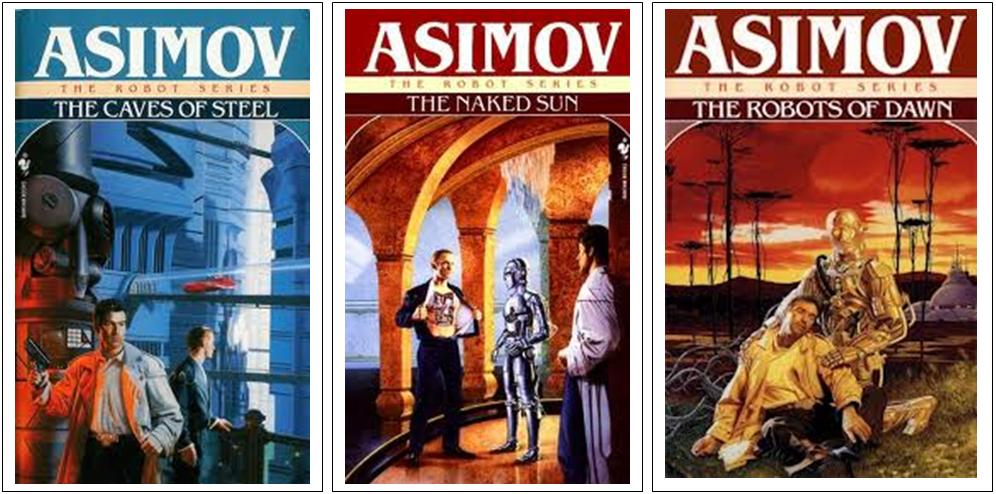
The Caves of Steel (1954) is the very beginning of the Foundation series. Far into the future (approx. 3000 years) mankind has discovered hyper-travel and has emigrated to the stars. Fifty planets, known as the Spacer worlds, have been terraformed and enjoy a low density of humans. Robots are used for labor intensive jobs. In the meantime Earth is over-populated and have passed laws against the use of robots. Elijah Bailey lives on Earth in one of the domed cities.

A Spacer ambassador has been found murdered outside his domicile. Elijah is forced to go work with his partner, R. Daneel Olivaw, a human-looking robot. Unfortunately one of things Elijah holds against Daneel is the fact that he looks just like the murder victim. On their journey of discovery they end up visiting the Spacer worlds.

Some of the themes Asimov explores in this combination of sci-fi and mystery are over-population, technology and prejudice.

The-Robots-Series-1

The Naked Sun (1957) brings us to the world of Solaria. Solaria is a planet where the population is kept at 20000 and robots serve the human population. In fact robots outnumber the humans greatly. This time the victim is a genetic specialist in the birthing center of the planet. On a planet where contact between people is kept at a minimum, we get a real locked-room mystery. Once again Elijah and Daneel need to solve the murder mystery.

In the Elijah books robots are for the most part treated as property and expected to do as their masters say. When Elijah calls the robot “Boy” it might be seen as Asimov’s way of breaching the topic of racism/slavery/prejudice. Asimov was agoraphobic and as such Solaria would probably be the exact opposite of his heaven. Elijah certainly has to struggle quite a deal with his own agoraphobia in this novel. We also get a look at the way we tend to make assumptions without enough information. The rest of Solaria just “knows” that Gladia has to be guilty of the crime, but Elijah is not as certain of that.

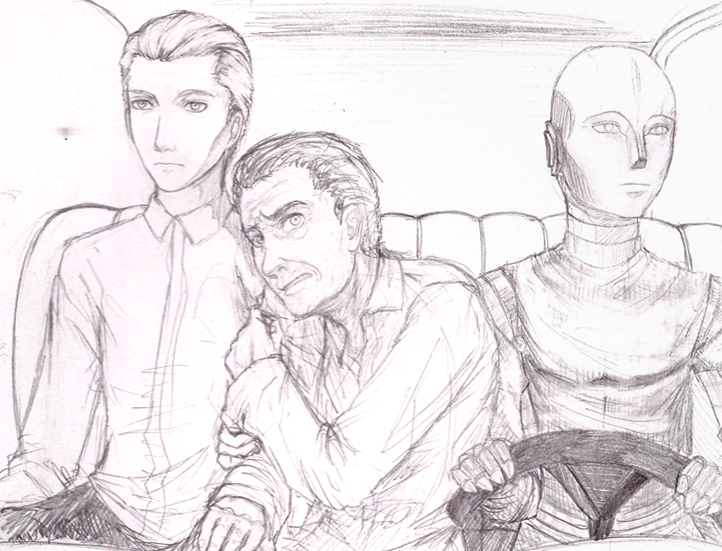
Daneel, Elijah and Giskard in hovercraft by Seabird

In The Robots of Dawn (1983) we once again meet Gladia from Solaria. She has settled on the planet Aurora. A roboticide has occurred and Elijah and Daneel need to find the killer. R. Jander Panell was another humaniform robot created by Han Fastolfe. The robots of Aurora are incredibly lifelike and their interaction with their humans can be quite intimate.

To aid in their investigation, Daneel and Elijah are assisted by another of Fastolfe’s creations, R. Giskard Reventlov. They discover that Jander was a member of Gladia’s staff. In fact, she considered him her husband. Some of the possibilities for motives are jealousy, power and greed. While Asimov’s Robot books are mysteries, they are also an exploration of sociological possibilities. The impact of technology (in this case robots) is one of Asimov’s recurrent themes. How far do we take technology or let technology take us? The Robots of Dawn is also very much about human relationships. How much do we let our urges, the taboos of society and our individualism steer our lives?

The Zeroth Law by Hera of Stockholm

Robots and Empire (1985) is the final book in the Elijah Bailey/Robot series. By this time Elijah has died and we encounter one of his descendants, Daneel Giskard. In it we get a step closer to Asimov’s Foundation series – a natural continuation of the Elijah/Robot’s series.

For most of the Spacer population Earth people are seen as vermin. They have been forbidden emigration to other planets and are forced to stay on over-populated, capped earth.

However, Earth people are overcoming their agoraphobia and are using faster-than-light transportation to get to planets away from the Spacer Empire. These “Settlers” see the Earth as something to revere. One of these Settlers is Daneel Giskard.

On a trade journey Daneel discovers that Solaria seems empty of humans. The robots are left, still working with their previously assigned jobs. Gladia Delmarre is still alive on Aurora and she is asked by Daneel to help figure out what has happened on Solaria. She brings R. Daneel and R. Giskard to aid in the investigation.

Once again Asimov explores the theme of technology and its effect on humans. The ending of Robots and Empire was quite touching and a fitting end to the Robot series. When you read the Foundation series, you will see just how Robots and Empire merges these two series. These books are a treat. While they are dated in some respects, their themes are incredibly relevant today.

Aldiss, Brian: Non-Stop (1958)

Here comes quite a treat. Brian Aldiss is one of the classics within science fiction. His type of science fiction likes to explore the human psyche through adventure. While written in 1958 this novel is as fresh as if it had been written today. We get a look at what a Freudian/Jungian world could look like all wrapped up in a great yarn.

Roy Complain, a hunter of the tribe of Greene, lives according to the “Teachings,” which valorize egotism and violence. Along with his tribe’s priest and four others, Complain set off on a to “Forwards,” the front of the ship (as the priest assures them it really is), to find the “control room.” On the way they have adventure – battles, discoveries and unexplained phenomena. Eventually they find the “Forwards” section. From then on revelation upon revelation leads us to the inevitable and bitter (and sadly believable) conclusion.

Schroeder, Karl: Permanence (2002)

French cover

“Permanence” is a stand-alone novel. Karl Schroeder brings us to a future where man-kind is spread across the galaxy. As he states on his website, he wanted to bring a new hard science into the world of science fiction. There, space-opera could run its course in whichever manner the book dictated. The added knowledge of our universe in 2001 made it possible to theorize in a new manner.

So in “Permanence” we get to meet brown dwarfs and the human habitats that surround them. Schroeder has used this knowledge about their strong magnetic fields to create a place where humans can exist. In this brown dwarf world interstellar cyclers are used to maintain contact between human habitats.

On one of these Halo worlds we find Rue Cassels. She runs away from home and finds an empty but functional cycler. She lays claim to it and in a race against other factors she works towards the right to ownership and the right to explore and exploit the cycler. We know right away that in such a plot there has to be conflict. There is plenty of that.

Schroeder has written a book that I’ve just read for the third time. There are some books that are like old friends. You don’t have to meet them all the time, but when you finally get together you have a really good time – as did I. Schroeder even managed to convince me to stay up late. Old age really does not teach us any sense. When I get a really fun book between my hands, I’m hopeless. Oh, well.