The Acorna books are part of Anne McCaffrey‘s Federated Sentient Planets Universe stories. Acorna I and II are written in conjunction with Margaret Ball.
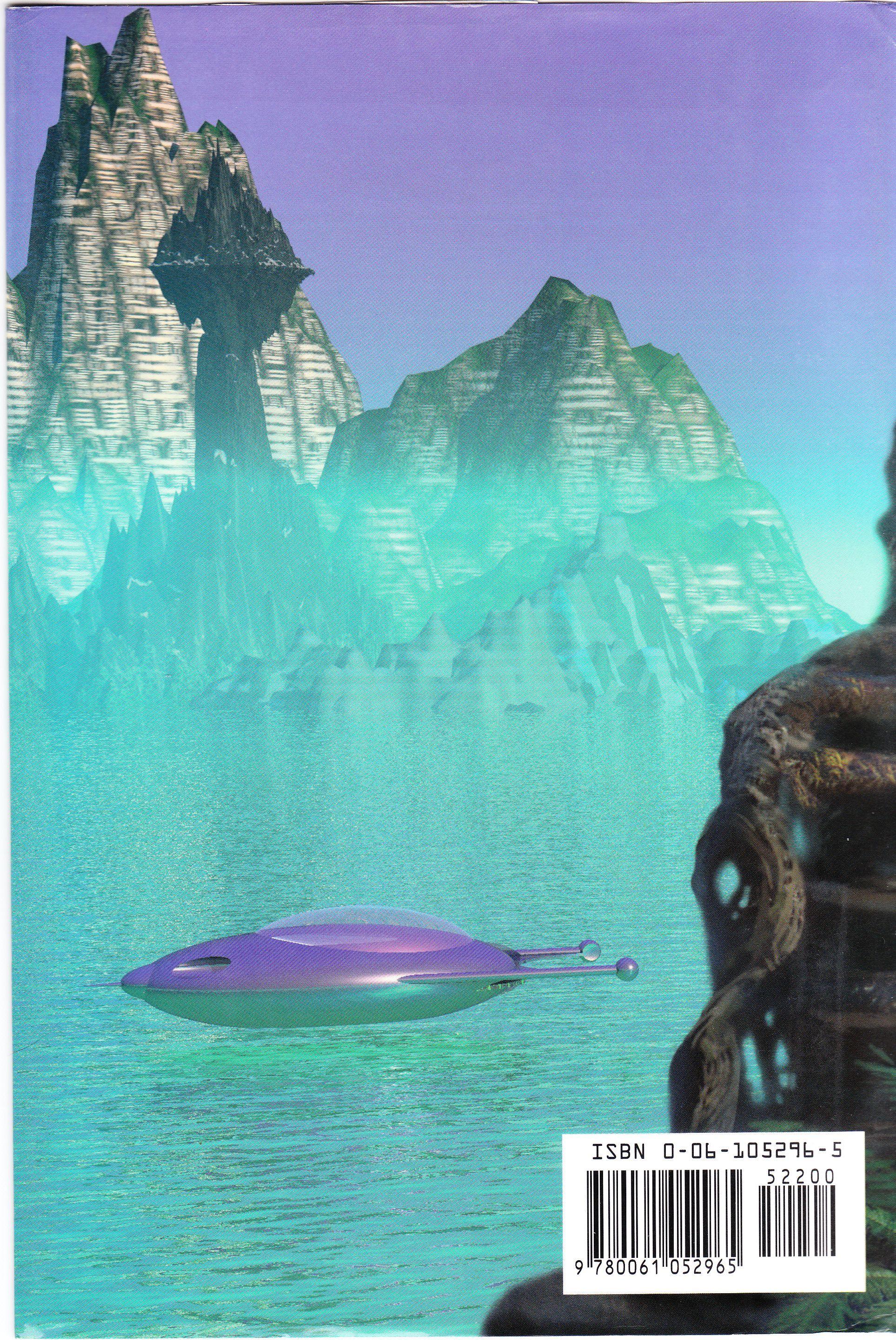
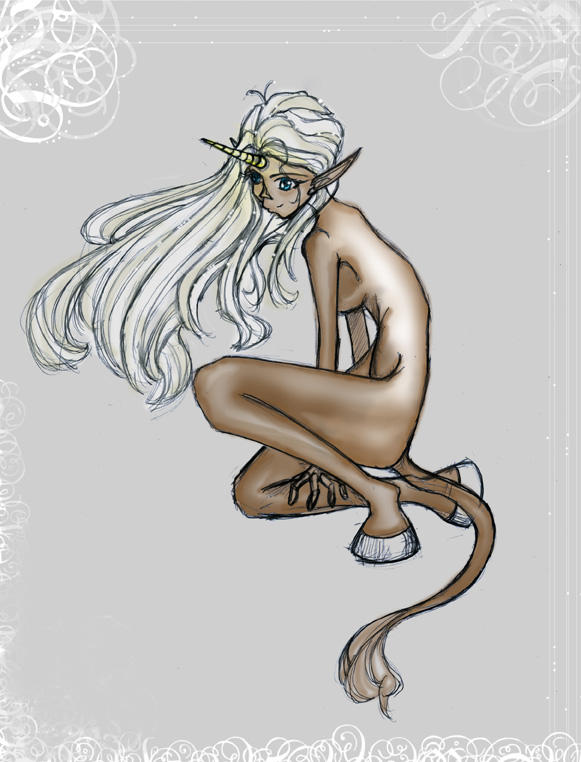
As you see from the art above, very few artists have tried to depict Acorna as she is described in Anne McCaffrey and Margaret Ball’s stories about the Unicorn girl/woman. Acorna’s characteristics are: a silvery mane and silvery curls on her calves, cloven hooves, two jointed fingers, and finally silvery eyes with pupils that can narrow. In The Unicorn Girl, Acorna is flat-chested.
I find myself unable to place any sort of age-group on this story. At times the writing has a very young feeling, possibly even entering the Children’s category. Then it changes and both writing and content is a little older. Perhaps that is due to the collaboration between the two authors. The first rescue of Acorna is one example of the very young style. As if by magic the young alien and her three benefactors get out scotfree of what ought to have been a difficult situation. In the labor camps the writing style is older and harsher. These changes confused me and led me to pay less attention to the story.
The plot itself is pretty good. There are aliens, escapes, human/alien interaction, corruption and goodies and baddies. As good and evil characters go, most of the ones in the story weren’t solidly into one or the other category. There are a couple of exceptions, but these are mainly minor characters.
Anne McCaffrey and Margaret Ball address an incredibly serious issue in their story – that of child slavery. Child slavery is in the real world becoming increasingly visible. At the time Acorna I was published (1997) child slavery was becoming something journalists brought into the light more often. Closing our eyes to troubles around the world is now becoming something we have to choose to do.
I liked Acorna’s adoptive fathers. There was enough silliness in them to make for humor in the story of orphan Acorna. Along with humor, there is action and conniving. I recommend Acorna I. I have to warn you that it is somewhat different to Anne McCaffrey’s other writing.
I wonder if true precognitives exist? There are certainly plenty of frauds out there, who in spite of generally being wrong have their followers. Ia lives in a world where paranormal powers of varying degrees is a fairly normal matter. Paranormal powers seem to be part of most of the species in Jean Johnson’s Theirs Not to Reason Why. When it comes to precognition Ia is strong enough be called “The Prophet of a Thousand Years”. Her predictions thus far have never missed their mark. What she has seen of the future frightens her because she wants life in the universe to survive.
Fighting for the survival of others or fighting to fulfill the political goals of others seems to be a soldier’s lot. This is a way of thinking that is foreign to me. I tend to think that humans need extinction. While some political systems seem saner than others, the politicians within those systems can get too caught up in games. Some of these so-called games cost young men and women their lives as soldiers fighting for what may or may not be healthy for people.
Ia’s precognition has saved the lives of many of the soldiers and non-combatants on her side. Fewer people have died than might have. If I were an officer, that would certainly be my main goal – to keep as many as possible alive while still managing to do the job that needs to be done. Losing that ability for a while – the long-term precognition – blinds Ia in a way that losing her left eye does not. Her team are so used to having solid information that they too are strongly affected by her loss. But needing to live without being able to depend on her foresight teaches Ia more about the quality of needing to lead through trust. I would find that one of the most difficult parts of being a leader, needing to trust my subordinates to do the job properly. But I imagine leaders learn a lot about themselves through such a process.
In the world of Theirs is Not to Reason Why there are quite a few political players. Not all of them are human. Some of these players are the Feyori. Ia is half Feyori and half human. In Hellfire Ia had her first manifestation as Feyori (she describes them as energy-based beings manifesting themselves as something like large soap-bubbles). That soap-bubble image is very much in my mind right now when I think about Ia’s meeting with the other Feyori in Hardship.
Hardship was a great addition to the serial about Ia. So many of the authors that I read are captivating writers who give me loads of action and imagination. Definitely recommended.
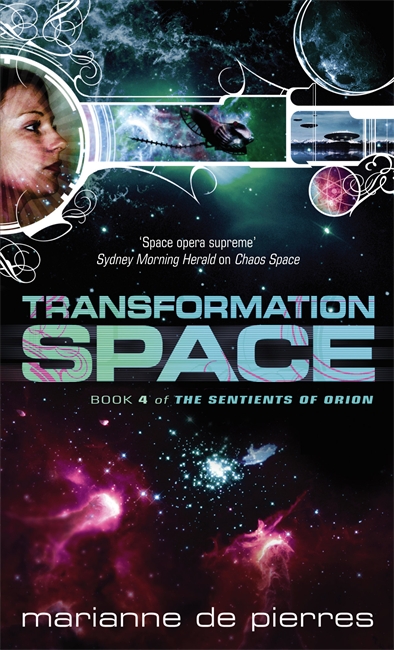
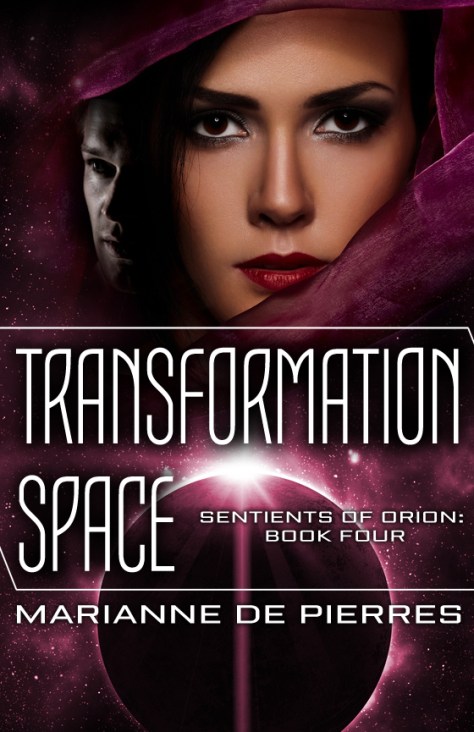
I haven’t really liked the other covers of the series that are like the one above. Nor have I liked the ones similar to the one below. But in the case of Transformation Space both covers have appealed to me. The bottom one is because of the eyes of the main model. In the above cover I love the details that reveal themselves as I review the picture along with the color combination.
Dum, da, rah, dum! The end is here.
Like this … Nova projected a grave melancholia, a vast emptiness without end that made Mira want to weep.
<you know this? little one?>
We all know. Do you feel it too?
According to answers.com the definition of melancholia is:
Melancholia brings about a form of pessimism that sees the future as blocked and unchangeable. Such pessimism is accompanied by ideas of guilt and unworthiness, which find expression through self-accusation and can even give rise to delusion. …. Mental suffering engenders a continual desire for death.
How far would we be willing to go to get out of our melancholia? At what point does the melancholia cause us to tip over the boundary of no, nos? There are plenty of stories out there about just what happens to people who end up in this valley of bleakness in their attempts to relieve the pain.
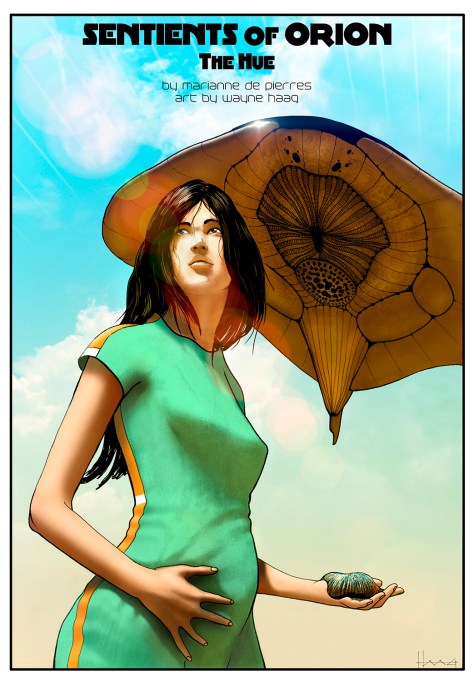
The lovely thing about fiction is that the author gets to explore such subjects. The serial Sentients of Orion has explored the issue of how far one particular non-humanesque is willing to go in order to relieve its melancholia. Because its motivations and background is foreign and more or less unknown to us, we only get to see the effects of trying to relieve its pain.
The Sacqr are one of those effects. You know, the Sacqr are seriously bad-ass. Nothing kills them, except maybe something really big stepping on them. Weapons seem to have no effect and their voraciousness has no limit. Even Rast Randall is scared shit-less by them, and Rast does not frighten easily. Being kept sensory deprived on the Post-Species vessel almost broke her but she pulled through and used her resilience to help keep the three survivors of that trip alive through Sacqr fun:
Jo-Jo’s muscles twitched with an uncontrollable desire to spring at the creature. Attack it before it could find him, surprise and aggression as his weapon. Not crouch here, shitting his pants, waiting for its maw to open and the bone-piercing stamen to extend down and skewer his skull.
Jo-Jo remembered how it was: ‘esque bodies flung across the floor of the food court on Dowl, Sacqr gorging on their body fluids. The adrenaline that had poured through him then now threatened to overcome his self-control, but Randall kept steady pressure on his head, pressing so hard that the pain across the bridge of his nose began to overshadow his fear.
How much garbage do you have to wade through in your life to be able to keep your cool in such a situation? There are people out there who go through similar experiences every day. Syria, Sudan and Eastern Burma spring to mind. Not much fun living there these days and I imagine what they have experienced is close to what the people of Araldis went through as it was invaded. Rast Randall had fought in plenty of conflicts/wars in her capacity as a mercenary leaving her with the tools to possibly survive what the Sacqr had to dish out.
I found myself admiring the inner strength Thales was able to dig up during Transformation Space. When I first got to know him, Thales seemed afraid of his own shadow. Yet by the end of the tale of the Sentients of Orion Thales emerges as a person who has discovered who and what he is and what price he is willing to pay to remain that person. That journey is one we all need to make. Some of us do. Some of us don’t.
Once again Marianne de Pierres caught me in the trap of her words and would not release me until Transformation Space was a done deal.
Not for me, but certainly for Rast Randall and Jo-Jo Rasterovitch who have both fallen for Baronessa Mira Fedor from Araldis. When Mira is captured by the Extropists (nascent humanesques/post-species) Mira shows why Rast and Jo-Jo care so much for her. Resilience is the quality I find most describes the young refugee from Araldis. I’m not certain if resilience is something that most find attractive, but I know that I do. Part of that attraction lies in my own history and perhaps part of it has to do with resilient people radiating some sort of invisible strength. Fighting her fears and going on in spite of the traumas that come her way signifies the kind of courage the young Baronessa has.
Insignia has shown Mira how utterly alien the thought patterns of other creatures can be. Wanton-Poda is about to show her how “evolved” humanesques no longer have much in common with their roots. Indeed, their morals are amoral seen from a Western point of view. Through this, dePierres shows us just how different our own cultures can be in this mix that our global village has become. What one ethnic background considers only proper another might consider sociopathic or paranoid or cruel. Judging others based on our own backgrounds is unwise yet impossible to avoid. Again and again Mira is confronted with the need to reach beyond her own way of thinking. But it ain’t easy!
Tekton is from highly competitive Lostol. Whether the whole population is like him is impossible for me to say, but he and his cousin both seem supremely self-absorbed and willing to do anything to win over the other. Sole (the Entity/God/strange intelligence) knows to use these two qualities against them in its attempt to achieve its own goals. We don’t find out what these goals are until the end of the Sentients of Orion serial (yes, I cheated). As we see in Mirror Space, Tekton learns what being helpless is all about and finds his narcissism challenged. Perhaps there is potential for change in him.
One person who seems to have no hope of changing is Trin Pelligrini. He keeps on insisting that Mira has run off and fights Cass Mulravey for power of the survivors. His ego needs constant stroking, one reason he is so fond of Djeserit. Yet this utter and complete belief in his own superiority might be what the survivors need in order to stay alive.
In fact, characters like Trin Pelligrini, Lancer Farr and Tektor Lostol are fascinating people. I find there is something about deviant fictional characters that makes a story much better. However much I hate it whenever such a person turns up in my own life, they surely make for a deeper understanding of the human psyche. Literature serves this function, along with many others, for me.
One thing that is certain is that Marianne de Pierres has the flow needed to grab hold of me and drag me along in her story. Annoyingly, yet wonderfully, I find myself unable to resist her pull.
The end of Dark Space has left Mira pregnant, raped by Trin so he could ensure his progeny with a pure-blood noble from Araldis. Rast states it so well
“Women get raped,” said Rast harshly, her pale skin flushed with emotion. “Sometimes in war, sometimes just for the hell of it. That’s what happens.” She gripped Mira’s wrist and pulled her close. Then she hugged her tightly for a long moment.
“We’ll get your world back for you, Baronessa. But tell me something: are you sure you really want it?”
Not only did Trin rape Mira and send her off-planet to get help. While staying behind he makes certain to besmirch Mira’s reputation by claiming that she has run off. For Trin does not want Mira to become more popular than he. After all, that might endanger his own shot at becoming Principe after the war.
War, ambition, greed, death.
Trin is more concerned with saving his men than with saving the population of Araldis. Cass Mulravey sees that he has no clue that if he wishes to rebuild his world, he will need women to bear children. The two of them are at odds through all of Chaos Space. Only Djeserit’s attempts to broker a peace between them keeps them from open dispute. Until Trin has managed to finagle the loyalty of the women who have followed Cass, he has to at least give the appearance of working for the greater good. Perhaps all of this pretending will turn to true behavior eventually???
We find out who Djeserit’s mother is. Oh, dear! Poor girl. None of us choose our own parents, but some of us are left with worse parents than others. Bethany Farr is no ideal mother. She seems to have repented of sending Djeserit off and now wants to save Djeserit and thereby Aldaris. But will Bethany carry through or perhaps only work towards the redemption of her daughter until her next “love” comes along??
Insignia, the biozoon carrying Mira, turns out to have an agenda of its own. The vessel has repeatedly tried to get Mira to understand that it does not care about humanesques in general, only the ones with which it can communicate. When its contract with the Fedor clan runs out in the middle of an escape, Mira fully comes to understand how true and real that is.
Mira is one severely traumatized person who is thrown from one chaotic episode to the next. Needing to make decisions pronto goes against her socialization, and tearing herself loose from that socialization is incredibly painful for her. In Dark Space Mira learned to handle a gun, something that was forbidden to the upper-class women. In Chaos Space she has to learn to see through the fallacies of her traditions. Having worked my way out of fundamentalism, makes it easy for me to relate to what Mira must have gone through. Being brought up in a society where women are taught from a young age that they are less and also taught how to internalize this tradition and accept it as right and proper makes the reach through the fog of indoctrination severely painful and self-actualizing. Mira is forced to grow once she makes the choice to make her way through her fog and grow she does.
Asking for help is more complicated than Mira had thought. Naively, Mira had expected that explaining her planet’s situation to OLOSS would bring OLOSS to the rescue. But OLOSS is concerned with what is in it for them and want to get hold of Insignia so they can study it. Having read something about the history of our own world this concern with profit in the face of aid is nothing new. In fact, I wonder if the need to profit from another person’s tragedy is embedded in the human psyche?
DePierres’ writing is as riveting in Chaos Space as it was in Dark Space. Again I found myself struggling to stop reading.
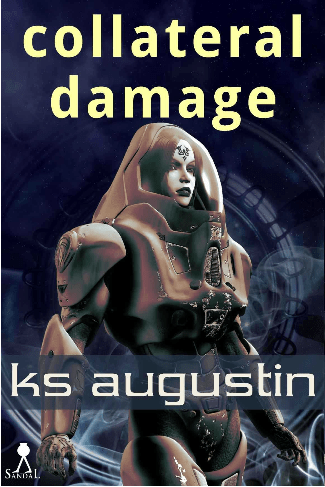
Collateral Damage is an erotic space opera short-story with little emphasis on the realities of space and more on the story between the two characters Meyal and Waryd. The only realistic bit about the Science Fiction lies in the state of the Earth. So, your reason for getting this story would have to be to see what develops between Meyal and Waryd and the story of how big corporations might treat their employees.
Do I believe a large corporation might kill its employee to get out of financial obligations? Hell, yes!!! If there is one thing I have come to realize, it is that the leadership of big corporations will sometimes be so concerned with the financial status of their shareholders and possible deniability that the sky is the limit when it comes to potential nefarious deeds.
Meyal and Waryd both seem like people who want to take care of their families and earn a bunch of money in the doing. Not being supposed to know about the other person and definitely not being allowed to communicate with each other probably only adds spice to their romantic relationship.
The ending of the story leaves me understanding that there is more to come in the future. According to Augustin’s web-site, Collateral Damage could be said to be the origin story of her other work. Collateral Damage was a pretty good story.
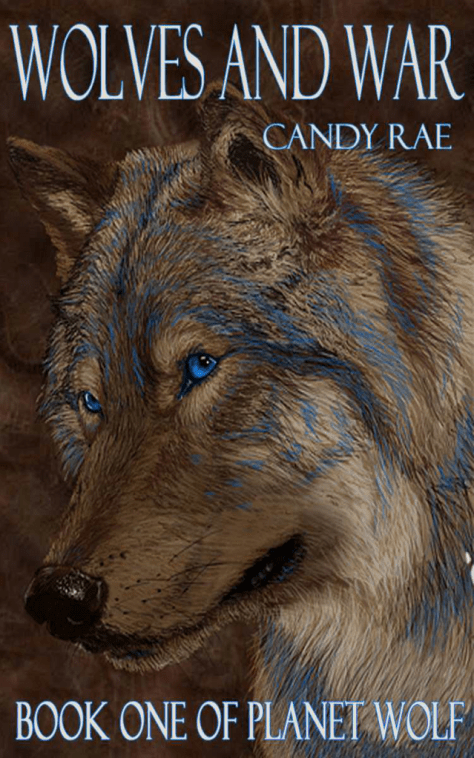
At the outset I want to make you aware of the British English / Scottish English phrasing and spelling in Wolves and War. NOT American English!!! Because of the sometimes young phrasing, I feel Wolves and War is meant for young adults and up. While harsh at times the violence is not descriptive. There is some romance, but it is about as innocent as romance can get. What you do need to remember (sort of a warning) is that Wolves and War is about war and war is anything but nice.
On to the fun stuff.
I really enjoyed Wolves and War. At times I hurt because of the terrible changes to the lives of some of the women and children. War’s nature is gruesome. I have NEVER experienced it myself and am speaking solely as one who reads and listens and watches. What amazes me time and again is what people are willing to put up with if the alternative is death. Often I have wondered why people choose to live rather than kill themselves when their lives become so miserable. Some of the lives on the Southern Continent end up being what I would call gruesome. Yet, somehow life is chosen. Why?
Wolves and War does not answer my why. In fact, it leaves me there with my questions. Ms. Rae has done a brilliant thing in doing that because I do not really want another person to answer all my whys. I don’t even need there to be an answer to my whys.
Wolves and War is a space opera type of Science Fiction – character and world-building is more important than technology.
When the Argyll has to land on the Northern Continent the crew and settlers have to abandon ship before it sinks leaving them without most of their doodads (I know, an extremely technological term). Until war comes to the Northern Continent life is somewhat easier there than on the Southern Continent and the lack of metals is compensated by making tools with a metal-like hardwood. Necessity is the mother of invention even if that invention is a re-invention of old earth weapons. Their smith makes swords, shields, helmets, armour, crossbows and something he calls a contrap:
… was able to fire pre-loaded arrows a fair distance and thirty at a time. The arrows were loaded into a wooded frame he called a magazine that was placed on the main frame of the contraption itself. The firing mechanism was spring-loaded and the magazine was drawn back and then loosed. Distance and trajectory could be altered by the manipulation of wheels and cogs.
All of this preparation would have been impossible without the Aboriginals of the planet of wolves. The Lind are great hulking beasts about the size of a horse but with the look of a wolf about them. They are furry, snouty and have paws. Somehow both the Lind and the Larg of the Southern Continent have developed telepathic abilities along with the ability to form words. The word thing made me think that their snouts must be formed differently from a wolf’s.
What interested the Linds at first about the humans is how humans use their hands and the seeming connection some of the Lind have with some of the humans. Being able to communicate via mind and words is essential in making the humans believe that the Lind are sentient creatures.
Tara is the first human to meet a Lind. Kolyei is a Lind that feels a connection with Tara. Tara is not alone in this ability. On the Northern Continent Tara and Kolyei and Jim and Larya are the two vadeln pairs we get to know most. Tara is only 12 at the time she and Kolyei meet while Jim is in his 40’s. Their Lind bond-person is pretty well matched age wise and this is a good thing as these bonds seem to be for life and so deep that one part does not wish to live if the other party dies. A lot of animal-human bond stories seem to have this as the down-side of bonding. On the up-side is an understanding of the other race’s traits and language along with a deep sense of being loved unconditionally.
I enjoyed the way Ms. Rae tried to not sugar-coat anything for me as a reader. Granted, the fighting was not as gory as fighting really is, but it did not have to be for me to understand the costs of the war between the Southern and Northern Continents. She also did not try to hide the problems that would arise with 20,000 male prisoners escaping into an environment where females are on the run and only 300. When the leader of the prisoners is unscrupulous, well – things go as they pretty much have to go.
Being a colony vessel, the Argyll crew and passengers did not have the same dilemmas nor the same type of people to work with. Without a doubt, that is where I would have wanted to be. Both the North and the South end up with aliens and a landscape that fits with the humans landing there. Any other option would have seen the humans from the Argyll killed and possibly the Lind of the Northern Continent in pretty bad shape as well. As a reader I am glad Ms. Rae chose as she did.
Edited by Anne Frasier/Theresa Weir Cover art by Phatpuppy (link) Cover design by eyemaidthis
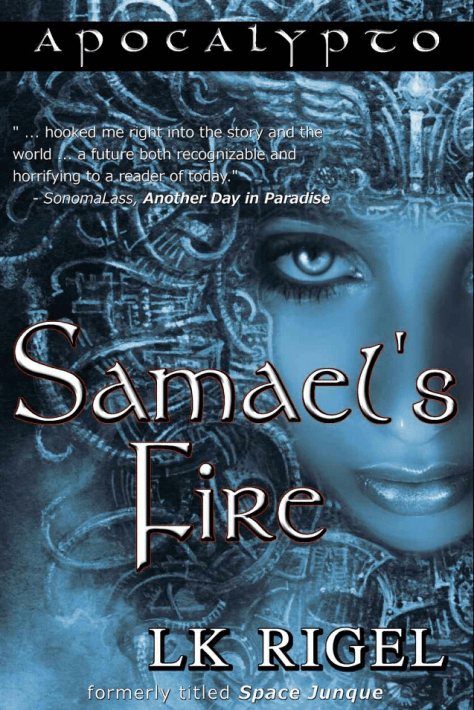
I saw the old cover for Space Junque on Rigel’s site and much preferred this one. This cover is seriously cool. Phatpuppy is on my list of favorite cover artists (she’s got her Halloween theme going right now).
Why change the title so often? Weird. Rigel explains it (I still like the above cover best):
Hero Material is a prequel, the story of how the paranormal world in the Apocalypto series replaces the old unmystical normal world. The series proper is a paranormal fantasy, and all the action is definitely on earth or within the realm of the gods.
In fact, when the paranormal elements of Hero Material nee Space Junque kick in, it’s been a shock to a lot of readers, not expecting such things in science fiction. I blame myself for too-light foreshadowing. But I blame the old cover too.
Now the name has been changed again – to Samael’s Fire.
As you see above Apocalypto is meant to be a paranormal fantasy series. Samael’s Fire is the first step on that road.
Charybdis Meadowlark is living in a post-apocalyptic version of our world where the corporations have been able to play to their heart’s content and the environment has gone down the drain. Environmental terrorists, like the DOGs, aren’t making the Earth any cleaner. When we meet Char, she is fleeing Sacramento. Her friend Mike has warned her that the DOGs are about to bomb Sacramento and that she needs to get off Earth and into space.
From the very beginning many of Char’s experiences are about fleeing one sort of trouble after the other. Trouble seems attracted to her but unlike a great majority of people Char has incredible luck in how it affects her.
Charbydis is very much our main character. The story is told from her point of view and she is the one we get to really know. The only other person we get to know fairly well is Jake. Char meets him as he sells her coffee at the coffee kiosk.
From all of the other reviews I feel certain you’ve realised that Char and Jake become an item. There is instant sexual attraction on both sides, they don’t really like each other and both are beautiful people. Like so many other novels there is a sort of love triangle.
In space there is plenty of action, a lot of explosions, some fighting and meetings with gods/goddesses and shapeshifters. These gods/goddesses are like the older type gods: norse/greek/roman = pretty selfish and fighting each other for their worshippers. It is upon meeting the gods/goddesses that the shift toward fantasy slowly happens.
Samael’s Fire is a safe and fun read both for those who do not like explicit violence and those who do not like explicit sex.
If an author is going to create an Apocalyptic event he might as well do it thoroughly. Killing off seven billion people overnight seems to be pretty thorough to me. Messing with the environment and changing the stars and planets we usually see adds to that thoroughness. R.J. Murray shares such an event with us in The Event. The Event appears to be a science fiction tale that slowly but surely leans toward fantasy. Not fantasy as we know it but rather new technology that has to be developed due to the teeny tiny damages wrought by Earth’s changes. Mutated people that have the qualities we find in traditional fantasy adds to the fantasy feel of the story.
As with other apocalyptic tales, we find that the qualities people already have seem to intensify in times of crisis. This is a normal trait in humans. Any type of traumatic event tends to pare down all of our extras leaving some sort of quality central that we draw upon. This is when we see a person run back into a mall again and again saving people’s lives while others break into buildings raiding them of wares, beat up others and do other heinous deeds. People are people whether our skyline changes or not.
The mutations we see are people whose bodies morph into something other than they were used to being (that is, those who did not turn to dust or remain human). Let’s see what we have:
Wizards are people who find themselves younger/stronger/longer-lived and able to handle the tools left from before the apocalypse. All races have their own wizards.
Elves also seem to be long-lived and changed into a stronger/younger version of themselves. But they seem more attuned to plants and living creatures rather than technology.
Dwarves are like the ones in stories: like to live underground and have an affinity for stone. Dwarves are shorter and more compact than humans. They will probably end up being longer-lived as well.
Humans are more numerous than the others and breed easier. There really isn’t much more to say about them.
Goblins are like the goblins we know from epic fantasy. There are various types, sizes and numbers. Most of them live underground or underwater. They too have wizards.
Thankfully Murray hasn’t fallen for the temptation of making people smarter or dumber than they were just because they happen to be elf, wizard, dwarf or goblin. There are qualities that are intensified but if you were dumb as bread before the apocalypse, well, you are going to remain dumb as bread – and probably dead within a very short time. Some of the people have to learn the hard way and for some that means they end up dead.
That probably tells you that it is not all happy endings. In spite of that I would not say that The Event is particularly dark. It is more like the traditional sword/sorcery stories in tone. I’m guessing this is a young adult story. It’s a pretty straight-forward tale without explicit violence or explicit sex. There is action and plenty of it.
Murray builds his world for us showing us how people become what they are and what happens to the Earth itself. By the end I felt pretty comfortable with the whole thing. I felt there was a proper ending although there was a tiny hill-hanger showing me that a continuation was on its way.
A pretty enjoyable tale that looks as if it has great potential.
Cover art by Michael Hicks. Stock images from bought from Dreamstime.com and edited in Photoshop
I saw the old cover on one of the reviews below and prefer this one.
Flow! To me it is all about the flow. It is that magical quality that some authors are born with and some authors can work their way into. Maintaining the flow through a whole text, whether it be fiction or non-fiction, is something most authors struggle with. Some authors never hit it while others fall in and out of it. Then we have the others.
Michael R. Hicks has the ability of remaining in the flow. He did it so well, I had to get the other two novels in the Redemption trilogy and read them right away.
Maybe part of that has to do with the harshness of Empire. Michael did not try to sugar-coat the conditions of the orphanage. I imagine there are people out there who cannot believe that such things exist, but they do. Muldoon is nothing unique in the world of orphanages.
The other thing that really hit me was Reza’s ability to adjust. Some people are like that. They just bend with the blows that life hits them with. Me, I’d break having to live through the death of my parents, abuse at the hands of caretakers and finally having to live with the enemy. Whenever I meet a bender, I am impressed all over again. So, I was impressed with Reza.
As Reza learns so too does Esah-Zhurah. She goes from thinking of him as beneath her to gaining a grudging respect of Reza’s possible value. Inevitable I guess. Tearing down the walls of propaganda takes time – even for superior aliens.
You can meet at , and .
Empire is available free as an e-book at most online retailers. If you can’t find it free at your favorite e-bookstore, you can always get it free from in multiple e-book formats.
I have the 2012 kindle edition. Stephen A Berry stated that It’s been rewritten to reflect present-day Earth and changes later in the series. The plot is unaltered and the heavy blaster fire unabated. I am always grateful when an author categorizes her/his own work (way to go Mr. Berry). The Biofab War is space opera.
A comment like that from an author is yet another reason to get me interested in reading their book. My curiosity is easily aroused.
The Biofab War is in some senses a believable future for humans – telling why would be a major spoiler. There are technological aspects that I could believe that we would allow ourselves to develop. Silly buggers is what we are. Biofab is a term Mr. Berry claims he originated through his Biofab Quartet. There is a whole biofab industry out there. The whole concept is fascinating.
The Biofab War is an excellent introduction to the Biofab Quartet. I like the whole idea of cousins and enemies and surprises and mistakes coming to kiss us on our behinds. There is plenty of action, lots and lots of it. Well-written fight scenes are fun. Mr. Berry writes well. Granted, he has cheated by re-writing the original, but who cares. Have fun.
Dragon Ship continues the story of the Korval Clan’s newest member, Theo Waitley, who we met in Ghost Ship.
Understandably, Theo is still wary about joining with the vessel, Bechimo. Being the first human for centuries who will go through the experience, she has noone to guide her. Bechimo is desperate for a Captain. He has been alone through centuries of trying to hide himself from people who want him themselves or want to destroy him.
On their journey (joined by Clarence 2nd pilot) Theo and Bechimo get to explore their understanding of each other. At the same time they also try to figure out if there is a market for a long run for the Korval Clan. Adventure lies along the route.
As with Ghost Ship, Dragon Ship is an adventure novel taking Theo and her crew from one exciting moment to the next. Lee and Miller’s writing is catchy and aimed at a Young Adult audience.
Crossfire is Nancy Kress‘ first book in a duology about the travellers from Earth to Greentrees. They have all pooled their resources so they can get away from an Earth where the people are rapidly self-destructing. All Greentrees needs is a bit of terraforming for humans to be able to enjoy it fully. But the people who have travelled to Greentrees have done so for various reasons and their personalities are more or less suited to this type of adventure.
Jake Holman and Gail Cutler are the group’s leaders. However, there are subgroups. These are the New Quakers, the Environmentalists, the New Cherokees, the Islamists, the modified Soldiers, the scientists and Jake the lawyer. Once they begin to settle on Greentrees, the New Cherokees take off as planned. Their aim is to live as indianlike as possible and to have a little as possible to do with the rest of the humans. The majority of the humans try to keep their differences in check and work together on building a town to live in.
However, any new world is bound to have some trouble for the arrivals and on Greentrees it just happens to be a group of primitive humanoid aliens. In spite of there being more than one group of these aliens, it does not seem as if they are native to Greentrees. The various groups of aliens behave very dissimilar to each other even though they share genetic material.
The humans who had thought themselves alone in this arm of the Galaxy discover that they have now, in fact, become embroiled in an interstellar war. The side chosen by the humans will also decide the fate of humanity.
I quite liked Crossfire. The characters were a bit much at times but I liked the way Kress presented different types of conflict and the resolution to them (where that was possible). There was plenty of action and psychology in this novel. Preaching was present but not to the point where it got annoying.
Cover art by Gene Mollica. Cover design by Annette Fiore DeFex. Interior text design by Laura K. Corless.
A Soldier’s Duty is my introduction to the writing of Jean Johnson, and a pleasurable acquaintance it has been. Gene Mollica is the cover artist. He captures the spirit of this novel really well.
A Soldier’s Duty is the first installment of the series Theirs Not To Reason Why. From the cover you can probably guess that the main character in this heroic tale is going to be a woman.
Is it possible to change the future? Maybe, if you are a precog like Ia. She has seen a future for the Galaxy so horrifying that she is willing to do anything to stop it. But to change the future will mean following a trail so narrow there is no room for mistakes. For Ia it will mean sacrifices beyond what she thinks she can bear. However, bear them she must.
In a sense, Ia is somewhat like Honor Harrington. She is willing to put the good of the group before her own wishes. Ia is also willing to work incredibly hard to be the best that she can be. A Soldier’s Duty was full of technical data (no idea how realistic it was). Where Honor and Ia’s likeness ends is in the style of writing that Jean has. Jean takes her writing that tiny indefinable step beyond David Weber’s. You know that step that drops you into the river of her words almost immediately.
I have come to realize that this artistic quality that separates the really good from the word-artists is so small that it is sometimes barely felt. However, it is felt. Jean manages the leap. A person has to be born with it I think.
I like this cover of Kris Longknife – one of those damn Longknives.
Mike Shepherd has really shown his gift for writing this time. Furiousis one of those read-through novels that just grips you and does not let you go. The whole Kris Longknife serious is fun to read. It leaves you with a sense of having enjoyed a tale of adventure bringing Kris (the main character) into some incredibly unlikely scenarios. But if you take away all of the science fiction and just focus on the story, it is about the age-old question of peace and war. How do you keep the peace between nations when there are so many conflicting points of view and goals?
Well, history has shown us time and again that we don’t. Not unless we find a common enemy, someone we can join together in fighting. So the circle of war and peace becomes a neverending process that gives us a breather every once in a while.
Kris is now being punished the events and her decisions in Daring. I just discovered I haven’t written anything about Mike Shepherd yet. I’ll just have to remedy that.
Anyways. Kris and her crew have been shipped off to undesireable places in the Union in an attempt to castrate their ability to create trouble. But trouble isn’t something that avoids Kris. Rather it tends to send its tentacles off in search of the princess in an attempt to place her in life-threatening situations. There are a couple of those in this novel. Saving her own life and the lives of others seems to be a fate that Kris simply is not able to avoid.
Furious was a fun read. There was tension, humour, romance and a sense of enjoyment from the author’s side.
Mike was super-adorable when he wrote about “that” arriving in this novel. The way he avoided the word “period” was sweet. I don’t know if that is a US trait, but it is kind of cute when people avoid words dealing with bodily functions.







 humanitysdarkerside