A newly married couple were looking for a home in the country and after finding one that was suitable returned home. The young wife after reaching home happened to thing that she had not noticed a water closet in the place and decided to write the owner about it. Being very modest she hesitated to spell out the words “water closet” in her letter so referred to it as W.C. The owner did not readily understand what she meant and after pondering a while decided she meant Westerly Church and answered:
Dear Madam,
I regret very much the delay in answering your letter and take great pleasure in informing you that the WC is located 9 miles from the house and is capable of seating 1450 people.
This is very fortunate especially if you are in the habit of going regularly.
But it will interest you that many people bring their lunch
and make a day of it while others who cannot spare the time go via auto and arrive just in time but generally are in too big a hurry to wait, that is if the place is crowded.
The last time my wife and I went was six years ago and we had to stand all the time. You may also be interested to know that it was planned to hold a bazaar to provide plush seats for the W.C. as they have for a long time been wanted. I might state that it pains us very much to be unable to go quite frequently. It is surely through no lack of desire but as we grow older it seems more of an effort particularly in the cold.
The Awakening should appeal to people who are into interesting magic systems and worlds. Ren Crown’s world is the one we inhabit (Layer one). A suppression spell has been cast on our layer keeping people from remembering anything to do with real magic. At some point the Magic community had decided to split the mundane world from anything to do with magic. Unauthorized magic is immediately discovered and investigated.
The Awakening begins with a death. Florence (Ren) Cross and her brother Christian are breaking into the garage of the girl Christian is asking for a school dance. Just weeks are left of the school-year. Christian had been acting peculiarly a few weeks. This evening he keeps on rubbing his wrists. Even Ren had been feeling an itch under her skin and feels an urge to create her own paint.
Outside, the weather is acting strangely. As soon as the two leave the garage lightning begins a thunder-less dance. Christian is having cramps and sparks fall off his fingertips.
“A weird wave of electricity surged through my fingers where they touched him. I snatched my hand back, staring at the digits. The charged feeling dissipated within me, but increased in the air around us, swirling and darkening. I tentatively touched his arm again, and the energy shot into me once more. It was like focused euphoria.”
In the magic community Christian and Ren are what the call “ferals”. Ferals are children with innate magic who grow up outside of the influence of the magic world. While they are supposed to be protected by magic laws, having unregistered magic-users available is a dream come true for scruple-less magic users. Christian’s awakening works on them as bees to pollen. These magic-users have the tools to drain all magic from a person, killing them. And so Christian dies and we meet grief.
At this point, Ren is still not aware of her own magic. Her awakening happens a little later, in her classroom under the eyes of their new art-teacher, Mr. Verisetti. What was supposed to be a dangerous yet happy event, is instead one of anger, tears and fear.
Zoelle writes about Ren’s grief in a manner that I think could help those who, themselves, are grieving or affected by the choices of others who are grieving. A consequence of a loved one dying may, sometimes, be that we, intentionally or unintentionally, make stupid and/or dangerous choices. Ren does and is not exempt from their consequences. Nor are her surroundings. Zoelle does not preach or judge. She just shows.
Not everything in the story is about Ren and her sorrow. There are strifes in the magic community that she and we find out about as we go. The magic school has students from all over the wizard community. Without preconceptions about this new world she is entering, not knowing who belongs to which family, the class system (highly stratified community) or what is possible, Ren finds herself stepping across divides that were thought unbreachable.
Without Christian about, Ren discovers that people want to be her friend. She is highly suspicious of some motives, but accepts any person with the same level of nerd/geek as herself.
Until she accomplishes her goal, Ren’s greatest fear is that others discover she is feral. Once her goal is over and done with, Ren wants to get the hell out of an incredibly dangerous place. Who knows. Maybe she will.
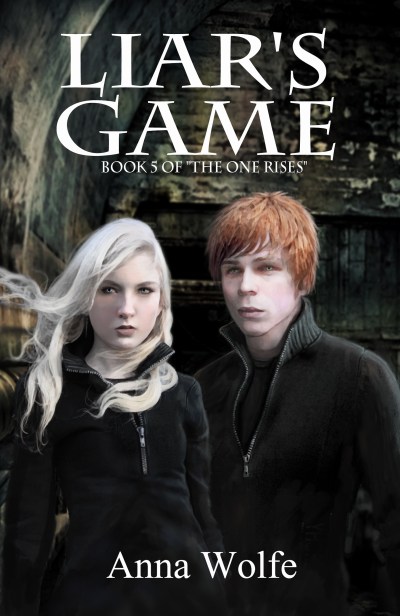
After reviewing books for four years (April), I have come to realize that great stories (regardless of category) come about through bloody hard work and zing. Any one of us can get to a point of writing good books. Only some of us manage zing. Anna Wolfe is one of them. I have had the privilege following Wolfe’s journey through The One Rises and have watched her mastery and self-confidence grow. By now you must realize that I am going to say that Liar’s Game is the best of the lot.
In her preface Wolfe makes certain no technical difficulties will arise in reading her story. She then gives a brief intro of the previous books. It is, as she states, possible to read Liar’s Game without having read the earlier four stories, but your enjoyment will be much higher if you have gotten to know the main characters Carrie, Silas, Mark, Edie and the Hatter ahead of time. In Liar’s Game we get to know more about Jiye, Mimi, Hyacinth and the Seer.
Up til now, the Seer has been shown as hated and implacable. Liar’s Game demonstrates that life is too complicated for such simplistic interpretations of the Seer:
“We care only about guiding our little globe down the right path. We care about the many, more than the one. And the two of you are necessary to preserve the best futures. But you must find the truth for yourselves or important possibilities become nothing more than frozen darkness.” They do not understand. How can they? They are both so young.
Finally, Dokuz asked a question he should have asked a hundred years ago. “How far can you See?”
At last. “Millenia.” And we won’t be able to help you surf the challenges that are coming. Not if you won’t let us help you.
Imagine what it must be like to see into the future for millennia and to know that quite a few of those paths lead to the annihilation of your species, humans. I know I would go crazy, and my guess is that the Seer most likely was insane during her early incarnations. At least until she became we. Wolfe does not explain the Seer’s we, but she has let us see how Carrie communicates with her memory sets. Once again, I am guessing and believe that the Seer chose at some time in the past to magically retain the memories of every incarnation. That would take courage, resilience and a whole lot of stubborn. Mark, Callie and Silas learn this side of her, and that changes them. How could it not?
Mark is frustrated. His demon-infection demands anger to sate its hunger, and Mark is a master at making people angry. Somehow, his ability recognizes what will hurt the most and tries to force words to bring hurt and anger out in all he meets. Being able to sense lies also aids his ability a great deal. Liar’s Game shows us how painful controlling his ability is.
The sensation in his mouth morphed into a ball of needles that was trying to escape his skull in every direction.
For some reason Callie can feed him without anger, but Callie is an extremely dangerous person to feed from. She has almost killed him once, and neither of them wishes to repeat that experience. So Mark starves rather than inflect unnecessary anger on people.
Silas winced and then a sick ball of dread opened up in his stomach. And now she dies. I’ll have to pass it off as a suicide, but after the events in San Fran, Edie and Mark will be at risk. They will both have to leave. And soon. Only Callie didn’t die. One moment turned into ten and still Callie stood there glaring at him. Shock rippled through him, and for a moment, he couldn’t hear anything. The room wavered under his feet, and he stumbled forward until he could sit on the end of the bed.
Why does Callie not die? Wolfe has hinted at the truth in the previous books. This should knock the final nail into your chest of understanding. No worries, though. All is revealed in Liar’s Game. Fair is fair, so Callie finds out about Silas. Gaining knowledge about each other tears down preconceptions and barriers and matures Silas and Callie for the Seer.
Anna Wolfe states that The One Rises series is intended for adults. Most likely that is because of the sex. It is certainly explicit but no more than the violence in many Young Adult stories. There is plenty of ACTION and some violence.
The Shadow Year begins and ends with Mr. Softee, the ice-cream man. At the beginning of the story our narrator, and main character, is “listening carefully for that mournful knell, each measured ding both a promise of ice cream and a pinprick of remorse.”
Our narrator describes a family learning to cope with a new financial reality. Their father lost his old job and was now working three jobs, while their mother worked one job, to pay the bills that still kept on coming in. Even though their father is not present in much of the book, Jeffrey Ford still manages to show a man who loves his family passionately and whose family loves him back. But because of his need to work so much, we also see children who view their father as a distant figure.
Their mother is clearly depressed and self-medicates with alcohol and The Complete Sherlock Holmes. She seems to be manic depressive, and we get to watch her come down from one of her manic episodes.
In those few seconds, I saw the recent burst of energy leaking out of her. As usual, it had lasted for little more than a week or so, and she’d used it all up. Like a punctured blow-up pool toy, she seemed to slowly deflate while shadows blossomed in her gaze.
Childhood is such a passionate time. If you have ever seen a three-year old express anger, joy, sadness or love, you know what a I mean. Everything is new and everything is normal. An adult might see a child’s circumstances as horrible, but that child knows of nothing else. As they grow and learn to compare, some of their passion is sloughed off.
There are three children in our main character’s family: Jim (seventh grade), narrator (sixth grade) and Mary (fourth grade/Room X). All three seem to be pretty smart with Mary as the probable winner. Her placement in a special class is due to the inability of her teachers to get an answer from her. All three are authority adverse. There is an hilarious episode regarding Jim’s personality/IQ test. All three get this self-confidence from their mother, who allows them quite a bit of leeway when it comes to school.
I found myself loving this family. Perhaps Mary in particular (although I probably identified most with the narrator). Mary is a child who follows her own paths. Her friends, Sally O’Malley and Sandy Graham, lived in a closet in her room and sometimes they go to school with Mary in the family basement where they are taught by their teacher, Mrs. Harkmar (all three make-believe). Mary also sports an alter-ego, Mickey. Her math abilities are pretty astounding and all learned while listening to Pop working out his horse races. Those abilities are used to identify the mystery behind the disappearance of Charlie Edison.
Poor little Charlie Edison. Lost in the battleground of Elementary (Primary) school. He is first on the list of who Bobby Harweed (bully and coward) beats up. Charlie is, sadly, also on the bully-list of some of the teachers. He does his best to stay invisible. Then one day he truly becomes invisible by disappearing for good. Our three siblings begin looking and use Botch Town as their aid.
Botch Town is Jim’s creation. It is a model of their neighborhood made from little bits and pieces Jim has picked up and glued together. Mary seems to have super-natural powers in predicting where people will be and what might happen. One of those predictions is regarding their neighborhood’s recent prowler.
Then we have the ghosts.
I loved Jeffrey Ford’s writing. Definitely recommended.
Dick van Dyke (hated by Pop, loved by the narrator): Shanty Town, I’ll Be Seeing You (comedy)
Jennifer Estep‘s Ashland, Tennessee, is like many corrupt cities/towns/countries. “Ashland might have a working police force and government, but the city was really run by one woman. Mab Monroe.” Monroe is your typical mobster. She has a respectable front powered by charity, fund-raising and activities appearing to give back to the community. Behind that façade, bribes and intimidation are favorite tools but she does not hesitate to stoop to kidnappings and murder if necessary. If you happen to be a law-abiding police officer, district attorney or judge, you are doomed one way or another.
In William Shakespeare’s Hamlet, Prince of Denmark, Prince Hamlet says to his mother Queen Gertrude:
“Nay, but to live
In the rank sweat of an enseamèd bed,
Stewed in corruption, honeying and making love
Over the nasty sty—”
Into such a bed of corruption, Estep places Spider (Gin Snow), assassin, main character and story-teller. Gin is known as Gin Blanco, part-time cook and waitress at the Pork Pit. She regularly takes classes at Ashland Community College – the eternal student. Pork Pit is owned by Fletcher (foster-father, ex-assassin and handler/go-between). Gin loves and trusts both Fletcher and Finnegan/Finn (foster-brother and bankier). As Spider’s Bite unfolds, we discover how Gin came to be in Fletcher’s household.
We first meet Spider in Ashland Asylum. She is there to kill one of the therapists. As an introduction, this assignment serves to introduce us to Gin, her profession, the types of inhabitants in Ashland and what kinds of magic exist. Ashland is a place of magic, vampires, giants, dwarves and humans. Gin is human and a stone- and ice-elemental. The other two main forms of magic are fire- and air-magic. Most elementals have the use of one magic. If they have two, one of them is normally a minor one. Ashland’s magic is not without its dangers, addiction being one of them. Insanity another. Fletcher and Finn are humans and without magic. Early on in the story, Gin takes on an assignment that has devastating effects on her relationship with Fletcher and Finn and has the potential of bringing her within reach of Mab.
Her assignment certainly brings her within reach of Detective Donovan Caine. Caine is one of the few honest public service-people in Ashland. Of course, he and Gin are bound to clash and end in the inevitable should/should not have sex situation. Fortunately, Estep chooses to portray Gin as the instigator and Caine as the doubting, shameful one. It would be strange if they had the usual roles in paranormal literature due to Caine being the upright police officer that he is. Happily, this romance bit did not take up too much of the story. Most of their interaction was through their investigation.
Finn, Gin’s foster-brother, is something worse than an assassin (as Gin puts it). He is a bankier and Gin’s go-to person in Spider’s Bite. It would be a safe bet to say that Finn and Gin are best friends. Their friendship is vital to the success of the investigation. When Caine becomes involved he and Finn go through the usual (is it like this all over the world?) who’s-the-manlier-man procedure. Thankfully, again, Estep does not force us to endure yet another threesome (god, I hate those). No mushy stuff and no threesome. What is the world coming to?
I had fun reading Spider’s Bite. There was plenty of action. Some violence and sex. Definitely recommended.
“Darling Annie!” He took her in his arms and kissed her. Annie wanted to should it from the rooftops. She had a sweetheart, and he was a toff to boot.
Poor little Annie Crook became involved with the wrong man. In Victorian times, whether they be in alternate or our history, the rabble risked much if they caught the attention of the upper class. Yet, sometimes, the rabble manages to surprise. Young Annie is one of the voices David Barnett introduces us to in Mechanical Girl.
At first, he thought the knocking was a gear slipping, or one of the spring wearing. He sat up in the chair, suddenly alert, and peered around. “Anybody else hear that?”
Arthur frowned. There it went again. He stood and walked to the port side. Probably a piece of driftwood or rubbish hauled over the side from one of the factory farms. He leaned over and looked at the black, oily water.
Lives of trawler-fishers are dangerous one. In the past, more so. Usually, lives are lost because of the ocean’s wiles, but for Arthur Smith the cause of death of was much more sinister. Left behind is 24-year-old Gideon Smith (our main protagonist). To him Sandsend seems like the end of the earth and he wants nothing more than to leave it behind and experience the adventures he reads about in World Marvels & Wonders.
To have his father’s death be the impetus for his investigation was not how Gideon thought his adventure would begin. Investigate he must, for there is something distinctly off about the disappearance of the crew of the Cold Drake. Anger can be a marvelous tool when we suspect something needs fixing. Anger at our gods, the fickleness of nature, people dying and leaving us behind and even at our own fears are all angers that can prompt action and change. Gideon is an angry man, and rightly so. Life in Victorian times (both alternate world and our) was unfair. It still is. Being wealthy makes life easier to navigate while poverty keeps people in their place. Annie was certainly kept in her place. Now Gideon has to find a way to leave his and investigate and explore.
Which is why he goes seeking Captain Trigger, that wonderful hero of the penny dreadfuls. Such a hero must see that Gideon’s cause is worth pursuing (taking Gideon with him). Getting hold of Captain Trigger proves difficult and Gideon must seek help. Who should turn up but Bram Stoker. Yes, that one. David Barnett throws conspiracies and magical names at us through the story. We just have to pay attention to where we are going.
Once Bram becomes involved, officials finally pay attention to Gideon’s worry about a smuggler’s cave. Stoker is just higher enough on the layers of society for him to be taken more seriously than Gideon. Let’s face it. That is the way the world works. I am taken more seriously than a homeless person. My husband is taken more seriously than I. Writing about inequality in a manner that is fun to read is something Barnett does well. Intended or unintended.
In the end, Gideon gets to meet Captain Trigger, a meeting that changes both men. Gideon also meets wonderful and strange Maria. As he and Maria get closer to an answer to both of their questions, stranger and stranger creatures turn up. Conspiracy indeed.
I had fun. Lots of fun reading Gideon Smith and the Mechanical Girl. Definitely recommended.
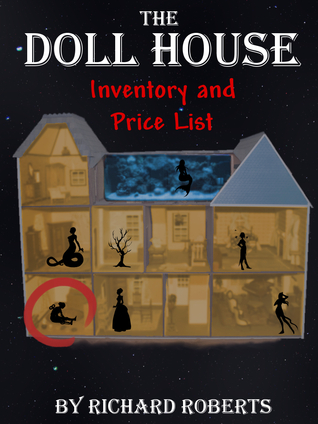
Ray has signed, in blood, a spell for knowledge. When he falls asleep, he finds himself dreaming of a house, The Dollhouse. Entering the Dollhouse is akin to playing with fire. Except Ray didn’t think anything would happen when he signed in blood a spell for seeking knowledge. Oh, dear, once again we learn that all actions have consequences.
Ray is fortunate in a couple of respects. He soon realizes that his dream is very real and sets out to understand what he is dealing with. Seven women with innocuous names but with personalities and abilities that ought to frighten a wise man.
Make no demands once you enter the Dollhouse, and try your best to not offend, and you may just make it out alive.
I had fun reading The Dollhouse: Inventory. Definitely recommended.
Ryke’s face was soot-stained, and his wrists were skinned raw where he had torn them twisting in his chains. His head ached.”
From this moment we are in the company of Ryke, a man who remains in a state of shock through the story. All of his friends, his leaders and his place in the world and loyalties have been torn from him. He thought he understood war, but he had never seen it from the side of the loser. War is much more brutal and bloody when you are not the winner. Why he has been kept alive when the rest of the Keep (excluding the women who were raped and kept on as chattel) was killed is a mystery to Ryke.
Then Col Istor (master of the invaders) shows him why. Errel, Prince of Tornor until the invaders took the keep, is still alive. Given a beating, but still alive. In return for keeping him that way, Ryke must pledge his service to Istor. Ryke gives the only pledge he feels capable of keeping. It is accepted.
“I’ll serve you,” he said, “with loyalty, as long as Errel’s left alone and unharmed.”
The Northern border is a land where the gap between male and female is immense. As is usual in such societies, women are meant for marriage, childbirth and possibly healing of the kind wise women did. Men, well, men. I am glad Elizabeth A Lynn wrote this book the way she did. Ryke’s prejudices are challenged. Lynn shows us that prejudices do not necessarily change even when confronted with evidence and anecdotes. This has been my experience as well, and I find it just as frustrating as Sorren and Norres expressed.
“The other was unimportant. It happened to all women. In war you could not even call it rape.”
Ryke is used to being in “middle management”. He likes leadership, but only to a certain extent. Beyond that, he prefers having another person tell him what to do and, to a certain extent, what to think. Errel (Prince to Ryke) is supposed to fill that spot, but Errel is not willing to play along. He challenges Ryke to think for himself and to make his own choices. Ryke hates that. At times I have wanted people to choose for me. Often I wonder if that is the way most of us want the world to be. If others choose for us, perhaps we have less responsibility? But I would not choose to have Ryke’s fear of choice. In the end, neither would he.
Definitely recommended.
P.S: I have not been able to find a link to Elizabeth A. Lynn anywhere.
P.P.S: “The art of the chearis, as it is described, resembles in some aspects the Japanese martial art aikido, created by Master Morihei Uyeshiba. This imitation is deliberate. Writers must write what they know. In gratitude for that knowledge, the author respectfully wishes to thank her teachers.” (Dedication page)
Keeping slaves is generally not something people openly admit today. Many countries continue this practice and my contention is that most states participate in this tradition while closing our minds and eyes to that fact. Traditionally, people have become slaves either through being conquered by another nation, power-hunger or through criminal acts.
Sometimes being conquered happens via false promises. Such is the case with the Serenian island in Anathema. Serenians were lured by promises of help from the Malborn. Once the Malborn were in force on the island, it took ten years for them to eradicate opposition. Criminals were those who would not obey the three “rules” Malborn leaders had set as a condition of harmony between the two people. “Trust, adore and obey” was what the Malborn required from the Serenians. Once you were deemed a criminal you would either be killed or enslaved along with your entire family. Add to that their military prowess, and the Malborn were bound to win.
Reychel remembers nothing but slavery. At fifteen slaves were branded with their master’s mark. This mark and their shaved heads clearly divided slaves from the rest of the population and it also make it extremely difficult for successful escapes to happen. Kandek, her master, is about to lose two of his slaves, one of whom is Reychel. The other is Ivy, Reychel’s best friend. First out is Ivy. Fortunately for Reychel, her turn comes soon after. Her escape was public and unusual.
When slavery is all a person has known all sorts of things about being a free person had to be learned. There was a whole network set up to help escaped slaves deal with their new status. Blending in was vital. Both of them also had to come to terms with Reychel having magic powers of some sort. Ivy already knew about hers. Her ability to calm others, even to the point of forcing them to do things, becomes an important element of the story. Learning Reychel’s ability is also essential. The reader knows this long before Reychel does.
Another discovery Reychel ends up making is the value of her friendship with Ivy. Why did Ivy want her rescued, and why is Ivy acting so strange now that they are out of slave quarters? Sometimes people have different opinions of what friendship is and what friends are for.
Usually, slaves weren’t worth enough for a master to mount a search for too long. That was the case with Ivy. Reychel, however, was the exception to the rule. Kandek will not give up. If not for the friendship of one of the militia both girls would have been caught within the first weeks. There is a love interest with Marc, the militia guard. Another discovery about Ivy is the result of that interest.
Ivy is a fun character. Reychel is in line with a young adult hero type. So is Marc. All three are important to the story and the action-filled adventure Megg Jensen gives us.
“Alia went still as she remembered exactly where she’d seen him before. It swept out from her childhood memories like canyon debris washed out by a flash flood …”
Memories have power. In Alia’s case these memories were triggered at a point in her life where a choice needed choosing. That choice brings her deeper into lore and traditions she loves. Following those traditions and that lore has the potential of making her more of an outsider than she is already.
While reading I wondered if McKinley was Navajo/Hopi himself. At the very least he must have researched the matter. Skinwalkers at one time worked for the benefit of the people but are now considered evil. Alia also believes they are evil until she discovers that everything depends on what side you are on.
Brian Patrick McKinley clearly has a talent for writing and has added to the joys of my reading obsession.
Merriam-Webster defines mojo as: “a power that may seem magical and that allows someone to be very effective, successful, etc.” Bad Mojo is certainly something Marcus suffers from during the three days that we walk with him.
“The cards were screaming at him to hop a plane to anywhere else … Right now they told him to change his fucking direction and fast.”
But Marcus’ father is dying. If not for that, he would have stayed away from his dysfunctional family another ten years. His mom and dad are conservative Christians, his cousin is a blood-bag to a vampire and his sister (who begged him to come home) keeps away from Marcus. He is thought, by his family, to be dirty and evil because he practices magic.
Marcus’ relatives aren’t the only dysfunctional people we meet. Old friends try to mess with him, and some of their requests are pretty unfriendly. All, in all, the tarot cards seem to have been correct, this time, in their predictions.
Scott McCoskey has written about a mess of a person and done it in a manner that I enjoyed. This is a self-published book and there were flaws, but McCoskey’s style makes up for that. Bad Mojo Blues is a fun crime-filled novella set in an unnamed small town in South-West New Mexico.
Pellini exhaled. “Since my senior year in high school.”
“What happened then? Did someone start teaching you?”
He cleared his throat. “Never talked to anyone about this stuff before,” he confessed, then added, “I mean, no people.”
Idris and I both tensed. “What non-people have you talked to about this?” I asked, doing my best to remain outwardly composed.
Pellini licked his lips before speaking. “Shit. I had an imaginary friend when I was little.” A flush darkened his face. “I called him …” He hesitated then took a deep breath and plunged on. “I called him Mr. Sparkly because that’s what he looked like. For as long as I can remember, until I was in second grade, he’d find me when I was in the sandpit in my backyard and take med away.”
“Wait. Away?” I asked. “Where to?” Maybe Mr. Sparkly was just an ordinary creeper?
He chewed his lower lip. “The place I saw him wasn’t like Earth,” he said. “It was like that.” To my shock he gestured toward the nexus. “Energy and colors and light.”
“Hey,” I said, not to greet her but to get her attention. “Hey.”
Her eyes rolled to meet mine.
She opened her mouth but did not yet speak. Instead it seemed
every sound in the forest was pulled inside her gasping lungs and I was standing in the vacuum. I knew my friends were only yards away but I did not hear their small, fast feet shuffling through the undergrowth. No birds sang and no squirrels knocked winter nuts down into empty trees. Even the shadows stopped crawling across the rocks as the sky held the clouds above in place.
My breath snagged in my throat and refused to leave my chest.
Tears came to the woman’s eyes and dripped to the forest floor
unchecked. Her head swiveled slowly, looking past her left shoulder and then her right. Her choked, thin voice cried out to the others. Willa, Luanna—she’s over here.
Two other women appeared, one on either side of her. They had
the same vaguely African features as the first, with hair bound into submission by scarves tied in loose knots. Their faces might have been round once, but their skin was drawn back and their wide cheekbones made shelves that shadowed their hollow jaws. Their teeth were exaggerated by fleshy lips robbed of their firmness, and when they spoke to one another it was a terrible sight. There she is, his darling one. His pretty one. Oh, Mae, she’s returned to you. She’s returned to us.
Mae crouched low to examine me with her enormous, brimming
eyes. My baby, she said, reaching one scrawny arm to my face. Mybaby. Miabella.
Who wants to live forever? Not I. Some people do and this greed is explored in the story about Eden Moore, her convoluted family tree and ghostly followers.
In Four and Twenty Blackbirds the John Gray death-cult uses a dark combination of Songhaien Sorko lore and Seminole lore to bring their founder back to life. Somehow John Gray is tied to young Eden, who we meet for the first time when she is five.
Five years old, Eden hears her three ghostly followers speak for the first time with the words in the quote above. As a child, I had no concept of dead or alive, and I imagine my reaction would have been much as Eden’s was. She was used to these women. They were different to other women, but, you know, people! As she grew older, she realized that others considered Eden a bit of an oddity. Apparently, at least until her first time at camp, no other person she met saw what she now understood were ghosts.
Cherie Priest is not afraid to tackle serious issues. One of the most serious issues in Southern USA is racism. As a child, I was bullied a lot. So, to some extent, I can imagine what it must have been like for Eden to be bullied for something she had no control over. Some of her class-mates and her pale faced relatives were horrible and on one occasion a co-student made it really simple for Eden to break the rules.
“You guys who aren’t all white and aren’t all black. You’re not anything except the worst mix of a bad lot, and it don’t surprise my dad at all that a family like yours would have something crazy like this going on.”
Auntie Lulu, Eden’s adopted mother and aunt, keeps the truth of Eden’s ancestry from her in an attempt to shield her. Being the last to know does not make for a happy Eden. But Eden must wait until she is old enough to search for the truth on her own.
Works well as a stand-alone, but is part of a series. Definitely recommended. I had trouble putting it down.
Rosemary Edghill does her usual cracking job writing The Warslayer.
“A terrible power has been unleashed in the land of Erchanen. Long was it prisoned upon the peaks of Grey Arlinn, until foul mischance freed it once more. Now it stalks the plains of Serenthodial, and Great Drathil is no more than an abode of shadows. We are a simple gentle people, without the arts of war, and we knew that only the greatest warrior who ever lived could help our people in their hour of greatest need. You are she.”
Quite understandably, Gloria (Glory) McArdle is a bit skeptical to being approached by three apparently insane (like all conventioneers) fans who are taking fandom to the extreme. What she gets instead is a new world.
It isn’t often a stuffed elephant gets to have a major supporting role, but Gorden, the elephant, does. Glory depends on him for comfort in all the strangeness and he is also in an essential place when one of the Allimir needs him. Or at least Vixen thinks that when she and Belegir are seeking the will of the Oracle. Comfort objects are important tools in emergencies and daily life. I think it is safe to say that Vixen’s new life is traumatic.
Vixen also brings her highly impractical costume including a real and blunt sword. It was thought that, for the sake of realism, the role as Vixen required learning to fight with a real weapon. Well, kind of fight. She discovers that her choreographed moves are of little use and improvisation is a must. In fact, having been an Olympic gymnast is far more important to Glory’s survival.
“The terrace directly below was still clear. It was an eight-foot drop. Glory turned away from the stairs and jumped.
They hated having her do her own stunts on TITAoVtS, because if she got hurt, production stopped dead, but in fact she was damned good at it, and the stuntpeople had taught her a few helpful tricks. She held the sword well out from her body and threw herself into a forward somersault, landing on her feet, crouching to absorb the impact – just like the vaulting horse, that – and backing up quickly against the wall. …”
Getting back to Earth after her arrival on Erchane requires the help of the Oracle. Belegir, the head wizard, goes with her as a guide. When they get there, Glory discovers that the Alimir aren’t as peaceful as they had told her. The walls of the temple are full of paintings of Allimirs’ killing.
“You-told-me-you-didn’t-do-things-like-that-” she growled in a low husky feline rumble, leaning over until she was staring right into his eyes. “You said you didn’t know how!”
Well, once upon a time, the Allimir had been a murdering horde killing everything in their way. Kind of like humans. Then, somehow, the old hero, Cinnas, banished War from Erchanen. But that enchantment only lasted one thousand years. And this magic was what the Allimir wanted Vixen to repeat. Like many of us they wanted another to deal with the consequences of their actions. I guess that fits with how my generation seems to feel about the future of the Earth. NOT our problem! Please solve and fix our mistakes and intentional shit. Because that is how we humans are, isn’t it? But Gloria is fully aware of her limitations.
“Well, cheer up. You’ve got me, now. When She sees that, She oughtta wet herself laughing. C’mon.”
The style of story, sword and sorcerery, kind of gives the ending away. As with most adventure stories the odds seem impossibly stacked against Vixen.
The Warslayer is an odd, yet profoundly pleasing, adventure tale with lots of action, humour and food for thought. Definitely recommended.
Reading to my daughter continues to be a pleasure. Our journey through the land of fantasy brought us into the world of Anne Bishop and the trilogy The World of the Fae.
The Pillars of the World is the first book of the series. It works well as a stand-alone novel. Bishop takes us in to a world where one man’s fears changed two countries into places where the gap between the powerful and the powerless becomes unbridgeable. Now the turn has come to Sylvalan.
Misogyny is said to be the hatred and dislike of girls or women. Personally, I believe it is more about fear of the perceived power or potential power of women and girls. Add to that a hunger for an increase in one’s own power and a religion or belief-system is born. Adolfo, the Master Inquisitor, the Witch’s Hammer, carries his misogynism and power hunger to extremes.
She’d never heard of the Evil One until Master Adolfo came to stay with Baron Hirstun. But she knew with absolute certainty that there was such a creature, that the Evil One did, indeed, walk the earth.
And its name was Master Inquisitor Adolfo, the Witch’s Hammer.
He was the very breath of Evil with his quietly spoken words and the gentle sadness in his eyes. Those things were the mask that hid a rotted spirit.
Oh, yes, treat the witch gently so that she may repent. Don’t look upon her limbs so that you won’t be swayed by lust.
The soul-rotted bastard just didn’t want those men to see the welts, the cuts, the burns he had inflicted on her to “help” her confess. The hobbles provided a clever excuse for why she couldn’t walk well. And he certainly hadn’t hesitated to indulge his lust. His rod was as much a tool as the heated poker and the thumbscrews.
While many witches in Sylvalan certainly have enough power to defend themselves, they also have a creed that states “do no harm”. Sometimes such beliefs are also taken to extremes. Not even saving themselves or their loved ones will bring the witches to use their magic to harm another person. Many of them end up being murdered after severe torture and forced confessions to crimes never committed. All for the sake of one man’s insatiable hunger and fear and other men’s envy.
Adolfo’s and his inquisitors’ distrust and dislike of the witches spreads to the rest of the population. We all know what happens when people flock together like sheep following the voice they want to hear rather than that little voice inside their own heads screaming STOP! The few who do try to stop what is happening end up being accused of the crime of “consorting with the Evil one” and killed.
All because of one man’s fears.
Not only the inquisitors regard witches as a lower species. The Fae in eastern Sylvalan consider themselves supreme beings of the earth. To take one’s pleasures with one of the non-fae is considered a right, but if a male fae should happen to breed a child upon one of the lesser species children are not taken care of. Female fae place the baby on the door-step of the father not wishing to sully Tir Alainn with mixed breeds. Tir Alainn is the home of the Fae, the place they venture out from when they want to play with those of lesser worth.
Definitely recommended both as a read-alone and read-together book.










 humanitysdarkerside