Some authors write horror too well for my own good. In the case of Mr. Black, this happened before the end of chapter 6. I could not go on. Not since beginning to read Apartment 16 by Adam Nevill have I been this frightened. The time before that was when I was 15 and tried to read Dracula. So, no very often.
It wasn’t the demon dogs who did it for me. They were just gross and gross can be fun, or at least interesting. But good old Elder God, Nyarlathotep, did me in.
Too bad, really, as Mr. Black’s writing was excellent. But, alas, so is my imagination.
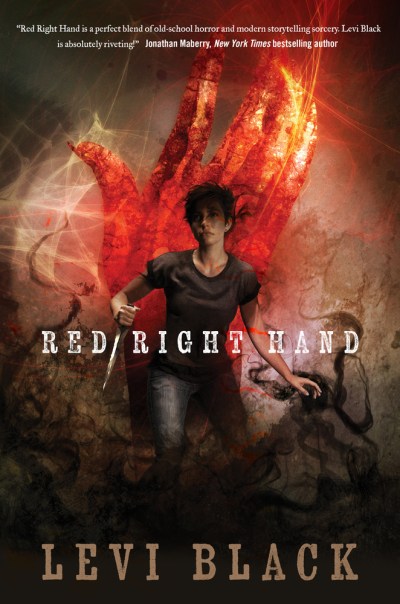
The Red Right Hand was given to me to review by Tor Books
The Vision Quest is the first short-story exploring the lives of Daniel “Two Horses” Thorne-Redstone and his friend. We are only introduced to Two Horses in The Vision Quest.
After Daniel had been on his own vision quest, his name became Two Horses and he was now considered a Penateka warrior. While visiting his grandmother, Two Horses shared his experiences of his vision quest. Two Horses’ vision quest is fraught with danger and mystery.
I cannot speak to the story’s authenticity with regards to the Penateka vision quests. The information I found pointed towards it being fairly OK. Nor am I certain of the story’s intended audience.
With those provisos, I found The Vision Quest a warm story about a young man’s coming-of-age ritual and his understanding of that ritual.
Hi, I’m Nathan and I make up stories. There’s a word for that. Delusional. And sexy.
Helix: Episode 1is part of the world of The Fifth Column. What I like most, aside from how well the text flows, is its realism. No mental leaps are required of me to believe in the likelihood of the methods used to acquire soldier material, how these people are tested, what training they receive and their use. The military and population application of all of the genetic manipulation described, especially unquestioning loyalty, is frightening.
Some of the brainwashing techniques described in the Sophia serial is brainwashing we all go through. Propaganda is poured at us from every available medium from the time we are born. Our ethics and moral values are all part of this propaganda. Soldiers who are sent to kill, especially the ones who end up in some form of black ops, must endure even more. What military and intelligence leaders want are people who obey and find a way to achieve whatever their leaders command them to do as efficiently as possible. Unlike religious cults, though, the military cannot have unquestioning loyalty in such men and women. At least not in officers.
The Fifth Column is not an officially sanctioned group. They aren’t interested in their doings getting out to the public. So their brainwashing needs to be more thorough.
One of their tools for finding relevant children is the Human Genome Project. Based on certain genetic markers, children from around the world get tested by Project GATE. Olesya, our main character, is one such child. Except she does not seem to have the desired genetic marker. However, she does make it into the program.
“For a while, he was silent. It was the longest she’d seen him not talk. Above the, fireworks crackled, then trickled down the velvet sky. Olesya tried to imagine what this scholarship on the other side of the world would be like without her big brother.
The snow squeaked under Zakhar’s jacket. He rubbed his face with a gloved hand and she realized he’d been crying. The fireworks had faded now, golden glitter in the night.”
Project GATE aims to make the perfect killers. By combining extensive testing, combat and assassin training, brainwashing techniques and an engineered virus, Project GATE gets unquestioning, loyal and adjustable soldiers.
After one of their tests, Olesya, together with other team-members, is broken out of Project GATE by the Sixth Column and de-programmed. The Chimera Vector took us through that process and it was not fun for either the programee or the de-programmer. Getting de-programmed is only the beginning of Olesya’s life with a mind of her own. Now the Sixth Column wants her to be their soldier. She, and the others from her old team, fight to free other Fifth Column members and to find their own people who seem to be disappearing. Theirs is a race against time and a superior power.
It turns out the Sixth Column is not only fighting against the Fifth Column but also against an organization whose members wear white armbands. All of these conspiracies give us much action, well-written action. With his background, Farrugia has the tools for being able to make the fighting realistic. Realism by itself, would not work well for some of the car-chases, so we get a bit of Bondism as well. We reacquaint ourselves briefly with Sophia and it is interesting to see what that tells us about the Sixth Column.
Helix was fun, had great flow and interesting people who kept me entertained. Definitely recommended.
Back in the olden-not-so-golden-days I used to know a bit of Latin. I would translate swear-words into Latin and use them on people who were particularly annoying. At home, our mouths would be washed with soap if we were caught swearing or one of us told on the other. All four of us were awful tattletales, especially if revenge was the goal. Some of these usages of “ass” were new to me.
IN WHICH WE GET TO THE BOTTOM OF SOME CRAZY-ASS LANGUAGE
This is one crazy-ass ass. | via Flickr
Let’s face it, there is no depth to which linguists will not sink in their hunt for the oddities of language. And that includes getting to the bottom of some of the weirdly versatile uses of strong, coarse, foul, no good, very bad language.Now you may think that strong language is useful only when practicing to be a longshoreman in the comfort of your own home (or so I assume), but no. As it turns out not only is strong language a powerful invective that you may not wish to use in front of a policeman, in casual speech it’s often used in innovative and productive ways that have changed colloquial American English grammar—rather unexpectedly.
We saw, for instance, how abso-bloody-lutely fan-freaking-tastic it could be to add a swear word infix to a humble polysyllabic like “Minne-fucking-sota,” in a process called “expletive infixation.” But while expletive infixation may be used for emphasis in casual speech, its usage is still fairly marked. It hasn’t made as insidious an infiltration into mainstream language as one other surprisingly popular curse word:ass. If you’re unconvinced about the grammatical versatility of “ass,” worry not, the linguists are on it!
Once, we were all happy enough using rather dull words like “very” and “really” as intensifiers, as in “a very big car” or “a really crazy idea.” They’ve often become so (another intensifier) overused and diluted in effect that many complain bitterly about their use at all. In casual speech, using “-ass” as an intensifier suffix attached to an adjective, we might express the same ideas as the more colorful “a big-ass car” and “a crazy-ass idea.” Obviously, we’re not talking about actual posteriors being big or crazy, so the curse word has developed into a kind of functional linguistic morpheme, carrying a more effective and emphatic weight. Although this is still a marked form that you mostly find in colloquial contexts, it’s getting increasingly common for the “-ass” intensifier to make appearances in mainstream media, as the linguistic register of record becomes ever more casual, perhaps in an effort to become more approachable.
You would never think that the word “ass” could give us so much in the way of grammatical delights…….
The Bastard Cadre, episodes 1-14 is the first book of this ongoing serial written by Lee Carlon. I am not used to continually changing stories, but find the concept fascinating. Carlon describes the way he works:
… one thing to note about this serialization is that unlike traditional serializations where the author is bound to the words that have been committed to the page, publishing online allows me to treat The Bastard Cadre as a continuous work in progress. Each episode is complete at the time of publication, but I do update the text from time to time. (peakcity)
Change can be daunting when you are an aspie. Part of that has to do with the accompanying anxiety. I have to go through mental gymnastics to keep anxiety’s influence on my opinion as limited as possible while reviewing The Bastard Cadre.
Newterra is on a world with two suns. Its geography is loosely based on Australia’s. Some of the inhabitants on Newterra might be descended from Earth humans. Others, not so much. Dragons, dualists, descendants and gods are in the last category, although, I’m arguing with myself about the gods. Newterra’s gods are not very old, they fight each other, hold separate territories and 20 years ago they Cleansed the world with a type of fire. The Cleansing took biological lives but not electrical ones. There are still plenty of AIs around. Vehicles can be picked up in almost any city and cleaning bots are still doing their jobs in the larger cities. We enter the world 20 years after the Cleansing and meet a world that has lost numbers and a great deal of understanding of technology.
Our main characters, Avril Ethanson, Ethan Godkind and Ranora fi’Intar, all seem to be human. Avril and Ranora are both young and have unusual abilities. Avril can affect electrical impulses. Ranora can read people and cards. Ethan is Avril’s foster-father and has held that role since soon after Avril was born. These three characters give us insight into how Newterra works and what its people are like. Clues to their importance and backgrounds are doled out during the telling of this story. This way of learning about places and people in a story is my preferred one.
Avril and Ethan are scavengers who salvage old tech and barter it for essentials. When we meet them, the past is about to catch up with Ethan. Life has a tendency to mess up our plans and put our procrastinations to shame. There was so much Ethan had planned on telling Avril to prepare him for what might happen. When they meet Beads, the finder, it is almost too late and Avril is in for some gigantic surprises that involve his heritage and potential future.
We learn little about Ranora’s background. She is a talented painter who brings the past to life. Bringing the past to life in her art is probably connected to her ability to read people and objects to uncover “secrets”. Ranora seems to be on her own when we meet her. Being alone in Newterra tends to shorten your life-expectancy. When a bounty-hunter gang shows up, Ranora uses her ability to claim a spot in it. We all make choices in our lives. Some mess life up for us while others bring unexpected gifts our way. Joining the gang was a choice that brought both mess and gift to Ranora, such as bringing her into contact with both Ethan and Avril.
The Bastard Cadre’s intended audience is young adult and older. From the get go we get an action-filled story about fate, betrayal, family and different ways of handling the world. The Bastard Cadre was given to me to review. Recommended.
Wild Magic is the first book in The Immortals four book series. It can be read alone or with the other three. The setting is in Tortall. In the world of Tortall and its neighboring countries, magic is called the Gift.
Daine is our main character. She is 13-years-old and an orphan. Daine has an unusual ability to communicate with animals. In spite of this, her gift does not show the hallmarks of the Gift. It turns out that her magic is a more dangerous, unpredictable and unusual magic, Wild Magic. In fact, Daine seems to be brimming with it.
Daine’s father is unknown (unknown to her). Before her mother managed to get around to telling Daine who he was, bandits killed her and Daine’s grandda and tried to burn down the homestead. At the time, Daine and Cloud (her pony) were away helping a breech-birth lambing.
“Coming out of their place, I couldn’t see anything anywhere but fog, couldn’t smell, couldn’t hear. I was clear to our village before I knew.
“They hit around dawn. The mill was burned, the miller dead. They took the wheelwright’s oldest girl and the headman’s wife. Really, they mighta passed my house by, Ma having the Gift, but they remembered she was pretty too, see.
“They fought—all of them. Ma, Grandda, dogs, ponies, horses—even the stupid chickens. Even Ma’s geese. Not the rabbits. They left. Well, they never fight, and you can’t ask them to go against their nature. But the rest fought. They killed some of the bandits.
“The bandits went crazy. They killed everything on the farm and didn’t carry any of it away, Mammoth told me. Mammoth was my boss dog. He said they was too cared of animals who fought like that.
“Mammoth told me what happened, and died.
“So we buried them, me and Cloud, every last one of our family. Cloud’s dam and sire, her brothers are in those graves.
“I straightened up the house, what was left. The raiders had tried to burn it, but only the upper story and the roof were gone. Ma had a bunch of charms against fire in the kitchen, so most of the downstairs was saved.
“It was two days before anyone came to see. After Ma helped them birth their children, nursed when they was sick. Two days! She could’ve been alive and hurt all that time! If the bandits had passed us by, Ma would have been at the village with medicines and bandages, making me and Grandda help.
Daine brought what she could from her home and left. Onua is the first person we know about who encounters Daine’s unusual ability to converse with animals. It turns out Daine is also unusually good with the bow and arrow. Way better than natural ability would make her. But Daine does not acknowledge that her abilities have anything to do with magic. That would mean confronting an episode we do not find out about until we are well into the story.
The second person Daine meets after Onua, is Numair, shape-shifter and magician. He is the one who spots the degree of her magic and identifies it. Numair is also the person who helps Daine understand that she must learn to control her magic. Otherwise Daine might end up unintentionally killing herself or others. So Daine battens down and does her best to stuff information into her head while at the same time ending up as Onua’s assistant. Turns out Onua is head hostler of the horses that the Riders use. Riders are semi-cavalry who go out in small groups to route out bandits and try to keep Tortall out of trouble.
Strange creatures attack Tortallians. Immortals seem to have escaped the God’s dimension that magicians had imprisoned them in 400 years previously. They are back and making sure people know it. Some of the Immortals are cruel beings, some are indifferent and some are helpful. Like people everywhere, I suppose.
Daine and her friends are attacked by the scarier versions of the Immortals. These creatures are difficult, but not impossible, to kill. Daine faces many difficult choices during Wild Magic. Some of them involve placing others in danger and understanding the meaning of free will. Other choices involve killing other intelligent creature. Not a simple matter for a 13-year old girl.
Daine also has to face pirates and the royalty of Tortall. For those who have read The Lioness series, you know that they can be a bit unusual. For Daine, who has grown up in a hierarchical and patriarchal society, Tortall royalty comes as a shock. But face them, she must. We meet characters from The Lioness series (another great children/young adult series that Pierce has written. The Immortals falls into the same age category.
“A weird wave of electricity surged through my fingers where they touched him. I snatched my hand back, staring at the digits. The charged feeling dissipated within me, but increased in the air around us, swirling and darkening. I tentatively touched his arm again, and the energy shot into me once more. It was like focused euphoria.”
A newly married couple were looking for a home in the country and after finding one that was suitable returned home. The young wife after reaching home happened to thing that she had not noticed a water closet in the place and decided to write the owner about it. Being very modest she hesitated to spell out the words “water closet” in her letter so referred to it as W.C. The owner did not readily understand what she meant and after pondering a while decided she meant Westerly Church and answered:
Dear Madam,
I regret very much the delay in answering your letter and take great pleasure in informing you that the WC is located 9 miles from the house and is capable of seating 1450 people.
This is very fortunate especially if you are in the habit of going regularly.
But it will interest you that many people bring their lunch
and make a day of it while others who cannot spare the time go via auto and arrive just in time but generally are in too big a hurry to wait, that is if the place is crowded.
The last time my wife and I went was six years ago and we had to stand all the time. You may also be interested to know that it was planned to hold a bazaar to provide plush seats for the W.C. as they have for a long time been wanted. I might state that it pains us very much to be unable to go quite frequently. It is surely through no lack of desire but as we grow older it seems more of an effort particularly in the cold.
The Awakening should appeal to people who are into interesting magic systems and worlds. Ren Crown’s world is the one we inhabit (Layer one). A suppression spell has been cast on our layer keeping people from remembering anything to do with real magic. At some point the Magic community had decided to split the mundane world from anything to do with magic. Unauthorized magic is immediately discovered and investigated.
The Awakening begins with a death. Florence (Ren) Cross and her brother Christian are breaking into the garage of the girl Christian is asking for a school dance. Just weeks are left of the school-year. Christian had been acting peculiarly a few weeks. This evening he keeps on rubbing his wrists. Even Ren had been feeling an itch under her skin and feels an urge to create her own paint.
Outside, the weather is acting strangely. As soon as the two leave the garage lightning begins a thunder-less dance. Christian is having cramps and sparks fall off his fingertips.
“A weird wave of electricity surged through my fingers where they touched him. I snatched my hand back, staring at the digits. The charged feeling dissipated within me, but increased in the air around us, swirling and darkening. I tentatively touched his arm again, and the energy shot into me once more. It was like focused euphoria.”
In the magic community Christian and Ren are what the call “ferals”. Ferals are children with innate magic who grow up outside of the influence of the magic world. While they are supposed to be protected by magic laws, having unregistered magic-users available is a dream come true for scruple-less magic users. Christian’s awakening works on them as bees to pollen. These magic-users have the tools to drain all magic from a person, killing them. And so Christian dies and we meet grief.
At this point, Ren is still not aware of her own magic. Her awakening happens a little later, in her classroom under the eyes of their new art-teacher, Mr. Verisetti. What was supposed to be a dangerous yet happy event, is instead one of anger, tears and fear.
Zoelle writes about Ren’s grief in a manner that I think could help those who, themselves, are grieving or affected by the choices of others who are grieving. A consequence of a loved one dying may, sometimes, be that we, intentionally or unintentionally, make stupid and/or dangerous choices. Ren does and is not exempt from their consequences. Nor are her surroundings. Zoelle does not preach or judge. She just shows.
Not everything in the story is about Ren and her sorrow. There are strifes in the magic community that she and we find out about as we go. The magic school has students from all over the wizard community. Without preconceptions about this new world she is entering, not knowing who belongs to which family, the class system (highly stratified community) or what is possible, Ren finds herself stepping across divides that were thought unbreachable.
Without Christian about, Ren discovers that people want to be her friend. She is highly suspicious of some motives, but accepts any person with the same level of nerd/geek as herself.
Until she accomplishes her goal, Ren’s greatest fear is that others discover she is feral. Once her goal is over and done with, Ren wants to get the hell out of an incredibly dangerous place. Who knows. Maybe she will.
Samantha (Sam) Sweet‘s dream is to open her own pastry shop. In the meantime, she has to work for the USDA cleaning out abandoned properties where the owners have defaulted their loans. Both mysteries in Sweet Masterpiece have to do with her USDA job.
Cake-baking weaves in and out of sleuthing. Sam is no exception from the rule of amateur sleuths. Amateur sleuths always solve the mystery. Either they announce their success or they lead the police by the hand until the police cannot but figure out the answer. Sweet Masterpiece is of the second category. Shelton has added in a little romance. Her beau is Deputy Beau Cardwell, the detective in charge of both sites.
Violence, swearing and sexual content are practically non-existent. You would have to work hard to be offended by any of it.
In Taos, New Mexico, Bertha Martinez dies after Sam has broken into her home. But not until Bertha manages to convince Sam to keep a worn wooden box safe, claiming that Sam is its new secret-keeper. Turns out, this box has strange powers to share. Powers that at first freak Sam out. Witchy stuff is suspected.
House number two does not have anything paranormal about it. A man’s body is discovered buried on the property. Turns out the body belongs to an artist who had disappeared from the art-world some years ago. Mystery number two is, of course, the one that Sam helps the police solve. Along the way, she is lectured by her deputy that forcing your evidence to fit your theory is a bad idea.
Sweet Masterpiece is a mystery of the light-hearted kind. I had fun reading it.
Once again we enter the world of master-sleuth and journalist Jack Emery. Believe it or not, there are people out there who are against world peace. In and of itself that is not a problem. However, when that person has a powerful organization backing them up, the world is in danger. A prime real-life example is Dick Cheney and his connections with the weapons’ industry. Power-hunger seeps into the pores of FEMA (Federal Emergency Management Agency) Administrator, Richard Hall, and his fanaticism drives USA towards another chasm.
The world needs people like Jack Emery, who, with the right motivation and co-conspirators, does not give up until a truth is found. And, that my friend, is something State of Emergency gives him.
The story starts off with Iranian computer scientist student, Dhaneshgahi, being kidnapped off MIT grounds. Already, we know that the target is in a heap of trouble, that the crime involves cracking and that the target is difficult.
The entire population of the US definitely qualifies as a difficult target, with the main perpetrator acting as “a friend in need”. Through his naughtiness, Richard Hall will, finally, experience the kind of USA he has longed to see. One that is much more controlled. A dusin apparent terrorist attacks have been pulled off. The National Security Council has no idea who is behind the attacks. Nor do they know how to defend against them. How do you defend against an enemy who has no name or known agenda? Richard Hall, through FEMA, suggests to the President that FEMA could use State Guards to protect vulnerable targets and ramp up general FEMA support. She tells him to make it happen. Finally, Hall has his foot inside the tower of power.
Richard Hall does well as a serial killer. He is driven by an inner mania to get his philosophy into life, cost what it may. According to him, the ends do justify the means. Cue crazy person laugh. Except in Richard Hall’s mind he is the only logical person around. And that may be correct. Where logic leads you depends on your starting point. His starting point is that control and punishment are the only tools through which the United States might return to greatness.
The system controlling the capacity and flow at the Hoover Dam is broken into, and “unprecedented flooding” follows. Jack Emery becomes curious. Curiosity in a journalist can be a dangerous thing if that journalist has freedom and connections to dig below surface facts. Saving the US in Foundation made Jack connections that got him into unusual places. Like the Hoover Dam after the break-in. The terrorists had not been able to cut the hard-wired security camera feeds. Jack and his buddy Joseph got to see the entire break-in and wondered about the team’s easy entry. From small mistakes the powerful may fall. And fall they do, all in usual Jack Emery style.
Break-ins, break-outs, invasions, battles, shortages, concentration camps, death on both sides, rebels, underground radios, explosions, moments of high tension and romantic entanglements all come together to form a fun and addictiveState of Emergency. Definitely recommended.
I had read one other story in the Amelia Peabody series before I read The Ape Who Guards the Balance (The Ape). The Ape occurs before my previous read. As each story solves its mystery, that was not a problem. Nor did I have difficulty jumping into the overarching story of the Emerson family.
Elizabeth Peters writes about the adventures of the Emerson family and their friends, servants and enemies. The family consists of Amelia Peabody Emerson (matriarch) and Radcliffe Emerson (patriarch). Both Amelia and Radcliffe have been with the series from the beginning. Walter (Ramses) is their son and Nefret their ward. In The Ape we also have Lia, the daughter of Radcliffe’s brother and sister-in-law and their ward, David. All six travel to Egypt for the 1906-07 excavation season.
Their adventures begin before leaving England. A mysterious man appears at a suffragette picket that Amalie and Ramses attend. This man later turns up in connection with a break-in and hauls away a large collection of Egyptian antiques. Shortly after, the stranger also seems to be involved in a kidnapping attempt of Amalie. The entire family suspects an old “enemy”, Sethos.
Once they arrive in Egypt, Ramses and David go on an adventure including a stolen papyrus, mysterious strangers and a blackmailing Nefret. The Professor is livid when he finds out what the threesome has done. But he is also intrigued. Then a mysterious bearded man turns up in Egypt as well, and it is not Sethos.
The Emerson family is egalitarian for the time it is written for (and for many families and places today). Nefret has just finished her clinical practice and Peters show us what a feat that was for a woman:
“Acquiring that training had been a struggle in itself. Over the violent objections of its (male) medical faculty, the University of London had, finally, opened its degrees to women, but the major universities continued to deny them, and the difficulty of obtaining clinical practice was almost as great as it had been a century earlier. Nefret had managed it, though, with the help of the dedicated ladies who had founded a woman’s medical college in London and forced some of the hospitals to admit women students to the wards and dissecting rooms.”
Lately, I have begun wondering whether I read male and female leads differently. Many of the comments on The Ape seem to be consistent with comments on strong women both in fiction and real life. A woman as strong as Amelia Peabody will be dissed for being strong but not perfect. In The Ape she certainly shows that she is far from perfect. Her own bias surprised her when David and Lia announced their engagement. She and Emerson are peas of a pod when it comes to stubbornness and a sense that their opinion is the only correct one, even if that opinion changes later on. Both see the other as emotional, adorable and hot. The words used to describe these qualities are different for each of them, further cementing both the standards of the time and the continued power language has today. We do get a taste of what it would be like if language was equal for both men and women in this thought from Amelia:
“… it was time for me to take charge of the discussion, which had degenerated into a series of emotional exchanges. This is often the case when men carry on a conversation.”
Gender is far from the only topic discussed in The Ape. Racism and classicism are very much present in the Victorian English who come to Egypt to loot the graves of ancient rulers and take their loot back to England. Peters points out the difference in the handling of this loot. Sometimes graves were completely vandalized by so-called archaeologists. Others, at least, tried to maintain both loot and their chambers as intact as possible. The Emersons’ are of the last category.
Issues and mystery are both weaved together in an enchanting story in the Agathaian (Agatha Christie) style. I definitely recommend The Ape Who Guards the Balance.
Once again Alan Scott serves us a plateful of humour with a dash of serious. OMG, that talk-show. “Women Who Bitch With Other Women” remind me of some very popular talk-shows that definitely do not have ASD’s in mind. “Next season’s must-have fashion accessory!” indeed.
Once again, the idiotic government wants to kill their once-upon-a-time tool. This is one of the worst thing about governments around the world. For heavens sake, let SCoT-1 get his well-deserved revenge instead of wasting unnecessary lives trying to stop an unstoppable person – especially with Terminal Flatulence on his side.
After reviewing books for four years (April), I have come to realize that great stories (regardless of category) come about through bloody hard work and zing. Any one of us can get to a point of writing good books. Only some of us manage zing. Anna Wolfe is one of them. I have had the privilege following Wolfe’s journey through The One Rises and have watched her mastery and self-confidence grow. By now you must realize that I am going to say that Liar’s Game is the best of the lot.
In her preface Wolfe makes certain no technical difficulties will arise in reading her story. She then gives a brief intro of the previous books. It is, as she states, possible to read Liar’s Game without having read the earlier four stories, but your enjoyment will be much higher if you have gotten to know the main characters Carrie, Silas, Mark, Edie and the Hatter ahead of time. In Liar’s Game we get to know more about Jiye, Mimi, Hyacinth and the Seer.
Up til now, the Seer has been shown as hated and implacable. Liar’s Game demonstrates that life is too complicated for such simplistic interpretations of the Seer:
“We care only about guiding our little globe down the right path. We care about the many, more than the one. And the two of you are necessary to preserve the best futures. But you must find the truth for yourselves or important possibilities become nothing more than frozen darkness.” They do not understand. How can they? They are both so young.
Finally, Dokuz asked a question he should have asked a hundred years ago. “How far can you See?”
At last. “Millenia.” And we won’t be able to help you surf the challenges that are coming. Not if you won’t let us help you.
Imagine what it must be like to see into the future for millennia and to know that quite a few of those paths lead to the annihilation of your species, humans. I know I would go crazy, and my guess is that the Seer most likely was insane during her early incarnations. At least until she became we. Wolfe does not explain the Seer’s we, but she has let us see how Carrie communicates with her memory sets. Once again, I am guessing and believe that the Seer chose at some time in the past to magically retain the memories of every incarnation. That would take courage, resilience and a whole lot of stubborn. Mark, Callie and Silas learn this side of her, and that changes them. How could it not?
Mark is frustrated. His demon-infection demands anger to sate its hunger, and Mark is a master at making people angry. Somehow, his ability recognizes what will hurt the most and tries to force words to bring hurt and anger out in all he meets. Being able to sense lies also aids his ability a great deal. Liar’s Game shows us how painful controlling his ability is.
The sensation in his mouth morphed into a ball of needles that was trying to escape his skull in every direction.
For some reason Callie can feed him without anger, but Callie is an extremely dangerous person to feed from. She has almost killed him once, and neither of them wishes to repeat that experience. So Mark starves rather than inflect unnecessary anger on people.
Silas winced and then a sick ball of dread opened up in his stomach. And now she dies. I’ll have to pass it off as a suicide, but after the events in San Fran, Edie and Mark will be at risk. They will both have to leave. And soon. Only Callie didn’t die. One moment turned into ten and still Callie stood there glaring at him. Shock rippled through him, and for a moment, he couldn’t hear anything. The room wavered under his feet, and he stumbled forward until he could sit on the end of the bed.
Why does Callie not die? Wolfe has hinted at the truth in the previous books. This should knock the final nail into your chest of understanding. No worries, though. All is revealed in Liar’s Game. Fair is fair, so Callie finds out about Silas. Gaining knowledge about each other tears down preconceptions and barriers and matures Silas and Callie for the Seer.
Anna Wolfe states that The One Rises series is intended for adults. Most likely that is because of the sex. It is certainly explicit but no more than the violence in many Young Adult stories. There is plenty of ACTION and some violence.
Narrator: Kevin T. Collins | Jacket photograph by Dan Burn-Forti/Getty Images | Source: amazon.com
The Shadow Year begins and ends with Mr. Softee, the ice-cream man. At the beginning of the story our narrator, and main character, is “listening carefully for that mournful knell, each measured ding both a promise of ice cream and a pinprick of remorse.”
Our narrator describes a family learning to cope with a new financial reality. Their father lost his old job and was now working three jobs, while their mother worked one job, to pay the bills that still kept on coming in. Even though their father is not present in much of the book, Jeffrey Ford still manages to show a man who loves his family passionately and whose family loves him back. But because of his need to work so much, we also see children who view their father as a distant figure.
Their mother is clearly depressed and self-medicates with alcohol and The Complete Sherlock Holmes. She seems to be manic depressive, and we get to watch her come down from one of her manic episodes.
In those few seconds, I saw the recent burst of energy leaking out of her. As usual, it had lasted for little more than a week or so, and she’d used it all up. Like a punctured blow-up pool toy, she seemed to slowly deflate while shadows blossomed in her gaze.
Childhood is such a passionate time. If you have ever seen a three-year old express anger, joy, sadness or love, you know what a I mean. Everything is new and everything is normal. An adult might see a child’s circumstances as horrible, but that child knows of nothing else. As they grow and learn to compare, some of their passion is sloughed off.
There are three children in our main character’s family: Jim (seventh grade), narrator (sixth grade) and Mary (fourth grade/Room X). All three seem to be pretty smart with Mary as the probable winner. Her placement in a special class is due to the inability of her teachers to get an answer from her. All three are authority adverse. There is an hilarious episode regarding Jim’s personality/IQ test. All three get this self-confidence from their mother, who allows them quite a bit of leeway when it comes to school.
I found myself loving this family. Perhaps Mary in particular (although I probably identified most with the narrator). Mary is a child who follows her own paths. Her friends, Sally O’Malley and Sandy Graham, lived in a closet in her room and sometimes they go to school with Mary in the family basement where they are taught by their teacher, Mrs. Harkmar (all three make-believe). Mary also sports an alter-ego, Mickey. Her math abilities are pretty astounding and all learned while listening to Pop working out his horse races. Those abilities are used to identify the mystery behind the disappearance of Charlie Edison.
Poor little Charlie Edison. Lost in the battleground of Elementary (Primary) school. He is first on the list of who Bobby Harweed (bully and coward) beats up. Charlie is, sadly, also on the bully-list of some of the teachers. He does his best to stay invisible. Then one day he truly becomes invisible by disappearing for good. Our three siblings begin looking and use Botch Town as their aid.
Botch Town is Jim’s creation. It is a model of their neighborhood made from little bits and pieces Jim has picked up and glued together. Mary seems to have super-natural powers in predicting where people will be and what might happen. One of those predictions is regarding their neighborhood’s recent prowler.
Then we have the ghosts.
I loved Jeffrey Ford’s writing. Definitely recommended.
Dick van Dyke (hated by Pop, loved by the narrator): Shanty Town, I’ll Be Seeing You (comedy)












 humanitysdarkerside