Tag Archives: #Family

Shearin, Lisa: Raine Benares

The fantasy adventure series about the elven seeker Raine Benares consists of six books. These are:
  • Magic Lost, Trouble Found (2007)
  • Armed & Magical (2008)
  • The Trouble With Demons (2009)
  • Bewitched & Betrayed (2010)
  • Con & Conjure (2011)
  • All Spells Break Loose (2012)

Entertainment and adventure are the main focus of the books. There is action, some romance, more action and humor. Shearin writes well and manages to hold my interest through all six books. “Magic Lost” was a bit rusty, but the books have gotten better and better.

Raine is a fun adventure character. She is a finder of things lost and people missing. But what Raine finds best is trouble. Action and adventure begins right off the bat. Focus is mainly on the adventure and not so much on world building or character building. But as the plot unfolds, so does Raine (and her compatriots).

Her favorite companion in trouble is her cousin, Phelan, and her friend Tam (a goblin mage). As we move further into the series Mychael (Paladin) and Pieras (almost brother) assist more and more in getting Raine out of trouble. For the main part trouble is focused on a pendant called the Saghred (has its own mind). For some reason the Saghred attaches itself to Raine, and as Raine soon discovers the Saghred is not conducive to a peaceful life. From that point on, Raine becomes involved in an international crisis, internal goblin politics, an elven uprising and so on.

Aaron, Rachel: The Spirit War (Eli Monpress) (2012)

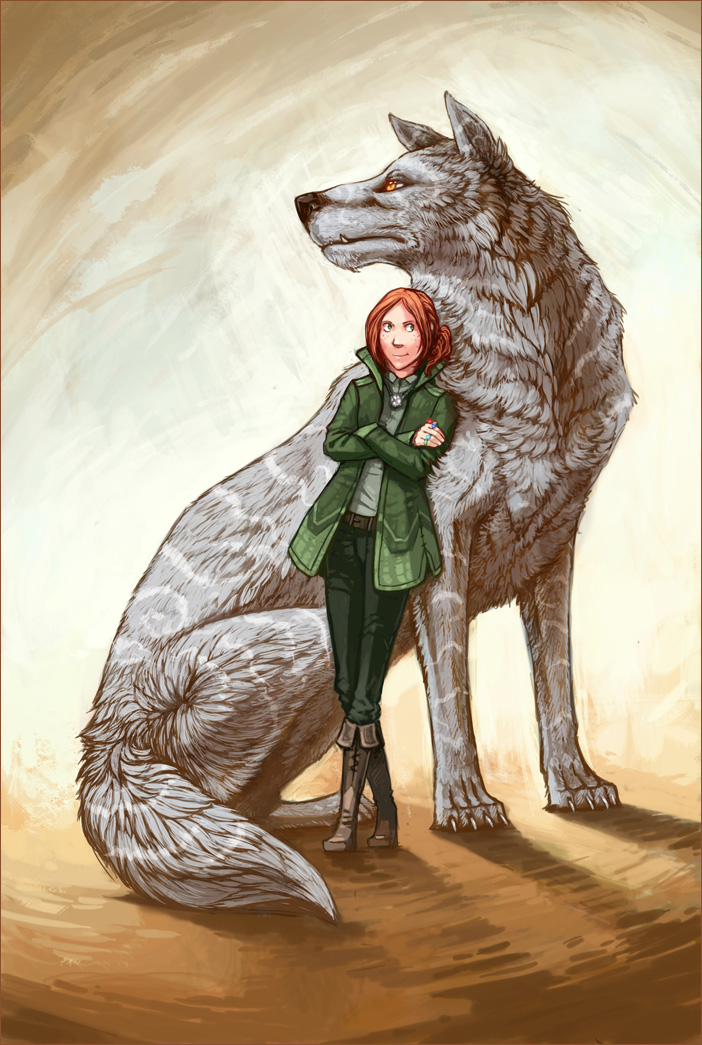
Miranda and Gin by Minna Sundberg

The Spirit War” is book no. 4 in the story about Eli Monpress, the cleverest thief in the world. Eli lives in a world where magic is based upon the cooperation with spirits that live inside all things. Although full of action and deception, all four books are light-hearted. Aaron writes well and brings her characters spirit and verve.

About the book: All Eli Monpress wanted was the biggest bounty in the world. He never meant to have obligations, or friends, but master swordsman Josef Leichten and Nico, the daughter of the dead mountain, have saved Eli’s life too many times to be called anything else. And when a friend upsets your plans and ruins all your hard work, what’s a thief to do?

After years of running from his birthright, Josef is forced to return home and take up his title as prince. War is coming for humans and spirits between the Immortal Empress and the Council of Thrones, and Josef’s little island is right in the middle. But conquest isn’t the Empress’s only goal, she has a personal vendetta against a certain thief.

What started as a simple side trip to help a friend is rapidly turning into the most dangerous job of Eli’s career, but he can’t back out now, not when Josef needs him. But when you’re under attack from all sides, even the world’s greatest thief can find himself cornered, and it’s going to take all the fast talking Eli can muster to survive the next few days.

Abulhawa, Susan: Mornings in Jenin (2010)

Mornings in Jenin” is a thought-provoking book about the Palestinian side of the Palestine/Israel conflict. It is the author’s debut. I read it in Norwegian, and the Norwegian translation was excellent. It got me thinking about how long conflicts can last, whether there is hope of reconciliation after such a long time and how on earth wounds can possibly heal on either side.

The story begins in the small village of Ein Had in 1941. All is well. The Olive groves have been harvested and the cycle of life continues as always. Seven years later, the Abulheja family are sent to live in a refugee camp in Jenin. Amal, is the main character of the novel. She has a bright and inquisitive mind, always seeking more knowledge. Through her story we discover what happens to her two brothers. Amal’s own journey through life is no less dramatic, taking Amal through childhood, marriage and parenthood.

Tolkien, J.R.R.: Letters From Father Christmas (1999)

Letters From Father Christmas is a gem from J.R.R. Tolkien. I have Letters as an audiobook. Derek Jacobi reads Father Christmas’ voice, John Moffatt reads Polar Bear’s voice and Christian Rodska reads Ilbereth’s voice.

“In these letters, Father Christmas kept the Tolkien children updated with stories about the hijinks at the North Pole – the slapsticky North Polar Bear and all the things he broke, firework explosions, the discovery of ancient caves full of old cave drawings, and battles with the goblins. (When Father Christmas couldn’t write, his Elvish secretary filled in).

Tolkien’s old-school style of writing is a bit formal and very correct, but he tosses in comments of exasperation, amusement, and in the last letter, a sort of sad resignation that children will grow up. Maybe it is because they were given to real children, not intended for publication, that the letters are only a little cutesy, and never cloying.”

A delightful read and completely unlike anything else that I have read by Tolkien. His love for his children and grand-children shows throughout the writing.

Nexø, Martin Andersen: Pelle, the Conqueror (1906-10)

“Pelle, the Conqueror” begins on the first of May 1877. Lasse Karlsson from Tommelia in Sweden arrives with his son Pelle at Bornholm in Denmark. They are fleeing poverty and starvation and try to find a decent living. Instead they are treated as indentured servants. As Pelle learns Danish, life becomes easier, but he and his father continue to be treated as outsiders. They refuse to give up their dream of a better life in Denmark.

In one sense you could call “Pelle” auto-biographical. Nexø (1869-1954) knew poverty from the inside. When he was 8, his family moved to Bornholm in hopes of having a safer life. Through this inside experience we get to follow Pelle and his father and friends through tragedy, comedy and success. There is an optimism inherent in these four books (mine is an omnibus) that has us identifying with Pelle’s fight to conquer his life.

Nexø writes beautifully. He brings the reader into the text and gives of himself to us. The journey through Pelle’s life is an amazing journey from a life of terrible circumstances into a life of possibilities. With warmth and generosity my heart was warmed by the excellence of Nexø’s text.


Barnes & Nobles seems to have the best price on this omnibus, consisting of 4 books: Boyhood; Apprenticeship; The Great Struggle; Daybreak.

Project Gutenburg offers Pelle the Conqueror.
——————————–
Pelle Erobreren is a Danish/Swedish movie from 1987 based on the book
1988:
  • Palm d’Or at the Cannes Film Festival
  • Golden Globe Award for Best Foreign Language Film
  • Oscar for Best Foreign Language Film

Wells, Jaye: Sabina Kane

Jaye Wells is the author of the Sabina Kane series. Her writing has progressed with each book. In the final installment of the series Well achieves that nirvanic place of writing that I’m certain all authors seek. Her writing flows and she makes me happy to have read her book. The Kane series is entertainment. I’m going out on a limb here, but I believe the books are meant for adults. Some of the content is a bit racy, but the violence avoids goriness. Wells keeps the tension going and the reader hanging on as best they can. This series works is set as an urban fantasy. Most of the books are focused on the characters and not places, so there aren’t a lot of scenic descriptions.

photoSphynx cat – RuthArt

RED-HEADED STEPCHILD (2009)

Sabina Kane is half vampire and half mage – a forbidden product of a forbidden romance. Her grandmother Lavina, is one of the tree leaders of the vampire race. She despises her granddaughter for the impurity that she has brought into the race. Sabina is aware/not-aware of this and does her best to please her grandmother – an impossible task.

Assassin is the only thing that the vampires have deemed Sabina worthy of being, so Sabina makes certain she is the best. When a mischief-demon steps into her living room and stabs her with apple-wood (deadly to vampires), Giguhl comes into Sabina’s life. Slowly, but surely, Sabina’s life changes and magic is introduced – along with the traditional hunky wizard guy who she is bound to fall in love with. One of her magic spells goes haywire and Giguhl gets a form like the above Sphynx cat to use amongst people. You can imagine he was pleased with that.

THE MAGE IN BLACK (2010)

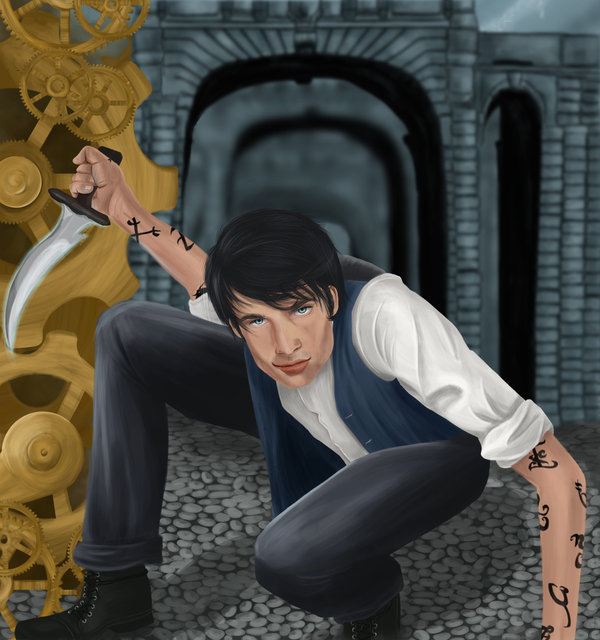
Adam Lazarus by Annie Walls

Learning that she had a twin sister in New York blew Sabina away. She was mostly dreading her meeting with her due to her lack of self-confidence. But Maise accepted her. Now Sabina is in New York and has decided to side with the mages, try to learn magic and work for peace. This enrages her grandmother, who orders her killed. Unfortunately, the process of being accepted by the mages is a difficult one. First she must be cleansed and her abilities decided. In addition Sabina must get used to drinking only processed blood. No more fresh from the vein.

Giguhl and Adam Lazarus continue to be Sabina’s side-kicks – to a varying degree. Giguhl has the humorous part in this play while Adam plays the romantic lead. Sabina struggles with all of the demands placed on her. Whatever a Chosen is, she knows she isn’t it – not matter what the wizards say. Meeting an old flame isn’t doesn’t exactly make life easier on her. But Maise is turning out to be someone Sabina likes and that lightens the burden a little.

GREEN-EYED DEMON (2011)

Maisie has been kidnapped and Sabina sets out to rescue her. First they have to figure out where she is. When all clues lead them to New Orleans, Sabina, Adam and Giguhl travel together to try to find a way to rescue Maisie. As dear grandmother was the one to kidnap Maisie, Sabina worries about the state her sister will be in when they find her.

A local witch and voodoo practitioner and her transgendered assistant find it in their hearts to help in the search. Old acquaintances of Adam end up helping the gang. Will this be enough to do the job?

With Green-Eyed Demon we begin to see the depth of Wells’ writing. She does a good job at portraying her figures. Giguhl is my favorite one. Sabina shows the difficulty of going good when she’s been soooo bad.

SILVER-TONGUED DEVIL (2012)

Cover shoot by Shirley Green

Maisie is back, but she is in trouble. The kidnapping and having to draw blood to survive has taken its toll. Sabina tries to support her, but feels out of her depth. Figuring out who to trust is turning out to be more difficult than she had thought possible, and Sabina is now becoming more and more pessimistic about the possibility of peace between the three races.

Then a string of sadistic murders begin happening, and suspicion falls on Sabina. At the same time her relationship with her lover, sister and demon are getting stronger. Sabina’s investigation into the killings turn up frightening questions and Sabina has to make some difficult choices.

BLUE-BLOODED VAMP (2012)

Now we get to the final book in the series, “Blue-Blooded Vamp”. Sabina is after Cain to revenge the killings of people Sabina has loved. Unfortunately, Cain is hunting Sabina, too.

Abel, the mage who bound Cain is the one who can help Sabina. Sabina sets out for Rome with her friends to find Abel and get some answers. When she gets there, Sabina discovers that the role she and her sister are supposed to play is a game of the gods and she is one of the key pieces.

Good ending. Happily ever after kind of. Wells has given the urban fantasy genre a new and interesting way of portraying the paranormal creatures out there.

Kushner, Ellen: The Privilege of the Sword (2006)

The Privilege of the Sword by Thomas Canty

The Privilege of the Sword” is part of Ellen Kushner’s Riverside stories and is a fun read. Kushner makes this whole world believable. It’s a fantasy book without magic or supernatural creatures. Instead we get a novel set in a time where women were commodities to be bought and sold for money and land.

Katherine, our main character, is sold to her uncle to pay her family’s debts. Her uncle is the decadent Mad Duke Tremontaine, and his plans for his niece do not follow conventional rules. Independence and the ability to defend herself are qualities that he aims to knock into her through sword lessons. Maybe not what Katherine had in mind, but she buckles up and does her best to uphold the agreement that was made between her mother and her uncle.

So, why is this book so good. One reason is that the characters of Katherine and Mad Duke are three-dimensional. Another is the humor and action that fills the novel. The Privilege of the Sword flows somewhere between peaceful and tempestuous.

The Privilege of the Sword is available as audiobook in an unabridged version and narrated by Ellen Kushner,  Barbara Rosenblat, Felicia Day, Joe Hurley,  Katherine Kellgren, Nick Sullivan,  Neil Gaiman

Gaiman, Neil: The Graveyard Book (2008)

Graveyard Book McKean 2.jpg
Bod in the graveyard. Art By Dave McKean

Neil Gaiman is another of my favorite authors. Each story I have read has captivated me. The Graveyard Book flows and left me with a sense of having enjoyed something wonderful. His texts lend themselves to being read out loud, and they would be fun and interesting for both reader and readee. However, reading to yourself is just as enjoyable. This is a Children’s story, but it is definitely not for the very young. Perhaps at least 8 years old due to some of the violence.

Nobody, or Bod as he is called, is a loveable boy. He’s completely believable and the characters around him are fascinating. I love his “mom” and “dad”. What a place to grow up and what friends to have. Like any kid, Bod accepts the world around him just as it is. His unusual childhood prepares him for whatever comes his way. I wish I could be more like him. Accepting people for what they are rather than what I think they are would be an incredible gift.


The Graveyard Book is available in four versions:

  1. The children’s version, illustrated by Chris Riddell;
  2. The adult version, illustrated by Dave McKean and
  3. The slipcased edition, illustrated by Dave McKean.
  4. Read by Neil Gaiman

The Graveyard Book won the Newbery Medal, Hugo Award for Best Novel, Locus Award for Best Young Adult Novel and the Carnegie Medal for 2009. It was also nominated for the British Fantasy Award for Best Novel and World Fantasy Award for Best Novel for 2009.

Briggs, Patricia: Moon Called (Mercy Thompson I) (2006)

Moon Called - The last full moon of october

This is the image that I feels illustrates Moon Called best and it shows Mercy (Mercedes) as I had imagined her from the words Patricia Briggs has written about her in Moon Called.

I am a fan of Ms. Briggs’ writing. My adventure with her began with the Hurog saga. Then it sort of developed into a full-fledged love affair and here I am writing about yet another series of hers.

Poor little teen-ager Mac/Alan. Little had he thought about the possibility of werewolves being real. Then all of a sudden he was mauled and changed into one by nefarious people. The Marrok (Bran) calls this rape. To make matters worse, Mac was experimented on and kept in a cage. One day he manages to escape and turns up at Mercedes’ garage (auto-shop). She is a softie and takes him under her wings, eventually introducing him to the Alpha of the Tri-Cities area, Adam Hauptman.

Map created by Michael Enzweiler

Adam and Mercy will according to all the foreshadowing become a couple. Mercy and Adam are very alike, yet incredibly different. She is a shape-shifting coyote, he is the alpha werewolf of the Tri-Cities area. If the two of them decide to become mates, his pack will have to accept Mercy as his second. At least one of the members of the pack seems to have done so already, Warren.

Warren is a sweet-heart. He is a gay were-wolf with an open lifestyle. Meeting Mercy changed his life for the better. For once he met another predator who did not care what gender he loved. Then she introduced him to Adam and Adam accepted him as well. That did not mean that the rest of the pack managed to embrace him as one of their own, but that is the way of the world. We all have different prejudices. Some are more vocal and open about them than others. Sadly, getting to love the person you love is not something we all get to experience.

Just now it really struck me. What if I refused to accept a person because of who they loved? How would that change me and the person I met like that? It is a concept I find terribly confusing.  It would be like me refusing to accept a person because of the color of their skin or hair or eyes. Being on the receiving end of such prejudice must hurt terribly.

Mercy is the kind of person that opens up her heart to a great variety of people. Vampire, werewolf, fae or human matters not. If the other person seems to be decent, then there is room for them in Mercy’s life. Her attitude does create problems when some of her friends meet others of her friends, but Mercy just expects them to be polite to each other no matter how much they might despise each other (vampires vs. werewolves comes to mind). And people often do what Mercy expects. For reasons they do not always understand themselves, Mercy is definitely a person they want to have in their lives. What a gift, and possibly, what a curse.

Her being a mechanic is a bonus for me. As a kid I wanted to be a lot of things and mechanic was one of them. There is something satisfying about being able to take things apart. Sadly, I stink at putting them back together again. Then there is the goo. Goo is the loveliest thing on earth. Mercy gets to fix cars and is a whole lot better at putting them back together again than I am. My “niece” is a mechanic. Even here in Norway it is still unusual for a girl to choose such a career. I absolutely love that my “niece” chose such a line of work. So the idea of a mechanic that happens to be a woman is an added attraction for me.

Just so you know. One of Patricia Briggs series also begins at the time of Moon Called. When Bran sends Charles off to deal with a problem in Chicago the series Alpha and Omega starts.


Amazon Kindle


Reviews:


Moon Called as cartoon:

SKU: C1606902032
Rating: Teen +
Cover: Amelia Woo
Writer: Patricia Briggs, David Lawrence
Penciller/Inker/Colorist: Amelia Woo (digitally painted)
Genre: URBAN FANTASY
Publication Date: March 2011
Format: Comic Book Collection
Page Count: 104+

ISBN-10: 1-60690-203-2
ISBN-13: 978-1-60690-203-5

Just because I like pointing out the obvious. Do the images below remind you of anything? Anything at all??

Layout 1


Meaney, John: Paradox (2001)

Paradox: Book I of the Nulapeiron Sequence (Bk. 1)

Cover art by Jim Burns

I’ve now read “Paradox” for the third time and am still enjoying it as much as the first. Because I’m a dork, I just realised that there are two more books to this series. Well, well, live and learn.

From the above I’m sure you can tell that I really liked “Paradox“. We get a large dash of philosophy, some biology, sociology, lots of action and a thoroughly likeable protagonist. Tom Corrigan is at the centre of our attention throughout the whole novel. He raises himself through the various layers of society through hard work, luck and other people’s ambition. There is no sugar-coating of our hero. He rises to the greatest heights and falls to the deepest depths of hell. Meaney is a really good writer.

Nulapeiron is a strange world. Semi-alive dwellings and vehicles. Subterranean demesnes layered from the poorest to the richest. At the very top we find the Oracles.

Tom Corrigan is witness to the brutal killing of a woman by the militia. She just happens to the same woman who gave him a small, seemingly insignificant info-crystal. Shocked to his core, Tom realises that she is one of the mythical Pilots.

This info-crystal, along with the Oracle Gerard, are the two things that push Tom onto a path that will take him to his destiny.

Benedict, Lyn: Shadows Inquiries series

Lane Robins writing as Lyn Benedict is the author of the Shadows Inquiries series. I think you’ll find that all of these books lean toward the lighter side of fantasy literature. Sylvie Lightner’s character lives in Miami, a slightly different Miami from what most people associate with it. This is a place where the magical and godly take up a lot of space.

Sylvie is the owner of Shadows Inquiries, a P.I. firm that investigates the supernatural. Sylvie Lightner fits the mold that most women in urban fantasy seem to be cast to. The difference in these books is that there seems to be a darker undertone, and Sylvie might be slightly darker than the average. Benedict’s writing is good. The plots are as below, so nothing really complicated.

SINS & SHADOWS (2009)

When one of Sylvie’s employees ends up killed during a case, Sylvie decides she has had enough of investigating the weird and unusual. It is time to close shop.

Then Kevin Dunne turns up looking for his lover, and he just will not take no for an answer. Sometimes you just cannot fight “fate” and Sylvie ends up working for Dunne. Knowing who/what Kevin Dunne is does not make the job pressure any lighter – quite the opposite in fact.

Sylvie’s least favorite part of the whole investigation is that she has to involve friends and her employee Alex. Sometimes the consequences are anything but good and the battle Sylvie has to fight is against herself and the supernatural community.

Sins & Shadows is great entertainment and has no pretensions of grandeur. It delivers what it promises – escape from reality for a while.

GHOSTS & ECHOES (2010)

Once again Benedict writes an entertaining book about the world of Sylvie Lightner. As the title says, ghosts will appear.

During the investigation of what appears to be simple burglaries, Sylvie discovers the involvement hands of glory. On top of looking into the burglaries, Sylvie has to look after her rebellious sister, Zoe. Sylvie feels she has more than enough on her plate.

But the fates would have it otherwise. While investigating the burglaries case, Sylvie is approached by detective Adam Wright who thinks he has picked up the ghost of a dead man. Against her will, Sylvie is drawn into the fate of detective Wright.

Ghosts, black magic and a wayward sister are bound to make for an exciting time for Sylvie. Fortunately for her she has her trusted employee, Alex, helping her out.

GODS & MONSTERS (2011)

The third novel in the Shadows Inquiries series follows in the path of the first two. Once again Sylvie Lightner is confronted with a mystery that only she is able to solve (with the help of a few others).

The legacy of her bloodline – with all of its inherent anger – continues to plague Sylvie. What others might think of as the gift of the century, Sylvie feels is more of a curse. But she will find it invaluable during the process of the novel.

Five women turn up dead in the Everglades. While something feels off about the whole thing, Sylvie decides this is probably a regular murder case. Hah, hah. When the bodies come to life and start killing, Sylvie has to step in and take what help she can in figuring out what dark magic is afoot.

The help of a necromancer is what Sylvie ends up with. Together they end up confronting the world of gods, and once again Sylvie decides that the gods are not all that great.

LIES & OMENS (2012)

The three people Sylvie cares most about are threatened. Zoe, Alex and Demalion are the one thing that can bring Sylvie out of her hiding and into investigating the magical attacks on Internal Surveillance and Investigation government agency.

What Sylvie has discovered throughout the other three books is that she needs help and does not have to do everything alone. That is definitely true in Lies & Omens. Sylvie will need all the help she can get in order to save the mundane world from the magical one.

As a final book in the Shadows Inquiries’ series, Lies & Omens works pretty well. The conclusion tied up loose ends and felt satisfactory.

McKinley, Robin: The Blue Sword (1982)

“The Blue Sword” by Emily Doyle

In spite of being written first, The Blue Sword is the second book in the Damarian saga. There are few things in life that I’m truly envious of, but the ability to write in a manner that flows is one. Maybe it has to do with the comfort that I’ve derived from such books. Truly excellent ones distract me from my pain and makes those long boring days when I can’t do much bearable. McKinley has this ability.

While the plot in The Blue Sword is straightforward, the execution is not. What a gift. I guess I’m just in a praise-mood today (maybe).

Harry Crew is a young woman who, after the death of her parents, has to move to Damar and her brother (Victorian standards in her country). There the adventure begins. She falls in love with the desert, gets kidnapped by the Hillfolk and has to fulfill her destiny as Harimad-sol, the hope of the Damarian people.

There is “slightly” more meat to the story =), thankfully. Action galore and some romance. Just the things that make for fun fantasy.


Winner of 1983 Newberry Honor Book

McKinley, Robin: The Hero and the Crown (1984)

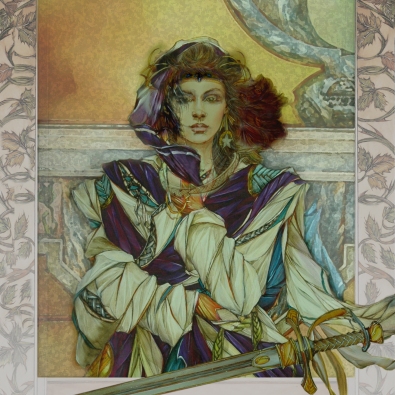
The Hero and the Crown (Damar, #2)To me reading is like listening to music or maybe it’s vice versa. Sometimes words flow seamlessly from one sentence to the next, one chapter to the next. Subject matter does not matter. I’ve seen it in academic articles and in this case in a young adult book.The Hero and the Crown flows beautifully. To me that makes McKinley and excellent writer. I’ve only read two of her books, but in both cases I found this indefinable flow. I suspect the ability to make text “flow” is something you have to be born with, like any other talent.
While “Hero” is the first book in the Damarian saga, it was written after The Blue Sword (another Newberry awarded book). Keep that in mind while reading the books.

Aerin is the only child of the Damarian king, born without talent and child of a suspect mother (dead). She refuses to act as a proper “lady” should. Instead she learns to wield the sword, chase dragons and tame horses. Then disaster strikes and Damarian faces war. As the king rides off with his forces, a messenger comes riding in asking for help to kill a dragon. Aerin goes off and …….


Winner of 1985 Newberry Medal Award

Gilbert, Martin: The Boys – Triumph Over Adversity (1996)

ForsideWhen I read “The Boy in the Striped Pyjamas” I was once again reminded of the story of 732 Jewish boys and girls whose story Martin Gilbert tells in his “The Boys: Triumph Over Adversity“. One book is from the viewpoint of someone standing outside the suffering while the other one is about the kids who went through hell. I’m not a believer in the many after-life versions of hell, but I am certainly a believer in the human ability to create hell for their fellow humans. In fact, we’re really creative in the many ways we cause others pain, and that worries me.

The Boys: Triumph Over Adversity tells such a story. This is the story of children who (along with their siblings and parents) were uprooted from their homes and dragged into the horrors of the Holocaust. These children were originally from Poland, Czechoslovakia and Hungary. Their lives were the lives of ordinary children with loving parents. As they just below and above ten years old for the most part, these children had no understanding of all of the abrupt changes in their lives. From living in regular homes, they were stuffed into ghettos and then dragged to even worse circumstances.

And then it all ended. No more parents or siblings, all alone in the world after having endured what only few people in the world have had to endure.

After their liberation from the camps, they had to begin rebuilding their lives in Britain. Despite being physically and emotionally drained by their nightmare past, they drew strength from their group. After leaving their hostels, they remained a close-knit and devoted band of siblings. Their families having been destroyed, they created a family among themselves.

So many people ask themselves how something as terrible as the Holocaust could have happened. I doubt there is any one answer to that question. After all, we let history repeat itself all over the world. What I do believe is that we are all capable of becoming something we had never thought was possible. Ervin Staub in his “Roots of Evil” and Max Weber in his “On Bureaucracy” – Iron Cage both try to look at why people are dehumanized and warn us of the consequences.

Monk, Devon: Dead Iron (2011)

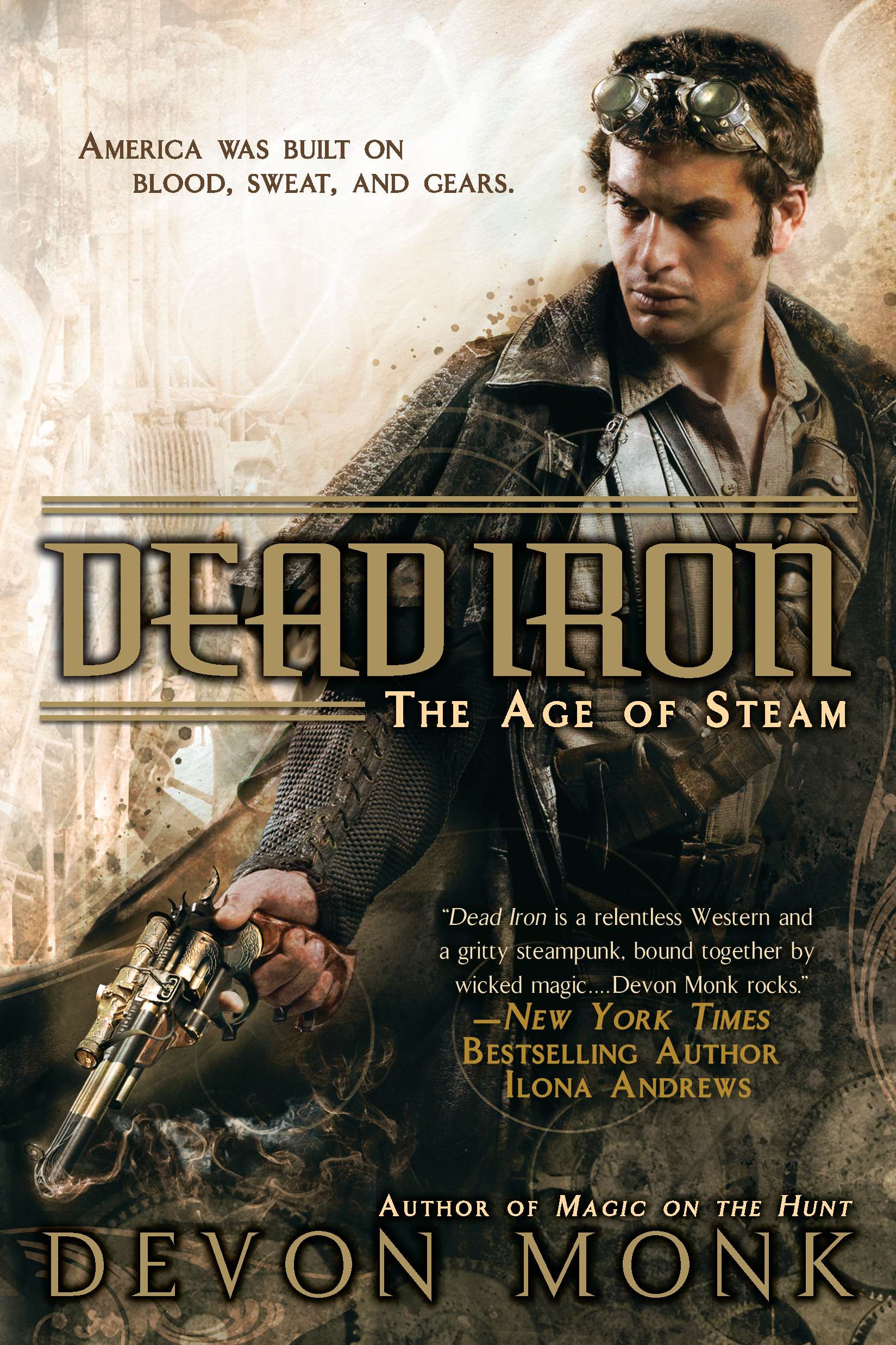
Dead Iron

The Age of Steam is the new series started by Devon Monk. This time she writes steam-punk (I wonder where they got the word steam-punk?). I don’t really understand why so many fantasy buffs don’t like steam-punk. It’s great fun along with most other fantasy. As Monk is the author, the quality of the book is guaranteed (thankfully). It’s light entertainment (a little heavier than the lightest) and doesn’t strive for moralistic or philosophical preaching. However, Monk does treat her characters as complex beings with dark and light sides. I abhor literature where the goodies are sugar-good and the baddies are black as tar bad. Way to go Monk.

Dead Iron is the first installation in the series about the bounty hunter Cedar Hunt. Cedar has a “slight” health problem that becomes uncontrollable about once a month. To protect others, he lives a bit outside town.

When a small boy goes missing, and the parents go to Cedar for help. After a lot of hesitation he takes on the case. During his search Cedar meets other strange people and a lot of prejudice and fear. In Dead Iron, Monk combines fantasy and technology in a wild-west world where the impact of iron and technology threatens to destroy the presence of magic.