Tag Archives: #Racism

Hicks, Michael R.: Empire (In Her Name – Redemption) (2009)

Empire

Cover art by Michael Hicks. Stock images from bought from Dreamstime.com and edited in Photoshop

I saw the old cover on one of the reviews below and prefer this one.

Flow! To me it is all about the flow. It is that magical quality that some authors are born with and some authors can work their way into. Maintaining the flow through a whole text, whether it be fiction or non-fiction, is something most authors struggle with. Some authors never hit it while others fall in and out of it. Then we have the others.

Michael R. Hicks has the ability of remaining in the flow. He did it so well, I had to get the other two novels in the Redemption trilogy and read them right away.

Maybe part of that has to do with the harshness of Empire. Michael did not try to sugar-coat the conditions of the orphanage. I imagine there are people out there who cannot believe that such things exist, but they do. Muldoon is nothing unique in the world of orphanages.

The other thing that really hit me was Reza’s ability to adjust. Some people are like that. They just bend with the blows that life hits them with. Me, I’d break having to live through the death of my parents, abuse at the hands of caretakers and finally having to live with the enemy. Whenever I meet a bender, I am impressed all over again. So, I was impressed with Reza.

As Reza learns so too does Esah-Zhurah. She goes from thinking of him as beneath her to gaining a grudging respect of Reza’s possible value. Inevitable I guess. Tearing down the walls of propaganda takes time – even for superior aliens.


You can meet Michael R Hicks photo at Michael R Hicks Logo, twitter-icon1 and Facebook-Logo.


Empire is available free as an e-book at most online retailers. If you can’t find it free at your favorite e-bookstore, you can always get it free from smashwords-logo in multiple e-book formats.


Ficks, J.L. & Dugue, J.E.: Kingsblood (The Chronicles of Covent) (2012)

Kingsblood cover

On the planet of Covent there once lived a dark elf named Shade. Growing up had brought Shade into the assassin work-force. I’ve often wondered what makes an assassin. In chapter 1 of Kingsblood we get a look at part of what brought Shade into the business.

I like Shade. Yes, he does some pretty gruesome stuff. But, you know, we all do at one time or another. Sometimes we are the victim and sometimes we are the perpetrator.

To Shade being an assassin is a job that he takes pride in. He is the best in his field. There are some people he will not kill – women and children. He also prefers to kill those who he considers black marks on his planet. Shade’s abilities are the best and therefore he wants jobs that challenge him. If you end up being under his protection, you know that you will be protected. On the other hand, if Shade decides the world is better off without you – well …

One person Shade decides to take under his wings is King Magnus. But, you know, one person (albeit the best assassin in the world) against a whole guild of assassins? Maybe Shade has bitten over more than he can chew this time. He is not quite alone. Shade has strange and mysterious people who root for him. Some of them even aid him. Hmmm. Wonder what kind of agenda they have?

There is plenty of action and humour. Our clumsy duo reappears in Kingsblood. You know, I feel sorry for them. Poor guys are out of their league.

Although several of the characters possess magic, there wasn’t really a lot of focus on magic. Instead action scenes were more about the fights themselves and Shade’s ability to be a shadow. King Magnus should be glad Shade is on his side.

I am going to say one extremely positive thing about Fick’s and Dugue’s writing. Even knowing what their agenda is, I struggled to see it in their writing. No soap-boxes, just really good writing.

 ——————————-

You can find the authors at Facebook-Logo and twitter-icon1.

Thom Scott’s website (last updated 2011)


DWED reviews


My review of The Waiting Game

I received a copy of Kingsblood as a reviewer’s copy but have tried to not let that influence my review.

Greenwood, C.: Magic of Thieves (Legends of Dimmingwood) (2012)

Magic of Thieves
Cover art by Michael Gauss

I really like the cover of Magic of Thieves. I don’t know if the gold effect carries over to paper-backs. On the screen a feeling of magic shines through.

Magic of Thieves seems to be a novel meant for a Young Adult audience. Our novel begins with the death of Ilan’s parents. Ilan is a “half-breed” as propaganda calls her. Being half Skeltai/half human is frowned upon. Having a parent who is a magic user is even worse. All of a sudden magic has become evil and the Praetor is on the hunt for all magic users.

While trying to escape the soldiers hunting for her, Ilan’s magic is triggered. The family friend Borlan takes her in but realises that she cannot stay. He gets a peddler to take her to Cros where she ought to be safe as a magic user. But they get waylaid by the thieves of Dimmingwood. This is where Ilan’s life takes a strange turn and she grows up among the thieves with the one called Brig taking a special interest in her raising.

Ilan is a feisty girl having to deal with the loss of her parents and the new father figure in her life. As she grows up her emotions grow up with her. I think Greenwood has made a believably tiresome and brave person who just tries to figure out her place in life. Encountering those who are stronger and weaker than herself is just part of the game.

Terrac was a self-righteous pain in the butt, as I guess he was intended to be. This too seems to be part of the teen-agy hormonal thing that we all have to go through. Some of us even retain that less than stellar quality. But Terrac had guts. He was brave enough to do what had to be done while trying to stick to his convictions.

These are the main two characters of Magic of Thieves. It was interesting to behold the changes they went through as life’s usual surprises hit them.


You can reach Dara England at DaraAndCarol and twitter-icon1.


Other reviews: The Middle Nerd

Dalglish, David: The Weight of Blood (The Half-Orcs) (2010)

Coverart by Peter Ortiz

There is a timeline for Dalglish’ books. You can find it on his website. However, that does not mean you have to read the books in that order. I haven’t.

David Dalglish has created a world called Drezel. Once upon a time the brothers Ashhur and Karak came to Drezel and ended up representing dark/chaos/death and light/order/life. They are godlike-creatures who have been cast from the planet and acquired followers. Like many brothers out there Ashhur and Karak fight. Unfortunately that usually involves getting their followers to fight each other.

The Weight of Blood is a dark story, one of death and destruction. The Half-Orc brothers Harruq and Qurrah Tun are responsible for quite a bit of that destruction. These two brothers seem very different yet Harruq would do just about anything for Qurrah, even if it means killing children or friends. What Qurrah will discover in The Weight of Blood is just how far he can drive his brother. Because one thing is for sure, Qurrah manipulates his brother. In spite of this, the brothers have great love for each other.

Dalglish writes dark fantasy well. His characters are complex and loveable (in spite of their deeds). Life isn’t a matter of black and white in Dalglish’s litterary world. Instead we get shades of grey that mirror real life.

I loved his writing and the world he has created.


Carson, Rae: Dangerous Voices (2012)

Cover artist Jenn Reese

Freedom of Speech. How far are we willing to go to let our voices be heard? How far are others willing to go to stop our voices from being heard?

Dangerous Voices is a wonderfully terrible short story about the lengths people are willing to go to let their voices be heard and to stop those voices from reaching out. What would my choice have been? Hmmmm.

If it was not for the magic, this could be a story right out of Amnesty International‘s archives.

I  am thankful I got to meet Rae Carson.

Flagg, Fannie: Welcome to the World, Baby Girl! (1998)

Fannie Flagg is four years younger than my mother and six years younger than my dad. As such, many of their experiences have been similar. Technological advances have followed the same tempo even though they are from different countries.

Cover photo: Elliot Erwitt/Magnum

The jump between the media world in the 1940’s, represented by Aunt Dorothy’s radio program, and the media world of the 1970’s, represented by Dena Nordstrøm’s television job, is immense yet non-existent. Gossip and social mores are often more important than politics and the “larger” issues.

Once again Fannie Flagg takes us to the lives of people living in the South of US. This time we visit Missouri and the phenomenon “passing”. Racial passing refers to a person classified as a member of one racial/social group attempting to be accepted as a member of a different racial/social group (Wikipedia).

It is one thing for me as a whiteish woman to sit here wondering at a world that makes so many of its citizens feel they need to hide their origins. To me it is an abstract exercise. For others it is not. People (probably myself included) attach shame to attributes that come with birth (whether these be physical or sociological). Imagine the fear of discovery of that “terrible/uncivilised/evil/…” quality. Sometimes these fears are founded and sometimes (fortunately) they are not.

Unravelling the mysteries of the past brings about surprises and feelings of betrayal, loss and love with the characters of Welcome to the World, Baby Girl! Fannie Flagg gives us an opportunity to face our own prejudices in a manner that brings us into the world of gossip and suspense that media is (whether it be new or old). As with Fried Green Tomatoes at the Whistle Stop Cafe, Welcome to the World, Baby Girl! is “utterly irresistible” (Time). You will miss something truly wonderful if you choose not to read this novel.

Flagg, Fannie: Fried Green Tomatoes at the Whistle Stop Cafe (1987)

My first meeting with Fannie Flagg (or Patricia Neal) was on the film-creen. I am trying to remember just how far back she and I go, and I believe I might have a tentative meeting period set at Grease the movie (with Olivia Newton-John and John Travolta).

When I encountered her literary work I had become an adult. Fried Green Tomatoes at the Whistle Stop Cafe became a movie. I got to meet the two friends Idgie and Ruth whose experiences made me laugh and cry.

Cover photo: Arthur Rothstein

Another few years down the road, I picked up the novel and fell in love again. Fannie Flagg became one of my favorite authors just a few pages into the book. And now, just a few weeks ago my dad fell in love as well, and not just with Fried Green Tomatoes. Having read one of her novels, he just had to borrow the rest of the Fannie Flagg novels I have in my library.

Part of his love for her work lay in the time period described. These were tough times in the US and the rest of the world. They weren’t called the depression years for nothing. Alabama struggled with recognizing women and non-christians/whites as equals.

I would have wanted Idgie for a friend. Her love, fierceness and loyalty toward Ruth is priceless. Ruth needs someone like Idgie to be able to see beyond the prison that life made for her.

I love the humour in the novel. When the search for Frank Bennett is on and Sheriff Kilgore eats at the cafe is priceless. Another moment occurs right after when the Sheriff steps into the beauty parlor with his men and gets thrown out all embarrassed at having overstepped the gender boundaries.

The story of the storyteller, Cleo Threadgoode, and her listener, Evelyn Couch, is heart-warming and uplifting. I still carry the images of the changes in Evelyn from the movie in my head. Her change in the novel are just as immense.

Flagg managed the job of jumping between the storyteller and her memories. Her writing flows, boy does it flow. If you want to read a novel about life, then Fannie Flagg is the author to read.


The film Fried Green Tomatoes came out in 1991 and is based on the novel.

1992:

  • Oscars: Nominated for Best Actress in a Supporting Role and Best Writing, Screenplay Based on Material Previously Produced or Published
  • American Comedy Award: Nominated for Funniest Actress in a Motion Picture (Leading Role) and Funniest Supporting Actress in a Motion Picture
  • Golden Globe: Nominated for Best Motion Picture – Comedy/Musical and Best Performance by an Actress in a Motion Picture – Comedy/Musical and Best Performance by an Actress in a Supporting Role in a Motion Picture
  • USC Scripter Award: Nominated
  • WGA Award (Screen): Nominated for Best Screenplay Based on Material from Another Medium
  • GLAAD Media Award: Won Outstanding Film
  • Wise Owl Award: Won Television and Theatrical Film Fiction
  • USC Scripter Award: Won

1993:

  • BAFTA: Nominated for Best Actress and Best Actress in a Supporting Role
  • BMI Film Music Award: Won
  • Young Artist Award: Won Best Young Actress Under Ten in a Motion Picture

Sykes, Wanda: I’ma Be Me

Wanda Sykes I'ma Be Me (2009)

Wanda Sykes is hilarious. Sure she is politically astute and opinionated, but mostly she is funny. Laugh until I cannot make a sound kind of funny. I really needed I’ma Be Me.

Some of the audience laughed so loud and hard they must have wet themselves.

I loved her piece on the Obamas. When she got to the part about the White House rocking I was a goner.

Wanda’s humor is warm-hearted and tender yet harsh.

Give yourself a treat and get this DVD.

Ee, Susan: Angelfall (2012)

Cover art by Silverlute

Angelfall is Susan Ee’s debut novel and the first book in the Penryn & The End of Days series. Wow. That woman has talent. The story of Penryn’s hunt for her sister is moving and exciting. It shows how low people can stoop and high they can rise once they are thrown into chaos through war. The angels have decided to destroy civilisation as we know it and Penryn and her family are one of the many victims. The situation is not made any simpler by Penryn’s mother being schizophrenic paranoid or her little-sister Paige having to use a wheel-chair.

Penryn’s mother is nuts. She is a frightening person that comes around every once in a while. But Penryn manages to communicate with her and is the parent in their little family. She has to make all of the tough decisions.

Then they are torn apart when the angels decide to take Penryn’s little sister – all because Penryn happened to throw a sword. Now Penryn ends up saving an angel (Rafe), making a deal with him and traipsing through dangers in her search for Paige. It isn’t easy being 17 years old and stuck with this kind of life.

There is plenty of action and the author manages to get whatever messages she has across without preaching. I loved it.

Kress, Nancy: Crucible (2004)

crucible by jim burnsCover by Jim Burns

Crucible continues where Crossfire left off. Nancy Kress was married to the author Charles Sheffield. In Crucible the characters Lucy and Karim talk a bit about the effects of the McAndrew driveCharles Sheffield invented the term in his books and Nancy has borrowed the term as an explanation for the way the space vessels behave while travelling at their various speeds. If you are a nerd/semi-nerd like myself, you will probably check the information out.

One of the effects of travelling at near-light-speed is the problem of your ageing compared with the people you have left behind. They will be older (or even dead) when you return to them. I imagine that could be quite traumatic. Crucible deals with that question.

Crucible can mean “test by fire”. We see Karim and Lucy go through their test of fire when they are stuck on the Vine world trying to survive and hopefully get back to other humans. The Vines are strange plantlike creatures whose existence seems very harmonious. For humans that can be difficult to deal with. We probably get off on a bit of conflict in our lives, predator/prey that we are. That and the fact that Vines don’t communicate the way we do makes life extremely difficult for Lucy and Karim.

Crucible is also the name of the vessel travelling from Earth to Greentrees. The passengers onboard are modified humans. What they bring to Greentrees is an arrogant attitude toward the people living there. Being modified makes the people on Greentrees listen to their beautiful voices and beautiful looks. Even Jake Holman (at age ancient) is fooled by them. But the people from Crucible come with an agenda of their own.

A lot of conflict is in the cards and Kress manages to convey the various personalities quite well. She is an interesting writer.


2005:  Nominated – Locus Award for Best Science Fiction Novel

Kress, Nancy: Crossfire (2003)

CrossfireCover by Jim Burns

Crossfire is Nancy Kress‘ first book in a duology about the travellers from Earth to Greentrees. They have all pooled their resources so they can get away from an Earth where the people are rapidly self-destructing. All Greentrees needs is a bit of terraforming for humans to be able to enjoy it fully. But the people who have travelled to Greentrees have done so for various reasons and their personalities are more or less suited to this type of adventure.

Jake Holman and Gail Cutler are the group’s leaders. However, there are subgroups. These are the New Quakers, the Environmentalists, the New Cherokees, the Islamists, the modified Soldiers, the scientists and Jake the lawyer. Once they begin to settle on Greentrees, the New Cherokees take off as planned. Their aim is to live as indianlike as possible and to have a little as possible to do with the rest of the humans. The majority of the humans try to keep their differences in check and work together on building a town to live in.

However, any new world is bound to have some trouble for the arrivals and on Greentrees it just happens to be a group of primitive humanoid aliens. In spite of there being more than one group of these aliens, it does not seem as if they are native to Greentrees. The various groups of aliens behave very dissimilar to each other even though they share genetic material.

The humans who had thought themselves alone in this arm of the Galaxy discover that they have now, in fact, become embroiled in an interstellar war. The side chosen by the humans will also decide the fate of humanity.

I quite liked Crossfire. The characters were a bit much at times but I liked the way Kress presented different types of conflict and the resolution to them (where that was possible). There was plenty of action and psychology in this novel. Preaching was present but not to the point where it got annoying.

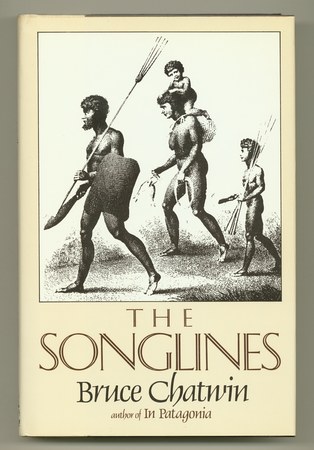
Chatwin, Bruce: The Songlines (1987)

My first comment on this book sounds negative. Maybe I mean it that way. I haven’t made up my mind yet. Bruce Chatwin is another white dude in a long line of white people telling the story of the Aborigines of Australia. It isn’t Bruce’s fault that I bought The Songlines at the library. That is mine and I am glad that I did.

Here in Norway there aren’t many books by indigenous Australians that are sold. But what does the term aboriginal Australian mean. After all, there used to be at least 250 languages spoken among the people. Now, all but 20 are endangered. The Songlines represents one of these groups.

Chatwin grew up with a dream of Australia. As an adult he went there and got to know Arkady, a son of Russian and Ukranian immigrants to Australia. Arkady had fallen for the Aboriginal way of living and he had shown the Indigenous people that he was trustworthy and would respect their traditions. That is why they agreed to show him their Songlines or paths that intersected with the Dreamtime (holy places).

This is why Arkady was the perfect go-to person for Bruce. He had answers to the questions Chatwin wondered about and the means to introduce him to at least some of the decision making elders.

The Aboriginal Land Rights Act of 1976 “defines ‘traditional landowners’ as a group of Aboriginals who have “primary spiritual responsibility” for sacred sites on a piece of land, and who are entitled by Aboriginal tradition to hunt and gather on that land. Traditional landowners are the key decision makers for their land, although Land Councils must also talk to affected communities.”

Arkady Volchok was mapping the sacred sites of the Aboriginals. Part of his mapping was done as a surveyor for an engineer planning on starting the building of the Alice Springs/Darwin railline. But first the engineer had to make certain that the line did not cross the work of a Dreamtime hero.

The Dreamtime has partly to do with the creation of the world and totems. Somehow the world was sung into being from an idea, a singing that is still going on and that the Aboriginal sacred rites help support. Being able to stay off the songline had become important to the railway company – or at least its engineer.

To the Aboriginal people one could even say that all of Australia is a sacred site, one that is extremely important to disturb as little as possible.

I think I like this idea. It makes more sense that the European one and is certainly a whole lot more beautiful and carries a much greater degree of respect toward the preservation of the Earth. Where we Westerners are so caught up in greed and consumption, environmentalism seems to be the way of the Aboriginal people.

I admit it. I got caught up in Chatwin’s writing. I had to go online to research a bit more, trying to figure things out. Great trick that.

Chatwin’s goal with this book is to document the nomads of Australia. Nomad to Chatwin means a person who “moves from pasture to pasture”. He had previously gone into the desert of Sudan with Mahmoud, a nomad. Now he wanted to know what the Australian nomadic trails were like. What he discovers is an incredibly complex world including trade, marriage and survival strategies. I am not even going to try to explain any of this because I do not even begin to understand the songline, anymore than I understand what it means to be a man. Read the book.

Briggs, Patricia: Alpha and Omega series

Patricia Briggs books fall into the light-reading fantasy section. Her books are fun and easy to read. In the Alpha and Omega novels we meet werewolves and witches, vampires and fae, all capable of wickedness and heroic deeds. As usual in such tales the characters tend to survive the most amazing things. There is plenty of humor, some romance and lots of action in this series. The Alpha and Omega series has been set in the same world as the Mercy Thompson series.

Bran – the leader of the werewolves (Marrock) in the US lives in the hills of Montana. He has two sons, Samuel and Charles. We’ve met Samuel already in the Mercy Thompson books, although he does make a brief appearance in his function as a doctor. Charles is Bran’s other son. He has been born a werewolf, not something that should be possible. Charles is Bran’s assassin. If a werewolf steps out of order, it is his job to take care of the problem. His ability to remain cool and collected while killing is one of the main reasons for having such a job.

CRY WOLF (2008)

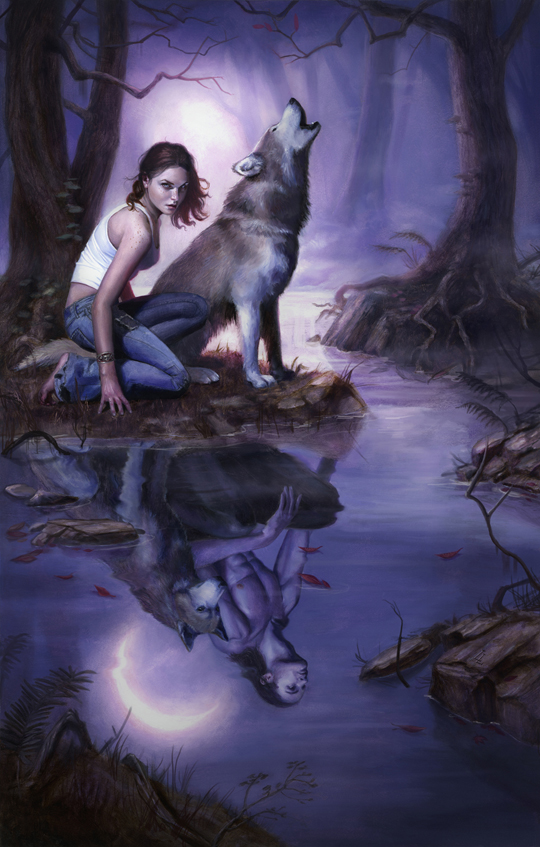
“Cover for omnibus” by Lindsey Look (Stunning cover)

Anna, Charles’ mate (to her surprise), has been living with a pack in Chicago. The other werewolves had been abusing her severely. When that came to the attention of Bran, Charles was sent to take care of the matter. That led to Charles and Anna’s wolves recognizing each other as mates. Anna is brought to Bran’s pack to live with them.

Walter Rice, a Vietnam veteran, lives up in the Cabinet Wilderness in Montana. One day he witnesses the attack on a young man and steps in to protect him. Rice ends up being mauled, but survives. When other mysterious deaths occur in the area a rogue werewolf is suspected and Charles is asked to look into it. He and Anna go.

HUNTING GROUND (2009) – Nominee for the Endeavour Award – for best book by a Pacific Northwest writer 2010

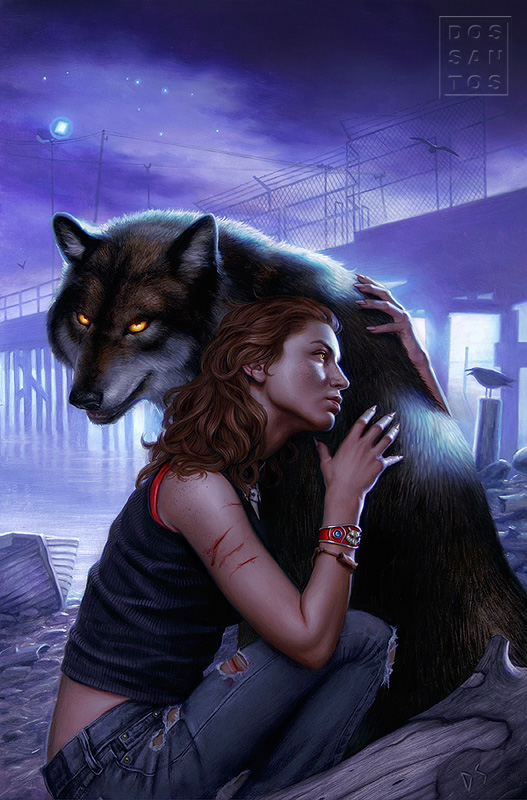
Cover by Dan Dos Santos

Charles is trying to convince his father to stay away from a convention of werewolves in Seattle. He feels his father will be in unnecessary danger from the European delegation. Charles’ intuition is acting up. Being an Omega, Anna is able to stand up to Bran without his Alpha influence taking over. After she has yelled at Bran, he is able to listen to what the two have to say.

Bran accepts Charles’ feelings and sends Charles and Anna instead as his representatives. Together they are to try to convince the other delegates of the need to go public. The other delegates aren’t exactly thrilled at the idea of going public. Here we see that the timeline is a bit back in time from the Mercy Thompson series. There the decision to go public has already been made and Adam is the werewolves’ outward face.

In Seattle people are being found dead and mauled. When Anna is attacked by vampires using werewolf tricks and magic, Charles has to figure out how to save the situation without getting killed by former lovers and new enemies.

FAIR GAME (2012)

Young Leslie has moved to California with her father. There she ends up in the capable hands of Mrs. Cullinan. When animals and children start disappearing (even Leslie’s new puppy) three people turn up at the neighbors and take her away. The neighbor and the three new people turn out to be fae. When one of them offers Mrs. Cullinan a favor as thanks for her warning, she says no thanks. Instead Leslie ends up being the one owed. But having learned that the fae were powerful and charming and that they ate children and puppies, Leslie was not eager to cash in her favor.

Fair Game is set a while after Hunting Ground but shortly after River Marked. Charles is struggling in his capacity as an assassin and Anna seems the only one capable of seeing it. She keeps on confronting Bran about it, and only Omeganess keeps her from shaking in her shoes. Because of the new rules, Charles no longer feels he is dispensing justice but rather murder and this is causing ghosts to haunt him.

When the FBI call the Marrock for help in solving a spree of murders, Bran chooses to send Charles and Anna to take a look. Anna gets to play good guy and Charles her bodyguard. In Boston Anna meets Leslie and they get to test each other’s intentions.


Alpha and Omega: Cry Wolf Graphic Novels published 2012 by Dynamite. Adapted by David Lawrence,  illustrated by Todd Herman with additional art by Jenny Frison and a cover by Dan Dos Santos.

Kirstein, Rosemary: Steerswoman

The Steerswoman's roadI have one complaint about the series – Where is the next book????? My goodness, this series was riveting. Kirstein needs to keep on writing – well, actually, in all selfishness, I need her to keep on writing. I think this was my third read-through and I was still captured by the writing and held prisoner until the end.

THE STEERSWOMAN’S ROAD (2003)

Rosemary Kirstein Steerswoman’Road is an omnibus containing The Steerswoman and The Outskirter’s Secret. In it Kirstein tells the story of the friendship between Rowan, the Steerswoman, and Bel, the Outskirter. Rowan and Bel meet right at the beginning while they are both about their own business. Bel has been travelling with other Outskirters and Rowan has been investigating strange blue jewels that are neither cut nor dug up.

Steerswoman are men and women who travel around the land asking questions and answering them. One must tell the true answer to any question and the Steerswomen must also do so. If one refuses to answer a Steerswoman, they can ban you. That means that no matter what the question you ask is, they will not answer it. Strange rule, but as knowledge is their whole purpose perhaps not.

Rowan’s questions about the jewels seem to have stirred up interest from the wrong parties. Thankfully, she and Bel have decided to travel together for a while because the next day brings an attack. From that point on there is tension, action, betrayal, discovery, friendships and travel. In fact, Rowan’s search for the truth of these blue jewels brings her into the Outskirts.

The Outskirter is about this part of her journey of discovery, and The Outskirter is just as exciting as The Steerswoman. The Outskirters are nomads who live at the border of where people can actually survive. Every day for them is about destroying and seeding the land so humans can live there. Steerswomen are unfamiliar territory to the Outskirters, yet Rowan manages to gain their trust and help them in her own way. The importance of her work becomes clearer and clearer as the role of the wizards in the attacks on Rowan begins to make a strange sort of sense. Rowan is also beginning to realize that perhaps wizards aren’t quite as wizardly as she had thought.

We as readers should have started realizing this long ago. What does not make sense to Rowan and the regular citizens of both the Outskirts and the Inland does to us. This is a science fiction series that to begin with might seem to be a fantasy one. Quite a few science fiction books are like that. The meeting between different sorts of technologic knowledge can, after all, make it seem like magic is afoot. Pressing a button on the wall to make light in the ceiling is pretty magical if you ask me – and I know how it all happens.

The Lost SteersmanTHE LOST STEERSMAN (2003) – 2004 Locus Science Fiction Award Nominee

Rowan and Bel have parted ways (on friendly terms). Bel is in the Outskirts spreading the bad news, and Rowan has ended up at the Annex in the town of Alameth looking for more information about Slado and the wizards. The Annex is a mess. Mira, the last Steerswoman living there, had not cared one whit about her duties. She was tired of being a Steerswoman and left everything a mess when she died. Now Rowan has to try to find desperately needed information in this chaos. On top of that the townspeople have problems accepting Rowan because she is so different from Mira.

When Rowan meets Janus, a Steersman who resigned the job and was considered lost, she is happy and confused. He was one of her oldest friends and Rowan finds the ban on him difficult in their conversations. After a while, Rowan begins to suspect that things are quite complicated with Janus.

The Lost Steersman is every bit as suspenseful as The Steerswoman’s Road. Kirstein keeps the standard of her writing amazingly high. It goes against the grain, but I think I’m going to put her along with Pratchett. Their styles are completely different. However, they both manage to involve me as a reader in some very serious topics with skills beyond anything I could aspire to.

The Language of Power THE LANGUAGE OF POWER (2004) – 2005 Locus Science Fiction Award Nominee

Rowan and Bel are once again together in their adventures. The Outskirts have been warned and Rowan is finally beginning to get somewhere in her search for the answers to Slade. All roads lead to Rome, it is said. In the Inlands, all roads seem to lead to Donner. To Donner Rowan and Bel go and there they unexpectedly meet Will – our lovable wanna-be apprentice – from the first book.

Will is on the run from Corvus, trying to hide in Donner and looking for revenge on the wizards. Rowan and Bel are overjoyed at meeting their old friend and seek to help him in his quest. But, as would be expected from an adventure novel, things never turn out as one would wish. Will is surprised at Rowan’s grasp of “magic”. Because he knows so much more about science than she, he tends to be a bit overbearing with her. Just because she doesn’t have the background Will has, certainly does not mean that she is without the ability to infer and deduce. After all, her whole life has been about the quest for knowledge – a true addict.

Unfortunately the next book in this series has not come out yet. Aaaargh. Please, Kirstein! We need the next installment! I love the intelligence and wit of Rosemary Kirstein. She actually expects me as a reader to think and doesn’t divert my attention with loads of sex and violence. Sex and violence can be fun, but this is sooooo much more thrilling.

Herbert, Frank: The Dosadi Experiment (1977)

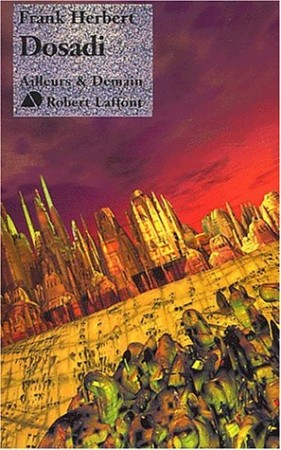
“The Dosadi Experiment” by Robert Laftont

Nominated for a Locus Award for best science fiction novel in 1978

The Dosadi Experiment takes place in the same universe as The Whipping Star, but can be read on its own.

I dipped my toes into the waters of Frank Herbert’s writing with The Dosadi Experiment. It’s been ages and ages, back in the days of the dinosaurs, so I cannot really remember what I thought, but it must have been positive because I kept on exploring Herbert’s world. I reread The Dosadi Experiment from time to time, and each time I discover new bits to love. As I change, so does my understanding of The Dosadi Experiment, and that is a sign of a classic to me.

The ConSentiency is composed of many species who have different abilities. The Taprisiots provide instant mind-to-mind communication between two minds anywhere in the universe. The Caleban provide instantaneous travel between any two points in the universe.

Our extremely intelligent and empathic Saboteur Extraordinary, Jorj X. McKie, gets an assignment that he soon discovers is probably a set-up. He is sent by the agency to Dosadi as their “best”. Compared to those already living on Dosadi, he was like an infant in swaddling clothes.

What he discovers on Dosadi is shocking in its blatant disregard of any and all ConSentiency regulation. Dosadi has been placed behind an impenetrable barrier called “The God Wall”. Humans and Gowachin have been dumped together in numbers that defy description. The planet itself is poisonous except for a narrow valley, containing the city “Chu”, containing nearly 89 million citizens.

Senior Liator Kaila Jedrik starts a war and Jorj becomes a pawn in her hope of saving the population of Dosadi.