I’m still not sure what to make of this notion (now being presented to us as an absolute fact), that women with Autism/Asperger’s Syndrome are being diagnosed less frequently, due to their apparently inherent ability to ‘mask’ their symptoms by ‘mimicking’ those around them.
There are just too many assumptions hidden within this concept that have not been deeply analyzed enough for my liking.
It almost seems like once again, we as women, are being told to turn a blind eye to any and all personal experiences that do not match up succinctly to the now, almost biblical accounts being written by psychologists, as to how women with Autism should present.
Accounts that not only seek to define our presentation, but come complete with a rationale as to why our supposedly ‘hard to spot’ tendencies have, for so long been so tricky, that it’s entirely understandable, and therefore forgivable, that…
Moon is an orphan. A 35-year-old orphan, but nevertheless. Orphans are one type of people this world has in abundance. How strange it is that we are so eager to bring children of our own genes into this world while so many live in horrendous circumstances. We humans aren’t very logical.
Finding your place in the world when you look and act different to the majority seems impossible for a child to do. Like most homeless orphans, Moon goes through some pretty traumatic experiences. Sometimes he thinks he has found his place. Then it turns out the people he lived with were only looking for cheap labor. When such labor was finished, he was tossed out. What would that do to a person? In my case, I would most likely die due to some of my autistic traits. Moon, survives any way he can.
We meet him right after the last group of people he was living with chains him up as bait for a predator. Shapeshifters that might be taken for the group of people called Fell aren’t very popular in Three Worlds.
Since this is fiction, Moon is saved just in the nick of time. When Moon discovers that the person who just saved him is like him he is stunned, angry, suspicious and afraid. Here he thought he was either a monster or all alone in the world. Then he is not. What would that do to a person?
What happens now is that Moon ends up in a society where people are like him. Except they aren’t. After all, Moon has seen a life they could not dream of. Yet again he does not fit into the mold set apart for him. But I think Wells has portrayed him perfectly. Of course, he isn’t thankful for the role these new people want him to play. Why should he be. They weren’t there when he was abused and battered. Instead, they were all learning how to fit into their society and to adhere to the rules created for each class of person. Someone who has had to make on his own isn’t going to be able to play such games. In this inability I recognize myself. But such an inability is bound to create conflict.
Add to that the Fell and Wells has created a world fraught with danger, adventure and plenty of action. Definitely recommended.
Łowcy czarnoksiężników (Polish title); translated by Sylwia Twardo
A female protagonist looking to die in what seems to be an accidental manner is a relief to meet. Wanting to die is something I experience on a regular basis so I find it nice to know that there are people in literature who feel the same way. Her death-wish is why Tremaine joins the clean-up crews after bombings and why she joins Gerard when he asks her to bring her uncle’s sphere along. Tremaine Valiarde is a woman with an unusual life up to now and it is about to enter the realm of the unexpected. She has two qualities that I really like. One is her ability to make difficult decisions quickly without needing to question her choices. The other is her ability to integrate others in her life as a matter of course. Actually, there are three qualities I really appreciate. The third is Tremaine’s ability to remain fairly clear-/ and level-headed in a crisis. When she, Florian and Gerard end up on an island in the middle of the ocean those qualities will become essential to survival.
Ilias and Giliead see it as their mission in life to hunt wizards. Their experience with wizards thus far in life has been that all wizards are insane. In Sypria being a sorcerer, wizard or even the victim of one gets you either shunned or killed. Ilias and Giliead are about to get their views challenged.
Prejudice is an interesting quality. All of our fear-attitudes are. There must be people out there who do not struggle with prejudices, but I have not met any of them yet. We get to see different types of prejudices in the people from Ile-Rien and the people from Sypria, but at heart all of their prejudices are the same. This is where Tremaine’s ability to integrate others into her life becomes especially important.
Meetings between two fairly different cultures are bound to be troublesome. But the need to fight a common enemy enables people to overcome some of the fear and cooperate. Gardier provides the role of a common enemy through their invasions of both Ile-Rien and Sypria. When survival depends upon the parties cooperating logic states that they cooperate. But reality both here in the real world and in the world of The Wizard Hunters shows that people aren’t always logical.
The Wizard Hunters is my first meeting with Martha Wells. I have had a lot of first meetings with authors over the years and not all have been as successful as this one. Definitely recommended.
“The chief psychiatrist told my parents that I couldn’t have Autism as I was sensitive, and didn’t like maths or trains and most of all, I didn’t fit the limited number of Aspies this man had treated, all of whom were boys. I gained a diagnosis of Borderline Personality Disorder – apparently a very common misdiagnosis for Asperwomen, and spent the next few years being told how dysregulated my emotions were and what a nasty manipulative little attention-seeking borderline I was.”
I am an Autistic woman. I was diagnosed with Asperger syndrome in 1994, a time when few people outside of a select group of mental health professionals knew anything about the more ‘Aspie’ part of the Autism spectrum.
When I got my diagnosis, I was told that being a woman with Autism was really rare. Most people on the Autism spectrum were boys. They lacked empathy, they did’t understand nonverbal cues, they couldn’t hold conversations, they were kind of flawed geniuses and liked maths and physics. Oh, and they all liked trains apparently, or trams and buses if they were a bit atypical. Of all these attributes, none of them involved people with Asperger’s being girls. Girls on the spectrum were – according to psychiatric wisdom – an anomaly. So I was an anomaly amongst anomalies and nobody knew anything about how to make my life better. I didn’t take…
“Given all of this, one could ask; just whose perception of ‘normal’ are we applying here and whose definition of ‘pretending’ or ‘masking’ are we using?”
It can be worn to conceal a person’s true identity for better or for worse.
The idea that Women with High Functioning Autism are not being adequately diagnosed, simply because they wear masks, also carries within it the ideation that all women with Autism intentionally try to conceal their true selves in order to ‘pass as normal’.
This in turn implies that all women with Autism willingly engage in the act of perpetrating some form of female deception which, in turn, somehow creates the inability of professionals to recognize them for who they are.
The idea that women are fiendish creatures, capable of deceiving men, is not a new one.
In fact, that particular idea is as old as humanity and has been used successfully over the course of history to deny women the same basic human rights and considerations as men.
White privilege and male privilege are terms that we in the West are familiar with.
“whites are taught to think of their lives as morally neutral, normative, and average, and also ideal” (Elizabeth Minnich)
The same goes for our patriarchal societies.
In the world of Nikki Glass this is true. Her old and regular life is is part of average US patriarchy where some people are more equal than others. In her new reality with Descendants of Gods turning up all over the place the most equal people are these Descendants. Nikki fell into that life by accident, although the others Descendants seem to have trouble accepting that fact.
In the US, the two largest groups of these Descendants are the Liberi Deorum and the Olympians. Both groups are immortal. They can be killed but that takes a lot of effort and the right kind of killer. Which is how Nikki accidentally became one. She happened to be a descendant who killed a Descendant. Intentional or not, the seed of immortality then passed to her.
I’ve often wondered at the appeal of immortality. Hell, I often wonder why people feel the need to stretch out their lives as long as medically possible. Neither seems very logical to me. Immortality would have to change you immensely as a person. Once all of your original bonds have died, who do you then become? Add to that the side-effects of your new identity and you might even have been the reason your old friends have died. Death-gods, gods of the hunt, trickster gods and war gods all seem to have death as a common problem. How would you contain the desire to cause destruction and mayhem? At what point do regular humans become insignificant to whatever long-term goals you might have?
No wonder the immortals think they deserve preferential treatment. Because Nikki is still a new entry into this life, her bonds to the regular world are strong. Her adoptive parents and adoptive sister are all alive and care a great deal about Nikki’s well-being. Because of her foster-home background Nikki has always been close-mouthed about her life. Talking about her new status is not something she cares to do, but circumstances ignore any such desires. Close-mouthed or not, the truth will out.
I likedDark Descendant by Jenna Black. It was fun, funny and full of near-death experiences.
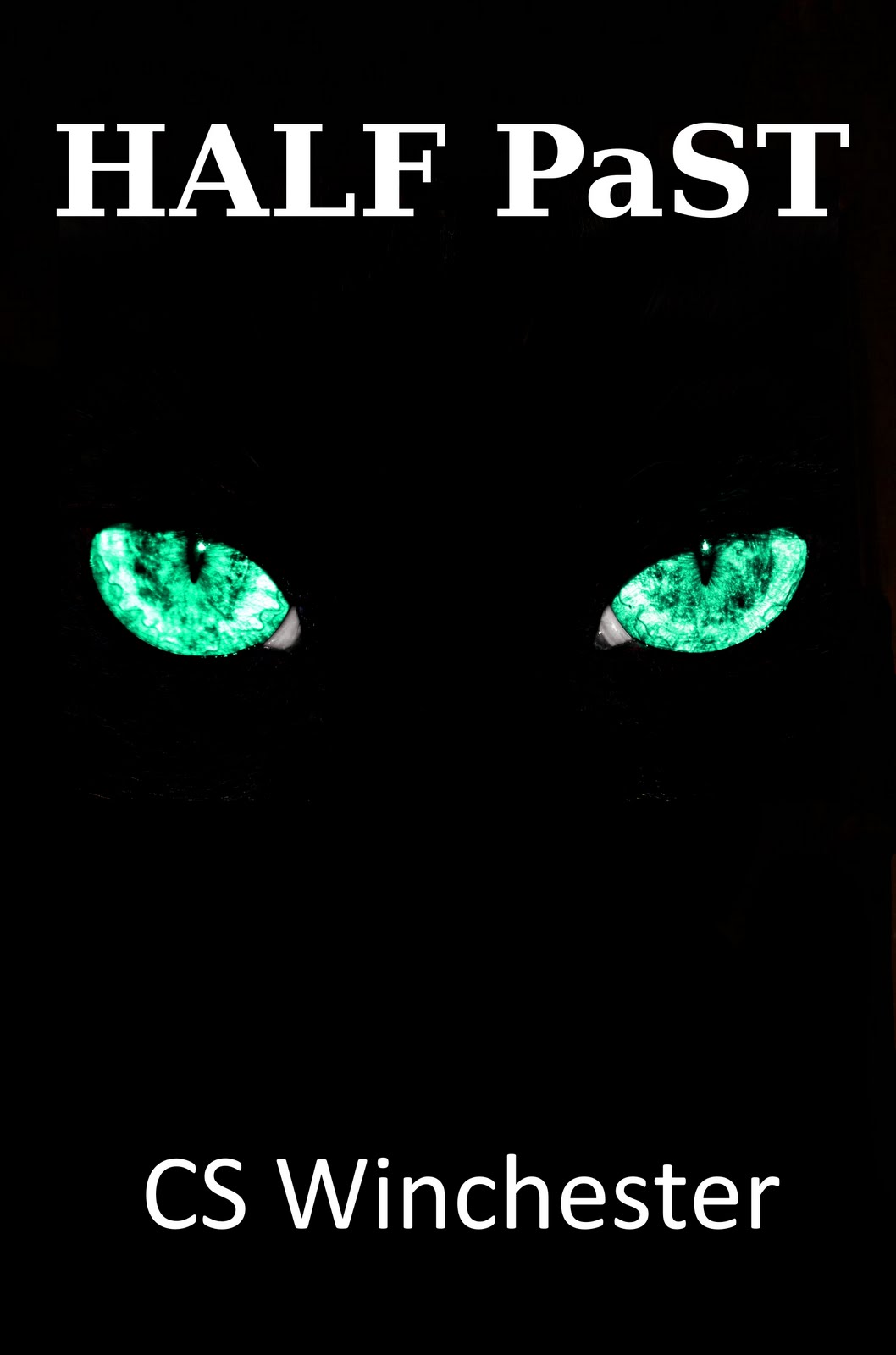
Thankfully, Half Pastdid not become mushy. Romance is fine. Once it becomes the focus of the story and reaches into bizarro-land I become confused and hope that no one actually has to go through that kind of stuff. There was romance in Half Past. Maybe romance is the wrong word. This is a confusing field for me. Frankie made decisions about her life that included Alex and Josh. Alex made a decision about himself and Frankie that stank to high heaven. Josh made a decision about his life that increased Frankie’s understanding of her feelings and value.
CS Winchester‘s vampires are far from glittery. These vampires are predatory creatures who do not hold back from what they deem necessary violence. Once a person has lived centuries their views on ethics and morals are bound to differ from whatever the fashionable view might be. Josh is the kind of person who can rip off a person’s head. He is also the kind of person who is willing to take in those in need of protection.
Frankie Wright’s powers are growing. She has a little more control over them now and is better able to use those powers to help the people around her. You see, Frankie suffers from an empathetic personality. Even though a person has been a complete dufus toward her, she has the ability to see that person’s suffering and need. Perhaps this has something to do with her psychic abilities. Or it could just be that Frankie is a pretty decent kind of person. Being decent doesn’t stop her from protecting society from the dangers the supernatural community might pose. I like Frankie. At times I find her annoying – like the people around her also do. It’s interesting being able to empathize with a fictional character’s compatriots.
I’m not sure what I think of Alex. He is seriously patronizing and seems to think that he owns Frankie. 700 years ago – when he began life – he would have. I wonder what it must be like to have to adjust to changing morals and ethics over and over again. I wonder if you would get to a point where you become stuck and lose the ability to fit in.
Half Past was a fun story with plenty of action, silliness and just a little bit of romance. I look forward to reading the next in line.
Rock group U2 femulating for the One video, 1991; From femulate.org; photographer, David Wojnarowicz
Dear Miriam,
The other day I set off for work, leaving my husband in the house watching the TV as usual. I hadn’t gone a hundred yards down the road when my engine conked out and the car juddered to a halt. I walked back home get my husbands help. When I got home I found him in the bedroom. I couldn’t believe my eyes. He was parading in front of the wardrobe mirror dressed in my underwear and high heel shoes, and he was wearing my make up.
I am 32, my husband is 34, and we have been married for 12 years. When I confronted him, he tried to make out that he had dressed up in my lingerie because he couldn’t find any of his own underwear. But when I asked him about the makeup, he broke down and admitted that he has been wearing my clothes for six months. I told him it had to stop, I would leave him.
He was made redundant from his job six month ago, and he says he has been feeling increasingly depressed and worthless. I love him very much, but ever since I gave him the ultimatum, he has become increasingly distant, and I don’t feel I can get through to him any more. Please can you help?
Mrs. B., Essex
Miriam says…
A car stalling after being driven a short distance can be caused by a variety of faults in the engine. Start by checking that there is no debris in the fuel line. If it is clear, check the jubilee clips holding the vacuum pipes onto the inlet manifold. If none of these approaches solves the problem, it could be that the fuel pump itself is faulty, causing low delivery pressure to the carburettor float chamber.
The process of getting ready to post this funny is a typical example of how my asperger mind works (i.e. speaking only for myself and not all aspergers).
After learning a little about copyrighting and all of that stuff, a great need has risen in me to find the original source of material.
With my funnies I try to look for pictures that will illustrate the subject. In the case of Dear Miriam I was taken on a journey of discovery.
Hilarious discussions of the correctness of the advice. Did Miriam really know what she was talking about when it came to car problems? There are some funny people out there.
Then a more serious side appeared, one that U2 illustrate. Men in women’s clothing. I realized I still a a ways to go in understanding the complexity of boy/girl roles and what we find acceptable in each other.
So, what was only a funny to begin with has become (for me) something that represents a deeper and much fought over issue in society.
The Hobby Lobby decision by the Supreme Court in the USA has the potential of being a decision that will impact not only them but other countries as well. Dylan Greene’s essay on the subject is amazing.
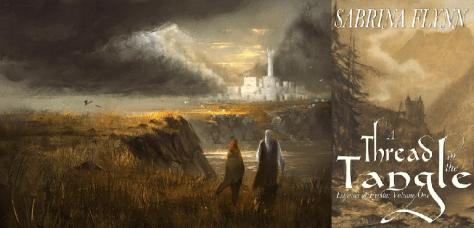
A Thread in the Tangle can be read by itself. Although the ending was abrupt and clearly meant as a cliff-hanger, the dilemma of the story was resolved.
“No, absolutely not,” Sotaen said shaking his head. “The nymphling is worth far too much. You’re nothing but a barbarian. How do I know you won’t sell her yourself, or take her for yourself when she come of age? Your fondness for women and debts are well known in my court.”
Isiilde is the nymphling Emperor Sotaen and Wise One Oenghus are talking about. Nymphlings are coveted by men, raped by men and forcibly married away to the highest bidder.
Our own world is not much different from the world of Fyrsta in that regard. Selling women into marriage is still a common practice. Slavery is a condition millions of people suffer through today as well. Having to live with the knowledge that your life is not your own and that at any time anything can happen to you if your owner wills it so must be gruesome. Slaves of old have shared their experiences with the world.
At four Isiilde doesn’t quite realize what it entails to be considered an object in the world of wealth. But she will learn.
Thankfully, her allies are powerful and devoted. Oenghus has reasons of his own for protecting Isiilde so fiercely. Her other ally is also a Wise One and the Archlord of the Isle all in one person. Marsais allows the two to live on the Isle under the protection of the Wise Ones until Isiilde comes of age.
Marsais and Oenghus are old friends. They both stand against the Void and the terrors it can unleash. Now their mission is to make Isiilde’s life as good as it can be until it is time for the bidding to begin. A Thread in the Tangle is full of humor and welcome relief from what lies in the future. Isiilde’s less than stellar ability to focus on anything for more than 5 seconds at a time gets her into trouble time and again. Good thing she is Marsais’ apprentice.
Being a nymph is a challenge in the world Isiilde is born into. Where once upon a time they had been revered for their connection with nature, they were now seen as sex-toys for the wealthy. Once the Guardians had defined them as less than sentient, it was a free-for all with regard to sexual abuse. When Isiilde learns of that history from the MUCH older Marsais she is angry.
I found the idea of a tooth fetish funny. What a cool creature Flynn introduced into her story along with that fetish.
A Thread in the Tangle fit me. There were some hiccups, but I see that other reviewers have addressed those. Flynn managed to combine humor, tension, sadness and magic into a world that I stayed in all night to finish.
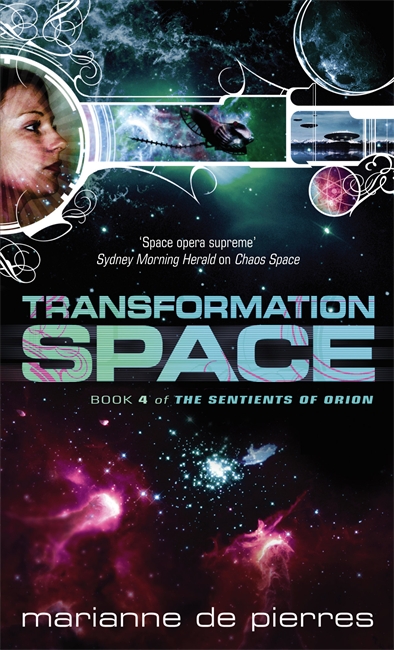
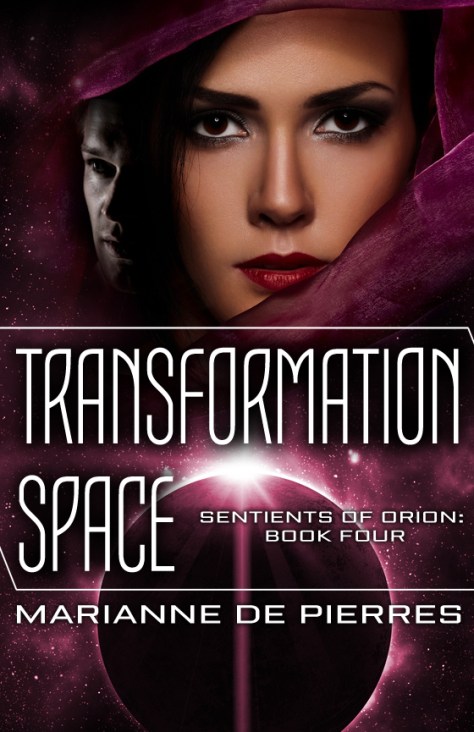
I haven’t really liked the other covers of the series that are like the one above. Nor have I liked the ones similar to the one below. But in the case of Transformation Space both covers have appealed to me. The bottom one is because of the eyes of the main model. In the above cover I love the details that reveal themselves as I review the picture along with the color combination.
Dum, da, rah, dum! The end is here.
Like this … Nova projected a grave melancholia, a vast emptiness without end that made Mira want to weep.
<you know this? little one?>
We all know. Do you feel it too?
According to answers.com the definition of melancholia is:
Melancholia brings about a form of pessimism that sees the future as blocked and unchangeable. Such pessimism is accompanied by ideas of guilt and unworthiness, which find expression through self-accusation and can even give rise to delusion. …. Mental suffering engenders a continual desire for death.
How far would we be willing to go to get out of our melancholia? At what point does the melancholia cause us to tip over the boundary of no, nos? There are plenty of stories out there about just what happens to people who end up in this valley of bleakness in their attempts to relieve the pain.
The lovely thing about fiction is that the author gets to explore such subjects. The serial Sentients of Orion has explored the issue of how far one particular non-humanesque is willing to go in order to relieve its melancholia. Because its motivations and background is foreign and more or less unknown to us, we only get to see the effects of trying to relieve its pain.
The Sacqr are one of those effects. You know, the Sacqr are seriously bad-ass. Nothing kills them, except maybe something really big stepping on them. Weapons seem to have no effect and their voraciousness has no limit. Even Rast Randall is scared shit-less by them, and Rast does not frighten easily. Being kept sensory deprived on the Post-Species vessel almost broke her but she pulled through and used her resilience to help keep the three survivors of that trip alive through Sacqr fun:
Jo-Jo’s muscles twitched with an uncontrollable desire to spring at the creature. Attack it before it could find him, surprise and aggression as his weapon. Not crouch here, shitting his pants, waiting for its maw to open and the bone-piercing stamen to extend down and skewer his skull.
Jo-Jo remembered how it was: ‘esque bodies flung across the floor of the food court on Dowl, Sacqr gorging on their body fluids. The adrenaline that had poured through him then now threatened to overcome his self-control, but Randall kept steady pressure on his head, pressing so hard that the pain across the bridge of his nose began to overshadow his fear.
How much garbage do you have to wade through in your life to be able to keep your cool in such a situation? There are people out there who go through similar experiences every day. Syria, Sudan and Eastern Burma spring to mind. Not much fun living there these days and I imagine what they have experienced is close to what the people of Araldis went through as it was invaded. Rast Randall had fought in plenty of conflicts/wars in her capacity as a mercenary leaving her with the tools to possibly survive what the Sacqr had to dish out.
I found myself admiring the inner strength Thales was able to dig up during Transformation Space. When I first got to know him, Thales seemed afraid of his own shadow. Yet by the end of the tale of the Sentients of Orion Thales emerges as a person who has discovered who and what he is and what price he is willing to pay to remain that person. That journey is one we all need to make. Some of us do. Some of us don’t.
Once again Marianne de Pierres caught me in the trap of her words and would not release me until Transformation Space was a done deal.
Contrary to popular belief, most mammals do not menstruate. In fact,it’s a feature exclusive to the higher primates and certain bats*. What’s more, modern women menstruate vastly more than any other animal. And it’s bloody stupid (sorry). A shameful waste of nutrients, disabling, and a dead giveaway to any nearby predators. To understand why we do it, you must first understand that youhave been lied to, throughout your life, about the most intimate relationship you will ever experience: the mother-fetus bond.
Source: Parenting with love
Isn’t pregnancy beautiful? Look at any book about it. There’s the future mother, one hand resting gently on her belly. Her eyes misty with love and wonder. You sense she will do anything to nurture and protect this baby. And when you flip open the book, you read about more about this glorious symbiosis, the absolute altruism of female physiology designing a perfect environment for the growth of her child.If you’ve actually been pregnant, you might know that the real story has some wrinkles. Those moments of sheer unadulterated altruism exist, but they’re interspersed with weeks or months of overwhelming nausea, exhaustion, crippling backache, incontinence, blood pressure issues and anxiety that you’ll be among the 15% of women who experience life-threatening complications.
From the perspective of most mammals, this is just crazy. Most mammals sail through pregnancy quite cheerfully, dodging predators and catching prey, even if they’re delivering litters of 12. So what makes us so special? The answer lies in our bizarre placenta. In most mammals, the placenta, which is part of the fetus, just interfaces with the surface of the mother’s blood vessels, allowing nutrients to cross to the little darling. Marsupials don’t even let their fetuses get to the blood: they merely secrete a sort of milk through the uterine wall. Only a few mammalian groups, including primates and mice, have evolved what is known as a “hemochorial” placenta, and ours is possibly the nastiest of all.
Source: Colorado State University
Inside the uterus we have a thick layer of endometrial tissue, which contains only tiny blood vessels. The endometrium seals off our main blood supply from the newly implanted embryo. The growing placenta literally burrows through this layer, rips into arterial walls and re-wires them to channel blood straight to the hungry embryo. It delves deep into the surrounding tissues, razes them and pumps the arteries full of hormones so they expand into the space created. It paralyzes these arteries so the mother cannot even constrict them.
What this means is that the growing fetus now has direct, unrestricted access to its mother’s blood supply. It can manufacture hormones and use them to manipulate her. It can, for instance, increase her blood sugar, dilate her arteries, and inflate her blood pressure to provide itself with more nutrients. And it does. Some fetal cells find their way through the placenta and into the mother’s bloodstream. They will grow in her blood and organs, and even in her brain, for the rest of her life, making her a genetic chimera**.
Cell free fetal DNA shedding into maternal bloodstream | Source: Wikipedia commons
This might seem rather disrespectful. In fact, it’s sibling rivalry at its evolutionary best. You see, mother and fetus have quite distinct evolutionary interests. The mother ‘wants’ to dedicate approximately equal resources to all her surviving children, including possible future children, and none to those who will die. The fetus ‘wants’ to survive, and take as much as it can get. (The quotes are to indicate that this isn’t about what they consciously want, but about what evolution tends to optimize.)
There’s also a third player here – the father, whose interests align still less with the mother’s because her other offspring may not be his. Through a process called genomic imprinting, certain fetal genes inherited from the father can activate in the placenta. These genes ruthlessly promote the welfare of the offspring at the mother’s expense.
How did we come to acquire this ravenous hemochorial placenta which gives our fetuses and their fathers such unusual power? Whilst we can see some trend toward increasingly invasive placentae within primates, the full answer is lost in the mists of time. Uteri do not fossilize well.
The consequences, however, are clear. Normal mammalian pregnancy is a well-ordered affair because the mother is a despot. Her offspring live or die at her will; she controls their nutrient supply, and she can expel or reabsorb them any time. Human pregnancy, on the other hand, is run by committee – and not just any committee, but one whose members often have very different, competing interests and share only partial information. It’s a tug-of-war that not infrequently deteriorates to a tussle and, occasionally, to outright warfare. Many potentially lethal disorders, such as ectopic pregnancy, gestational diabetes, and pre-eclampsia can be traced to mis-steps in this intimate game.
What does all this have to do with menstruation? We’re getting there.
From a female perspective, pregnancy is always a huge investment. Even more so if her species has a hemochorial placenta. Once that placenta is in place, she not only loses full control of her own hormones, she also risks hemorrhage when it comes out. So it makes sense that females want to screen embryos very, very carefully. Going through pregnancy with a weak, inviable or even sub-par fetus isn’t worth it.
Endometrium | Source: Wikipedia Commons
That’s where the endometrium comes in. You’ve probably read about how the endometrium is this snuggly, welcoming environment just waiting to enfold the delicate young embryo in its nurturing embrace. In fact, it’s quite the reverse. Researchers, bless their curious little hearts, have tried to implant embryos all over the bodies of mice. The single most difficult place for them to grow was – the endometrium.
Far from offering a nurturing embrace, the endometrium is a lethal testing-ground which only the toughest embryos survive. The longer the female can delay that placenta reaching her bloodstream, the longer she has to decide if she wants to dispose of this embryo without significant cost. The embryo, in contrast, wants to implant its placenta as quickly as possible, both to obtain access to its mother’s rich blood, and to increase her stake in its survival. For this reason, the endometrium got thicker and tougher – and the fetal placenta got correspondingly more aggressive.
But this development posed a further problem: what to do when the embryo died or was stuck half-alive in the uterus? The blood supply to the endometrial surface must be restricted, or the embryo would simply attach the placenta there. But restricting the blood supply makes the tissue weakly responsive to hormonal signals from the mother – and potentially more responsive to signals from nearby embryos, who naturally would like to persuade the endometrium to be more friendly. In addition, this makes it vulnerable to infection, especially when it already contains dead and dying tissues.
The solution, for higher primates, was to slough off the whole superficial endometrium – dying embryos and all – after every ovulation that didn’t result in a healthy pregnancy. It’s not exactly brilliant, but it works, and most importantly, it’s easily achieved by making some alterations to a chemical pathway normally used by the fetus during pregnancy. In other words, it’s just the kind of effect natural selection is renowned for: odd, hackish solutions that work to solve proximate problems. It’s not quite as bad as it seems, because in nature, women would experience periods quite rarely – probably no more than a few tens of times in their lives between lactational amenorrhea and pregnancies***.
We don’t really know how our hyper-aggressive placenta is linked to the other traits that combine to make humanity unique. But these traits did emerge together somehow, and that means in some sense the ancients were perhaps right. When we metaphorically ‘ate the fruit of knowledge’ – when we began our journey toward science and technology that would separate us from innocent animals and also lead to our peculiar sense of sexual morality – perhaps that was the same time the unique suffering of menstruation, pregnancy and childbirth was inflicted on women. All thanks to the evolution of the hemochorial placenta.
We can make an estimate from studies of the Hadza of Tanzania, who reach puberty around 18, bear an average of 6.2 children in their lives (plus 2-3 noticeable miscarriages) starting at 19, and go through menopause at about 43 if they survive that long (about 50% don’t). Around 20% of babies die in their first year; the remainder breastfeed for about 4 years. So this is 25 years of reproductive life, of which about 20 are spent lactating, and 4.5 pregnant. That would leave only about 6 periods, but amenorrhoea would cease during the last year of lactation for each child, so this figure is too low. On the other hand, this calculation ignores the ~50% of women who died before menopause, miscarriages, months spent breastfeeding infants who would die, and periods of food scarcity, all of which would further reduce lifetime menstruation. Stats from: www.fas.harvard.edu/%7Ehbe-lab/acrobatfiles/who%20tends%20hadza%20children.pdf
The end of Dark Space has left Mira pregnant, raped by Trin so he could ensure his progeny with a pure-blood noble from Araldis. Rast states it so well
“Women get raped,” said Rast harshly, her pale skin flushed with emotion. “Sometimes in war, sometimes just for the hell of it. That’s what happens.” She gripped Mira’s wrist and pulled her close. Then she hugged her tightly for a long moment.
“We’ll get your world back for you, Baronessa. But tell me something: are you sure you really want it?”
Not only did Trin rape Mira and send her off-planet to get help. While staying behind he makes certain to besmirch Mira’s reputation by claiming that she has run off. For Trin does not want Mira to become more popular than he. After all, that might endanger his own shot at becoming Principe after the war.
War, ambition, greed, death.
Trin is more concerned with saving his men than with saving the population of Araldis. Cass Mulravey sees that he has no clue that if he wishes to rebuild his world, he will need women to bear children. The two of them are at odds through all of Chaos Space. Only Djeserit’s attempts to broker a peace between them keeps them from open dispute. Until Trin has managed to finagle the loyalty of the women who have followed Cass, he has to at least give the appearance of working for the greater good. Perhaps all of this pretending will turn to true behavior eventually???
We find out who Djeserit’s mother is. Oh, dear! Poor girl. None of us choose our own parents, but some of us are left with worse parents than others. Bethany Farr is no ideal mother. She seems to have repented of sending Djeserit off and now wants to save Djeserit and thereby Aldaris. But will Bethany carry through or perhaps only work towards the redemption of her daughter until her next “love” comes along??
Insignia, the biozoon carrying Mira, turns out to have an agenda of its own. The vessel has repeatedly tried to get Mira to understand that it does not care about humanesques in general, only the ones with which it can communicate. When its contract with the Fedor clan runs out in the middle of an escape, Mira fully comes to understand how true and real that is.
Mira is one severely traumatized person who is thrown from one chaotic episode to the next. Needing to make decisions pronto goes against her socialization, and tearing herself loose from that socialization is incredibly painful for her. In Dark Space Mira learned to handle a gun, something that was forbidden to the upper-class women. In Chaos Space she has to learn to see through the fallacies of her traditions. Having worked my way out of fundamentalism, makes it easy for me to relate to what Mira must have gone through. Being brought up in a society where women are taught from a young age that they are less and also taught how to internalize this tradition and accept it as right and proper makes the reach through the fog of indoctrination severely painful and self-actualizing. Mira is forced to grow once she makes the choice to make her way through her fog and grow she does.
Asking for help is more complicated than Mira had thought. Naively, Mira had expected that explaining her planet’s situation to OLOSS would bring OLOSS to the rescue. But OLOSS is concerned with what is in it for them and want to get hold of Insignia so they can study it. Having read something about the history of our own world this concern with profit in the face of aid is nothing new. In fact, I wonder if the need to profit from another person’s tragedy is embedded in the human psyche?
DePierres’ writing is as riveting in Chaos Space as it was in Dark Space. Again I found myself struggling to stop reading.
Being the kind of person I am, I had to gather as much information as I could on Long Lankin when I reviewed the novel by the same name. Horror tales were popular in the good ol’ days as well as today.
.
Belinkin and the nurse are two extremely frightening people who “had it coming” when IT came.
Kilbryde Parish Church; Credit: University of St. Andrews
Tores. The projections or knobs at the corners of old-fashioned cradles, and the ornamented balls commonly found surmounting the backs of old chairs. Motherwell.
——————————————————–
Other names that this lay is know by: Lammerlinkin, Lammikin, Lamkin, Lankin, Linkin, Belinkin, Long Lankin, Lantin, Long Lankyn or Longkin, Rankin or Balcanqual.








 humanitysdarkerside