Sadedin, Suzanne: How the Woman got her Period (Quora, 2014)

Jean-Christophe Lousse, Jacques Donnez Laparoscopic observation of spontaneous human ovulation. Fertil. Steril.: 2008, 90(3);833-4 PMID:18440526

HOW THE WOMAN GOT HER PERIOD

Contrary to popular belief, most mammals do not menstruate. In fact,it’s a feature exclusive to the higher primates and certain bats*. What’s more, modern women menstruate vastly more than any other animal. And it’s bloody stupid (sorry). A shameful waste of nutrients, disabling, and a dead giveaway to any nearby predators. To understand why we do it, you must first understand that youhave been lied to, throughout your life, about the most intimate relationship you will ever experience: the mother-fetus bond.

pregnant-women
Source: Parenting with love

Isn’t pregnancy beautiful? Look at any book about it. There’s the future mother, one hand resting gently on her belly. Her eyes misty with love and wonder. You sense she will do anything to nurture and protect this baby. And when you flip open the book, you read about more about this glorious symbiosis, the absolute altruism of female physiology designing a perfect environment for the growth of her child.If you’ve actually been pregnant, you might know that the real story has some wrinkles. Those moments of sheer unadulterated altruism exist, but they’re interspersed with weeks or months of overwhelming nausea, exhaustion, crippling backache, incontinence, blood pressure issues and anxiety that you’ll be among the 15% of women who experience life-threatening complications.

From the perspective of most mammals, this is just crazy. Most mammals sail through pregnancy quite cheerfully, dodging predators and catching prey, even if they’re delivering litters of 12. So what makes us so special? The answer lies in our bizarre placenta. In most mammals, the placenta, which is part of the fetus, just interfaces with the surface of the mother’s blood vessels, allowing nutrients to cross to the little darling. Marsupials don’t even let their fetuses get to the blood: they merely secrete a sort of milk through the uterine wall. Only a few mammalian groups, including primates and mice, have evolved what is known as a “hemochorial” placenta, and ours is possibly the nastiest of all.

Hemochorial placenta a disadvantage for humans
Source: Colorado State University

Inside the uterus we have a thick layer of endometrial tissue, which contains only tiny blood vessels. The endometrium seals off our main blood supply from the newly implanted embryo. The growing placenta literally burrows through this layer, rips into arterial walls and re-wires them to channel blood straight to the hungry embryo. It delves deep into the surrounding tissues, razes them and pumps the arteries full of hormones so they expand into the space created. It paralyzes these arteries so the mother cannot even constrict them.

What this means is that the growing fetus now has direct, unrestricted access to its mother’s blood supply. It can manufacture hormones and use them to manipulate her. It can, for instance, increase her blood sugar, dilate her arteries, and inflate her blood pressure to provide itself with more nutrients. And it does. Some fetal cells find their way through the placenta and into the mother’s bloodstream. They will grow in her blood and organs, and even in her brain, for the rest of her life, making her a genetic chimera**.

Cell free fetal DNA shedding into maternal bloodstream | Source: Wikipedia commons
Cell free fetal DNA shedding into maternal bloodstream |
Source: Wikipedia commons

This might seem rather disrespectful. In fact, it’s sibling rivalry at its evolutionary best. You see, mother and fetus have quite distinct evolutionary interests. The mother ‘wants’ to dedicate approximately equal resources to all her surviving children, including possible future children, and none to those who will die. The fetus ‘wants’ to survive, and take as much as it can get. (The quotes are to indicate that this isn’t about what they consciously want, but about what evolution tends to optimize.)

There’s also a third player here – the father, whose interests align still less with the mother’s because her other offspring may not be his. Through a process called genomic imprinting, certain fetal genes inherited from the father can activate in the placenta. These genes ruthlessly promote the welfare of the offspring at the mother’s expense.

How did we come to acquire this ravenous hemochorial placenta which gives our fetuses and their fathers such unusual power? Whilst we can see some trend toward increasingly invasive placentae within primates, the full answer is lost in the mists of time. Uteri do not fossilize well.

The consequences, however, are clear. Normal mammalian pregnancy is a well-ordered affair because the mother is a despot. Her offspring live or die at her will; she controls their nutrient supply, and she can expel or reabsorb them any time. Human pregnancy, on the other hand, is run by committee – and not just any committee, but one whose members often have very different, competing interests and share only partial information. It’s a tug-of-war that not infrequently deteriorates to a tussle and, occasionally, to outright warfare. Many potentially lethal disorders, such as ectopic pregnancy, gestational diabetes, and pre-eclampsia can be traced to mis-steps in this intimate game.

What does all this have to do with menstruation? We’re getting there.

From a female perspective, pregnancy is always a huge investment. Even more so if her species has a hemochorial placenta. Once that placenta is in place, she not only loses full control of her own hormones, she also risks hemorrhage when it comes out. So it makes sense that females want to screen embryos very, very carefully. Going through pregnancy with a weak, inviable or even sub-par fetus isn’t worth it.

Endometrium | Source: Wikipedia Commons

That’s where the endometrium comes in. You’ve probably read about how the endometrium is this snuggly, welcoming environment just waiting to enfold the delicate young embryo in its nurturing embrace. In fact, it’s quite the reverse. Researchers, bless their curious little hearts, have tried to implant embryos all over the bodies of mice. The single most difficult place for them to grow was – the endometrium.

Far from offering a nurturing embrace, the endometrium is a lethal testing-ground which only the toughest embryos survive. The longer the female can delay that placenta reaching her bloodstream, the longer she has to decide if she wants to dispose of this embryo without significant cost. The embryo, in contrast, wants to implant its placenta as quickly as possible, both to obtain access to its mother’s rich blood, and to increase her stake in its survival. For this reason, the endometrium got thicker and tougher – and the fetal placenta got correspondingly more aggressive.

But this development posed a further problem: what to do when the embryo died or was stuck half-alive in the uterus? The blood supply to the endometrial surface must be restricted, or the embryo would simply attach the placenta there. But restricting the blood supply makes the tissue weakly responsive to hormonal signals from the mother – and potentially more responsive to signals from nearby embryos, who naturally would like to persuade the endometrium to be more friendly. In addition, this makes it vulnerable to infection, especially when it already contains dead and dying tissues.

The solution, for higher primates, was to slough off the whole superficial endometrium – dying embryos and all – after every ovulation that didn’t result in a healthy pregnancy. It’s not exactly brilliant, but it works, and most importantly, it’s easily achieved by making some alterations to a chemical pathway normally used by the fetus during pregnancy. In other words, it’s just the kind of effect natural selection is renowned for: odd, hackish solutions that work to solve proximate problems. It’s not quite as bad as it seems, because in nature, women would experience periods quite rarely – probably no more than a few tens of times in their lives between lactational amenorrhea and pregnancies***.

We don’t really know how our hyper-aggressive placenta is linked to the other traits that combine to make humanity unique. But these traits did emerge together somehow, and that means in some sense the ancients were perhaps right. When we metaphorically ‘ate the fruit of knowledge’ – when we began our journey toward science and technology that would separate us from innocent animals and also lead to our peculiar sense of sexual morality – perhaps that was the same time the unique suffering of menstruation, pregnancy and childbirth was inflicted on women. All thanks to the evolution of the hemochorial placenta.

Suzanne Sadedin, PhD in Zoology from Monash University.
Links:
The evolution of menstruation: A new model for genetic assimilation
Genetic conflicts in human pregnancy.
Menstruation: a nonadaptive consequence of uterin… [Q Rev Biol. 1998]
Natural Selection of Human Embryos: Decidualizing Endometrial Stromal Cells Serve as Sensors of Embryo Quality upon Implantation
Credits: During my pregnancy I was privileged to audit a class at Harvard University by the eminent Professor David Haig, whose insight underlies much of this research. Thanks also to Edgar A. Duenez-Guzman, who reminded me of crucial details. All errors are mine alone.
* Dogs undergo vaginal bleeding, but do not menstruate. Elephant shrews were previously thought to menstruate, but it’s now believed that these events were most likely spontaneous abortions.
** Scientists Discover Children’s Cells Living in Mothers’ Brains (Thanks to Robyn Adair for the link).
*** I initially said 7-10 times based on my course notes, but haven’t been able to source that statistic so I’m assuming I misheard. One older published estimate for hunter gatherers was around 50, but this relied on several assumptions that suggest it’s a significant over-estimate. In particular, it includes 3 whole years of menstruation before reproduction (36 periods) for no obvious reason.

We can make an estimate from studies of the Hadza of Tanzania, who reach puberty around 18, bear an  average of 6.2 children in their lives (plus 2-3 noticeable miscarriages) starting at 19, and go  through menopause at about 43 if they survive that long (about 50%  don’t). Around 20% of babies die in their first year; the remainder  breastfeed for about 4 years. So this is 25 years of reproductive life, of which about 20 are spent lactating, and 4.5 pregnant. That would leave only about 6 periods, but amenorrhoea would cease during the last year of lactation for each child, so this figure is too low. On the other hand,  this calculation ignores the ~50% of women who died before menopause,  miscarriages, months spent breastfeeding infants who would die, and periods of food scarcity, all of which would further reduce lifetime  menstruation. Stats from: www.fas.harvard.edu/%7Ehbe-lab/acrobatfiles/who%20tends%20hadza%20children.pdf


Photographs added by humanitysdarkerside
dePierres, Marianne: Chaos Space (The Sentients of Orion II) (2008)

The Sentients of Orion - Marianne dePierres
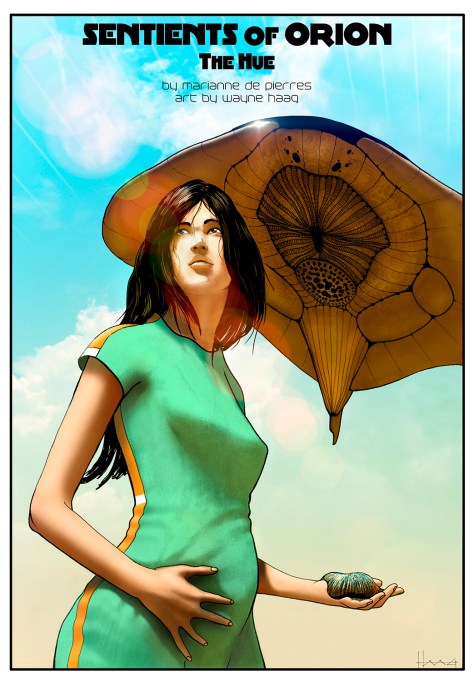
Cover art by Wayne Haag

The end of Dark Space has left Mira pregnant, raped by Trin so he could ensure his progeny with a pure-blood noble from Araldis. Rast states it so well

“Women get raped,” said Rast harshly, her pale skin flushed with emotion. “Sometimes in war, sometimes just for the hell of it. That’s what happens.” She gripped Mira’s wrist and pulled her close. Then she hugged her tightly for a long moment.

“We’ll get your world back for you, Baronessa. But tell me something: are you sure you really want it?”

Not only did Trin rape Mira and send her off-planet to get help. While staying behind he makes certain to besmirch Mira’s reputation by claiming that she has run off. For Trin does not want Mira to become more popular than he. After all, that might endanger his own shot at becoming Principe after the war.

War, ambition, greed, death.

Trin is more concerned with saving his men than with saving the population of Araldis. Cass Mulravey sees that he has no clue that if he wishes to rebuild his world, he will need women to bear children. The two of them are at odds through all of Chaos Space. Only Djeserit’s attempts to broker a peace between them keeps them from open dispute. Until Trin has managed to finagle the loyalty of the women who have followed Cass, he has to at least give the appearance of working for the greater good. Perhaps all of this pretending will turn to true behavior eventually???

We find out who Djeserit’s mother is. Oh, dear! Poor girl. None of us choose our own parents, but some of us are left with worse parents than others. Bethany Farr is no ideal mother. She seems to have repented of sending Djeserit off and now wants to save Djeserit and thereby Aldaris. But will Bethany carry through or perhaps only work towards the redemption of her daughter until her next “love” comes along??

Insignia, the biozoon carrying Mira, turns out to have an agenda of its own. The vessel has repeatedly tried to get Mira to understand that it does not care about humanesques in general, only the ones with which it can communicate. When its contract with the Fedor clan runs out in the middle of an escape, Mira fully comes to understand how true and real that is.

Mira is one severely traumatized person who is thrown from one chaotic episode to the next. Needing to make decisions pronto goes against her socialization, and tearing herself loose from that socialization is incredibly painful for her. In Dark Space Mira learned to handle a gun, something that was forbidden to the upper-class women. In Chaos Space she has to learn to see through the fallacies of her traditions. Having worked my way out of fundamentalism, makes it easy for me to relate to what Mira must have gone through. Being brought up in a society where women are taught from a young age that they are less and also taught how to internalize this tradition and accept it as right and proper makes the reach through the fog of indoctrination severely painful and self-actualizing. Mira is forced to grow once she makes the choice to make her way through her fog and grow she does.

Asking for help is more complicated than Mira had thought. Naively, Mira had expected that explaining her planet’s situation to OLOSS would bring OLOSS to the rescue. But OLOSS is concerned with what is in it for them and want to get hold of Insignia so they can study it. Having read something about the history of our own world this concern with profit in the face of aid is nothing new. In fact, I wonder if the need to profit from another person’s tragedy is embedded in the human psyche?

DePierres’ writing is as riveting in Chaos Space as it was in Dark Space. Again I found myself struggling to stop reading.


Reviews:


Chaos Space on Amazon US


My review of Dark Space

Bradford, Owyn: “Get your exit letter, see what freedom’s done!”

A satirical look at belief by one of my friends

1) “If you want earrings count ’em one, two three,
if you want to wear no skivvies just like me,
if you want to drink a beer when the day is hot,
then a Godforsaken Mormon is what you are not.”

Chorus:

Count the restrictions, what you cannot do,
worse than a baconburger if you are a Jew,
give your money, do your tasks, wear a suit and tie,
or in the outer darkness you are gonna cry.

2) Don’t touch your little factory, don’t you date a black,
or from the good ol’ bishie you will take some flak,
Shouldn’t show your shoulders or go in the lake –
that’s the devil’s hangout, for goodness’ sake!

Chorus:

3) Funeral potatoes, oh my heck,
all that flippin’ stuff makes my hips a wreck!
Fast Sunday makes me hungry but what is worse
is kiddie testimonies, oh what a curse!

Chorus:

4) They stammer and they lisp that the chuwch is two
but it sure don’t cut the ice with me or you.
If you’ve had it up to here and “Enough!” you say,
than write that flippin’ letter and do it today!

Chorus:

5) They take our hard earned cash and they build a mall,
but if we are in need, who’re we to call?
There’s money for investments and for the Brethren too,
but there is nothing but frustration for me and you!

Chorus:

6) Count your aggravations, count them one by one,
then pack your bag, my friend, and prepare…to…run!
Count your aggravations, count them one by one,
then pack your bag, my friend, and prepare…to…run!

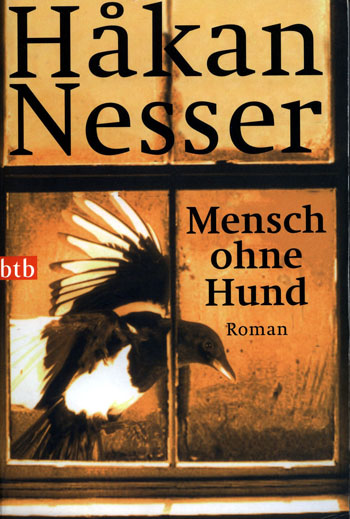
Nesser: Håkan: Männikska utan hund (Barbarotti series) (2006)

Illustration by Getty Images; Cover by Jan Biberg

Menneske uten hund is very much a character driven story without much focus on Hollywood action. It hurt to read about the dysfunctional families with their roots in the couple Rosemarie Wunderlich Hermansson and Karl-Erik Hermansson who lived in the imaginary town of Kymlinge.

Karl-Erik was a bully. The way he mowed down any resistance Rosemarie might have to his desires was telling. His treatment of Robert when Robert had his accident was also cruel. However, what hurt most was the manner in which he made it so clear that Ebba was superior to her siblings, Kristina and Robert. Rosemarie seemed unable to do anything about the situation and at the time we meet the family it seems as if she even struggles to find it in her to love her children and grandchildren.

Claiming that a mystery ever has a happy ending seems folly to me. Nesser is no exception to this. Murder is the crime in Menneske uten hund and murder does seem to have greater consequences than most other crimes. Perhaps that has to do with murder being so final.

When Robert and Henrik go missing, the whole family struggles. Ebba the favored child has lost her own favored child. Falling apart was never part of her plans, yet that is what she does leaving Lars and Kristoffer trying to figure out how to deal with their own loss while holding themselves together for Ebba.

Kristina and Jacob’s relationship changes drastically and not for the better. At least not for Kristina. Kristina herself states that sometimes we follow through with our choices even though we know these could have disastrous consequences.

Although the general tone of the novel was one of grief, Barbarotti lightened the mood with his “deals”.

I loved this story and I loved the cover. Barbarotti and his colleagues seem real and I am glad my neighbor introduced me to him and the Hermansson clan.


Nesser has another character called Van Veeteren and these stories are also in English. Chief Inspector Van Veeteren lives in a non-existent country and can be followed through five stories.


Reviews:


Translations of Männikska utan hund:

The Lay of Lambert Linkin

Being the kind of person I am, I had to gather as much information as I could on Long Lankin when I reviewed the novel by the same name. Horror tales were popular in the good ol’ days as well as today.
.
Belinkin and the nurse are two extremely frightening people who “had it coming” when IT came.
Kilbryde Parish Church;  Credit: University of St. Andrews
Kilbryde Parish Church;
Credit: University of St. Andrews
Thought to be the original version
Belinkin was as gude a mason
As e’er pickt a stane;
He built up Prime Castle,
But payment gat nane.
The lord said to his lady,
5 When he was going abroad,
“O beware of Belinkin,
For he lyes in the wood.”
The gates they were bolted,
Baith outside and in;
10 At the sma’ peep of a window
Belinkin crap in.
“Gude morrow, gude morrow,”
Said Lambert Linkin.
“Gude morrow to yoursell, sir,”
15 Said the fause nurse to him.
“O whare is your gude lord?”
Said Lambert Linkin.
“He’s awa to New England,
To meet with his king.”
20 “O where is his auld son?
Said Lambert Linkin.
“He’s awa to buy pearlings,
Gin our lady ly in.”
“Then she’ll never wear them,”
25 Said Lambert Linkin.
“And that is nae pity,”
Said the fause nurse to him.
“O where is your lady?”
Said Lambert Linkin.
30 “She’s in her bouir sleepin’,”
Said the fause nurse to him.
“How can we get at her?”
Said Lambert Linkin.
“Stab the babe to the heart
35 Wi’ a silver bo’kin.”
“That wud be a pity,”
Said Lambert Linkin.
“Nae pity, nae pity,”
Said the fause nurse to him.
40 Belinkin he rocked,
And the fause nurse she sang,
Till a’ the tores o’ the cradle
Wi’ the red blude down ran.
“O still my babe, nurice,
45 O still him wi’ the knife.”
“He’ll no be still, lady,
Tho’ I lay down my life.”
“O still my babe, nurice,
O still him wi’ the kame.”
50 “He’ll no be still, lady,
Till his daddy come hame.”
“O still my babe, nurice,
O still him wi’ the bell.”
“He’ll no be still, lady,
55 Till ye come down yoursell.”
“It’s how can I come doun,
This cauld frosty nicht,
Without e’er a coal
Or a clear candle licht?”
60 “There’s twa smocks in your coffer,
As white as a swan;
Put ane o’ them about you,
It will shew you licht doun.”
She took ane o’ them about her,
65 And came tripping doun;
But as soon as she viewed,
Belinkin was in.
“Gude morrow, gude morrow,”
Said Lambert Linkin.
70 “Gude morrow to yoursell, sir,”
Said the lady to him.
“O save my life, Belinkin,
Till my husband come back,
And I’ll gie ye as much red gold
75 As ye’ll haud in your hat.”
“I’ll not save your life, lady,
Till your husband come back,
Tho’ you wud gie me as much red gold
As I could haud in a sack.
80 “Will I kill her?” quo’ Belinkin,
“Will I kill her, or let her be?”
“You may kill her,” said the fause nurse,
“She was ne’er gude to me;
And ye’ll be laird o’ the Castle,
85 And I’ll be ladye.”
Then he cut aff her head
Fra her lily breast bane,
And he hung ‘t up in the kitchen,
It made a’ the ha’ shine.
90 The lord sat in England A-drinking the wine:
“I wish a’ may be weel
Wi’ my lady at hame;
For the rings o’ my fingers
95 They’re now burst in twain!”
He saddled his horse,
And he came riding doun;
But as soon as he viewed,
Belinkin was in.
100 He hadna weel stepped
Twa steps up the stair,
Till he saw his pretty young son
Lying dead on the floor.
He hadna weel stepped
105 Other twa up the stair,
Till he saw his pretty lady
Lying dead in despair.
He hanged Belinkin
Out over the gate;
110 And he burnt the fause nurice,
Being under the grate.

Tores. The projections or knobs at the corners of old-fashioned cradles, and the ornamented balls commonly found surmounting the backs of old chairs. Motherwell.

——————————————————–

Other names that this lay is know by: Lammerlinkin, Lammikin, Lamkin, Lankin, Linkin, Belinkin, Long Lankin, Lantin, Long Lankyn or Longkin, Rankin or Balcanqual.

Summers, Jordan: Red (Dead World I) (2008)

Cover design by Christian McGrath

I generally do some research before writing about a book. When the blurb began:

“What if Little Red Riding Hood and the Big Bad Wolf turned out to be the same person?”

I went off on one of my curiosity sprees. Roald Dahl has a wonderful version of Little Red Riding Hood (below) that resembles the version of Little Red Riding Hood that Jordan Summers writes about.

Red has three Riding Hoods that are eaten by the big bad wolf while their grandmothers are left alone. Our Were-theme is discovered in the first chapter when the murderer describes being wracked with the pain of being ripped apart and put back together again. Then he mauls and eats his murder victim. Summers’ description of the mauling and eating is just as descriptive as her description later on in the novel of sex and its prelude – pretty explicit.

The mystery part of Red is pretty straight-forward. As a reader I know everything long before Red and Morgan do. When Renee Forrester, Lisa Salomon and Moira Collins turn up dead, I  draw conclusions faster than the couple-to-be. Embroiled as they are in the action and full of fear of being discovered, fear of the other not liking them, fear of the other person liking them, and being horny to the degree that the two of them are probably slows them down.

Red is full of the non-existent, exterminated Others. These people were supposed to have been wiped out. Instead they are turning up all over the place. Some of them do not even know that they are an Other. Discovering what they are might just mean the difference between life and death for themselves and others.

We are all Others of some sort. It isn’t my Asperger side that defines me as an Other but rather the Beast in me that might rear its head at some point in my life. We sure see a lot of the Beast types in the world without needing to genetically tinker one into us.

I liked Red.


Reviews:


Red on Amazon.com


Red Riding Hood, 2014; by LessThanHuman
Red Riding Hood, 2014;
by LessThanHuman

Little Red Riding Hood and the Wolf

As soon as Wolf began to feel
That he would like a decent meal,
He went and knocked on Grandma’s door.

When Grandma opened it, she saw

The sharp white teeth, the horrid grin,
And Wolfie said, “May I come in?”
Poor Grandmamma was terrified,
“He’s going to eat me up!” she cried.

And she was absolutely right.
He ate her up in one big bite.
But Grandmamma was small and tough,
And Wolfie wailed, “That’s not enough!
I haven’t yet begun to feel
That I have had a decent meal!”
He ran around the kitchen yelping,
“I’ve got to have a second helping!”
Then added with a frightful leer,
“I’m therefore going to wait right here
Till Little Miss Red Riding Hood
Comes home from walking in the wood.”
He quickly put on Grandma’s clothes,
(Of course he hadn’t eaten those).
He dressed himself in coat and hat.
He put on shoes, and after that
He even brushed and curled his hair,
Then sat himself in Grandma’s chair.
In came the little girl in red.
She stopped. She stared. And then she said,

“What great big ears you have, Grandma.”
“All the better to hear you with,” the Wolf replied.
“What great big eyes you have, Grandma.”
said Little Red Riding Hood.
“All the better to see you with,” the Wolf replied.

He sat there watching her and smiled.
He thought, I’m going to eat this child.
Compared with her old Grandmamma
She’s going to taste like caviar.

Then Little Red Riding Hood said, “But Grandma,
what a lovely great big furry coat you have on.”

“That’s wrong!” cried Wolf. “Have you forgot
To tell me what BIG TEETH I’ve got?
Ah well, no matter what you say,
I’m going to eat you anyway.”
The small girl smiles. One eyelid flickers.
She wimps a pistol from her knickers.
She aims it at the creature’s head
And bang bang bang, she shoots him dead.
A few weeks later, in the wood,
I came across Miss Riding Hood.
But what a change! No cloak of red,
No silly hood upon her head.
She said, “Hello, and do please note
My lovely furry wolfskin coat.”

Roald Dahl, Revolting Rhimes (audioversion)


The Importance of Play

musingsofanaspie's avatarMusings of an Aspie

This morning as I was lying on the floor wrestling with my dog for her tennis ball–complete with fake growling on my part and some real growling on her part–I realized how important play is in my life.

Still. At the age of 45.

Since childhood, I’ve enjoyed playing board games and card games, solving puzzles and competing at (some) sports. Basically if there’s a game and I can potentially win at it, or at least enjoy trying, I’m there. But I’m also a huge fan of spontaneous, unstructured, completely pointless play.

Play in its purest form.

Play that arises in the moment and leads to unexpected, unbridled fun.

Which is probably why the assertion that autistic children don’t play “right” is so offensive to me. Why have autism researchers and therapists and clinicians forgotten the meaning of play? Worse, why are autistic kids so often described as not understanding…

View original post 967 more words

Cornell, Paul: London Falling (James Quill I) (2012)

London Falling

I think the novel actually has a few things in common with Mary’s Glamour books, that, while not realising it at the time, I’d been influenced by her in the writing of it. The force our heroes encounter is ‘the paramilitary wing of feng shui’, something similar to the Psychogeography of the Situationist movement, the power of buildings and landscape (in this case, London) to ‘remember’ beings and events. In other words, it looks and feels like magic, but my inclination (and the police instinct of my leads) is to pick that concept apart, to ask what that means. So, actually, rather as becomes clear of Mary’s series in Glamour in Glass, London Falling is an SF novel wearing another genre’s clothes. It’s actually a ‘clever people solve a problem’ book, in the tradition established by SF editor John W. Campbell. (Paul Cornell)

There is a section in London Falling where Sefton explains the whole concept of “remembering”. You should read it. The concept is rather thought-provoking and essential to the character of Mara Losley and her cat.

Mara Losley is a person whose road was paved with the best of intentions. Then the rule of unintended consequences stepped in, and Mara was drawn onto a much darker path than she had started out on. We meet her at her darkest. As with all good gruesome characters, Mara lets nothing stand in the way of her goals and her beloved team West Ham United F.C.

I feel the need to get this off my chest right away, however small that chest might be. Football fans are insane. Each and every one of them. Completely and utterly bonkers. Seriously. Insane. It doesn’t matter if we are talking US sissy football or European proper football. ALL football fans are deranged. Mara Losley just takes her fandom to another level. She shines in her madness. There is no doubt in her mind that WHUFC is the bestest team in the universe and any player daring enough to challenge that belief is in for a rough time. The player and the sacrifices needed for his punishment.

Paul Cornell has written a wonderfully gruesome antagonist. Mara Losley has spent years upon years honing her creepiness and people’s forgetting and remembering when it comes to who she is. Now all of that work is in danger. And all because of the Smiling Man and his shenanigans.

I loved DS Quill. He heads his team of four and the four of them have to solve the riddle of what happened to Rob Toshack, the crime lord supreme of London. All of a sudden the guy exploded in a shower of blood. Blood everywhere in the interrogation room. On the officers, Mr. Toshack’s brief and the furniture. Four liters can cover a lot of space. Mr. Cornell’s goriness is perfect in its gooey, disgusting and awful description. I’m guessing some of the readers out there will find it too much.

Back to DS Quill. Why him and not one of the others? At the beginning Quill seems like an utter piss-pot. Then Cornell begins opening the cover of Quill’s head. Suddenly I find myself slowly but surely driven to accepting that my suspicions about him are about to come true. Shudder. What a fate! He isn’t the only one to have a terrible shadow hanging over him but he is the one whose remembering/forgetting I understand best. And poor Harry. What a father to have.

Second Sight is something a lot of people think they want to have. As London Falling demonstrates, the reality of Sight is not the blessing some might believe it to be. When the foursome of Quill, Ross, Costain and Sefton receive their curse all at the same time, they will have to dig deep into themselves to manage the trauma that follows. That trauma is intense and it takes a while for each of the four to realize that they are not going mad.

A thanks to Paul Cornell for writing London Falling and another thanks to Suzanne McLeod for recommending this series.


Reviews:


London Falling

  • Language: English
  • ISBN-10: 0230763219
  • ISBN-13: 978-0230763210
  • ASIN: B00AER81ZU

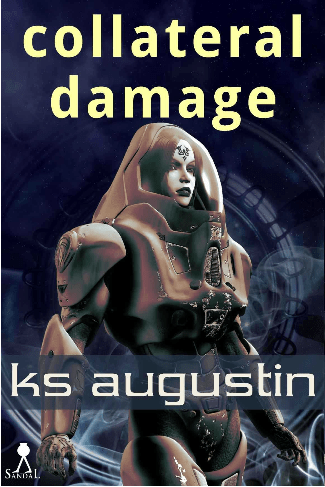
Augustin, KS: Collateral Damage (2013)

collateral damage
Cover art by Sandal Press

Collateral Damage is an erotic space opera short-story with little emphasis on the realities of space and more on the story between the two characters Meyal and Waryd. The only realistic bit about the Science Fiction lies in the state of the Earth. So, your reason for getting this story would have to be to see what develops between Meyal and Waryd and the story of how big corporations might treat their employees.

Do I believe a large corporation might kill its employee to get out of financial obligations? Hell, yes!!! If there is one thing I have come to realize, it is that the leadership of big corporations will sometimes be so concerned with the financial status of their shareholders and possible deniability that the sky is the limit when it comes to potential nefarious deeds.

Meyal and Waryd both seem like people who want to take care of their families and earn a bunch of money in the doing. Not being supposed to know about the other person and definitely not being allowed to communicate with each other probably only adds spice to their romantic relationship.

The ending of the story leaves me understanding that there is more to come in the future. According to Augustin’s web-site, Collateral Damage could be said to be the origin story of her other work. Collateral Damage was a pretty good story.


Reviews:


Collateral Damage

  • ISBN: 978-0-9873174-3-8
  • ASIN: B00B0NOYGW

Berg, Albert: Derelict (2009)

Derelict

Derelict is a proper little horror tale. Even I was able to figure this out. Berg managed to keep the creepiness going throughout the story by little tricks and cues. There was absolutely no doubt in my mind that Derelict was going to have a horror ending, and it did. Cue applause.

While all the horror elements were present in this story about the three space sailors checking out the empty ship, Albert Berg trod the fine line between just enough (for me that is) and too much. I’m guessing my level of dealing with horror is at about the young adult level. Anything tougher than that and I’m frightened out of my knickers. This is one of the serious draw-backs of being a flow addict.

Derelict is about three sailors checking out the seemingly empty Persephone that has docked at their space station on Mars. I would not have liked to be in Warwick’s place as the truth slowly unfolds.


Reviews:


Derelict:

  • Language: English
  • ASIN: B00558WOZG

Hall, Tyler Rudd: The Death of Jonas Wakefield (King and Wakefield) (2013)

The Death of Jonas Wakefield
Cover design by Chris Pratt

It never ceases to amaze me to find that I am the first person to review a story I like.

When I first saw that Jonas Wakefield was an Imp detective I fell for the abbreviation and thought he was either an Imp or he investigated Imp crimes. He does investigate Imp crimes, but Imp is an abbreviation for implants (the sort that allow you to live your life more or less in virtual reality). Jonas Wakefield is more of a maximalist when it comes to being fitted with the best he can afford in implant technology. His like of staying in virtual reality has made him enough of an expert that people come to him and his semi-partner Reagan King when they need something looked into “over there”.

Reagan King’s profession is funny considering the tendencies of her partner. She happens to be an Imp counselor, meaning that she counsels people who struggle with virtual reality addiction. Each partner depends on the other when their own expertise regarding virtual reality comes to short.

In the story The Death of Jonas Wakefield a husband suspects foul play when his wife disappears in virtual reality. He seeks out Reagan who then calls in Jonas to assist her in this matter. Foul play indeed. As the title suggests Jonas dies and is taken to an appropriate facility afterwards. I enjoyed this strange facility. Fascinating place for a corpse to go to. Not your usual kind of mortuary.

A fun mystery staying true to the genre while including futuristic elements.


The Death of Jonas Wakefield

  • Language: English
  • ASIN: B00E4CSLKQ

Weather Girls: It’s Raining Men

I heard this today and just felt energy course through me. Hope it gets its energy through to you as well.

Hi – Hi! We’re your Weather Girls – Ah-huh –
And have we got news for you – You better listen!
Get ready, all you lonely girls
and leave those umbrellas at home. – Alright! –

Humidity is rising – Barometer’s getting low
According to all sources, the street’s the place to go
Cause tonight for the first time
Just about half-past ten
For the first time in history
It’s gonna start raining men.

It’s Raining Men! Hallelujah! – It’s Raining Men! Amen!
I’m gonna go out to run and let myself get
Absolutely soaking wet!
It’s Raining Men! Hallelujah!
It’s Raining Men! Every Specimen!
Tall, blonde, dark and lean
Rough and tough and strong and mean

God bless Mother Nature, she’s a single woman too
She took off to heaven and she did what she had to do
She taught every angel to rearrange the sky
So that each and every woman could find her perfect guy
It’s Raining Men! Hallelujah! – It’s Raining Men! Amen!
It’s Raining Men! Hallelujah!
It’s Raining Men! Ame———nnnn!

I feel stormy weather / Moving in about to begin
Hear the thunder / Don’t you lose your head
Rip off the roof and stay in bed

God bless Mother Nature, she’s a single woman too
She took off to heaven and she did what she had to do
She taught every angel to rearrange the sky
So that each and every woman could find her perfect guy
It’s Raining Men! Yeah!

Humidity is rising – Barometer’s getting low
According to all sources, the street’s the place to go
Cause tonight for the first time
Just about half-past ten
For the first time in history
It’s gonna start raining men.

It’s Raining Men! Hallelujah! – It’s Raining Men! Amen!
It’s Raining Men! Hallelujah! – It’s Raining Men!

Writer: JABARA, PAUL / SHAFFER, PAUL
Copyright: Lyrics © EMI Music Publishing, Warner/Chappell Music, Inc.

Lee, Yeongdo: Over the Horizon (오버 더 호라이즌) (2004)

Over the Horizon

Yeongdo Lee (李英道 / 이영도) is a new discovery for me. Considering how poor my Korean reading abilities are, that is no wonder. Again, it was the cover that drew me in.

Over the Horizon is the first novella in a three-story collection. It was released on Kindle for free and boy am I glad I downloaded it. While Amazon shows this short story to be 92 pages long, those pages include a whole lot of intro information at the end about Yeongdo Lee and his other work.

I love the cover. It is a perfect introduction to our story and true to both the spirit and the letter of the novella.

Tyr Strike, our main character, happens to be a human with an orc for a boss. He is the assistant sheriff who does not want to go out into the snow to visit Professor Mataphi at Thuja Hall. Professor Mataphi is acting decidedly out of character and the sheriff wants to know what is troubling him.

What Tyr Strike ends up having to deal with is the rescue of the soul of a violin from the thief Horizon.

In a sense it is almost as if Over the Horizon is a ghost story in the way it is presented. But it isn’t. Not really. But it is eerie and thought-provoking. Most of the thought-provocation comes from me being a Viking caught in the grip of the faery world presented in a Korean manner (translated into English).

Highly recommended by me.


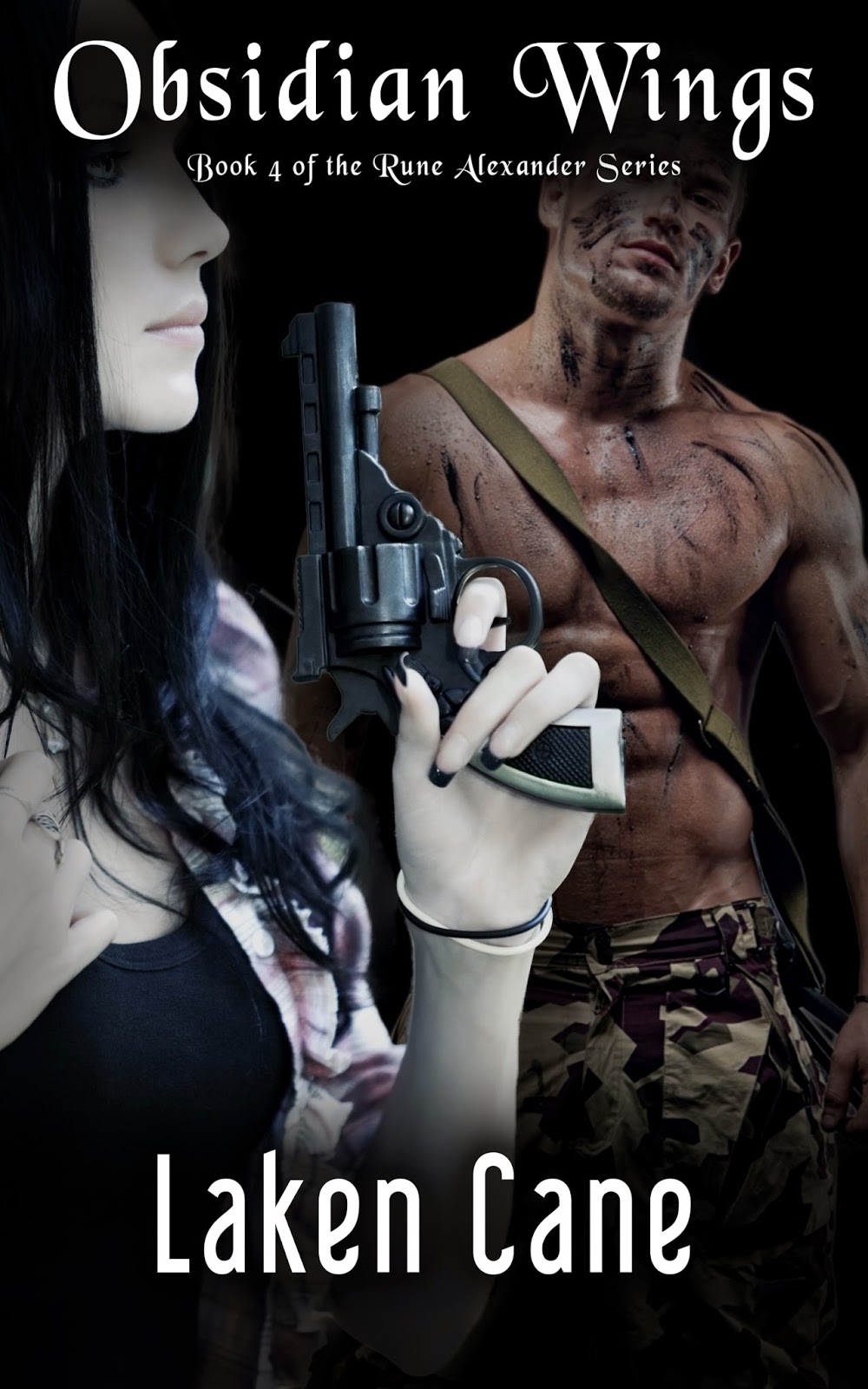
Cane, Laken: Obsidian Wings (Rune Alexander IV)

Obsidian Wings

The birds annoyed me. Not because they are were-birds/shapeshifters but because Cree carried a person as large as Shad. My asperger soul was triggered to the point of obsession and that set me off in research mode. That is when it became fun. I adore digging into stuff. While increasing my knowledge on the requirements for flight vs. weight vs. mass vs. pain tolerance vs. … I discovered a couple of things (at least that was the way all of this information was put together inside my head). There is a theoretical possibility of humans being able to fly. For flight to happen the human’s form would have to change drastically making us more like the flying creatures we know and less like humans. Were-birds or genetic tinkering are the only alternatives. Whether this would make Cree able to carry Shad is another matter altogether, and not knowing is now something I feel comfortable with.

I feel I need to thank Laken Cane for handing me this chance to look at the possibility of humans and flight.

Much later, she lay wrapped in his arms and realized she’d never felt more at peace than when she was with the berserker.

It was not a wholly comforting thought.

Sometimes knowing that another person’s presence brings a sense of completion can frighten us. I happen to be married to a man who brings me that sense. Allowing the peace he brought to set roots in my life was incredibly complicated and perhaps even worrying. What would happen to me if my heart gave up that piece of me? Personally, I do not have words for what his entry into my heart brought.

For a person like Rune, with the frightening and lonely background she has had filled with self-harm, self-disgust and self-fear, letting go of part of herself would be an even greater challenge. Yet a choice needs to made sooner or later. And it will be made eventually and during Obsidian Wings.

In the meantime Shad is driving Rune crazy with his over-protectiveness and willingness to fight Owen for her. I have no idea what Owen’s obsession is with Rune. Nor do I understand why Cruikshanks thinks he is unable to stay away from Rune. Three men driving Rune insane with their need for her while all (hah, hah) she wants is for her world to become whole again, Z to live and the twins to be back in the group, giving Ellis his Levi back and Lex her anchors.

I liked the second demon that turns up on the scene. Well, really it is the first demon but in a way it ends up being the second one for a lot of people. That is about as confusing as I can make this statement in my attempt to avoid giving anything away.

So, yes! Once I had resolved my issues with the birds I was a happy one myself and finished Obsidian Wings in no time.


My review of:

  1. Shiv Crew
  2. Blood and Bite
  3. Strange Trouble

Shaman shapeshifting into a bird
Shaman shapeshifting into a bird; By Susan Seddon Boulet

Birds of Paradise project (Cornell University)

If a human were to have wings? (SciFi Forums)

On Shapeshifting (Sarah Ann Lawless)

Shapeshifting (Wikipedia)

Shapeshifting (World of Warcraft)

Tengu: Guildwars (Wikipedia)

Voluntary shapeshifting (TV Tropes)

Why can’t humans fly like birds? (Rhett Allain)

Parable of the Isms (1935-)

a-tale-of-two-cows-illustrated

Feudalism: You have two cows. Your lord takes some of the milk. (Anonymous)

Socialism: You have two cows. The government takes one and gives it to your neighbor. (Silas Strawn, 1935)

Pure socialism: You have two cows. The government takes them and puts them in a barn with everyone else’s cows. You have to take care of all the cows. The government gives you as much milk as you need. (Anonymous)

Bureaucratic socialism: You have two cows. The government takes them and puts them in a barn with everyone else’s cows. They are cared for by ex-chicken farmers. You have to take care of the chickens the government took from the chicken farmers. The government gives you as much milk and as many eggs as the regulations say you should need. (Anonymous)

Communism: You have two cows. You give them to the Government, and the Government then gives you some milk. (Silas Strawn, 1935)

Pure communism: You have two cows. Your neighbors help you take care of them, and you all share the milk. (Anonymous)

Applied communism: You have two cows. You have to take care of them, but the government takes all the milk.

Fascism: You have two cows. You give them to the Government, and the Government then sells you some milk. (Silas Strawn, 1935)

Militarianism: You have two cows. The government takes both and drafts you. (Anonymous)

Capitalism: You have two cows. You sell one and buy a bull. (Silas Strawn, 1935) Then put both of them in your wife’s name and declare bankruptcy.  (Pat Paulsen, 1968)

Nazism (dictatorship): You have two cows. The Government takes both and shoots you. (Silas Strawn, 1935)

New Dealism: You have two cows. The Government takes both, shoots one, buys milk from the other cow, then pours the milk down the drain. (Silas Strawn, 1935)

Environmentalism: You have two cows. The government bans you from milking or killing them. (Anonymous)

Totalitarianism: You have two cows. The government takes them and denies they ever existed. Milk is banned. (Anonymous)

Pure democracy: You have two cows. Your neighbors decide who gets the milk. (Anonymous)

Representative democracy: You have two cows. Your neighbors pick someone to tell you who gets the milk. (Anonymous)

American democracy: The government promises to give you two cows if you vote for it. After the election, the president is impeached for speculating in cow futures. The press dubs the affair “Cowgate”. (Anonymous)

British democracy: You have two cows. You feed them sheeps’ brains and they go mad. The government doesn’t do anything. (Anonymous)

Singapore democracy: You have two cows. The government fines you for keeping two unlicensed farm animals in an apartment. (Anonymous)

Anarchy: You have two cows. Either you sell the milk at a fair price or your neighbors try to kill you and take the cows. (Anonymous)

Political correctness: You are associated with (the concept of “ownership” is a symbol of the phallocentric, warmongering, intolerant past) two differently-aged (but no less valuable to society) bovines of nonspecified gender. (Anonymous)

Counterculture: Wow, dude, there’s like… these two cows, man. You have got to have some of this milk. I mean totally. (Anonymous)

Surrealism: You have two giraffes. The government requires you to take harmonica lessons. (Anonymous)

Therapyism: You have two cows. One is a metaphor for your inner child. The other is the manifestation of anger toward a parental figure. You take one of the cows on walks through grassy fields by the gentle ocean waves. The other you beat with an anger bat. (©2007 Mike McLoughlin, Executive Director, Memphis Recovery Centers)

Recoveryism: You have twelve cows … and a sponsor. (©2007 Mike McLoughlin, Executive Director, Memphis Recovery Centers)

Insurancism: You have two cows. The Federal regulator requires you to hold one cow in reserve because they predict a shortage of milk. The Provincial/State regulator requires you to drop the price of milk because they predict a surplus of milk. The courts deem your cows inherently dangerous and order you to provide free milk to anyone who has ever been frightened by a farm animal. The marketing people are promising chocolate milk at an enhanced commission and you discover your own actuaries have been building pricing models assuming goats instead to save on the expense line. (©2002 Saskia Oltheten Matheson)

Russian company: You have two cows. You drink some vodka and count them again. You have five cows. The Russian Mafia shows up and takes however many cows you have.

Californian company: You have a million cows. Most of them are undocumented immigrants.

US Company: You have two cows. You sell one, and force the other to produce the milk of four cows. Later, you hire a consultant to analyse why
the cow has dropped dead.

Greek company: You have two cows. You borrow lots of euros to build barns, milking sheds, hay stores, feed sheds, dairies, cold stores, abattoir, cheese unit and packing sheds. You still only have two cows.

French company: You have two cows. You go on strike, organise a riot, and block the roads, because you want three cows.

Japanese company: You have two cows. You redesign them so they are one-tenth the size of an ordinary cow and produce twenty times the milk.
You then create a clever cow cartoon image called a Cowkimona and market it worldwide.

Italian company: You have two cows, but you don’t know where they are. You decide to have lunch.

Swiss company: You have 5000 cows. None of them belong to you. You charge the owners for storing them.

Chinese company: You have two cows. You have 300 people milking them. You claim that you have full employment, and high bovine productivity.
You arrest the newsman who reported the real situation.

Indian company: You have two cows. You worship them.

British company: You have two cows. Both are mad.

Iraqi company: Everyone thinks you have lots of cows. You tell them that you have none. No-one believes you, so they bomb the ** out of you and invade your country. You still have no cows, but at least you are now a Democracy.

Australian company: You have two cows. Business seems pretty good. You close the office and go for a few beers to celebrate.

New Zealand company: You have two cows. The one on the left looks very attractive…

United nationism: You have two cows. France vetoes you from milking them. The United States and Britain veto the cows from milking you. New Zealand abstains.

Frisbeetarianism: You have two cows. One of them flies up on the roof and gets stuck. You hope the government provides cow ladders.

Intel Pentium 60 – A80501-60: You have 2.0000000056987983 cows.

In the marketing department: Congratulations! You are now the proud owner of two thousand millicows!

Political philosophy / Wikipedia / Lillic0rr

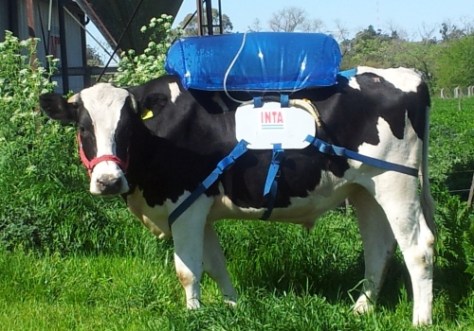
INTA's methane collecting cows
Image source: INTA: purified methane is used to generate heat, light and motor energy.

Argentina’s INTA governmental research body has developed cow backpacks that trap its daily 300 litres (or 80 gallons) of methane in order to turn it into green energy. Researchers claim the process is painless for the cow.

Use public libraries