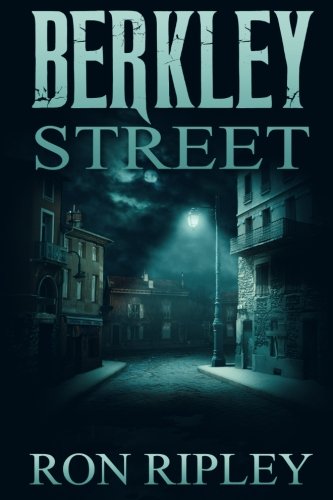
Ripley, Ron: Berkley Street (2016)


Ron Ripley understands the importance of atmosphere in his story about Shane Ryan. Like most supernatural creatures, ghosts have been used for centuries by story tellers. Berkley Street is full of them.

Berkley Street is the first story in the 9-book Berkley Street series. Each novel brings its problem (haunted site) to completion while continuing the overarching story (Shane Ryan’s near-death experiences), leaving us without nasty cliffhangers. The last few pages of the e-book are “Bonus Chapters” that explain how one of the inhabitants of Berkley Street 125 became a ghost. Berkley Street jumps between the time before 1982 when Shane’s parents disappeared and after Shane moved back into 125. The novel can be read as a set of short-stories tied together by Shane’s present day search for his parents.

Shane Ryan is overcome when he sees the property his parents have bought.

“Wow,” Shane whispered. “Wow.”

Shane’s parents laughed happily, and he followed them up the front walk. His father took out the house key, unlocked the large door and opened it. Shane stepped into the biggest room he had ever seen.

A huge set of stairs stretched up into the darkness, and dim pieces of furniture filled what he realized was a hallway. Close to where Shane stood, a tall grandfather clock ticked away the time.

And behind the tick of the second hand, Shane heard whispers.

Someone whispered in the walls.

The house, itself, is strange. On the outside it was designed to look like a small castle. The inside does not know its own composition. Number and size of levels, rooms, doors and passages changes at the whim of the ghost mistress.

22 years after the disappearance of Shane Ryan’s parents, he returns as a veteran of the US wars in Afghanistan and Iraq. In spite of the many battles he has seen, nothing frightens him as much as his own house. No matter how afraid he is of the house at Berkley Street 125, Shane has fought his aunt and uncle in court for the ownership of “His monstrous familial home.” The only reason he kept on fighting them for ownership was so he could return to search for his parents, who had disappeared inside the house.

“What are you saying, sir? Missing? On the road somewhere?”

“From your house,” the chaplain said in a gentle voice. “They’ve vanished.”

Fear is a marvellous emotion. It keeps us out of trouble. Well, unless we let fear rule our behaviour. The permanent residents of 125 taught Shane, the child and teenager, how to use his fear to help him. Most of the ghosts cannot stop projecting fear. Except for when the ghost mistress commands them, they are OK people. We get to know German Carl, Italian Roberto, “the ragman” and “the old man” who all died as adults. Eloise, Thaddeus and Vivienne died when they were young. We also meet the dark ones. All the ghosts play a role in the hunt for the whereabouts of Shane’s parents. Not only the dead have roles in the story of Berkley Street 125 and Shane Ryan. Ghosts, Shane’s mother and father, aunt and uncle, Detective Marie Lafontaine, Veteran Gerald Beck, and ex-resident Herman Mishal all reveal 125’s character. Shane’s main opponent is the ghost mistress, the one who holds the heart of the house. Her only wish is to add Shane to her collection of ghosts. Shane and the ghost mistress are both set on destroying the other. Their tactics are extremely different. Where the ghost mistress uses terror to control others, Shane tries a more diplomatic approach.

Ron Ripley’s story pressed the right buttons and frightened me. I did manage to finish it.


Reviews:

Yates, A.M.: Stealer (2016)

Cover by Clarissa Yeo

As the bus-doors squealed shut, she fantasized about stealing the rainbow-striped balloon and drifting away to wherever the wind blew. Maybe to wherever her father was.

Victim mentality is difficult to let go of. A person gets so wrapped up in what has been that they forget the future does not have to look the same. There are choices. However, reaching for that choice, when one’s self-image seems shot to pieces and one’s position as underdog appears set in stone, is nigh to impossible.

Dee is 17 years old and considered an odd-ball. She is taller than most, has unusual hair and a scarred back. Her position on the social status totem pole is low. Laura, her only, and now ex-, friend, left her for a higher spot. Predatory kids consider her easy bait.

“Don’t feed the wolves. Never feed the wolves.”

To top it all, Dee thinks she is probably insane. She hears and sees things that the other kids apparently do not. Take Danny’s broken pencil:

Every tooth mark incised the instrument with Danny’s belief in magic – belief in gods who used magic.

And, the pencil…… It glowed and floated.

Her way out of victim mentality and hiding from the wolves slowly begins when the Vasquez brothers go after Danny. In spite of being left with dog shit in her hair,  facing her fears slowly becomes possible.

Dee has a strange treasure collection. A broken pencil, broken key-chain, broken glasses, broken lighter, broken needle and broken guitar pick probably do not seem like much to most of us. But Dee senses that these objects represent something more, and the only person with whom Dee dares talk about what she sees and hears is her grand-father. He is also the person who reveals who her father is, a man called River who appeared and disappeared right before his eyes. As it turns out, Dee’s heritage becomes essential to her survival. One day, a guy steals her collection and disappears into thin air. Dee desperately wants her things back but has no idea how to go about it.

Then, she sees a speaking glow bug that calls itself Nid. A deal is made. If Dee frees Nid, Nid promises that Dee will travel safely to the place where the box has gone and that Dee will make it back to her family, safe and sound.

Yates has done a great job on her new world. Crescent is both similar and dissimilar to our own world. Society is highly stratified into different Breeds. At top are the “Leaders” and near the bottom are “Stealers“. Guess which one Dee belongs to. The right to define is a right we fight wars over. Stealers are a perfect example of what happens when the powers that be use their power to re-name. Stealers used to be called “Scouts“.

A scout is a person who seeks information about the unknown, one who goes in front, one who acts as a buffer for those behind while a stealer is a person who takes what does not belong to them. Instead of being part of a team, Stealers are now enslaved by those who can afford to own them. Propaganda has it that the only thing Stealers do well is run from trouble and steal your things. Propaganda also has it that as long as people fulfil the duties Leaders claim each breed must, all needs will be taken care of. As Stealer shows, propaganda in Crescent is as true as propaganda anywhere.

I really liked Stealer. Some of the foreshadowing is obvious and trendy. For instance, Dee and Hunter. If two people meet, and that meeting is hostile, it is almost written in stone that they become lovers. In addition, Yates  throws in the required competitor for the main character’s affections. Dee follows in the tradition of a mystery parent giving their child great powers. Then something happens and those powers become immense. For the most part, Yates avoids  overdoing it. Yates also writes Dee as a believably confused and surprised young woman in a confusing and surprising situation. Moving to new cultures is difficult. Language, traditions and presentation in Crescent are different to the ones of her own home-town somewhere in the US. Yates tells a story full of action and adventure with interesting characters, both main- and side-characters. I could identify with some of them. Crescent is a fun world with solutions I do not think I have seen before.


Reviews:

De Pierres, Marianne; Peacemaker 1 (2014)

The Peacemaker series begins with the novel Peacemaker. Peacemaker also has a first installment of the webcomic edition on De Pierres website. De Pierres has called her Peacemaker stories cowpunk, meaning they are Australian Westerns (yes there is such a thing) with possible aliens/paranormal creatures, technologically enhanced humans and animals and an environmentally challenged country. Australia has gone from having its current 500 national parks to only one, Birrumen Park. There was still an outback while Virgin’s father was alive. He started a park lobby because he saw the direction real estate developers were dragging the country in. Now, Birrumen lies, as the last of its sort, in the heart of a supercity and is surrounded by a road, The Park Esplanada. Noise, people and buildings drench the outside of the park.

Peacemaker is told by Virgin. She is our main character.  Most of her childhood has been spent with her father in Birrumen Park. He taught her to not trust anyone, least of all those closest to her, and to love the park as much as he did. Virgin is passionate about keeping the Park out of the hands of real estate developers. As long as the tourists keep coming, the Park still has a chance.

… the company scientists deemed it too environmentally fragile to handle the impact of permanent residents. Tourists did enough damage.

And we had to have tourists.

The Park saved Australia’s tourism industry and tourists save the Park. My daughter just did her BA dissertation on eco-tourism. Many places depend on tourists to stay alive, but tourists bring their own set of problems that aren’t compatible with keeping a place “untouched”. Owners of the park are forced to make concessions like the Wild West theme of Birrumen. The future we see in Peacemaker is a likely one. Humans don’t have the intelligence to control our population growth or our ecological foot-prints.

Benny, Virgin’s horse, and the Park both ground Virgin when the chaos of the city becomes too much. Both are filled with technology. Benny has been augmented with recording equipment, and endurance and cognitive enhancers. All of his augmentations send information back to Totes, the park tech, and then on to the company storage and processing centre. Birrumen has all sorts of measuring equipment to make sure the park is left as undisturbed as possible. An electromagnetic field above the park keeps unwanted people out and the view in. No human is supposed to be in the park after dark. One evening Virgin forgets her phone inside and has to go back in.

Even though I’d been ranger here for a few years, I was suddenly a little nervous. The sand and rock and palms that I knew so well during the day had taken on an eerie quality.

The company didn’t like us “on board” (their expression for being in the park) after dark – something to do with insurance. I always pushed that directive to the limit because I like to see the sunset. …

As I bent to fumble with the pump, I felt my phone underfoot. Then another sound attracted my attention – muffled voices from the other side of the semicircle of palms that skirted the Interchange area.

Voices? Impossible! I was the last person out of the south-east sector every day. Park scanners and satellite imaging confirmed it, as well as my own visual sweep.

I picked up my phone and crept towards the sound, my boots silent on the sand. There were two of them, arguing, but I couldn’t get a handle on the thread. …

A strangled cry got me running toward them, hauling my pistol free from my holster. …

But the pair had fallen down onto the sand.

I flicked my phone light on and shone it at them. Only one person was there. Blood trickled from a small, deep wound on his neck.

Impossible! There were two! …

Weirdness arrives in the form of a crow. Virgin is attacked and wounded but manages to escape. On top of that, she was supposed to pick up her new partner, Marshall Nate Sixpence, but made it too late to make a good first impression. Then, her imaginary friend from her childhood reappears, a large wedge-tailed eagle called Aquila. Virgin is certain she is going insane because she is the only one who sees Aquila. Except she isn’t. Turns out Nate can also see imaginary friends. Hmmm. Maybe they aren’t as imaginary as Virgin thinks. Nathan calls them disincarnates. Her life is turned on its head. She goes from routine to chaos, from safety to one life-threatening situation after the other. Therein lies the mystery. Virgin’s investigative journalist friend, Caro, helps Virgin many times. Her boss, Bull Hunt, Superintendent of Park Ecology, remains on her side even when the police go after her. He used to be friends with her father and has continued to take care of her.

In some ways Virgin is a loner. She certainly thinks of herself as one, but tends to gather friends because of the way she treats people: Blunt but tries to protect the weak. Some of those friends are interesting cases. Totes, the park tech, is one such. Even though he bugs her apartment, Virgin keeps him on because she believes he is on her side. Chef Dabrowski feeds her and is as much of a surrogate parent as she will let him be. She is the kind of person who does not want to be a burden to the people she loves, yet does her best to help the very same people. Her personality appeals to my Asperger.

This is my favorite De Pierres series thus far. Her writing is compelling, the story asks interesting questions, is fun, full of action, full of interesting characters and has a great female lead. Plus it’s in Australian English. So, a definite yes from me.


Reviews:


Winner Aurealis Award– Best Science Fiction Novel, 2014

Goody, Heide & Grant, Iain; Clovenhoof I (2012)

Heide Goody & Iain Grant‘s collaboration began with Clovenhoof. They enjoyed it enough to continue collaborating on at least eleven more stories. I adored Clovenhoof. If you enjoy British humour, this is a must. Life right now needed Clovenhoof. When my Asperger struggles to deal with what life hands me, laughs are precious. Clovenhoof was fall over funny and relevant. Probably relevant for any person who has had siblings, parent issues or have struggled to fit into their local cultures and bureaucracies.

“We’re a little disappointed,” said Saint Peter. “Let’s take the measure of suffering. This was very straightforward. All suffering should be graded as good or higher.”

“And we’re certainly getting those grades in a lot of the suffering that we deliver,” said Satan.

“A lot. Not all.”

“Yes, but it wouldn’t be reasonable to expect it for everything,” Satan argued. “We got some clients who simply enjoy it too much, and then there are those who lie about the experience because they can’t help themselves.”

… “You give me no choice but to recommend your immediate removal from the post.”

Poor Satan. The guy can never catch a break. First he gets thrown out of Heaven. His punishment for wanting to save God’s children was being master of Hell, a hellish job. Then, he gets thrown out of Hell for trying to meet the demands of the assessment board. Fired by uptight Michael and conniving St. Peter (helped by, hmmm, not telling). Where does he end up? Earth. England. Birmingham. Sutton Coldfield.

“Having restocked the shelves of the Thriller section with a newly arrived box of Deightons and Le Carrés and settled down for a mid-morning cup of tea, Ben heard a muffled roll of thunder, looked up and saw that a naked man had appeared on the pavement outside the shop.”

Ben Kitchen is one of our main characters, the owner of the aforesaid used book-store (Books ‘n’ Bobs). He lives in the same building as Mr. Jeremy Clovenhoof (Michael’s sense of humour), and is painfully shy towards women he might be interested in. The two of them coincidentally end up on the same floor of an apartment building in Boldmere. They live in flats 2a and 2b.

We also get to know Nerys from the third floor of the same building. She works at Helping Hand Job Agency. One of her clients turns out to be Jeremy. And what a client he is. Both she and Ben try to figure out where Jeremy is from and why he is such an odd person.

Satan has no concept of money, credit cards, bills, rent, making food, what to wear, social rules, how to find a job or any of the other hellish things we are expected to magically understand upon reaching adulthood. Add in the fact that Satan is an Alien, and as one might expect of The Devil in such a situation, he makes a mess of things – both in his life and in others. However, Satan is an OK guy. He knows he did his best in Hell and wants to get a second opinion from God. Michael and he have not been on good terms since the War in Heaven, so Clovenhoof is not about to trust any decision made by him and St. Peter. Getting that second opinion is not a simple matter when the opposition refuses to cooperate. Because he is an Alien, Satan sees the world without the prejudices we grow up with. He also does not have the same moral compass humans like to imagine they have. In many ways Satan makes me think of the experiences many Aspergers have in trying to connect with their surroundings. So many rules and regulations make no sense and “morals and empathy” are just words people use to persecute others.

The story moves between the new and unusual experiences Satan has on Earth and the reason Satan got kicked out of Hell (it might not be what you think it is). I have learned several vital things about English society. Good thing there are search engines:

  • Scrumpy Thunder
  • Lambrini
  • Crispy Pancakes

Reviews

Turner, Tej; Dinnusos Rises (2017)

I recommend reading The Janus Cycle before you continue with Dinnusos Rises. As the story moves along, we reconnect with the paranormal members of Sunset Haze: Patrick (violin+half-fey), Faye (flute+dream walker), Jack (acoustic guitar+half-fey), and Ellen/Jessica (voice+medium/ghost). Neal lets them practice in one of the club’s rooms in exchange for the occasional session downstairs. Their abilities draw people. We also reconnect with Tilly, Pandora and Frelia.Toward the end of The Janus Cycle, we read:

“… Janus was once this great place where nobody gave a fuck and you could just have fun, but then some bloody kids who don’t have a clue tried to steal your vibe.”…

“You just need to move on, he declared. “Look around you – this, what we have here tonight – isn’t it that feeling, that craziness you were looking for? You are Janus. Let those kids keep the empty shell. You can make a new one!” (The Janus Cycle, p. 217)

That place is, Dinnusos.

“… Victorian, with high ceilings and sash windows. It’s big, too. … If the main bar ever gets too rowdy and you fancy some quiet, there’s a whole labyrinth of rooms on the upper floors you can get lost in. One of the city’s old canal ways runs along the back of the building.” (Dinnusos, p. 14)

Neal and Tristan became a couple in The Janus Cycle.  Dinnusos is owned by Neal. His partner painted magical murals, on most of the walls of the club, that appear to have prophetic value for some of the main characters. You can find Dinnusos in Yesterville:

“A place of urban decay and broken streetlamps. Vagrants and outcasts. Faded signposts and overgrown gardens. Thrifty means and humble dreams.” (Dinnusos, p. 14)

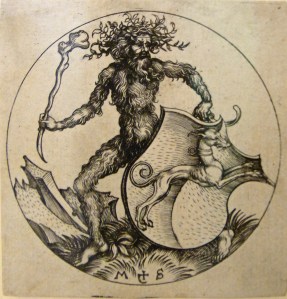
Wilder Mann mit Wappenschild copper engraving by Martin Schongauer

Tej Turner has used the same writing style he used in The Janus Cycle. There is an overarching story with chapters that get told from a different point of view, allowing us to catch up with the life of the individual and keeps the story going at the same time. Taxus Baccus (TB) is an environmental organization led by Jardair, Jack’s wuduwāsa father (Turner plays with the Greek and Roman pantheons throughout the story). Until TB arrived at Jack’s house (a squat), Jack and his pet squirrel, Nuttles, lived on their own. Their lives go from quiet to chaotic in a matter of hours. TB travels from town to town addressing, in their own way, environmental issues each town struggles with. Tej Turner uses Taxus Baccus to address the fragility of our supposed right to free speech and the right to live our lives as we wish.

“It seems to me that this country is run by sociopaths with gloating expressions and oily hair. They wander around Westminster with their leather briefcases, selling off public assets to their pals from boarding school and members of their extended family who have vested interests. All the while, class war is waged through an ever-encroaching succession of draconian legislations. They will not rest until they have rounded up everyone into the rat race because they, by fortune of birth, are the big cats. The the more rats there are, the more they have to dig their paws into.” (Dinnusos, p 62)

Dinnusos Rising contends that it we, the general populace, make such methods possible through our complacency and docility. The percentage of people who turn up for various elections certainly seem to support that contention. Westminster uses various media to pimp their message to the public

“… the news channels and tabloids were doing their utmost to demonise us. Footage and photos were being carefully selected, and it seemed their cameras only had spare film for the more outrageous members f the movements … They never told the public why were were doing the things we were doing. They made us seem like rebels without a cause.” … (Dinnusos, p. 72)

Through The National Conciliation Act (NCA), Westminster intends to cement the corporatocracy we see strengthening its hooks into various governments around the world.

“Later on we will be interviewing MP, Mr. Ben Fitzgerald, to see if he can shed any light upon rumours Westminster is considering bringing in new legislation which will grant authorities more power to dismantle anti-social behaviour.” (Dinnusos, p. 92)

The NCA bans political demonstrations and movements like Taxus Baccata.  It would give Westminster the power to shut down any business charity or organisation which was perceived as having a “subversive agenda“. They could tighten restrictions on the internet. It would become illegal for employees to speak badly about the companies they work for and turn civil disobedience into a criminal – rather than civil – offence.

Pandora’s workplace, Fibertine Investment Bank (FIB), is a great example of a corporation that wants the NCA passed. FIB invests in corporations around the world and outwardly appear to be concerned about ethical corporation issues. They even have their own Ethical Practices Officer. However, when Pandora tries to bring ethical issues to the attention of her boss, Mr. Watts, he reminds her of FIB’s business motto:

“Business is blameless,” … there is no need to feel guilt, or worry about facing consequences. (Dinnusos, p. 92)

Corporatocracy is not the only topic Turner addresses. Friendship represented by Pandora and Frelia, Faye and Tilly, and Jack and Tilly is a complicated dance. Trust is betrayed, destructive and healthy decisions are made, and new beginnings are all part of the friendships in Dinnusos Rising. Turner also shows us individual experiences with self-harm, suicide ideation, drugs, abuse,  sexuality, and gender. We see how falling in love may affect other relationships. Again, Tilly is the one who meets most of the challenges. She is also the youngest of our characters.

Dinnusos Rises is well-edited, well written, has fleshed out characters, and presents current issues in a package filled with action and adventure. Both Dinnusos Rises and The Janus Cycle are excellent contributions to discussions about the above topics. Dinnusos Rises has my whole-hearted recommendation.

I was given an ARC copy to review.


My review of The Janus Cycle

Jenkins, David Elias: The First Spark (2016)

The First Spark, Independent (2016)
Cover by David Elias Jenkins

Finding a soul-mate is not a given in life. In Free Spark, David Elias Jenkins introduces us to John and Isabella Gaunt who embody what soul-matedness seems to be all about. At first, their soul-matedness was metaphorical. Due to unforeseen circumstances, it later became literal. Their changing relationship brought heartache and a greater purpose in life. Both knew, without a doubt, that their most important contribution to Free Reign would be to bring down Jonas Reach, Emberdark and their bosses. Getting there demands more sacrifice and heartache for both of them. Those opposing them, find a terrifying pair willing to use any and all tools to get their revenge and stop the precursor artifacts that threaten Free Reign’s way of life.

The Watch is Free Reign’s police force. At first, Free Reign’s best, Maeve fights the couple. She misunderstands what they are about. That probably has to do with the level of devastation left behind them. However, once Maeve herself becomes hunted by the same forces John and Isabella are fighting, she realizes that life is even more complicated than she thought. And Maeve is not a naïve character but knows well that certain people “weigh the law down with gold and influence until it snapped.

“The destructive power of the fire elementals had razed the Longshadow district of Free Reign to the ground two hundred years ago. There were still plaques and memorials to the dead from that disaster in the main square.

Yet the very contraption of cogs and wheels that whirs and rattles me down this mountain is powered by that same magic, harnessed and directed to useful purpose. …

“Three sets of headlights glared at her in close formation like the myriad eyes of an arachnid. They separated slightly as the road widened and Maeve could see riders straddling three Angeldarts.” (loc 3939)

Free Reign is a city where magic (thaumaturgy) and technology intertwine into a type of literature called arcanepunk. The title of the story refers to the thaumaturgy that Free Reign is built on. First Spark bleeds magic into the air, ground and water of Free Reign and has made the city a place where strange creatures feel comfortable. Like all cities, Free Reign is a place where cruelty and succor live side by side in a political system that depends on its leaders being as little corrupt as possible.  I know, I know. Impossible.

The First Spark has enough violence to go around, but it is violence with a purpose. I would find it impossible to believe a story about the dregs of society (be they low or high on the social ladder) without violence. The First Spark pretty much shows this darker side of society as it is. I like the job Jenkins has done in blending law and crime, grief and determination and helpful with destructive. The First Spark is a mystery-thriller with lots of action, some violence and pretty broken characters.

Recommended.

The author gave me a copy of The First Spark to review


The First Spark is available on Amazon

Farrugia, Nathan M.; Inversion (Helix V)(2016)

Farrugia‘s Sophia and Olesya serials have forced me to reevaluate some of my preconceptions, stereotypes or prejudices. Thrillers are meant to keep us at the edge of our seat until some sort of climax occurs. Farrugia’s episodes have brought us threats to humanity, political entities and various teams. His “super-heroes” are Olesya and Sophia, and their various team-members have had their spot in the lime-light. Like all thriller-heroes, Olesya, Sophia and their team-members survive when they, logically, should not. My Aspie demands that I check out what exists and what does not, i.e. stun-net-guns with adhesive qualities. I can lay that aside, because an excellent thriller needs to stretch our sense of logic but not completely break it. Or, at least, that is my judgement of an excellent thriller. Inversion proves, once more, what an excellent writer Farrugia is.

An excellent thriller also needs convince us that their plot could happen in real life. Authors who are not willing to sacrifice their writing to tighten up their plots, research their material and have writing in their blood, never reach that point. Farrugia does.

Inversion brings us to Wrocław, Poland and once again to Purity.

“But how do they frame Russia if everyone’s dead?” Aviary asked.

“Exactly,” Sophia said. “The world will be furious. And in their fury, they’ll support Purity.”

Consider Poland’s Jarosław Kaczyński’s methods:

…Law and Justice party has continued to depict the accident as an assassination of its leader, with blame shared by the usual villainous alliance of liberals and communists….

Poland’s present turmoil is the story of how anger at Poland’s liberals mutated into a war on liberal democracy itself. (The Guardian)

A thriller also needs to mess with our minds. In the Sophia and Olesya serials we do not know who the real powers are. I have made guesses in all of my previous reviews, and some of those guesses now seem wrong. Part of that has to do with the long lives of those who are behind the messes of Farrugia’s world. We have been told, through Major Sievers, Hal and Denton, that there are some seriously powerful people behind what is going on. But I have no idea how interlinked the various groups are.

This time around, the people behind Purity use a celebratory march in Wrocław as a lure for Aviary, and, through her, the Russian Directorate. Purity needs a big, bad bear to blame for what is about to happen. The people behind Purity control elements of The Fifth Column, the leadership of Purity and JW GROM (Poland’s antiterrorism unit).

Intron’s Hélio does not trust the documentation Doctor Meresz shared about the kill-switch. As we saw in Anomaly, that is a good thing. Hélio wants to stay with Sophia until he has run some tests on her theories. He and his body guards go with the team to Wrocław. Whether they are trustworthy is debatable. That depends on Intron’s agenda.

Inversion shows us how little control Sophia and Olesya actually have. Their choices depend on Aviary’s findings and those findings are the result of people who know what will trigger both team-leaders, and especially Sophia.

“… she won’t rest until she rights her wrongs.” He stared at the trashcan. “Even then, I don’t think she’ll stop.”

Besides wanting to know who the people behind these groups are, I really want to know how DC knew how to turn up where he did when he did. And what about that gunship? Who do the cloaked ones belong to? Oh, and when you go into a fight, don’t partner with a person your are falling in love with. Losing focus on the roofs around the market place is seriously dangerous to your health. Try to remember that the next time you go to Wrocław in Poland. And do those bobby pins mean anything? Please, I need to know.

Definitely recommended.

I received a complimentary copy of Inversion from Farrugia


Reviews:


My reviews of:

  1. Helix I (Olesya and Sophia)
  2. Exile (Helix II)
  3. Interceptor (Helix III)
  4. Anomaly (Helix IV)
  5. The Chimera Vector (Sophia)
  6. Seraphim Sequence (Sophia II)
  7. Phoenix Variant (Sophia III)

Inversion can be bought at Amazon.com


Vaughn, Carrie: Steel (2011)

steel-by-carrie-vaughn
Steel is an historical fantasy about a girl who is thrown into the past and who desperately wishes to return to what she did not appreciate until she thought it was lost. It is an action-filled coming-of-age story set in beautiful Bahamas on the Diana, captained by Marjorie Cooper. It is a story about choices, and how those choices define us. What Steel is NOT, is a swashbuckling romance.

A large wave surged under them then, sending the boat rocking steeply. Jill, the world-class athlete who’d never yet lost her balance in a fencing bout, fell. Stumbling back, she hit the side of the boat and went over. Grabbing uselessly for the edge, she rolled into the ocean. ….

Waves pitched her, her sunglasses were torn away, the water was cold, shocking after the tropical air. She couldn’t catch her breath – swallowed water instead. Flailing, she searched for up, groped for the surface – couldn’t find it. Her lungs were tightening. It had been sunny a moment ago – where was the sun?

Someone grabbed her. Hands twisted into her clothing and pulled her into the air. She clutched at her rescuers, gasped for air, heaving deep breaths that tasted of brine, slimy and salty. But she was out of the water. She was safe. She wasn’t going to die.

Many people talk about pirates as if they lived a romantic life. Many historical eras seem to leave people longing for them. But there was nothing to wish for in days that were usually all about survival. Marjorie Cooper is the Captain of the pirate ship Jill ends up on. Cooper and the rest of the crew quickly realize that Jill is completely clueless about everything that has to do with a pirate’s life. Suspicions about her being a spy for Edmund Blane (another pirate) are soon squashed by her ineptitude. Even fencing, a sport Jill thought she excelled at, was of a whole different caliber in the Bahamas in the late 1800’s.

Jill could only shake her head – no, she’d never fought for blood. Not real blood. Only ranks, medals, and maybe a college scholarship. She bowed her head, embarrassed, when tears fell. She wiped them away quickly. Her still-wet hair stuck to her cheeks. Salt water crusted her clothing. However much she wanted to sit down, pass out – or drop the rapier, which she wouldn’t have been able to raise again if Henry came at her in another attack – she remained standing before the captain, as straight as she could, which wasn’t very at moment.

“What’s your name, lass?”

“Jill. Jill Archer,” she said, her voice scratching. She only just noticed that she was thirsty.

“And, Jill, how do you come to be adrift in the wide sea so far from home?”

The tears almost broke then, and she took a moment to answer. “I don’t know.”

Slowly, Jill learns what it means to be a pirate and also what it means to be an adult. Basically, that meant work. The kind that left her little time and energy to plan, to regret or to think about her family. Wood had to be kept free of mold, sails had to be mended, ropes had to be spliced, the ship had to be emptied, barnacles removed and repeat. During a beaching of the Diana for barnacle removal, the ship’s prisorner, Doctor Emory, tried to signal his friends in the hope that they would see his signal and rescue him. Having signed their articles, Jill does not feel the same way. In part that is because of Marjorie Cooper, who wasn’t as bad as many of her crew. She rescued slaves but also looted the “enemy”.  Battles were fought and  magic rapier tips kept on appearing. During a large part of the story, the Diana chased Blane while Jill became more and more integrated into the crew.

Often, Jill found herself thinking that she should tell her siblings, Tom and Mandy about her experiences. She wonders if her family misses her. She regrets her moping, when, really, there was nothing to mope about. Slowly she goes from being an unaware, privileged, white, middle-class girl to learning some of life’s more difficult lessons. One is that very little in life can be taken for granted. A difficult lesson to learn is that when you feel helpless it is easier to follow orders you do not understand rather than to disobey. What happens when a point that seems like one of no return appears? What then? Jill learns what obsession looks like and how it brings danger to others. She learns about the dire consequences some choices have and how some of those consequences reach far into the future to bring a 16-year old girl into the past to right them.

Definitely recommended.


Reviews:

Carr, Patrick W.: A Cast of Stones (The Staff and the Sword I) (2013)

A Cast of Stones, Bethany House Publishers, 2013
I think A Cast of Stones fits the Harry Potter age range. Patrick W. Carr’s writing is technically excellent. The story is well-edited and the text flows from sentence to sentence. As far as plots go, A Cast of Stones is stereotypical epic fantasy and much of it reminds me of other stories. Readers should be able to tell how the trilogy will end after finishing A Cast of Stones. At times Carr fell for the temptation to moralize. In spite of this, I recommend it for readers who need clear HEROs. Errol is definitely that. He starts as one by being an orphan. However, the way we find him at the beginning of the story is atypical of the Heo story.

Cruk grunted and grimaced his imitation of a smile. “The boy’s got the right of it. He is pretty useless.”

Errol nodded with satisfaction. “See?” (p.103)

That uselessness is due, for the most part, to his alcoholism. A few years earlier, when he was 14 years old, Errol experienced something traumatic enough to drive him to drink. Being an orphan made it easier to go down that road. Because he is our HERO, we know he must find his way to a heroic personality.

In the village Errol grew up in, the leader of the boys, and the “chosen one” is Liam. He has most of the qualities that make up good leaders: Magnetic personality, is talented at everything he works to achieve, smart, tries to do what is right (but also what is kind) and lives as he preaches.

“We’re all the same,” Liam said. “I just concentrate and try really hard at everything. Anyone can do it if they just try hard enough.”

Errol stared. Did Liam really believe that?

“Now,” Liam said, “recite the vowels and consonants.”

He really did. (116)

In spite of his near-perfectness, Errol admires Liam. And so does every other person Liam meets. Paritcularly women. But Liam is not affected by this adoration and seems not to notice it. Errol and Liam are joined by Martin, Luis and Crux. All three have secrets they hide from the “boys” (19 years old) and pasts they need to pick up again. Martin and Luis are meddlers and Crux a protector. He is also a tough teacher for Errol who lacks most “civilized knowledge”.

‘Cruk’s eyes narrowed. “You’ll have to learn on the way. I’ll teach you. First lesson, don’t ever annoy your teacher.”‘ (p.82)

At times, the methods employed by meddling Martin and Luis are highly questionable. They,  appear to believe that “the end justifies the means”. For churchmen and believers, they do not have much faith. In fact, that could probably be said of most of the church leaders we meet in this trilogy. Faith in their deity’s power is low.

The religion we learn about in A Cast of Stones is similar to the Roman-Catholic faith. Three-in-one godhead, celibate priesthood, rituals and hierarchies are close to identical to the RC church. Except for the magic bit that its Readers employ. Any magic but Reader-magic is forbidden and magic-users are usually killed. Rulers inherit their power but each ruler is invested with his (yes, his) powers. The old King has no heirs, which is why a new one must be found. Errol and Liam play an important role in picking the new ruler. No wonder people want to stop them.

One of the people who tries to hinder Errol from fulfilling his heroic destiny is Abbot Morin. He also believes that “the end justifies the means”. Some of his means carry a high price for both Errol and himself. However, everything that is thrown his way is meant to mould Errol into the Hero he most likely needs to become before the end of the trilogy. The trilogy is set up as a combination of serial and series. Certain threads are tied up while others remain tantalizingly open, much as most Hero trilogies do. I enjoyed it.


Reviews:

Art based on “The Luggage” @Terry Pratchett

My blogs terrypratchettandme and zanegreyandme are what often happens when an Aspie has an interest. We immerse ourselves and want to share. This collage is an example of that immersion. The Luggage is a great writing tool whose antics I have enjoyed immensely.

humanitysdarkerside's avatarTerry Pratchett and me

View original post

Brin, David; Kiln People (2002)

As with many of his novels, David Brin’s Kiln People is an excellent science fiction story about a highly possible future. David Brin seems to keep himself up-to-date on neurological research and extends that information into alternatives we might well encounter if humans do not destroy themselves (also highly probable) before such technology becomes possible.

Racism is a huge part of the short lives of dittos in Kiln People. Dittos are clones, made of nano-clay, who live only 24 hours. A person’s  consciousness is copied into them and all of their experiences may be copied back into your consciousness again – as long as it is done within 24 hours after their birth. At that time, dittos turn into a kind of sludge. The color the ditto equals its value and abilities. Prices go from the cheapest Orange dittos, that are generally used for manual labor where independent thinking or sensing is seldom required, to the most expensive Platinum ones, that are like a better version of their Archie (original). Dittos are have varying degrees of independent thinking but must always be obedient to their Archie’s commands. They can be forced to do anything you can possibly imagine. Dittos are made to fight each other to the death, to be sex-slaves, to dig in the mines or to be substitute private detectives. Their sensory system can be hyper-sensitive or practically non-existent depending on exactly what you want them to experience, which leaves a lot of room for shitty owners to make their ditto’s life a living hell. While an Archie may do anything to a ditto they meet, instant destruction follows if a ditto harms an Archie. Even though people are allowed to make their dittos do anything, only wealthy people get away with “real” criminal activities. So, just like today. No matter how nice their owner is, dittos are still at the bottom of the social ladder. Albert Morris is a fairly decent owner.

“… I figure if you make a creature, you’re responsible for it. That ditto wanted to matter. He fought like hell to continue. And now he’s part of me, like several hundred others that made it home for inloading, ever since the first time I used a kiln, at sixteen.”

“… The copier sifts your organic brain to engrave the Standing Wave onto a fresh template made of special clay, ripening in the kiln. Soon a new ditto departs into the world to perform errands while you have breakfast. No need even to tell it what to do.

It already knows.

It’s you.”

Albert is the main character. As a private investigator he uses dittoes to go where he does not want to go. In fact, with enough money, he would never have to leave his home. Depending on the case, Albert uses different colored dittos. In Kiln People, Albert uses Ebony (huge processing abilities), Greys (used as representatives) and Greens (used for his dirty work).

Albert has two missions in life. One is to reveal the identity of Beta. Beta and Albert have a long history of killing each other (i.e. their dittos), and Albert really wants to know who is behind his arch-nemesis’ alias. Being as good a private detective as possible is his second mission. Corporate espionage and digging up dirt on  competitors is something private investigators continue to do in the future.

“Ugh. What put me in this mood? Could it be Ritu’s news? A reminder that real death still lurks for us all?

Well, shrug it off! Life’s still the same as it was in the old days.

Sometimes you’re the grasshopper.

Sometimes you are the ant.”

Albert gets hired by incomprehensibly wealthy Aeneas Kaolin, co-inventor of dittos and owner of Universal Kilns, to look into the disappearance of Kaolin’s long-time friend, Yosil Maharal. When Maharal turns up dead in what seems to be a car accident, Albert wonders if it might be something more.

One thing I really liked about Kiln People was the way Brin told the stories of Albert’s dittos in Albert’s voice. At one point, there were four Alberts at the same time. None of them knew what was going on with any of the others because they had not been reintegrated into their Archie. Brin’s world-building happened through the eyes and ears of the various Alberts. What they learned, we learned.

I would not have wanted to live in such a society. I find ours challenging enough. It was an interesting society, though, and one I think most people would embrace. No room for Aspies though. Genetic tinkering had become common enough that our worst ailments were eradicated. That, I wouldn’t mind. Just as I think of today’s society, some of the political choices of the society of Kiln People did not make sense. At least the fanatics behaved predictably.

Towards the end, I felt preached at. I don’t mind crazy men’s ranting, but this felt more like Brin telling, not showing. I also enjoyed Brin’s sense of humour.

“Albert? Is that you in there?”Illusion or not, I couldn’t refuse her anything. Though lacking a body – or any other means to make sound – I somehow gathered strength to mouth four words.

“… just … a … fax … ma’am …”

In conclusion, I think I can safely say that there is plenty of action, no romance, much social commentary, humour, and some preaching. I liked it.


Reviews:


Translations:

  • Audible: Read by Andy Caploe; Brilliance Audio, 2016
  • Bulgarian: Килн хора; Translated by Венцислав Божилов; Бард, 2002; Goodreads
  • English (British): Kil’n People; London, Orbit, 2002; Review
  • French: Le Peuple d’argile; Translated by Thierry Arson; Presses de la Cité, 2004; Review
  • German: Copy; Translated by Andreas Brandhorst; Heyne, 2005
  • Hebrew:  אנשי הכבשן; Translated by Ṿered Ṭokhṭerman; מודן הוצאה לאור, 2004; Review
  • Hungarian: Dettó; Translated by Haklik Norbert; Budapest, Metropolis Media, 2009; Reviews
  • Japanese: キルン・ピープル; Translated by 酒井昭伸 (Sakai Akinobu);  ハヤカワ文庫 (Hayakawa bunko) SF1628, 2007; Cover art: 加藤直之 (Katou Naoyuki); Review
  • Russian: Глина; Translated by С. Самуйлов; АСТ: Люкс, 2005 г; Cover art: SharksDen и Д. Бернса; Reviews
  • Spanish: Gente de Barro; Translated by Rafael Marín Trechera; Nova, 2003; Review

Betty Zane (Ohio River I) (1903)

I have a blog called “Zane Grey and me”. This is my review of the first book he wrote, “Betty Zane”. Betty Zane is one of Grey’s ancestors and also the heroine of this historical novel. It does not pretend to be unbiased or historically correct, but Zane has tried to make it as correct as his white male privilege allows.

humanitysdarkerside's avatarZane Grey and me

Heroism of Miss Elizabeth Zane, 1851 Popular Graphic Arts; Library of Congress Prints and Photographs Division, LC-USZ62-2355

Charles Francis Press, New York, 1903

Parents’ Magazine Press, 1947

In this busy progressive age there are no heroes of the kind so dear to all lovers of chivalry and romance. There are heroes, perhaps, but they are the patient sad-faced kind, of whom few take cognizance as they hurry onward. But cannot we all remember some one who suffered greatly, who accomplished great deeds, who died on the battlefield–some one around whose name lingers a halo of glory? Few of us are so unfortunate that we cannot look backward on kith or kin and thrill with love and reverence as we dream of an act of heroism or martyrdom which rings down the annals of time like the melody of the huntsman’s horn, as it peals out on a frosty October morn purer and sweeter with each succeeding…

View original post 1,298 more words

To diverse or not to diverse your writing

While looking for something completely different, I came upon this wonderful video by the author Francina Simone. It is called “Diversity isn’t about adding POC or LGBT”. If you are sensitive to a “fuck” or two, be warned.

By the way. I ordered Francina Simone book. She lives what she preaches.

http://www.youtube.com/watch?v=Bx3I5p4qgUQ

Charish, Kristi; Owl and the Japanese Circus (2015)

The world of Owl and the Japanese Circus, by Kristi Charish, is dominated by antique thief extraordinaire, Owl, previously known as Alix Hiboux. Alix’s transformation from archaeology grad student to thief is in part a result of one of the laws we get to know in this urban fantasy. The International Archaeological Association (IAA) operates outside the law of the land in certain cases. Not all archaeological discoveries can be shared with the public. Also, the IAA takes care of their people in the know. Unfortunately for Alix, she fell victim to one such person.

“In exchange for saying, “No, I was wrong, none of the data in that report was falsified, the postdoc and supervisor still remain god apparent, I’m a bad grad student,” I had been verbally promised funding for the next four years and a coveted transfer to the lost city dig site in Ephesus, Turkey. Right after I had signed the paperwork that had legally absolved the university and my supervisor of any wrongdoing, all my funding had been terminated and my transfer had disappeared.”

All of a sudden, Alix was persona non grata in academia. Her reputation was ruined, and she needed to make a living. Turning thief was a matter of getting back at her old university and utilizing her outstanding understanding of the authenticity of antiques and antique languages. She chose her clients carefully (she thought), made sure they never met face-to-face, and paid a courier well to deliver the orders. All went well. Owl made loads of money. And then – poof – vampires. Once the lid is off Pandora’s box, there is no putting the monsters back. When we meet her, Owl is on the run from said vampires.

“I turned around slowly and looked up at the tallest Japanese man I’d ever seen, wearing a pair of designer sunglasses. He wore a tailored suit with diamond cuff links – real diamond cuff links – and matching shoes, but that wasn’t what got the kid. A tattoo of a dragon wound its way around his neck and disappearing underneath his shirt. It was striking, and a stark contrast to the expensive outfit. It was also a signature.”

One does not refuse Mr. Ryuu Kurusawa. Owl has done jobs for him before but never met him or his people.  That is about to change.

“Ryuu Kurosawa, a Vegas mogul known for his Japanese Circus-themed casino, looked up from a white couch and smiled that business smile you come to expect from professional sharks. Not the ones that take your money, the ones that eat you while you’re still screaming.”

In return for retrieving the missing contents of a magical egg, Mr. Kurosawa will hold off the vampires. Or else.

Like most humans I have met, Owl is incredibly inconsistent and willfully blind to her own fears. And, as is the case when we are willfully blind, she does not learn from her mistakes. Even though she now knows that there are supernaturals, she never spots them. For one so focused on the details of archaeology, Owl misses the details of people around her. This leaves her with room for growth.  Quite naturally, she also has huge trust issues. Along with those come a tendency to self-sabotage anything that might lead to friendship. Her tools are language and running away. However, there is some hope.

“You made me nervous the last time I was here. I didn’t know what to make of it, and personal conversations make me uncomfortable, so I did something stupid and decided to avoid you.” I ran my hand through my hair. “I’m a hell of a lot better with inconsequential conversations about vampires and RPGs,” I added, hazarding a look at him. He was still watching me and sizing me up from the doorway. Then he walked back to the outdoor bar and took the seat beside me. “All right,” he said. “We can go back to talking about RPGs and my vampire problems?” I said, maybe a little too hopefully. “No. We can have the conversation you didn’t want to have three months ago, and then I’ll decide whether I still want to be friends with you.”

One relationship Owl would never dream of sabotaging is her relationship with her Egyptian Mau cat, Captain. He goes with her everywhere. At first, I thought that would be a problem because of all of her traveling and her line of work. After a look at the various cat carriers out there, traveling was no longer an issue. When it comes to her line of work, Captain is a potential liability. Traveling with a cat in a carrier makes it easier to be spotted once that detail leaks. However, he is also a vampire alarm. Plus she loves him and he gives her balance.

Owl’s best, and oldest, friend is Nadya. The two met while at grad school. About six months before trouble hit Alix, Nadya suspected something nasty was going on and left for Tokyo. She advised Alix to do the same, but as we know, Alix ended up as Owl. Nadya is extremely smart and business savvy. She lives in the Shiyuba (sp?) district of Tokyo, owns a night club called the Space Station Deluxe and is Alix’s go-to-person when there is need of hacking.

Owl and the Japanese Circus was a fun YA urban fantasy with long-term potential. Definitely recommended.


Reviews:


Trivia:


Available at Amazon

The Purina Diet

Artist: Dan Collins
Artist: Dan Collins

Yesterday I was buying a large bag of Purina dog chow for Athena the wonder dog at Wal-Mart and was about to check out. A woman behind me asked if I had a dog. What did she think I had, an elephant? So since I’m retired, with little to do, on impulse, I told her that no, I didn’t have a dog, and that I was starting the Purina Diet again.

Although I probably shouldn’t, because I’d ended up in the hospital last time, but that I’d lost 50 pounds before I awakened in an intensive care ward with tubes coming out of most of my orifices and IVs in both arms.

I told her that it was essentially a perfect diet and that the way that it works is to load your pants pockets with Purina nuggets and simply eat one or two every time you feel hungry and that the food is nutritionally complete so I was going to try it again. (I have to mention here that practically everyone in the line was by now enthralled with my story.)

Horrified , she asked if I ended up in intensive care because the dog food poisoned me. I told her no; I stepped off a curb to sniff an Irish Setter’s ass and a car hit us both.

I thought the guy behind her was going to have a heart attack, he was laughing so hard!

WAL-MART won’t let me shop there anymore.

I cannot trace this joke back further than 2008 when it was sent as email to Chris Pietschmann.

Use public libraries